
Immediate implant
Placed straight after extraction when the socket walls are intact, there is no active infection and the implant can be anchored firmly.
- Needs
- Intact socket, no infection
- Extraction
- Same visit
- Decided by
- CBCT scan and examination
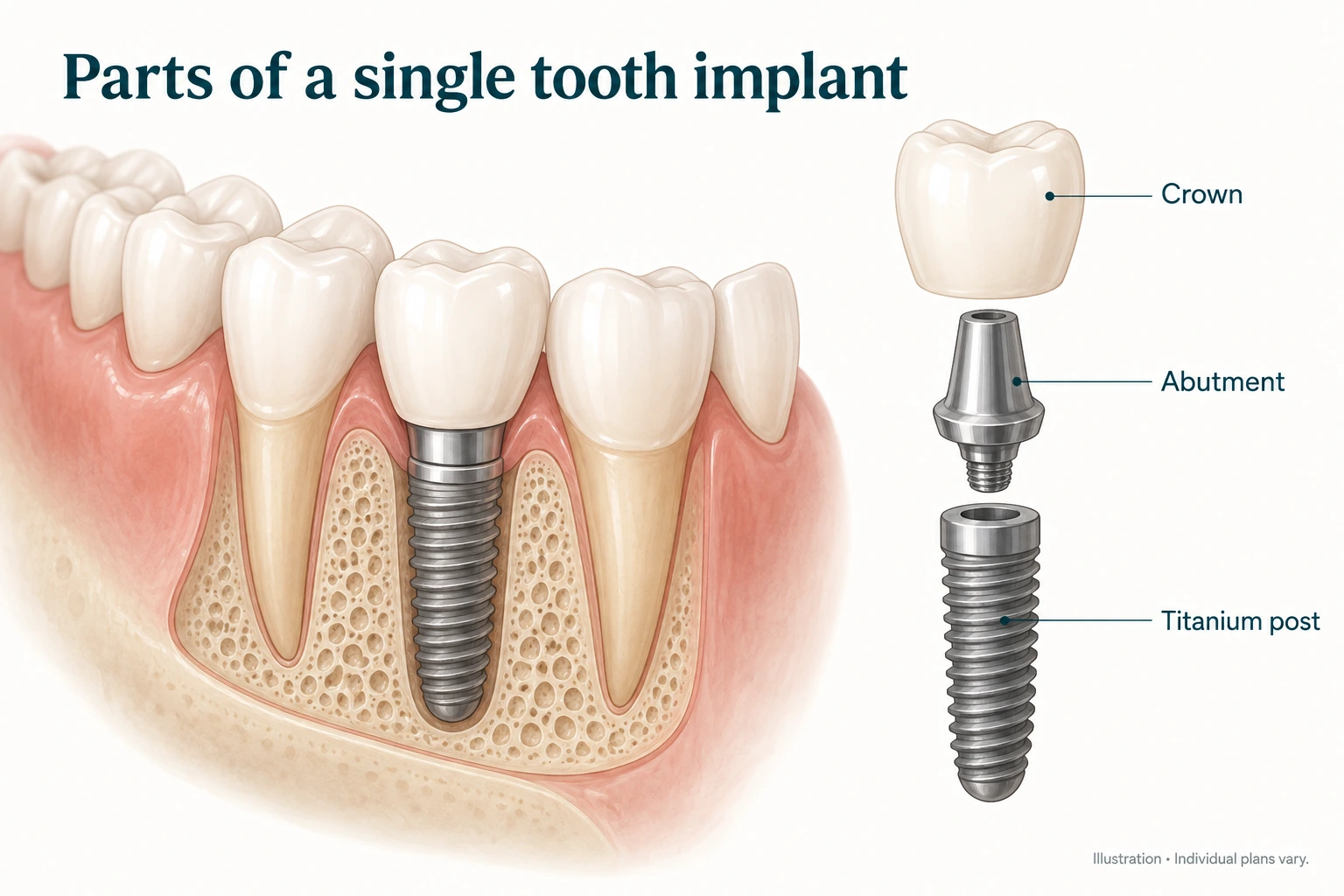
A single tooth implant replaces one missing tooth with a titanium post in the jawbone, an abutment and a custom crown. It suits healthy adults with enough bone. Plan two trips of about 4–6 days, 3–6 months apart.
Free medical review within 24 hours · No obligation · ★ 5.0 from 157 Google reviews
Editorially reviewed by the Vivid Clinic Surgical Board · Last reviewed September 2026

The implant acts as a new root. Over several months the bone grows onto its surface and locks it in place. Missing several teeth? Our dental implants in Istanbul page covers bridges on implants and All-on-4.
| Trips to Istanbul | Usually 2 |
|---|---|
| Days per trip | About 4–6 days each |
| Surgery time | Around 1 hour for one implant; up to 1–3 hours with extraction or grafting |
| Anaesthesia | Local anaesthesia; sedation available for anxious patients |
| Hospital stay | None — outpatient treatment |
| Healing (osseointegration) | Typically 3–6 months |
| Bone grafting | Only if the scan shows thin or short bone |
| Temporary tooth | Usually available for visible front teeth |
| Back to desk work | Usually 1–2 days |
| Exercise | Light activity after 2–3 days; hard training after about a week |
| Results last | The implant can last for decades with good care; the crown may need replacing after 10–15+ years |
| Aftercare | Soft foods for a few days, careful brushing and flossing, check-ups every 6–12 months |
During pregnancy, elective surgery such as implant placement is normally postponed.
Your CBCT scan and examination decide which approach is safer. The scan shows bone height and width and the position of the sinus and nerve.
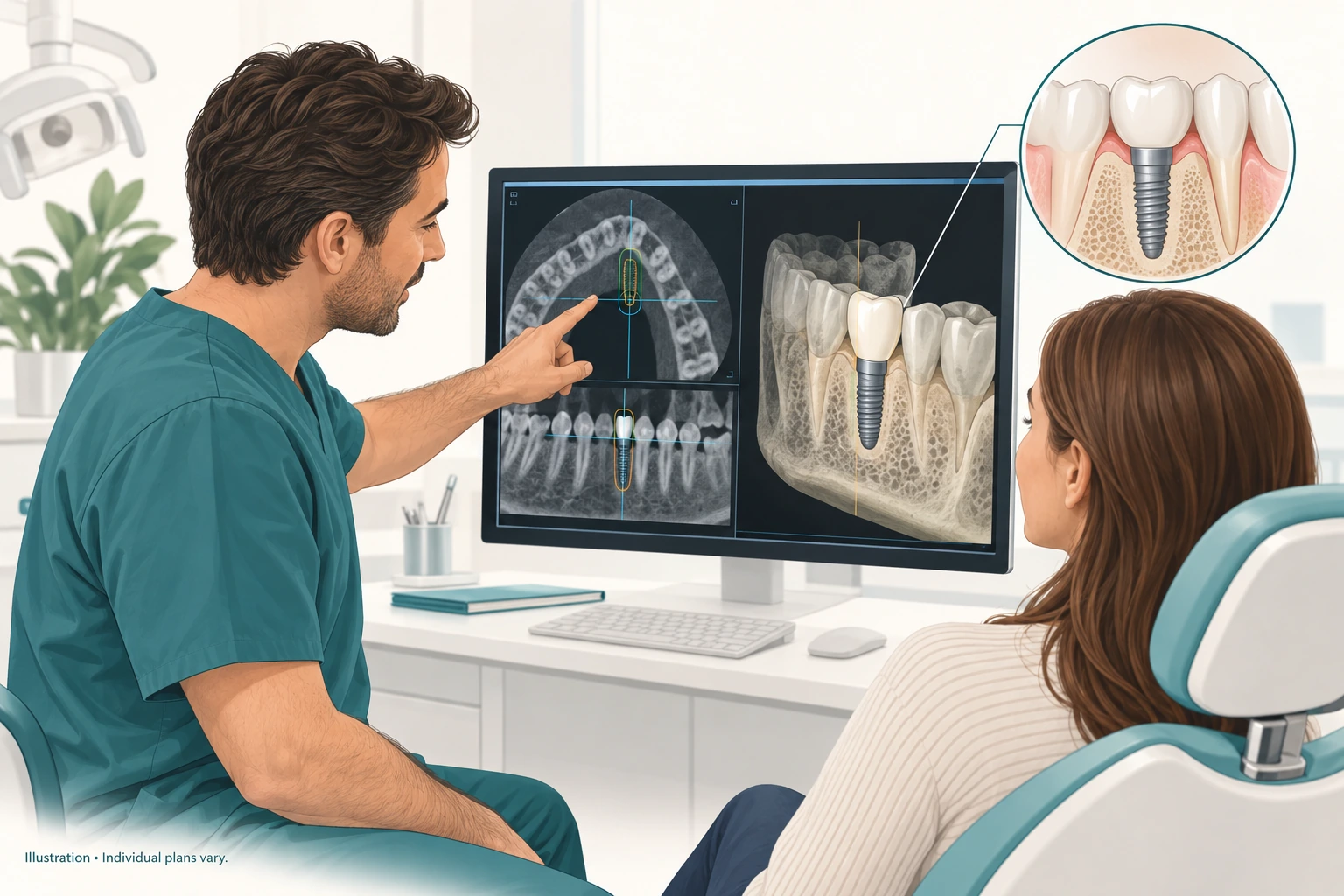
Placed straight after extraction when the socket walls are intact, there is no active infection and the implant can be anchored firmly.
If the tooth is infected or bone is thin, it is removed first and the site heals for a few months before placement.
Added only if the scan shows thin or short bone, to give the implant enough support.
Some patients ask for a metal-free implant because of metal sensitivity concerns or thin gums. Zirconia implants are an option in selected cases, with some limitations.
A tooth implant is a two-phase treatment: the root first, the tooth later. You should feel pressure but not sharp pain during placement.
Examination and a CBCT scan to plan implant size and angle.
If needed, the failing tooth is removed gently to protect bone.
The implant is placed under local anaesthesia; stitches or healing cap.
About 3–6 months at home while the implant fuses with bone.
Stability checked, abutment fitted and a digital scan taken.
Tried in, adjusted for shade and bite, then cemented or screwed.

Trip 1 places the implant. Trip 2, about 3–6 months later, fits the crown. Each trip is about 4–6 days, and a graft done beforehand can add time.
Trip 1 · Days 1–2
A VIP transfer takes you to your hotel. Next day: consultation, CBCT scan and plan sign-off; extraction and placement are often the same day.
Trip 1 · Days 3–6
Rest with soft foods and a check-up on healing. A final check before you fly, with the 24/7 support line open once home.
Trip 2 · Days 1–2
After 3–6 months: arrival, then an X-ray, stability check, abutment placement and a digital scan for your crown.
Trip 2 · Days 3–6
Laboratory work and a try-in, then final fitting, a bite check and aftercare advice before you fly home.
A recent X-ray or CBCT, a photo of the gap and a short note on your dental history. A Vivid Clinic dentist tells you whether a single implant suits you and whether grafting is likely. Free, no obligation.
Most people are back at desk work within 1–2 days. Mild swelling and soreness are usually controlled with standard pain relief and cold packs.
A well-integrated implant is designed to last for many years, often decades; the crown may need replacing eventually. Daily cleaning around the implant, not smoking and regular check-ups matter most.
Your coordinator arranges transfers, hotel and appointments for both trips, and the 24/7 support line stays open between them. The NHS overview of dental treatments offers practical guidance on looking after teeth and gums.


In short: a single tooth implant leaves neighbouring teeth untouched and supports the bone, but needs minor surgery and two trips. A three-unit bridge is quicker and needs no surgery, but the teeth either side are cut down for crowns.
| Single tooth implant | Three-unit bridge | |
|---|---|---|
| Neighbouring teeth | Left untouched | Cut down and crowned |
| Surgery | Minor surgery and a healing phase | None |
| Trips to Istanbul | Usually two, 3–6 months apart | Typically one, of about 5–7 days |
| Bone under the gap | Supported by the implant | Continues to shrink over time |
| Often sensible when | Neighbouring teeth are healthy or lightly filled | Neighbouring teeth already need crowns |
If the teeth beside the gap already need crowns, a bridge may be the sensible choice. Our dental crowns in Istanbul page explains that route.
A single “tooth implant cost” figure is rarely accurate without seeing your scan. A Vivid Clinic dentist quotes after reviewing your X-ray and photos, and treatment in Turkey is often more affordable than in the UK, US or much of Europe. For the full breakdown, read dental implants cost in Turkey: 11 factors.
Typically covers:
Your price depends on
Placing one implant is a routine procedure, but it still carries risks. If an implant does not integrate, it can usually be removed, the site allowed to heal and a new implant placed later.
The ADA's patient site MouthHealthy offers practical guidance on looking after teeth, gums and restorations.
Sometimes. An immediate single tooth implant can be placed straight after extraction when the socket walls are intact, there is no active infection and the implant can be anchored firmly. If the tooth is infected or bone is thin, the dentist usually removes it first and waits a few months, or grafts the socket, before placing the implant. Your CBCT scan and examination decide which approach is safer.
Usually two. On the first trip, about 4 to 6 days, the single tooth implant is placed and healing is checked. You then go home for 3 to 6 months while the implant fuses with the bone. The second trip, also about 4 to 6 days, is for the abutment, scans, try-in and the final crown. A bone graft done beforehand can add time to the overall plan.
Not usually. For a visible front tooth, you can normally leave with a temporary tooth. This may be a small removable plate, a bonded temporary or, in suitable cases, a temporary crown on the implant itself. Back teeth are sometimes left without a temporary while a single tooth implant heals, because the gap is not visible and this protects the implant from chewing forces.
It depends on those teeth. If the neighbouring teeth are healthy or only lightly filled, a single tooth implant avoids cutting them down for bridge crowns. If they already have large fillings or crowns that need replacing, a bridge can restore them and fill the gap in one treatment. Your dentist will compare both options for your case and explain the long-term pros and cons of each.
Most single tooth implant crowns at Vivid Clinic are made from zirconia, either monolithic for strength on back teeth or layered with porcelain for extra translucency at the front. The choice depends on where the tooth sits, your bite and the shade of your natural teeth. Your dentist will show you shade options and explain why a material suits that position. See our zirconium crowns page.
A single tooth implant is placed under local anaesthesia, so you should feel pressure but not sharp pain during the procedure. Sedation is available for anxious patients. Afterwards, mild swelling and soreness for a day or two are usually controlled with standard pain relief and cold packs. Avoid hot drinks and chewing on that side at first, eat soft foods for a few days and do not smoke.
A well-integrated single tooth implant is designed to last for many years and often for decades. The crown on top wears like any restoration and may need replacing after 10 to 15 years or more. The most important factors you control are daily cleaning around the implant, not smoking and check-ups every 6 to 12 months. Regular check-ups also help catch inflammation around the implant early.
Send a recent X-ray (or CBCT if you have one), a photo of the gap and a short note about your dental history. The consultation is free and you are under no obligation to book.
Free · No obligation · Reply within 24 h
Open a summary of this guide in your AI assistant.
 ChatGPT