
Blepharoplasty Turkey

Blepharoplasty in Turkey upper and lower eyelid surgery in Istanbul, usually day-case, in a 6–7 day plan

Blepharoplasty removes or repositions excess eyelid skin, muscle and fat to treat hooded upper lids and under-eye bags. It suits healthy adults with no significant eye disease. It is usually a 1–2 hour day-case operation; plan about 6–7 days in Istanbul.

  • 6–7 days in Istanbul
  • 1–2 hours, usually day-case
  • Stitches out around day 5–7

Free medical review within 24 hours · No obligation · ★ 5.0 from 157 Google reviews

Editorially reviewed by the Vivid Clinic Surgical Board · Last reviewed September 2026

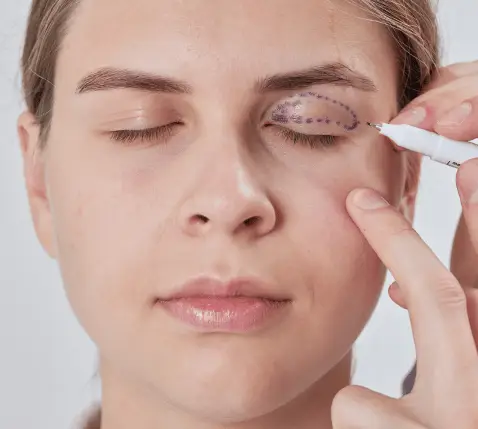
Close-up of a woman with her eyes closed while a gloved hand marks her upper eyelid with a surgical pen
At a glance

What is blepharoplasty, and what to expect

Blepharoplasty is surgery on the eyelids. It tidies the upper lids when loose skin folds onto the lashes, and smooths the lower lids when fat pushes forward to form bags. The surgeon may remove measured skin, a thin strip of muscle and some fat, or reposition fat rather than removing it.

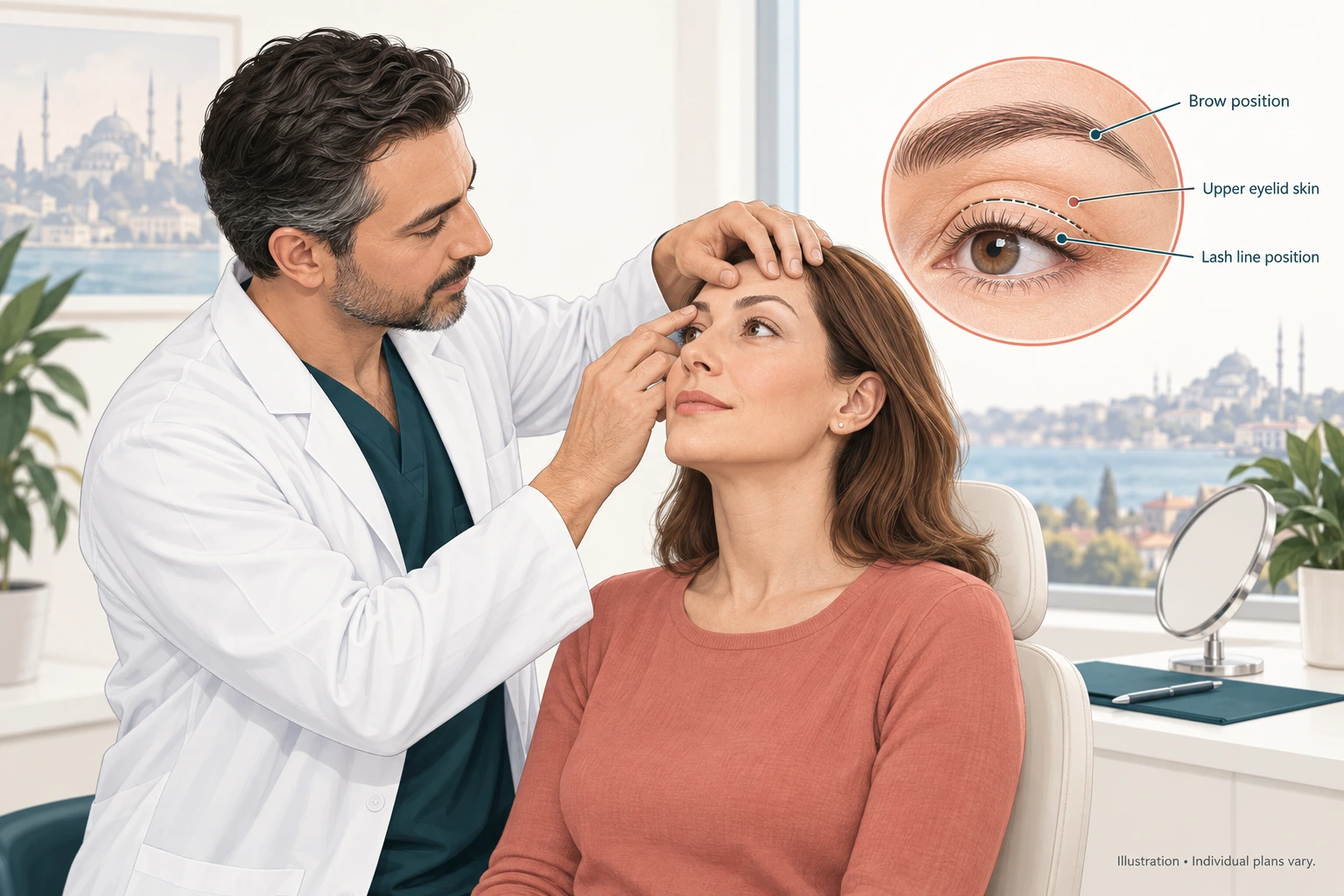
Blepharoplasty Turkey: illustration of a surgeon assessing upper eyelid skin and brow position during a blepharoplasty consultation
Brow, lid and lash-line position are checked before any plan.Illustration
Procedure time
1–2 hLonger for upper and lower together
Stay in Istanbul
6–7 daysUsually a day-case
Stitches out
Day 5–7Transconjunctival often needs none
Back to desk work
7–10 daysBruising mostly fades in 2–3 weeks
Final result
2–3 monthsAs swelling and scars settle
Results last
Many yearsUpper lids; lower-lid fat rarely redone
See all procedure details
Blepharoplasty in Istanbul at a glance
Procedure timeTypically 1–2 hours (upper and lower lids together can take longer)
AnaesthesiaLocal anaesthesia with sedation, or general anaesthesia
Hospital stayUsually day-case; an overnight stay may be advised for combined surgery
Recommended stay in Istanbul6–7 days
StitchesRemoved around day 5–7 (transconjunctival incisions usually need none)
Back to desk workUsually 7–10 days
ExerciseWalking from day 1; strenuous exercise after 2–3 weeks
Contact lensesUsually after about 2 weeks, once your surgeon agrees
Final resultAround 2–3 months as swelling and scars settle
Results lastUpper lids often many years; lower-lid fat removal rarely needs repeating
Real patient results

Blepharoplasty before and after

Results from Vivid Clinic patients, shared with consent. Individual results vary. 6 cases shown; each caption states what the photos show and what is not recorded.

See the full gallery
  • Eyelid lift (blepharoplasty) · Case VC-19237
    • Left: before · Right: after
    • View: front
    • Follow-up interval: not recorded

    Before: Hooded upper lids and lower-lid bags. After: Opened eyes.

    Vivid Clinic patient, shared with consent. Individual results vary; this is one case, not a promise of your outcome.

  • Eyelid lift (blepharoplasty) · Case VC-19240
    • Left: before · Right: after
    • View: front close-up
    • Follow-up interval: not recorded

    Before: Heavy upper lids and lower-lid bags. After: Smoother lids.

    Vivid Clinic patient, shared with consent. Individual results vary; this is one case, not a promise of your outcome.

  • Eyelid lift (blepharoplasty) · Case VC-19243
    • Left: before · Right: after
    • View: front close-up
    • Follow-up interval: not recorded

    Before: Hooded upper lids. After: Visible upper-lid crease.

    Vivid Clinic patient, shared with consent. Individual results vary; this is one case, not a promise of your outcome.

  • Eyelid lift (blepharoplasty) · Case VC-19249
    • Left: before · Right: after
    • View: front
    • Follow-up interval: not recorded

    Before: Hooded upper lids. After: More open eyes.

    Vivid Clinic patient, shared with consent. Individual results vary; this is one case, not a promise of your outcome.

  • Eyelid lift (blepharoplasty) · Case VC-19255
    • Left: before · Right: after
    • View: front
    • Follow-up interval: not recorded

    Before: Lower-lid bags. After: Smoother lower lids.

    Vivid Clinic patient, shared with consent. Individual results vary; this is one case, not a promise of your outcome.

  • Eyelid lift (blepharoplasty) · Case VC-19262
    • Left: before · Right: after
    • View: front
    • Follow-up interval: not recorded

    Before: Upper and lower lid heaviness (male). After: Refreshed eye area.

    Vivid Clinic patient, shared with consent. Individual results vary; this is one case, not a promise of your outcome.

Photos are unedited clinic composites; before and after photos may differ in lighting, clothing and pose. Consent is on file at the clinic.

Candidacy

Who is blepharoplasty right for — and who should wait?

Blepharoplasty often suits you if

  • Loose or hooded upper-lid skin makes make-up difficult or rests on your lashes
  • You have puffy lower lids or bags that do not go away with sleep
  • You are generally healthy and do not smoke, or can stop around surgery
  • You want fresher, rested eyes rather than a different eye shape

It is wiser to wait, or see an eye specialist first, if

  • You have severe dry eye, uncontrolled thyroid eye disease or glaucoma
  • You had laser eye surgery recently, or your lower lids are very lax
  • Your whole brow has dropped — a brow lift may be the true fix

Under-eye darkness caused by pigment, or fine crepey skin, is not corrected by surgery alone.

Your options

Blepharoplasty options at Vivid Clinic

Every eyelid plan is built around your anatomy. These are the mainstream techniques your surgeon may recommend.

Medical illustration of an upper blepharoplasty incision hidden in the natural eyelid crease
The upper-lid incision sits in the natural crease.Illustration
Most common

Upper blepharoplasty

Excess skin, and where needed a thin strip of muscle and a little fat, is removed through the natural crease. Conservative skin removal protects full eye closure.

Incision
In the upper-lid crease
Scar
Usually well hidden in the fold
Treats
Hooded, heavy upper lids
Skin and bags

Lower blepharoplasty (transcutaneous)

An incision just below the lashes lets the surgeon tighten loose skin and muscle and treat fat bags. A small outer-corner stitch (canthopexy) may add support.

Incision
Just below the lashes
Treats
Loose skin and bags
Lid support
Assessed carefully
No external scar

Transconjunctival lower blepharoplasty

The incision is inside the lower lid. It suits younger patients whose main problem is bulging fat rather than loose skin.

Incision
Inside the lower lid
Stitches
Usually none
Treats
Fat bags with firm skin

When bags sit above a hollow tear trough, fat can be repositioned over the bony rim instead of removed. Upper and lower lids can often be treated in one operation. The American Academy of Ophthalmology's EyeWiki summarises both lower-lid approaches.

Step by step

How blepharoplasty is done, step by step

Blepharoplasty at Vivid Clinic is planned around your lids, brow position and lower-lid support. Most patients return to the hotel the same evening.

  1. Marking

    Sitting upright, crease and skin to remove are marked.

  2. Anaesthesia

    Local with sedation, or general for combined or lower-lid surgery.

  3. Incisions

    Upper crease, under the lashes, or inside the lower lid.

  4. Tissue work

    Skin, muscle and fat trimmed or repositioned; support added if needed.

  5. Closure

    Fine stitches; transconjunctival surgery often needs none.

  6. Recovery

    Cold compresses, then back to your hotel or an overnight stay.

Illustration of transconjunctival lower blepharoplasty approach through the inside of the lower eyelid
Under-eye fat can be treated from inside the lid.Illustration
Your Istanbul journey

Six to seven days, fully coordinated

Day 1

Arrival

A VIP transfer takes you from the airport to your hotel, and your patient coordinator welcomes you. An interpreter is available if you need one.

Day 2

Consultation and surgery

Consultation, photographs, blood tests and eye history, then surgery at the partner hospital. Most patients return to the hotel the same evening.

Days 3–5

First check and rest

A wound check at Vivid Clinic on day 3, with eye drops and ointment explained. Then head elevation, cold compresses and short walks.

Days 5–7

Stitches out, fit to fly

Stitches are removed, and lid position and closure are checked before you fly with lubricating drops. The 24/7 support line stays available.

Send your eye photos. Get an honest answer.

Front and side photos, eyes open and closed. A plastic surgeon tells you whether blepharoplasty, ptosis repair or a brow lift fits your eyes. Free, no obligation.

Recovery

Blepharoplasty recovery timeline

Expect a lighter, more open upper lid and a smoother lower lid, so you look rested rather than operated on. Bruising usually peaks around day 2–3.

  1. Week 1Swelling, bruising and tightness; blurred vision from ointment is common. Sunglasses help outdoors.Expected phase
  2. Day 5–7Stitches removed; lid position and closure checked.
  3. Week 2Most people return to desk work and light social plans; light make-up once wounds have healed.
  4. Weeks 3–4Bruising has usually gone; scars look pink but are fading. Normal exercise resumes gradually.
  5. Months 2–3Residual swelling settles and upper-lid scars become pale. The result is judged now.

How long blepharoplasty lasts

Upper-lid results typically last many years, although skin keeps ageing and brows may descend over time. Lower-lid fat removal or repositioning is rarely repeated.

In the first week, keep your head elevated, use cold compresses and follow the eye drop and ointment routine. Walking is fine from day 1.

Illustration: patient resting with cold compresses in an Istanbul hotel room during blepharoplasty recovery
Cold compresses and head elevation help early swelling.Illustration
The right diagnosis

Blepharoplasty or ptosis repair?

Diagram comparing eyelid ptosis, where the lid margin droops, with excess upper eyelid skin (dermatochalasis)
Different problems, different operations.Illustration

In short: blepharoplasty treats excess skin and fat. If the lid margin itself sits too low (ptosis), removing skin will not raise it — that needs a ptosis repair.

CriterionBlepharoplastyPtosis repair
The problemExcess skin and fatEyelid margin sits too low
Usual causeAgeing skin and forward-pushing fatStretched lifting muscle (levator) or its tendon
What the surgeon doesRemoves or repositions skin, muscle and fatTightens or advances the levator
Raises the lid marginNoYes
Can be combinedYes, when both problems are presentYes, when both problems are present

At consultation your surgeon measures the lid margin to pupil distance to tell the difference. If your brow has dropped, see our endoscopic brow lift; to change the outer-corner angle, see the fox eye lift. Heavy lids with mid-face descent may pair with a facelift, and fine lines may need only non-surgical injectables. All options are on our face aesthetics page.

Price and packages

What determines your blepharoplasty quote

Eyelid surgery is quoted only after a surgeon reviews your photographs. Blepharoplasty in Turkey is often more affordable than in the UK, US or much of Europe, but your plan should be chosen for safety and suitability first. The consultation is free.

Your all-inclusive package

Typically covers:

  • Consultation and tests
  • Surgery and anaesthesia
  • Medication, eye drops and ointment
  • Hotel accommodation
  • VIP airport and clinic transfers
  • Patient coordinator and interpreter
  • Post-operative checks and stitch removal
  • 24/7 support line

Your price depends on

  • Which lids: upper, lower or both
  • Technique: transcutaneous, transconjunctival, fat repositioning or canthal support
  • Whether ptosis repair is also needed
  • Anaesthesia, any overnight stay, and combined procedures such as a brow lift
Why Vivid Clinic

Why patients choose Vivid Clinic for blepharoplasty in Turkey

Meet our medical team
  • Eyelid care reviewed by Prof. Dr. Özgür Pilancı, plastic surgeon
  • Accredited partner hospitals with anaesthetic monitoring
  • Honest diagnosis: blepharoplasty, ptosis repair or brow lift
  • All-inclusive coordination, multilingual coordinators and interpreters
  • 24/7 aftercare line in Istanbul and after you return home
5.0 157 Google reviewsVivid Clinic Google Business Profile · checked September 2026 Read reviews

Medical review

This page was medically reviewed by a plastic surgeon on the Vivid Clinic team.

Portrait of Prof. Dr. Özgür Pilancı, plastic surgeon on the Vivid Clinic team

Prof. Dr. Özgür Pilancı

Plastic, Reconstructive & Aesthetic Surgeon

  • Plastic surgery specialist since 2006 (Cerrahpaşa, Istanbul)
  • Associate professor since 2015
  • Clinical fellow in Rio de Janeiro in 2016
View profile
Safety

Risks of blepharoplasty and how we reduce them

Eyelid surgery is common, but no operation is free of risk. Very rarely, bleeding behind the eye occurs; it is an emergency and can affect vision.

Possible effects

  • Bruising and swelling
  • Dry or irritated eyes, or temporary difficulty closing the eyes
  • Asymmetry or visible scars
  • Lower-lid malposition (the lid pulling down)
  • Infection

How we reduce them

  • Screening for dry eye, thyroid disease and blood-thinning medication
  • Conservative skin removal and assessment of lower-lid support
  • Accredited partner hospitals with anaesthetic monitoring
  • Written warning signs: increasing pain, swelling or change in vision
  • A check before you fly and remote follow-up once home

UK travellers may find the NHS advice on cosmetic surgery abroad helpful. The American Society of Plastic Surgeons notes eyelid surgery can also help when heavy lids restrict vision.

FAQ

Frequently asked questions about blepharoplasty in Turkey

Blepharoplasty Turkey: how many days should I stay in Istanbul?

Most patients plan 6–7 days. Surgery usually takes place on day 2 after your consultation and tests, and you normally return to the hotel the same evening. Stitches are removed around day 5–7, and your surgeon checks eyelid closure and position before clearing you to fly. If you are having upper and lower lids together or a combined procedure, your coordinator may suggest one or two extra days.

Will upper blepharoplasty fix a droopy eyelid caused by ptosis?

Not on its own. Upper blepharoplasty removes excess skin and fat, but ptosis means the eyelid margin itself sits low because the lifting muscle has weakened or stretched. That needs a ptosis repair to tighten or reattach the levator muscle. Many patients have both problems, and the two can often be corrected in one operation. Your surgeon measures your lid position at consultation to decide which you need.

Eyelid surgery Turkey: can upper and lower lids be done in one operation?

Yes, in suitable patients. Treating both lids together means a single anaesthetic, one recovery period and one trip, and the swelling settles at the same pace. Combined surgery usually takes longer and is more often done under general anaesthesia, and your surgeon may recommend an overnight stay. People with dry eye or lax lower lids may be advised to stage the surgery instead.

Blepharoplasty Turkey: is transconjunctival surgery right for my under-eye bags?

It often is when bags are caused by bulging fat and your skin is still fairly firm, which is common in younger patients. The incision is inside the lower lid, so there is no visible external scar and usually no stitches. If you also have loose skin, a small skin pinch or a traditional lower-lid approach may work better. Hollow tear troughs may be treated by repositioning fat rather than removing it.

Blepharoplasty Turkey: when can I wear contact lenses, make-up and glasses again?

Glasses can usually be worn straight away if they do not press on the wounds. Eye make-up is generally allowed once stitches are out and the incisions have healed, often around 10–14 days. Contact lenses are usually reintroduced after about two weeks, when swelling has eased and your eyes feel comfortable. Your surgeon gives you personal timings at your final check before you leave Istanbul.

When can I return to work after blepharoplasty in Turkey?

Most people return to desk work after about 7–10 days, around the second week. Bruising usually peaks around day 2–3 and has mostly faded by weeks 3–4, so many people plan social events after that. Walking is fine from day 1, and strenuous exercise usually waits 2–3 weeks. Residual swelling settles over 2–3 months, which is when the final result is judged.

How long do blepharoplasty results last?

Upper-lid results typically last many years, although your skin continues to age and your brows may descend over time. Lower-lid fat removal or repositioning is rarely repeated. Results look best when expectations are realistic: fresher, rested eyes rather than a different eye shape. See real outcomes in our blepharoplasty before and after gallery, bearing in mind every face heals differently.

Free assessment

Plan your blepharoplasty in Istanbul

Send clear front and side photos of your eyes, with your eyes open and closed. It is free and there is no obligation.

  1. Share your details and photosHere, or by WhatsApp on +90 545 742 3565.
  2. Medical review within 24 hoursHonest advice on blepharoplasty, ptosis repair or a brow lift, and your recommended plan.
  3. Your personalised Istanbul planDates, hotel, transfers and your coordinator’s contact.

Get my free eyelid surgery plan

Free · No obligation · Reply within 24 h

Vivid Clinic — Consultation Request
This site is protected by reCAPTCHA and the Google Privacy Policy and Terms of Service apply.