
Single implants
One implant replaces one tooth. Where teeth are missing in different areas, several single implants may be placed.
- Implants
- 1 per missing tooth
- Restoration
- A crown on each
- Best for
- Separate gaps
Dental implants replace missing teeth with titanium posts that fuse with the jawbone and support crowns, a bridge or a full-arch set of teeth. They suit healthy adults with enough bone, or who can have a graft. Expect two trips of about 5–7 days, 3–6 months apart.
Free medical review within 24 hours · No obligation · ★ 5.0 from 157 Google reviews
Editorially reviewed by the Vivid Clinic Surgical Board · Last reviewed September 2026
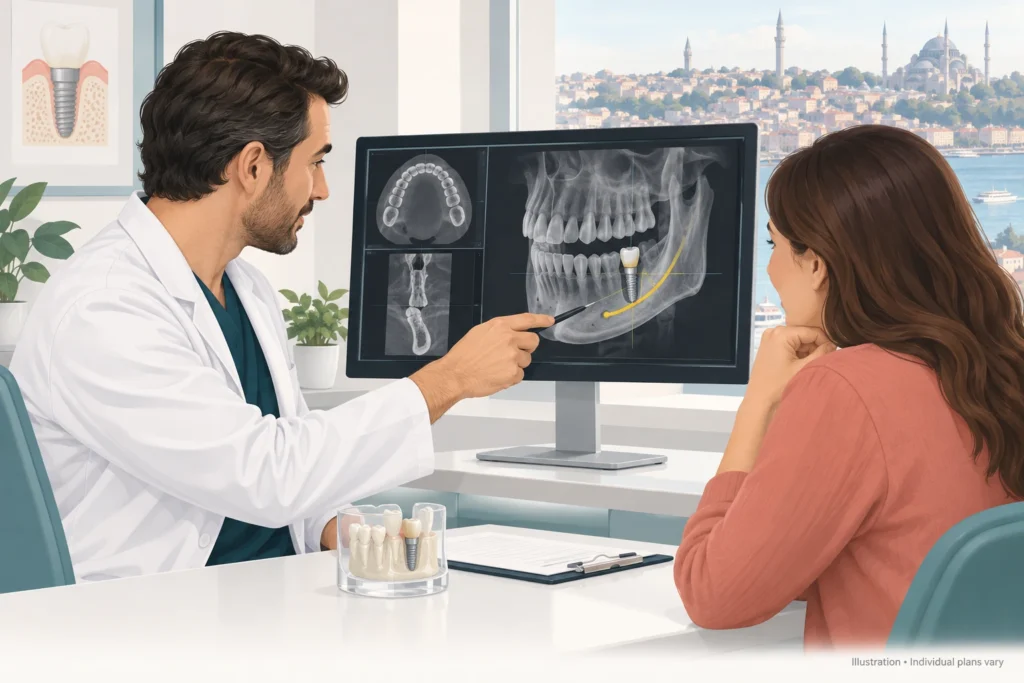
An implant is a small screw-shaped post placed in the jawbone where a tooth root used to be. The bone grows tightly around it, then an abutment holds a crown, bridge or full-arch set of teeth. This page covers several teeth, a whole arch or a full mouth; for one tooth, see our single tooth implant page.
| Trips to Istanbul | Usually 2 (placement, then final teeth) |
|---|---|
| Days per trip | About 5–7 days each |
| Surgery time | Around 1–2 hours for most cases; longer for full-arch treatment |
| Anaesthesia | Local anaesthesia; IV sedation available on request |
| Hospital stay | None — outpatient dental treatment |
| Healing (osseointegration) | Typically 3–6 months between trips |
| Bone grafting / sinus lift | Only if your CBCT scan shows it is needed |
| Temporary teeth | Removable or fixed provisional teeth; fixed provisionals often possible with All-on-4/All-on-6 |
| Back to desk work | Usually 1–3 days |
| Exercise | Light activity after 3–4 days; strenuous training after about a week |
| Results last | Implants can last for decades with good care; crowns and bridges may need renewal after 10–15+ years |
| Aftercare | Soft diet at first, careful hygiene, check-ups every 6–12 months |
Results from Vivid Clinic patients, shared with consent. Individual results vary. 1 case shown; each caption states what the photos show and what is not recorded.
Before: Upper implant abutments with no teeth. After: Complete implant-supported upper prosthesis.
Vivid Clinic patient, shared with consent. Individual results vary; this is one case, not a promise of your outcome.
Photos are unedited clinic composites; before and after photos may differ in lighting, clothing and pose. Consent is on file at the clinic.
If implants are not right for you yet, we say so and discuss alternatives such as a conventional bridge or a well-fitted denture.
The right plan depends on how many teeth are missing and where. Most implants are titanium, which has the longest track record. Some patients ask for a metal-free alternative; our zirconia implants page explains who that suits.

One implant replaces one tooth. Where teeth are missing in different areas, several single implants may be placed.
When three or four neighbouring teeth are missing, two implants can often support a three- or four-unit bridge.
A full-arch bridge fixed on four or six implants, for people who have lost most or all teeth in a jaw.
Tilting the back implants in All-on-4 uses the available bone and avoids the sinus or the lower jaw nerve. Read our guide to All-on-4 dental implants in Turkey.
Your CBCT scan comes first. It shows bone height and width, the sinus, the lower jaw nerve and any hidden infection. It guides implant choice and, in suitable cases, a surgical guide. Thin bone may need a graft, sometimes placed with the implant, sometimes months before.
Clinical exam, CBCT scan, photos and medical history.
Failing teeth extracted; infection or gum disease treated.
Implants placed under local anaesthesia, with optional sedation.
Removable temporary, or a fixed provisional bridge for full arches.
Implants integrate with the bone over about 3–6 months.
Abutments attached; final crowns or bridge tried in and fixed.
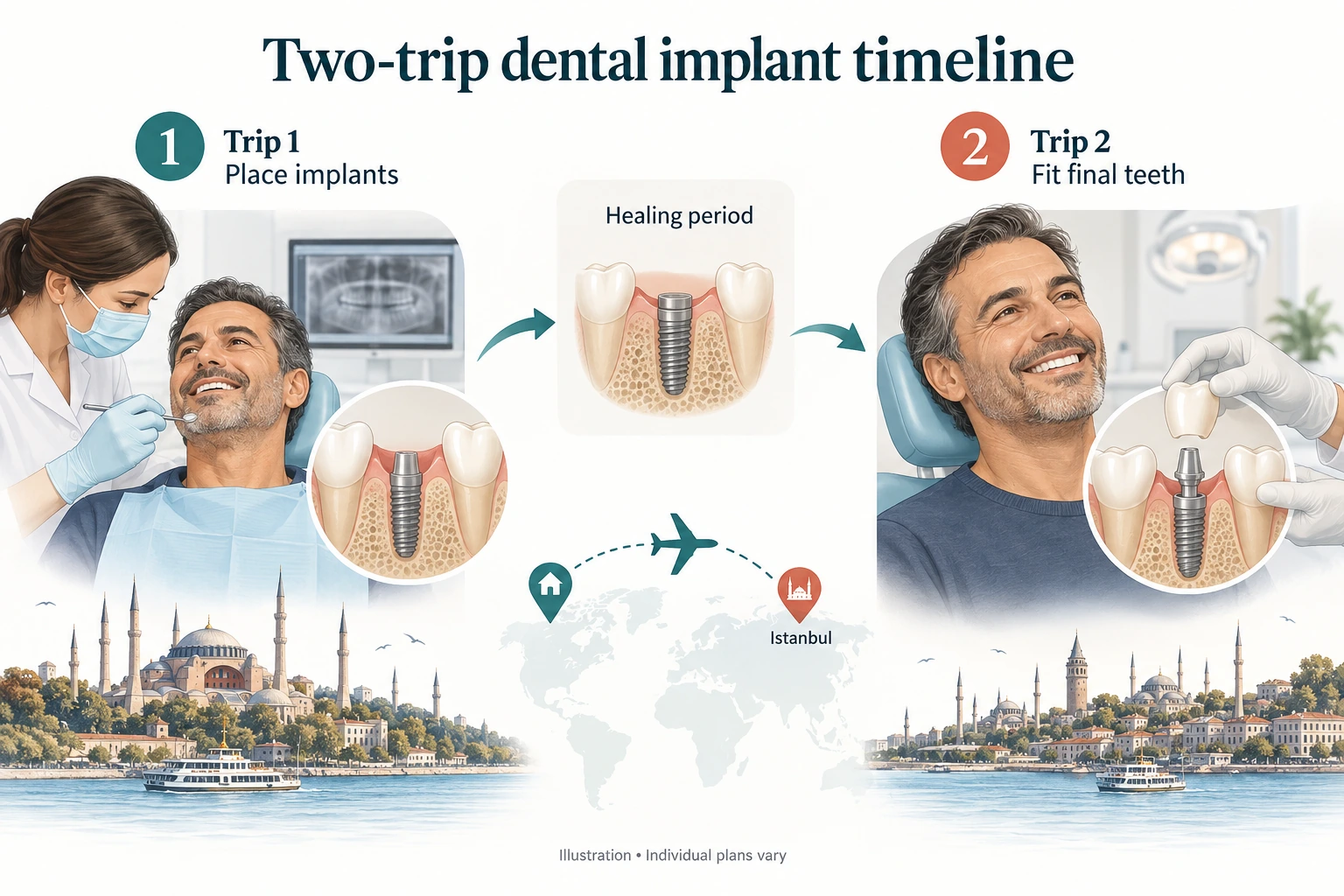
Each trip usually takes about 5–7 days. If a larger graft is needed first, the timeline is longer, and your written plan says so.
Trip 1 · Days 1–2
A VIP transfer takes you to your hotel. Next day: consultation, CBCT scan and plan sign-off. Extractions and implant placement follow the same day or the next.
Trip 1 · Days 3–7
Soft diet at your hotel and a check-up on swelling and comfort. All-on-4 patients typically have a fixed provisional bridge fitted. A healing and suture check comes before you fly.
Months at home
You follow a soft-to-normal diet plan, keep up careful hygiene and send progress photos if asked. The 24/7 support line stays available.
Trip 2 · Days 1–7
Stability check, X-ray, abutments and digital scans, then a try-in to review shape, colour and bite. The final fit comes with hygiene instructions and your implant passport.
A panoramic X-ray or CBCT, a few smile photos and a short note about your goals. Our dental team shows the number of implants, whether grafting is likely and how many days each trip needs. Free, no obligation.
Most people return to desk work within 1–3 days. Healing inside the bone takes months, which is why final teeth come on the second trip.
Once integrated, implants are designed to be a long-term solution, and many last for decades. The crowns or bridge on top face daily wear and may need repair or replacement, often after 10–15 years or more.
Long-term success depends on hygiene, not smoking and regular check-ups. The American Dental Association's patient site MouthHealthy has practical guidance on caring for implants and gums.
In short: implants avoid cutting healthy teeth and help preserve bone, but need surgery, healing time and two trips. A conventional bridge relies on shaping the neighbouring teeth and does not replace the root.
| Dental implants | Conventional bridge | |
|---|---|---|
| Neighbouring teeth | Left untouched | Shaped for crowns |
| Replaces the root | Yes | No |
| Jawbone | Helps preserve it | Can continue to shrink under the bridge |
| Treatment | Surgery, 3–6 months of healing, usually two trips | No surgery; neighbouring teeth are prepared |
| Sensible when | Neighbouring teeth are healthy | Neighbouring teeth already need crowns |
Removable dentures are the least invasive option but can move while eating and speaking. If a bridge suits you, our dental crowns in Istanbul page covers that route.
Every implant plan is different, so a personal quote is only given after a dentist has reviewed your X-ray or CBCT and photos. Treatment in Turkey is often more affordable than in the UK, US or much of Europe. Our guide to dental implants cost factors in Turkey explains more.
Typically covers:
Your price depends on
Choose what you need to replace. This is a typical implant count only; your dentist confirms it from your scan and examination.
Implant surgery is common and well established, but it is still surgery. If an implant does not integrate, it can usually be removed and, after healing, replaced.
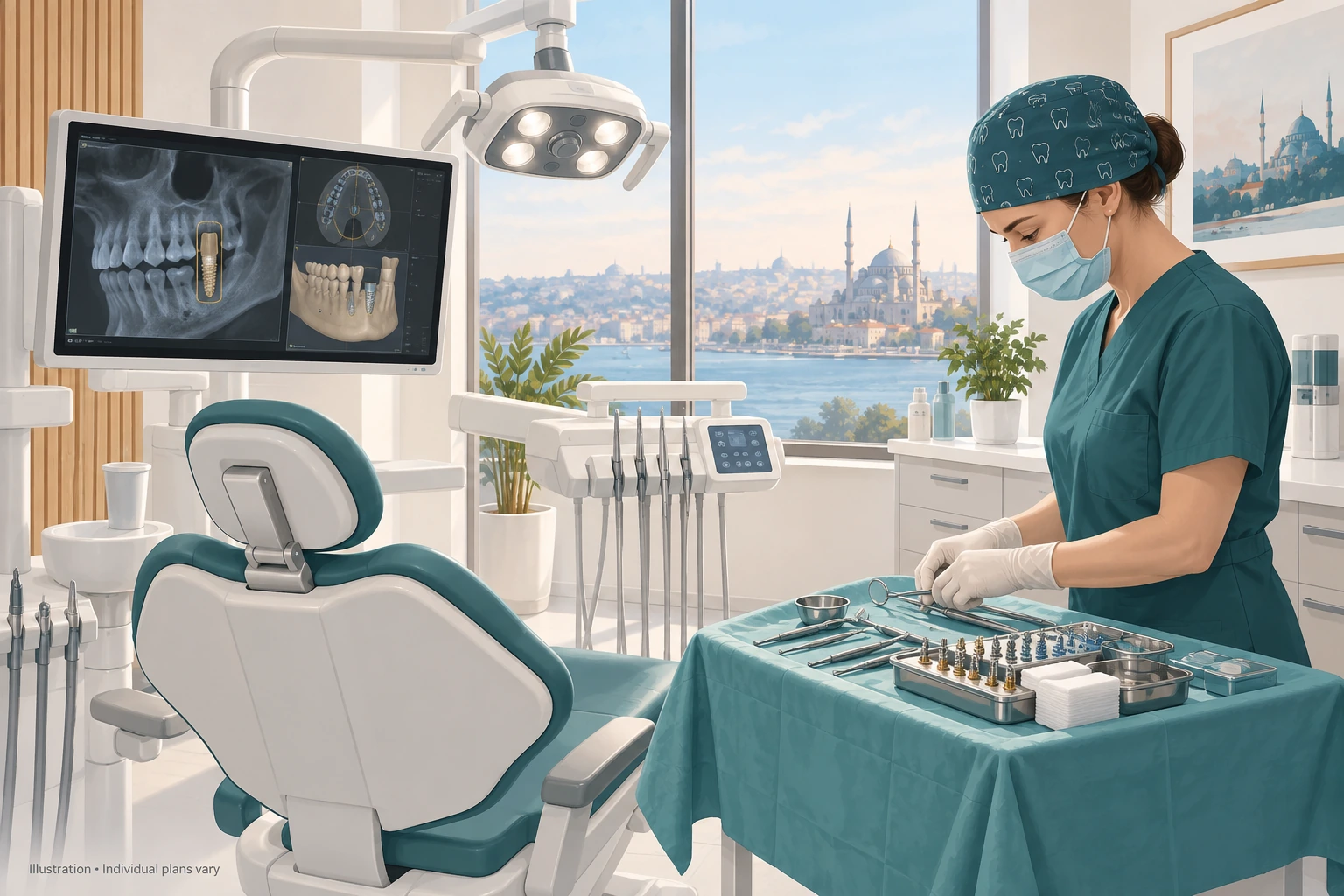
The NHS overview of dental treatments describes implants as an option when bone and general health allow.
Most patients need two trips. The first, usually about 5 to 7 days, covers the CBCT scan, any extractions and implant placement, plus a healing check. After 3 to 6 months of healing, a second trip of similar length is used to fit abutments and the final crowns or bridge. If bone grafting is needed first, the timeline can be longer, and your dentist confirms it in your written plan.
Often, yes. When the implants achieve good primary stability on the day of surgery, All-on-4 or All-on-6 patients can usually have a fixed provisional bridge within a few days. That means they fly home with teeth rather than a gap. This is a temporary bridge with a soft-food diet. The final, stronger bridge is made on the second trip after 3 to 6 months of healing.
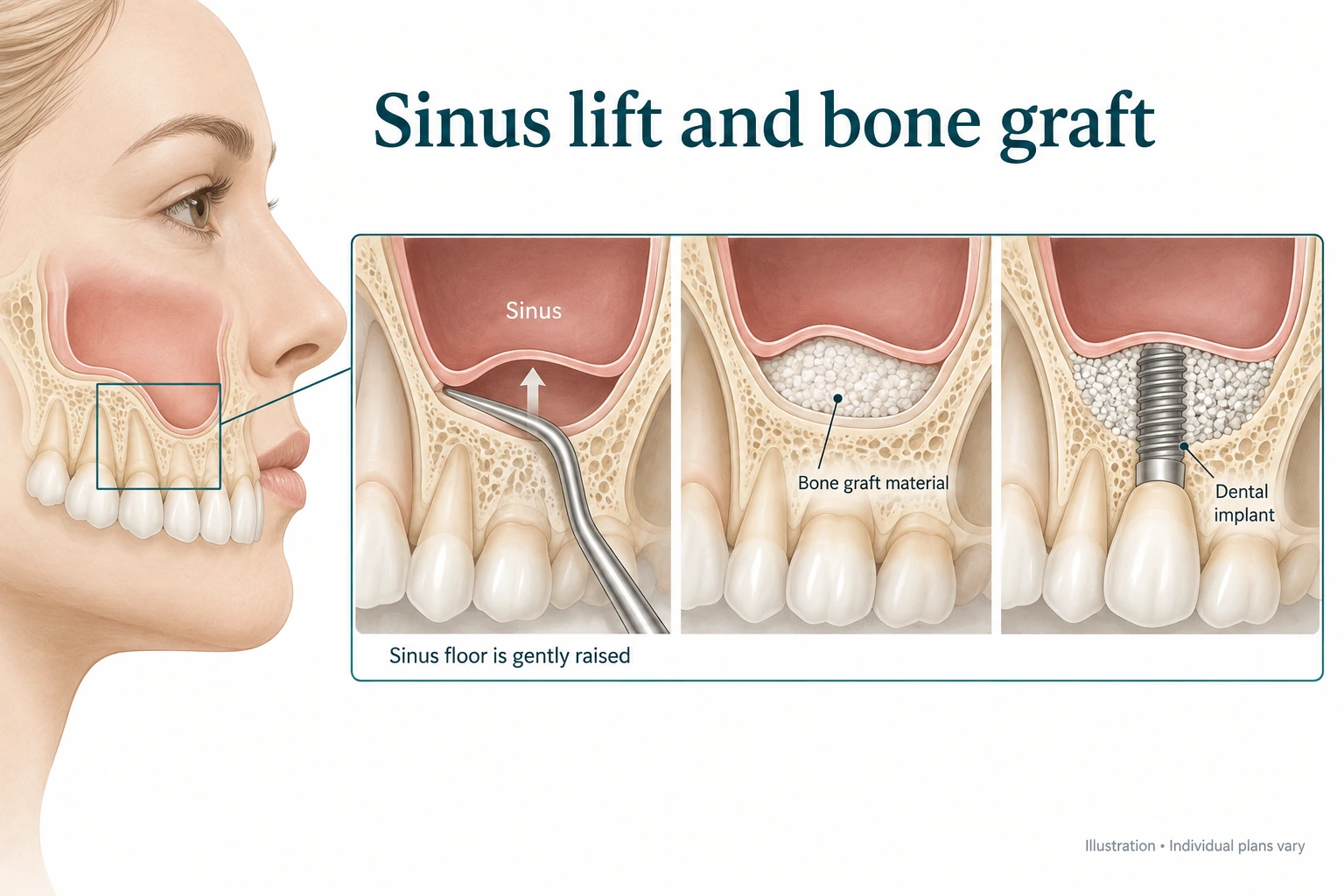
Only if your CBCT scan shows there is not enough bone height or width where the implant should go. Bone loss is common after long-term tooth loss or denture wear, especially in the upper back jaw under the sinus. Small grafts are often done during implant placement. Larger grafts or a lateral sinus lift may need several months of healing before implants go in, which adds time to your plan.
Both replace a full arch of teeth with a fixed bridge. All-on-4 uses four implants, with the back two usually angled to avoid the sinus or nerve and to reduce the need for grafting. All-on-6 uses six implants, spreading the biting load across more support. Some dentists prefer this in the upper jaw or for strong bite forces. Your bone volume, bite and scan decide which suits you.
Vivid Clinic uses internationally recognised titanium implant systems with traceable batch documentation. The exact brand is named in your written treatment plan before you travel. You also receive an implant passport listing the brand, model, diameter and length of every implant. That way, any dentist at home can source compatible parts for maintenance or repairs years later, wherever you live.
Most people return to desk work within 1 to 3 days after dental implants Istanbul surgery. Some swelling, mild bruising and soreness are normal in the first 48 hours and are usually managed with prescribed pain relief and cold packs. Light activity is fine after 3 to 4 days, and strenuous training after about a week. Soft, cool foods and no smoking help healing in the first week.
It depends on your teeth and bone. Implants avoid cutting healthy neighbouring teeth and help preserve the jawbone, but they need surgery, healing time and two trips. A conventional bridge needs the neighbouring teeth shaped for crowns and does not replace the root. Dentures are the least invasive option but can move while eating and speaking. Your dentist explains which suits you after reviewing your scan.
Send your panoramic X-ray or CBCT, a few photos of your smile and a short note about your goals. It is free and there is no obligation.
Free · No obligation · Reply within 24 h
Open a summary of this guide in your AI assistant.
 ChatGPT