Deep plane facelift Turkey

Deep Plane Facelift in Turkey cheeks, jowls and jawline lifted beneath the SMAS, in a 10–14 day plan

A deep plane facelift lifts the cheeks, jowls and jawline by repositioning the tissue beneath the SMAS muscle layer, not just tightening skin. It suits healthy people with moderate to advanced facial sagging. Plan 10–14 days in Istanbul.

  • 10–14 days in Istanbul
  • 3–5 hours, general anaesthesia
  • Usually 1 night in hospital

Free medical review within 24 hours · No obligation · ★ 5.0 from 157 Google reviews

Editorially reviewed by the Vivid Clinic Surgical Board · Last reviewed September 2026

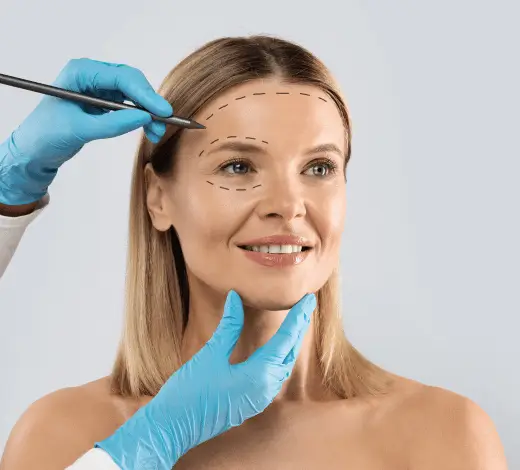
Smiling blonde woman with dotted marking lines on her forehead and cheek as gloved hands hold a surgical pen and support her chin
At a glance

What is a deep plane facelift, and what to expect

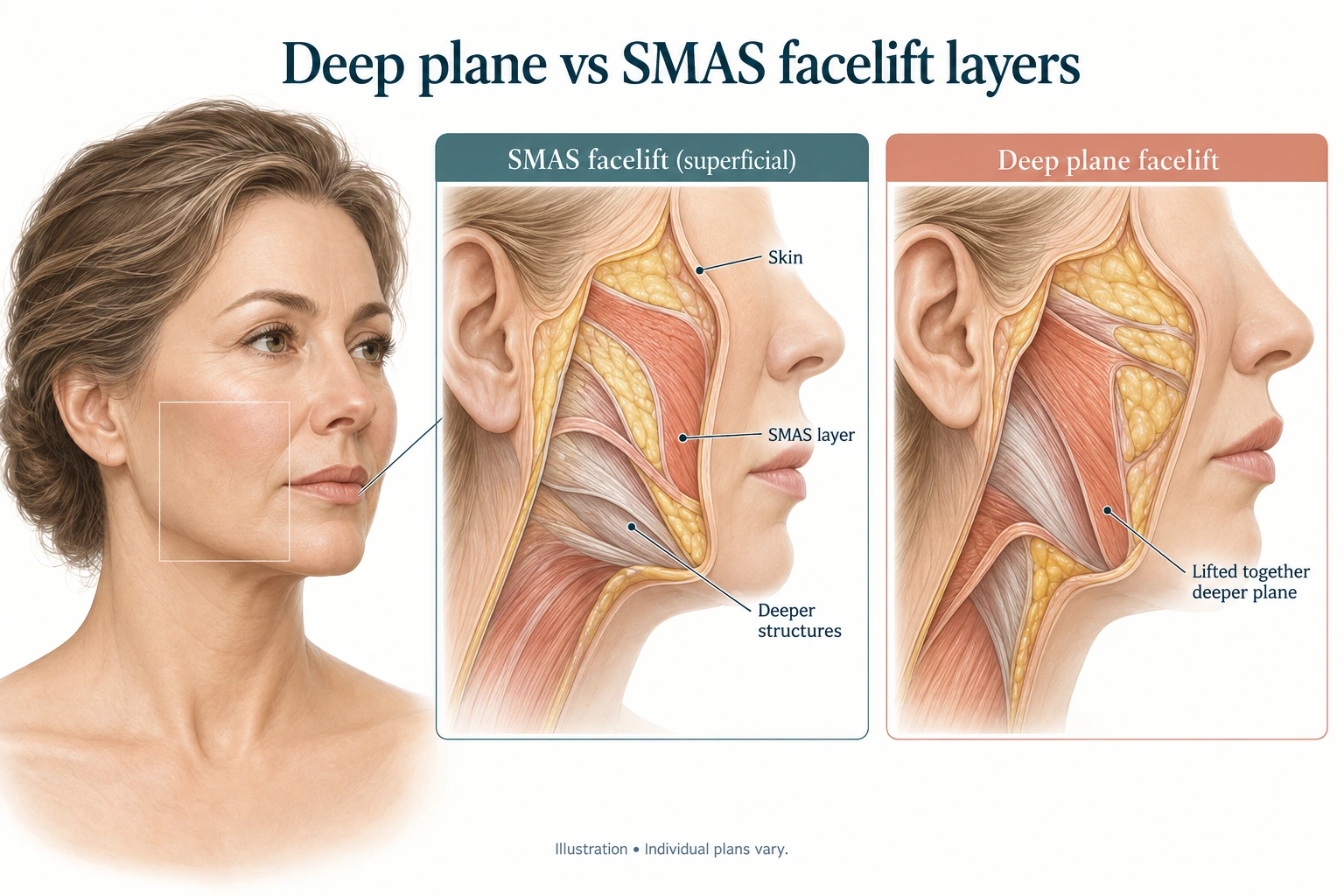
The face is built in layers: skin, fat, a fibrous-muscular layer called the SMAS, and deeper structures. With age, the ligaments that anchor them loosen, and jowls and deep nasolabial folds appear. A deep plane facelift releases these ligaments and lifts skin, SMAS and cheek fat together as one unit.

Deep plane facelift Turkey: medical illustration comparing skin, SMAS and deep plane facelift layers of the cheek and jawline
Where each facelift technique works beneath the skin.Illustration
Procedure time
3–5 hLonger with a neck lift or eyelids
Stay in Istanbul
10–14 daysIncluding 1 night in hospital
Back to desk work
2–3 weeksWalking from the day after surgery
Hairline stitches out
Day 10–14Front-of-ear stitches around day 5–7
Final result
3–6 monthsSubtle refinement up to 12 months
Results last
Many yearsThe face keeps ageing naturally
See all procedure details
Deep plane facelift at a glance
Procedure timeTypically 3–5 hours (longer when combined with a neck lift or eyelids)
AnaesthesiaGeneral anaesthesia
Hospital stayUsually 1 night
Recommended stay in Istanbul10–14 days
WalkingFrom the day after surgery
Back to desk workAround 2–3 weeks
ExerciseLight walks from week 1; strenuous exercise after 4–6 weeks
StitchesFront-of-ear stitches around day 5–7; hairline stitches or clips around day 10–14
Final resultSettles over 3–6 months; subtle refinement up to 12 months
Results lastMany years; the face continues to age naturally
Real patient results

Facelift before and after

Results from Vivid Clinic patients, shared with consent. Individual results vary. 6 cases shown; each caption states what the photos show and what is not recorded.

See the full gallery
  • Facelift · Case VC-37701
    • Left: before · Right: after
    • View: front
    • Follow-up photo: 6 months (as labelled on the clinic composite)

    Before: Heavy jowls and neck laxity. After: Defined jawline and neck.

    Combined procedures: deep plane face and neck lift, platysmaplasty, upper blepharoplasty. The visible change reflects all of them, not one procedure alone.

    Vivid Clinic patient, shared with consent. Individual results vary; this is one case, not a promise of your outcome.

  • Facelift · Case VC-37702
    • Left: before · Right: after
    • View: front
    • Follow-up photo: 6 months (as labelled)

    Before: Jowls, heavy upper eyelids. After: Smoother lower face, more open eyes.

    Combined procedures: deep plane face and neck lift, platysmaplasty, upper blepharoplasty. The visible change reflects all of them, not one procedure alone.

    Vivid Clinic patient, shared with consent. Individual results vary; this is one case, not a promise of your outcome.

  • Facelift · Case VC-37700
    • Left: before · Right: after
    • View: front
    • Follow-up photo: 9 months (as labelled on the clinic composite)

    Before: Sagging mid-face and jowls. After: Lifted mid-face, smoother jawline.

    Combined procedures: endoscopic mid-face lift, revision rhinoplasty, deep plane face and neck lift. The visible change reflects all of them, not one procedure alone.

    Vivid Clinic patient, shared with consent. Individual results vary; this is one case, not a promise of your outcome.

  • Facelift · Case VC-37705
    • Left: before · Right: after
    • View: front
    • Follow-up photo: 9 months (as labelled on the clinic composite)

    Before: Sagging mid-face. After: Lifted, smoother face.

    Combined procedures: endoscopic mid-face lift, revision rhinoplasty, deep plane face and neck lift. The visible change reflects all of them, not one procedure alone.

    Vivid Clinic patient, shared with consent. Individual results vary; this is one case, not a promise of your outcome.

  • Facelift · Case VC-19110
    • Left: before · Right: after
    • View: side profile
    • Follow-up interval: not recorded

    Before: Jowls and loose neck. After: Smoother jawline and neck.

    Vivid Clinic patient, shared with consent. Individual results vary; this is one case, not a promise of your outcome.

  • Facelift · Case VC-19122
    • Left: before · Right: after
    • View: oblique
    • Follow-up interval: not recorded

    Before: Jowls. After: Smoother jawline.

    Vivid Clinic patient, shared with consent. Individual results vary; this is one case, not a promise of your outcome.

Photos are unedited clinic composites; before and after photos may differ in lighting, clothing and pose. Consent is on file at the clinic.

Candidacy

Who is a deep plane facelift right for — and who should wait?

A deep plane facelift may suit you if

  • You have visible jowls, a softened jawline, mid-face descent or deep nasolabial folds
  • You also have neck laxity, as a face and neck lift are often planned together
  • You do not smoke, or are willing to stop fully before and after surgery
  • You are in good general health, at a stable weight, with realistic expectations

It is better to wait or choose something else if

  • You have uncontrolled high blood pressure, diabetes or a bleeding disorder
  • You use blood thinners that cannot safely be paused, or plan major weight loss within a year
  • Your laxity is early and mild, where a smaller procedure or non-surgical care may be enough

Most patients are in their mid-40s to 70s, but anatomy matters more than age. Never stop prescribed medication without your doctor's advice.

Your options

Facelift techniques at Vivid Clinic

Your surgeon recommends a technique after examining your face. There is no single right facelift for everyone.

Illustration of a surgeon marking facial lift vectors during a deep plane facelift consultation
Planning lift vectors with your surgeon before a deep plane facelift.Illustration
Featured technique

Deep plane facelift

Lifts cheek, jowl and jawline as one unit beneath the SMAS, usually combined with a neck procedure. Tension sits on the deeper layer, not the skin.

Layer
Beneath the SMAS
Strongest for
Mid-face, jowls and nasolabial area
Demands
Technically demanding
Well established

SMAS facelift

The SMAS is tightened with stitches (plication) or a strip is trimmed and re-sutured (SMASectomy).

Layer
The SMAS itself
Strongest for
Lower face and jawline
May suit
Less mid-face descent
Early jowling

Mini facelift and MACS lift

Shorter incisions and a more limited lift. Recovery is often a little quicker, but the effect is smaller and may not last as long.

Incisions
Shorter
Strongest for
Early jowls
Neck and mid-face
Smaller effect

An endoscopic mid facelift lifts the cheek through small hidden incisions. Many patients combine a facelift with a neck lift, fat grafting, an eyelid lift or a forehead lift. Our deep plane facelift guide explains the anatomy.

Step by step

How a deep plane facelift is done

The operation is performed under general anaesthesia by an anaesthesiologist at an accredited partner hospital. The aim is to put tissue back where it used to be, not to pull the skin tight.

  1. Marking

    Incisions and lift vectors marked with you sitting upright.

  2. Anaesthesia

    General anaesthesia at an accredited partner hospital.

  3. Incisions

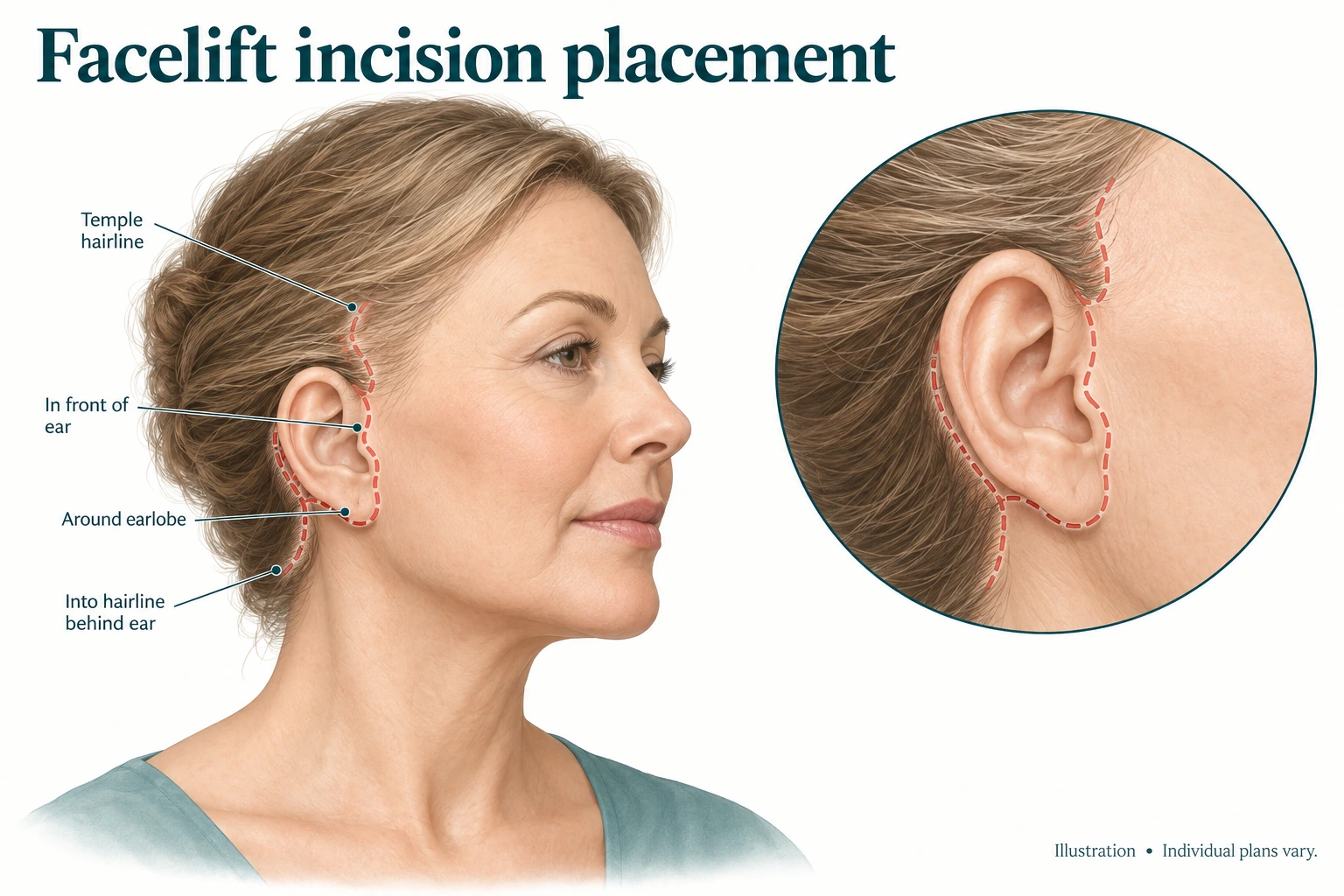
    Temple hairline, in front of the ear, behind the ear.

  4. Release

    Retaining ligaments released; cheek and jowl tissue mobilised.

  5. Repositioning

    Tissue lifted mostly vertically and secured with deep sutures.

  6. Closure

    Excess skin trimmed without tension; light compression dressing.

Illustration of facelift incision lines hidden around the ear and into the hairline
Incisions follow natural creases around the ear and hairline.Illustration
Your Istanbul journey

Ten to fourteen days, fully coordinated

Day 1

Arrival

A VIP transfer takes you from the airport to your hotel. Your coordinator explains the plan, and an interpreter is available.

Day 2 and night 1

Tests, surgery and hospital night

Consultation, blood tests, ECG and anaesthetic review, then surgery. You stay overnight under nursing observation.

Days 3–8

Discharge and rest

Check-up, drains removed if used, then back to your hotel. Short walks and dressing checks; front-of-ear stitches come out around day 6–8.

Days 10–14

Final check, fit to fly

Remaining hairline stitches or clips come out and your surgeon confirms you are fit to fly. The 24/7 support line stays open.

Send your face photos. Get an honest answer.

Front, both sides and at an angle. A plastic surgeon tells you whether a deep plane facelift, a neck lift or a combination suits you. Free, no obligation.

Recovery

Deep plane facelift recovery timeline

Walking starts the day after surgery. Most people return to desk work after two to three weeks.

  1. Week 1Swelling and bruising peak around days 2–3; tightness and numbness around cheeks and ears. Head elevated, no bending or lifting.Expected phase
  2. Weeks 2–3Bruising fades; most feel comfortable going out, and many return to desk work.
  3. Weeks 4–6Most visible swelling has settled; light exercise restarts, strenuous training after about six weeks.
  4. Months 3–12Jawline swelling resolves, sensation returns and scars mature. The final result is judged at 6–12 months.

What to expect, and how long it lasts

The aim is a sharper jawline, softer jowls and a lifted cheek, while still looking like you. Fine wrinkles and skin texture are not changed, so skincare or resurfacing may be recommended.

Results commonly last many years, varying with skin quality, genetics, sun, smoking and weight. Your face keeps ageing from its new starting point.

Infographic showing typical facelift recovery milestones from week one to month six
Typical recovery milestones; your own timeline may differ.Illustration
Choosing an approach

Deep plane facelift vs neck lift

In short: a deep plane facelift treats cheeks, jowls and jawline, and the neck when combined. A neck lift alone suits concerns below the jawline when the cheeks and jowls are still well supported.

CriterionDeep plane faceliftNeck lift on its own
Main areasCheeks, jowls and jawlineNeck skin, platysmal bands, fat under the chin
Best suited toModerate to advanced saggingNeck concerns with well-supported cheeks and jowls
Treats the neckWhen combinedYes
Treats jowls and mid-faceYesNo

Fillers, threads and energy devices can soften early changes, but cannot reposition deep tissue or remove loose skin, and their effects are shorter-lived. See our neck lift in Turkey page, facial results in our before and after gallery, and all options on our face aesthetics page.

Price and packages

What determines your deep plane facelift quote

A facelift quote is personal and only given after a surgeon has reviewed your photos, because an accurate plan depends on your anatomy. The consultation is free. Our facelift cost guide explains the factors in more detail.

Your all-inclusive package

Typically covers:

  • Consultation, blood tests and ECG
  • Surgery and general anaesthesia
  • Hospital stay
  • Medication and compression garments
  • Hotel accommodation
  • VIP airport and clinic transfers
  • Patient coordinator or interpreter
  • Aftercare, stitch removal and 24/7 support line

Your price depends on

  • Technique: deep plane, SMAS, mini or endoscopic mid facelift
  • Combined procedures: neck lift, platysmaplasty, fat grafting, eyelids, brow or lip lift
  • Operating time and hospital nights needed for your plan
  • Length of stay in Istanbul and hotel category
Why Vivid Clinic

Why patients choose Vivid Clinic for a deep plane facelift

Meet our medical team
  • Plastic surgeons, with medical review by Prof. Dr. Özgür Pilancı
  • Accredited partner hospitals in Istanbul with overnight nursing care
  • A technique chosen for your anatomy, not a one-size-fits-all lift
  • All-inclusive coordination: transfers, hotel, tests, interpreter and aftercare
  • 24/7 post-operative support line and remote follow-ups at home
5.0 157 Google reviewsVivid Clinic Google Business Profile · checked September 2026 Read reviews

Medical review

This page was medically reviewed by a plastic surgeon on the Vivid Clinic team.

Portrait of Prof. Dr. Özgür Pilancı, plastic surgeon on the Vivid Clinic team

Prof. Dr. Özgür Pilancı

Plastic, Reconstructive & Aesthetic Surgeon

  • Plastic surgery specialist since 2006 (Cerrahpaşa, Istanbul)
  • Associate professor since 2015
  • Clinical fellow in Rio de Janeiro in 2016
View profile
Safety

Risks of a deep plane facelift and how we reduce them

Every operation carries risk, and a facelift is no exception. Haematoma is the most common early complication, more likely in men and in people with high blood pressure.

Illustration of a hospital recovery room in Istanbul used for overnight observation after a facelift
Your first night after surgery is spent under hospital observation.Illustration

Possible effects

  • Haematoma (a collection of blood under the skin)
  • Temporary numbness; facial nerve weakness is uncommon and usually temporary
  • Visible scars, delayed skin healing or minor asymmetry
  • Infection, hair loss around incisions or a change in earlobe shape
  • Anaesthesia-related risks such as blood clots

How we reduce them

  • Blood pressure controlled before and after surgery
  • Certain medicines and supplements paused under medical advice
  • Overnight monitoring in an accredited partner hospital
  • Careful anatomical dissection by an experienced plastic surgeon
  • No nicotine for at least four weeks before and after surgery

The American Society of Plastic Surgeons and the NHS list similar complications.

FAQ

Frequently asked questions about deep plane facelift in Turkey

Deep plane facelift Turkey: how many days should I stay in Istanbul?

Plan 10–14 days. You arrive on day one, have your consultation, tests and surgery on day two, and spend one night in hospital. Front-of-ear stitches usually come out around day six to eight and the remaining hairline stitches around day ten to fourteen. Your surgeon checks your healing before confirming you are fit to fly. Combined procedures can extend this, and your coordinator will adjust your plan.

Does a deep plane facelift Turkey package include a neck lift?

Not automatically. Many patients need both because jowls and neck laxity usually develop together, and the two are often performed in one operation through a small extra incision under the chin. If your neck is firm, a facelift alone may be enough. Your surgeon will assess your photos and examination, then explain whether a neck lift or platysmaplasty adds real benefit for your anatomy before your quote is finalised.

Is a mini facelift Istanbul option enough if my jowls are only mild?

It can be. A mini facelift uses shorter incisions and treats early jowling with a shorter recovery. However, it has less effect on the mid-face and neck, and results may not last as long as a deep plane lift. If you also have cheek descent, deep nasolabial folds or neck laxity, a mini lift can leave these untreated. Your surgeon will compare both options against your photos.

How long before a deep plane facelift Turkey trip must I stop smoking or vaping?

Stop all nicotine, including cigarettes, vapes, patches and gum, for at least four weeks before surgery and four weeks after, or longer if your surgeon advises. Nicotine reduces blood flow to the lifted skin and raises the risk of wound breakdown and skin loss. Please be honest with your surgeon: a nicotine test may be requested, and surgery may be postponed if you are still using it.

Where are the incisions after an Istanbul facelift, and will they show?

Incisions usually run inside the temple hairline, along the natural crease in front of the ear or just inside it, around the earlobe and behind the ear into the hairline. A small incision under the chin is added when the neck is treated. Scars are pink for several months, then typically fade to fine lines that hair or make-up can conceal, though they are never completely invisible.

When can I return to work after a deep plane facelift in Turkey?

Most people return to desk work after around two to three weeks. Swelling and bruising peak around days two to three, then bruising fades during weeks two and three, when many feel comfortable going out with light make-up or hair styled over the incisions. Light walks are fine from the first week, while strenuous training and heavy lifting usually wait about six weeks, until your surgeon agrees.

How long does a deep plane facelift last?

Results commonly last many years, but a facelift does not stop the clock. Your face keeps ageing from its new starting point, and longevity varies with skin quality, genetics, sun exposure, smoking and weight changes. Fine wrinkles and skin texture are not changed by a facelift, so skincare or resurfacing may be recommended alongside. Your surgeon explains realistic expectations for your face at consultation.

Free assessment

Plan your deep plane facelift in Istanbul

Send clear photos of your face from the front, both sides and at an angle. It is free and there is no obligation.

  1. Share your details and photosHere, or by WhatsApp on +90 545 742 3565.
  2. Medical review within 24 hoursHonest advice on a deep plane facelift, a neck lift or a combination, and your travel plan.
  3. Your personalised Istanbul planDates, hotel, transfers and your coordinator’s contact.

Get my free facelift plan

Free · No obligation · Reply within 24 h

Vivid Clinic — Consultation Request
This site is protected by reCAPTCHA and the Google Privacy Policy and Terms of Service apply.