
Silicone gel
Designed to feel close to natural breast tissue. Modern cohesive gels hold together rather than behaving like a liquid.
- Use
- Most widely used in Turkey and Europe
- If the shell tears
- Can be silent; periodic imaging advised
The main breast implant types are silicone gel and saline, in round or anatomical shapes, several profiles and smooth or textured surfaces. Most Vivid Clinic patients receive silicone gel implants chosen from measurements and sizers. Plan 6–7 days in Istanbul.
Free medical review within 24 hours · No obligation · ★ 5.0 from 157 Google reviews
Editorially reviewed by the Vivid Clinic Surgical Board · Last reviewed September 2026

Breast implants are medical devices with a silicone outer shell, filled with silicone gel or sterile salt water (saline). Fill, shape, profile, width and surface all change how the result looks and feels. Ready to plan the operation itself? See our breast augmentation in Istanbul page.

| Procedure time | Typically 1–2 hours |
|---|---|
| Anaesthesia | General anaesthesia |
| Hospital stay | 1 night |
| Recommended stay in Istanbul | 6–7 days |
| Most common fill at Vivid Clinic | Silicone gel |
| Back to desk work | About 1 week |
| Exercise | Upper-body training after about 6 weeks |
| Final result | Implants settle over 3–6 months |
| Results last | Many years; replacement or revision may be needed over time |
| Implant monitoring | Imaging for silent rupture as your surgeon advises |
Results from Vivid Clinic patients, shared with consent. Individual results vary. 6 cases shown; each caption states what the photos show and what is not recorded.
Before: Small breasts. After: Fuller, rounder breasts.
Vivid Clinic patient, shared with consent. Individual results vary; this is one case, not a promise of your outcome.
Before: Small breasts. After: Fuller, rounder breasts.
Vivid Clinic patient, shared with consent. Individual results vary; this is one case, not a promise of your outcome.
Before: Small, slightly uneven breasts. After: Fuller, more even breasts.
Vivid Clinic patient, shared with consent. Individual results vary; this is one case, not a promise of your outcome.
Before: Small breast volume. After: Rounded, projected breast.
Vivid Clinic patient, shared with consent. Individual results vary; this is one case, not a promise of your outcome.
Before: Small breasts. After: Fuller breasts.
Vivid Clinic patient, shared with consent. Individual results vary; this is one case, not a promise of your outcome.
Before: Flat chest. After: Rounded breast projection.
Vivid Clinic patient, shared with consent. Individual results vary; this is one case, not a promise of your outcome.
Photos are unedited clinic composites; before and after photos may differ in lighting, clothing and pose. Consent is on file at the clinic.
Want only a modest, natural-feeling change and have spare fat? Fat transfer breast augmentation may suit you better than any implant type. Some patients benefit from a hybrid of both.
Every implant has a silicone outer shell. What fills it changes how it feels and how a leak shows. Silicone gel implants are the standard choice at Vivid Clinic.

Designed to feel close to natural breast tissue. Modern cohesive gels hold together rather than behaving like a liquid.
A more highly cross-linked, highly cohesive gel keeps its shape even when upright. Most often used for anatomical implants.
Filled with sterile salt water. Saline implants tend to feel less natural and ripple more in slim patients.
A brand name alone does not make a good result: fit, placement and technique matter more. Your surgeon tells you the manufacturer, model and volume before surgery, and you receive an implant card with serial numbers.
Implant volume is measured in cubic centimetres (cc), not cup sizes. Your surgeon matches the implant's base width to your breast, then chooses the profile. Low or moderate profiles look softer on a broad chest; high profiles add projection on a narrow chest.
Send photos online for an early surgeon opinion.
Chest width, breast base width, skin stretch and tissue thickness.
Try sizers in a bra; 3D simulation where available.
Blood tests and an anaesthetic review.
General anaesthesia, usually through a discreet fold incision.
One hospital night, check-ups and your implant card.

Your exact schedule is confirmed with your plan. Most patients are cleared to fly on day 6 or 7.
Day 1
A VIP airport transfer takes you to your hotel. Your patient coordinator or interpreter meets you.
Day 2
Consultation, measurements, sizers and tests, then surgery at an accredited partner hospital. You stay one night with nursing care.
Days 3–5
Discharge after a surgeon check. Rest, short walks and a dressing check at the clinic.
Days 6–7
Final review and fit-to-fly confirmation, then an airport transfer. The 24/7 post-operative support line continues at home.
A plastic surgeon suggests the implant type, shape, profile and volume range that suit your body. Free, with no obligation.
Most people are back at desk work after about a week. Incisions and pocket placement are explained on our breast augmentation page.
Breast implants are not lifetime devices, and the longer you have them, the more likely complications become. Many patients keep the same implants for well over a decade; others replace them earlier.
For silicone implants, the FDA recommends ultrasound or MRI checks for silent rupture at five to six years, then every two to three years. If you later want implants out, see our breast implant removal page.
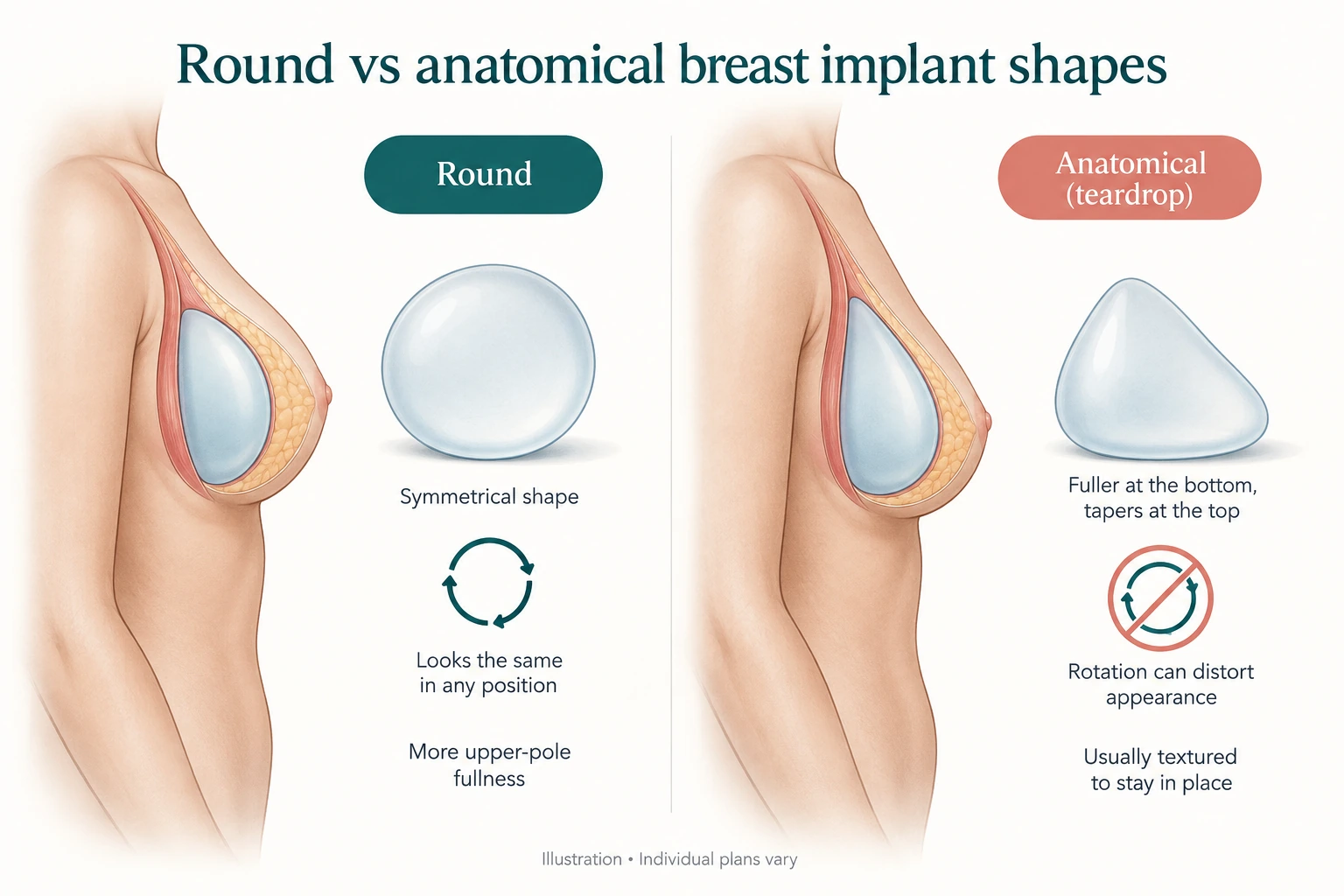
In short: round implants are the most common choice and look the same if they rotate. Anatomical implants can suit very little breast tissue or a wish for a subtle slope, but rotation can distort the breast.
| Round | Anatomical (teardrop) | |
|---|---|---|
| Shape | Symmetrical | Fuller at the bottom, tapering towards the top |
| Upper fullness | More upper-pole fullness | A subtler upper slope |
| If it rotates | Appearance does not change | Rotation can distort the breast |
| Surface | Smooth or micro-textured shells are common | Usually textured to stay in place |
| Gel | Cohesive silicone gel | Most often firmer form-stable gel |
| Often suits | Most patients | Very little breast tissue, or a subtle slope |
For a deeper comparison, read our guide to round vs teardrop breast implants.
An honest quote needs a surgeon's review of your photos first. We then give a personal quote for the implant and plan that suit you. The consultation is free.
Typically covers:
Your price depends on
This page was medically reviewed by a plastic surgeon on the Vivid Clinic team.

Plastic, Reconstructive & Aesthetic Surgeon
Textured surfaces were developed to reduce rotation and capsular contracture. The FDA reports a higher risk of a rare lymphoma, BIA-ALCL, with textured than smooth implants. Your surgeon names the surface of any implant recommended and explains why.
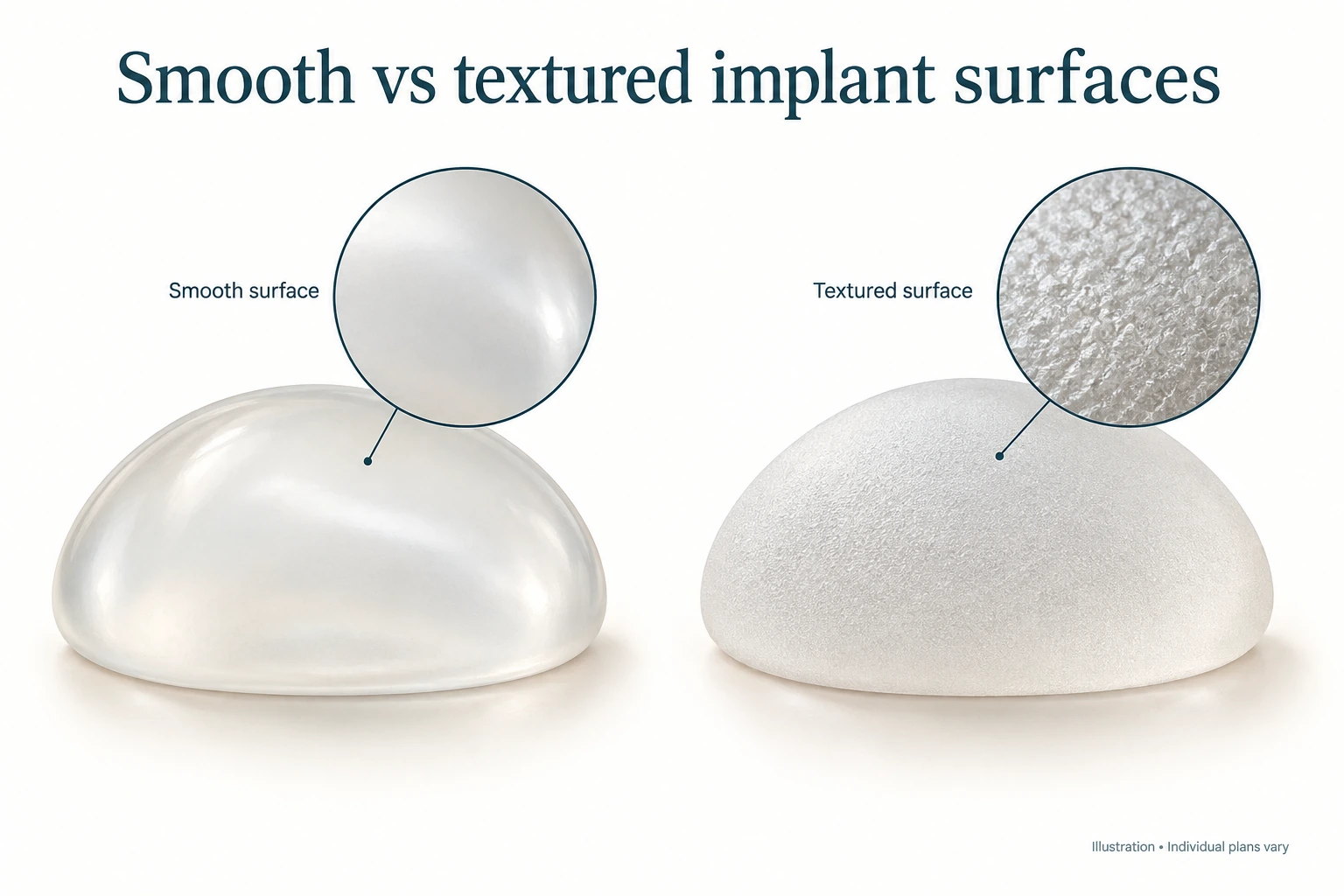
BIA-ALCL usually appears years after surgery as persistent swelling, fluid or a lump near the implant. It is treated by removing the implant and capsule; the FDA's BIA-ALCL questions and answers do not recommend removal without symptoms.
At Vivid Clinic, most patients choose silicone gel implants, either standard cohesive gel or firmer form-stable gel. Within those, you can choose round or anatomical shapes, several profiles and a wide range of volumes. Surface options are discussed openly because of the link between textured implants and BIA-ALCL. Saline implants are rarely used in Turkey today, so your surgeon will confirm whether they are an option for you.
Silicone gel implants are designed to feel close to natural breast tissue, and modern cohesive gels hold together rather than behaving like a liquid. Saline implants tend to feel less natural and ripple more in slim patients. A saline leak is easy to spot because the breast deflates. A silicone tear can be silent, so periodic imaging is recommended for silicone implants.
It depends on the width of your chest and breast and the projection you want. Low or moderate profiles have a wider base and a softer look on a broad chest. Moderate-plus is the most common middle ground. High or extra-high profiles are narrower with more projection, useful on a narrow chest. An implant wider than your breast can sit too far into the armpit or cleavage.
There is no fixed expiry date. Breast implants are not lifetime devices, and the chance of needing another operation rises over time. Many patients keep their implants for more than ten years, but capsular contracture, rupture, pregnancy or weight change can mean earlier surgery. For silicone implants, the FDA advises imaging at five to six years after surgery and then every two to three years to check for silent rupture.
Some textured implants remain available, but the FDA reports that BIA-ALCL risk is higher with textured than smooth surfaces, and one manufacturer's macro-textured implants were recalled in 2019. For most round implants, smooth or lightly textured shells are a common choice. Your surgeon will name the exact surface of any implant recommended and explain why, so you can decide with full information.
Yes. During your consultation in Istanbul you can try sizers inside a bra and, where available, see a 3D simulation. Your surgeon then checks that the preferred volume fits your breast width and skin stretch. Sizers are a guide rather than an exact preview, because implants placed under tissue and muscle look slightly smaller than the same sizer worn in a bra.
Yes. Women with breast implants should continue routine breast screening. Tell the radiographer you have implants so they can use additional displacement views, which move the implant back to show more breast tissue. Implants placed under the muscle can make imaging slightly easier. Bring your implant card to appointments, and discuss any new lump, swelling or change in shape with a doctor promptly.
Send your photos and goals through WhatsApp or the form. A Vivid Clinic surgeon reviews them, and your coordinator returns a personalised plan. The consultation is free and without obligation.
Free · No obligation · Reply within 24 h
Open a summary of this guide in your AI assistant.
 ChatGPT