
Cheek dimples on both sides
Both dimples are marked together so they sit as symmetrically as your natural smile allows.
- Incision
- Inside the cheek
- Anaesthesia
- Local
- Procedure time
- Typically 20–30 minutes
Dimple surgery (dimpleplasty) creates cheek dimples through a tiny incision inside the mouth, so there is no skin scar. It suits healthy adults who want dimples when they smile. Plan 2–3 days in Istanbul; most people return to work within one or two days.
Free medical review within 24 hours · No obligation · ★ 5.0 from 157 Google reviews
Editorially reviewed by the Vivid Clinic Surgical Board · Last reviewed September 2026

Natural dimples come from a small band or split in a cheek muscle that pulls the skin inward when you smile. Dimpleplasty recreates that connection from inside the mouth. Your surgeon creates a small attachment between the cheek muscle and the underside of the skin, placed where it suits your smile.
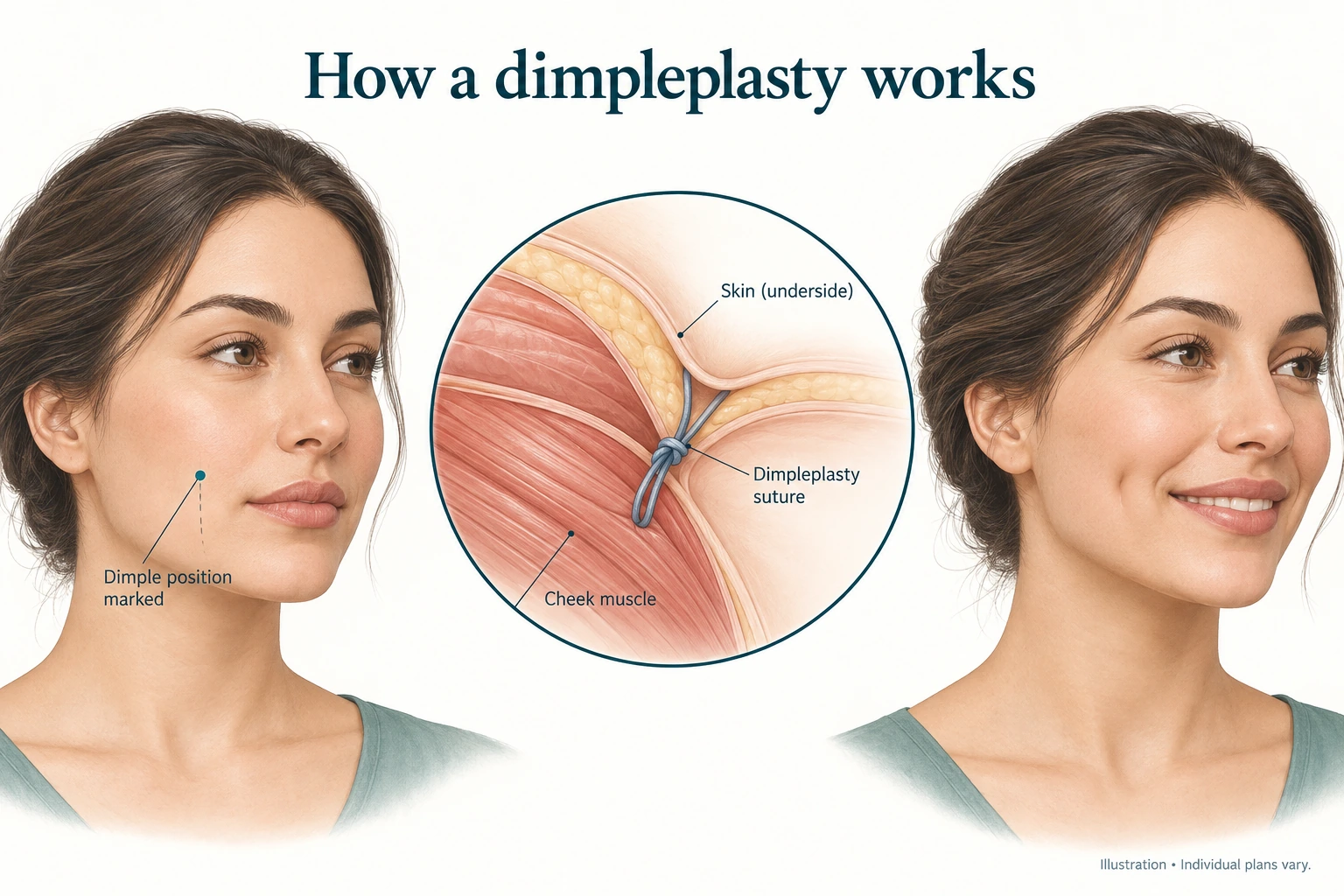
| Procedure time | Typically 20–30 minutes for two cheek dimples |
|---|---|
| Anaesthesia | Local anaesthesia |
| Hospital stay | None (day procedure) |
| Recommended stay in Istanbul | 2–3 days |
| Back to desk work | Usually 1–2 days |
| Exercise | Light activity after a few days; strenuous exercise after about 1–2 weeks |
| Diet | Soft food for a few days |
| Stitches | Inside the mouth; dissolvable stitches do not need removal |
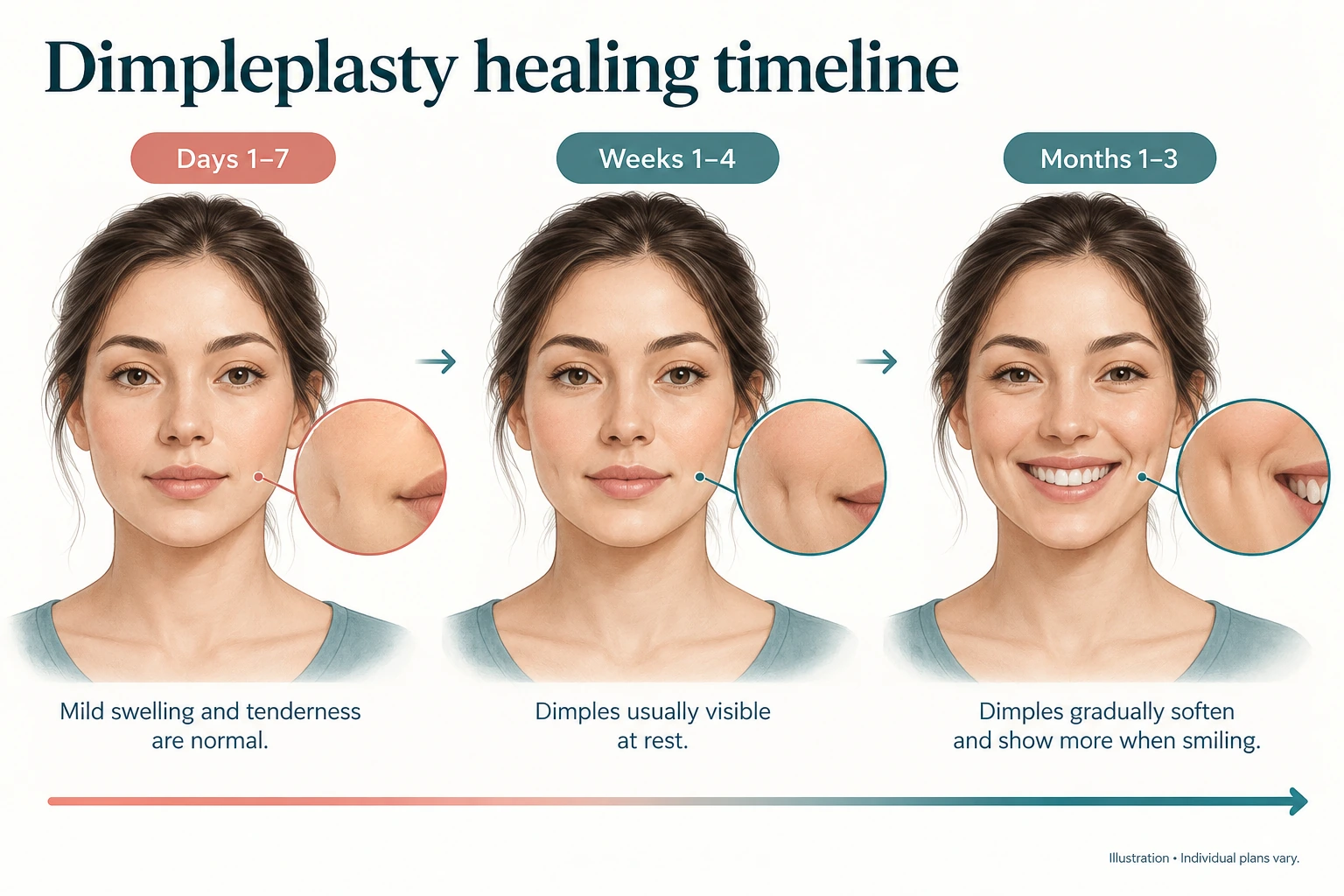
| Dimples at rest | Common for the first few weeks, then softening |
| Final result | Usually settles over 2–3 months |
| Results last | Designed to be long-lasting, but dimples can soften over time |
Dimples can soften over time, and the two sides of a face are never identical. Your surgeon explains what to expect for your cheeks.
The dimple point is marked with you smiling. A common reference is where a line down from the outer eye corner meets a line out from the mouth corner, then adjusted to your face.
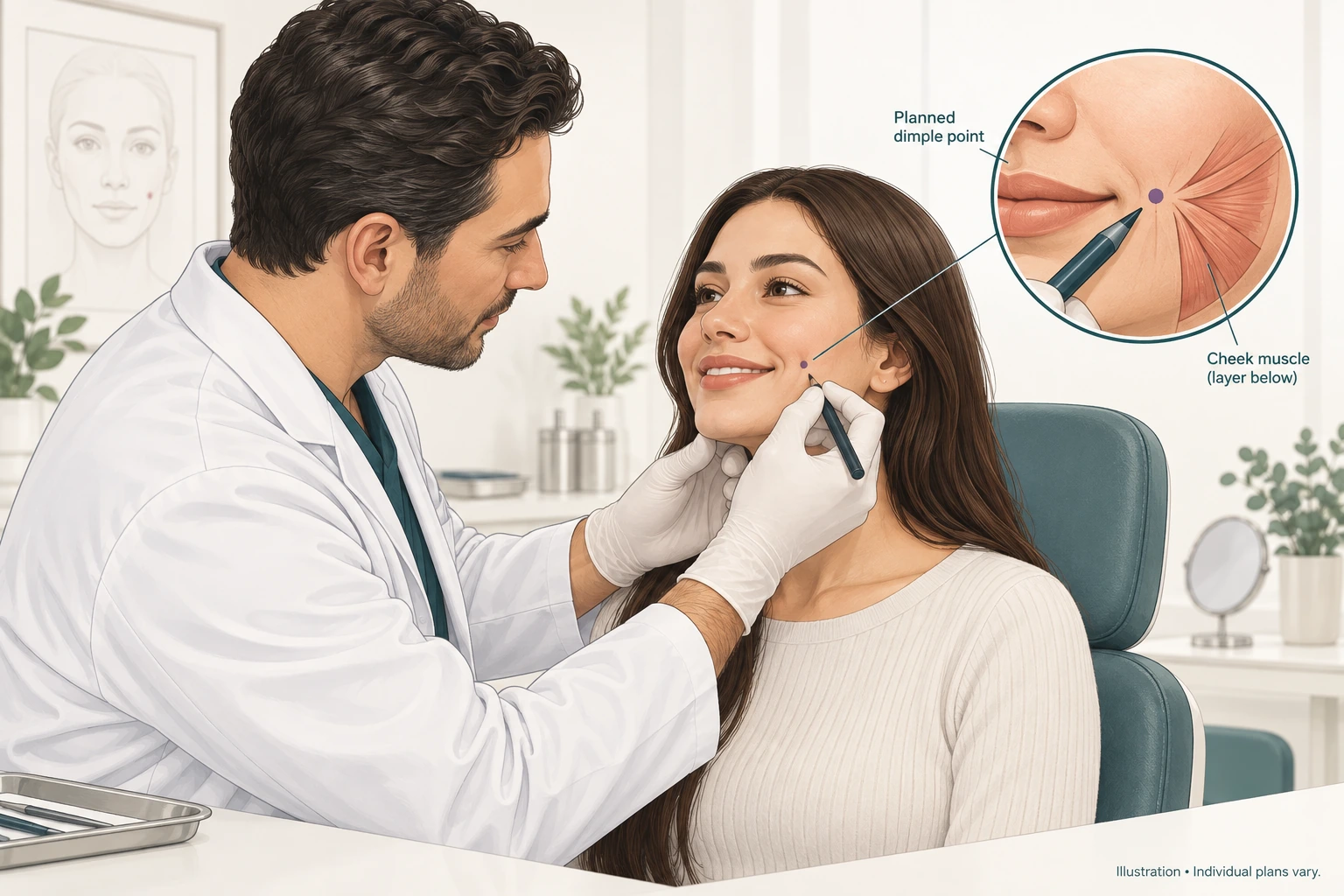
Both dimples are marked together so they sit as symmetrically as your natural smile allows.
Some people prefer one dimple. It can look more natural if the other side already has a faint natural dimple.
A chin dimple links the chin muscle to the skin, usually through an incision inside the lower lip. Suitability depends on chin shape and proportions.
Also slimming the lower cheeks? See buccal fat removal (bichectomy). Some patients plan dimples alongside rhinoplasty or injectables as part of wider facial balancing.
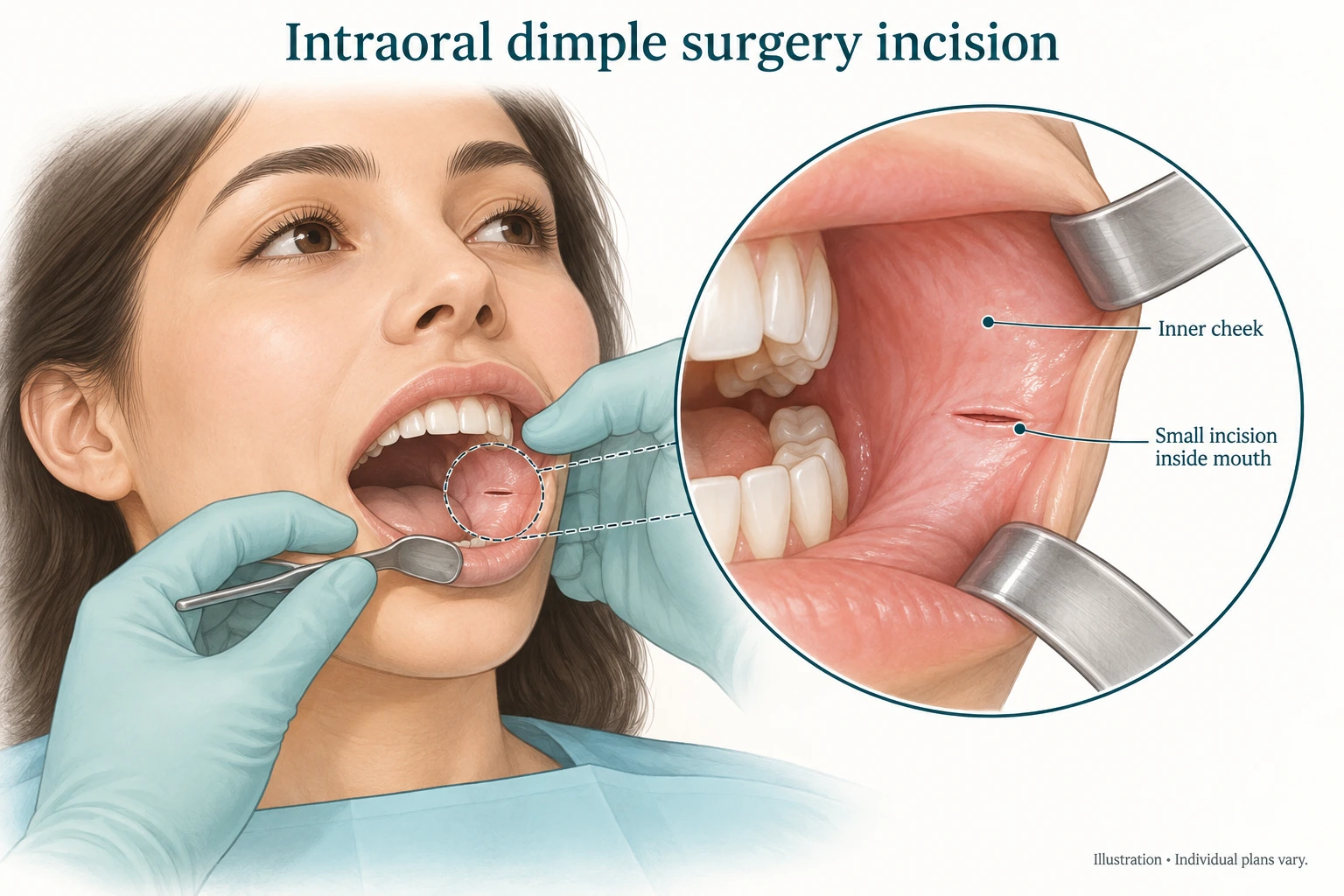
You are awake and comfortable under local anaesthetic. All the work is done from inside the mouth, and the same steps are repeated on the other side.
Dimple point marked while you smile; you confirm in a mirror.
Cheek numbed from inside the mouth; you stay awake.
Tiny incision inside the cheek, away from the salivary duct.
A suture joins cheek muscle to the underside of the skin.
Dissolvable stitches; repeated on the other side.
Back to your hotel the same day with mouth-care advice.
Day 1
A VIP transfer takes you from the airport to your hotel, and your patient coordinator welcomes you. An interpreter is available.
Day 2
A face-to-face consultation, marking and your dimple surgery, then back to your hotel the same day.
Day 3
Your surgeon checks the incisions and dimple position and explains mouth care. Most patients fly home that day or the next.
Front and both sides, relaxed and smiling, and tell us where you would like your dimples. A plastic surgeon explains whether dimple surgery suits your face. Free, no obligation.
Most people return to normal routines within a day or two. Dimples look deeper and show at rest at first, then soften.
Most patients see dimples that appear when they smile and look subtle at rest once healed. Dimpleplasty is designed to be long-lasting, and many people keep their dimples for years.
Because it relies on healing tissue and the suture's hold, dimples can become shallower over time, sometimes on one side more than the other.
In short: dimple surgery adds a small point of definition that appears when you smile. Buccal fat removal reduces lower-cheek fullness to change overall face shape.
| Dimple surgery | Buccal fat removal | |
|---|---|---|
| Approach | Inside the cheek | Inside the cheek |
| What it does | Links cheek muscle to the skin | Reduces the lower-cheek fat pad |
| Effect | A dimple when you smile | A slimmer lower cheek |
| Changes face shape | No | Yes |
Your surgeon explains whether combining both is sensible for your face. See our buccal fat removal page, facial aesthetics examples in our before and after gallery, and all options on our face aesthetics page.
Your quote is prepared after a surgeon has reviewed your photos. Turkey is often more affordable than the UK, US or much of Europe, and the consultation is free.
Typically covers:
Your price depends on
This page was medically reviewed by a plastic surgeon on the Vivid Clinic team.

Plastic, Reconstructive & Aesthetic Surgeon
Dimple surgery is a small procedure, but it is still surgery.
General advice is available from the NHS and the International Society of Aesthetic Plastic Surgery. See also our guide to side effects of plastic surgery on the face.
Two to three days is usually enough. You arrive on day one, have your consultation and the procedure on day two, and return to your hotel the same day. Your surgeon checks the dimples on day three, and most patients fly home that day or the next. Stitches inside the mouth dissolve on their own, so you do not need to come back for removal, and later follow-ups can be done remotely.
At first, yes. For the first few weeks the new dimples are usually visible even when your face is relaxed, because the internal attachment is still tight and healing. Over the following weeks they gradually soften, and in most people they become more noticeable when smiling than at rest by around two to three months. How much they show at rest long term varies with your cheek tissue.
They can. Dimpleplasty is designed to be long-lasting, and many people keep their dimples for years, but results depend on how your tissue heals around the attachment. Some dimples become shallower over time, and occasionally one side fades more than the other. If that happens, a small revision can be discussed. Your surgeon will explain the technique chosen and what to expect for your cheeks.
Some unevenness in the first weeks is common, because swelling and healing rarely progress identically on both sides. Wait until around two to three months before judging symmetry. If a clear difference remains, your surgeon will assess it and may suggest a minor adjustment. Sending clear photos of your smile from the front during follow-up helps the team compare both sides accurately.
Possibly. A chin dimple is a separate procedure that connects the chin muscle to the skin, usually through an incision inside the lower lip, and it can sometimes be done in the same session as cheek dimples. Whether it suits you depends on chin shape and projection. Your surgeon will review your photos and discuss whether a chin dimple would look natural on your face.
Most people return to desk work within one or two days. Mild swelling and tenderness are normal in the first week, so eat soft food, rinse with the prescribed mouthwash after meals and avoid very hot drinks. Do not press or massage the dimples. Light activity is fine after a few days, and strenuous exercise usually resumes after about one to two weeks.
The dimple point is marked on your skin while you smile, and you confirm the position in a mirror before the procedure. A common reference is where a line down from the outer corner of the eye meets a line out from the corner of the mouth. The final position is adjusted to your face, smile and preferences, so the dimple looks as if you were born with it.
Send photos of your face from the front and both sides, relaxed and smiling, and tell us where you would like your dimples. It is free and there is no obligation.
Free · No obligation · Reply within 24 h
Open a summary of this guide in your AI assistant.
 ChatGPT