
This article is pending clinical review by the Vivid Clinic medical team.
Quick answer: If you’ve been searching for deep plane facelift before and after photos to understand what real recovery timelines look like, this article walks through two documented Vivid Clinic cases — one at six months, one at nine months — and explains exactly what each photo pair can, and cannot, tell you. Both patients had additional procedures alongside their facelift, and both photo sets have documented limitations in lighting, angle or expression. We explain all of it here so you can read these images, and any before-and-after photos you encounter elsewhere, with a clinically informed eye.
What deep plane facelift before and after photos can show
Before-and-after photography is a genuinely useful tool for understanding facial rejuvenation surgery, but it is a limited one. A well-matched photo pair can show general changes in jawline definition, jowl reduction, neck contour and midface volume position. What it generally cannot show, especially without a controlled clinical photography protocol, is the precise magnitude of change, skin quality shifts, or anything about how a result was achieved technically. Photos are also a single frozen moment: they don’t show movement, expression range, or how a face looks from every angle in daily life. When you’re comparing a deep plane facelift before and after image pair, the most useful approach is to look for consistent findings across multiple views rather than reading too much into any single frame. Reputable references like the American Society of Plastic Surgeons’ facelift results guidance emphasize that outcomes vary by individual anatomy, technique, and healing — a point worth keeping in mind as you review any clinic’s photo gallery, including our own.
Case M: the six-month combination and photo views
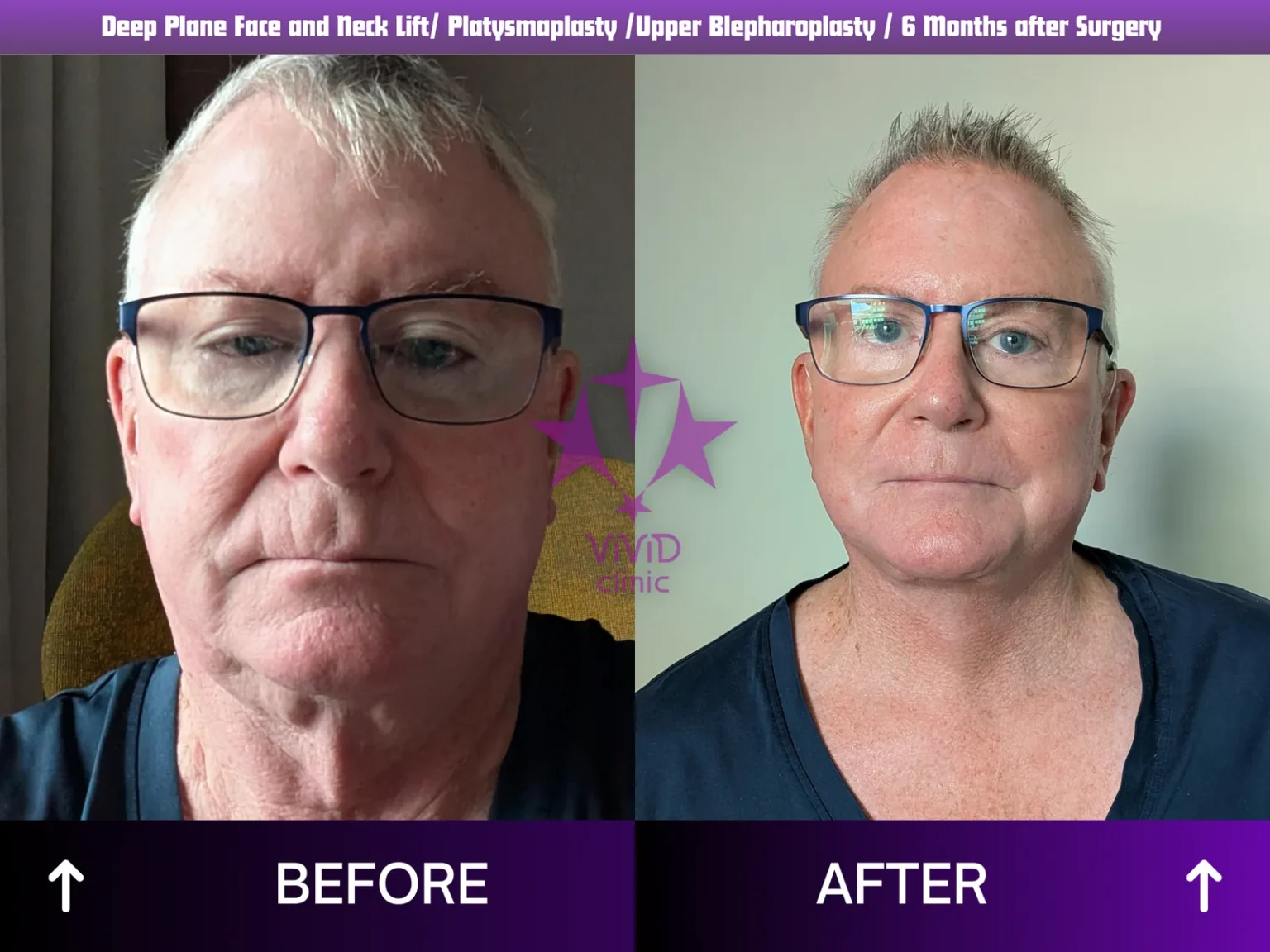
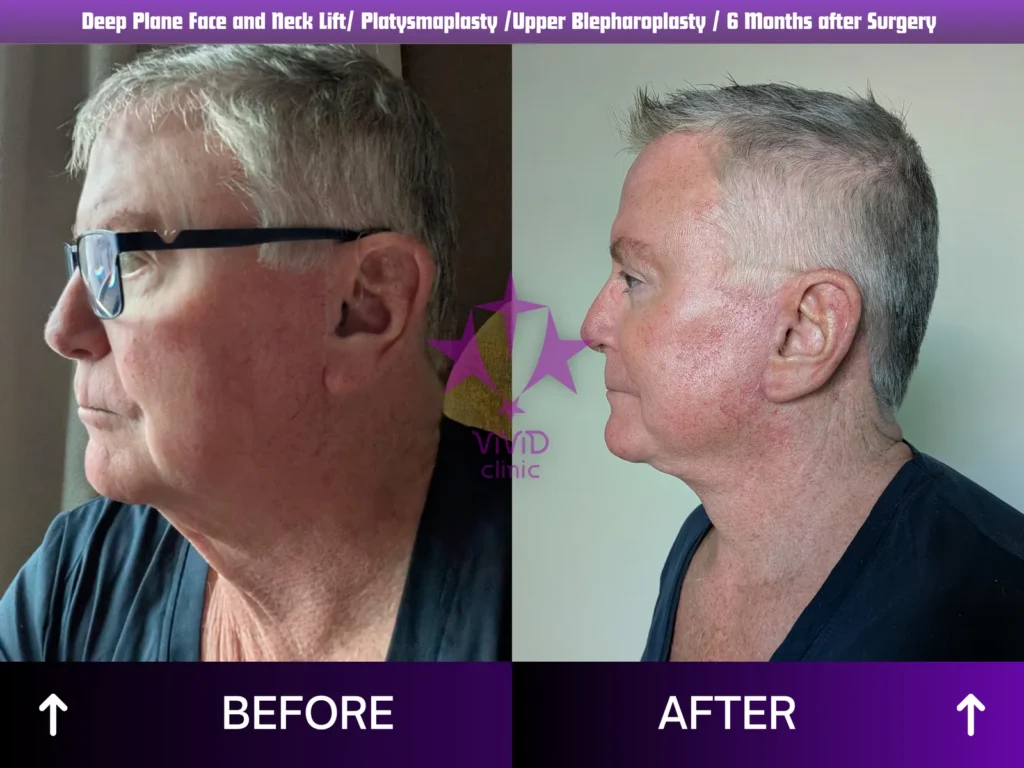
Case M is a patient who underwent three combined procedures: a deep plane face and neck lift, platysmaplasty (tightening of the platysma muscle band in the neck), and upper blepharoplasty (upper eyelid surgery). The photos referenced here were taken six months after surgery. It’s important to state plainly that what you’re viewing is the visible outcome of three procedures performed together, not an isolated facelift result — the jawline and neck changes you may notice could be influenced by the platysmaplasty, and any change around the upper eyes reflects the blepharoplasty, not the facelift itself.
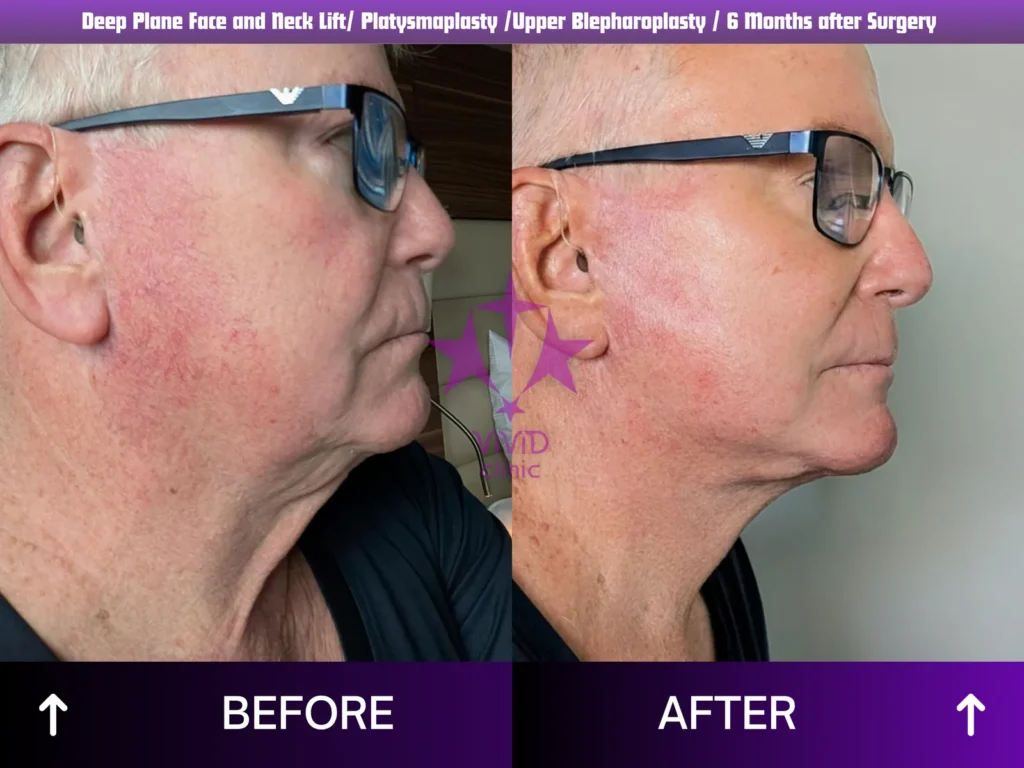
Two views were documented for Case M. The first is a frontal comparison, shown below, and the second is a right-facing profile comparison discussed in the following section.

In this frontal pair, both the before and after photos show the patient wearing glasses, and the lighting conditions differ between the two images. Glasses can partially obscure the midface and periorbital area, and differing lighting can change how shadows fall along the jawline and neck — both of which affect how reliably you can compare the two photos side by side. We’re noting this openly rather than presenting the comparison as a perfectly controlled clinical photograph, because it isn’t one, and honest before-and-after education depends on saying so.
Case F: the nine-month combination and frontal view
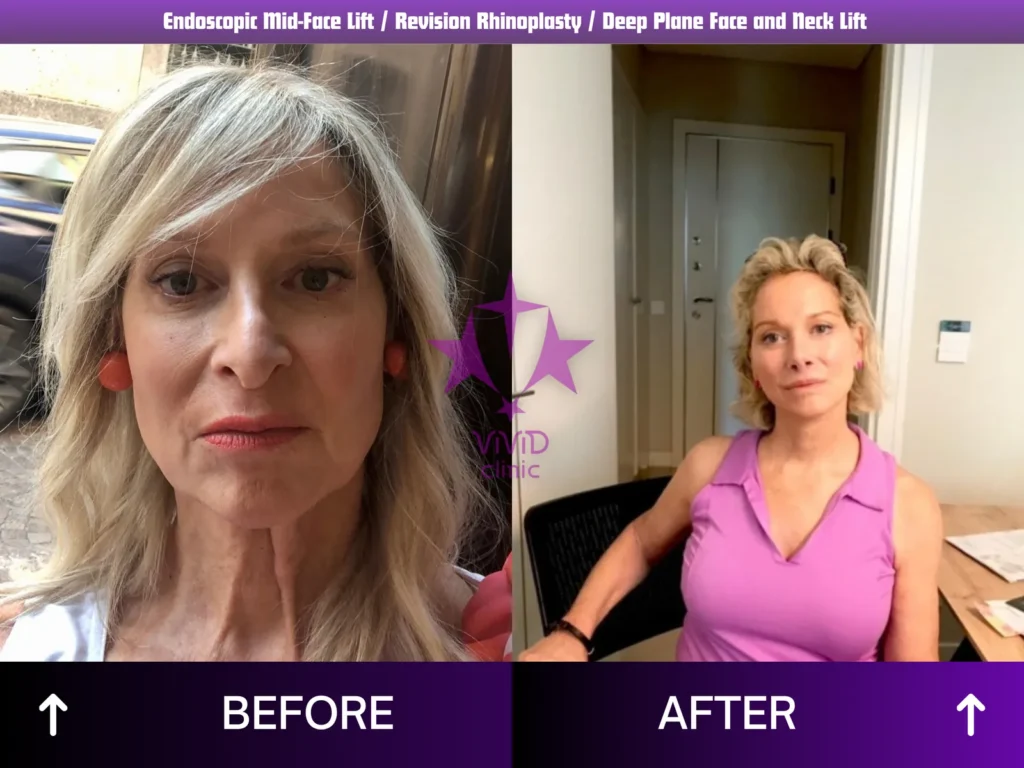
Case F is a different patient from Case M, photographed nine months after a combination of three procedures: an endoscopic mid-face lift, revision rhinoplasty (a repeat nose surgery, typically more complex than a first-time procedure), and a deep plane face and neck lift. As with Case M, every visible change in this photo pair is the combined product of three separate operations, not a single-procedure result.
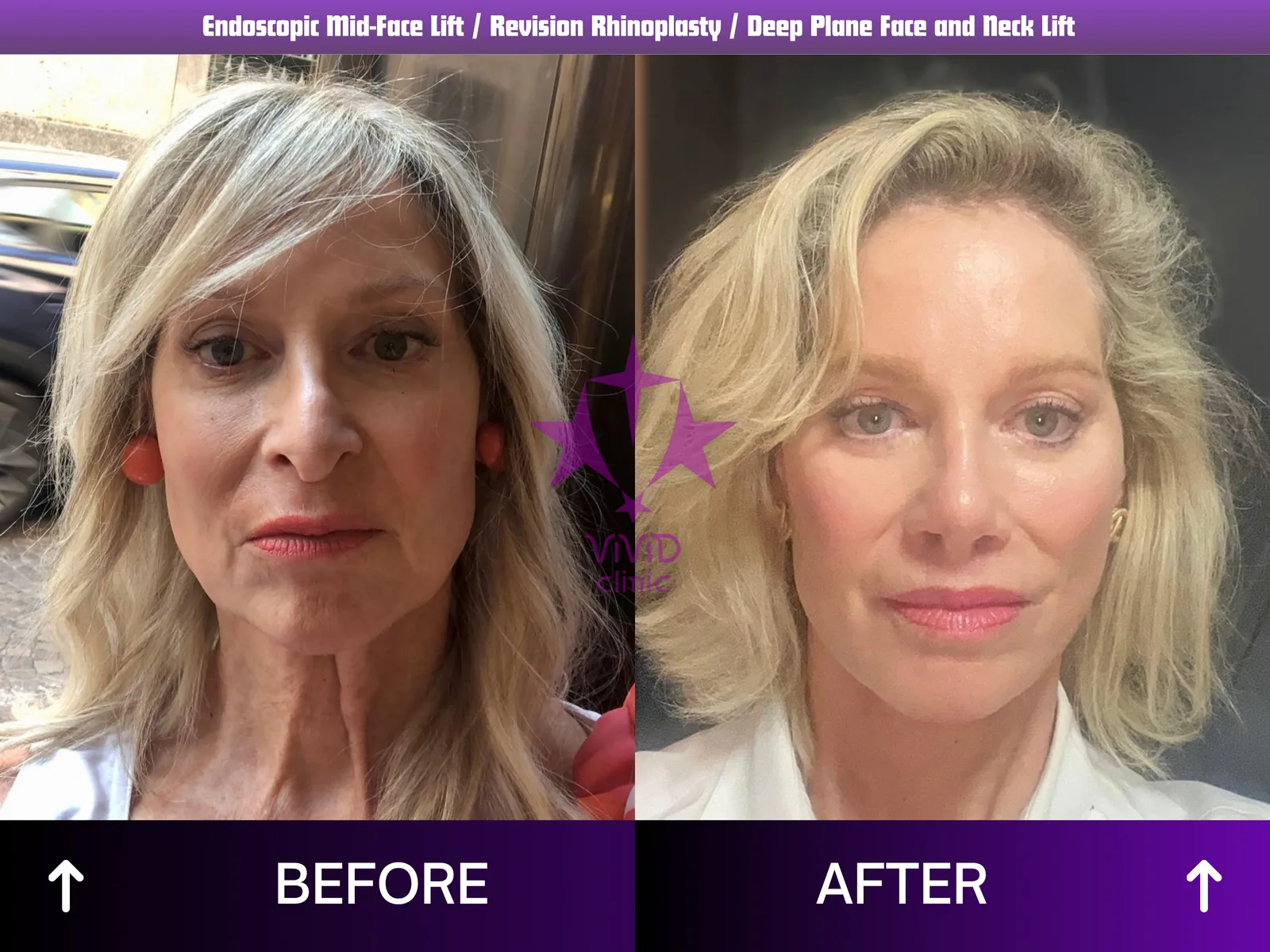
This is the preferred frontal comparison available for Case F, but lighting, makeup, hairstyle and expression all differ between the before and after photos, which limits how precisely the two can be compared. It’s also worth being direct about what this image is not suitable for: because revision rhinoplasty changes are best assessed from matched profile and base (looking-up) views, and those matched views aren’t available for this case, this frontal photo should not be used to judge the nasal surgery result specifically. It’s a general facial comparison, not a nasal outcome record. A third photograph exists for Case F but has been excluded from this article and from our before-and-after materials generally, because its timing conflicts with the two images referenced here and it doesn’t meet our standard for a clean, single-subject comparison.
For Case M’s supporting angle, a right-facing profile comparison (image M8) was also documented at six months. Like the frontal pair, both the before and after profile photos show the patient wearing glasses, and the head angle differs slightly between the two shots — another reminder that even a “matched” pair can have real-world variation that a purely clinical photography protocol would minimize.
How lighting, expression and camera angle affect comparisons
Lighting direction changes how shadows define (or hide) the jawline, neck bands and cheek contours — a single overhead light can make jowls look more pronounced than side lighting would, independent of any surgical change. Facial expression matters too: a relaxed jaw versus a slightly tensed one can shift the visible neckline by a noticeable margin. Camera angle and distance affect perceived proportions, and accessories like glasses can obscure the brow, upper eyelid and midface entirely. None of this means the photos are unreliable or misleading by intent — it means that reading before-and-after photography requires the same care you’d apply to any single data point: useful, but not proof on its own. This is exactly why we disclose these specific limitations for Case M and Case F rather than letting the images speak without context.
Why these are two cases, not a six-to-nine-month timeline
Because Case M is documented at six months and Case F at nine months, it might be tempting to read them as sequential check-ins on one person’s healing journey. They are not. Case M and Case F are two different patients, with different combinations of procedures, different anatomy, and different healing histories. Comparing them as if they were the same person’s month-six and month-nine photos would be inaccurate and would misrepresent what each case actually shows. We’re stating this explicitly because it’s a common misreading of multi-case galleries, and because a third Case F photo (labeled with a six-month timestamp) was excluded from this article precisely because its timing conflicted with the other Case F images and risked creating exactly this kind of confusion.
Who may be suitable, and who may not
Candidacy
Good general candidates for a deep plane facelift are typically adults in reasonably good health, with realistic expectations, who are bothered by jowling, midface descent, or neck laxity that non-surgical options haven’t adequately addressed. Non-smokers, or those willing to stop smoking well before and after surgery, tend to have more predictable healing. As Case M and Case F both show, a deep plane facelift is also frequently combined with adjacent procedures — neck work, eyelid surgery, or midface lifting — when a patient’s overall facial aging involves more than one area.
Limitations
A facelift, including a deep plane technique, doesn’t address every concern. It won’t meaningfully change skin texture or sun damage the way resurfacing treatments might, it doesn’t reshape the nose, and it isn’t a substitute for eyelid surgery if upper or lower lid changes are the primary concern. We want to be clear that we are not diagnosing or assessing suitability for the specific patients photographed in Case M or Case F — their candidacy was determined through their own individual consultations — and this section is general guidance only, not a claim about either documented case.
Preparation and consultation
Preparation for a deep plane facelift typically begins with a detailed consultation covering your medical history, current medications, and any prior facial surgery, since revision cases (as in Case F’s rhinoplasty history) often require extra planning. Your surgeon will usually ask you to stop smoking, adjust or pause certain medications and supplements that increase bleeding risk, and arrange for a companion to help during the first days of recovery. Blood tests and, depending on your health history, medical clearance may be requested before scheduling. For patients traveling to Istanbul, Turkey for surgery, preparation also includes planning travel dates around both the procedure and a realistic recovery window before flying home.
Procedure Overview
The ranges below reflect general, evidence-informed guidance for a deep plane face and neck lift, not a day-by-day account of Case M or Case F specifically. When a neck lift is combined with platysmaplasty, or a facelift with upper blepharoplasty as in Case M, duration and early recovery can extend modestly beyond a facelift performed alone.
| Duration | 3–6 hours, depending on the combination of procedures |
| Hospitalization | Typically one night for combined procedures |
| Mobility | Gentle walking same or next day; avoid strenuous activity for 2–3 weeks |
| Return to Activity | Most people feel comfortable in public after roughly 2–3 weeks, once visible bruising fades |
| Recovery | Residual swelling can linger 3–6 months, with final settling up to about a year |
| Anticipated Results | Initial improvement visible by 4–6 weeks, continuing to refine for up to 12 months |
How the operation is planned and performed
A deep plane facelift repositions deeper facial tissue layers — not just the skin — which is why results are generally intended to look more natural and hold longer than skin-only lifting techniques. When combined with a neck lift, as in both Case M and Case F, the surgeon also addresses neck skin laxity and, where indicated, the platysma muscle bands beneath it, which is what platysmaplasty specifically targets. Planning starts with a physical assessment of skin quality, fat distribution, bone structure and the degree of laxity present, and the surgical plan is built around your anatomy rather than a one-size-fits-all template. When multiple procedures are combined in one operation, as documented in both cases here, the sequencing and combined anesthesia time are planned carefully by the surgical team to balance thoroughness with safety. You can read our full guide to the deep plane facelift technique for more detail on how the layered approach differs from older facelift methods.
Recovery and the results timeline
Recovery from a deep plane facelift follows a general arc: noticeable swelling and bruising in the first one to two weeks, gradual improvement over the following weeks, and continued subtle refinement for months afterward. Neck and lower-face swelling tends to resolve more slowly than swelling around a straightforward upper eyelid procedure. When a facelift is combined with platysmaplasty, some tightness or tingling in the neck is common in the early weeks and typically eases gradually. When combined with revision rhinoplasty, as in Case F, nasal swelling can take longer to fully settle than facial swelling, since revision nasal tissue has often already been operated on once and can respond to surgery differently than tissue that hasn’t been touched before, per general guidance from the ASPS on rhinoplasty recovery. We are describing general recovery patterns here — not a specific day-by-day account of what Case M or Case F individually experienced, since that level of detail wasn’t documented for this article.
Risks and safety considerations
As with any surgical procedure, a deep plane facelift carries risks that should be discussed thoroughly during consultation, including but not limited to bleeding, infection, nerve irritation affecting facial movement or sensation, scarring, asymmetry, and reactions to anesthesia. Combining procedures — as both Case M and Case F did — can extend total surgical and anesthesia time, which is a factor your surgical team weighs when planning your operation. The ASPS’s safety guidance on eyelid surgery and its general facelift results page are useful starting points for understanding standard risk categories, though your own surgeon is the right source for how these risks apply to your individual health profile. Choosing a qualified, experienced surgical team and following pre- and post-operative instructions closely are the most meaningful ways to support a safe outcome.
Cost factors and combination planning
We won’t quote a fixed price here, because the honest answer is that cost varies by complexity, the specific combination of procedures chosen, surgeon experience, the surgical setting, anesthesia requirements, and the aftercare package involved. Both Case M and Case F illustrate why: a facelift alone is priced differently than a facelift combined with platysmaplasty and blepharoplasty, or combined with a midface lift and revision rhinoplasty. During your consultation, your surgeon and patient coordinator will walk through which combination, if any, makes sense for your goals and build a cost estimate around that specific plan rather than a generic package price.
Your journey at Vivid Clinic in Istanbul
When you choose Vivid Clinic for your care in Istanbul, Turkey, your journey is coordinated from the moment you book. Our patient coordinators plan your visit around your surgery date, arrange a VIP airport transfer, and check you into a partner five-star hotel for your stay. You’ll meet your surgeon for an in-person consultation to confirm your plan before proceeding, have your procedure performed at our accredited facility, and recover under the clinical team’s aftercare protocol, with a check-up before you fly home. After you return home, Vivid Clinic’s team stays in contact for remote follow-up as you continue healing. Package inclusions can change, so please confirm current details with your patient coordinator before booking.
Choosing a surgeon and discussing expectations
Because a deep plane facelift is a technically demanding procedure, and because combination surgeries like those in Case M and Case F add further complexity, experience matters. Ask about your surgeon’s specific training and volume with deep plane technique, review facelift procedures at Vivid Clinic and neck lift surgery to understand the individual procedures, and bring your own reference photos and questions to your consultation. A good consultation should leave you with a realistic sense of what surgery can and can’t change for your specific anatomy — not a promise of a particular look. You can also review our surgical team before your consultation to understand their backgrounds.
Frequently Asked Questions
More Views of These Deep Plane Facelift Before and After Cases
Additional frontal and profile views of the Vivid Clinic cases discussed above.
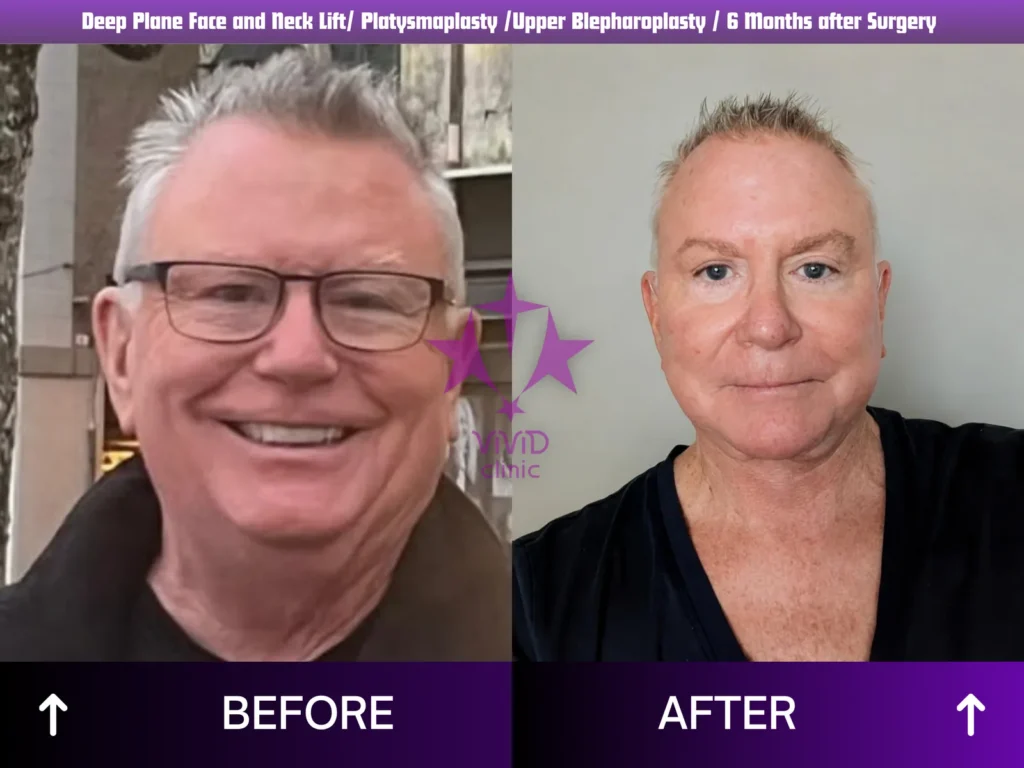
Results vary from person to person. These photos show individual outcomes and are not a guarantee of results; your surgeon will explain what is realistic for you during your free consultation.
What should I look for in deep plane facelift before and after photos?
Look for matched lighting, angle, expression and distance between the before and after shots, and check whether any other procedures were combined with the facelift, since those will also affect what you’re seeing. As shown in Case M and Case F, real clinical photos often have some mismatch — noting it honestly is more useful than pretending it isn’t there.
Can deep plane facelift before and after photos show the effect of surgery alone?
Only when the facelift was performed as a standalone procedure, with no other surgery combined. In both Case M and Case F, the facelift was combined with additional procedures — platysmaplasty and blepharoplasty in one case, midface lift and revision rhinoplasty in the other — so the visible change reflects all procedures performed together, not the facelift in isolation.
Are six- and nine-month deep plane facelift results directly comparable?
Only when they’re from the same patient with a consistent photography setup. Case M (six months) and Case F (nine months) are two different patients with different procedure combinations, so their results shouldn’t be compared as if tracking one person’s healing over time.
How do face and neck lift results differ from eyelid or nose surgery changes?
A face and neck lift primarily affects jawline definition, jowling and neck contour by repositioning deeper tissue layers. Eyelid surgery (blepharoplasty) changes the upper or lower eyelid area specifically, and rhinoplasty reshapes the nose. When procedures are combined, as in both documented cases here, changes in a single before-and-after photo reflect all of them together, which is why we disclose each case’s full combination rather than attributing visible change to any one procedure.
How can I assess whether these results are relevant to my own anatomy?
The most reliable way is a one-on-one consultation where a surgeon evaluates your specific skin quality, bone structure, degree of laxity and goals, since Case M and Case F’s outcomes reflect their own individual anatomy and procedure combinations, not a universal result. You can also review our full before-and-after gallery alongside the Aesthetic Society’s neck-lift case photos for a broader range of documented outcomes before your consultation.
Reading deep plane facelift before and after photos well means looking past the images themselves — to the procedures combined, the photo conditions, and the individual anatomy behind each case. Case M and Case F offer a transparent look at two real, differently combined outcomes, limitations included. If you’d like to discuss what’s realistic for your own face and goals, get a free consultation with the Vivid Clinic team in Istanbul, Turkey today.