
 ChatGPT
Quick answer: Hip dips are the inward curves on the outer hip and upper thigh. They are a normal variation in body shape, not a defect, and their appearance is shaped by bone structure, muscle and fat distribution. Vivid Clinic in Istanbul, Turkey, offers a free consultation to discuss your hip dips.
Editorially reviewed by the Vivid Clinic Surgical Board. Last updated: October 2026.
Hip Dips: What They Are and Where They Appear
Hip dips are the soft indentations that can appear on the outer side of the hip, usually just below the top of the hip bone and above the upper thigh. People often describe them as a dip between the hip and the thigh when viewed from the side or from behind. They are a visible feature of body shape, and they can look more or less pronounced depending on posture, clothing, lighting and the angle of a photo.
It helps to start with the term itself. Hip dips are not a diagnosis, a condition or a sign of a health problem. They describe a contour. Because people differ in bone structure, muscle tone and the way fat is distributed, the same body can look different from one angle to another.
Normal Pelvic Anatomy and the Outer Hip Contour
The outer hip is shaped by the bony structure of the pelvis and upper thigh bone, the muscles that cross the hip, the fat layer beneath the skin, and the skin itself. The bony ridge at the top of the hip and the position of the upper thigh bone influence how the outer contour rises and falls. When the bone sits in a particular way, the soft tissue above and below it can create a visible curve even when body weight is stable.
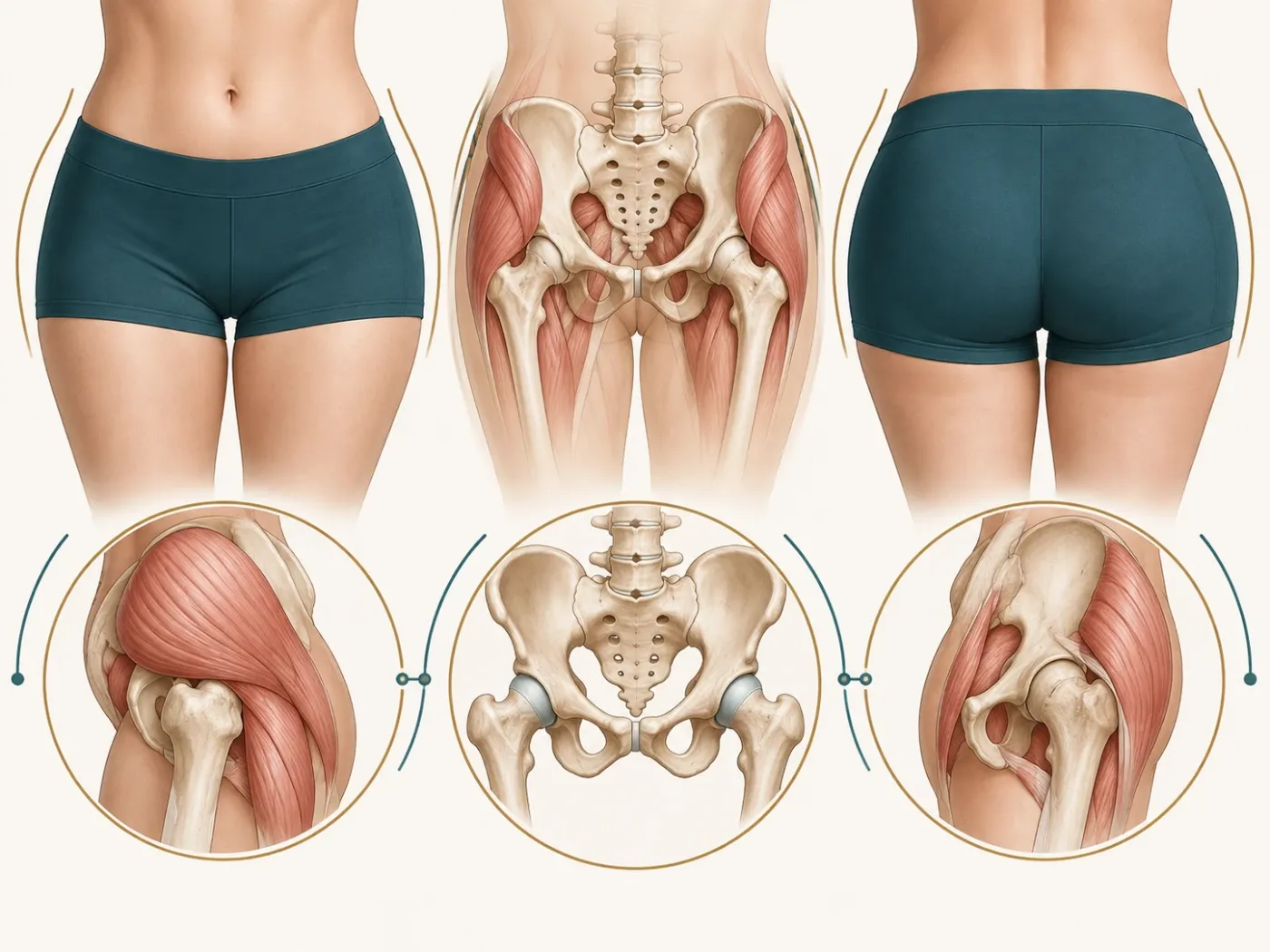
Muscle matters too. The muscles on the outside of the hip and buttock change the outline of the area when they are relaxed or contracted. Fat and skin then sit over this framework. Because these layers vary between people, two people of similar weight can have very different hip contours.
Why Hip Dips Appear Across Body Sizes
Hip dips are seen in people of many body sizes. A slim person may notice them because there is little soft tissue to smooth the transition between hip and thigh. A person with more soft tissue may notice them because fat is distributed in a way that does not fill the curve. Neither situation is a sign that something has gone wrong.
Pregnancy, age and hormonal changes can also affect how body contours look over time, because fat distribution and skin elasticity change. Those are general life changes rather than causes that a person can diagnose from a mirror.
What Exercise Can and Cannot Change
Exercise can strengthen and shape the muscles around the hip and buttock, and it supports overall fitness. That can change how the outer hip looks at the margins, especially when muscle tone improves. It cannot change the underlying bone structure, and it cannot selectively remove fat from one small area. Spot reduction is not a reliable way to change one contour.
Expectations matter. A person who exercises may still see hip dips, and that is an accurate outcome rather than a failure. Regular activity is a sensible general health habit and a reasonable first step for anyone who wants to build strength, but it does not guarantee a particular silhouette.
Weight Changes and the Hip Contour
Weight changes can alter the way fat sits across the hips and thighs, so some people notice hip dips become more or less visible as their weight changes. Weight loss does not always remove the contour, because the bone and muscle structure beneath the skin stays the same. Sustainable change depends on health, nutrition and personal goals, and it is best discussed with a qualified clinician.
Leaving Hip Dips Alone Versus Seeking Treatment
Many people choose to leave hip dips as they are. Normal variation is a valid body shape, and treatment is always optional. Choosing not to act is a complete and reasonable decision.
Some people do consider a treatment option, usually after they have explored the anatomy and understood what different procedures can and cannot change. The value of a consultation is that it separates the choice from pressure. You can learn your options, hear the limitations, and decide without any obligation.
Fat Transfer and Fillers: Limits and Suitability
Fat transfer uses a person’s own fat, removed from one area of the body and re-injected into another. The American Society of Plastic Surgeons lists the buttocks among the common areas for fat transfer, and notes that the area has many blood vessels, so it recommends a board-certified plastic surgeon with fat grafting experience. The same guidance points to fat survival being uncertain, which makes the final result hard to predict.
Hip dip treatment is not a standard procedure with one predictable result. Hip, thigh and buttock areas differ in suitability, and fat survival depends on technique and aftercare. Fillers are another option some clinicians discuss, but availability and suitability vary, and they are not a guaranteed solution. Vivid Clinic confirms which options apply to you during consultation. For buttock-focused volume planning, see our guide to a Brazilian butt lift.
Hip Dips: Candidacy and Reasons to Defer Treatment
A person who may be a candidate for a treatment usually has realistic expectations, stable health, and a clear goal. Reasons to defer include recent weight changes, pregnancy or breastfeeding plans, smoking, active medical conditions, and a feeling that the decision is being made under pressure. These are general considerations, and each one is assessed individually.
Hip Dip Correction Overview: Realistic Expectations
Optional overview of relevant treatments, not a recovery table for a natural feature.
| Aspect | Details |
|---|---|
| Duration Process | Set at consultation for each option. Normal anatomy has no procedure duration. |
| Hospitalization Duration | Fat transfer is generally an outpatient procedure, so you go home the same day (Cleveland Clinic). |
| Mobility Duration | Walking and movement limits are set by your surgeon after assessment; no fixed figure is applied here. |
| Return to Activity | Some people return to work and regular activities after a week, while others need two weeks or more (Cleveland Clinic, fat transfer). |
| Complete Recovery | Swelling can take up to several weeks to subside, and final results take about six months (Cleveland Clinic, fat transfer). |
| Anticipated Results | Fat survival varies by technique and aftercare, so results are individual and not guaranteed (ASPS). |
How to Prepare for a Hip Dip Correction Consultation
Preparation starts with a complete medical history, a list of medications and supplements, and an honest discussion of your goals. The surgeon will examine the area, ask about past surgery and discuss whether your expectations match what is possible. No one should self-diagnose or attempt unsupervised treatment, and no product or exercise should replace a clinical assessment.
Hip Dip Correction Recovery and When to Judge Results
Recovery depends on the option chosen. Early effects include swelling and tenderness, which can take several weeks to settle. Your clinician will explain activity limits, travel clearance, and when results can be assessed. Follow the aftercare plan you agree with your team.
Hip Dip Correction Risks, Limitations and Medical Red Flags
Fat transfer carries recognized risks. According to Cleveland Clinic, these include bleeding, fat entering a vein and traveling to the lung, fluid collecting under the skin, most fat cells not surviving, significant scarring, and results that do not meet expectations. These are reasons to take surgery seriously and to choose a qualified surgeon. Seek urgent medical care if you develop chest pain, shortness of breath, fever, or unusual swelling or redness after any procedure.
What Affects the Cost of Hip Dip Correction in Istanbul
Cost depends on the surgeon, facility, anesthesia, complexity, combinations of procedures, travel and aftercare. This article does not give a fixed figure, and any quote should be individual and written. Compare what is included, such as consultation, follow-up visits and aftercare, rather than the headline number alone.
Hip Dip Correction in Istanbul: Your Patient Journey at Vivid Clinic
For people who choose to explore a consultation, the journey at Vivid Clinic in Istanbul, Turkey may begin with arrival in Istanbul and a VIP airport transfer, where the package includes one. Where eligibility is confirmed at consultation, a five-star hotel check-in follows. The one-on-one consultation with your surgeon comes first, followed by the treatment or surgery day if you decide to proceed. Post-operative care and a check-up visit come next, then departure, with remote aftercare arranged with your team. Transfer and hotel benefits apply only to select procedures, and eligibility is confirmed at consultation.
Choosing a Qualified Surgeon for Hip Dip Correction
A consultation is the place to ask about training, experience and the facility. You can review the clinicians on the Vivid Clinic medical team page, and you should check credentials through official registries in your country. Vivid Clinic invites you to a free consultation with a plastic surgeon to discuss your hip dips and whether any option fits your goals.
Five Frequently Asked Questions About Hip Dips
Are hip dips normal at any body size?
Yes. Hip dips are a normal variation in body shape and appear in people of many sizes. Their visibility depends on bone structure, muscle tone, fat distribution and skin, so a slim person and a person with more soft tissue can both notice them. Normal variation is not a defect, and no body size makes hip dips a medical problem. If you are unsure whether a concern is about appearance or function, a clinician can help you decide. Treatment is always optional, and deciding to leave hip dips alone is a complete and reasonable choice. A consultation can explain how hip dips relate to your own anatomy.
Can exercise get rid of hip dips?
Exercise can change how the muscles around the hip and buttock look, and it supports overall fitness. It cannot change the underlying bone structure, and it cannot remove fat from one small area on command. Hip dips may remain visible after training, and that is an accurate outcome rather than a failure. For many people, regular activity is a sensible habit for health, and it can make the outer hip look firmer at the edges. Anyone wanting to change hip dips with a specific goal should discuss expectations with a clinician, because exercise alone does not guarantee a particular contour.
Does weight loss change hip dips?
Weight changes can alter how fat sits across the hips and thighs, so hip dips can look different as body weight changes. Weight loss does not always remove them, because the bone and muscle structure beneath the skin stays the same. Some people notice little change, while others see a shift in contour. Sustainable weight management depends on health, nutrition and personal goals, and it is best planned with a qualified clinician. If you are considering treatment, a consultation can help you decide whether to wait, focus on general health or explore options, since the picture can change with weight.
Can fat transfer reduce hip dips, and what are its limits?
Fat transfer may be discussed for some people who want more volume in a contour area, but it is not a guaranteed way to reduce hip dips. Fat survival is unpredictable, and the final result depends on technique, aftercare and individual biology. Some transferred fat cells may not survive, and results can fall short of expectations. Fat transfer carries recognized risks, including bleeding and fluid collection, so it should be performed only by a qualified surgeon with relevant experience. Whether this approach suits your hip dips is decided at consultation, after your anatomy and goals are assessed.
When is a consultation about hip dips useful?
A consultation about hip dips is useful when you want to understand your anatomy, learn what different options can and cannot change, or review risks and recovery before deciding. It is also useful if hip dips affect your confidence or clothing choices and you want an informed view. A consultation is not a commitment to treatment. At Vivid Clinic in Istanbul, a free consultation with a plastic surgeon lets you ask questions, share your medical history and discuss realistic goals. Any decision should be made calmly, without pressure.
Sources and Further Reading on Hip Dips
- Cleveland Clinic: Fat Transfer
- American Society of Plastic Surgeons: Six of the Most Common Areas for Fat Transfers
Deciding What to Do About Your Hip Dips
Hip dips are a normal feature of body shape, and the decision about whether to do anything about them belongs to you. This article is educational and does not replace individual medical advice. Medical claims depend on the procedure, your anatomy and your health, and they should be confirmed by a qualified clinician.
If you want to explore your options, Vivid Clinic invites you to a free consultation with a plastic surgeon in Istanbul, Turkey. You can ask about hip dips, fat transfer, cost factors and aftercare, and you can leave without any obligation. Get a Free Consultation.