
 ChatGPT
Quick answer: A dorsal hump is a bump on the bridge of the nose. For a dorsal hump non-surgical nose job vs rhinoplasty decision, filler adds volume while rhinoplasty can reshape the bone and cartilage that create the bump. At Vivid Clinic in Istanbul, Turkey, a free consultation with a plastic surgeon can clarify your options.
Editorially reviewed by the Vivid Clinic Surgical Board. Last updated: October 2026.
What Is a Dorsal Hump, and Why Do Patients Compare Options?
A dorsal hump is a raised area along the bridge of the nose, where the upper part of the nose looks more prominent than the rest of the profile. Many people have a bridge that is naturally more pronounced, and that is normal variation. Nothing about your nose needs correcting simply because it differs from an image you have seen online. Any treatment is optional.
People who notice a bump often search for a quick fix, which is why they look up the phrase dorsal hump non-surgical nose job vs rhinoplasty when they start comparing options. The two approaches are not interchangeable. One adds material to the nose, while the other changes its underlying structure, and understanding that difference is the first step. For a broader vocabulary, our guide to nose shapes explains the common terms.
Removal versus camouflage: the core distinction
A dorsal hump is a structural feature, so removing it means changing the bone and cartilage that form the bridge. Rhinoplasty is the surgical method for that purpose. The American Society of Plastic Surgeons (ASPS) lists visible humps or depressions on the bridge among the concerns rhinoplasty can address.
A non-surgical approach works differently. Camouflage uses dermal filler to add volume, which may soften the look of a depression or balance the surrounding contour. Filler does not remove bone or cartilage, so it cannot make a true bump disappear. It changes the shape around the bump rather than the bump itself.
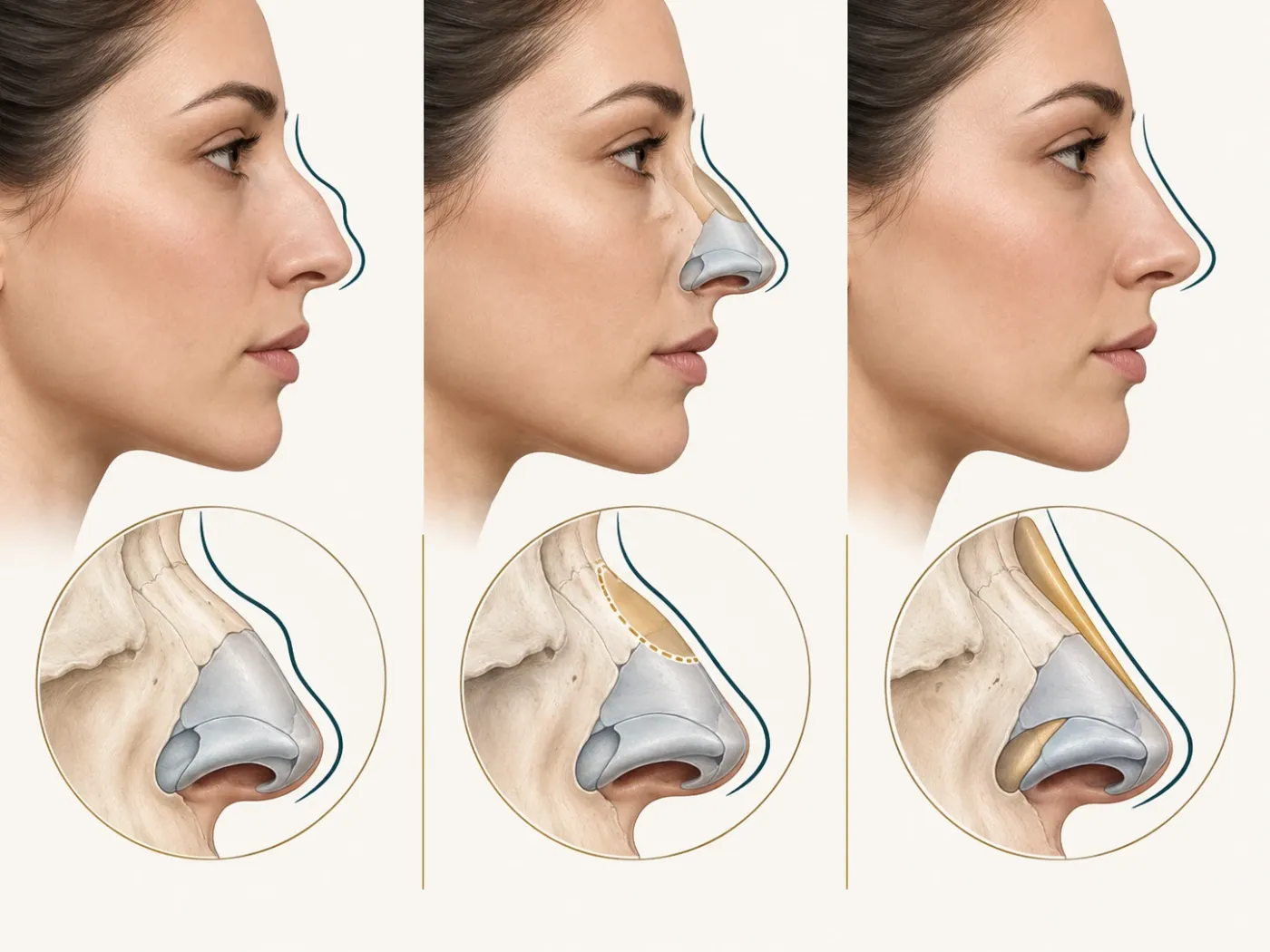
Why adding filler may make the nose larger
Filler adds volume, and that volume has to go somewhere. Placed on or beside the bridge, it can increase projection or width in certain views. That is why a dorsal hump non-surgical nose job vs rhinoplasty comparison should not stop at the bump itself, because the change you are trying to create may look fuller rather than smaller.
The effect is easiest to see in profile. Adding projection at the top of the nose can alter the relationship between the bridge, the tip and the lower face. A change that looks subtle from the front may be more noticeable from the side, which is why photographs from several angles matter during planning.
For this reason, a consultation should begin with proportions. Your surgeon will look at your side profile, nasal tip, nostrils and facial balance before discussing any filler option. If filler is not suitable for your nose, the honest answer may be rhinoplasty, or no treatment at all.
When rhinoplasty can reduce a bridge hump
Rhinoplasty reshapes the nose through surgery. According to ASPS, it can enhance facial harmony and the proportions of the nose, and it can address concerns such as nasal width, tip shape and nostril position. Reducing a bridge hump is one of the goals a surgeon can consider during planning. Our rhinoplasty service page describes how that planning works in practice.
The surgeon decides what to reshape and how much, based on your anatomy and goals. ASPS notes that results may not be completely symmetric, which is one reason realistic planning matters more than any single image. A sample photo can show a technique, but it cannot promise your outcome.
Compare durability, recovery and function
Durability is the first major difference. Dermal filler is temporary. ASPS describes fillers as temporary treatments and notes that ongoing treatments will be needed for long-term results. Rhinoplasty changes the structure of the nose rather than adding a product, although the final shape still depends on healing.
Recovery also differs. Filler is given as an office injection, and the sources reviewed for this article do not specify a downtime window for it, so ask your clinician what to expect. Rhinoplasty is surgery. ASPS notes that initial swelling subsides within a few weeks, that swelling may come and go during the first year, and that the new nasal contour may take up to a year to fully refine.
Function is the third area. ASPS states that rhinoplasty can correct impaired breathing caused by structural defects in the nose. Filler does not address those structural causes, so it should never be chosen to solve a breathing concern.
Nasal filler safety and candidate limitations
Dermal filler safety depends on the product, the injection technique, the area treated and the experience of the clinician. ASPS states that severe complications from dermal fillers are uncommon, but that significant complications can occur, which is why it advises patients to be in the care of a board certified plastic surgeon.
The nose carries specific risks. A 2020 review in Plastic and Aesthetic Research lists the nasal dorsum among high-risk zones for vascular complications because of its large vessels. The authors describe how filler entering a blood vessel can block blood flow, and they note that the nasal arteries connect to vessels supplying the eye, so injection there carries a risk of blindness.
Candidate limits follow from these risks. Your medical history, current medications, previous facial procedures and expectations all shape whether filler is appropriate, and only a clinician can weigh them. This article cannot determine candidacy for you.
Dorsal hump non-surgical nose job vs rhinoplasty: candidacy and reasons to defer treatment
Candidacy depends on the structure of your nose, the reason you want a change, and your overall health. Someone seeking a visible reduction of a bump is usually discussing surgical options, while someone seeking a softer contour may ask about filler. Neither route suits everyone, and some people are better served by waiting.
Reasons to defer treatment include uncertainty about your goals, a recent change in health, or simply needing more time to decide. A responsible consultation does not pressure a decision. If your clinician recommends waiting, treat that advice as part of good care rather than a missed opportunity.
Dorsal Hump Correction Overview: Realistic Expectations
The table below summarizes the timing language in the sources reviewed for this article.
Optional overview of relevant treatments, not a recovery table for a natural feature.
| Aspect | Details |
|---|---|
| Duration Process | Rhinoplasty: a surgical procedure, with timing set by the surgeon’s plan (no range given in the verified sources). Filler: an office injection, with timing set by the treatment plan. |
| Hospitalization Duration | Rhinoplasty: admission needs depend on the anesthesia plan and the surgeon’s assessment. Filler: given as an office injection; any need for further care is assessed by the clinician. |
| Mobility Duration | Rhinoplasty: ASPS directs patients to ask their surgeon about activity limits, and no universal period is given. Filler: no separate mobility restriction is specified in the verified sources. |
| Return to Activity | Rhinoplasty: ASPS lists “When can I resume normal activity and exercise?” as a question for the surgeon, so no universal date applies. Filler: no downtime window is specified in the verified sources. |
| Complete Recovery | Rhinoplasty: initial swelling “subsides within a few weeks,” and the nasal contour “may take up to a year” to fully refine (ASPS). Filler: effects are temporary, and “ongoing treatments will be needed for long-term results” (ASPS). |
| Anticipated Results | Rhinoplasty: the final shape is judged after the refining period, which ASPS describes as up to a year. Filler: “Most fillers do dissipate over time” (ASPS), so results depend on the product and on individual response. |
The gaps matter. The verified sources do not give fixed durations for the procedure, hospital admission or return to work, because these depend on the plan and on your health. Ask your surgeon for individual timing rather than relying on figures from general articles.
How to Prepare for a Dorsal Hump Correction Consultation
Preparation starts with an honest medical history. Share your current medications, supplements, allergies, previous facial procedures and any breathing concerns. Your clinician needs this information before discussing a dorsal hump non-surgical nose job vs rhinoplasty plan.
Bring your functional concerns and realistic goals. If you have trouble breathing through your nose, mention it at the start, because breathing is a structural question rather than an appearance one. Do not self-diagnose or try injections or supplements on your own, since unsupervised treatment carries its own risks.
At Vivid Clinic in Istanbul, Turkey, the consultation is a one-on-one assessment with the medical team, and you can request a free consultation with a plastic surgeon before deciding anything. This gives you time to ask about options, risks and the cost factors discussed below.
Dorsal Hump Correction Recovery and When to Judge Results
Early effects are not the final result. Swelling is expected after surgery, and ASPS notes that initial swelling subsides within a few weeks. Swelling can also fluctuate during the first year, so judging the shape too early can be misleading.
Activity, exercise and travel timing are individual. ASPS directs patients to ask their surgeon when they can resume normal activity and exercise, so follow the written aftercare plan from your treating clinician rather than a general timeline.
After filler, any unusual pain, skin color change or visual disturbance requires immediate medical attention, whatever the time since the injection.
Dorsal Hump Correction Risks, Limitations and Medical Red Flags
Rhinoplasty is surgery, and it should not be described as simple or risk free. ASPS lists anesthesia risks, changes in skin sensation, difficulty breathing, the possibility of revisional surgery, infection, poor wound healing or scarring, skin discoloration and swelling, and an unsatisfactory nasal appearance. ASPS describes nasal septal perforation as rare.
Filler carries its own risks. Vascular occlusion, skin loss and, rarely, blindness are the serious complications to discuss. Because these events can be serious, sudden pain, pallor or vision changes after an injection call for emergency care, not a wait-and-see approach.
Medical assessment should come first if you have difficulty breathing, a history of complications from earlier treatments, or any skin condition in the treatment area. These are reasons to speak with a clinician before considering any option, and this article cannot assess them for you.
What Affects the Cost of Dorsal Hump Correction in Istanbul
Cost depends on the surgeon’s experience, the facility, the anesthesia, the complexity of the plan, whether other features are combined, travel and accommodation, and aftercare. No fixed price is given in this article, because individual plans differ.
When comparing quotes, compare like with like: the same procedure or product, the same follow-up and the same inclusions. For filler, ask how many sessions may be needed over time, since repeat treatment adds to the total. For rhinoplasty, ask what the quote covers and what it excludes.
Dorsal Hump Correction in Istanbul: Your Patient Journey at Vivid Clinic
Your journey with Vivid Clinic begins when you arrive in Istanbul, Turkey. Where your package includes it, a VIP airport transfer takes you to a five-star hotel for check-in, though eligibility for transfer and hotel benefits is confirmed at consultation because they apply to select procedures only. Your one-on-one consultation with the medical team follows, where your anatomy, medical history and goals are reviewed. If you go ahead, the surgery or treatment day is planned in advance, with post-operative care, a check-up visit before departure and remote aftercare follow-up once you are home. Every step is confirmed individually for your plan.
Choosing a Qualified Surgeon for Dorsal Hump Correction
A consultation is where filler and surgery are weighed against your anatomy. At Vivid Clinic in Istanbul, Turkey, you can request a free consultation with a plastic surgeon to discuss your nose and the options that fit your goals. Our medical team page introduces the clinicians, and you should also verify any surgeon’s credentials through their board certification before you decide.
Ask your clinician about their training with the specific treatment you are considering, and request your plan in writing.
Frequently Asked Questions About Non-Surgical Nose Job vs Rhinoplasty
Why does liquid rhinoplasty add volume rather than remove a hump?
Liquid rhinoplasty uses dermal filler to add volume, which can soften the look of a depression or change the surrounding contour. It does not remove bone or cartilage, so it cannot reduce a true bump. That is the central difference in any dorsal hump non-surgical nose job vs rhinoplasty comparison: filler adds material, while rhinoplasty reshapes the existing structure. Because most fillers dissipate over time, according to ASPS, repeat treatment may be needed to maintain the effect. Whether any filler approach is suitable for your nose is decided at a consultation with a plastic surgeon, not from an article.
Can filler make the overall nose look larger?
Yes, filler can make parts of the nose look fuller. Because it adds volume, it may increase projection or width from certain angles, which is why a dorsal hump non-surgical nose job vs rhinoplasty decision should consider the whole profile. A clinician will assess these proportions before discussing any filler option. If filler is not suitable, rhinoplasty remains the option designed to reshape the bridge, and sometimes the best answer is to wait. Vivid Clinic in Istanbul, Turkey, offers a free consultation with a plastic surgeon to review your profile in person.
Can a non-surgical nose job correct obstruction?
No. A non-surgical nose job does not treat breathing problems. ASPS states that rhinoplasty can correct impaired breathing caused by structural defects in the nose, which is a surgical goal that filler does not achieve. If you have difficulty breathing through your nose, that concern should be assessed by a clinician before you consider any appearance-focused option. In a dorsal hump non-surgical nose job vs rhinoplasty discussion, breathing is a functional question, not a cosmetic one.
What serious nasal filler risks should I discuss?
The most serious risks to discuss are vascular occlusion, where filler enters a blood vessel and blocks blood flow, along with skin loss and, rarely, blindness. A 2020 review in Plastic and Aesthetic Research lists the nasal dorsum among high-risk zones because of its large vessels. Before considering a dorsal hump non-surgical nose job vs rhinoplasty option involving filler, ask any clinician about their experience with nasal injections, their technique and their emergency plan. ASPS notes that severe complications are uncommon, but that does not make them minor.
How do longevity, recovery and repeat costs compare with rhinoplasty?
Filler is temporary. ASPS notes that ongoing treatments are needed for long-term results, so repeat sessions can add up over time. Rhinoplasty is surgery with its own recovery, where swelling typically subsides within a few weeks and the final contour may take up to a year to refine. In a dorsal hump non-surgical nose job vs rhinoplasty comparison, the question is not only the price of one session but the total cost of maintaining a result. No figures are quoted here, because a clinic will provide an individual estimate based on your plan.
Sources and Further Reading on Non-Surgical Nose Job vs Rhinoplasty
- ASPS: Dermal Fillers Safety
- ASPS: Dermal Fillers
- ASPS: Rhinoplasty
- ASPS: Rhinoplasty Recovery
- ASPS: Rhinoplasty Safety
- Plastic and Aesthetic Research (2020): Complications after cosmetic periocular filler: prevention and management
Related reading: Best rhinoplasty surgeons in Istanbul · Nose job in Turkey
Non-Surgical or Surgical: Making Your Dorsal Hump Decision
Choosing between a dorsal hump non-surgical nose job vs rhinoplasty is a personal decision, and it should rest on your anatomy, health and goals. Filler and surgery each have clear limits, and neither replaces a medical assessment.
This article is for informational purposes only and does not replace a personal medical consultation. Suitability, risks, recovery, and expected results should always be discussed with a qualified medical professional.
If you are considering options in Istanbul, Turkey, Vivid Clinic can help you understand your choices with a personalized plan. Get a Free Consultation with a plastic surgeon and take a considered first step.