
 ChatGPT
Quick answer: A bulbous nose rhinoplasty before and after comparison shows how a surgeon may refine the tip of the nose, but results depend on anatomy, skin, and healing time. At Vivid Clinic in Istanbul, Turkey, the first step is a free consultation with a plastic surgeon, not a promise of a specific result.
Editorially reviewed by the Vivid Clinic Surgical Board. Last updated: October 2026.
Searching for bulbous nose rhinoplasty before and after examples is a natural step when you are weighing a change to the tip of your nose. Photos can be helpful, but they can also mislead. Lighting, camera angle, head position, swelling, and the time since surgery can all change how a nose looks. This guide explains what to look for, what photos can and cannot show, and how to prepare for an honest conversation with a surgeon.
A bulbous tip is a description many people use for a nasal tip that appears rounded or full. Whether that feature bothers someone is a personal matter. Some people feel it affects their profile or the balance of their face, while others are content with their appearance. Nothing in this article suggests that a normal nose needs correction. Treatment is always optional, and the decision belongs to the person who lives with the result.
Why Matched Front, Profile and Base Views Matter
When you compare before and after images, the most useful photos are matched. That means the same camera distance, the same head position, similar lighting, and the same expression across the pictures. A front view shows width and symmetry. A profile view shows projection, meaning how far the tip extends forward from the face. A base view, taken from below, shows nostril shape and the angle between the nose and the upper lip. If one photo is taken from a slightly different angle, the tip can look larger or smaller than it really is.
The American Society of Plastic Surgeons describes rhinoplasty as a way to reshape the nose to improve facial harmony and proportion. Its listed treatment targets include tip shape, nostril size or position, and asymmetry. Those targets can only be judged properly in photographs that were taken consistently. Ask the clinic whether its images follow a standard photographic approach and whether the patient agreed to their use.
A practical example helps. Imagine two photos of the same person, one taken with the head tilted upward and the camera close, and one taken straight on from a standard distance. The tip can look shorter in the first and more balanced in the second, even though the nose has not changed.
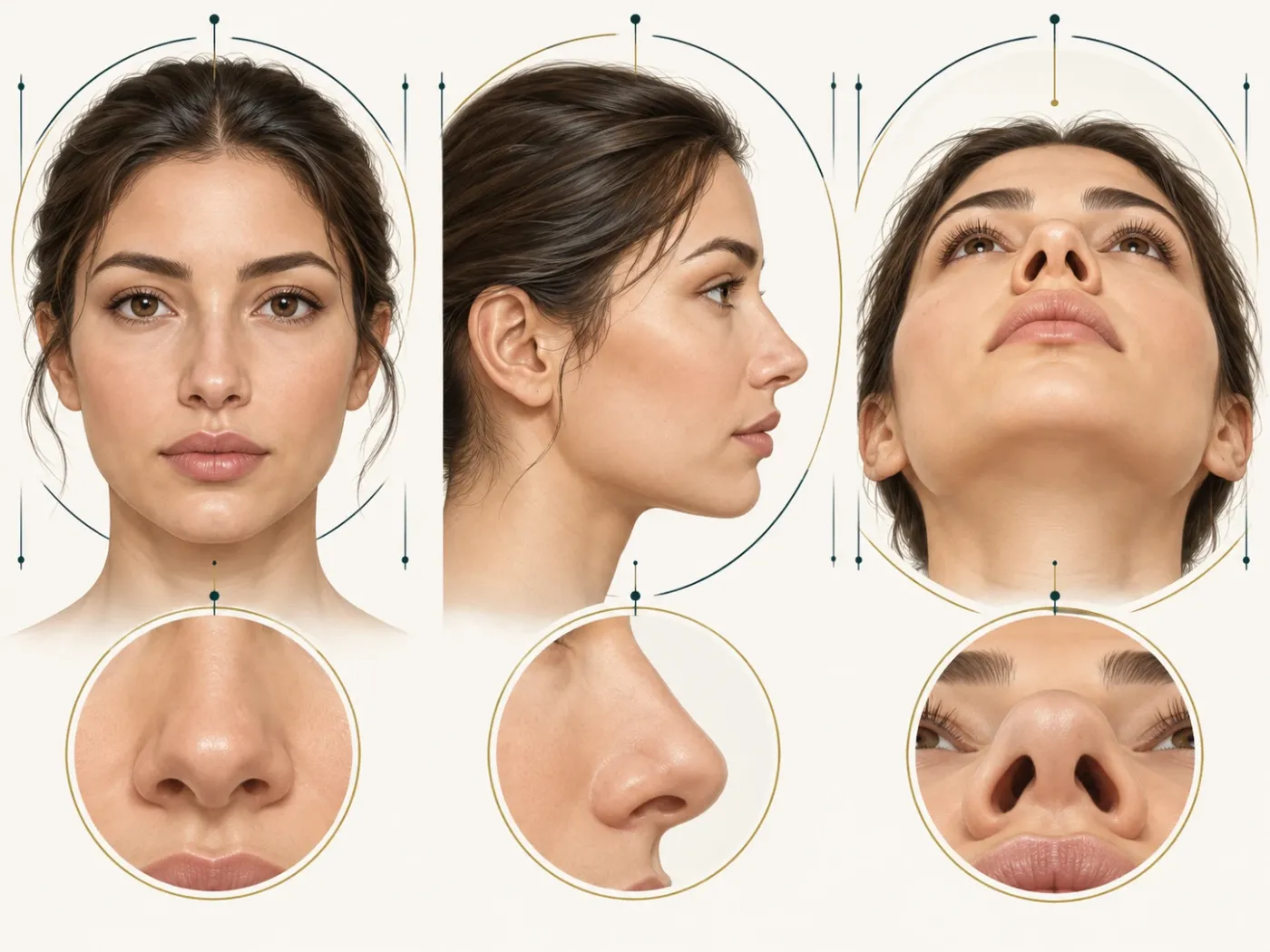
What Tip Width and Projection Comparisons Show
Tip width and projection are the two measurements people most often try to judge from photos. Width is the lateral spread of the tip between the nostrils. Projection is how far the tip sits in front of the face in profile. Both are shaped by cartilage structure, soft tissue, and the position of the nostrils, so two noses that look similar at first glance may differ in ways that only a clinical examination reveals.
The ASPS notes that the goal of rhinoplasty is facial balance and correct proportion. Everyone’s face is asymmetric to some degree, and results may not be completely symmetric. That point matters when you compare yourself with a gallery. The aim is a nose that suits your face, not a copy of someone else’s features.
When you review comparisons, look for clear notes about what was changed and which views were used. Be cautious with claims that describe a result as dramatically narrower or more projected without matched images to support them. If a comparison is hard to interpret, that is a reason to ask questions rather than to draw conclusions.
Swelling Versus Lasting Contour Change
One of the most common reasons people misread a rhinoplasty result is timing. Early on, swelling can hide the shape the surgeon intended. The ASPS states that initial swelling subsides within a few weeks, but that it may take up to a year for the new nasal contour to fully refine. Swelling may also come and go, and it can be more noticeable in the morning during the first year.
That means a photo taken in the first weeks is an early snapshot, not a final picture. When a gallery shows images from different time points, ask what each interval represents. A result shown at two weeks, three months, and one year tells a very different story from a single image labeled as the final outcome. Good clinics show timing clearly and avoid describing early appearance as final.
Thick Skin, Asymmetry and Revision Limits
Skin quality is one of the factors surgeons consider when they discuss how a refined tip may look. Because it varies from person to person, that discussion belongs in a consultation rather than in a general guide. Ask your surgeon how skin quality will be assessed and how that assessment affects the technique they recommend.
Asymmetry deserves the same honesty. The ASPS notes that results may not be completely symmetric. A good surgeon will explain which asymmetries are typical and which, if any, they would aim to address. Be wary of any promise that eliminates asymmetry entirely, because that promise does not reflect how faces are built.
Revision surgery is also part of the conversation. The ASPS lists the possibility of revisional surgery among the risks of rhinoplasty. Ask how the clinic approaches a second procedure and whether any additional cost would apply.
Questions to Ask When Viewing a Clinic Gallery
Galleries are useful when they are transparent. Check the date or time since surgery for each photo, whether the images are standardized, and whether the patient agreed to share them. Vivid Clinic’s before-and-after gallery explains how to evaluate these images, and the same checklist applies to any clinic you consider.
- Were the front, profile, and base views taken with the same distance, lighting, and head position?
- How many weeks or months after surgery was each photo taken?
- Does the clinic show results for the same type of nose and the same technique you are considering?
- Were the photos cropped, retouched, or edited in any way?
- Does the gallery note its limitations, such as swelling or the need for later review?
- What experience does the operating surgeon have with tip refinement?
Bulbous Nose Rhinoplasty Before and After: Candidacy and Reasons to Defer Treatment
Candidacy is a medical judgment, not a visual one. A surgeon assesses your overall health, nasal structure, breathing, goals, and expectations before deciding whether surgery is appropriate. The ASPS notes that rhinoplasty can also address impaired breathing caused by structural defects in the nose. For that reason, the assessment includes a functional review as well as an aesthetic one. If breathing is a concern, raise it openly, because it can change the plan. You can read more about the approach on the clinic’s rhinoplasty page.
There are good reasons to defer treatment. You may be recovering from an illness, managing a medical condition that affects healing, or simply unsure what you want to change. Deferring is a valid choice. A surgeon who encourages you to wait while you think is usually acting in your interest. If your main reason for considering surgery is pressure from someone else, take more time before deciding.
Bulbous Nose Rhinoplasty Overview: Realistic Expectations
Optional overview of relevant treatments, not a recovery table for a natural feature.
| Aspect | Details |
|---|---|
| Duration Process | Set individually by your surgeon, based on the technique planned and any combined procedures. Ask for the expected duration of your specific plan at consultation. |
| Hospitalization Duration | Depends on the technique, the facility, and your overall health. Your surgeon confirms whether an overnight stay is needed. |
| Mobility Duration | Walking and early activity limits are set individually by your surgeon after the procedure. |
| Return to Activity | Desk work, exercise, and travel are cleared separately. The ASPS lists “When can I resume normal activity and exercise?” as a question to ask your surgeon (ASPS rhinoplasty recovery). |
| Complete Recovery | Early swelling subsides within a few weeks, but the nose may take up to a year to fully refine (ASPS rhinoplasty recovery). |
| Anticipated Results | Judge the shape only after the nose has settled. The ASPS states that rhinoplasty results are long-lasting, with gradual natural changes as the face ages (ASPS rhinoplasty results). |
How to Prepare for a Bulbous Nose Rhinoplasty Consultation
Preparation begins with honesty about your medical history. Tell your surgeon about any prior nasal surgery, breathing problems, allergies, medications, supplements, and habits that may affect healing. Share the full list of medicines you take, including over-the-counter products. Your surgeon uses this information to decide whether surgery is appropriate and how it should be planned.
At Vivid Clinic in Istanbul, Turkey, the consultation is designed to be a free consultation with a plastic surgeon, where you can discuss your concerns before any decision is made. Bring your photographs, a short list of what you would like to change, and a list of what you would like to keep. A good assessment includes the nose from several angles, a conversation about breathing, and a clear explanation of what is realistic.
Bulbous Nose Rhinoplasty Recovery and When to Judge Results
Recovery has two parts: the early effects that everyone notices, and the slower settling that follows. As the ASPS guidance describes, initial swelling subsides within a few weeks, and the nose may keep refining for up to a year.
Aftercare is individualized. Your surgeon will explain how to care for the nose, when to return for check-ups, and when you can resume exercise and daily routines.
Bulbous Nose Rhinoplasty Risks, Limitations and Medical Red Flags
Rhinoplasty is surgery, and it carries risks that should be discussed before any decision is made. The ASPS lists anesthesia risks, changes in skin sensation, difficulty breathing, infection, poor wound healing or scarring, skin discoloration and swelling, and an unsatisfactory nasal appearance. It also lists the possibility of revisional surgery. Describing these risks is not a reason to avoid a consultation. It is a reason to ask thorough questions.
Nasal septal perforation, a hole in the nasal septum, is listed by the ASPS as rare. The same guidance notes that additional surgery may be needed to address it, and that it may be impossible to correct this complication. Your surgeon should explain how they assess this risk in your case.
Seek medical assessment promptly for any new or worsening symptom after surgery, rather than waiting for your next scheduled visit.
What Affects the Cost of Bulbous Nose Rhinoplasty in Istanbul
Cost depends on several factors, and no fixed price applies to every patient. The surgeon’s experience, the facility, anesthesia, the complexity of the plan, and whether other procedures are combined all influence the total. Travel, accommodation, follow-up visits, and personal needs during recovery can also matter when you plan treatment abroad.
Quotes are individual. Ask for a written estimate that lists what is included, what is excluded, and what would change the total if your plan changes during consultation. Compare like with like. Two offers can look very different if one includes the surgeon, facility, anesthesia, and aftercare, while the other does not.
Bulbous Nose Rhinoplasty in Istanbul: Your Patient Journey at Vivid Clinic
If you choose to explore treatment with Vivid Clinic, your journey may begin when you arrive in Istanbul. Where the package includes it, a VIP airport transfer can take you to a five-star hotel check-in, and eligibility for these travel and hotel benefits is confirmed at consultation because they apply only to select procedures. A one-on-one consultation follows, where your surgeon reviews your history, photographs, goals, and the options that fit your face. If you go ahead, the surgery or treatment day is planned around your comfort and safety, and postoperative care follows with a check-up visit before your departure. After you return home, remote aftercare can continue the follow-up process. This journey is described for planning purposes only, and it is optional at every stage.
Choosing a Qualified Surgeon for Bulbous Nose Rhinoplasty
A consultation with a plastic surgeon is the moment to ask detailed questions and receive individual answers. Vivid Clinic’s medical team page explains that every treatment plan is reviewed by the clinic’s surgical board, and that patients meet their doctor in person before any procedure. Use that information as a starting point, then verify the credentials of any surgeon you consider through the appropriate professional board and their published training.
Frequently Asked Questions About Bulbous Nose Rhinoplasty Before and After
Which photo views best show nasal tip width and projection?
The most useful views are a front photo for tip width and symmetry, a profile photo for projection, and a base view for nostril shape and the angle between the nose and the upper lip. All three should be taken with the same camera distance, lighting, and head position. When you review a bulbous nose rhinoplasty before and after set, check that each pair of images matches before comparing them. Mismatched angles can make the tip look larger, smaller, or differently shaped than it really is. If a clinic does not provide matched views, ask for them during your consultation.
Why can early swelling obscure a rhinoplasty result?
Swelling is a normal part of healing, and it can hide the shape the surgeon intended. The ASPS notes that initial swelling subsides within a few weeks, but that the new nasal contour may take up to a year to fully refine. Swelling can also come and go and may be more noticeable in the morning during the first year. For that reason, a photo taken early is not a final image. When you study a bulbous nose rhinoplasty before and after gallery, look for the time since surgery on every picture before you draw any conclusion.
How does skin thickness influence visible definition?
Skin quality is one of the factors surgeons consider when they discuss how a refined tip may look. Because each person’s skin is different, the effect on definition is best discussed during a personal consultation rather than assumed from photographs. When you research bulbous nose rhinoplasty before and after examples, be cautious about comparing your skin with someone else’s, since photos rarely show skin quality clearly. Ask your surgeon how they assess skin in your case and how that assessment shapes the technique they would recommend.
Can a gallery show what my individual result will be?
A gallery can show the kinds of changes that have been achieved for other patients, but it cannot predict your individual result. Your anatomy, healing, goals, and the technique chosen all affect the outcome. Bulbous nose rhinoplasty before and after images are best used to learn what to ask, including how the photos were taken, when they were taken, and what limitations the clinic notes. A surgeon can give you an individual assessment, but no responsible clinic can promise a specific result. Treat any gallery as educational context rather than a promise.
What should a surgeon disclose about technique, timing and combined procedures?
A surgeon should explain the technique they recommend and why it fits your nose, the expected timeline for swelling and settling, and the risks and limitations relevant to your case. They should also say clearly whether any other procedure is suggested alongside the nose, and how that combination would change recovery, cost, and the risks involved. For bulbous nose rhinoplasty before and after planning, ask for this information in writing.
Sources and Further Reading on Bulbous Nose Rhinoplasty
- American Society of Plastic Surgeons: Rhinoplasty
- American Society of Plastic Surgeons: Rhinoplasty Recovery
- American Society of Plastic Surgeons: Rhinoplasty Results
- American Society of Plastic Surgeons: Rhinoplasty Safety
Related reading: Best rhinoplasty surgeons in Istanbul · Nose job in Turkey
Planning Your Bulbous Nose Rhinoplasty Results
Learning about bulbous nose rhinoplasty before and after images is a sensible way to prepare for a conversation with a surgeon. It is not a substitute for a medical evaluation. Vivid Clinic in Istanbul, Turkey, offers a free consultation with a plastic surgeon so that you can ask your own questions, discuss your health, and decide whether treatment is right for you. Treatment is always optional, and there is no obligation to proceed.
This article is for general education only. It does not diagnose any condition or recommend a specific treatment. Outcomes vary between individuals, and all procedures carry risks that must be reviewed with a qualified surgeon.