
 ChatGPT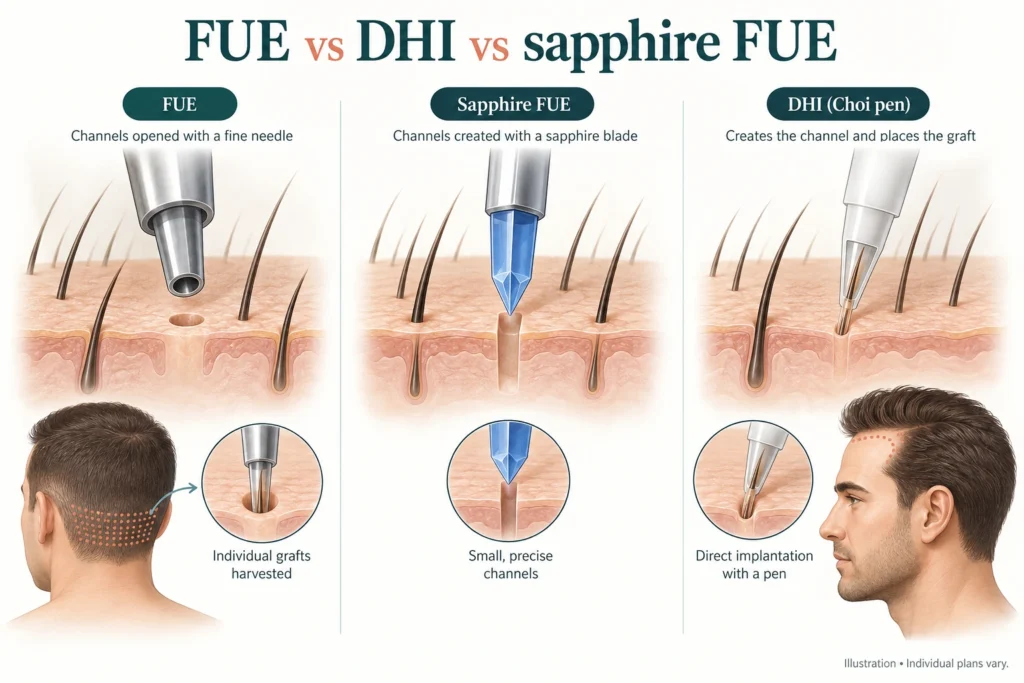
Introduction
Deciding between FUE vs DHI for your hair transplant journey is a crucial choice that can shape not just your hairline, but also your confidence and self-image. The world of modern hair restoration offers more precise, natural, and minimally invasive solutions than ever before. But how do you choose between these two advanced techniques, especially when every clinic seems to promise exceptional results? If you are feeling overwhelmed or anxious about making the right decision, you are not alone.
This comparison guide is designed for international patients like you who want trusted, expert-backed answers, especially if you are considering Istanbul, Turkey as your destination for life-changing hair transplant surgery. By the end, you will clearly understand the 5 essential differences between FUE and DHI, how these methods work, and which may best suit your goals. Your hair transplant at Vivid Clinic in Istanbul begins with understanding, planning, and a free consultation with a specialist to chart the right path forward.
What Is FUE Hair Transplantation?
FUE (Follicular Unit Extraction) is a modern hair transplant technique that involves extracting individual follicular units from the donor area and implanting them into bald or thinning regions of the scalp. Each follicle is harvested one by one, using a tiny punch tool, which leaves only minimal puncture wounds and avoids the linear scar of older strip methods. The International Society of Hair Restoration Surgery describes follicular unit excision as one of the two established ways to harvest donor hair.
FUE is renowned for its minimally invasive approach, shorter healing period, and natural-looking results. For many patients, especially those interested in shorter hairstyles or seeking less visible signs of surgery, FUE offers great promise. The artistry and precision of the surgeon play a vital role in the final outcome, making expert selection a key step in your journey.
How FUE Works
The FUE process starts by identifying suitable donor hairs, typically at the back or sides of the scalp. Under local anesthesia, each follicle is delicately extracted with a micro-punch instrument. After careful handling and separation, the surgeon makes precise micro-incisions in the recipient area. The prepared grafts are then implanted into these tiny channels, following the natural direction and density of your original hair. FUE leaves no visible linear scar and can cover both large and small areas effectively.
Who FUE Is For
FUE is particularly suitable for patients who:
- Wish to keep their hair short after surgery
- Have concerns about scarring or want rapid healing
- Require coverage for medium to large areas of thinning
- May plan multiple sessions/treatments
What Is DHI Hair Transplantation?
DHI (Direct Hair Implantation) is an advanced evolution of the FUE concept. The main difference lies in how the hair follicles are implanted. In DHI, the surgeon uses a specialized tool called a Choi Implanter Pen, which allows for simultaneous creation of the channel and graft insertion. This can help ensure greater precision in density, angle, and placement, ideal for patients seeking meticulous definition, such as in the hairline or eyebrow regions. DHI is highly prized for its minimally invasive approach and for reducing the time the grafts remain outside the scalp, which may support optimal survival rates for each follicle.
How DHI Works
After harvesting individual hair follicles (in the same way as FUE), the grafts are loaded into the Choi Implanter Pen. Skilled surgeons then insert each follicle directly into the recipient area, immediately creating the channel and implanting the graft in a single move. This process is repeated one by one, allowing for extraordinary precision and less trauma to the scalp tissue.

Who DHI Is For
DHI is typically recommended for:
- Patients seeking flawless, ultra-dense hairline restoration
- Women and men aiming for high-density results in small areas
- Individuals with limited donor supply (thanks to precision handling)
- Those concerned about minimizing trauma or surgical incisions
Why Patients Choose FUE or DHI in Istanbul, Turkey
Istanbul has become the capital for world-class hair transplantation, attracting thousands of international patients each year. Why Turkey, and especially Vivid Clinic in Istanbul?
- Globally trained, English-speaking hair restoration surgeons
- Advanced medical infrastructure and technology
- Personalized care for medical tourists, from airport transfer to aftercare
- Highly competitive cost compared to the UK, EU, or Gulf regions
- Comprehensive, VIP-style support throughout your stay
Both FUE and DHI are performed with exceptional skill in Istanbul, allowing patients to access cutting-edge solutions with confidence. The culture of excellence means you can rely on natural, discreet outcomes that meet modern international standards. Vivid Clinic designs every patient’s journey to provide peace of mind, world-class hospitality, and transformative results.
Side-by-Side Comparison: FUE vs DHI
| Aspect | FUE Technique | DHI Technique |
|---|---|---|
| Extraction Method | Individual follicular units harvested from donor area with micro-punch tool | Same as FUE: individual extraction via micro-punch |
| Implantation Process | Grafts placed into pre-made recipient channels | Grafts loaded into Choi Pen and implanted directly without pre-made channels |
| Scarring | Tiny circular scars; no linear scar; almost invisible in short hair | Tiny circular scars; same as FUE, minimized by the pen technique |
| Graft Survival | High with careful graft handling | Potentially higher due to less out-of-body time for grafts |
| Session Duration | 6-8 hours typical, depending on graft count | 6-10 hours; longer for the same area due to delicate pen insertion |
| Ideal Candidate | Those seeking significant coverage or multiple sessions | Those prioritizing hairline, density, or minimally invasive restoration |
5 Essential Differences: FUE vs DHI
- Implantation Method: FUE implants grafts into channels, while DHI uses a pen for direct placement. This affects both the healing process and the precision of the final result.
- Control Over Direction & Density: DHI provides finer control, which can be critical for hairlines and detailed designs.
- Graft Handling: DHI minimizes the time grafts are outside the body, potentially improving their survival rate and growth.
- Session Duration & Fatigue: DHI can take longer due to the slow, meticulous process, excellent for focused areas, less so for full-coverage treatments.
- Cost Factors: DHI is usually more labor-intensive, involving additional tools and staff, which may influence the overall quote provided at your consultation.
Understanding these core distinctions is the first step towards making an informed, confident choice for your personal hair restoration strategy.
Procedure Overview Table: FUE and DHI at Vivid Clinic
| Aspect | Details |
|---|---|
| Duration Process | 6-10 hours (depending on graft number and technique) |
| Hospitalization Duration | Outpatient, no overnight stay required |
| Mobility Duration | Same day; patients can walk and perform basic activities |
| Return to Activity | Light work within 2-4 days; strenuous exercise after 10-14 days |
| Complete Recovery | Redness and crusting resolve in 7-14 days; final growth in 10-12 months |
| Anticipated Results | Initial shedding after 2-4 weeks; visible growth starts in 3-4 months, matures over 12 months |
This overview table summarizes what to expect with a hair transplant at Vivid Clinic, whether you choose FUE or DHI. While procedure times can vary slightly between the two, DHI often takes longer for focused, detailed work, both methods avoid the need for a hospital stay and support rapid return to daily life. Your surgeon will discuss a tailored post-operative care plan, helping you enjoy natural growth as soon as possible.
How the Procedure Works: Step by Step
Step 1: Personal Consultation and Planning
Before your procedure, a plastic surgeon at Vivid Clinic will evaluate your scalp, hair characteristics, and discuss your goals. Together, you’ll agree on the incision pattern, hairline design, and exact number of grafts required. This personalized planning is essential for achieving results that look natural and suit your lifestyle.
Step 2: Preparation and Local Anesthesia
The treatment area is carefully cleaned, marked, and numbed with local anesthesia. For both FUE and DHI, hair in the donor region is usually trimmed for optimal harvesting. This ensures accuracy in follicle extraction and minimizes trauma to the tissue.
Step 3: Follicle Extraction
Skilled surgeons use a micro-punch tool to gently extract individual follicles from the back or sides of your scalp. Graft survival depends on delicate handling, every follicle is counted, sorted, and stored in a special solution to maintain viability.
Step 4: Graft Implantation (FUE vs DHI)
- FUE: Small ‘channels’ are made in the recipient site using fine blades or needles; grafts are individually placed into these channels.
- DHI: Each graft is loaded into a Choi Implanter Pen and immediately inserted, creating the implant site and placing the follicle in one single motion.
The choice between these approaches affects how precisely hair can be angled and how densely each area can be restored.
Step 5: Immediate Aftercare
The scalp is gently bandaged or left open to air, depending on the plan. Patients receive comprehensive aftercare instructions, including how to wash, sleep, and protect new grafts. The result: a smooth, supported transition from surgery to recovery, with the expert team at Vivid Clinic by your side.
Operation Process Overview at Vivid Clinic Istanbul
At Vivid Clinic in Istanbul, your journey starts with a personal touch. From the moment you arrive, a VIP airport transfer brings you to your 5-star hotel, setting the tone for comfort and peace of mind. Before your procedure, you’ll meet your surgeon for a one-on-one consultation to finalize your treatment plan and answer any concerns.
On the procedure day, you’re accompanied by a caring medical team to ensure you feel confident at every stage. Post-operatively, professional aftercare supports your healing, and a scheduled checkup helps monitor progress before your departure. When you return home, Vivid Clinic continues to stay in touch, providing remote aftercare follow-up to maximize your final results and long-term satisfaction.
Who Is a Good Candidate for FUE or DHI?
The right method depends on your individual goals, hair type, and expectations. Generally, suitable candidates for FUE or DHI are:
- Individuals with realistic expectations about density and regrowth
- Those with sufficient donor hair at the sides/back of the scalp
- Patients in good overall health, without uncontrolled medical conditions
- People bothered by thinning, male/female pattern hair loss, hairline recession, thinning eyebrows, or scar camouflage needs
A comprehensive consultation is always needed to determine which technique will achieve the look you want while preserving long-term health and density of your scalp.
Who May Not Be Suitable?
While FUE and DHI are safe and effective for most, some patients may not be ideal candidates, for example:
- Those lacking enough donor hair for effective coverage
- Anyone with ongoing scalp infections/skin disease
- People with uncontrolled chronic illnesses
- Individuals dealing with unrealistic expectations or body dysmorphia
- Young patients whose pattern of hair loss is not yet stable
Your Vivid Clinic surgeon in Istanbul will carefully evaluate your scalp, medical history, and goals to recommend the most appropriate option, always prioritizing safety and authenticity.
Benefits of FUE and DHI
- No large scars: Both FUE and DHI avoid the linear scarring of older strip methods, supporting short haircuts after surgery.
- Faster recovery: Most patients return to light activity within days and feel ‘themselves’ again quickly.
- Minimal discomfort: Local anesthesia means the procedures are virtually pain-free, with only minor soreness afterward.
- Natural-looking results: Hair direction, density, and angle can be tailored, especially with DHI for sensitive areas like the hairline or eyebrows.
- Customizable sessions: Both methods can be adapted for large or small areas, including restoration after injury or previous surgeries.
- Versatility: FUE is ideal for higher-volume transplants; DHI excels at delicacy, density, and detail.
FUE vs DHI: Pros and Cons
FUE Pros
- Efficient for large areas and multiple sessions
- Less expensive than DHI (usually)
- Great for patients who want to keep hair short
FUE Cons
- Implantation may be less precise than DHI for dense, detailed hairlines
- Requires pre-made channels, which can slightly impact healing
DHI Pros
- Allows for maximum control over hair angle, density, and placement
- Typically results in excellent, natural-looking frontal lines
- Reduces the time grafts spend outside the body
- Minimizes total incisions in recipient area
DHI Cons
- Takes significantly longer for large sessions
- Usually higher in cost due to complexity and team size
- Needs a highly trained team and careful graft handling throughout
Recovery Timeline: What to Expect with FUE and DHI
The initial healing period with both techniques is brief:
- Day 1-3: Mild swelling, tightness, and protected rest
- Days 4-7: Redness, small crusts/scabs; most can return to work
- Weeks 2-4: Shedding phase as transplanted hairs fall out, this is normal
- 3-4 months: New hair growth begins
- 6-9 months: Significant thickening and maturation
- 12 months: Full final results visible, hairline settles into natural shape
Follow all post-procedure instructions, avoid direct sun, and refrain from vigorous exercise until cleared. For a detailed guide on aftercare, see the Comprehensive Guide to Hair Transplant Aftercare on our site.
When Will You See Results?
Both FUE and DHI follow a similar timeline. Expect initial shedding within the first month, a natural part of the follicle’s cycle. You’ll typically notice visible new growth after 3 to 4 months, with the most dramatic change coming at the 6 to 12-month mark. Be patient: each month brings incremental gains. DHI may support slightly improved early growth due to minimized graft trauma, but final long-term results depend on your unique biology and the expertise of the surgical team. Results vary by individual.
Risks and Safety Considerations
Like any surgery, FUE and DHI carry potential risks:
- Minor bleeding, redness, or swelling
- Temporary numbness or tingling
- Follicle shock loss or incomplete regrowth
- Infection (rare with expert sterile technique)
- Unwanted scarring (minimized with technique)
- Asymmetry or unnatural appearance if not skillfully planned
Your safety is top priority at Vivid Clinic. The highly qualified team in Istanbul achieves not only technically excellent but also natural, discreet long-term results. All surgical planning, anesthesia, and aftercare is tailored for international patients’ comfort and peace of mind.
Cost Factors: What Influences the Price of FUE vs DHI?
The final cost of your procedure depends on several important variables rather than a fixed number:
- The number of grafts required (more grafts = higher cost)
- Technique selected (DHI may be more costly due to pen technology, tool use, and staffing)
- Surgeon’s experience and reputation
- Facility standards (accredited clinic, nursing care, safety protocols)
- Service inclusions (VIP transfer, 5-star accommodation, English-speaking staff, aftercare visits)
- Personal complexity of your case (repair, multiple areas, combination with facial or eyebrow work)
The best way to receive an accurate, personalized quote is through a free consultation with a Vivid Clinic specialist. Your initial medical evaluation takes all these variables into account, ensuring you get transparent, realistic expectations for your investment.
Why Choose Vivid Clinic in Istanbul for Your Hair Transplant?
Vivid Clinic stands apart for international patients seeking FUE or DHI hair transplant in Istanbul:
- Elite, experienced surgeons focused on natural, age-appropriate results
- End-to-end concierge service including airport pickup, hotel, translation, and personal guides
- State-of-the-art facilities with advanced medical technology
- Dedicated aftercare, both in Istanbul and via remote telemedicine after you return home
- A record of satisfied international patients, with real, documented outcomes
- No generic, ‘factory’ approach, every plan unique, ensuring you avoid overharvesting or overpromising
For more insight into clinical quality, you can meet the Vivid Clinic medical team or view authentic outcomes in the Before & After Gallery. Results vary by individual.
Related guides: DHI hair transplant explained, FUE hair transplant in Turkey and Sapphire FUE.
FAQs: FUE vs DHI
What is the main difference between FUE vs DHI?
The primary difference between FUE and DHI is the method of implanting hair follicles. FUE involves creating tiny channels in the recipient area before grafts are inserted, while DHI uses a specialized implanter pen to insert follicles directly, creating the channel and placing the graft in a single step. This distinction allows DHI to offer greater precision over direction and density, particularly beneficial for detailed hairline work. However, both FUE and DHI are minimally invasive and deliver natural-looking outcomes when performed by experienced specialists.
Is recovery time different for FUE vs DHI?
The recovery timeline for FUE vs DHI is quite similar. Most patients return to light activities 2-4 days after either procedure, with swelling and redness decreasing in 7-10 days. DHI may lead to slightly less scabbing or scalp trauma in some cases, but the difference is minor when expert techniques and aftercare are provided. Both methods require following post-op instructions carefully to support optimal healing and results.
Who is a better candidate for FUE vs DHI?
FUE is best for patients needing broad coverage or planning for multiple sessions, especially those comfortable with short hair or shaving. DHI is better suited for those seeking high-density, natural hairline design, or detailed restoration in smaller areas. A doctor will assess your scalp, hair type, and goals to recommend the best option for you. At Vivid Clinic, every patient receives a personalized evaluation to ensure the right match of technique to needs.
Does FUE vs DHI impact cost?
Generally, DHI is more complex, time-intensive, and requires additional tools, which may make it more expensive than FUE for the same number of grafts. However, the final cost is always determined after a full consultation, considering your specific surgical plan, the number of grafts, and the overall complexity. Vivid Clinic provides transparent, tailored quotes, no fixed prices, so you always know exactly what to expect.
Are the results of FUE vs DHI permanent?
Both FUE and DHI techniques use healthy donor follicles that are genetically resistant to hair loss, making the results long-lasting. However, continued aging or untreated underlying conditions may affect surrounding native hair. Lifelong results depend on proper planning, realistic expectations, and careful aftercare. Your surgeon at Vivid Clinic will discuss your potential for lasting success and how to maintain your result as part of your treatment plan.
Conclusion: Making Your Final Decision
Choosing between FUE vs DHI means weighing your personal goals, expectations, and the specific features offered by each technique. At Vivid Clinic in Istanbul, you benefit from honest guidance, the latest technology, and an international standard of care, from free consultation through every stage of your transformation. Whether you’re looking for fuller coverage or a finely perfected hairline, there’s a solution designed for you. Book your free consultation to receive a detailed, personalized plan and take the next step toward a more confident you. Explore more on our hair transplant page or review real patient results. Your journey to natural confidence starts at Vivid Clinic, Istanbul.