 ChatGPT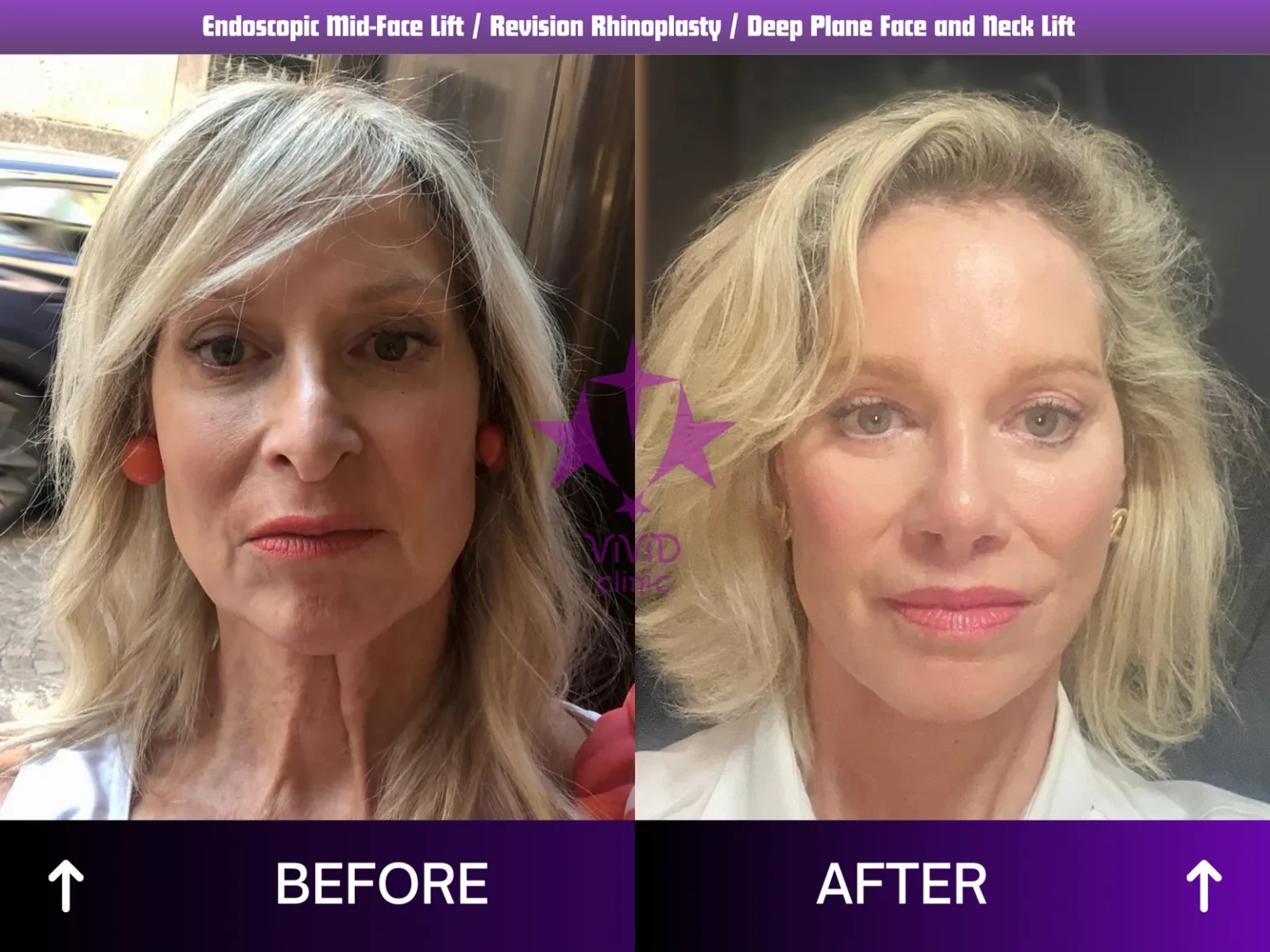
Quick answer: Anyone researching revision rhinoplasty before and after photos is usually trying to answer one practical question: what can a photo actually tell me about how a nose was refined? This article walks through a single documented case from Vivid Clinic in Istanbul, Turkey, photographed nine months after surgery, and is honest about what the available images can and cannot show. This case involved more than the nose alone, and that combination matters to how the photos should be read. This article is written as an educational look at photo interpretation rather than a promise of any specific outcome.
How Revision Rhinoplasty Before and After Photos Should Be Assessed
Before/after photography is a useful communication tool, but it is only as informative as the images behind it. A properly documented rhinoplasty case is typically photographed from several standardized angles — frontal, both obliques, both profiles, and a base view looking up the nostrils — under matched lighting, with a neutral expression and consistent hair position, at defined time points during healing. When any of those elements vary between the “before” and “after” images, the comparison becomes harder to interpret precisely, even if the surgical result itself is sound.
Readers evaluating any clinic’s photos, including Vivid Clinic’s, should ask which angles are present, whether conditions were matched, and how many months separate the photos from the surgery date. These questions matter more than they might seem, because a flattering angle or lighting change can visually soften or exaggerate a result that photography alone did not create.
Case F: Revision Rhinoplasty Within a Combined Facial Operation
The case reviewed here, referred to as Case F, involved a single combined operation: an endoscopic mid-face lift, a revision rhinoplasty, and a deep plane face and neck lift, performed together and documented at nine months postoperatively. It is important to state this plainly every time this case is discussed, because any visible change in the after photo reflects the combined effect of three separate procedures, not the nose alone.
A viewer cannot isolate which portion of the change came specifically from the rhinoplasty component when the mid-face and lower face and neck were also being lifted and repositioned in the same surgery. This is a common and legitimate way to plan combined facial rejuvenation and structural nasal work together, and it is one reason patients considering revision rhinoplasty at Vivid Clinic sometimes discuss it alongside other facial procedures during consultation, but it also means Case F should never be presented as a “pure” rhinoplasty before-and-after example.
Case F: Revision Rhinoplasty Before and After Gallery
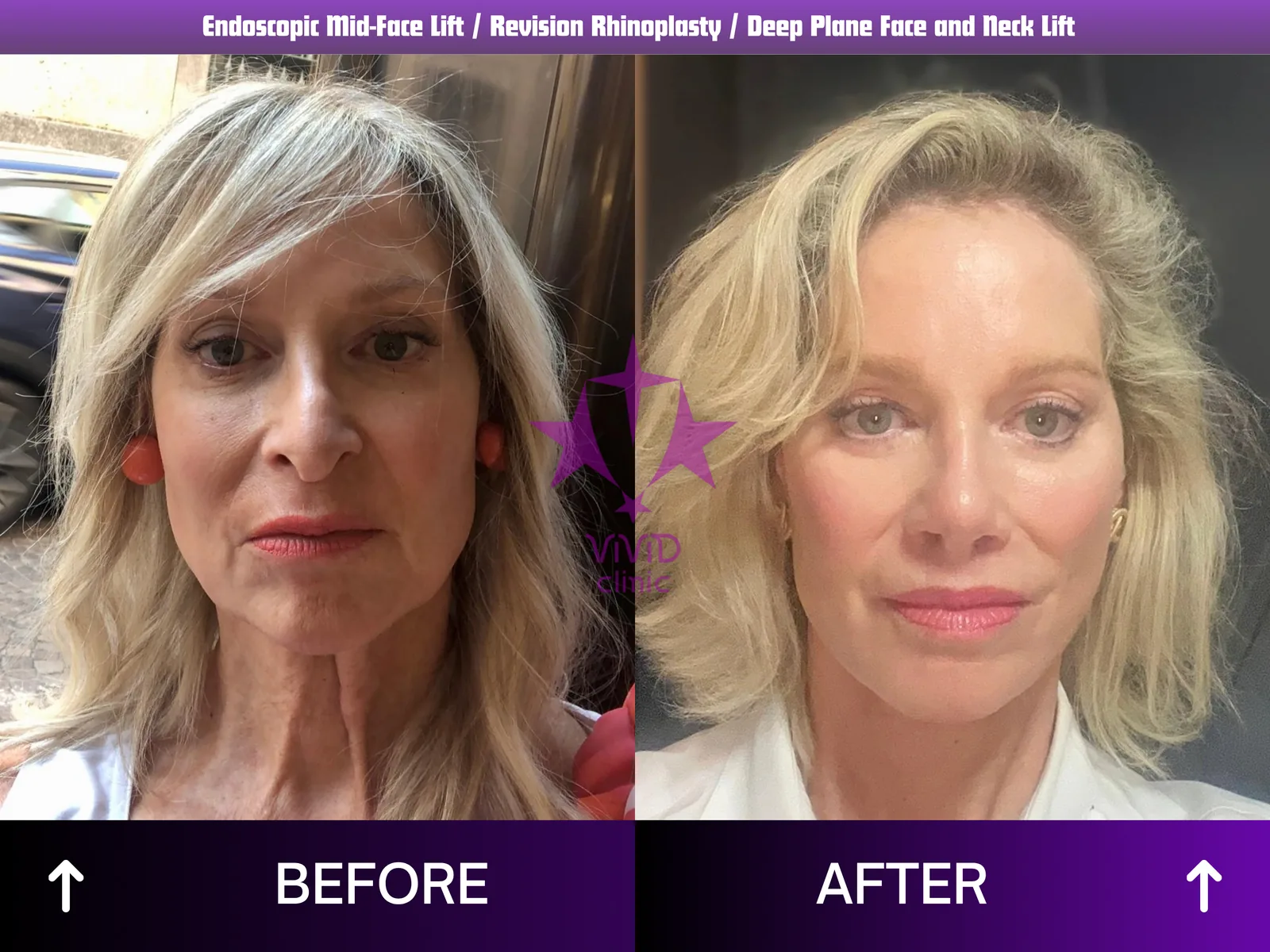
The two documented photographs of Case F are presented together below as a revision rhinoplasty before and after gallery, each with the angle and time point stated, followed by a detailed look at what these before and after images can and cannot show.
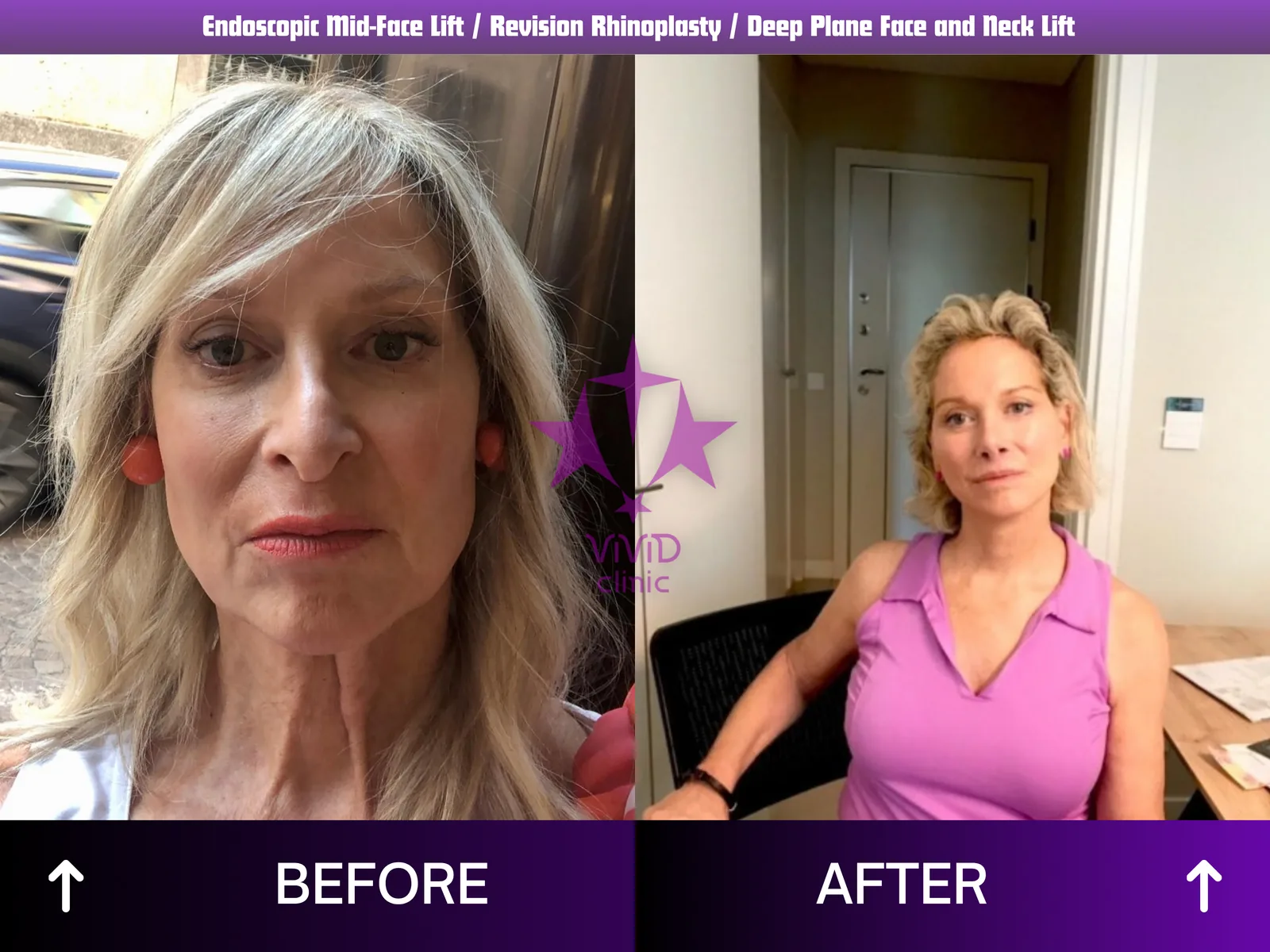
A third photograph associated with this case, labeled at a different time point and including other individuals in frame, was excluded from this article due to a timing discrepancy with the two nine-month images shown here. Only the two frontal comparisons that consistently document nine months are used in this review.
What the Available Frontal Photographs Can Show
Two frontal images are available for Case F. The first (shown above) is a direct frontal before-and-after comparison, though lighting, makeup, hairstyle, and facial expression differ between the two photographs, which limits how precisely fine nasal contour changes can be read. The second frontal image, shown below, pairs a closer “before” shot with a more distant “after” view, which is useful for general context about the face as a whole but is not suited to detailed nasal assessment.
Together, these two images can give a general impression of frontal facial appearance at nine months following the combined operation. What they cannot do is substitute for angle-matched clinical photography of the nose specifically. Readers should treat frontal-only images, however clear, as a partial record rather than a complete documentation of a rhinoplasty result.
Why Nine Months Should Not Automatically Be Called the Final Result
Nine months is a meaningful healing milestone, but it is not automatically the endpoint of rhinoplasty refinement, and this is especially true for revision cases. According to the American Society of Plastic Surgeons’ guidance on rhinoplasty recovery, swelling — particularly at the nasal tip — can persist and gradually resolve well beyond the early follow-up period, with the nose continuing to refine its final shape for up to a year or longer after surgery.
Revision cases, which often involve scar tissue from a prior operation and sometimes cartilage grafting, can take even longer to fully settle than a first-time rhinoplasty. For that reason, this article does not describe the nine-month photograph of Case F as a final result. It represents one documented point in an ongoing healing process, and further subtle change would be a normal and expected part of that process rather than a sign that anything went wrong.
What Matched Profile and Base Views Would Add
A complete rhinoplasty photo set normally includes profile views from both sides and a base view looking up through the nostrils, in addition to frontal images. Profile views are typically where changes to the nasal bridge, tip projection, and rotation are most visible, while base views help show symmetry of the nostrils and the columella. Vivid Clinic does not currently have matched profile or base views available for Case F, and that is a genuine limitation of this particular documentation set — not a judgment on the surgical outcome itself, which simply was not photographed from those angles at the same time points.
Readers who want a fuller picture of how a revision rhinoplasty result reads from multiple angles should ask any clinic, including Vivid Clinic, whether a complete standardized photo set exists for a given case before drawing conclusions from frontal images alone.
Who May Be Suitable, and Who May Not
Candidacy
People who have already had one rhinoplasty and are unhappy with a specific, identifiable aspect of the result — such as asymmetry, an irregularity along the bridge, or a tip shape that did not settle as planned — are often the ones who explore revision rhinoplasty. Good candidates are typically in stable general health, have realistic expectations about what a second surgery on already-operated tissue can achieve, and have waited long enough after their first procedure (often at least a year) for swelling to fully resolve before pursuing further changes.
Limitations
Revision surgery is not right for everyone. Individuals with very thin remaining cartilage, significant scar tissue, or unresolved healing from a first surgery may need staged planning or additional grafting, and some structural goals may simply not be achievable. This article does not diagnose or make suitability claims about the specific patient in Case F; suitability can only be determined through an individual, in-person or virtual medical evaluation.
Preparation and Consultation
Preparing for a revision rhinoplasty consultation generally means gathering records from the original surgery when available, being ready to describe specifically what concerns you about the current result, and being open about your full medical history, including any breathing symptoms, since a comprehensive evaluation may address both appearance and nasal function. At Vivid Clinic, this preparation feeds directly into the surgical planning conversation, where your surgeon reviews your anatomy, prior surgical history, and goals together before any procedure date is confirmed.
Procedure Overview
The table below reflects general, evidence-informed ranges for revision rhinoplasty as a standalone procedure. Case F combined revision rhinoplasty with an endoscopic mid-face lift and a deep plane face and neck lift, so that patient’s actual combined recovery would have reflected all three procedures together, not revision rhinoplasty alone.
| Category | Typical Range |
| Duration | 2–4 hours, often longer than a primary rhinoplasty due to scar tissue and any grafting required |
| Hospitalization | Usually one night for observation |
| Mobility | Light walking the day after surgery; avoid bending or straining for 2–3 weeks |
| Return to Activity | Splint typically removed around day 7; social recovery around 2–3 weeks; exercise resumes around 4–6 weeks |
| Recovery | Swelling, especially at the tip, can resolve more slowly than after a first rhinoplasty |
| Anticipated Results | Initial shape visible after splint removal; revision cases often need 12–18 months to reach a settled, final result |
How the Operation Is Planned and Performed
Revision rhinoplasty planning starts with a careful review of what was done in the original surgery, what tissue and cartilage remain available, and what the patient wants to change.
Because scar tissue and altered anatomy make revision surgery technically more demanding than a first-time procedure, surgeons often need additional cartilage — sometimes harvested from the septum, ear, or rib — to rebuild or refine structural support. The approach, whether closed or open, and the specific techniques used depend on the individual anatomy and the goals identified during consultation; this article does not attribute a specific technique to Case F beyond what has been stated, since that level of surgical detail was not documented for this case.
When revision rhinoplasty is combined with facial lifting procedures, as in Case F, the surgical team also has to sequence and coordinate the different components of the operation within a single anesthetic session.
Recovery and the Results Timeline
In general terms, most rhinoplasty patients see a splint removed around a week after surgery, with visible bruising and swelling continuing to fade over the following two to three weeks.
Deeper swelling, especially around the nasal tip, tends to reduce gradually over many months, and revision cases in particular can take longer to reach their settled appearance than first-time rhinoplasty. These are general, ASPS-informed ranges rather than a day-by-day account of what the Case F patient specifically experienced, since that detailed timeline was not documented. What is documented is a single photographed point at nine months, and as noted earlier in this article, that point should be understood as a stage in an ongoing process rather than a finished outcome, particularly given the added complexity of a combined mid-face and deep plane facial lift performed at the same time.
Risks and Safety Considerations
As with any surgical procedure, revision rhinoplasty carries risks, including but not limited to infection, bleeding, adverse reaction to anesthesia, asymmetry, unsatisfactory aesthetic outcome, need for further revision, and changes in nasal sensation.
Revision surgery can carry added technical risk compared with a first rhinoplasty because of scar tissue and reduced remaining cartilage. When combined with additional procedures such as a mid-face lift and deep plane face and neck lift, as in Case F, overall surgical time and anesthesia exposure increase, and recovery from the combination should be planned for accordingly. A thorough consultation, full disclosure of medical history, and choosing an experienced surgical team are standard ways patients and clinics work to reduce these risks, though no surgery can be guaranteed complication-free.
Cost Factors and Combination Planning
Cost for revision rhinoplasty varies by the complexity of the case, the amount of grafting required, whether additional procedures are combined into the same operation, and the individual surgeon’s assessment during consultation — this article does not state a fixed price, and any number quoted before a proper evaluation should be treated cautiously. Combining revision rhinoplasty with procedures such as an endoscopic mid-face lift or deep plane facelift, as in Case F, affects overall planning, operating time, and recovery, and is typically priced as a package reflecting the full combination rather than the rhinoplasty component in isolation. A personalized quote follows a real consultation, not a general article.
Your Journey at Vivid Clinic in Istanbul
When you choose Vivid Clinic for your care in Istanbul, Turkey, your journey is coordinated from the moment you book. Our patient coordinators plan your visit around your surgery date, arrange a VIP airport transfer, and check you into a partner five-star hotel for your stay. You’ll meet your surgeon for an in-person consultation to confirm your plan before proceeding, have your procedure performed at our accredited facility, and recover under the clinical team’s aftercare protocol, with a check-up before you fly home. After you return home, Vivid Clinic’s team stays in contact for remote follow-up as you continue healing. Package inclusions can change, so confirm current details with your patient coordinator before booking.
Choosing a Surgeon and Discussing Expectations
Revision rhinoplasty is widely regarded as one of the more technically demanding procedures in facial plastic surgery, so experience specifically with revision cases is worth asking about directly when you meet our surgical team. A good consultation should include a clear, honest conversation about what is realistically achievable given your existing anatomy and prior surgery, what the recovery will involve, and how your case will be documented. You can review examples in our revision rhinoplasty before and after gallery, understanding that, as with Case F, many documented cases involve combined procedures rather than rhinoplasty alone.
Frequently Asked Questions
What should I look for in revision rhinoplasty before and after photographs?
Look for matched angles (ideally frontal, profile, and base views), consistent lighting and expression, a clearly stated time point after surgery, and full disclosure of any other procedures performed in the same operation. Revision rhinoplasty before and after photographs that are missing this context are harder to interpret reliably, whatever clinic they come from.
Can nine-month revision rhinoplasty photos be described as final results?
Not automatically. General clinical guidance indicates that rhinoplasty results, and revision results especially, can continue refining well beyond nine months as residual swelling resolves, sometimes for a year or more. A nine-month photo is a useful checkpoint but should not be labeled the final outcome.
Why are profile and base views useful alongside frontal photographs?
Profile views typically show changes to the nasal bridge, tip projection, and overall rotation most clearly, while base views help illustrate nostril symmetry. Frontal photos alone, as in Case F, cannot substitute for this fuller picture, which is why their absence is stated openly in this article.
Can these photographs show breathing improvement after revision rhinoplasty?
No. Photographs, including the frontal images shown here, document visible external appearance only. They cannot demonstrate breathing, airway, or any other functional outcome, and no such claim is made about Case F or any other case based on photography alone.
How do previous surgery and combined procedures affect a revision consultation?
Prior surgery changes the available cartilage, tissue quality, and scar pattern a surgeon has to work with, which is why revision consultations typically involve a more detailed review of surgical history. When revision rhinoplasty is combined with other procedures, such as the endoscopic mid-face lift and deep plane face and neck lift performed alongside Case F’s rhinoplasty, the consultation also needs to address how those procedures are sequenced and how combined recovery will be managed.
Reading revision rhinoplasty before and after photographs carefully — noting the angles available, the time point, and any procedures combined with the rhinoplasty — gives a more honest picture than the images alone. Case F illustrates both what frontal photography can offer and its real limitations at nine months. If you’re considering revision rhinoplasty at Vivid Clinic in Istanbul, Turkey, Get a Free Consultation to discuss your anatomy, goals, and options directly with our surgical team.
Related reading: Learn more about rhinoplasty at Vivid Clinic, explore our endoscopic mid-face lift technique and deep plane facelift approaches used alongside revision cases, browse our before-and-after gallery, or meet our surgical team.