 ChatGPT
Medically reviewed by Prof. Dr. Özgür Pilancı, Plastic, Reconstructive & Aesthetic Surgeon — August 2026
Quick answer (updated August 2026): Butt shapes are mostly set by bone, muscle and fat distribution, which is why the same exercise changes different shapes differently. Buttock shape is set by three things — the shape of your pelvis, the size and position of the gluteal muscles, and how your body distributes fat. The common descriptions are round, square, A-shaped (fuller at the bottom), V-shaped or “inverted” (fuller at the top, tapering downward) and heart-shaped. A Brazilian butt lift transfers your own fat to change volume and projection, and around 60–80% of the transferred fat typically survives long term. It cannot change your pelvis — and the single most important thing to ask any surgeon is which tissue plane they inject into.
What actually sets your shape
Three layers, in order of how much they are fixed.
The pelvis and femur. Bone width, the angle at which the pelvis is set, and the prominence of the greater trochanter of the thigh bone determine the outline your soft tissue drapes over. This layer does not change. It is also the explanation for hip dips — the slight indentation between the hip bone and the top of the thigh, which is the trochanteric depression showing through. Hip dips are a skeletal feature, present in people at every body-fat level, and no exercise removes them.
The gluteal muscles. Gluteus maximus provides most of the bulk and projection; gluteus medius and minimus sit higher and further out and shape the upper-outer curve. This layer genuinely responds to training. Progressive strength work — hip thrusts, squats, deadlifts, hip abduction — builds these muscles, and for many people that is the most effective route to a fuller shape.
The subcutaneous fat. How much you carry and, crucially, where your body chooses to put it, which is largely genetic and hormonal. This is the layer surgery can move.
The shape descriptions, honestly
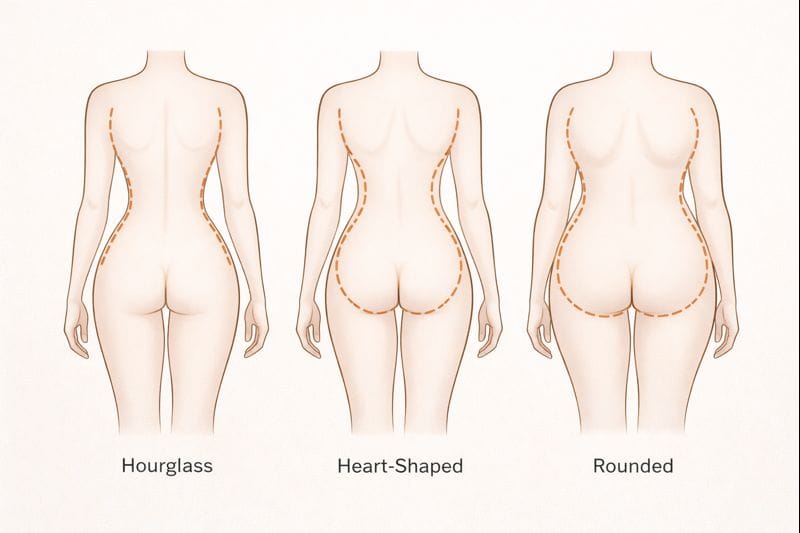
These labels come from fitness and aesthetic culture rather than from anatomy, and most real bodies sit between categories. They are still useful, because they describe where volume sits relative to the widest point.
Round (O-shaped) carries fullness fairly evenly, with projection in the middle and a smooth curve from waist to thigh. Often reflects a good distribution of both fat and muscle.
Square (H-shaped) runs close to straight from the waist down, with limited inward curve at the waist and limited outward curve at the hips. Frequently down to a wider pelvis with a “shelf” of fat at the upper outer hip.
A-shaped (pear) is narrower at the top and fullest at the bottom, near the crease where buttock meets thigh — a lower-body-dominant fat distribution.
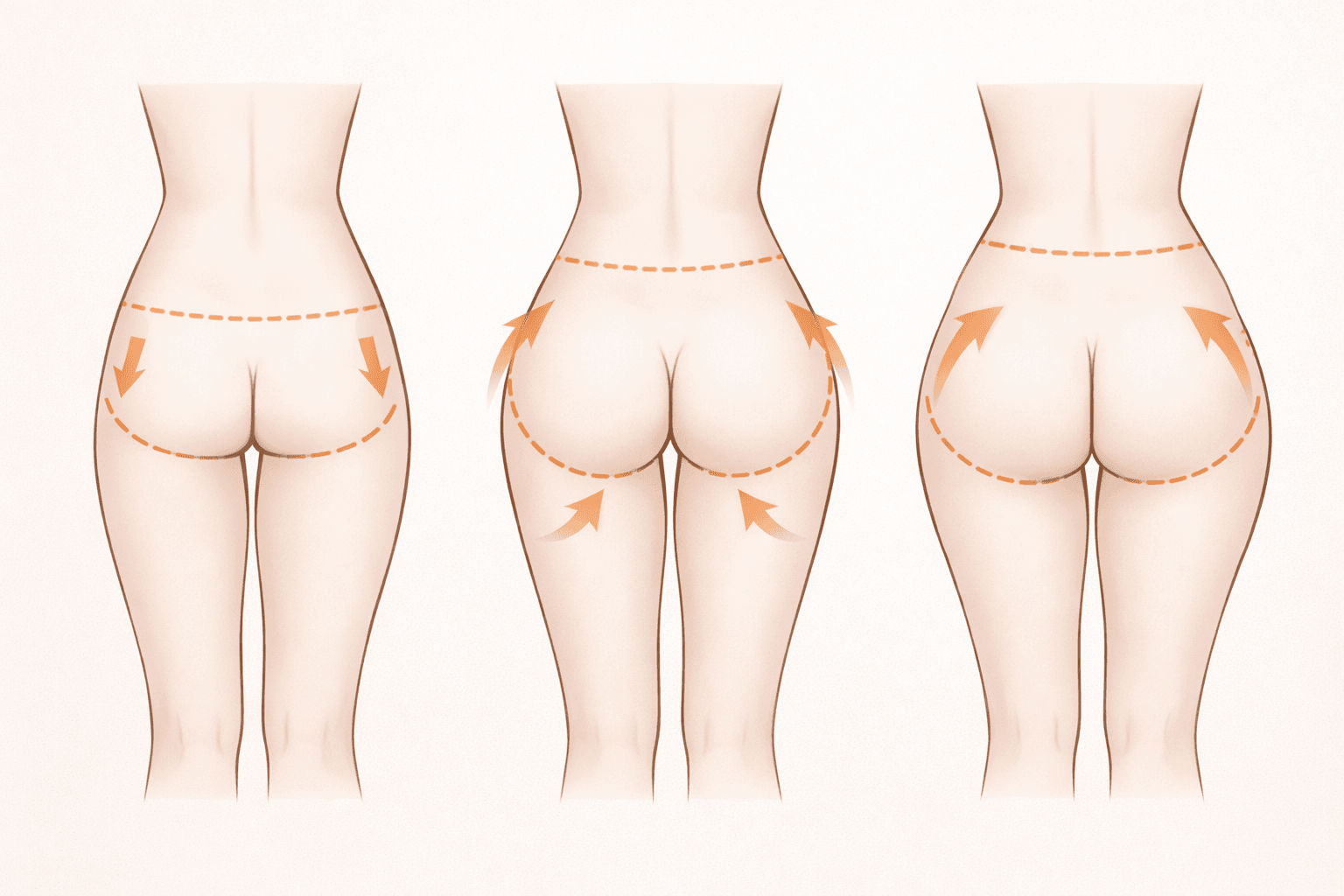
V-shaped, which is what most people mean by inverted, is the reverse: fullest at the top and tapering toward the bottom, with less volume at the lower pole. It becomes more common with age as tissue volume in the lower buttock reduces and the crease flattens.
Heart-shaped is fuller at the bottom and rounded outward at the hips, narrowing toward the waist.
None of these is a defect. They describe skeleton and fat distribution — largely inherited traits — and they are read very differently in different places and different decades.
The waist does half the work
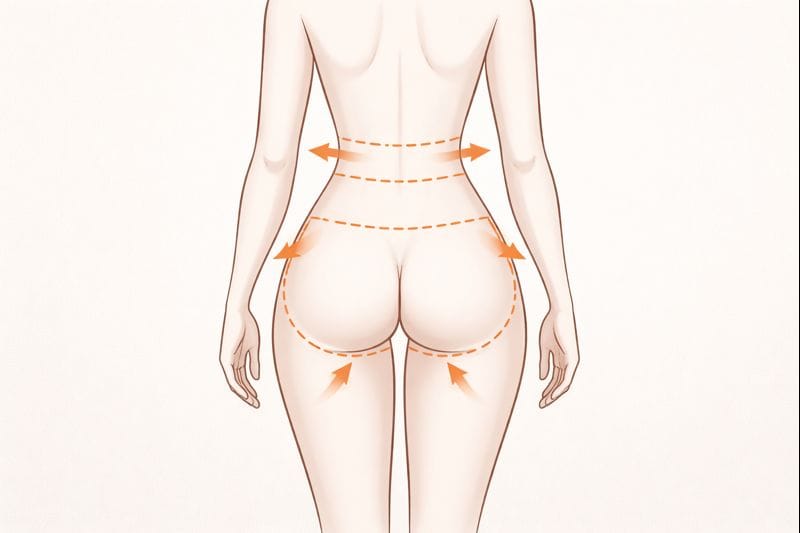
The thing that most changes how a buttock reads is often not the buttock at all. Shape is perceived as a ratio: the contrast between the narrowest point of the waist and the widest point of the hips is what the eye picks up.
This is why so much gluteal surgery is really two operations. Liposuction of the waist, flanks and lower back — often called lipo 360 — narrows the frame, which increases the contrast without adding a gram anywhere. The fat removed is then, in a BBL, the fat that gets transferred. Our Vaser liposuction page covers the removal side.
It is also why an unsuccessful BBL is often a contouring failure rather than a volume failure: volume added without the surrounding contour being addressed reads as bigger rather than as better shaped.
What a BBL does
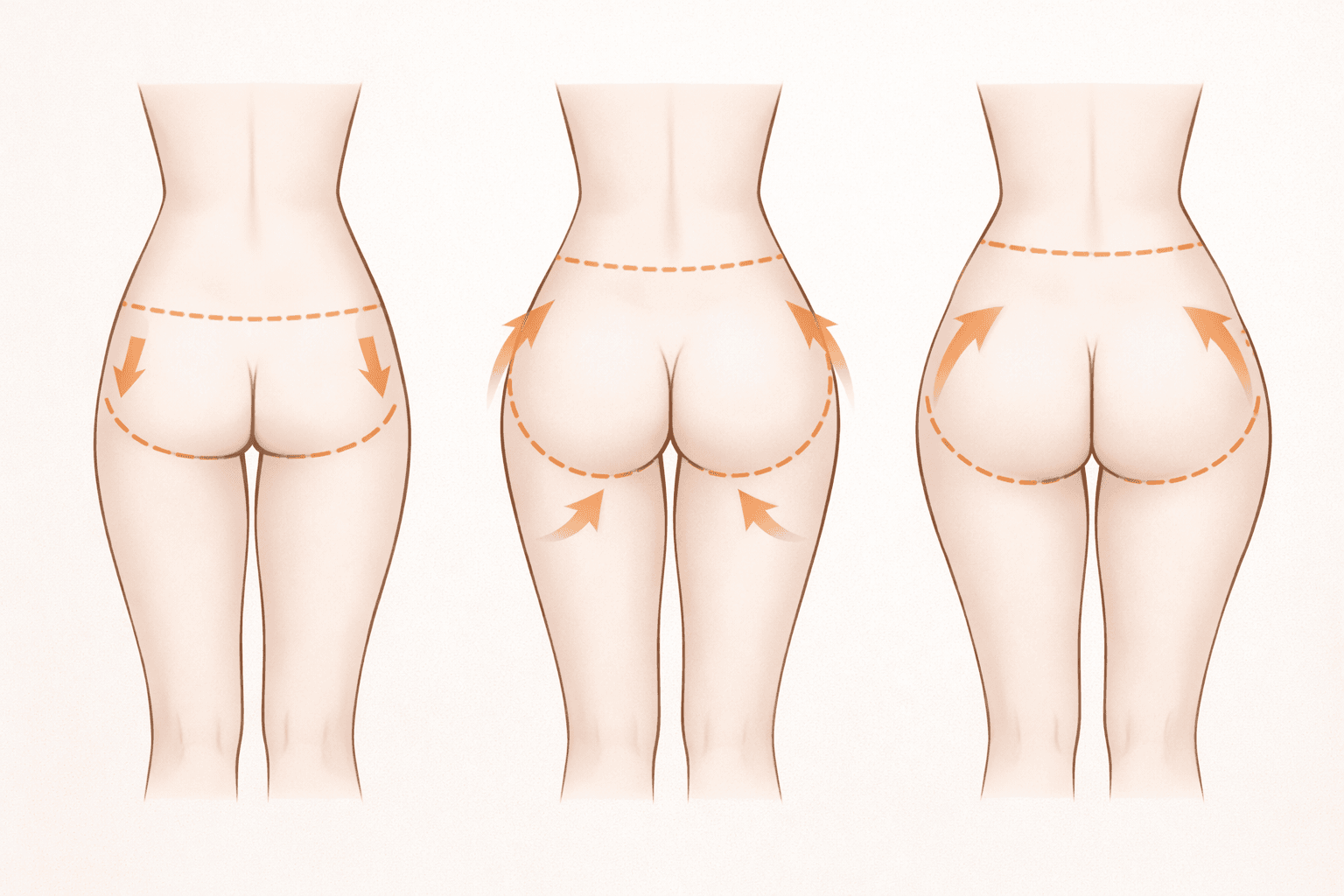
A Brazilian butt lift is gluteal fat grafting. Fat is harvested by liposuction from the abdomen, flanks, back or thighs, processed, and reinjected into the buttocks to add volume and projection and to fill specific deficiencies such as an under-full lower pole or a hip dip.
The name is misleading in two directions. It is not a lift — it does not remove skin or raise sagging tissue, and someone whose main issue is skin laxity after major weight loss needs an excisional procedure instead. And it is not Brazilian in origin.
Fat survival. Not all transferred fat survives. Typically around 60–80% establishes a blood supply and stays permanently; the rest is reabsorbed over the first few months. This is why surgeons overfill slightly, why the result at one week is not the result, and why the honest assessment point is three to six months. A second session is sometimes needed, and someone very lean may simply not have enough donor fat for the result they want.
Cost. In Istanbul, a BBL typically runs £3,400–£6,400 depending on the extent of liposuction and what the package includes — considerably below UK and US pricing. Our BBL in Turkey guide sets out what is and is not usually included, and you can see how results are documented in our before-and-after gallery.

Safety: the one question that matters
Gluteal fat grafting has carried the highest mortality of any cosmetic procedure, and it is important to understand both why, and what has changed.
The mechanism is pulmonary fat embolism. If fat is injected deep into the gluteal muscle, the cannula can breach one of the large gluteal veins, and fat entering that vein travels to the lungs. A 2017 task force report from the Aesthetic Surgery Education and Research Foundation confirmed 25 deaths in the United States over the preceding five years; in a survey of 692 surgeons covering nearly 199,000 cases, 3% reported a patient fatality and 7% reported at least one pulmonary fat embolism.
That report produced three specific recommendations: do not inject into deep muscle, do not use cannulas smaller than 4 mm, and do not angle the cannula downward. Professional bodies subsequently issued a joint safety statement advising that fat be placed only in the subcutaneous space above the gluteal fascia, supporting real-time ultrasound guidance to confirm the cannula tip stays in that plane, and recommending accredited facilities and a limit on procedures per day.
The evidence that this worked is now substantial. A survey of board-certified cosmetic surgeons compared two periods. In 2016–2018, when only 39% of surgeons avoided injecting into muscle, there were two fatal pulmonary fat embolisms in 22,800 cases — roughly 1 in 11,400. In 2019–2021, by which point 82 of 85 surveyed surgeons reported injecting exclusively above the muscle, there were zero fatal and zero non-fatal pulmonary fat embolisms across 12,172 cases. Use of closed-system peristaltic pumps rose from 22% to 51% over the same period.
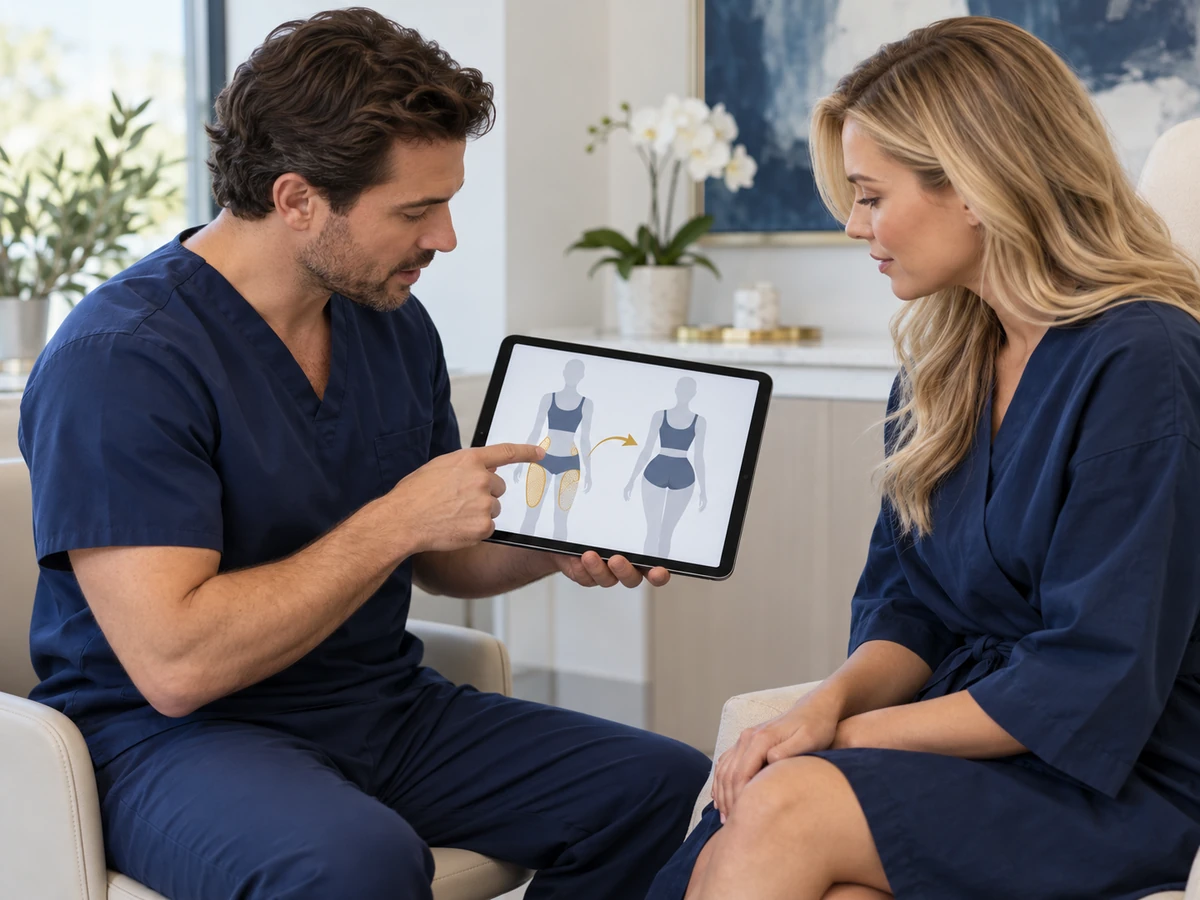
So the practical guidance for a patient is unusually concrete. Ask your surgeon, in these words: which plane do you inject into, and do you use ultrasound guidance? The answer should be “subcutaneous only, above the fascia, never intramuscular.” Ask where the surgery takes place and whether the facility is accredited. A surgeon who cannot answer these clearly, or who treats the question as an inconvenience, has told you what you need to know.
Beyond embolism, the ordinary risks of liposuction and fat grafting apply: bleeding, infection, contour irregularity, fat necrosis producing firm lumps, asymmetry, and the possibility of needing revision.
Recovery in outline
Sitting is restricted in the early period to protect the transferred fat’s developing blood supply — typically two to three weeks of avoiding direct pressure, using a BBL pillow under the thighs when sitting is unavoidable, and sleeping on the front or side. A compression garment is worn over the liposuction areas. Swelling is substantial at first and settles over weeks, with the final volume clear at around three to six months once fat resorption has finished. Most people return to desk work within one to two weeks and to full exercise at six weeks or so, on a surgeon’s schedule.
Long-term maintenance matters: transferred fat behaves like the fat it came from, so significant weight change afterwards changes the result.
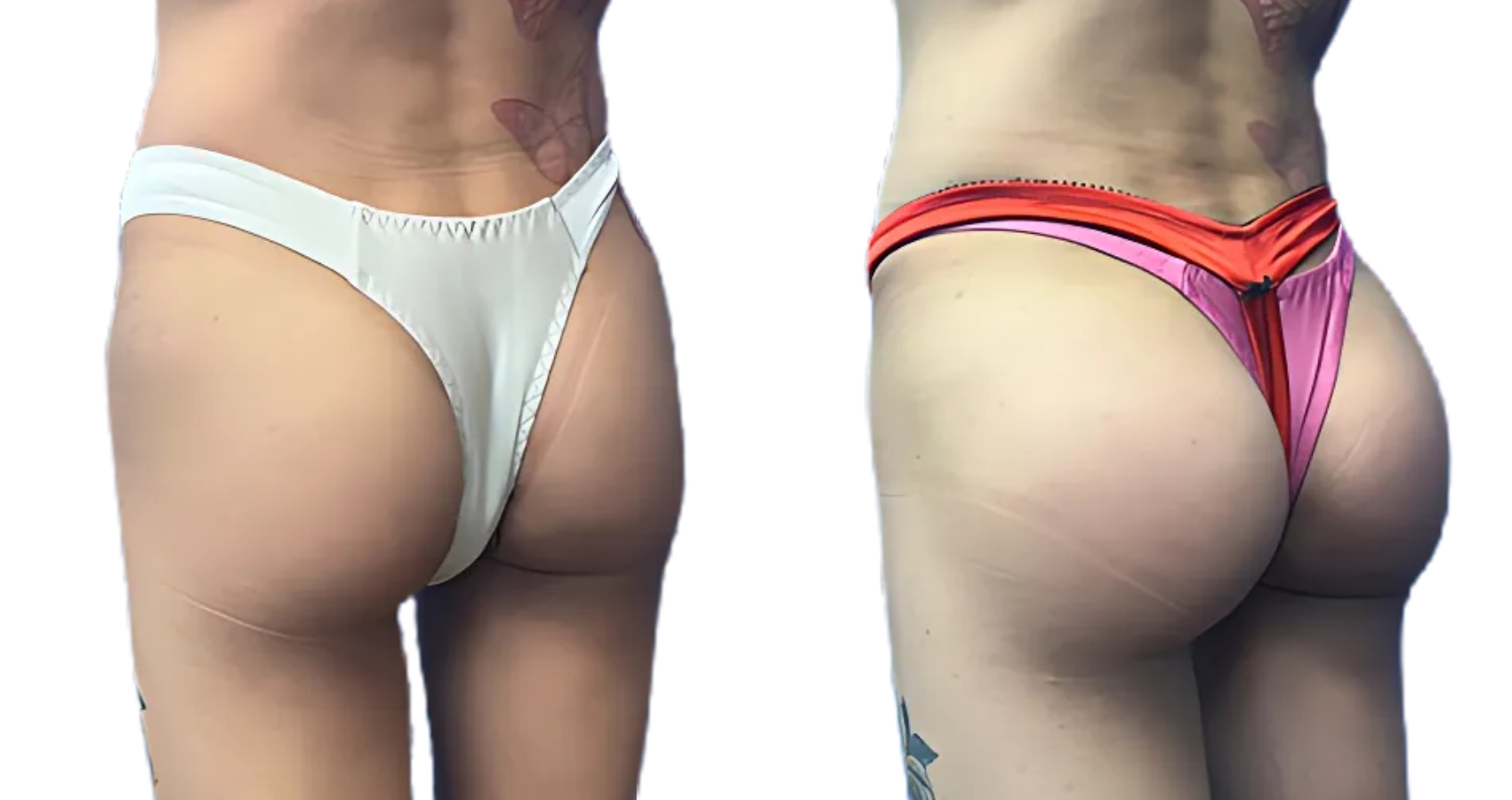
BBL Before & After Results at Vivid Clinic




Frequently Asked Questions
What is an inverted or V-shaped buttock?
A V-shaped buttock — often searched as “inverted” — carries most of its volume in the upper portion and tapers toward the bottom, so the lower pole is comparatively flat and the crease where buttock meets thigh is less defined. It reflects pelvic shape and fat distribution, and becomes more common with age as volume in the lower buttock reduces. Where treatment is wanted, fat grafting targeted to the lower pole is the usual approach, since strength training alone builds the muscle above rather than filling the area below.
Can exercise change your butt shape?
It can change one of the three layers. Strength training builds the gluteal muscles — maximus for projection, medius and minimus for the upper-outer curve — and for many people that produces a meaningful change in fullness and firmness. What exercise cannot do is alter the pelvis, redirect where your body stores fat, or remove hip dips, which are skeletal. Training changes size and firmness; it does not change the underlying architecture.
Are hip dips something that can be fixed?
Hip dips are the trochanteric depression, a normal feature of the skeleton where the hip bone meets the top of the thigh. They occur at every body-fat level and in very lean, very fit people, and no exercise removes them because there is no muscle or fat that can be added in that exact position by training. Fat grafting can soften the indentation by adding volume over it, which is a common part of a BBL, but the underlying bony shape stays as it is.
How much fat survives a BBL?
Typically around 60–80% of the transferred fat establishes a blood supply and stays permanently. The remainder is reabsorbed over the first months, which is why the immediate post-operative result is larger than the final one, and why surgeons assess at three to six months rather than earlier. Patients who are very lean may not have sufficient donor fat, and a second session is sometimes needed to reach the intended volume.
Is a BBL safe now?
It is considerably safer than it was, and for a specific and identifiable reason. Deaths were caused by fat injected into deep gluteal muscle entering the large gluteal veins and travelling to the lungs. After professional bodies recommended subcutaneous-only injection above the gluteal fascia, adoption rose sharply and outcomes changed measurably: one survey found two fatal embolisms in 22,800 cases in 2016–2018 against zero fatal or non-fatal embolisms in 12,172 cases in 2019–2021. Safety now depends almost entirely on the individual surgeon’s technique and facility, which makes those two questions the ones to ask.
How much does a BBL cost in Turkey?
In Istanbul, a BBL typically runs £3,400–£6,400, varying with how much liposuction is involved and what the package covers. That is substantially below typical UK and US pricing, which is the main reason patients travel. Compare what is actually included — surgeon and anaesthetist fees, hospital facility, garments, accommodation, transfers, follow-up and any revision policy — rather than the headline figure, and weigh the safety questions above at least as heavily as the price.
Can you be born without a belly button?
Effectively, yes. The navel is a scar left where the umbilical cord was attached, and a small number of people have essentially no visible navel — usually following surgical repair of an umbilical hernia or an abdominal wall condition such as gastroschisis or omphalocele in infancy, and occasionally as an anatomical variant. It has no functional consequence. Where a navel is absent or distorted, umbilical reconstruction can create one, and it is a routine part of abdominoplasty, where the navel is repositioned as the abdominal skin is redraped.
Wondering whether your shape is a volume question, a contour question, or neither? Send photographs for a free online assessment and get a straight answer — including when the honest answer is that training, not surgery, is what would get you there.