
 ChatGPT

Medically reviewed by Prof. Dr. Özgür Pilancı, Plastic, Reconstructive & Aesthetic Surgeon — August 2026
Quick answer (updated August 2026): A forehead lift — also called a brow lift — raises the eyebrows and softens the horizontal forehead lines and vertical frown lines above them. It does not remove eyelid skin, and it does not fill hollow temples: a low brow is a position problem, a hollow temple is a volume problem. Options run from endoscopic lifting through small hidden incisions to coronal, hairline, temporal and direct approaches, and the right one depends on your forehead height, your hairline and how much lift the outer brow needs.

What a forehead lift actually does
A forehead lift repositions the eyebrows upward and weakens the muscles that pull them down. It treats brow droop, deep forehead creases and the vertical "elevens" between the brows. It does not treat the eyelid itself, and it adds no volume anywhere.
The frontalis is the only muscle that lifts the brow; the corrugator, procerus and outer orbicularis oculi pull downward. As the forehead’s supporting tissues loosen, the depressors win.
Hence the most common planning error. A low brow crowds the upper lid and produces pseudo-blepharoptosis — an eyelid that looks heavy when the brow above it is the culprit. Removing upper eyelid skin will not fix that, which is why StatPearls advises lifting the brow first where both are planned. A facelift does not raise the brow either.

The techniques, and what separates them
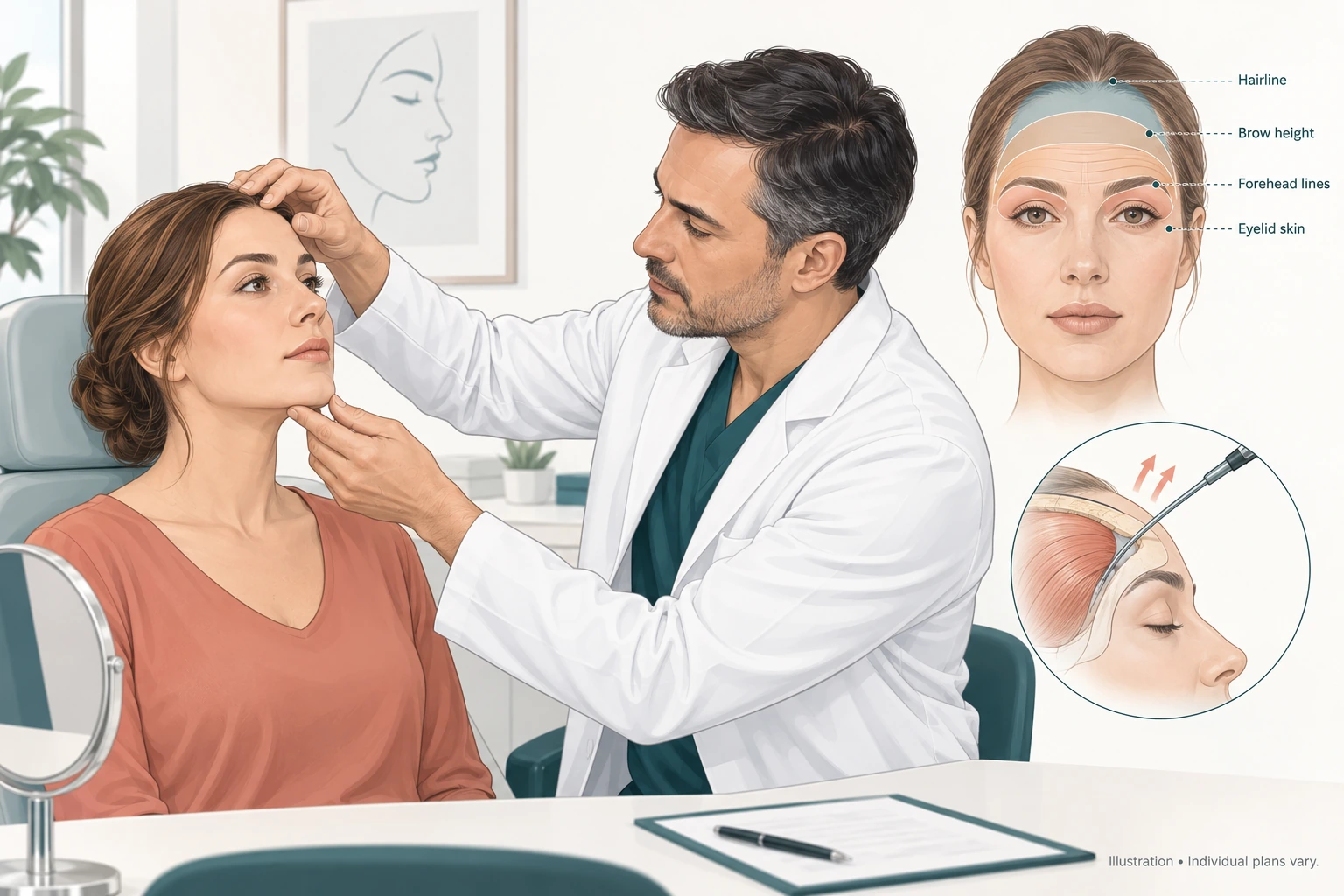
What distinguishes brow lift techniques is where the incision sits and what it does to your hairline. Forehead height, hairline position and hairline stability drive the choice more than anything else.
Endoscopic. Three small incisions about a centimeter behind the hairline plus two in the temporal scalp, with a camera guiding the release down to the orbital rim; the brow is then fixed with sutures, anchors or bone tunnels. No long scar, but it can raise the hairline, and StatPearls says to expect roughly 5 mm of relapse.
Coronal. One incision ear to ear across the scalp, hidden in hair. Widest exposure, but a strip of scalp is removed, so the hairline rises by the width excised — wrong if your hairline is already high or receding.
Hairline (pretrichial or trichophytic). The incision follows the frontal hairline, just in front of it or a few millimeters behind. It does not raise the hairline and can lower one, and published comparisons put the lift on a par with endoscopic technique. The cost is a longer incision and a real scar risk.
Temporal or lateral brow lift. A limited incision inside the temporal hairline raising only the outer third of the brow — the same territory as a fox eye lift.
Direct and mid-forehead. The incision sits immediately above the brow hairs, or inside a deep forehead crease. Most precise, and valuable for marked asymmetry or facial nerve palsy, but the scar is on the face — which is why StatPearls calls it increasingly reconstructive rather than cosmetic.
How much lift is right

The right amount restores brow position without changing your expression. Classical descriptions put a woman’s brow just above the bony rim with its peak between the lateral limbus and lateral canthus, and a man’s flatter, at rim level.
Treat those as landmarks, not rules: StatPearls cautions that the classical female brow "should not be regarded as the sole criterion" for periorbital femininity. Over-lifting the medial brow produces the permanently startled look, and it is far harder to undo than to avoid. Endoscopic technique also raises the forehead as a unit, so more than 3 to 4 mm of existing brow asymmetry counts against it.
Hollow temples are a volume problem

Temple hollowing is loss of tissue in the temporal fossa, and lifting will not fill it. The temple is layered — skin, subcutaneous fat, the temporoparietal fascia, a loose areolar plane, the deep temporal fascia with the superficial temporal fat pad between its two layers, then temporalis muscle and bone.
Volume disappears from several layers at once. StatPearls attributes facial hollowing to dermal thinning, muscular atrophy, fat loss and reduced bone thickness, with skeletal atrophy typically beginning in the third and fourth decades; weight loss and previous surgery accelerate it. The effect on the temple face is specific — the upper face narrows, the brow ridge and orbital rim look more prominent, and the eye reads as skeletal.
The temple treatment ladder
Three rungs, doing different jobs.
Hyaluronic acid filler is the reversible starting point. A 2025 review of upper-face technique describes three recognized planes — superficial fatty, interfascial and supraperiosteal — with under 1 mL per side. It is temporary, and not a trivial injection: the superficial temporal artery, middle temporal vein and sentinel vein all run here, and ASPS lists vascular occlusion, skin necrosis and vision loss among filler risks.
Fat grafting layers processed fat in small aliquots. StatPearls names temporal hollowing as an indication and is blunt about survival — roughly 80% of patients keep about 80% of what is injected, while the remaining fifth resorb nearly all of it, hence overcorrection of around 20%. Rare but serious complications include fat embolism and blindness from ophthalmic artery occlusion.
A temple lift — the temporal component of an endoscopic brow lift — repositions tissue upward. It raises the brow tail but creates no volume, so it complements filling rather than replacing it. Implants can also be placed over the temple, with pooled facial-implant complication rates of 4% to 11%.
Forehead contouring works on bone
Forehead contouring, or frontal cranioplasty, reshapes the frontal bone itself, and is a different operation from any lift. It is most often sought as part of facial feminization.
StatPearls describes three approaches: burring the brow ridge alone, which works only where the anterior sinus wall is thick or absent; ridge reduction plus augmenting the forehead’s contour with bone cement; and removing, thinning and recessing the anterior wall of the frontal sinus, favored by many established surgeons in this field. A hairline incision gives exposure and lets the hairline be reshaped at the same sitting; a coronal one avoids a frontal scar. Recognized complications include forehead numbness, brow weakness, nasofrontal duct obstruction, hematoma and cerebrospinal fluid leak.
Recovery
Most people are presentable in about two weeks. ASPS puts initial wound healing, and return to work and normal activity, at 10 to 14 days, with healing continuing for several weeks after that.
A representative course: one to three hours of surgery, dressings off within one to three days, head elevated for a week, sutures or staples out at around a week, and no vigorous activity for two weeks. Expect a tight, tension-headache-like ache for the first day or two; Cleveland Clinic puts complete healing at up to six months.

The risks worth understanding
ASPS lists bleeding, infection, poor healing, fluid collection, facial nerve injury, altered sensation, a raised hairline, hair loss around incisions, asymmetry, unfavorable scarring, dry or irritated eyes and possible revision surgery. Three deserve expanding.
Nerve injury. The frontal branch of the facial nerve runs within the temporoparietal fascia and is vulnerable in the temple. StatPearls reports temporary weakness as more common than permanent paralysis — but a weakened frontalis is a brow that cannot lift.
Altered sensation. The supraorbital and supratrochlear nerves supply the forehead and scalp. Numbness behind a hairline or coronal incision is expected, and patients are told it may not fully resolve.
Hair. Alopecia along the incision is recognized, reduced by angling incisions parallel to the follicles and closing without tension.
How to read a forehead lift before and after

Look for the same expression in both photographs: a raised-brow "before" against a relaxed "after" manufactures a lift no surgeon performed. Check that camera height and head tilt match, since a lowered chin lifts the brow visually. Look for images taken at three months or later. Then check the hairline — if it has moved backward, that is the technique showing. Our before-and-after gallery is the honest place to start.
Related Before and After Results at Vivid Clinic
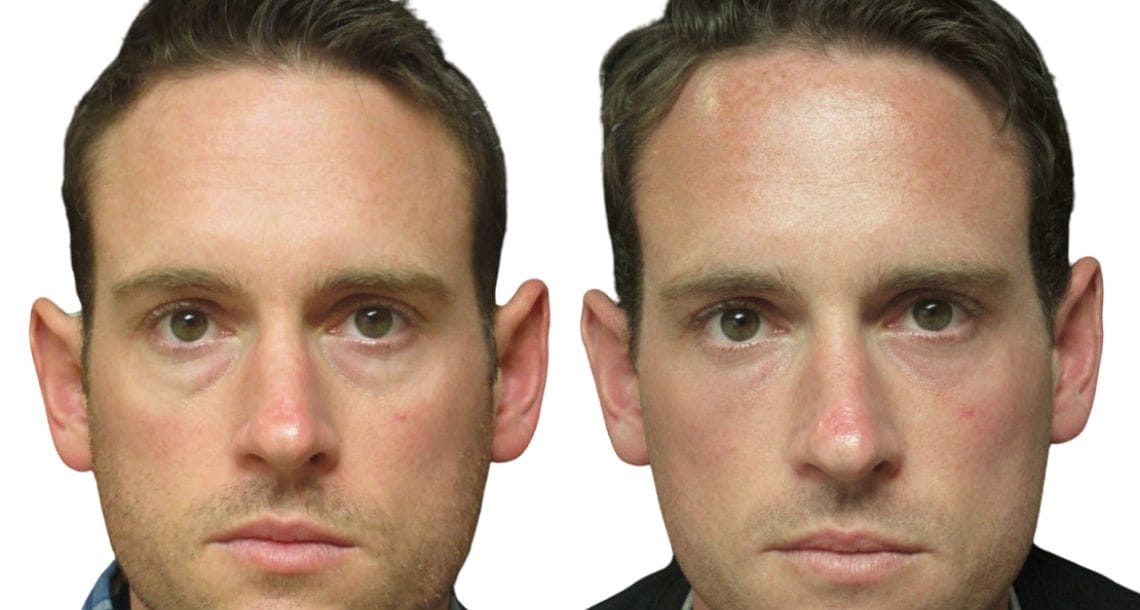
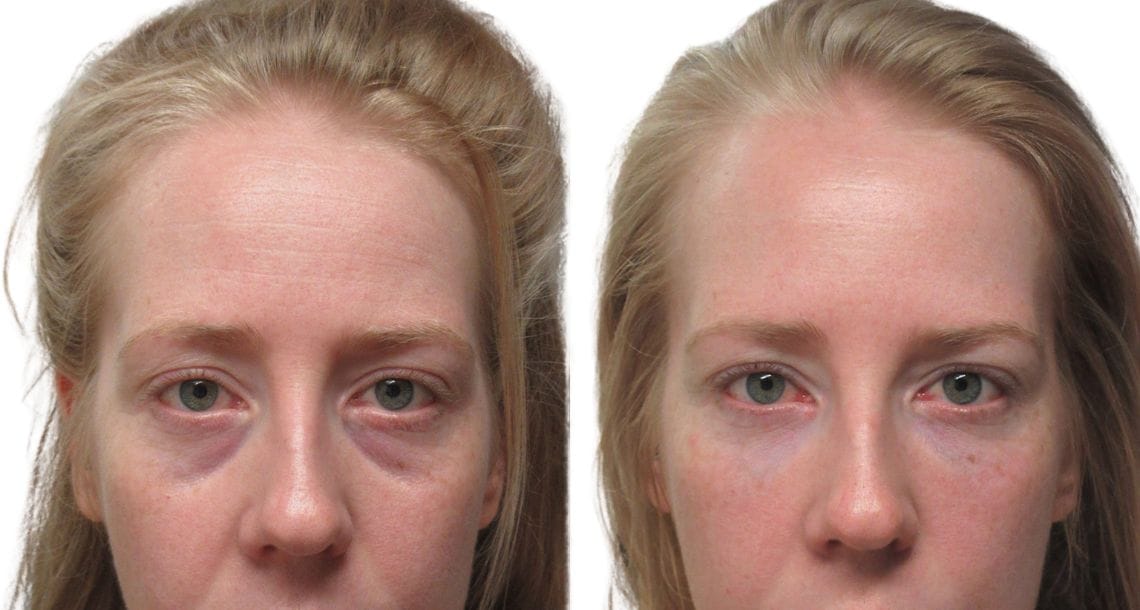
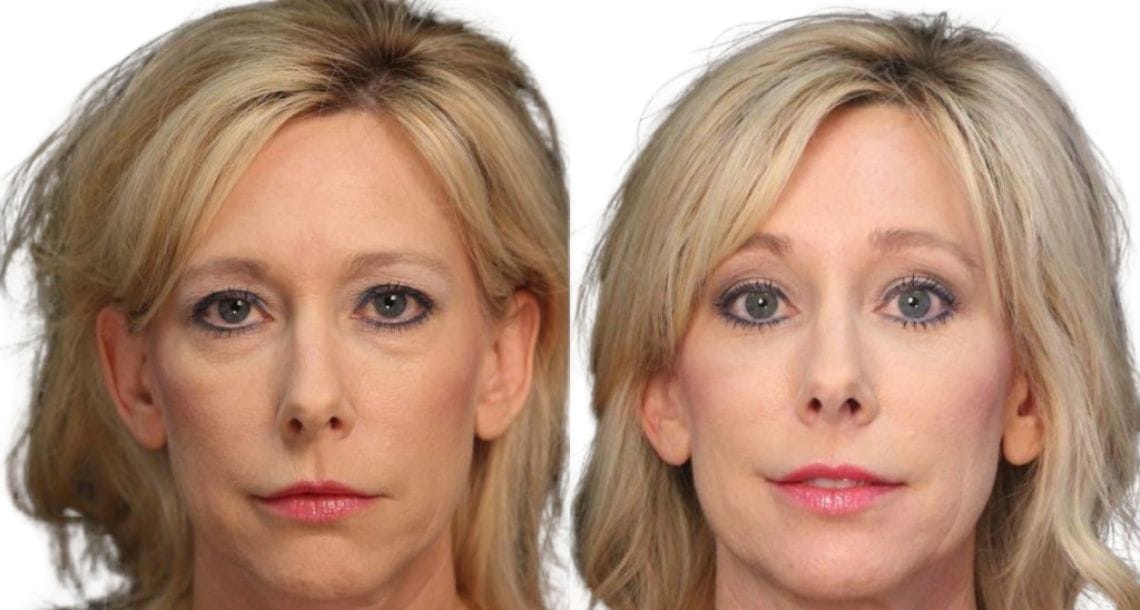
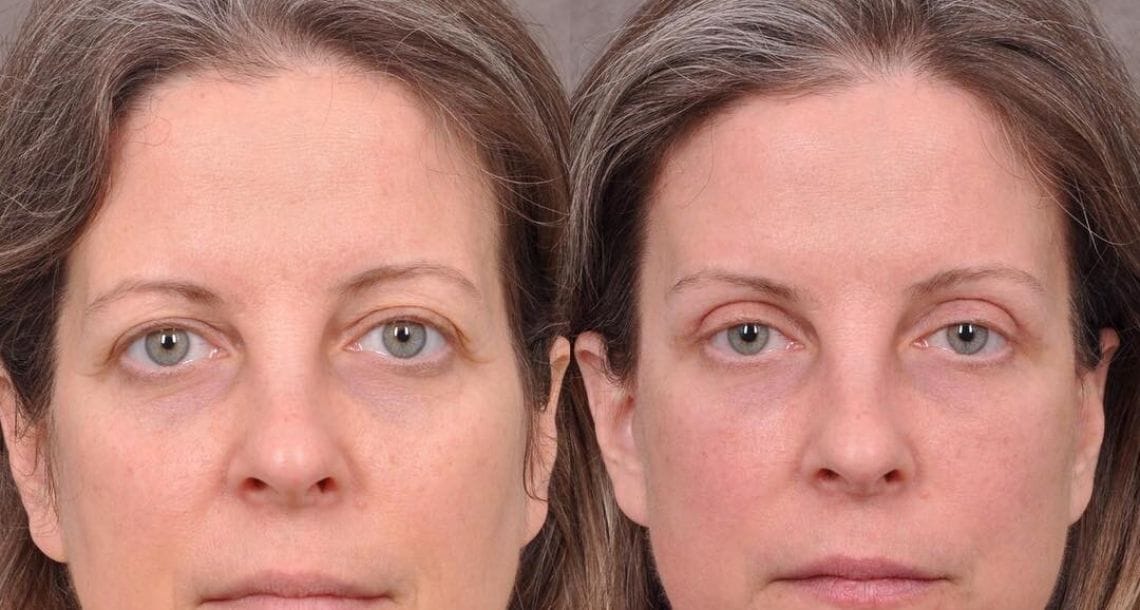
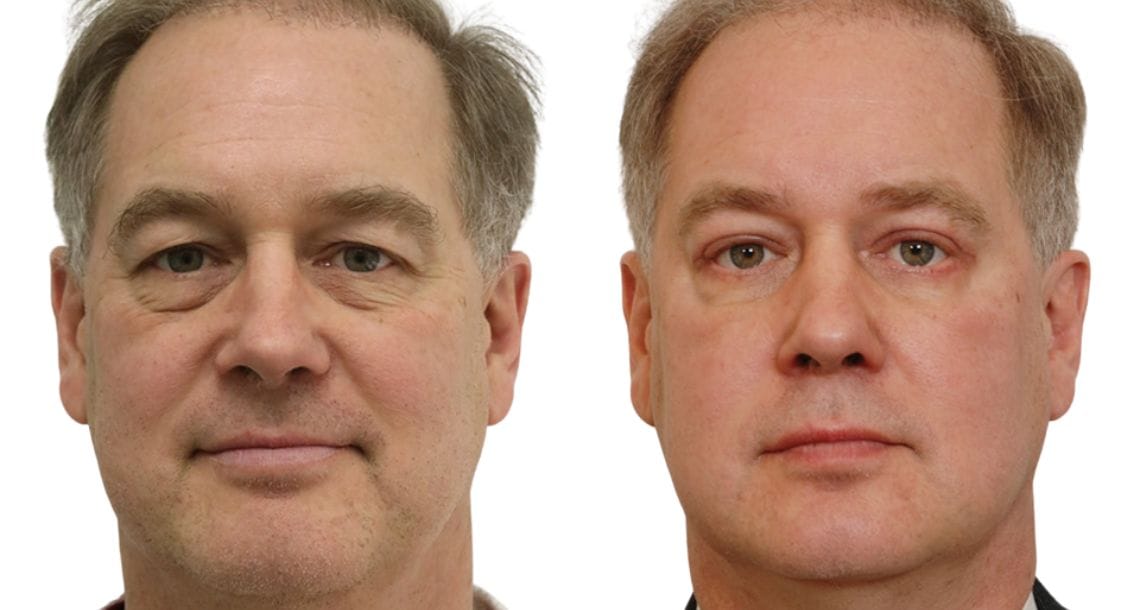
The photos below show real Vivid Clinic patients who had eyelid surgery — a related procedure, not a forehead lift itself — shared with their consent to show how our Istanbul team documents results. Ask during your free consultation to see cases that match your own treatment. Individual results vary. Browse the full Before & After Gallery.

Frequently Asked Questions
Is a forehead lift the same thing as a brow lift?
Yes. The two names describe the same family of operations and surgeons use them interchangeably: "brow lift" emphasizes the eyebrow position being corrected, "forehead lift" the region released to get there. What varies between them is the incision — endoscopic, coronal, hairline, temporal or direct — and how much of the forehead is dissected.
Will a forehead lift fix hooded upper eyelids?
Sometimes, and it is worth settling before you book anything. If the heaviness comes from a brow that has dropped onto the lid, lifting the brow addresses the cause; if it comes from excess skin on the lid itself, eyelid surgery does. Many people have both, in which case StatPearls advises performing the brow lift first so less upper-lid skin is removed afterwards.
How long do forehead lift results last?
There is no fixed number, and any clinic quoting one precisely is guessing. Cleveland Clinic describes the result as long-lasting while noting that lines can reappear as aging continues. A settling of a few millimeters in the first months is expected rather than a failure — StatPearls anticipates around 5 mm of relapse after endoscopic technique.
What causes hollow temples, and can they be reversed?
Hollowing in the temporal fossa comes from tissue loss across several layers at once — thinning skin, atrophy of the temporal fat, muscle volume loss and reduced bone thickness, which StatPearls notes typically begins in the third and fourth decades. Weight loss and previous surgery accelerate it. Volume can be restored, temporarily with hyaluronic acid filler or more durably with fat grafting, but results vary between individuals.
Is forehead contouring the same as a forehead lift?
No. A forehead lift moves soft tissue; forehead contouring reshapes the frontal bone, usually by reducing the brow ridge and, where the frontal sinus is prominent, thinning and recessing its anterior wall. The two are often performed together, since a hairline incision gives access for both, but they solve different problems and only one involves the skeleton.
What are the main risks of forehead lift surgery?
Beyond the general risks of bleeding, infection and poor healing, the ones specific to this operation are injury to the frontal branch of the facial nerve causing brow weakness, numbness of the forehead and scalp from supraorbital or supratrochlear nerve injury, hair loss along the incision, a hairline raised by the technique itself, asymmetry and dry eyes. Lasting numbness and scar-line hair loss are the two patients most often underestimate.
Wondering whether your problem is your brow, your eyelid or your temples? Send photographs for a free online assessment and get a straight answer about what would and would not change. You can also browse the full range of face procedures.