
 ChatGPT

Medically reviewed by Prof. Dr. Özgür Pilancı, Plastic, Reconstructive & Aesthetic Surgeon — August 2026
Quick answer (updated August 2026): Round lips, like every other lip type, are a description rather than a diagnosis. Round, wide, full, thin, heavy upper, heavy lower and downturned are descriptive labels, not medical classifications — they describe how tall your vermilion is, how wide your mouth is, which lip carries more of it, and where your corners sit. Which one fits you decides which treatment is relevant. Hyaluronic acid filler adds volume and can be dissolved. A lip flip uses a small dose of botulinum toxin to roll the upper lip outward without adding volume, and wears off in months. A lip lift is surgery: it permanently shortens the skin between nose and lip, and leaves a scar.

The parts of a lip, and what each is called
Almost every lip complaint is really about one named structure. The vocabulary below is what a consultation runs on.
The vermilion is the red part — hairless, highly vascular, thin mucous membrane. Its outer edge is the vermilion border, outlined by the white roll, a pale convexity two to three millimeters wide raised by the muscle beneath. Above sits the philtrum, the central groove from the nose, framed by two vertical philtral columns; where it meets the vermilion it forms the double arch of the Cupid’s bow, with the fuller tubercle below. The oral commissures are the corners.
One structure matters most for safety: the superior and inferior labial arteries run in the submucosa right at the junction between vermilion and inner mucosa — exactly where lip filler goes.
Lip shapes: what “round”, “wide”, “full” and “thin” describe
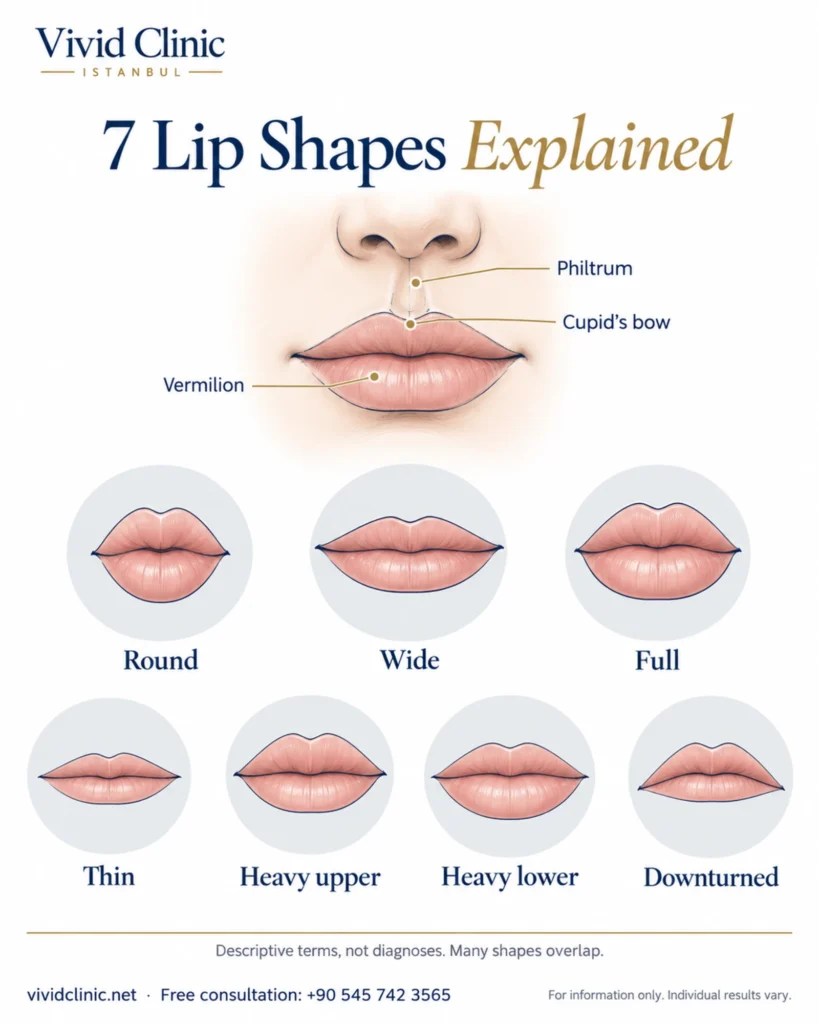

These are descriptive labels, not a clinical taxonomy — no surgical textbook classifies lips this way. They are still useful, because each maps onto a measurable dimension.
Full and thin describe vermilion height: how much red lip is on show. Round lips have generous vermilion height relative to mouth width, so the lip reads as a short, deep oval — compact rather than spread out, usually with a softer, less peaked Cupid’s bow. Wide lips are the opposite emphasis, horizontal width relative to the lower face; convention puts lip width at roughly 40% of lower-face width — an average, not a target. If you already have round lips, the usual goal is to refine the border or balance the corners rather than add more volume.
Heavy upper and heavy lower describe which lip carries more of that height — convention puts the lower lip taller, between 1.6:1 and 2:1. Downturned lips describe commissures sitting below the line of the mouth. None is a defect — they are just the coordinates a clinician uses to decide what to change.
How lips change with age — and why the lip lift exists

Lips age in a documented pattern, and not simply by “getting thinner”. Three things change at once, and only one responds to filler.
The red lip thins — thinning of the vermilion is described in the literature as a hallmark of natural aging — and as it inverts, the lip flattens and loses its pout. The skin portion of the upper lip lengthens as laxity increases, so the nose-to-lip distance grows, the philtrum loses definition, and less tooth shows when you smile. And the commissures descend. Vertical lip lines usually arrive around 40, driven by collagen and elastin loss, smoking and sun exposure.
That middle change is the one filler cannot fix, and it is the reason lip lifts exist. Descending commissures and a heavier jawline belong to lower-face aging more broadly — facelift territory rather than lip territory.
Hyaluronic acid filler: what it adds, and what it cannot
Filler adds volume. It does that well, but volume is only one of the three things that change in an aging lip.
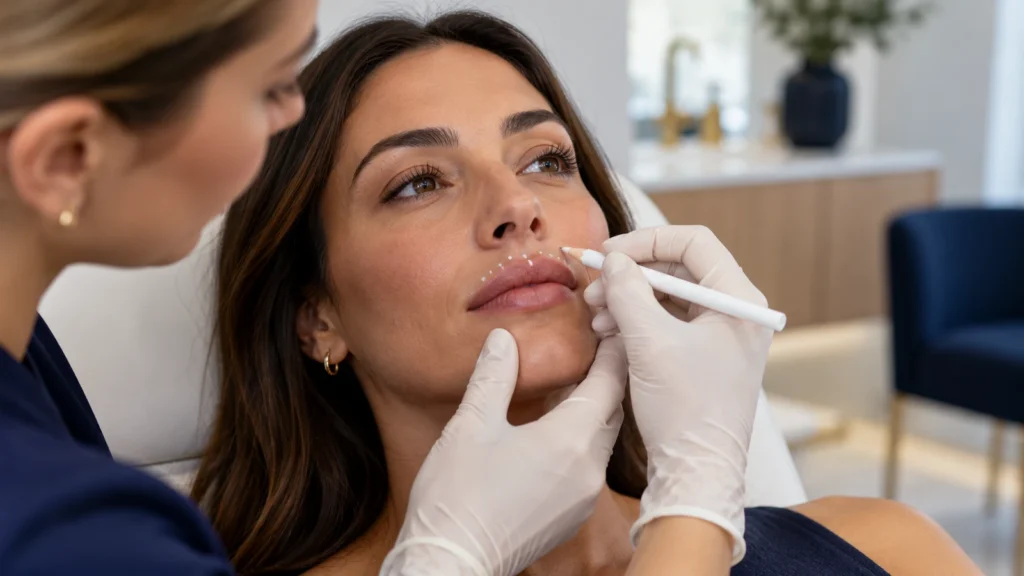
Modern lip filler is synthetic hyaluronic acid, a gel form of a substance the body already makes. Cleveland Clinic describes a typical treatment as around one milliliter — a fifth of a teaspoon — with swelling settling in 24 to 48 hours, occasionally up to a week. Duration is commonly quoted at six to eighteen months, and its great advantage is that it is reversible: hyaluronidase dissolves it. The FDA has not approved lip fillers for anyone under 21. For round lips, a conservative volume and careful placement along the border usually look more natural than a large syringe count.
What filler cannot do is shorten a long philtrum or raise a downturned corner, and adding volume to an already-long upper lip tends to make it read heavier, not younger.
The lip flip: a small dose of toxin, and its honest limits

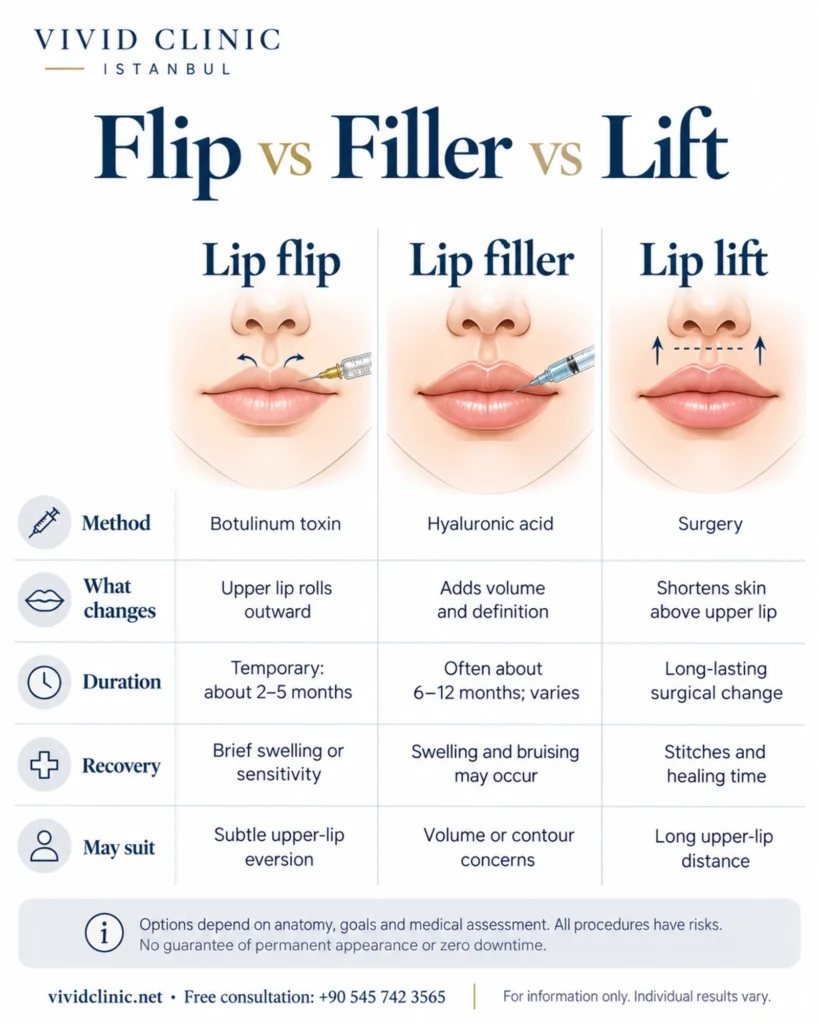
A lip flip is a small dose of botulinum toxin that relaxes the muscle at the upper lip margin so the lip rolls slightly outward. It adds no volume. It is subtle, and short.
Nothing shows immediately — Cleveland Clinic notes it takes about a week for the lip to look fuller. Duration is the trade-off: the American Society of Plastic Surgeons puts results at two to three months, Cleveland Clinic at two to five. Side effects include weakness around the mouth: difficulty with a straw, with whistling, sometimes with speech.
On “lip flip injection sites”. Much of what that search returns is a how-to. This article gives none: no injection-point map, no unit counts, no technique. Botulinum toxin is a prescription-only medicine, the target sits millimeters from the muscle that closes your mouth, and the difference between a good result and a mouth that cannot hold a straw is a matter of depth and dose judged against your own anatomy. A clinician assesses your tooth show, muscle strength and philtral length, then decides whether a flip is the right tool at all. That assessment is the treatment, and it is not something to attempt on yourself.
Surgical lip lift: shortening the philtrum, permanently
A lip lift removes a strip of skin between the nose and upper lip, shortening the philtrum so more vermilion shows and the lip rolls outward. It changes lip proportion rather than volume, and it is permanent.
The standard approach is the subnasal or “bullhorn” lift: a bullhorn-shaped incision under the nose, hidden in the creases at the nasal base, after which the center and sides of the upper lip are advanced upward. Cleveland Clinic describes suitable candidates as people with a thin, long upper lip — conventionally, around half the height of the chin — and little or no upper tooth showing at rest. A separate corner lift addresses downturned commissures, though ASPS surgeons caution it can leave visible scars. Because the incision sits at the nasal base, lip lift planning and rhinoplasty are often discussed together.
Lip lift recovery is typically outpatient under local anesthetic, with sutures out at roughly four to seven days and bruising usually gone inside a week. The scar takes longer: a fresh incision under the nose stays pink and firm for months before it fades. Anyone told a lip lift is “scarless” has been told something untrue.
In short: volume is a filler question, a vanishing lip suits a flip, a long upper lip needs a lift. Swelling makes the first two weeks misleading either way; our before-and-after gallery shows how facial work reads once healed.
Overfilling, migration and the complication that matters


Most lip filler goes uneventfully. Three things are worth understanding first.
Overfilling erases the landmarks a lip is judged by — a flattened Cupid’s bow, a filled-in philtral dimple, a blurred vermilion border and a shelf of product on the white skin above. “Migration” is the popular name for that shelf, though one long-term MRI follow-up found no movement of hyaluronic acid between facial fat compartments over 27 months — while still detecting filler at that point, well beyond the six to twelve months most consultations quote. The likelier explanation is product placed too superficially, or simply too much.
Vascular occlusion — filler entering or compressing an artery — is rare but urgent. Published guidance lists the warning signs: sudden, escalating pain, at the injection site or somewhere distant; blanching, followed by a mottled purple pattern; and capillary refill slower than two seconds compared with the other side. Changes usually appear immediately or within hours, occasionally days later. Treatment is prompt hyaluronidase, and prompt is the operative word.
The most useful question for an injector is not which brand they use but what would you do if my lip blanched? The NHS advises checking registration and avoiding anyone who has only done a short course, plus group treatments, voucher deals and treatments in homes or hotels. The FDA adds: never buy filler sold direct to the public, and never use needle-free “pen” devices.
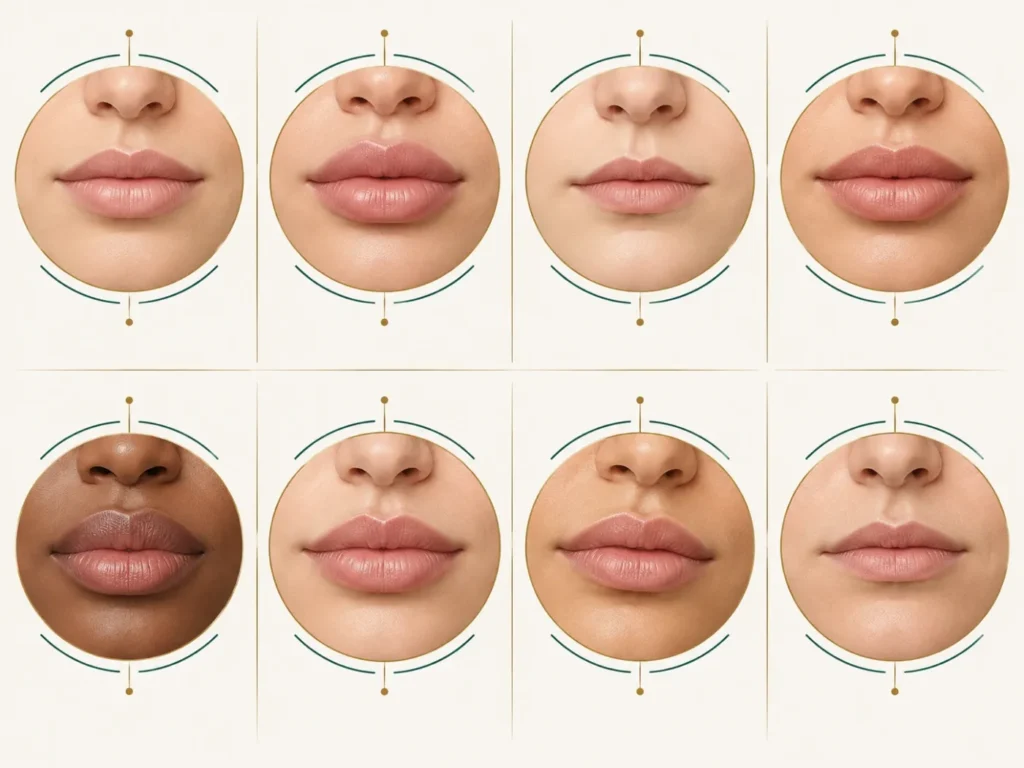
Lip Shapes and Filler Approaches: Visual Guide
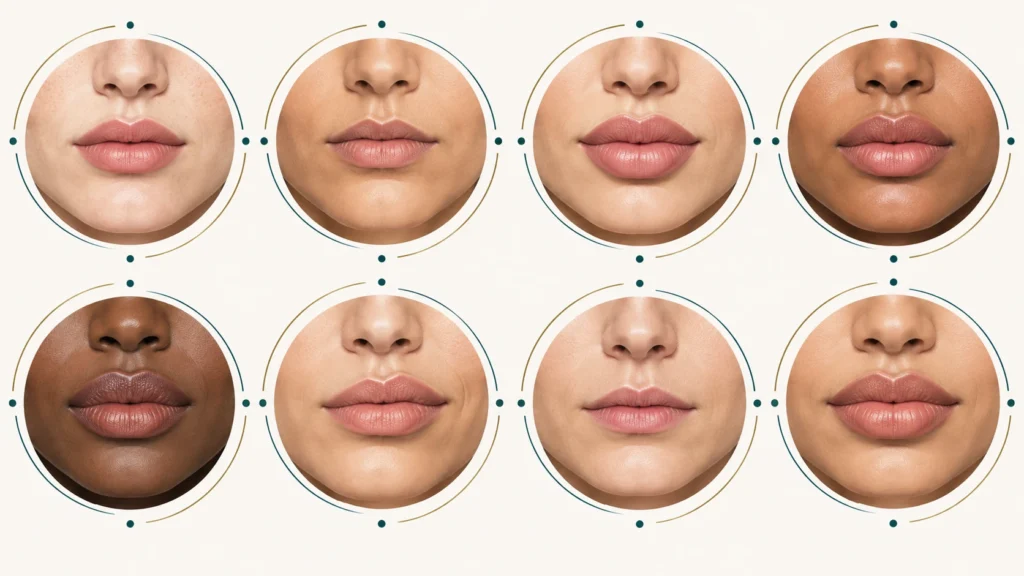
These illustrations compare round lips with other common lip shapes and show how filler, a lip flip and a lip lift each change the mouth. They are editorial illustrations, not patient photographs; your Vivid Clinic practitioner in Istanbul will assess your own lips in person.




Frequently Asked Questions
What are round lips?
Round lips is a descriptive term rather than a medical one. It describes a mouth where the vermilion — the red part — has generous height relative to width, so the lips read as a short, deep oval rather than a long horizontal line, usually with a softer, less peaked Cupid’s bow. It is a shape, not a condition.
What are the main types of lips?
There is no formal clinical classification, but the labels people use map onto measurable dimensions: full and thin describe vermilion height; round and wide describe height against width; heavy upper and heavy lower describe which lip carries more of it; downturned describes where the corners sit. Each responds to a different intervention — or to none.
Where does a lip flip get injected?
Patient-facing sources describe the general region — the upper lip margin and the corners of the mouth — but precise placement and dose are clinical decisions made against your own anatomy, and this article deliberately does not provide a technique guide. Botulinum toxin is a prescription-only medicine that must be prescribed and administered by a trained, registered clinician. If you are searching this in order to inject yourself, please do not: an over-treated result cannot be reversed.
Is lip filler reversible?
Hyaluronic acid filler is, which is the main reason it dominates lip treatment. Hyaluronidase, an enzyme that breaks down hyaluronic acid, dissolves it — and the same enzyme treats a filler-related vascular emergency. Dissolving is a medical procedure in its own right, and clinicians advise waiting some weeks before retreating. Fat grafting is not reversible.
How long does lip lift recovery take?
A lip lift is usually outpatient under local anesthetic, with stitches out at roughly four to seven days and bruising typically settling within a week. Most people are presentable within two weeks. The longer part is the scar under the nose, which stays pink and slightly firm for months before it softens and pales.
What are the warning signs of a filler complication?
Swelling, bruising and tenderness for a day or two are expected. What is not expected is pain that escalates rather than settles, or pain felt away from the injection site; skin that turns white or pale; a mottled, purple, net-like discoloration; or an area that stays pale for more than two seconds after you press and release. Any of these needs your injector contacted immediately, not tomorrow.
Not sure whether your lips need volume, a flip, or a change of proportion? Send photographs for a free online assessment and get a straight answer about which of the three would change what is bothering you — including when the answer is none of them.