
 ChatGPT

Medically reviewed by Prof. Dr. Özgür Pilancı, Plastic, Reconstructive & Aesthetic Surgeon — August 2026
Quick answer (updated August 2026): Two different operations get filed under one heading. Labiaplasty reduces or reshapes the labia minora. Perineorrhaphy — also called perineoplasty — repairs the perineal body, the muscular platform between the vaginal opening and the anus, usually after a childbirth tear that healed poorly. One fact matters more than either: labia minora vary enormously in size, shape, color and symmetry, and the overwhelming majority of people who ask about labiaplasty have entirely normal anatomy.
Normal covers a very wide range
There is no standard vulva, and the measured evidence says so. A study of 657 women aged 15 to 84 found labia minora length clustering roughly between 30 and 50 mm by age group, with widths near 10 to 15 mm.
Set that beside the marketing. Labia are routinely called “hypertrophic” above 30 to 40 mm — yet in that study, mean length exceeded that threshold in more than half of participants. The American College of Obstetricians and Gynecologists states that such tables should not be used to determine surgical appropriateness.
Asymmetry is normal, color varies with age, and labia minora extending beyond the labia majora are common rather than a deformity. The imagery people compare themselves against is edited or censored to remove protrusion, so the comparison was never real.

Functional symptoms and appearance concerns are different questions
Both are legitimate reasons to seek advice, and they are not the same conversation. Functional symptoms are mechanical and specific: tugging or twisting during cycling or intercourse, chafing in clothing, recurrent irritation, interference with hygiene.
Appearance concerns are about how the anatomy looks, measured against images that were never representative. What should follow is an examination, an explanation of the normal range, and time — not a booking. Neither means you need surgery.
Labiaplasty: what the two main techniques differ on
Both techniques reduce labial length. They differ in where the scar sits and what happens to the natural edge.
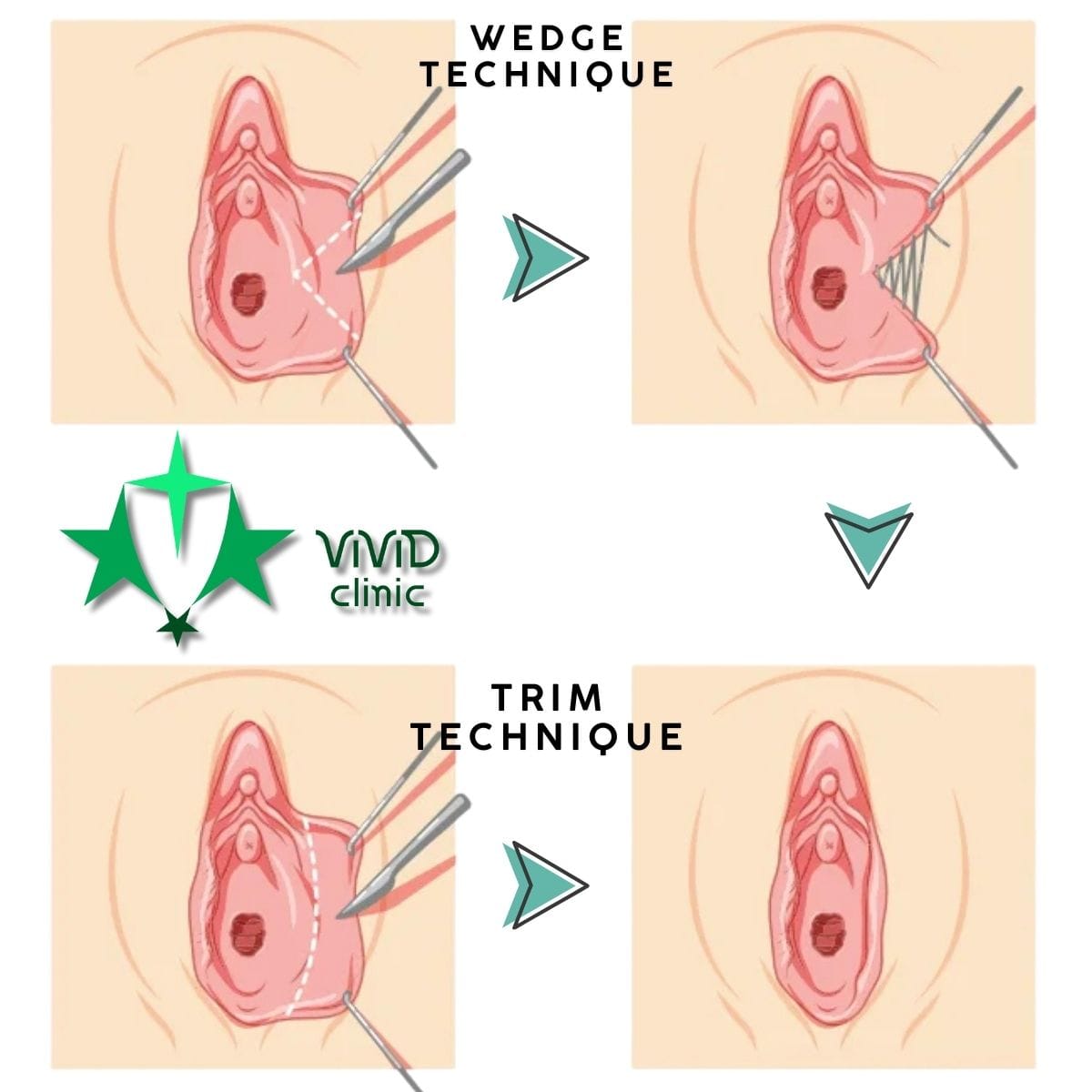
Trim, or edge excision, removes tissue along the free border and closes directly. It is quicker, and removes the border itself — which suits someone whose complaint is a thickened or darkly pigmented edge. The cost is a scar along that whole edge, with a recognized risk of irregular contour, asymmetry and altered sensation.
Wedge resection removes a V-shaped, full-thickness segment from the most protuberant part and closes the gap, keeping the natural border intact. The scar is a single transverse line, which is why it is held to disturb sensation less. It takes longer and has more reported healing difficulty at the closure. Neither is universally better.
Perineorrhaphy and perineoplasty: repairing the perineal body
This is the operation most people are actually looking for when they search the term, and it is reconstructive rather than cosmetic. The perineal body is the fibromuscular anchor between the vaginal opening and the anus, where the bulbospongiosus, superficial transverse perineal muscles and external anal sphincter converge — and the most common site of injury in childbirth.
Up to 90% of vaginal births involve some tearing, most of it first- or second-degree. Third- and fourth-degree tears — obstetric anal sphincter injuries, or OASIS — are far less common: the Royal College of Obstetricians and Gynaecologists puts them at about 3 in 100 vaginal births, and 6 in 100 first births.
Tears are repaired at delivery. Perineorrhaphy is what happens later, when that repair has not held or has healed badly: scar tissue is excised, the separated muscle layers are re-approximated, and the height of the perineal body and the angle of the vaginal opening are restored. Perineoplasty and perineorrhaphy are used interchangeably.
Be equally clear about what it does not do: it does not repair a damaged anal sphincter, which is a separate operation, and it treats neither urinary incontinence nor prolapse.
Recovery runs six to eight weeks, with nothing inserted into the vagina for at least six. After a sphincter injury the RCOG describes soreness for four to six weeks, review at six to twelve weeks, and reassures that six to eight in ten women have no lasting problems. If symptoms persist six months after birth, get assessed rather than research surgery.

Vaginoplasty, “tightening,” and what the evidence supports
Vaginoplasty — posterior colporrhaphy — brings separated muscles together and removes excess vaginal lining. The evidence behind it is thin, and thinner still for the non-surgical versions.
ACOG’s assessment is that published data on genital cosmetic procedures is largely expert opinion, case reports and small series, and that current evidence does not support improvement in body image, libido or sexual satisfaction. In 2018 the US Food and Drug Administration warned that the safety and effectiveness of energy-based devices for this has not been established, citing reports of vaginal burns, scarring and painful intercourse.
For many symptoms after pregnancy, the correct answer is not surgery at all. Supervised pelvic floor muscle training is first-line: NICE recommends at least three months for stress or mixed urinary incontinence and four for prolapse. Abdominal wall changes after pregnancy are a separate problem with a separate operation, covered on our tummy tuck page.

Recovery, scars and sensation
Expect a longer timeline than the marketing suggests. After labiaplasty a first review at about a week is standard, nothing goes into the vagina for at least four to six weeks, and exercise is restricted similarly.
Most distorting swelling has gone by six weeks, but some persists up to six months — which is why no surgeon should judge or revise a result before then. Early altered sensation is common and usually settles; reduced genital sensitivity is a recognized permanent risk, listed by the NHS.

Risks you should hear about before consenting
The risk list is not short, and a consultation that glosses over it is not a consultation. ACOG lists pain, bleeding, infection, scarring, adhesions, altered sensation, painful intercourse, reoperation, hematoma, fistula and wound breakdown.
Over-resection deserves particular weight. The American Society of Plastic Surgeons calls it the most common complication of labiaplasty, producing chronic dryness, scarring and pain with intercourse — and it is the hardest to undo, because there is no spare tissue to put back. Wound problems follow perineal repair too: after childbirth-related repairs, roughly 25% of women have some breakdown and 20% an infection within six weeks.
When you need a gynecologist, not a cosmetic surgeon
Some symptoms are not cosmetic problems, and treating them cosmetically can make them worse. See a gynecologist rather than a cosmetic surgeon if any of these applies.
A bulge, heaviness or something coming down suggests pelvic organ prolapse. Leaking urine, stool or wind, or urgency, needs assessment, and physiotherapy comes first. Persistent pain or burning, or pain with intercourse not confined to a scar, needs a diagnosis first. A lump, an ulcer, unexplained bleeding or a rapid change in appearance should be examined promptly.
Itchy white patches, skin that splits easily, or shrinking of the vulva may be lichen sclerosus. It needs diagnosis and steroid treatment, is not corrected by cutting, and carries a raised risk of vulval cancer — which is why it must never be handled as an aesthetic complaint.
Expectations, body image and why a careful clinic slows down
A good consultation on this subject should feel slower than you expect. That is a feature, not an obstacle.
ACOG expects clinicians to screen for sexual dysfunction, depression, anxiety and body dysmorphic disorder, to refer for psychological evaluation before surgery wherever a concern exists, and to explore motivation carefully enough to rule out pressure from a partner or family member. UK guidance notes that the wish for labial reduction can be a displacement for other anxieties — in which case counseling, not surgery, is the right response. Relief of a mechanical symptom is achievable; a transformed relationship with your body is not.
Age, development and safeguarding
This surgery is not appropriate for minors outside a genuine medical indication. That is not a cautious hedge — it is the settled position of the relevant professional bodies.
The labia continue developing through puberty and into early adulthood, which is why the NHS states plainly that labiaplasty should not be performed on girls under 18, and UK and Australian guidance agrees. ACOG allows an exception only for significant congenital malformation, or persistent symptoms directly attributable to the labial anatomy.
Related Before and After Results at Vivid Clinic
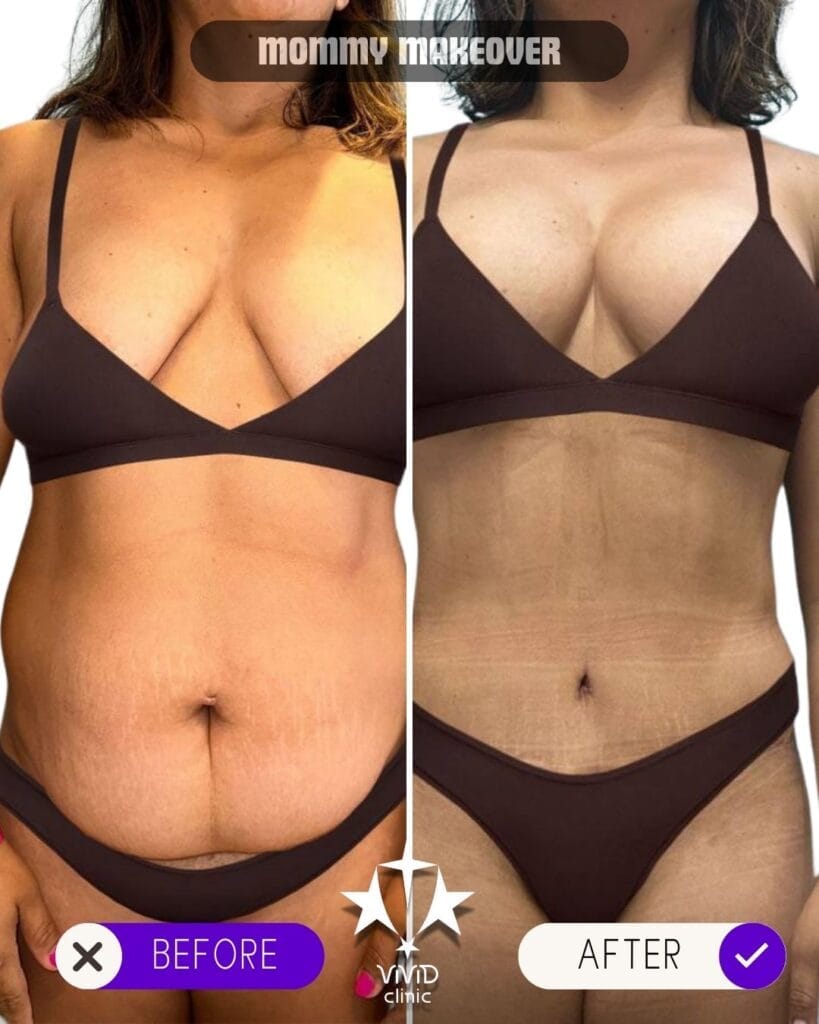
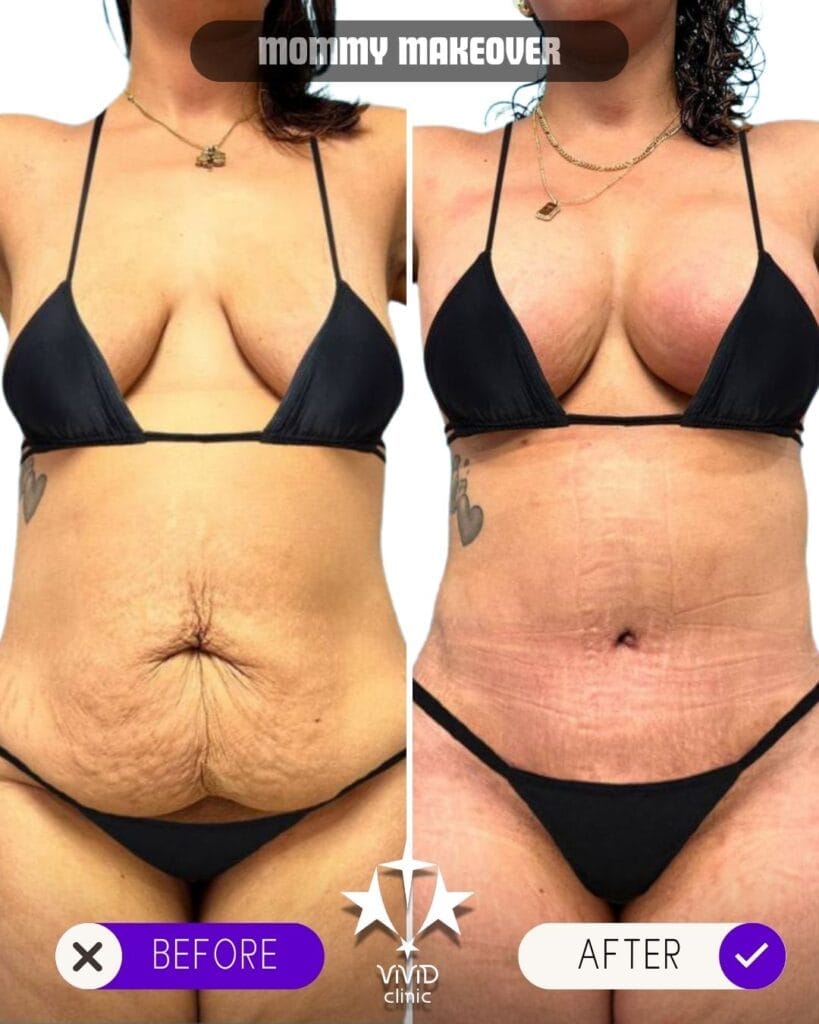
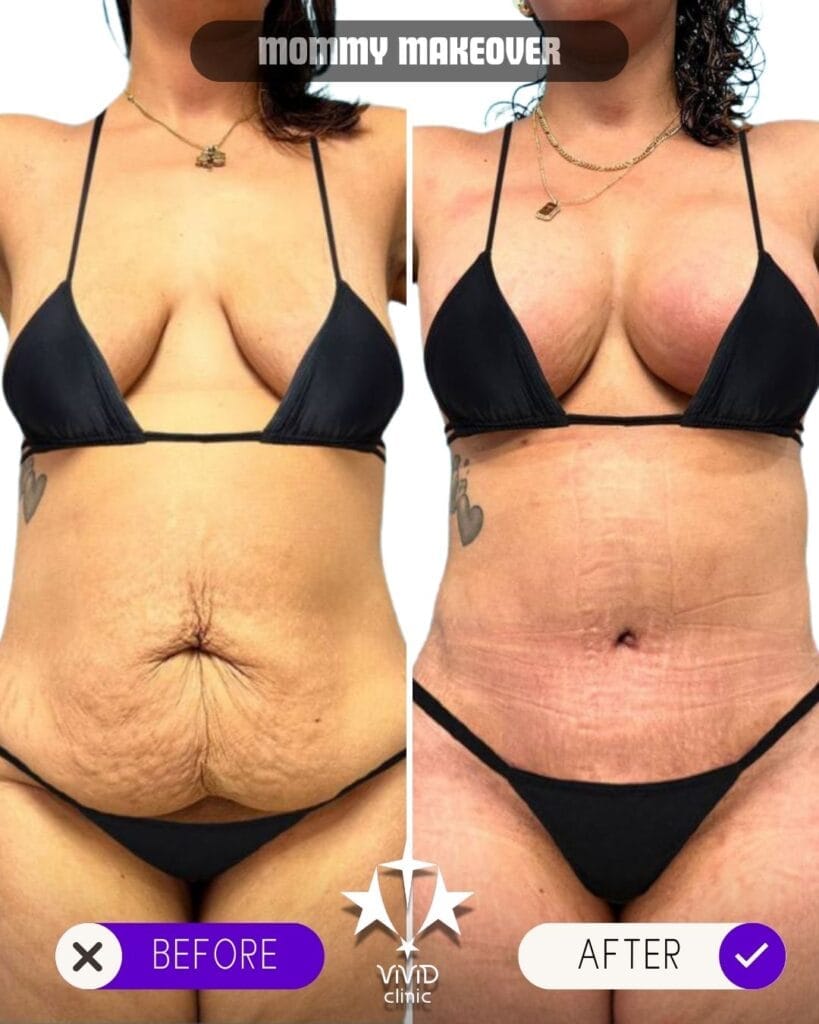
The photos below show real Vivid Clinic patients who had tummy tuck combined with intimate surgery — a related procedure, not perineorrhaphy itself — shared with their consent to show how our Istanbul team documents results. Ask during your free consultation to see cases that match your own treatment. Individual results vary. Browse the full Before & After Gallery.
Frequently Asked Questions
What is a perineorrhaphy?
It is a surgical repair of the perineal body, the fibromuscular structure between the vaginal opening and the anus where several pelvic floor muscles converge. It is usually performed after childbirth injury, when a tear or episiotomy repair has broken down or left painful scar tissue. The surgeon excises the scar, re-approximates the separated muscle layers and restores the perineal body’s height.
Is perineorrhaphy the same as perineoplasty?
In practice the terms are used interchangeably, and both describe repair of the perineum. Some surgeons reserve perineorrhaphy for suture repair of a specific defect and use perineoplasty more broadly. What matters more is what is being repaired: ask the surgeon to describe the defect found on examination, and if they cannot point to one, question whether an operation is the answer.
How do I know whether my labia are normal?
Almost certainly they are. Measurement studies show labia minora length commonly falling anywhere between roughly 30 and 50 mm, with wide variation in width, color and texture, and asymmetry between the sides is the norm. Extending beyond the labia majora is common and is not a defect. ACOG warns explicitly that measurement tables should not be used to decide whether surgery is appropriate.
How long after surgery before sex can resume?
Plan on at least four to six weeks after labiaplasty and at least six after a perineorrhaphy, with nothing else inserted into the vagina in that time either. This is not a figure to negotiate down: the tissue is under tension while it heals, and early strain is a leading cause of wound breakdown.
Does vaginal “tightening” surgery actually work?
The honest answer is that the evidence is weak. ACOG’s position is that published data on these procedures is largely expert opinion, case reports and small series, and that current evidence does not support improvement in body image, libido or sexual satisfaction. Energy-based devices carry an explicit FDA warning that their safety and effectiveness is not established. For symptoms after pregnancy, supervised pelvic floor physiotherapy is first-line.
Can a teenager have labiaplasty?
Not for appearance. The labia continue developing through puberty into early adulthood, which is why NHS, UK and Australian guidance all advise against genital cosmetic surgery under 18. ACOG permits an exception only for significant congenital malformation or symptoms directly caused by the labial anatomy. A distressed teenager needs examination, reassurance about the normal range and, where appropriate, psychological support — not an operation.
Not sure whether what you are describing is a surgical problem at all? Ask for an unhurried, private consultation and expect a straight answer — often that your anatomy is entirely normal, or that the right person to see is a gynecologist.