
 ChatGPT
Medically reviewed by Prof. Dr. Özgür Pilancı, Plastic, Reconstructive & Aesthetic Surgeon — August 2026
Quick answer (updated August 2026): Knowing the early signs of infection after surgery, and how they differ from normal healing, helps you act quickly. Most recoveries after cosmetic surgery are uneventful. Pain, swelling and bruising that peak in the first two to three days and then steadily improve are normal healing. The warning pattern is change in the wrong direction after day two or three: worsening pain, spreading redness, discharge turning thick or foul-smelling, fever, or wound edges turning dusky, white or black. Infection is very treatable and tissue damage manageable — when caught early. If something on this page matches what you see, contact your surgical team today:.
Normal healing vs warning signs, symptom by symptom
Almost everyone recovering from surgery wonders whether what they see is normal. Almost always, it is: surgical site infections affect roughly 1 to 3 in 100 surgical patients, and tissue necrosis is rarer still. The useful skill is knowing the handful of signs that matter. Spreading redness and warmth can signal cellulitis, which the NHS describes in its guide to cellulitis.
Pain. Normal surgical pain is worst in the first 48 to 72 hours, then improves a little every day and stays controllable with prescribed medication. The warning sign is the reversal: pain that had been settling and worsens after day two or three, or one spot turning severe and throbbing.
Swelling. Normal swelling is symmetrical, comes up over the first days, and settles gradually over weeks. The warning sign is a sudden, one-sided increase — especially if the area feels tense and looks bruised, suggesting bleeding under the skin (a hematoma) — or any rapidly expanding swelling.
Redness. A narrow rim of mild pinkness along the incision line is normal. Redness that spreads outward day by day, feels hot, or travels as a streak away from the wound suggests cellulitis, a skin infection needing prompt treatment.
Discharge. A little clear or slightly blood-tinged fluid in the first days is common. Thick, cloudy, white-yellow or green discharge — especially foul-smelling — is a sign of infection.
Fever. A slightly raised temperature in the first day or so can be part of the normal response to surgery. A fever above 101°F (38.4°C), or fever with chills, should be reported the same day.
The wound edges. Healing edges are pink and gradually knit together. Edges turning dusky purple, grey, white or black, or nearby skin becoming cool, pale or mottled, need review quickly — that is compromised blood supply, covered below.


Surgical site infection: timeline, risk and treatment
Wound infections rarely appear immediately. Most declare themselves three to seven days after surgery, and a surgical site infection can arise up to 30 days after an operation — for many international patients, after the flight home; the final section covers that.
More than half of surgical site infections are superficial — skin and the tissue just beneath it. Deeper infections — under the fascia, or around an implant — are rarer and more serious, announcing themselves with fever, malaise and pain out of proportion to the wound’s appearance.
Smoking, diabetes (especially if poorly controlled), immunosuppression, obesity and malnutrition all raise infection risk — which is why stopping smoking around surgery is a safety instruction, not a lifestyle suggestion. Treatment is usually straightforward when started early: a wound swab, antibiotics, and sometimes opening part of the incision to let an infected collection drain. What turns a treatable infection into a serious one is mostly delay.
What “necrotic” actually means
Necrosis means tissue death. When cells are injured beyond recovery — most often because their blood supply has failed — they die and cannot regenerate. “Necrotic” simply describes tissue that has died — an end state, and it always has a cause.
After surgery, that cause is almost always circulation. An operation that lifts and moves skin — a facelift, a breast reduction or lift, a tummy tuck — asks the repositioned skin to survive on a reduced blood supply while new vessels grow in. Usually it does. When the supply is not enough, the tissue furthest from good circulation — typically the wound edge — begins to die. This is skin necrosis, and the larger the lifted flap, the more the blood supply must do.
Who is most at risk? Smokers, above everyone else. Nicotine narrows small blood vessels and smoking impairs oxygen delivery — exactly what a healing flap cannot afford. In a classic facelift series, skin sloughing was roughly three times more common in smokers — consistent enough that many surgeons decline to operate on active smokers. Diabetes, previous scarring or radiotherapy, and very tight closure add risk.
What early trouble looks like. Compromised skin does not go black overnight — it progresses, and the early stages are the treatable ones: skin that stays pale or turns dusky purple, feels cool, or looks mottled → then blistering → then a dry, leathery black eschar (a scab of dead tissue). If you see the early signs, do not wait for the late ones — contact your surgical team the same day:.
Caught early, compromised skin can often be rescued — by relieving tension, treating infection, improving oxygen delivery (stopping smoking immediately matters even now; selected cases get hyperbaric oxygen) and careful wound care. Even established small-area necrosis usually heals with dressings, though it may leave a wider scar. Early recognition changes the outcome.
The types of necrosis, briefly
Search “types of necrosis” and you will find a pathology classification; the terms sound more alarming than they are.
Coagulative necrosis is what happens when blood supply fails in most solid tissues — the dead tissue keeps its structure for a time; ischemic skin necrosis is essentially this. Liquefactive necrosis is tissue digested into liquid — the pattern of bacterial infection; pus is the everyday example. Other patterns — caseous, fibrinoid, gangrenous — belong to conditions outside cosmetic surgery.
Fat necrosis is the one cosmetic-surgery patients actually meet. After breast surgery, fat grafting or a tummy tuck, fat with marginal blood supply can die and be walled off, presenting weeks or months later as a firm, usually painless lump, sometimes an oil cyst. Post-surgical fat necrosis is benign — not cancer, never becomes cancer, and often softens on its own over months. But because a firm breast lump can feel and even image like a tumour, every new lump deserves professional assessment, usually with imaging — in either direction, do not self-diagnose.

Seroma, hematoma or abscess?
Three kinds of lump get confused; they differ in urgency.
A seroma is a pocket of clear, straw-coloured tissue fluid — a soft, squishy swelling appearing about seven to ten days after surgery, most often after operations that create a space under the skin, such as a tummy tuck. Small seromas are absorbed by the body; larger ones may need drawing off with a needle. A nuisance, not an emergency — unless it becomes hot, red and painful, suggesting infection.
A hematoma is a collection of blood. It usually appears within the first day or two, as a tense, bruised, painful, one-sided swelling. A small stable hematoma may only prolong bruising; a rapidly expanding one is urgent, because active bleeding needs to be stopped.
An abscess is an infected, pus-filled collection: hot, increasingly painful, often with fever. Abscesses need drainage — antibiotics alone rarely clear them — so: prompt review, not wait-and-see.
Go to emergency care now if…
Some symptoms bypass the clinic. Call emergency services or go to the nearest emergency department — wherever you are — for any of the following:
- Throbbing pain or swelling in one calf or leg — a possible deep vein thrombosis (DVT), a recognised risk in the weeks after any surgery.
- Breathlessness or chest pain, with or without leg symptoms — a possible pulmonary embolism. An emergency-services call, not a clinic call, and not something to sleep on.
- Spreading redness with fever, or feeling rapidly, severely unwell.
- Signs of sepsis: confusion or slurred speech; blue, grey, pale or blotchy skin or lips; a rash that does not fade when pressed; difficulty breathing; passing little or no urine.
- A wound that opens (dehiscence), especially if deeper tissue is visible.
- Any rapidly expanding swelling at the surgical site.
None of these are common; all are time-critical. Clinic for concerns, emergency department for emergencies.

Spots and pimples near the wound
A crop of small spots around a dressing or along shaved skin is usually not a wound infection. Dressings, tape, compression garments and regrowing hair commonly cause folliculitis or acne-like lesions — small pimples centred on hair follicles, without spreading redness or fever — which settle once the skin can breathe. The distinction: folliculitis is scattered spots on calm skin; infection is a hot, spreading, increasingly painful area around the incision itself. If unsure, a photograph sent to your surgical team settles it quickly.
If you have flown home and something looks wrong
Because infections most often appear from day three onward, a problem may only declare itself after you are back home. If it does: photograph the area in good light, contact the clinic that operated on you, and see a local doctor or urgent-care service — all three; the local doctor is not optional. Never wait for a flight back to Istanbul to have a spreading infection, a suspected DVT or a deteriorating wound assessed — these conditions are treated by time, and any qualified doctor anywhere can start treatment. Your surgeon can then advise remotely and plan any revision once you are safe. For anything on the emergency list, use local emergency services first and inform the clinic second.

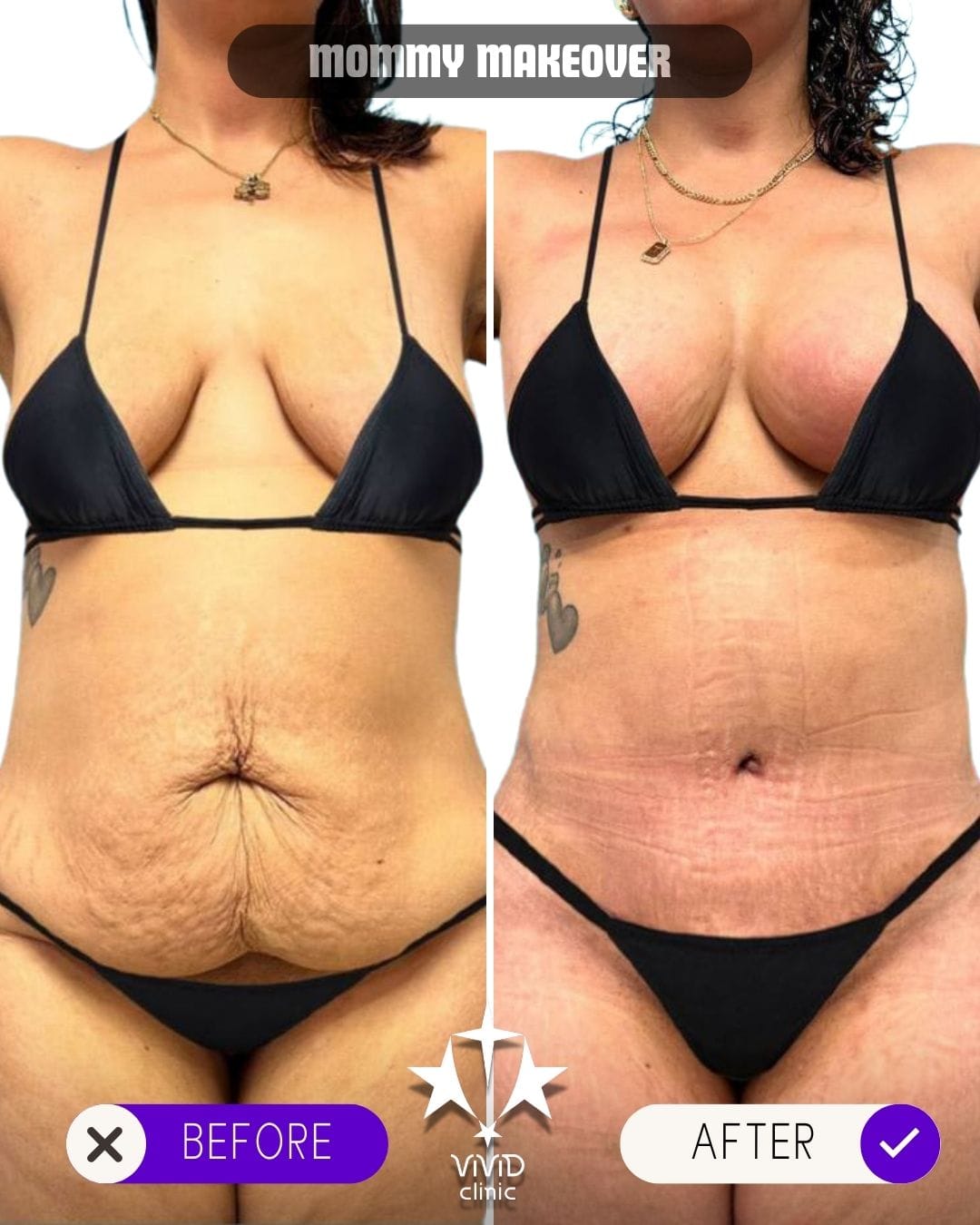
Related Before and After Results at Vivid Clinic
The photos below show real Vivid Clinic patients who had tummy tuck (healed results) — a related procedure, not infection care itself — shared with their consent to show how our Istanbul team documents results. Ask during your free consultation to see cases that match your own treatment. Individual results vary. Browse the full Before & After Gallery.



Frequently Asked Questions
What does necrosis mean?
Necrosis means the death of body tissue, most commonly because its blood supply has been cut off, but also through severe infection, trauma or chemical injury. “Necrotic” describes tissue that has already died and cannot recover, so treatment focuses on the cause, protecting surrounding healthy tissue, and removing dead tissue where needed. After cosmetic surgery it is rare and almost always relates to blood supply at the edges of lifted skin.
What are the first signs of infection after a surgery?
Increasing rather than decreasing pain, redness spreading outward from the incision, warmth, thick or foul-smelling discharge, and fever above 101°F (38.4°C). Timing is a clue: infection typically appears three to seven days after surgery. A wound that was settling and then deteriorates is the classic pattern and deserves a same-day call.
What does the start of skin necrosis look like?
Early compromised skin looks pale, dusky purple or mottled, and may feel cool — usually at the wound edges, where circulation is weakest. If blood supply is not restored, blistering follows, then a dry black eschar. The early, discoloured stage is the treatable one — any dusky or darkening area near an incision should be reviewed promptly, not watched for a week.
I found a hard lump under my scar — is it necrosis or something worse?
A firm, painless lump appearing weeks after breast or abdominal surgery is most often fat necrosis: fat that lost its blood supply and has been walled off. It is benign, does not turn into cancer, and often softens over months. But because a firm lump — particularly in the breast — cannot be reliably distinguished from a tumour by touch, every new lump should be assessed professionally, usually with imaging.
When is swelling after surgery an emergency?
Two situations. First, swelling at the surgical site that expands rapidly, feels tense and is one-sided — a possible active bleed (hematoma) needing urgent review. Second, swelling in one calf or leg at any point in the weeks after surgery — a possible deep vein thrombosis. Add breathlessness or chest pain and it may be a pulmonary embolism: call emergency services immediately.
I had surgery abroad and my wound looks infected now that I am home. What should I do?
Do three things, today: photograph the wound in good light, contact your operating clinic, and see a local doctor or urgent-care service. Do not choose between the last two — infections and clots are treated by time, and any qualified doctor can start treatment. Your surgeon can advise remotely and plan follow-up once the immediate problem is controlled. For emergency symptoms, use local emergency services first.
Worried about something you can see right now? Contact our post-operative care team — — and send photographs; a same-day answer is what this service is for. For anything on the emergency list above, go to your nearest emergency department or call your local emergency number first, wherever you are.