
 ChatGPT
Quick answer: Hip dip fat transfer is a fat grafting approach that some patients consider to soften the look of the outer hip. It is not right for every hip contour, and it carries specific surgical risks. At Vivid Clinic in Istanbul, Turkey, you can request a free consultation with a plastic surgeon to discuss whether any option fits your goals.
Editorially reviewed by the Vivid Clinic Surgical Board. Last updated: October 2026.
Many people notice a small inward curve on the outer hip, just above the thigh, and wonder whether it needs attention. This curve is a normal variation in body shape. Hip dip fat transfer is one of several options people research when they want the outer hip to look fuller, and it is worth understanding what it can and cannot do before you think about treatment.
This guide explains how fat grafting works in the lateral hip, how it compares with fillers, and which questions to bring to a consultation. The article is educational and does not replace a personal medical assessment.
What Fat Grafting Changes in the Lateral Hip
The outer hip is shaped by the pelvic bone, the muscle layers over it, and the fat and skin on top. A hip dip is usually a contour of this layered structure rather than a defect. Fat grafting moves fat from one part of the body to another, so any change to the outer hip depends on how much fat can be added there and how the surrounding tissue responds.
Fat grafting adds soft tissue volume, but it cannot change the shape of bone. If the curve is driven mainly by the underlying bone or muscle, added fat may change the surface less than people expect.
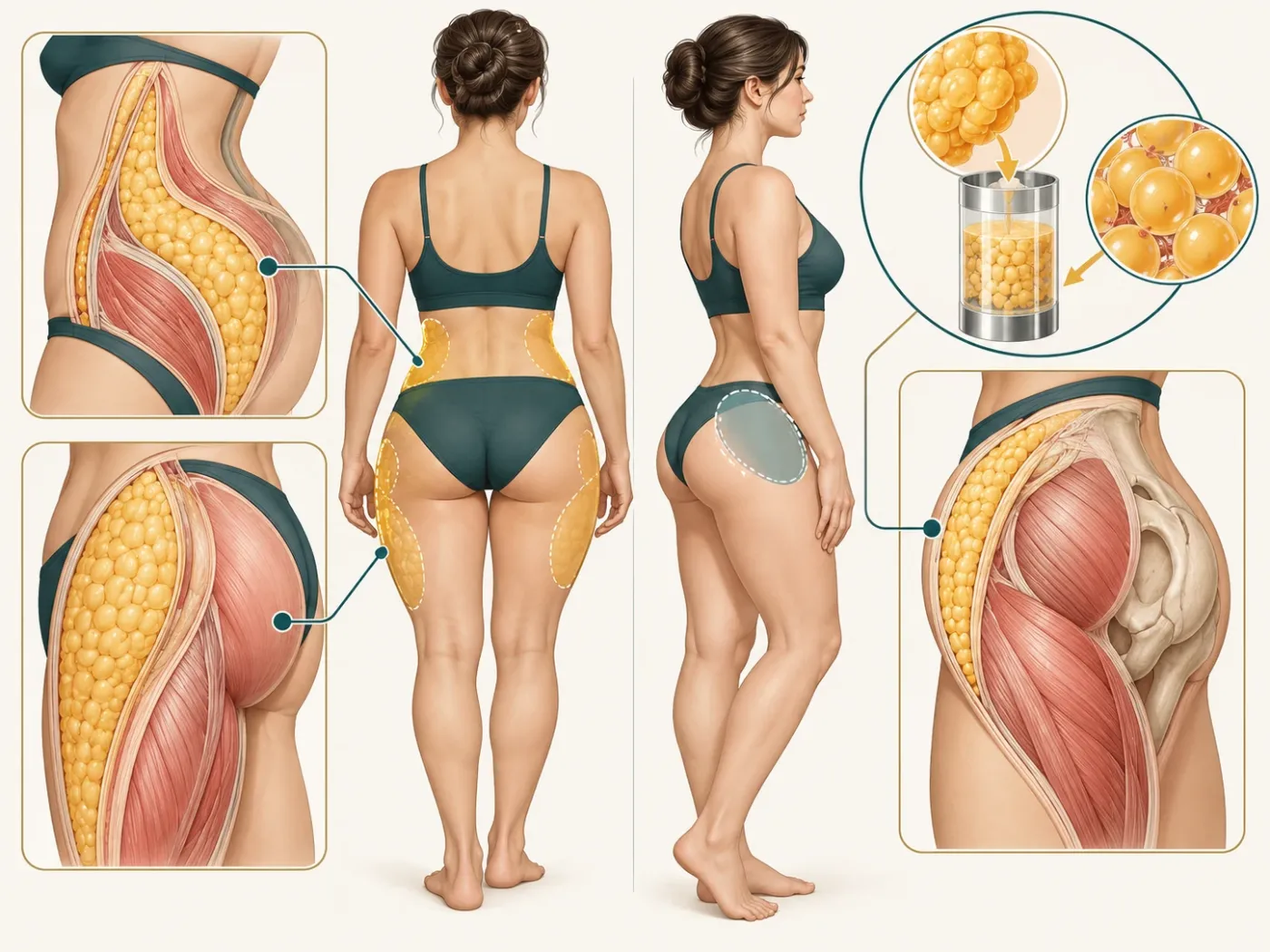
Transferred fat may not all stay. The American Society of Plastic Surgeons describes fat necrosis as a possible complication, meaning some fatty tissue may die after treatment. Because the amount retained is not fully predictable, a surgeon will usually explain how the result may change over time.
Donor Fat and Candidacy Assessment
Fat grafting needs donor fat, which is usually collected from another area of the body with a liposuction-type technique. Vivid Clinic offers VASER liposuction, but whether any donor-site work is part of a lateral hip plan is confirmed only at consultation.
Candidacy depends on more than the wish to change a contour. A surgeon usually reviews overall body proportions, the amount of available donor fat, skin quality, previous surgery, and whether the goal is realistic. Medical conditions, current medications, smoking, and pregnancy or breastfeeding plans can all change what is advisable, so these are reviewed in detail before any decision.
Fat Transfer Versus Fillers: A Comparison
Some readers compare fat grafting with injectable fillers because both aim to add fullness. They work differently. Fat grafting uses the patient’s own tissue, while fillers are a different material placed by injection. The American Society of Plastic Surgeons notes that most fillers dissipate over time, and that repeat treatment may be needed to maintain results.
The Society’s dermal filler safety guidance is written mainly for facial use. It describes risks including lumps, asymmetry, skin damage, and, in very rare cases, filler blocking a blood vessel. This article does not claim that filler is offered for the hip. Whether any filler option suits your outline, and whether it is available at all, is confirmed only at consultation.
Comparing the two is less about which is better and more about durability and the trade-offs you are willing to accept. Fat graft volume depends on how much fat survives, while filler effects fade on a schedule set by the product and the body.
Technique, Safety and Surgeon Selection
Technique matters because the safety of fat grafting depends heavily on where the fat is placed. The Multi-Society Task Force for Safety in Gluteal Fat Grafting issued an advisory on gluteal fat grafting stating that fat should be placed in the subcutaneous tissue and never in the muscle. The advisory links fatal fat embolism, in which fat enters the venous circulation, to deaths it reviewed.
That advisory concerns buttock procedures and does not automatically transfer to lateral hip anatomy, but the principle of avoiding deep or muscle placement is directly relevant. The American Society of Plastic Surgeons also notes that fat embolism is more likely with injection into muscle, high pressure, or very small cannulas.
Surgeon selection matters for these reasons. Ask who will perform the procedure, what training and experience they have in fat grafting, and how the facility handles emergencies. Look for board certification, and verify credentials through official registries rather than relying on marketing claims alone.
Retention, Asymmetry and Staged Results
Fat retention varies from person to person. Early swelling can make a result look larger, and as swelling settles the shape can change. The Aesthetic Society notes that swelling after butt lift procedures may last weeks or even months in some cases, and that final results after Brazilian butt lift fat grafting may take three to six months to become evident.
Asymmetry can occur between the two sides, and sometimes a second session is discussed. The Multi-Society advisory recommends considering staged procedures when the desired result may require more than one operation.
Hip Dip Fat Transfer: Candidacy and Reasons to Defer Treatment
There are good reasons to defer any treatment decision. Consider waiting if you are dealing with an unresolved health issue, if you are pregnant or planning a pregnancy, if you are not comfortable with the recovery plan, or if you feel pressure from others rather than your own goals. A consultation is also a chance to ask whether treatment is needed at all.
Fat embolism and anatomy-specific safety are reasons for caution. Fat grafting near the hip involves deep tissue layers and blood vessels, so the risks are not trivial. Fat or filler should never be injected outside a licensed clinical setting, and online instructions from unverified sources should not be followed.
Hip Dip Fat Transfer Overview: Realistic Expectations
Optional overview of relevant treatments, not a recovery table for a natural feature.
| Aspect | Details |
|---|---|
| Duration Process | Fat grafting: not stated in the sources reviewed for this article; set individually at consultation. Fillers: depends on the product and the plan, confirmed by the clinician. |
| Hospitalization Duration | Fat grafting: the American Society of Plastic Surgeons advises surgery in a certified ambulatory surgery center or hospital operating room. Whether an overnight stay is needed is confirmed by the treating clinician. Fillers: not covered by the sources reviewed; confirmed by the clinician. |
| Mobility Duration | Fat grafting: walking is generally advised after the second postoperative day to help prevent blood clots, per The Aesthetic Society guidance for Brazilian butt lift fat grafting. |
| Return to Activity | Fat grafting: desk work, driving, and similar activity after about 10 to 14 days in Brazilian butt lift guidance, using a pillow when sitting; strenuous exercise after about eight weeks. These are not verified for the lateral hip. Fillers: not covered by the sources reviewed. |
| Complete Recovery | Fat grafting: swelling may last weeks or even months, and final results may take three to six months to become evident, per Brazilian butt lift guidance. Lateral hip settling is individual and confirmed by the surgeon. |
| Anticipated Results | Fat grafting: retention varies, and the result is assessed after swelling settles. Fillers: most dissipate over time, and repeat injections may be needed to maintain results, per ASPS filler safety guidance. |
The timings above come from published guidance for Brazilian butt lift fat grafting, which involves a different body area. Lateral hip timings are not verified in the sources reviewed for this article, so treat them as a starting point for discussion. Your surgeon sets the actual timeline for your plan.
How to Prepare for a Hip Dip Fat Transfer Consultation
Preparation starts with an honest health history. Bring a full list of medications and supplements, previous surgeries, any bleeding or clotting history, and known allergies. Mention any functional concerns, such as how the curve affects clothing, posture, or comfort, because these shape which options are relevant.
Set realistic goals. Describe the shape you want in your own words, and ask the surgeon what can and cannot change. Do not self-diagnose or start any unsupervised treatment before a clinician has assessed you.
Hip Dip Fat Transfer Recovery and When to Judge Results
Recovery has two stages. Early effects such as swelling, bruising, and tenderness settle over the first weeks. Tissue settling continues for longer, and the final shape is assessed later. Published guidance on Brazilian butt lift fat grafting notes that compression garments are typically worn for six to eight weeks, though the plan for your own hip will be set by your surgeon.
Aftercare usually includes walking as soon as your surgeon advises, following instructions on garments and activity, and attending every follow-up visit. Report unusual pain, fever, or changes in skin color to the treating team promptly.
Hip Dip Fat Transfer Risks, Limitations and Medical Red Flags
Fat grafting is surgery and carries real risks. The American Society of Plastic Surgeons lists general surgical risks for buttock enhancement, including bleeding, infection, fluid accumulation, skin loss, poor wound healing, and deep vein thrombosis. Its safety page also lists fat necrosis, meaning some fatty tissue may die. Risks should be discussed in detail before you give consent.
Fat embolism is the most serious concern raised in the sources reviewed. Any symptom after surgery that worries you should be reported to the treating team immediately, and severe symptoms require emergency care without delay.
Limitations include uncertain fat retention, the possibility of asymmetry, and the fact that some outlines are shaped by bone and muscle rather than soft tissue. Medical assessment comes first. If you have a history of blood clots, heart or lung conditions, or bleeding disorders, speak with a clinician before considering any procedure.
What Affects the Cost of Hip Dip Fat Transfer in Istanbul
No single fixed price applies to a hip dip fat transfer. Related options are listed on the Vivid Clinic body aesthetic services page. Cost depends on the surgeon’s experience, the facility, the type of anesthesia, the complexity of the plan, whether other procedures are combined, travel and accommodation, and aftercare.
To compare fairly, ask each clinic for a written, dated quote that lists what is included and what is not. A lower number may leave out follow-up visits, facility fees, or anesthesia. This article does not state any price or average, because quotes are individual to the plan.
Hip Dip Fat Transfer in Istanbul: Your Patient Journey at Vivid Clinic
If you choose to explore care with Vivid Clinic, the journey begins when you arrive in Istanbul, Turkey. Where the package includes it, a VIP airport transfer collects you and brings you to a five-star hotel for check-in, and eligibility for these transfer and hotel benefits is confirmed at consultation because they apply to select procedures. Your one-on-one consultation with the medical team follows, where the surgeon reviews your anatomy, medical history, goals, and whether any option is appropriate. If a treatment is recommended, the surgery or treatment day is planned in advance for your comfort and safety. Postoperative care follows, then a check-up visit before you depart. After you return home, remote aftercare follow-up continues with the team. Every step depends on the plan confirmed for you, and no option is recommended until it has been assessed.
Choosing a Qualified Surgeon for Hip Dip Fat Transfer
At Vivid Clinic, a treatment plan is shaped after a personal consultation with the medical team, not from photos alone. A free consultation with a plastic surgeon is the practical next step if you want a personal answer about hip dip fat transfer. You can review the Vivid Clinic medical team page to see the surgeons and specialists available in Istanbul, Turkey, and verify their credentials independently.
Bring these questions to your consultation:
- Which option do you recommend for my anatomy, and why?
- How is my donor fat assessed, and what volume is realistic?
- How do you keep fat out of muscle, and how do you manage fat embolism risk?
- What are my specific risks, and what symptoms should I report right away?
- When can I walk, return to desk work, and resume exercise?
- What is included in the quote, and what is not?
Frequently Asked Questions About Hip Dip Fat Transfer
How does lateral hip fat transfer differ from a full BBL?
A full Brazilian butt lift adds fat to the buttocks, a larger area with different anatomy and different planning. A hip dip fat transfer focuses on the outer hip, where the curve is shaped by the pelvis, muscle, fat, and skin. Because the target area is smaller and the tissue layers differ, the amount of fat needed, the planning, and the safety considerations are not the same. Published gluteal fat grafting safety guidance does not transfer directly to the hip, so a clinician must review your plan. Vivid Clinic can explain how these differences apply to your body during a free consultation with a plastic surgeon. The clinic’s Brazilian butt lift page covers the buttock procedure separately.
What donor fat and health factors affect candidacy?
Candidacy for hip dip fat transfer depends on how much donor fat is available and whether it is suitable to harvest, along with overall body proportions, skin quality, and past surgery. Health factors matter too. Medical conditions, current medications, bleeding or clotting history, smoking, and pregnancy or breastfeeding plans can all change what is advisable. A surgeon reviews these details before recommending any plan. A hip dip fat transfer is not appropriate for everyone, and a consultation is the way to learn whether your situation supports it.
How do fillers compare with fat grafting for durability and limitations?
Fillers and fat grafting both add volume, but they behave differently over time. The American Society of Plastic Surgeons notes that most fillers dissipate and that repeat treatment may be needed to keep results. Fat grafting uses your own tissue, but some transferred fat may not survive, so the final volume is hard to predict. Filler guidance is written mainly for facial use, and this article does not establish that filler is offered for the hip. When comparing a hip dip fat transfer with any filler option, ask about durability, the risk of lumps or asymmetry, and what happens if you want to change the result.
What safety and recovery questions should I ask my surgeon?
Ask how the surgeon plans to keep fat out of muscle, how they manage the risk of fat embolism, and what training they have in fat grafting. Ask about the facility, the anesthesia plan, and what emergency support is available. For recovery, ask when you can walk, when you can return to desk work and exercise, how long swelling may last, and when a final result can be assessed. A good hip dip fat transfer consultation ends with clear answers, written instructions, and a defined follow-up plan.
What should an Istanbul quote and follow-up plan include?
An Istanbul quote for a hip dip fat transfer should be written, dated, and itemized. It should list the surgeon’s fee, facility, anesthesia, donor-site work, consultations, garments, and follow-up visits. It should also state whether travel, transfer, and hotel benefits are included, and which of these depend on eligibility confirmed at consultation. The follow-up plan should cover check-up visits, remote aftercare contact, and what happens if a second session is discussed. Compare like-for-like care, and avoid judging a hip dip fat transfer by a single number without knowing what it includes.
Sources and Further Reading on Hip Dip Fat Transfer
- American Society of Plastic Surgeons: Buttock Enhancement Safety
- American Society of Plastic Surgeons: Dermal Filler Safety
- American Society of Plastic Surgeons: Buttock Augmentation with Fat Grafting
- Multi-Society Task Force: Gluteal Fat Grafting Safety Advisory
- The Aesthetic Society: How Long Does It Take to Recover from a Butt Lift?
Related reading: What hip dips are and why they happen
Is Hip Dip Fat Transfer Right for You?
Hip dip fat transfer is one of several possible discussions for the outer hip, and it is not the right answer for everyone. Learning about anatomy, risks, recovery, and cost is a good start, but a personal assessment is what turns general information into a plan. This article is for informational purposes only and does not replace a personal medical consultation. Suitability, risks, recovery, and expected results should always be discussed with a qualified medical professional.
If you are considering hip dip fat transfer in Istanbul, Turkey, Vivid Clinic can help you understand your options with a personalized treatment plan. You can request a free consultation with a plastic surgeon and take the time you need to decide what is right for you.