
 ChatGPT
Quick answer: Marionette lines are folds that run from the corners of the mouth toward the chin. Skin aging, loss of collagen and elastin, genetics, sun exposure and repeated lip pursing can contribute. Options range from skin care to filler, selected muscle treatment and surgery. At Vivid Clinic in Istanbul, Turkey, a plastic surgeon can help you sort out yours.
Editorially reviewed by the Vivid Clinic Surgical Board. Last updated: October 2026.
Many adults notice marionette lines gradually, often in a photo or a reflection in bright light. For some people, the lines are simply a feature they accept. For others, they change how rested or serious they look, and that concern is worth discussing with a professional. This guide explains the causes, the main treatment families and their limits, so you can prepare for a useful conversation.
Where Marionette Lines Sit Compared With Nasolabial Folds
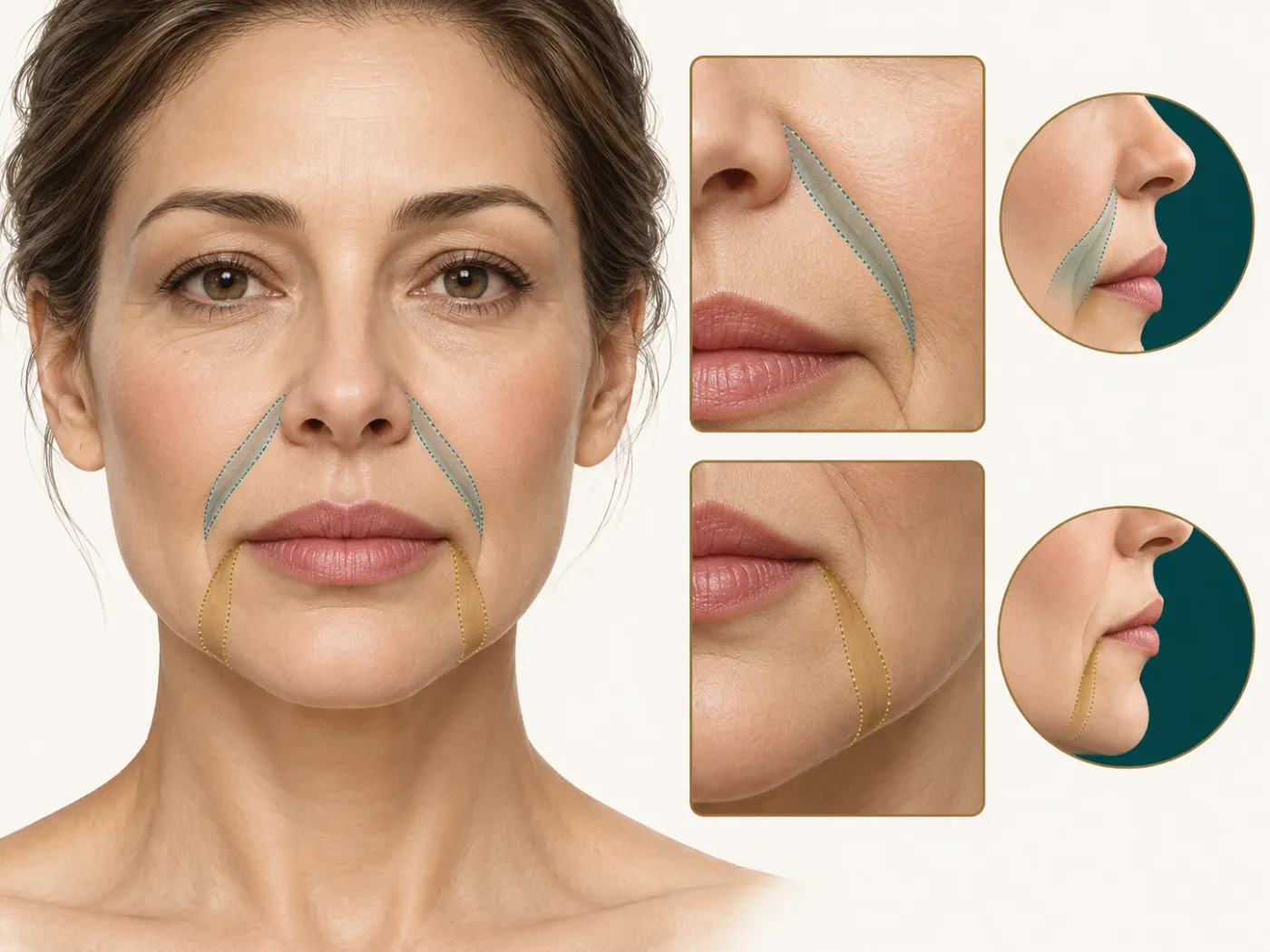
Marionette lines are often confused with nasolabial folds. Nasolabial folds run from the sides of the nose down past the corners of the mouth. Marionette lines begin at the corners of the mouth and run downward toward the chin, forming a separate, lower curve on the face.
The distinction matters because a plan built for one area is not automatically right for the other. A clinician looks at where each fold begins, how deep it appears at rest and how it changes when you smile or speak. The illustration below is educational and shows the anatomy and assessment factors discussed in this guide.
Volume Loss, Skin Changes and Lower-Face Ageing
The Cleveland Clinic explains that marionette lines can develop from aging, as the skin naturally loses collagen and elastin. These proteins help skin stay firm and bounce back, so as they decline, folds can become more visible. Skin changes are only one part of the picture.
Many people also feel that the lower face looks less supported over time. Whether a particular line reflects a loss of underlying support, loose skin or a repeated movement pattern is a question for an in-person assessment. A mirror check at home cannot answer it, and two lines that look identical can have different causes.
Genetics plays a role as well. The Cleveland Clinic notes that having parents or grandparents with marionette lines can make them more likely for you, which is one reason some people notice them earlier than their peers.
Skin Care and Non-Procedural Choices
Lines cannot be fully prevented, but the Cleveland Clinic lists habits that may slow their worsening: quitting smoking, protecting the skin from the sun and wearing a daily SPF 30 facial sunscreen. These steps support general skin health. They are not a way to remove folds that are already established.
The same source also lists repeated lip pursing and severe stress among contributing factors. If you notice that you tighten the mouth area often, such as while concentrating or during difficult periods, it may be worth mentioning to your clinician. Small daily habits can matter as much as any product.
Filler, Muscle Treatment and Lifting Options
The Cleveland Clinic names several approaches for marionette lines, including botulinum toxin (Botox), chemical peels, dermal fillers, laser skin resurfacing, microneedling, thread lifts and facelift surgery. Each approach addresses a different part of the problem, and none is a universal answer. Vivid Clinic’s facial aesthetics overview describes related facial procedures for readers comparing options.
Dermal Filler
According to the Cleveland Clinic, fillers may help mild to moderate lines, although they can sometimes look unnatural and no single filler is considered best. The American Society of Plastic Surgeons notes that most fillers dissolve over time, so repeat treatments may be needed. Common reactions include bruising, swelling, redness and tenderness at the injection site.
The same society lists less common problems, including lumps, asymmetry, infection and skin tissue injury. Very rarely, filler can enter a blood vessel and block blood flow, which can cause skin loss and, when the eye is affected, vision loss. This is one reason treatment should be planned by a qualified clinician who is prepared to manage complications.
Botulinum Toxin for Muscle Activity
Botulinum toxin is a muscle-relaxing treatment. A treating clinician may consider it when muscle movement appears to be part of the pattern, and it is not a universal treatment for folds. A patient information leaflet from the Doncaster and Bassetlaw Teaching Hospitals NHS Foundation Trust describes initial effects within 48 to 72 hours, with full effect possibly taking up to 14 days.
The same leaflet says results usually last between three and six months, which is why follow-up sessions are common. It describes side effects as uncommon and temporary, with tenderness at the injection site and bruised eyelids among the more common ones.
Facelift and Lifting Surgery
The Cleveland Clinic lists facelift surgery as an option for deeper lines. Vivid Clinic’s facelift information page describes a typical operation of three to five hours under general anaesthesia, with one night in hospital, often combined with a neck lift. Surgery addresses the supporting tissues of the lower face, so it is considered for a different set of concerns than injectables.
Choosing Treatment Based on Cause, Not Line Depth Alone
A deep-looking line is not automatically a filler problem, and a shallow line is not automatically a Botox problem. The useful question is what is driving the appearance. The same fold can have more than one cause, which is why a single-treatment answer is rarely complete.
For discussion purposes, clinicians often sort the factors into three groups: loss of underlying support, muscle activity and loose skin. This framing helps explain why options differ, and why a plan may combine steps over time rather than rely on one treatment.
Marionette Lines: Candidacy and Reasons to Defer Treatment
Candidacy depends on your anatomy, medical history, current medications, goals and expectations. Your surgeon evaluates suitability before recommending any approach, and no article can make that decision for you. A realistic plan starts with an honest picture of what can and cannot change.
Sometimes the best decision is to wait. If you are still gathering information, have a recent illness, or are unsure what outcome you want, deferring treatment is a reasonable choice. Your clinician will ask about pregnancy plans, bleeding tendencies and medications before recommending a plan, and that questioning is part of safe care.
Procedure Overview and Realistic Expectations
Optional overview of relevant treatments, not a recovery table for a natural feature.
| Aspect | Details |
|---|---|
| Duration Process | Facelift: three to five hours under general anaesthesia (Vivid Clinic facelift page). Botulinum toxin and filler: not stated in the sources reviewed; your clinician confirms at consultation. |
| Hospitalization Duration | Facelift: one night in hospital (Vivid Clinic facelift page). Injectable options: no admission is described in the sources reviewed. |
| Mobility Duration | Facelift: walking can start the day after surgery (Vivid Clinic facelift page). Injectable options: no mobility limit is described in the sources reviewed. |
| Return to Activity | Facelift: desk work in about two to three weeks (Vivid Clinic facelift page); ASPS notes many people are ready to return to work by the end of week two and resume exercise between days 15 and 30. Injectable options: not stated in the sources reviewed. |
| Complete Recovery | Facelift: light activities by the end of week two and normal activities after about day 30, though very minor swelling, bruising and numbness can take up to a year to settle (ASPS). Botulinum toxin: side effects are described as mostly mild and temporary (NHS Trust leaflet). |
| Anticipated Results | Botulinum toxin: effects begin within 48 to 72 hours, full effect up to 14 days, usually lasting three to six months (NHS Trust leaflet). Facelift: final results may take a few months to appear (ASPS). Filler: most dissolve over time, so repeat treatment may be needed (ASPS). |
Results always vary with anatomy, healing and the plan your clinician recommends. Treatment effects are generally temporary apart from surgery, and the lines themselves can return over time as skin continues to age.
Preparation and the Consultation Assessment
Preparation starts with honesty about your medical history. Tell your clinician about medications, supplements, allergies, previous cosmetic treatments and any bleeding or healing concerns. Do not start or stop medications based on this article; ask your clinician first.
Think about function as well as appearance. If lines affect how you eat, speak or smile, mention it, because functional concerns can change the plan. Bring photographs from several years ago if you have them, and be ready to describe what you want to change and what you would like to keep. A free consultation with a plastic surgeon at Vivid Clinic is the right place to ask these questions in person.
Recovery, Aftercare and When Results Can Be Assessed
Early effects and settling are different things. For facelift surgery, the American Society of Plastic Surgeons notes that bruising and swelling usually peak around days three and four, then ease over several weeks. Some residual swelling and tightness may remain after the first month, and a small amount can take up to a year to resolve.
For injectables, the effect changes over the first two weeks, so judging the result on day one is premature. Travel clearance and activity timing are individual. Your surgeon decides when you can fly, and your treating clinician explains which activities to avoid while you heal. Remote aftercare follow-up can continue after you return home.
Risks, Limitations and When Medical Assessment Comes First
Every treatment carries risks, and surgery is never risk-free. For injectables, the Cleveland Clinic and the American Society of Plastic Surgeons describe bruising, swelling, infection, asymmetry and, rarely, vascular complications. For facelift surgery, swelling, bruising and numbness are expected during recovery, and any operation carries anaesthesia and wound risks that your surgeon reviews with you.
Seek urgent medical care if you notice severe or spreading pain, rapidly worsening redness, changes in skin color, or any change in vision after a treatment. Limitations are part of an honest plan. No treatment stops aging, and results may need maintenance.
Cost Factors and Comparing Care Plans
The cost of treatment in Istanbul, Turkey can vary with the plan, the surgeon’s experience, the facility, anaesthesia type, procedure complexity, combined procedures, accommodation and transfers, aftercare and your personal needs. Injectable costs also depend on the amount of product used and whether repeat sessions are needed.
This article does not publish fixed prices, because quotes depend on the individual plan. When you compare options, ask for a dated, itemized estimate for each one so you are comparing like with like. At Vivid Clinic, the next step is a personal assessment, not a price list.
Your Optional Patient Journey at Vivid Clinic in Istanbul
If you decide to travel, your journey with Vivid Clinic can begin when you arrive in Istanbul, Turkey. Where a package includes it, a VIP airport transfer takes you to a five-star hotel for check-in, and eligibility is confirmed at consultation because transfer and hotel benefits apply only to select procedures. Your one-on-one consultation with the medical team comes before any decision about a surgery or treatment day. Where the package includes it, post-operative care and a check-up visit take place before you depart, and remote aftercare follow-up continues after you return home. Please confirm current package inclusions with the clinic before you plan travel.
Why Consultation and Verified Surgeon Credentials Matter
Vivid Clinic’s medical team page introduces the clinic’s doctors across several specialties. Each treatment plan is reviewed by a surgical board before travel, which is a practical safeguard for international patients. Ask any clinic to show you the credentials of the surgeon who will treat you, and check them with the relevant professional body.
The American Society of Plastic Surgeons advises that filler treatment be performed by a board-certified plastic surgeon who understands the risks. Use your free consultation with a plastic surgeon to discuss your lines, your options and your questions before you commit to anything.
Related guides: marionette lines filler vs Botox vs facelift and how to get rid of smile lines.
Frequently Asked Questions About Marionette Lines
How do marionette lines differ from nasolabial folds?
Marionette lines start at the corners of the mouth and run down toward the chin, while nasolabial folds run from the sides of the nose past the mouth corners. Because they sit in different places, they can have different causes and need different plans. A clinician examines both areas together, looking at how each fold appears at rest and during movement. That assessment helps decide whether the marionette lines need a separate approach, a combined plan or no treatment at all. Vivid Clinic can review this distinction during a free consultation with a plastic surgeon in Istanbul, Turkey.
Do marionette lines always come from volume loss?
No. Mouth-corner creases can come from several sources at once. The Cleveland Clinic lists aging with loss of collagen and elastin, genetics, sun exposure, repeated lip pursing, severe stress and smoking as contributing factors. Volume loss may play a part for some people, but it is not the only explanation for marionette lines. Loose skin or repeated muscle movement can also be involved. That is why an in-person assessment matters: the right plan depends on which factors are actually present in your face, not on the depth of the fold alone.
What can skin care realistically change for marionette lines?
Skin care supports general skin health, and it can help slow the worsening of marionette lines. The Cleveland Clinic recommends quitting smoking, protecting skin from the sun and wearing a daily SPF 30 facial sunscreen. These habits are useful, but they are not a reliable way to remove a fold that is already established. Skin care cannot restore lost support in the lower face. If you want a change that is visible in the mirror, ask your clinician which treatment matches your cause, rather than expecting a cream to reshape the fold.
When might filler, selected muscle treatment or surgery be considered for marionette lines?
A clinician may consider dermal filler for mild to moderate marionette lines, understanding that fillers dissolve over time and may need repeating. Botulinum toxin may be considered when muscle movement appears to be part of the pattern. Facelift surgery is an option the Cleveland Clinic lists for deeper lines, and it involves a longer recovery and a different set of risks. No single option is best for everyone. Your surgeon evaluates suitability and explains the trade-offs, so you can choose with clear expectations.
What makes an individual lower-face assessment necessary?
Two people with similar marionette lines can need very different plans. A thorough assessment looks at skin quality, lower-face support, the muscle pattern at rest and in motion, your medical history, current medications and what you hope to achieve. It also checks whether an approach is appropriate for your anatomy. Without that assessment, any recommendation is only a guess. Vivid Clinic invites you to request a free consultation with a plastic surgeon in Istanbul, Turkey, so your options are reviewed for your face specifically.
Sources and Further Reading
- Cleveland Clinic: Marionette Lines: What They Are, Causes, Filler, & Treatments
- American Society of Plastic Surgeons: Dermal Fillers Risks and Safety
- Doncaster and Bassetlaw Teaching Hospitals NHS Foundation Trust: Botox Treatment patient information
- American Society of Plastic Surgeons: Your Facelift Recovery Explained From Day 1 to Day 30
Your Next Step: an Informed Personal Choice
If you are considering marionette lines treatment in Istanbul, Turkey, Vivid Clinic can help you understand your options with a personalized plan. Start with the cause, weigh the trade-offs and let a qualified surgeon confirm what suits your face. This article is for informational purposes only and does not replace a personal medical consultation. Suitability, risks, recovery and expected results should always be discussed with a qualified medical professional.