
 ChatGPT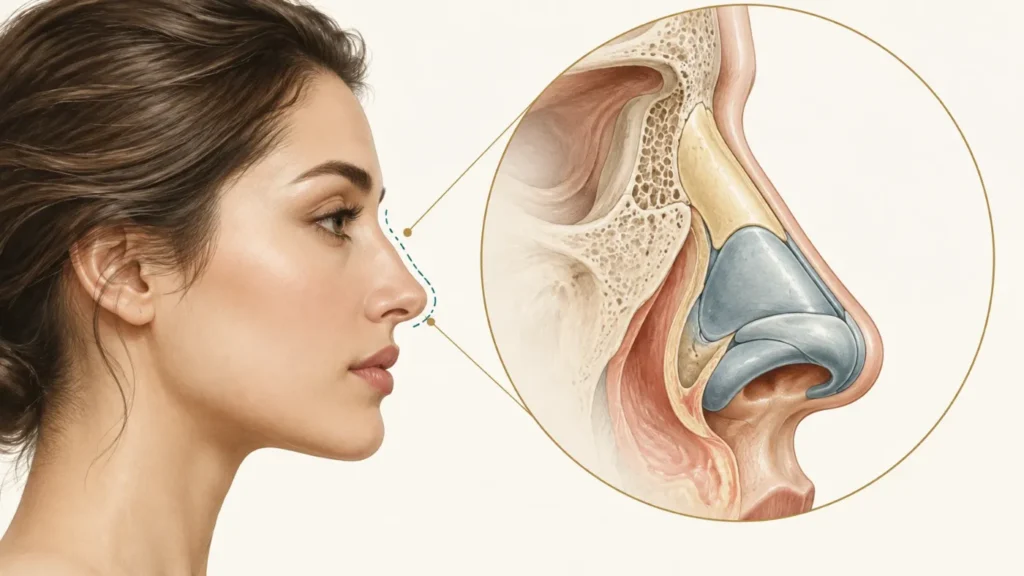
Quick answer: A dorsal hump is a visible bump along the bridge of the nose, made of bone, cartilage, or both. Surgical reduction during rhinoplasty removes it; filler only camouflages it. At Vivid Clinic in Istanbul, Turkey, a free consultation with a plastic surgeon offers a personal answer.
Editorially reviewed by the Vivid Clinic Surgical Board. Last updated: October 2026.
What Is a Dorsal Hump?
A dorsal hump is a raised area along the top of the nose, between the eyes. It is most often noticed in profile, where the bridge creates a visible line from the forehead to the tip. Many people notice a bridge profile in photos before anyone else does, and it is a normal variation in nose shape. Not every bump needs treatment.
The term describes the shape of the bridge, not a disease. A dorsal hump can be subtle or pronounced, and it can be present from adolescence or appear more clearly as the face changes over time. Lighting, camera angle, and overall facial proportions can also make a bridge look more prominent than it is.
People who notice a dorsal hump usually ask two questions. The first is what the bump is made of. The second is whether it can be reduced without affecting how the nose works. The answers depend on the cause and on a proper examination, which is why this guide covers both. The American Society of Plastic Surgeons lists visible humps or depressions on the bridge among the nose profile concerns that rhinoplasty can address.
If you are comparing nose shapes in general, the clinic’s guide Roman Nose and 9 Other Nose Shapes Explained describes how different profiles are discussed during planning.
Bone, Cartilage, Inherited Shape, and Injury
The upper part of the nose is supported differently from the lower part, and a dorsal hump can involve bone, cartilage, or both. A bump formed mainly by bone is planned differently from one formed mainly by cartilage. During the examination, a surgeon usually works out which structure is responsible, because this shapes the options that are realistic for that nose.

Inherited shape is a common reason for a dorsal hump. A family nose pattern can carry a bridge profile from one generation to the next, and the bump may be part of an overall look that the person already accepts. Heredity explains many bridge shapes, but it does not explain every change, which is why the history matters.
Injury is the other major cause. A fracture or blow to the nose can leave the bridge shifted or raised, and the change may not be obvious until swelling settles. A history of nose injury, even one from many years earlier, is useful information for the surgeon. Tell the clinician about any sports injury, accident, or previous nose procedure.
When Obstruction or Injury Needs Assessment
Not every dorsal hump is only a cosmetic question. Breathing difficulty can come from structural causes inside the nose, and the American Society of Plastic Surgeons notes that rhinoplasty can also correct impaired breathing caused by structural defects in the nose. For this reason, surgeons ask about breathing before recommending any change to the bridge.
Seek medical assessment promptly after a recent nose injury, new trouble breathing through the nose, bleeding that does not stop, a sudden change in shape, or swelling that is painful or getting worse. These situations are not appropriate for self-care. A clinician needs to examine the nose before any plan is made.
There is no safe home method to reduce the bone or cartilage of the nose. Pressing, filing, or attempting to break the bridge can cause injury, bleeding, infection, and lasting shape changes. Any concern about a dorsal hump should be taken to a qualified clinician rather than handled at home.
Surgical Planning and Nasal Bridge Support
When a dorsal hump is reduced during rhinoplasty, the surgeon plans how much to remove and what will support the nose afterward. Removing too much from the bridge can leave a sunken or irregular profile, so the plan is built around the nasal framework rather than the bump alone. The UF Health rhinoplasty overview lists loss of nasal support and contour deformities among the risks of the procedure, which is why structure is considered before anything is removed.
Support is the central planning question. The bridge needs a stable framework so that the nose keeps its shape while it heals. The technique is chosen according to the anatomy and the goals discussed at consultation, and no single method fits every nose. A surgeon can explain which approach is being considered and why.
Surgery is one option among several. A good consultation covers whether the dorsal hump is the main concern, whether breathing is involved, and whether the expected change is realistic for that anatomy. It also covers whether a non-surgical approach could meet the goal, or whether the hump is better left alone.
Non-Surgical Camouflage and Its Limits
Filler is sometimes discussed as a way to soften the look of a dorsal hump. Filler adds volume; it does not remove bone or cartilage. In other words, filler camouflages a dorsal hump rather than removing it, and that difference is the most important limitation to understand before considering it.
A narrative review of non-surgical rhinoplasty describes fillers for subtle nasal enhancement through volume addition rather than structural reduction. The same review notes that patients with large dorsal humps should be referred for surgical evaluation. The review also states that patient selection requires informed understanding of the temporary nature of results, so filler is not a permanent change to the bridge.
Filler carries its own risks. The review describes vascular occlusion as the most serious complication of non-surgical rhinoplasty, reported in 0.35 percent of cases in the studies it summarizes, along with visual loss at 0.09 percent and skin necrosis at 0.08 percent. Because the review is narrative rather than a systematic review, its figures should be read as context, not as a guarantee. The practical lesson is that any filler plan for a dorsal hump should be made only with a qualified clinician who checks the anatomy and explains the risks in person.
Dorsal Hump Candidacy and Reasons to Defer Treatment
Candidacy for any dorsal hump treatment depends on overall health, goals, skin quality, bone and cartilage structure, breathing function, and realistic expectations. A person with an unclear cause, a recent injury, an active infection, or a condition that affects healing usually needs an evaluation before any plan is discussed. Medical history is considered alongside the appearance concern.
There are good reasons to wait. The nose may still be changing, a recent injury may not have settled, a breathing problem may need separate assessment, or the decision may simply not be ready. Treatment is optional. A dorsal hump that a person accepts, or that is part of a family look, does not require correction.
Normal variation deserves respect. Many noses with a visible bridge are healthy and fully functional. Choosing not to change the nose is a valid decision, and a good clinician will help you weigh that option as seriously as any procedure.
Dorsal Hump Removal Overview: Realistic Expectations
The table below summarizes sourced timings for rhinoplasty, the main procedure that can address a dorsal hump. A dorsal hump is a normal anatomical feature rather than a condition with its own recovery timeline, so the rows describe the procedure, not the bump itself.
Optional overview of relevant treatments, not a recovery table for a natural feature.
| Aspect | Details |
|---|---|
| Duration Process | Rhinoplasty often takes 1 to 3 hours and may take longer (UF Health). |
| Hospitalization Duration | Most patients go home on the same day as surgery; complex procedures may require a short hospital stay (UF Health). |
| Mobility Duration | A nasal splint and cast may stay in place for 1 to 2 weeks (UF Health). Strenuous exercise and heavy lifting are restricted during early healing (Mass Eye and Ear). |
| Return to Activity | Most patients feel comfortable returning to work or school after about one to two weeks (Mass Eye and Ear). Desk work and exercise timing should be set by the treating surgeon. |
| Complete Recovery | Most swelling improves by 2 to 3 months, but full recovery takes about a year (UF Health). Internal swelling can take up to a year or longer (Mass Eye and Ear). |
| Anticipated Results | Initial swelling subsides within a few weeks, and the new contour may take up to a year to refine (American Society of Plastic Surgeons). The nose should not be judged at the three-month mark (Mass Eye and Ear). |
These are typical ranges from the cited sources, not guarantees. Individual timelines depend on the technique, the anatomy, and how healing progresses. No verified timing was found for filler in this guide, so filler timings are not listed; the consultation team can explain individual details.
How to Prepare for a Dorsal Hump Removal Consultation
Preparation starts with an honest medical history. The clinician will want to know about existing conditions, current medications and supplements, previous nose injuries or surgeries, breathing symptoms, allergies, and smoking habits. This information helps decide whether a change is appropriate and how the procedure should be planned.
The examination usually covers the bridge in profile and from the front, the nasal airway, and the quality of the skin. The clinician should explain what appears to cause the dorsal hump, which options exist, and what limits each one has. Ask about the expected change and whether it is realistic for your anatomy.
Bring photos of profiles you like or dislike, a list of questions, and any previous reports or imaging. Do not stop or start any medicine on your own before the consultation; medication guidance is individual and should come from the treating team.
Dorsal Hump Removal Recovery and When to Judge Results
Right after surgery, the nose and face are typically swollen and painful. The UF Health overview notes that nasal packing, if used, is usually removed within 3 to 5 days, and that the splint and cast may remain in place for 1 to 2 weeks. Early discomfort is expected, and the aftercare instructions from the treating team should be followed exactly.
During the first week, avoid blowing the nose, since this can cause pressure and bleeding. Avoid strenuous exercise, heavy lifting, and any activity that puts the face at risk of impact. Mass Eye and Ear notes that much of the visible bruising will have faded by the time many patients return to work or school.
Settling continues for months. The American Society of Plastic Surgeons notes that swelling may come and go and may be worse in the morning during the first year. The tip of the nose may keep some swelling and numbness for several months. Final shape should not be judged early, and the treating clinician decides when travel and a return to exercise are safe for you.
Dorsal Hump Removal Risks, Limitations and Medical Red Flags
Rhinoplasty is surgery and carries risks. The UF Health overview lists loss of nasal support, contour deformities, worsened nasal breathing, and the need for further surgery as risks specific to the procedure. General surgical risks include reactions to medicines, breathing problems related to anesthesia, bleeding, infection, and bruising.
Small burst blood vessels can occur and are usually minor, but they can be permanent. In rare cases, a revision procedure is needed to correct a minor deformity. These possibilities are part of an honest discussion about whether surgery fits the goal, and they should be raised at consultation rather than discovered afterward.
Seek urgent medical care after surgery for heavy bleeding, fever, severe pain that is not controlled, or difficulty breathing. Contact the treating team for any concern about the healing. Filler also carries risks, and vascular occlusion is the most serious complication described for non-surgical rhinoplasty, so filler should only be planned by a qualified clinician.
What Affects the Cost of Dorsal Hump Removal in Istanbul
No fixed price applies to every dorsal hump treatment, and this guide does not list one. A quote depends on the surgeon’s experience, the facility, anesthesia, the complexity of the plan, whether other procedures are combined, travel arrangements, and aftercare. Any quote is individual and should follow a consultation.
When comparing offers, check exactly what is included: the consultation, surgery, facility, anesthesia, follow-up visits, and any revision policy. A lower figure that leaves out important parts of care is not a true comparison. Ask for a written plan that lists each item so the options can be compared fairly.
Cost is only one factor. Expected results, safety, the clinician’s experience, and how well the plan fits your goals matter more than the number on a quote.
Dorsal Hump Removal in Istanbul: Your Patient Journey at Vivid Clinic
Patients who choose to explore treatment at Vivid Clinic in Istanbul, Turkey, typically start with a remote review of their goals and medical history. Where the package includes it, a VIP airport transfer brings you from arrival in Istanbul to a five-star hotel check-in, and eligibility for these benefits is confirmed at consultation. A one-on-one consultation with a plastic surgeon then reviews your options before any decision is made. If surgery or treatment is planned, the treatment day takes place at a partner hospital in Istanbul, followed by post-operative care, a check-up visit before departure, and remote aftercare once you are home. Transfer and hotel benefits apply only to select procedures, so the plan is confirmed individually.
Choosing a Qualified Surgeon for Dorsal Hump Removal
Choosing the surgeon matters more than choosing a price. Verify credentials with the relevant medical board, ask how many similar nose procedures the surgeon performs, and look at how the surgeon discusses limits and risks. A good surgeon will be direct about what a dorsal hump treatment can and cannot change.
According to the clinic’s doctor directory, treatment plans are reviewed before travel, patients meet their doctor in person before any procedure, and surgeries take place at a partner hospital in Istanbul. You can meet the medical team and review the surgical profiles before deciding. For the procedure itself, see the clinic’s rhinoplasty service page.
A free consultation with a plastic surgeon is the step that turns general information into a personal answer. It is the right place to ask whether a dorsal hump should be reduced, camouflaged, or left as it is, and what the realistic limits of each option are.
Frequently Asked Questions About Dorsal Hump
Is a nasal bridge hump made of bone, cartilage or both?
A dorsal hump can be made of bone, cartilage, or both, and the cause affects the options. During the examination, a surgeon looks at the bridge in profile and from the front to work out which structure forms the bump. A dorsal hump that is mainly bone is planned differently from one that is mainly cartilage, and many bumps involve both. Inherited shape is a common reason for a bridge profile, and past injury can also change the bridge. Photos alone cannot settle which structure is involved, so an in-person clinical assessment is the reliable step.
Can injury or breathing symptoms change the assessment?
Yes. A recent nose injury, a past fracture, or new trouble breathing changes how a dorsal hump should be assessed and can make the examination more urgent. Breathing problems can come from structural defects inside the nose, so surgeons check the airway before recommending any change to the bridge. Bleeding that does not stop, new swelling, or severe pain after an injury needs prompt medical care. Do not attempt any home method to reduce a dorsal hump, because it can cause injury and infection.
Can filler remove a hump rather than camouflage it?
No. Filler adds volume and can camouflage a dorsal hump, but it does not remove bone or cartilage. A review of non-surgical rhinoplasty describes filler for subtle enhancement, and it notes that patients with large humps should be referred for surgical evaluation. Filler results are temporary, and the most serious complication described is vascular occlusion, which is why only a qualified clinician should plan filler work. A consultation can explain whether camouflage suits your goal or whether surgery is the better route for this dorsal hump.
How is structural support considered in surgical removal?
When a dorsal hump is reduced surgically, the surgeon plans how much to remove and how the nasal bridge will stay supported afterward. Removing too much can leave a sunken or irregular profile, and loss of nasal support is one of the listed risks of rhinoplasty. Surgeons assess the nasal framework before any cutting, and the technique is chosen for the anatomy and goals. Support planning is one reason a dorsal hump should be evaluated in person, and no surgeon can promise one specific shape.
What should I expect from recovery and an individualized quote?
Expect swelling and discomfort in the first days, a splint for about one to two weeks, and gradual settling over months. Most patients feel comfortable returning to work or school after about one to two weeks, while full recovery can take about a year. A quote for dorsal hump treatment depends on the surgeon, facility, anesthesia, complexity, travel, and aftercare, so it is individual and should follow a consultation. Ask for a written list of what the quote includes before you decide.
Sources and Further Reading on Dorsal Hump
- American Society of Plastic Surgeons: Rhinoplasty
- American Society of Plastic Surgeons: Rhinoplasty Recovery
- American Society of Plastic Surgeons: Rhinoplasty Results
- UF Health: Rhinoplasty
- Mass Eye and Ear, Facial Plastic Surgery: Rhinoplasty Recovery Time
- Torres Céspedes et al., A Narrative Review of Evolving Techniques in Nonsurgical Rhinoplasty (Cureus, 2026)
Related reading: Bulbous nose: causes, types and refinement options · Nose job in Turkey
Deciding Whether to Address Your Dorsal Hump
A dorsal hump is a normal variation for many people, and treatment is optional. If it affects how you feel about your profile, or if you have breathing or injury concerns, a free consultation with a plastic surgeon at Vivid Clinic in Istanbul, Turkey can help you understand your options for this dorsal hump, the realistic limits of each, and the next steps.
Medical disclaimer: This article is for general education and is not medical advice, diagnosis, or treatment. Outcomes, timelines, and suitability vary by individual. Only a qualified clinician who examines you can recommend a treatment plan.