 ChatGPT
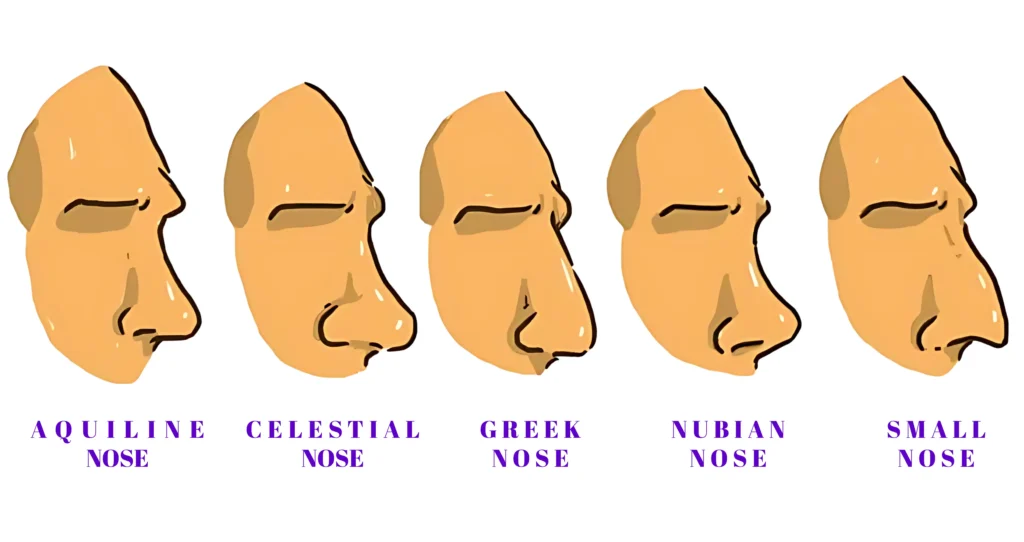
Every nose is built from the same handful of variables — bridge height, dorsal curve, tip rotation and nostril width — yet the combinations they form are almost unlimited. Roman, Greek, aquiline, button, hooked, celestial: each name describes a distinct silhouette, and each responds differently to rhinoplasty. Understanding which shape you have — and what actually changes it — is the first real step toward a nose that fits your face, whether you’re simply curious or already planning surgery in Istanbul.
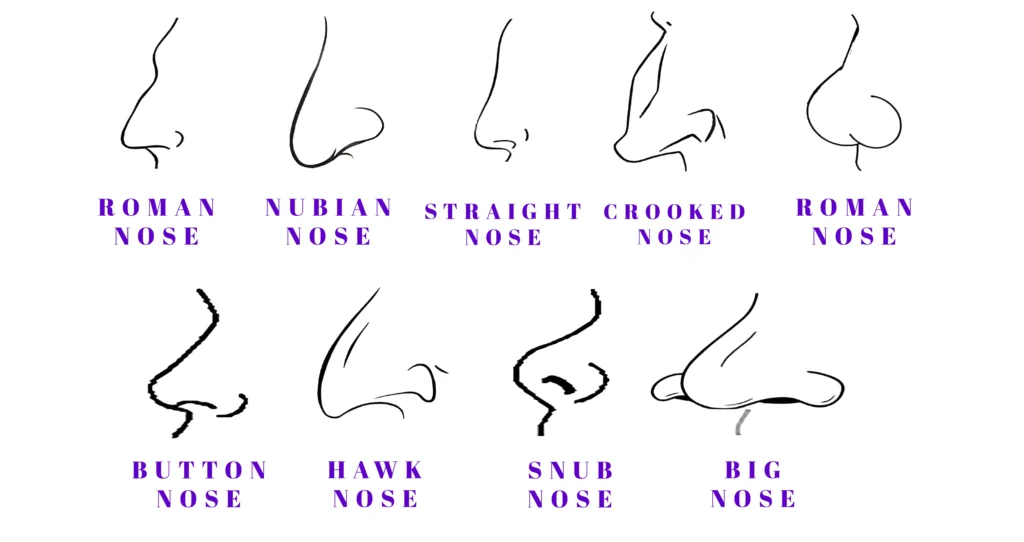
Quick answer: There are 10 widely recognized nose shapes — Roman, Aquiline, Hooked, Eagle, Button, Arched, Greek, Celestial, Nubian and Bulbous — each defined by its bridge, tip and dorsal profile. Every shape can be refined with rhinoplasty; the technique changes (dorsal reduction, tip-plasty, augmentation or structural grafting), but the goal at Vivid Clinic in Istanbul is always the same: a nose that matches your facial proportions, not a single “ideal” template. A free consultation with our surgical board is the fastest way to find out which approach fits your nose.
Why Nose Shape Matters
Your nose sits at the center of your face, so even small differences in shape change how the rest of your features read. A strong Roman or hooked profile tends to be perceived as authoritative and striking; a soft button or celestial tip reads as delicate and approachable. Neither is objectively better — but when your nose shape works against your other features (a very strong bridge on a small, delicate face, for example, or a wide base on a narrow jawline), it can throw off facial balance. That’s usually the real reason people look into how their nose shape fits their face before they look into rhinoplasty itself.
Rhinoplasty and Aesthetic Enhancement
At Vivid Clinic, rhinoplasty is planned around the nose you already have, not a generic mold. Our surgical board maps your bridge, tip cartilage and skin thickness during a 1-on-1 consultation, then recommends the narrowest set of changes that will achieve your goal — softening a hump, lifting a drooping tip, narrowing a wide base — while keeping the nose recognizably yours. That distinction matters most for ethnic rhinoplasty, where the aim is refinement, not erasure of your natural bone structure.
1. Roman Nose: A Classic Aesthetic
What Is a Roman Nose?
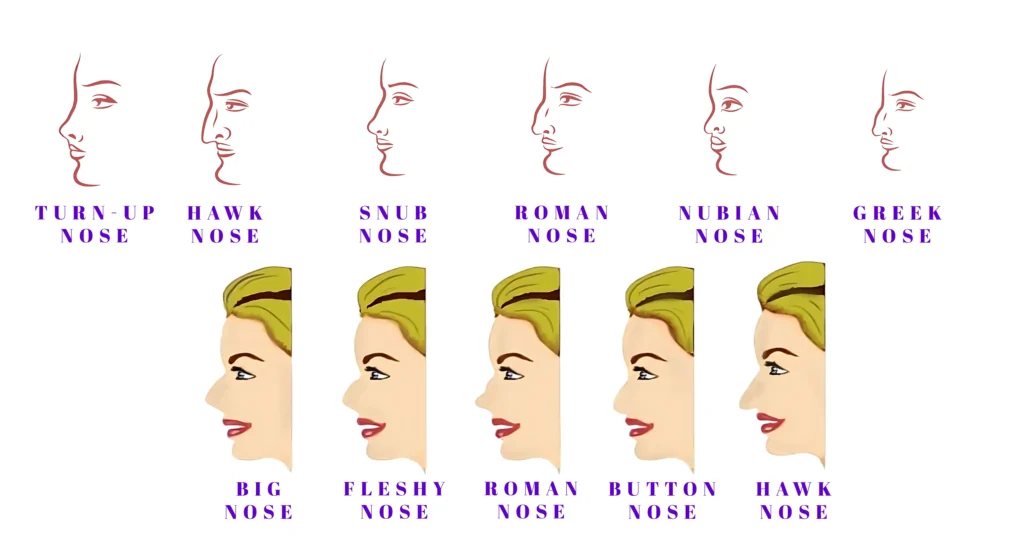
The Roman nose is defined by a prominent, gently curved bridge — the profile seen throughout classical sculpture. It’s often read as strong and authoritative, and plenty of people with a Roman nose keep it exactly as it is. Others want the bridge’s prominence softened without losing the overall structure.
Rhinoplasty for Roman Nose
Rhinoplasty for a Roman nose typically rasps down the dorsal hump and refines the bridge line, using closed rhinoplasty for moderate humps or open rhinoplasty when the tip also needs reshaping. At Vivid Clinic, the goal is a straighter, more balanced bridge that still looks like a natural extension of your face — not a flattened, generic result.
2. Aquiline Nose: Sharp and Defined
What Defines an Aquiline Nose?
An aquiline nose has a pronounced curve or hump along the bridge, often compared to a bird’s beak — “aquiline” literally means eagle-like. It’s closely related to the Roman nose but usually has a sharper, more angular curve rather than a smooth arch.
Aquiline Nose Rhinoplasty
Aquiline nose rhinoplasty smooths the curvature through cartilage and bone rasping; more pronounced humps may need a controlled osteotomy to narrow the bridge after the hump is reduced. Mild to moderate curves often don’t require breaking the nasal bones at all — your surgeon confirms which applies once your CT imaging is reviewed at consultation.
3. Hooked Nose: Strong and Prominent
What Is a Hooked Nose?
A hooked nose has a downward-pointing tip combined with a pronounced curve along the bridge, which draws the eye toward the center of the face. It’s a distinguished, memorable look — but it’s also one of the shapes people most often ask about softening.
Hooked Nose Rhinoplasty
Hooked nose rhinoplasty combines tip rotation with dorsal hump reduction: the surgeon lifts and repositions the nasal tip while smoothing the curved bridge so the nose no longer points downward. It’s a structural change, so most patients need 12–18 months for the tip’s final position to fully settle.
4. Eagle Nose: Dramatic and Bold
Characteristics of an Eagle Nose
The eagle nose has a strong, curved bridge similar to an aquiline nose but with a more dramatic downward curve toward the tip, creating a striking, bold profile.
Rhinoplasty for Eagle Nose
Our surgeons soften an eagle nose by reducing the curve and refining the tip in the same operation, using open rhinoplasty for the structural work this shape usually needs. The result is a more balanced bridge line without losing the nose’s natural strength.
Not sure which rhinoplasty approach fits your nose shape?
5. Button Nose: Petite and Soft
What Is a Button Nose?
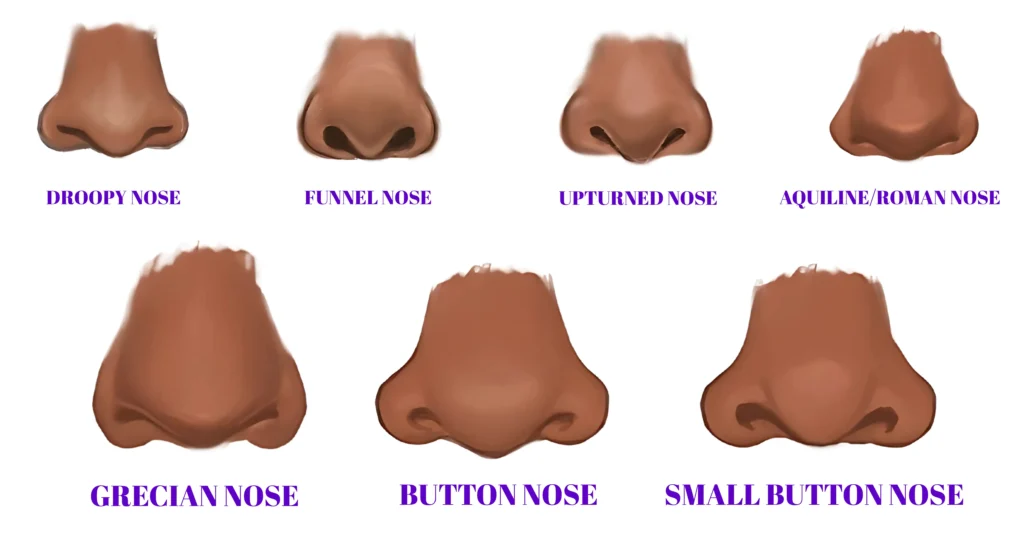
A button nose is small, rounded and compact, with a tip that sits close to the face. It’s one of the most requested rhinoplasty outcomes precisely because it reads as youthful and approachable.
Button Nose Rhinoplasty
Button nose rhinoplasty isn’t a fixed template — it’s sized to your face. Our surgeons use 3D imaging during consultation to plan the tip and bridge against your chin, forehead and cheekbones, so a smaller nose still looks proportionate rather than over-reduced.
6. Arched Nose: Elegant and Curved
The Natural Curve of an Arched Nose
An arched nose has a distinct upward curve along the bridge, giving it a refined, elegant line. Some people embrace the curve; others want it smoothed for a straighter profile.
Rhinoplasty for an Arched Nose
At Vivid Clinic, we adjust the curvature of an arched nose with targeted dorsal reduction, creating a more streamlined bridge while preserving the elegance that makes this shape distinctive.
7. Greek Nose: The Straight Profile
What Is a Greek (Grecian) Nose?
The Greek or Grecian nose runs in a single straight line from the brow to the tip, with little to no curve or hump — the profile most associated with classical “ideal” proportion. It’s often confused with the Roman nose, but where a Roman nose has a visible bridge curve, a true Greek nose is flat and continuous.
Greek Nose Rhinoplasty
Because a Greek nose is already straight, greek nose rhinoplasty is usually about proportion rather than correction — subtle tip refinement, a slightly narrower bridge, or restoring straightness lost to a previous injury or surgery. It’s typically one of the more conservative rhinoplasty plans our surgeons perform.
8. Celestial Nose: Upturned and Youthful
What Is a Celestial Nose?
A celestial nose has a slightly concave bridge and an upturned tip that points gently skyward. It’s a soft, youthful shape, though a pronounced upturn can sometimes expose the nostrils more than a patient would like.
Rhinoplasty for a Celestial Nose
Correcting a celestial nose usually means building up the bridge with cartilage grafting and rotating the tip down slightly, so the nostrils are less visible from a front-on angle. It’s a precise, structural technique rather than a reduction.
9. Nubian Nose: Wide and Balanced
What Is a Nubian Nose?
A Nubian nose is broad at the base with a flatter, wider bridge and a rounded tip — a shape common across African and some Middle Eastern heritage. It’s frequently the shape people mean when they ask about ethnic rhinoplasty.
Ethnic Rhinoplasty for a Nubian Nose
Ethnic rhinoplasty for a Nubian nose focuses on refining width and adding bridge height without flattening the nose’s natural character — thicker skin and softer cartilage need different grafting techniques than the reduction-only approach used on thinner-skinned noses. Preserving your heritage while improving proportion is the priority, not imposing a narrower “default” shape.
10. Bulbous Nose: Round and Full
What Is a Bulbous Nose?
A bulbous nose has a rounded, fuller tip caused by wider or weaker lower cartilage, sometimes making the tip look disproportionately large compared to the bridge.
Rhinoplasty for a Bulbous Tip
Tip-plasty is the main technique for a bulbous nose: reshaping and, where needed, trimming the lower cartilage to create a more defined tip, usually combined with sutures that narrow the cartilage into a cleaner point. Because it’s cartilage-only work, downtime is often shorter than bridge-focused rhinoplasty.
Nose Shape & Rhinoplasty Technique Comparison Table
Every shape above responds to a different combination of techniques. Here’s how they compare at a glance:
| Nose Shape | Defining Trait | Typical Rhinoplasty Approach |
|---|---|---|
| Roman | Prominent, curved bridge | Dorsal reduction (open/closed) |
| Aquiline | Sharp bridge hump | Rasping ± osteotomy |
| Hooked | Downward tip, curved bridge | Tip rotation + dorsal reduction |
| Eagle | Dramatic curved bridge | Open structural rhinoplasty |
| Button | Small, rounded tip | Proportional refinement |
| Arched | Upward bridge curve | Targeted dorsal reduction |
| Greek | Straight, continuous line | Conservative tip refinement |
| Celestial | Concave bridge, upturned tip | Cartilage grafting + tip rotation |
| Nubian | Wide base, flat bridge | Ethnic rhinoplasty (grafting) |
| Bulbous | Round, full tip | Tip-plasty |
Your Rhinoplasty Journey in Istanbul at Vivid Clinic
Most of our rhinoplasty patients arrive in Istanbul two to three days before surgery. We handle the airport transfer to your hotel, so your first day is for resting, not logistics. Day two is your in-person 1-on-1 consultation with your surgeon — this is where your nose shape, skin thickness and facial proportions are mapped and the surgical plan is finalized, alongside pre-operative tests. Surgery itself takes 2–4 hours, followed by one night of hospital monitoring. From there you move to your hotel for the initial recovery period, with a follow-up checkup before you fly home, usually around day seven. Splints and most visible swelling resolve within 7–10 days; the deeper refinement — the part that decides your final profile — continues for 6–12 months, tracked through photo check-ins with your surgeon. If you’d like the full cost breakdown before booking, our nose job cost guide covers pricing by technique and what’s included in your package.
Two situations come up often enough to flag directly. If your nose shape came with breathing difficulty — a common issue alongside hooked or aquiline profiles — read our deviated septum and septoplasty guide, since septoplasty can often be combined with your rhinoplasty in a single operation. And if you’ve had rhinoplasty before and the result didn’t settle the way you expected, our revision rhinoplasty guide walks through what’s different about correcting a previously operated nose.
Ready to plan your rhinoplasty in Istanbul?
Rhinoplasty Procedure Overview Table
| Process | Duration |
|---|---|
| Surgery Duration | 2-4 hours |
| Hospitalization Duration | 1 day |
| Mobility Duration | 2-3 days |
| Return to Activity | 7-10 days |
| Complete Recovery | 4-6 weeks |
| Anticipated Results | 6-12 months |
Personalized Rhinoplasty at Vivid Clinic
No two noses are alike, and no single technique fits all ten shapes above. Our surgical board assesses your facial structure and desired outcome during a free consultation, then recommends the narrowest set of changes that will get you there — whether that’s a subtle Greek-nose refinement or structural ethnic rhinoplasty for a Nubian nose.
- Free Consultation: Discuss your goals with our plastic surgeons and leave with a customized treatment plan and transparent quote — no obligation.
Nose and smile: the two halves of facial harmony. A refined nasal profile is only half of the lower-face picture; the smile line and teeth carry the rest. Many rhinoplasty patients at Vivid Clinic pair their nose surgery with cosmetic dentistry in Istanbul in the same trip, from a Hollywood smile to affordable full mouth dental implants in Turkey, because both can be planned from a single facial assessment.
FAQs
How is ethnic rhinoplasty different from a standard nose job at Vivid Clinic?
Ethnic rhinoplasty preserves the structural character of your heritage — a strong bridge, wider base or fuller tip — while refining proportion, rather than imposing one universal “ideal” shape. Our surgeons combine cartilage grafting and structural techniques suited to thicker or thinner skin types common in Middle Eastern, Mediterranean, African and South Asian noses.
Can button nose rhinoplasty make my nose too small for my face?
No — button nose rhinoplasty at Vivid Clinic is planned around your facial proportions, not a fixed template. Our surgeons use 3D imaging during your consultation to size the new tip and bridge against your chin, forehead and cheekbones, so the result looks proportionate rather than over-reduced.
What does hooked nose rhinoplasty involve?
Hooked nose rhinoplasty combines tip rotation with dorsal hump reduction: the surgeon lifts and repositions the nasal tip while smoothing the curved bridge so the nose no longer points downward. Most patients need 12–18 months for the tip’s final position to fully settle.
Does aquiline nose rhinoplasty always require breaking the nasal bones?
Not always. Mild to moderate aquiline curves can often be corrected with cartilage and bone rasping alone. More pronounced curves may need an osteotomy — a controlled bone realignment — to narrow the bridge; your surgeon confirms which approach applies during your CT-based consultation.
How long does rhinoplasty for a Roman nose take to show final results?
Swelling from rhinoplasty for a Roman nose subsides significantly within 4–6 weeks, but the bridge and tip continue to refine for 6–12 months as deep swelling resolves — which is why Vivid Clinic schedules a follow-up review around the one-year mark.