
 ChatGPT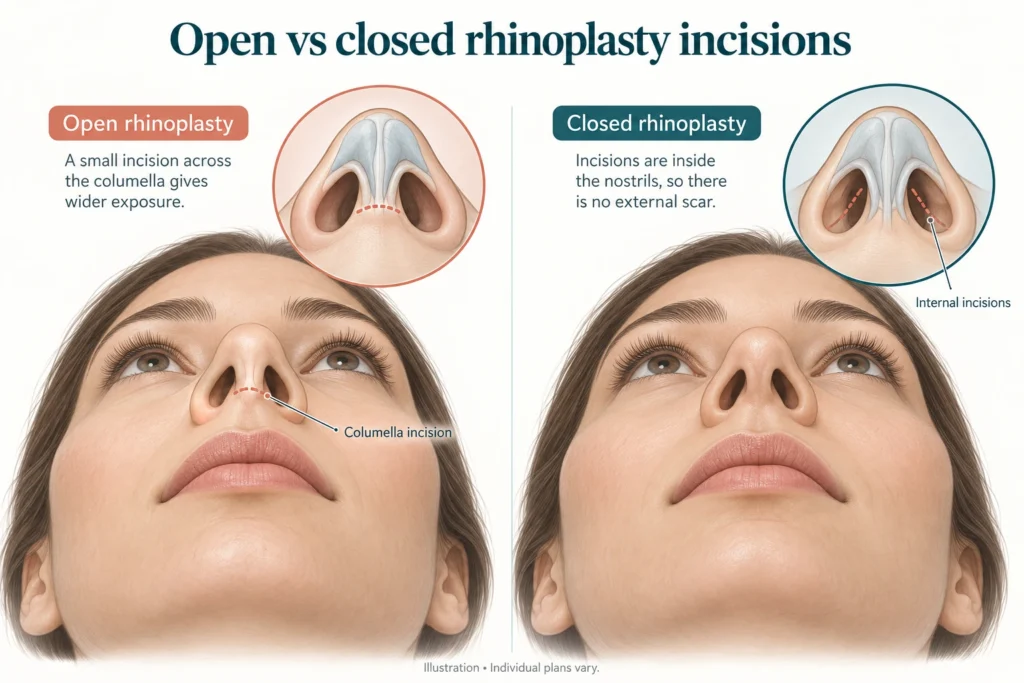
Introduction
If you’ve spent hours imagining a more confident, refreshed version of yourself, the journey to rhinoplasty often feels intensely personal. Your nose sits at the center of your face and shapes how you feel in the mirror and in photos. As you explore options, you’ll discover two main surgical techniques: open rhinoplasty and closed rhinoplasty. The stakes feel high, and so do the questions. Which one heals faster? Which achieves more natural results?
Is one better for international patients? This guide dives deep into open vs closed rhinoplasty, offering honest differences, emotional insights, and practical details to help you make the best decision for your future self. Every nose and face is unique. At Vivid Clinic in Istanbul, Turkey, world-class surgeons ensure international patients receive bespoke care, expert planning, and results that harmonize with your face and personality. Here’s your complete, patient-centered comparison before booking that free consultation.
What Is Open Rhinoplasty?
Open rhinoplasty is a surgical technique where the surgeon makes a small, precise incision across the columella, the thin strip of tissue separating the nostrils. This approach allows the surgeon to lift the nasal skin gently, providing direct, unobstructed visibility and access to the underlying cartilage and bone. Open rhinoplasty is especially suitable for complex nose reshaping, revising previous surgeries, correcting significant deviations, or when achieving dynamic structural changes is the main goal.
Surgeons can manipulate nasal structures with exceptional precision, which translates to greater consistency for detailed or transformative results. For international patients choosing open rhinoplasty in Istanbul, the technique offers a pathway to dramatic improvements in both function and appearance, all under the attentive care of a premier plastic surgery team at Vivid Clinic. The American Society of Plastic Surgeons explains that rhinoplasty can be performed through a closed procedure, with incisions hidden inside the nose, or an open procedure with an incision across the columella.
How Open Rhinoplasty Works
Under general anesthesia, your surgeon performs a tiny incision on the columella and hidden incisions inside the nostrils. The skin is softly elevated, and the underlying tissues, including cartilage, bone, and septum, are reshaped or reinforced as needed. Grafts may be placed for complex corrections, especially in cases of prior trauma or revision surgery. Finally, the skin is re-draped and incisions closed with fine sutures. The external scar is subtle and typically fades until barely visible. Patients benefit from the direct view, which empowers the surgeon to sculpt and adjust structures with utmost accuracy. The entire procedure usually lasts two to four hours, depending on complexity.
What Is Closed Rhinoplasty?
Closed rhinoplasty, also known as endonasal rhinoplasty, is a less invasive technique where all incisions are confined to the inside of the nostrils. There is no external scar across the columella. This means there is no visible incision on the outside of the nose, resulting in a virtually scarless appearance. Closed rhinoplasty is preferred for patients needing subtle changes, straightforward reshaping, or tip refinement when the nasal anatomy allows. Many primary nose jobs, meaning first-time rhinoplasties, can be successfully performed with the closed approach. Closed rhinoplasty requires the surgeon to work through very limited windows, so it’s most suitable for simpler adjustments where broad visualization and intricate maneuvers aren’t necessary.
How Closed Rhinoplasty Works
After general anesthesia is administered, the surgeon creates two to three small, hidden incisions inside the nostrils. All surgical work, including cartilage reshaping, tip refinement, or dorsal hump reduction, is accomplished through these internal incisions. There is no need to lift the skin off the nasal framework completely. This results in less disruption to the nasal tissue, which often translates into reduced swelling and a quicker early recovery for straightforward cases. The procedure typically takes one to two hours, though this varies with surgical goals and technique.
Why Patients Choose Rhinoplasty in Istanbul, Turkey
Istanbul, Turkey has earned a reputation as a center for rhinoplasty, drawing international patients with a combination of medical excellence, advanced techniques, and luxury hospitality. Surgeons at Vivid Clinic blend European standards with Turkish artistry, attracting patients from the UK, Europe, and the Gulf. The city’s vibrant culture, modern hospitals, and affordability provide a welcoming environment for transformative journeys. For patients weighing open vs closed rhinoplasty, Istanbul offers advantages like:
- World-class, internationally trained surgeons with extensive rhinoplasty portfolios
- Personalized, patient-centered care from consultation to remote aftercare
- Luxurious hotel accommodations and VIP transfers for stress-free recovery
- Comprehensive treatment planning for international patients
- Competitive pricing compared to similar expertise in Western Europe or the Gulf
Vivid Clinic stands out by offering seamless support, honest counsel about surgery options, and a focus on natural, harmonious outcomes tailored to each face.
Who Is a Good Candidate for Open or Closed Rhinoplasty?
Deciding between open and closed rhinoplasty is heavily influenced by your facial anatomy, aesthetic goals, previous surgeries, and the complexity of changes desired. You may be an ideal candidate for open rhinoplasty if you have:
- Significant asymmetry or complex nasal structure issues
- A history of previous rhinoplasty (revision cases)
- Major shape corrections, such as a deviated septum or extensive hump
- Thick skin or complex tip reshaping needs
Closed rhinoplasty may be suitable if you:
- Desire mild to moderate changes (e.g., subtle tip refinement, small hump removal)
- Have good skin elasticity and relatively straightforward nasal anatomy
- Are seeking minimal downtime and the absence of any external scar
Ultimately, the best approach is personalized. A surgeon at Vivid Clinic evaluates your nose’s internal and external structure, your skin type, medical history, and your expectations to recommend the safest and most effective option.
Who May Not Be Suitable for Either Technique?
Not every patient is a candidate for every rhinoplasty technique. You may not be eligible for closed rhinoplasty if your anatomy or goals require extensive cartilage grafts, major septal corrections, or significant structural work. Meanwhile, certain medical conditions, such as uncontrolled high blood pressure, severe autoimmune disorders, or chronic nasal infections, may make any nasal surgery risky. Smokers, individuals with poor wound healing, or those unwilling to follow strict post-surgical guidelines may be advised to delay surgery. A comprehensive pre-operative evaluation, including medical tests and discussions about expectations, helps determine suitability and maximize safety.
Benefits of Open Rhinoplasty
Open rhinoplasty offers several distinct advantages for patients whose goals require accuracy and visibility:
- Direct visualization: The surgeon can see and access underlying tissues fully, leading to precise corrections.
- Better for complex cases: Ideal for revision rhinoplasty, major deviations, or re-building nasal tips.
- Custom grafting: Easier placement of cartilage grafts for structural support and reshaping.
- High consistency: More predictable outcomes for difficult or asymmetric cases.
- Suited for teaching and documentation: Widely used in training and major aesthetic centers.
For patients traveling from abroad, open rhinoplasty’s adaptability can ensure even challenging noses are transformed safely and artistically.
Benefits of Closed Rhinoplasty
Closed rhinoplasty’s advantages center on subtle transformation, recovery, and minimal visible trauma:
- No external scars: All incisions are made inside the nostrils, leaving the columella untouched.
- Reduced swelling: Minimal skin elevation results in lower immediate swelling and, for some, less bruising.
- Shorter operative time: Straightforward cases can be performed faster, lessening anesthesia time.
- Faster early recovery: Many patients enjoy speedier returns to work or social life.
- Preserved tip support: Leaving the nasal support structures more intact benefits suitable candidates.
For international patients who want simple, subtle changes with minimal downtime, closed rhinoplasty can be an excellent choice, when the anatomy permits.
Open vs Closed Rhinoplasty: 11 Differences Side by Side
| Aspect | Open Rhinoplasty | Closed Rhinoplasty |
|---|---|---|
| Incision Location | Columella + nostril (external & internal) | Inside nostrils only (internal) |
| Visibility | Direct, full access (great for complex changes) | Limited, indirect access (suitable for minor adjustments) |
| Scar | Small scar on columella (usually fades over time) | No external scar |
| Best for | Complex or revision cases, tip reshaping | Primary cases, mild to moderate reshaping |
| Operation Time | 2-4 hours | 1-2 hours |
| Initial Swelling | More swelling (due to skin lifting) | Usually less (faster subsiding) |
| Recovery Time | 10-14 days to return to normal activities | 7-10 days to return to normal activities |
| Revision Possibility | Easier to perform revision if needed | Challenging to revise very complex issues |
| Suitability for Teaching | Preferred for teaching/training | Less commonly used for training |
| Surgeon’s Preference | Favored for complex, artistic cases | Chosen for straightforward cases |
| External Splint Duration | 7 days typical | 5-7 days typical |
This table highlights how open rhinoplasty provides more flexibility and control in complicated cases, while closed rhinoplasty favors quick recovery and minimal invasiveness for simpler goals. Your consultation at Vivid Clinic will focus on which factors matter most to you, including visible scarring, downtime, complexity, and your unique anatomy.
Procedure Overview Table
| Aspect | Details |
|---|---|
| Duration | Open: 2-4 hours Closed: 1-2 hours |
| Hospitalization | Usually outpatient (same-day discharge) |
| Mobility | Light walking after several hours; typical mobility next day |
| Return to Activity | Open: 10-14 days Closed: 7-10 days |
| Complete Recovery | Open: 3-6 months Closed: 2-4 months |
| Anticipated Results | Early visible improvement in 2-4 weeks; final contour at 6-12 months |
Open rhinoplasty generally carries a longer recovery but allows for substantial change, especially if cartilage or nasal structure must be rebuilt. Closed rhinoplasty is popular for its faster short-term recovery and absence of external marks, but is best reserved for easier reshaping cases. Both approaches allow you to return home safely, with remote follow-up provided by Vivid Clinic for international patients. Full refinement of swelling and shape can take up to a year, but initial improvements are visible relatively quickly for both methods.
How the Rhinoplasty Procedure Works: Step by Step
Regardless of technique, your rhinoplasty journey follows carefully sequenced steps designed for your safety, comfort, and the best chance of your desired outcome:
- Consultation: You meet your plastic surgeon, virtually or in person, to discuss your anatomy, goals, and medical background.
- Planning: 3D imaging or digital photography helps simulate potential results and enables precise surgical planning.
- Pre-Op Preparation: Blood tests, a physical exam, and medication review ensure you’re ready. You receive detailed instructions for fasting, medications, and post-op care.
- Surgical Day: You arrive at Vivid Clinic, are introduced to the surgical team, and undergo anesthesia. Your surgeon performs the planned open or closed rhinoplasty technique.
- Immediate Recovery: After surgery, you’re monitored in recovery. Splints and sometimes internal nasal packing are placed for support.
- Post-Op Care: You’re discharged once stable. Detailed guidance covers medications, cleaning routines, and activity restrictions.
- Follow-Up: Stitches (external or internal) and splints are removed after 5-7 days. You continue with online followups and in-clinic visits if possible.
For those flying in from abroad, Vivid Clinic’s coordinators handle every logistic, from airport pickup to hotel bookings, so you can focus on a smooth experience from arrival to final checkup.
Operation Process Overview at Vivid Clinic
At Vivid Clinic in Istanbul, your journey is designed to feel clear and supported from the beginning. After arriving in Istanbul, international patients are welcomed with VIP airport transfer and assisted with 5-star hotel check-in. Your one-on-one consultation allows the surgeon to evaluate your anatomy, listen to your goals, and finalize a personalized treatment plan. On surgery day, the medical team guides you through every step, followed by monitored recovery, post-operative care instructions, and a checkup visit before departure. After you return home, Vivid Clinic continues remote aftercare follow-up to support your healing process.
Open vs Closed Rhinoplasty Recovery Timeline
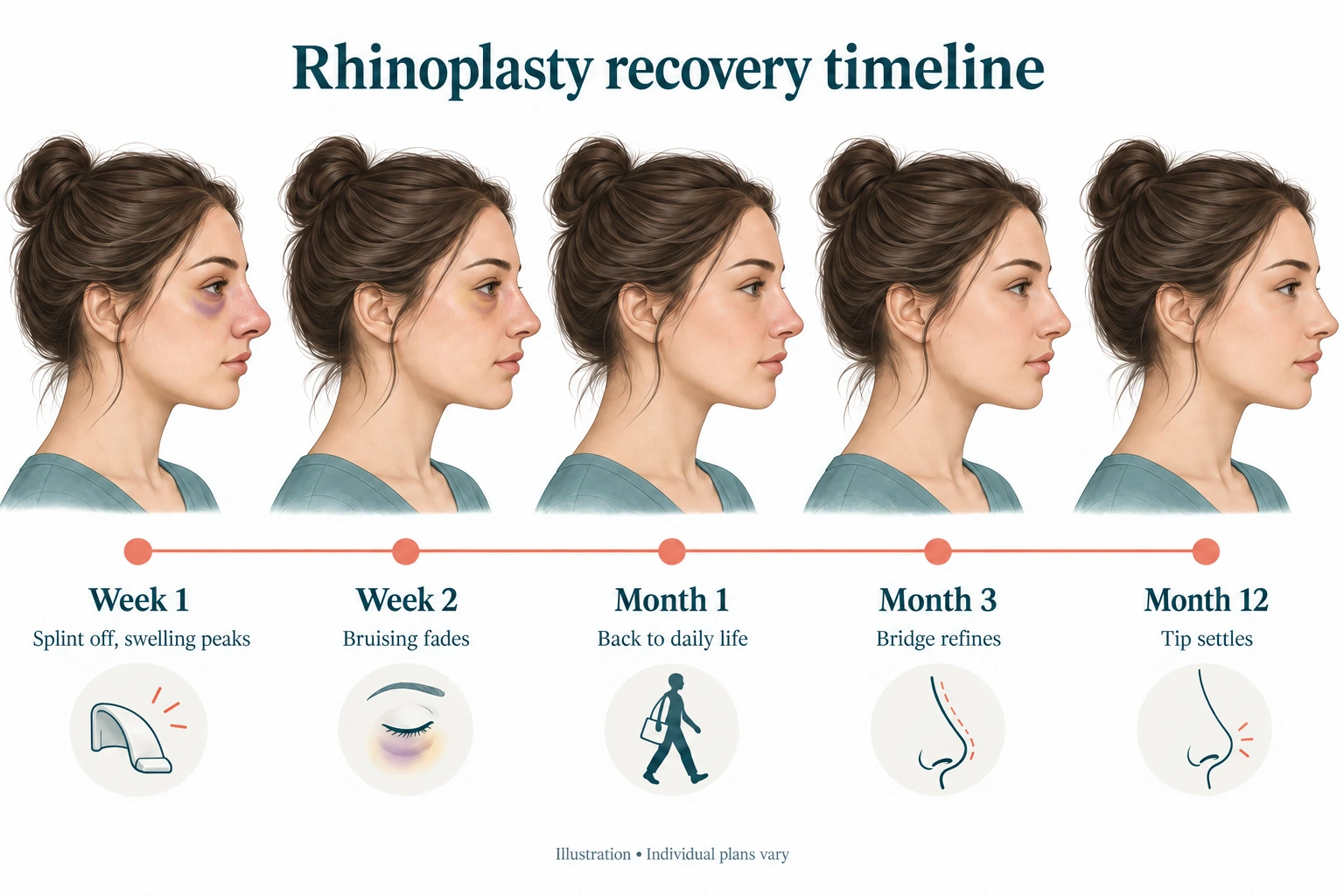
Recovery duration and experience differ slightly between open and closed rhinoplasty. Open technique typically involves more swelling, especially across the nasal tip, and can take a few extra days for visible bruising and discomfort to subside. External stitches (from the columella incision) are removed within 5-7 days, and the tiny scar tends to fade significantly over time. Closed rhinoplasty patients may have faster reduction of swelling due to less tissue disruption, and love the absence of any external stitch removal.
Regardless of technique, most patients return to desk-based work in 7-14 days, avoid strenuous activities for 4-6 weeks, and see their final results gradually unfold over months. Vivid Clinic provides a tailored aftercare program, with support for pain management, wound care, and tips to speed up recovery for international travelers. For step-by-step recovery details and tips on flights and aftercare, see the Rhinoplasty Recovery In Turkey Step By Step Guide.
When Will You See Results?
Here’s what most patients can expect when it comes to results:
- Initial look: After splint removal, swelling and bruising mask your final result. The new nose shape is visible but often puffy at first.
- Improvement phase: Swelling decreases steadily over 6-8 weeks, especially with closed rhinoplasty. The nasal tip (especially after open technique) may remain firmer for several months.
- Final contour: Most patients see refined, stable nose shape at 6-12 months post-op. Open rhinoplasty patients can expect the tip and bridge to settle last.
Photos taken at Vivid Clinic throughout your journey help you appreciate subtle and dramatic changes, always with the reminder that results vary by individual. Review real examples in the Before & After Gallery.
Risks and Safety Considerations
Both open and closed rhinoplasty are safe when performed by experienced surgeons in accredited facilities, as at Vivid Clinic. However, like any surgical procedure, they carry potential risks, including:
- Infection, bleeding, or prolonged swelling
- Visible scarring (open technique, usually minimal and fades)
- Breathing difficulties or asymmetry
- Need for revision or secondary surgery
- Temporary numbness or changes in skin sensation
- Reactions to anesthesia
Thorough patient evaluation, clear communication about goals, and meticulous aftercare greatly reduce the likelihood of complications. Vivid Clinic’s team guides you through all risks, setting realistic expectations and providing reassurance each step of the way.
Cost Factors for Open vs Closed Rhinoplasty
The price of rhinoplasty in Istanbul with Vivid Clinic depends on several factors rather than a fixed rate. Generally, open rhinoplasty may cost more due to longer surgery time, greater complexity, or the need for cartilage grafting. Closed rhinoplasty can be more affordable for suitable cases. Considerations include:
- Surgeon’s credentials and experience
- Technique required (open vs closed)
- Complexity of nose shape or revision needs
- Facility accreditation and anesthesia team
- Length of hospital stay (usually not needed except for complex or combined cases)
- Medical tests and aftercare support
- Hotel, VIP transfers, language support for international patients
An individualized treatment plan, following a free consultation with a Vivid Clinic surgeon, is the best way to receive an accurate cost breakdown. For a deeper dive into price components and what’s included, see Rhinoplasty Cost in Turkey.
Who Should Choose Open vs Closed Rhinoplasty?
The right method depends on your goals, anatomy, priorities, and the surgeon’s expert assessment:
- Choose open rhinoplasty if: you need dramatic change, major corrections, revision after previous surgery, or advanced tip work.
- Choose closed rhinoplasty if: you desire minor reshaping, have symmetrical features, and prefer minimal downtime with no external scar.
Your consultation at Vivid Clinic is the key: surgeons will study your nose, explain which approach matches your needs, and support your decision with visual aids and honest conversation.
Why Choose Vivid Clinic in Istanbul for Rhinoplasty?
Vivid Clinic combines artistry, technology, medical safety, and warm hospitality, making it a sought-after destination for rhinoplasty in Istanbul. Why do international patients choose Vivid?
- Rhinoplasty led by Prof. Dr. Özgür Pilancı, Vivid Clinic’s lead surgeon, experienced in both open and closed techniques
- Detailed digital imaging and simulation tools for individualized planning
- Concierge support from airport pickup through to remote aftercare at home
- Luxurious recovery facilities and attentive nursing
- Transparent consultation process, free for new patients
- Multilingual staff and tailored travel packages
By choosing Vivid Clinic, you’re not just booking a procedure, you’re gaining a supportive team devoted to natural, beautiful, and safe outcomes. To explore more facial harmony treatments, visit our Rhinoplasty and Face Aesthetic pages.
Related guides: rhinoplasty in Turkey, revision rhinoplasty before and after and types of noses.
FAQs About Open vs Closed Rhinoplasty
What is the main difference between open vs closed rhinoplasty?
The main difference between open vs closed rhinoplasty is incision location and visibility for the surgeon. Open rhinoplasty utilizes a small incision across the columella (the skin between the nostrils) plus internal incisions, allowing the surgeon to lift the nasal skin and directly visualize all structures. This approach is ideal for complex reshaping or revision surgeries. Closed rhinoplasty, on the other hand, uses only incisions inside the nostrils, so there is no external scar and less tissue disruption. It’s typically chosen for simpler cases where subtle changes are required. The right method depends on your nose structure and expected improvements.
Which technique, open or closed, has a faster recovery process?
Closed rhinoplasty usually offers a faster recovery compared to open rhinoplasty. Because closed rhinoplasty avoids lifting the nasal skin off the underlying cartilage and bone, swelling and bruising are often less pronounced, and patients can resume normal activities sooner, often within 7-10 days. Open rhinoplasty, which involves a small external incision and greater tissue manipulation, tends to result in more swelling, particularly around the nasal tip. Most open rhinoplasty patients are ready to return to daily activities in 10-14 days, but both approaches require patience for swelling to resolve completely over several months. Your personal healing speed depends on anatomy and surgical complexity.
Will I have a visible scar after open vs closed rhinoplasty?
With open rhinoplasty, a very fine scar is created on the columella, the skin between your nostrils, but it typically fades over months and may become nearly invisible. Skilled surgeons at Vivid Clinic use meticulous closure techniques to ensure scars heal as discreetly as possible. Closed rhinoplasty leaves no external scar since all incisions are inside the nostrils. If having absolutely no visible scar is a top priority, closed rhinoplasty might be preferred for suitable candidates, but not everyone is a candidate for this approach. Be sure to consult your surgeon about your preferences and anatomy during your evaluation.
Is open vs closed rhinoplasty better for complex nose reshaping?
Generally, open rhinoplasty is better suited for complex nose reshaping, such as major corrections, revision (secondary) procedures, or when extensive tip work or cartilage grafting is required. The open approach gives the surgeon direct access and precise control over all nasal structures, making it the gold standard for difficult or asymmetrical cases. Closed rhinoplasty is most effective for straightforward changes, like minor tip refinement or reducing a dorsal hump. Your surgeon will explain which approach is optimal for your needs after a detailed facial analysis at Vivid Clinic.
How do I know if open vs closed rhinoplasty is right for me?
The best way to determine if open vs closed rhinoplasty is right for you is by scheduling a consultation with an expert rhinoplasty surgeon. Your facial anatomy, skin quality, previous nose surgeries, and aesthetic goals all play a role in matching you to the safest, most effective technique. At Vivid Clinic, consultations, available both in-person and virtually for international patients, allow surgeons to carefully assess your nose, discuss potential outcomes for each approach, and create a custom plan. Every patient is unique, and your treatment should be tailored to your specific needs and expectations.
Conclusion: Your Next Step for a Confident Change
Your nose shapes how you feel, look, and connect with the world. Choosing between open vs closed rhinoplasty is a deeply personal decision best made with honest information, compassionate support, and an expert surgical partner. Istanbul’s Vivid Clinic brings together artistry, advanced medical techniques, and holistic care to guide you at every stage, from your first online chat to your final recovery selfie. Take the next step in your aesthetic journey: consult with a top plastic surgeon, receive bespoke advice, and find the approach that will reveal your most confident, harmonious self.