
 ChatGPT

The Little V That Started a Conversation
You push your hair back after a swim, catch your reflection, and there it is: a neat V pointing down toward the middle of your forehead. Your father has it. Maybe your grandmother did too. For years you barely noticed it, and now you cannot stop looking.
That shape is a widow’s peak, and it is one of the most recognisable hairline patterns there is. Some people love the sharp frame it gives the face. Others wonder whether it is the first sign of hair loss, or whether it could be softened or reshaped. At Vivid Clinic in Istanbul, Turkey, these questions often come up during a free consultation with a plastic surgeon and the hair restoration team.
This guide explains what the pattern is, what it does and does not say about your genes, how to tell it apart from early recession, and the honest range of options, from changing nothing at all to hairline design surgery.
What Is a Widow’s Peak?
Quick Answer: A widow’s peak is a V-shaped point in the centre of the front hairline, where the hair dips lower than at the sides. It is a normal variation in hairline shape, usually present from childhood or the teenage years, and on its own it is not a sign of hair loss or a medical problem.
The name is usually traced to the pointed hoods once worn by women in mourning, which dipped toward the forehead. Today it simply describes a hairline with a central point and two higher arcs either side.
Widow’s Peak Hairline vs Straight and Rounded Hairlines
Hairlines are often described in a few broad shapes:
- Rounded or bell-shaped: a soft, continuous curve, common in women and younger men.
- Straight or square: an even line across the forehead with defined corners.
- Widows peak hairline: a central V with the sides sitting higher.
- M-shaped: two receded temple corners with the centre holding, often linked to pattern hair loss.
The difference between the last two matters, and we come back to it below.
What Your Widow’s Peak Says About Your Genes
You may have read that a widow’s peak is controlled by a single dominant gene. It is a popular classroom example, but the reality is less tidy.
Quick Answer: A widow’s peak is commonly described as inherited and often runs in families. However, hairline shape is not thought to follow a simple single-gene pattern, and the science behind it is still limited. Having one tells you little about your future hair loss on its own.
Why the Single-Gene Story Is an Oversimplification
Hairline shape is set as follicles develop on the forehead before birth. Several genes and developmental factors are likely involved, so family patterns are not always predictable.
Common Myths, Gently Corrected
- “A widow’s peak means you will go bald.” Not by itself. Pattern hair loss is a separate process.
- “Only men have one.” Women have them too, and they are often more visible when hair is swept back.
- “It is a sign of a health problem.” In almost all people it is simply a feature, like dimples. Very rarely, an unusual hairline is one of several features of a congenital condition, and a doctor would look at the whole picture.
Natural Widow’s Peak or Early Recession?
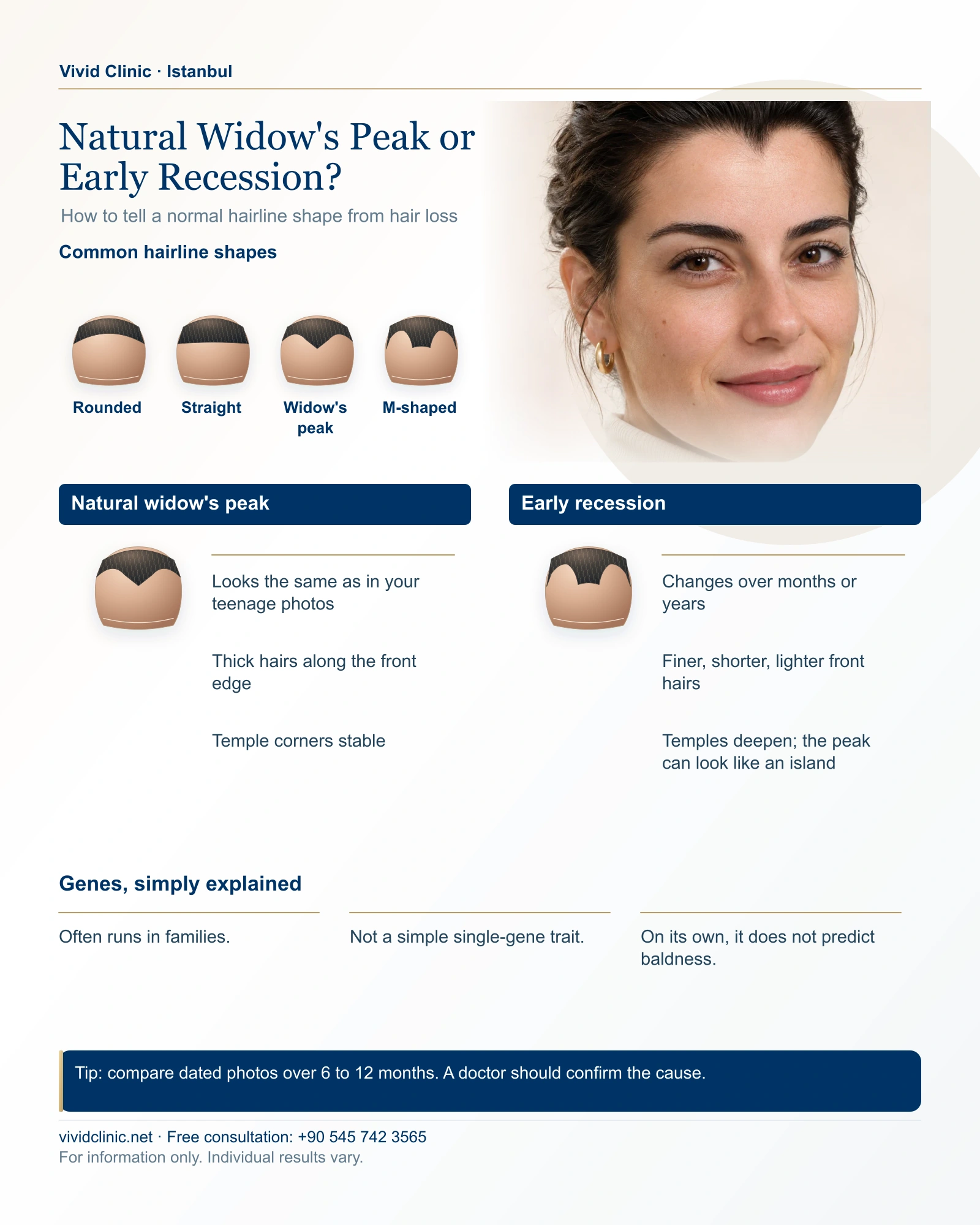
Quick Answer: A natural widow’s peak has usually looked the same since your teens, with stable temples and thick hair along the front edge. Recession keeps moving: the temples deepen, the front hairs become finer, and the peak can start to look more pronounced only because the sides are moving back.
Signs It Is Simply Your Natural Shape
- Old photos from your late teens show the same outline.
- The hairs along the front are as thick as the rest of your scalp.
- The temple corners have not visibly changed in several years.
Signs Worth Checking With a Doctor
- The peak looks sharper because the temples are retreating.
- Front hairs are wispy, shorter and lighter.
- The central point starts to look like an island separated from the sides.
Recession is a different topic with its own treatment path, and you can read more about hair loss treatment options at Vivid Clinic. If you are unsure, compare dated photos over 6 to 12 months and ask a doctor to examine your scalp.
Should You Keep, Soften or Reshape Your Widow’s Peak?
There is no right answer here, only your preference. Many people with a widow’s peak would never change it, and that is a completely healthy choice. Surgery is not needed for a normal hairline, and a good surgeon will tell you so.
Who May Consider Changing It
- People who feel the point is too sharp or too low for their face.
- Those with a high forehead plus a peak, who want an overall lower hairline.
- People with early recession around a peak who want the frame restored.
- Women who want a softer, more rounded front line.
Who May Not Be Suitable
- People with active, unstable hair loss who have not tried medical treatment.
- Those with very limited donor hair at the back and sides.
- Anyone with uncontrolled medical conditions or unrealistic expectations.
- Very young patients whose hairline pattern has not yet settled.
7 Ways to Keep, Soften or Reshape a Widow’s Peak
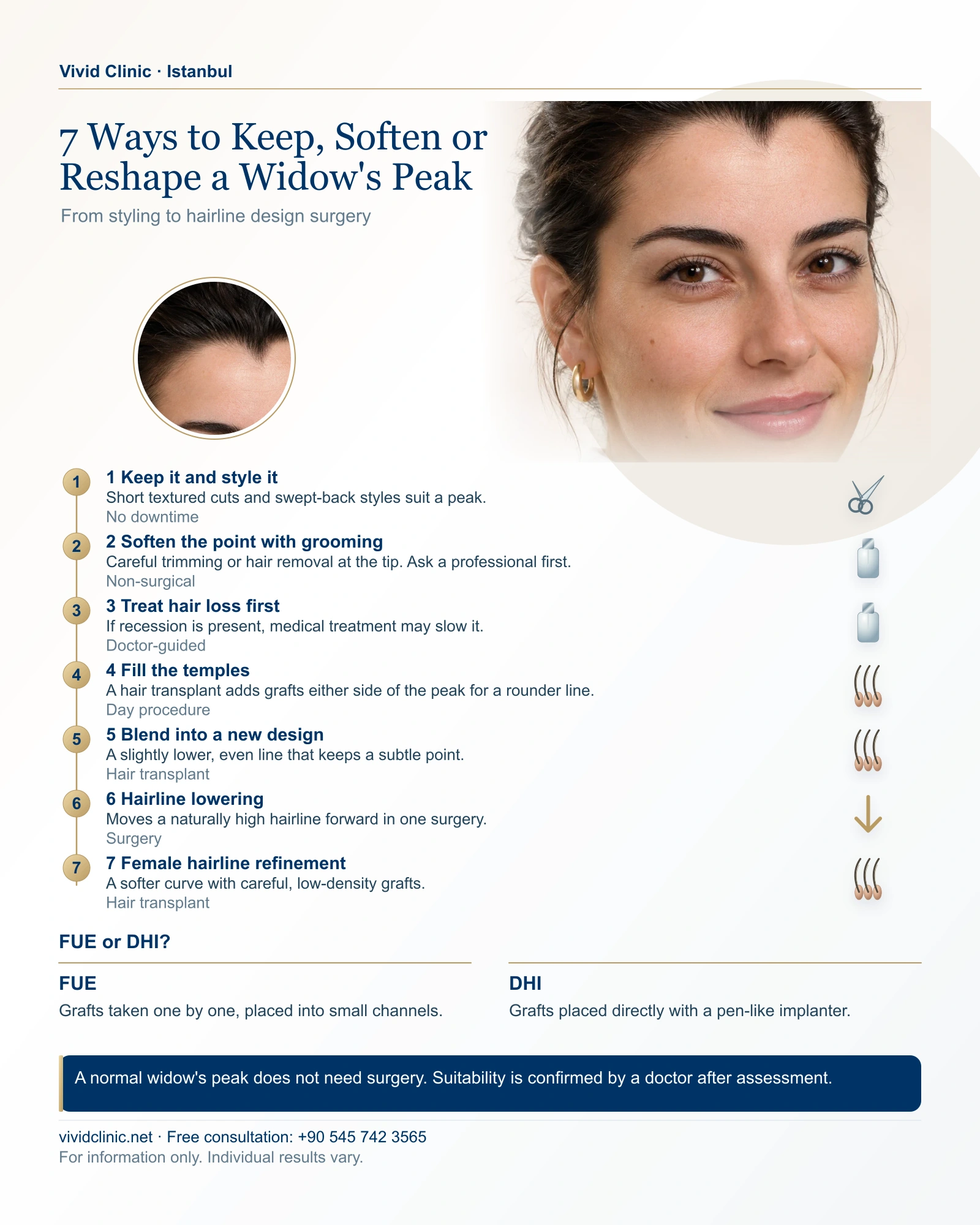
1. Keep It and Style It
Short textured cuts and swept-back styles suit a peak well, while a fringe or side part hides it.
2. Soften the Point With Grooming
Some people trim or remove hair at the tip of the point. Ask a professional first, because an uneven result is easy to create.
3. Treat Any Underlying Hair Loss First
If recession is part of the picture, medical options such as topical minoxidil, or prescription treatment for suitable men, may slow further loss. These should be guided by a doctor.
4. Fill the Temples With a Hair Transplant
A hair transplant can add grafts into the higher areas either side of the peak. This makes the overall line rounder and the point less dramatic, while keeping a natural irregular edge.
5. Blend the Peak Into a New Hairline Design
For some, the surgeon designs a slightly lower or more even front line that keeps a subtle central point. This is often the most natural compromise.
6. Hairline Lowering Surgery for a High Peaked Hairline
When the forehead is naturally tall and the hair is dense, hairline lowering surgery moves the whole hairline forward in one procedure. The peak can usually be preserved or softened as part of the plan.
7. Female Hairline Refinement
Women often seek a softer curve rather than a sharp V. Female hair transplantation can refine the front line and temples with careful, low-density placement.
How Hairline Design With a Hair Transplant Works
FUE Technique
With FUE hair transplant, individual follicular units are taken from the back and sides of the scalp using a fine punch. Small channels are then opened at the front, and grafts are placed at the angle and direction of the native hair.
DHI Technique
DHI hair transplant uses a pen-like implanter to place each graft directly, which gives fine control over angle and depth. It is often chosen for detailed hairline work and smaller areas.
Designing a Natural Line Around the Peak
The surgeon draws the proposed line with you before anything begins. Single-hair grafts sit at the very front, with slightly denser grafts behind. The edge is kept soft and irregular, because a ruler-straight line rarely looks natural. Your age, face shape and long-term hair loss risk all shape the design.
Procedure Overview Table: Hair Transplant for Hairline Design
| Aspect | Details |
|---|---|
| Duration Process | Usually 4 to 8 hours in a single day, depending on the number of grafts |
| Hospitalization Duration | Not usually required; performed as a day procedure under local anesthesia |
| Mobility Duration | Walking the same day |
| Return to Activity | Desk work in about 3 to 5 days; gym and swimming after about 3 to 4 weeks |
| Complete Recovery | Scabs clear in about 10 to 14 days; redness may take several weeks to fade |
| Anticipated Results | Early growth at 3 to 4 months; fuller result at 12 to 18 months |
Timings are general estimates and vary between patients. Hairline lowering surgery follows a different timeline, which your surgeon will explain.
Operation Process Overview at Vivid Clinic
Your journey begins when you arrive in Istanbul, where a VIP airport transfer takes you to your 5-star hotel for check-in and a chance to rest. Next comes your one-on-one consultation, where the doctor examines your hairline and donor area, discusses whether you want to keep, soften or reshape your widow’s peak, and draws the proposed design with you. On treatment day, the procedure is carried out under local anesthesia, with breaks and clear updates throughout. Post-operative care includes your first wash, written aftercare instructions and medication guidance. A checkup visit before you fly confirms that healing has started well. After departure, the team continues remote aftercare follow-up, reviewing your photos at key stages of the growth timeline.
Recovery Timeline After Hairline Design Surgery
Days 1 to 3
Mild swelling around the forehead and some tightness are common. You sleep with your head raised and avoid touching the grafts.
Days 4 to 14
Small scabs form and then soften with gentle washing. Most people return to desk work in this window, often wearing a loose hat outdoors.
Weeks 2 to 8
Many transplanted hairs shed. This is expected, because the follicle stays in place and rests before growing again.
Months 3 to 6
New hairs begin to appear along the redesigned line. Early growth is often fine and uneven.
Months 12 to 18
The hair thickens and the final shape becomes clear. Results vary by individual.
Hairline Lowering Recovery in Brief
After hairline lowering, sutures are usually removed after about 7 to 10 days, and most people return to work within 1 to 2 weeks. The fine incision continues to mature over many months.
Benefits of Reshaping a Widow’s Peak
- A softer or more balanced frame for the face.
- A lower front line for those with a tall forehead.
- More freedom with hairstyles.
- Restored temple corners where early recession has started.
- Your own hair, growing naturally once established.
Risks and Side Effects to Understand
Every procedure carries risks. With a hair transplant, these include swelling, temporary numbness, infection, folliculitis, temporary shock loss of nearby hair, and lower-than-expected graft growth. A poorly designed line can look unnatural, which is why planning matters so much.
Hairline lowering adds the risks of any scalp surgery, including a visible scar line, numbness, and temporary shedding near the incision. Your surgeon will discuss your personal risks in detail before you decide.
How to Prepare Before Your Procedure
- Share clear photos of your hairline from the front, sides and top.
- Tell your doctor about all medications, supplements and medical conditions.
- Stop smoking and limit alcohol for the period your doctor advises.
- Avoid haircuts that are very short right before surgery unless instructed.
- Plan your trip so that you can attend the checkup visit before flying.
Aftercare Tips for Better Healing
- Follow the washing routine exactly as shown by the team.
- Sleep with your head elevated for the first few nights.
- Avoid direct sun, swimming and heavy exercise for the advised period.
- Do not pick at scabs, even when they itch.
- Send progress photos when the team asks for them.
Cost Factors in Istanbul, Turkey
The cost of reshaping a widow’s peak depends on your plan. Key factors include:
- Whether you choose a hair transplant or hairline lowering surgery.
- The number of grafts needed and the size of the area.
- FUE or DHI technique.
- Any treatment for underlying hair loss.
- Accommodation, transfers and the length of your stay.
- Aftercare and follow-up included in the package.
For a personal estimate, you can use the surgery price calculator or request a tailored quote after your assessment.
Why Choose Vivid Clinic for Widow’s Peak Hairline Design?
Quick Answer: Vivid Clinic combines careful hairline planning with an organised international patient journey in Istanbul, Turkey. You can start with a free consultation with a plastic surgeon and the hair restoration team, who will tell you honestly whether changing your hairline makes sense.
At Vivid Clinic, every plan begins with listening. Some patients decide to keep their natural line, and that is a good outcome too. When surgery does suit you, the design is drawn and agreed with you in advance. You can meet the Vivid Clinic medical team and browse the before and after gallery to see the clinic’s work.
What International Patients Should Expect
Most hair transplant patients stay in Istanbul for around 3 to 4 days, including consultation, procedure and a checkup visit. Hairline lowering may need a slightly longer stay. Coordinators help with scheduling, and follow-up continues online after you fly home.
FAQs
Is a widow’s peak a sign that I am going bald?
A widow’s peak on its own is not a sign of baldness. It is a hairline shape that most people have had since childhood or their teenage years. What matters is change over time. If your temples are moving back, the hairs at the front are becoming finer, or the peak is starting to look like an island, that suggests pattern hair loss rather than your natural outline. A doctor can examine your scalp, check for miniaturised hairs and advise whether medical treatment is worth considering. At Vivid Clinic, this assessment is part of the consultation, so you get a clear answer before you consider any procedure.
Can a hair transplant soften a widow’s peak without removing it completely?
Yes, a hair transplant can soften a widow’s peak while keeping a subtle central point. The surgeon places grafts in the higher areas either side of the peak, so the overall line becomes rounder and the V looks less sharp. Single-hair grafts are used at the very front for a soft, natural edge. Both FUE and DHI can be used, usually as a single day procedure under local anesthesia. Results vary by individual, and growth usually becomes visible from around 3 to 4 months, with a fuller result at 12 to 18 months.
Is hairline lowering or a hair transplant better for a high widow’s peak hairline?
It depends on your forehead height, hair density and hair loss history. Hairline lowering moves the entire hairline forward in one surgery, so it can suit people with a naturally tall forehead, dense hair and no significant hair loss. A hair transplant suits those who want to fill areas around a widow’s peak or who have some recession, and it can be repeated or adjusted later. Hairline lowering leaves a fine incision line near the front, which should be discussed. Your surgeon will examine your scalp and explain which approach fits your anatomy and goals.
How long should I stay in Istanbul for widow’s peak hairline design?
For a hair transplant to reshape a widow’s peak, most international patients plan around 3 to 4 days in Istanbul. This usually covers arrival, the one-on-one consultation, procedure day, the first wash and a checkup visit before flying. Hairline lowering may need a slightly longer stay or a return visit for suture review, depending on your surgeon’s advice. Vivid Clinic coordinates your VIP airport transfer and 5-star hotel, and remote aftercare continues after you return home, so the team can review your progress photos.
What affects the cost of changing a widow’s peak in Turkey?
The cost of reshaping a widow’s peak in Turkey depends mainly on the procedure and the size of the area. A small softening with a limited number of grafts is a different plan from a full hairline redesign or hairline lowering surgery. Technique choice, such as FUE or DHI, also plays a part, as does any treatment for underlying hair loss. Package elements like hotel nights, VIP transfers and aftercare follow-up affect the final figure. Vivid Clinic provides a personalised quote after reviewing your photos, and you can use the online surgery price calculator for an early idea.
Conclusion
A widow’s peak is part of your family story, not a flaw that needs fixing. For many people the best choice is to keep it and style it with confidence. For others, softening the point, filling the temples or lowering a tall forehead brings the face back into balance. The right answer starts with knowing whether you are looking at a natural shape or early recession.
If you would like an expert opinion, Vivid Clinic in Istanbul, Turkey offers a free consultation with a plastic surgeon and the hair restoration team. Request your free quote and send your photos to start the conversation.
Real Before and After Results at Vivid Clinic
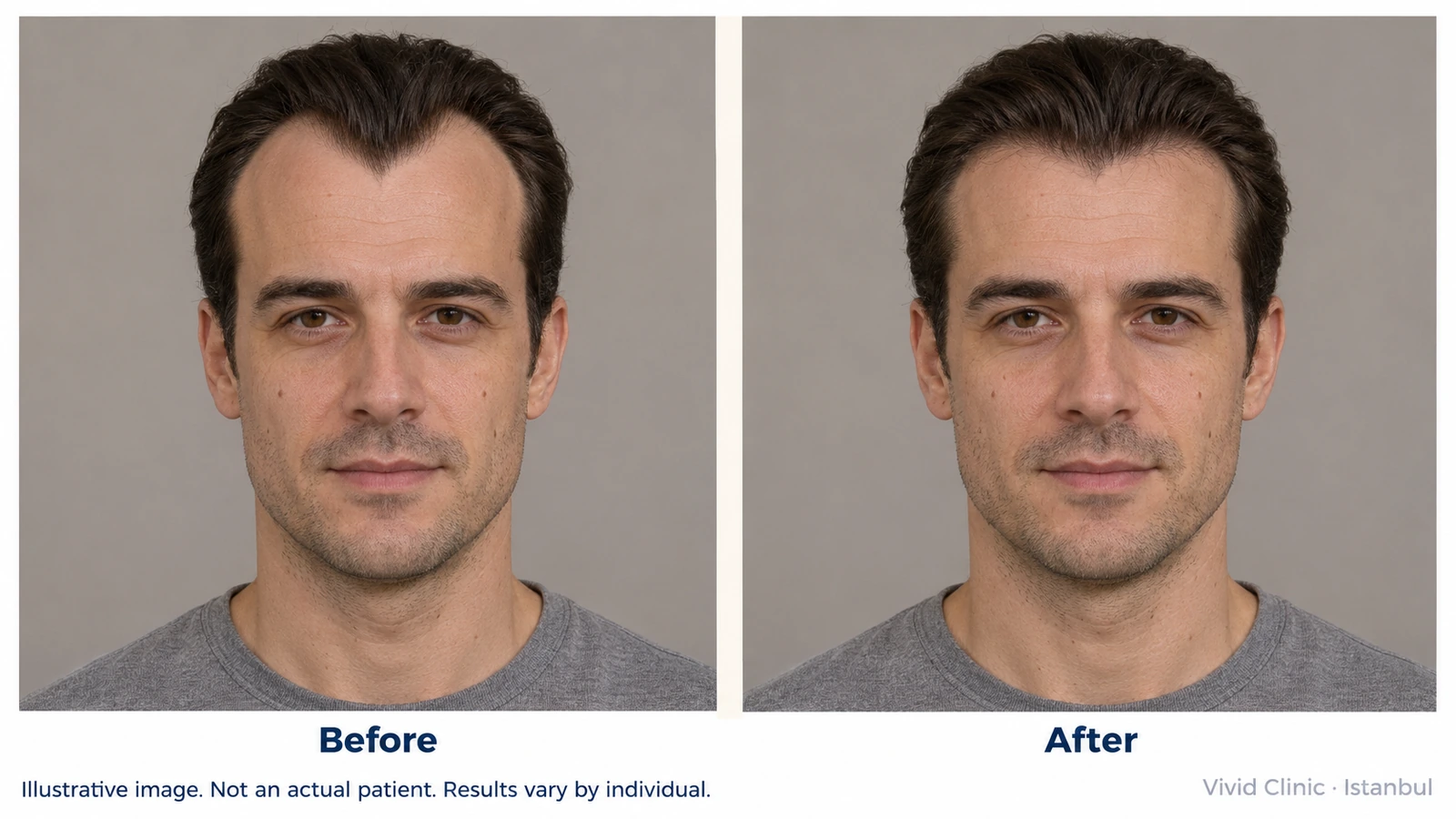
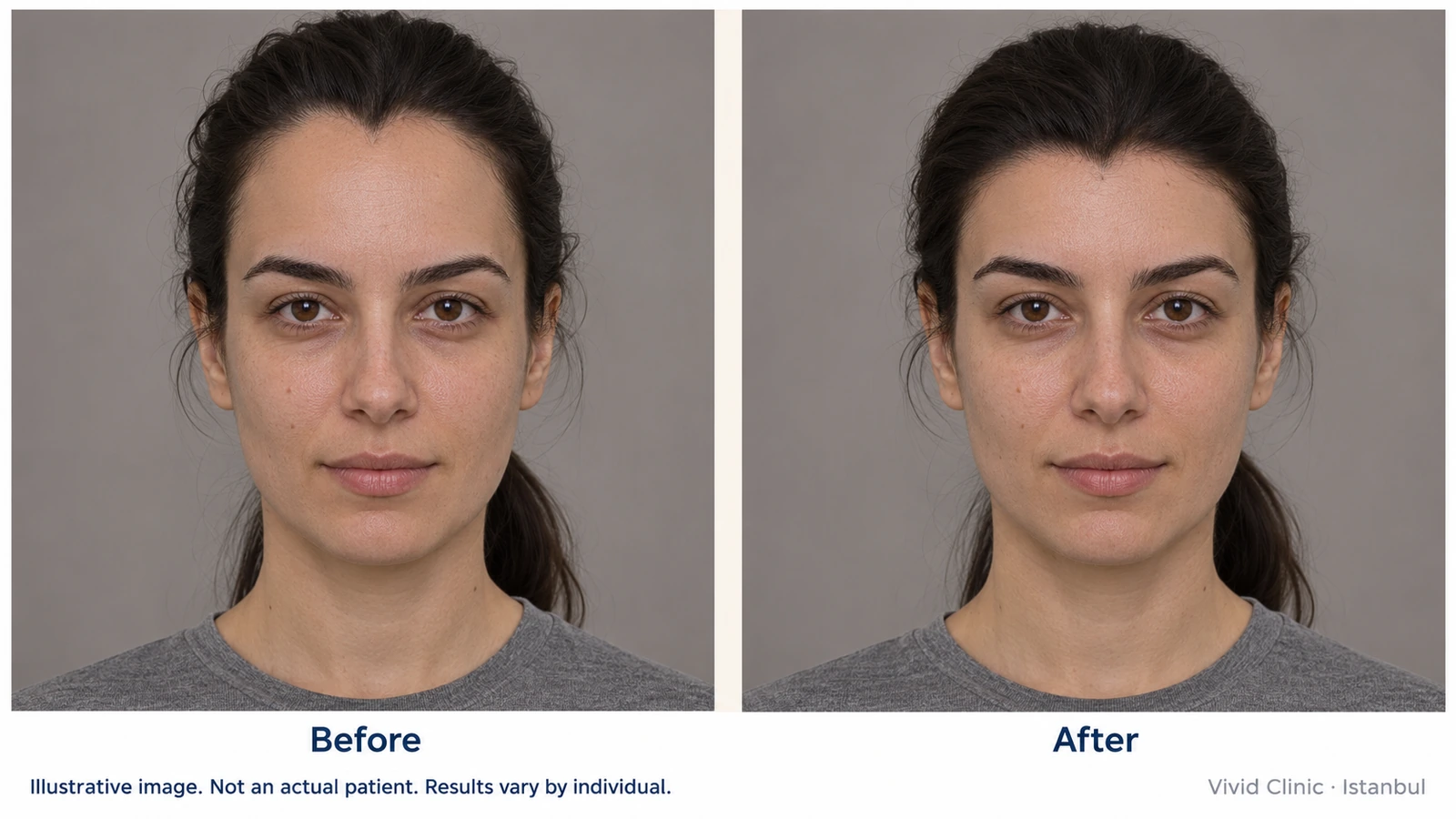
The photos below show real Vivid Clinic patients from the clinic’s own gallery, shared with consent as published on the clinic site. They show hair transplant cases in general, not cases treated specifically for a widow’s peak, and results vary by anatomy, healing and treatment plan.


See more patient results in the full before and after gallery. If you are thinking about your own hairline, request your free quote and the Vivid Clinic team will review your photos.
This article is for general information and does not replace a personal medical consultation. Suitability, risks, recovery and expected results should be discussed with a qualified medical professional. Results vary by individual.