
 ChatGPT

Medically reviewed by Prof. Dr. Özgür Pilancı, Plastic, Reconstructive & Aesthetic Surgeon — August 2026
Quick answer (updated August 2026): Effective hair loss treatment starts with identifying the cause. Hair shedding is a symptom, not a diagnosis — the right treatment depends entirely on the cause, which is why “what is good for hair loss” has no single answer. For the most common cause, hereditary pattern loss, the best-evidenced treatments are topical minoxidil and, in men, oral finasteride; laser combs and caps have real but modest evidence and work best as an add-on. A hair transplant makes sense only once loss is stable and the donor area is strong — and it redistributes hair rather than creating it, so medication usually continues afterwards.

Why “what is good for hair loss” has no single answer
Because hair loss is not one condition. A crash dieter shedding handfuls three months after losing weight, a man whose hairline has crept back over a decade, and a woman with an itchy, scarred frontal hairline have three different diseases — and the treatment that helps one does nothing, or harms, in another. Diagnosis comes before treatment — that is the frame for everything below.

First: is it shedding or hair loss?
Losing hair every day is normal. The American Academy of Dermatology puts normal shedding at 50 to 100 hairs a day — part of the ordinary growth cycle, in which each follicle moves through growth (anagen), transition (catagen) and rest (telogen) before the hair falls and a new one grows.
Excessive hair loss usually means one of two things: the cycle has been disturbed and more hairs than usual are falling — shedding, which typically recovers — or something is stopping hairs from growing back at all — true hair loss, which tends to progress until treated. Telling the two apart is the most useful thing a dermatologist does at a first appointment.

The main causes, and how doctors tell them apart
Androgenetic alopecia (pattern hair loss) is by far the most common cause, affecting roughly half of men and women over a lifetime. In men it follows the Norwood scale — temples first, then crown; in women the Ludwig scale — a gradual widening of the part with the front hairline usually preserved. It is driven by genetic sensitivity of follicles to dihydrotestosterone (DHT), which progressively miniaturizes them. It does not recover on its own, but it responds to treatment, and it is the loss pattern for which transplants were designed.

Telogen effluvium is the great imitator: a shock pushes many follicles into the resting phase at once, and two to three months later hair falls diffusely — often alarmingly. Recognized triggers include serious illness, high fever, surgery, childbirth (peak shedding around four months after delivery), crash dieting or losing 20 pounds or more, severe stress, thyroid disease, iron deficiency and stopping hormonal contraception. Once the trigger is corrected, fullness typically returns over six to nine months — so the key step is finding the trigger, which sometimes means blood tests, not products.
Alopecia areata is autoimmune: smooth, round, completely bald patches that can appear over days, behaving unpredictably — regrowth is common, relapse is common. It needs a dermatologist, not a device.
Traction alopecia comes from years of tension — tight ponytails, braids, buns, extensions. Caught early it reverses when the tension stops; continued long enough, it scars permanently.
Scarring (cicatricial) alopecias, including frontal fibrosing alopecia, destroy the follicle and replace it with scar tissue. The classic picture in women: a receding frontal hairline with itching, burning, redness or scaling, often with eyebrow loss. This is urgent — hair lost to scarring does not come back, so treatment aims to stop progression, and every month of delay costs hair permanently.
Drug-induced shedding accompanies many medicines — retinoids, some blood pressure and cholesterol drugs, anticoagulants, mood stabilizers and chemotherapy among them. Never stop a prescribed medicine on your own; ask the prescriber whether the timing fits.
Minoxidil: the best-evidenced place to start
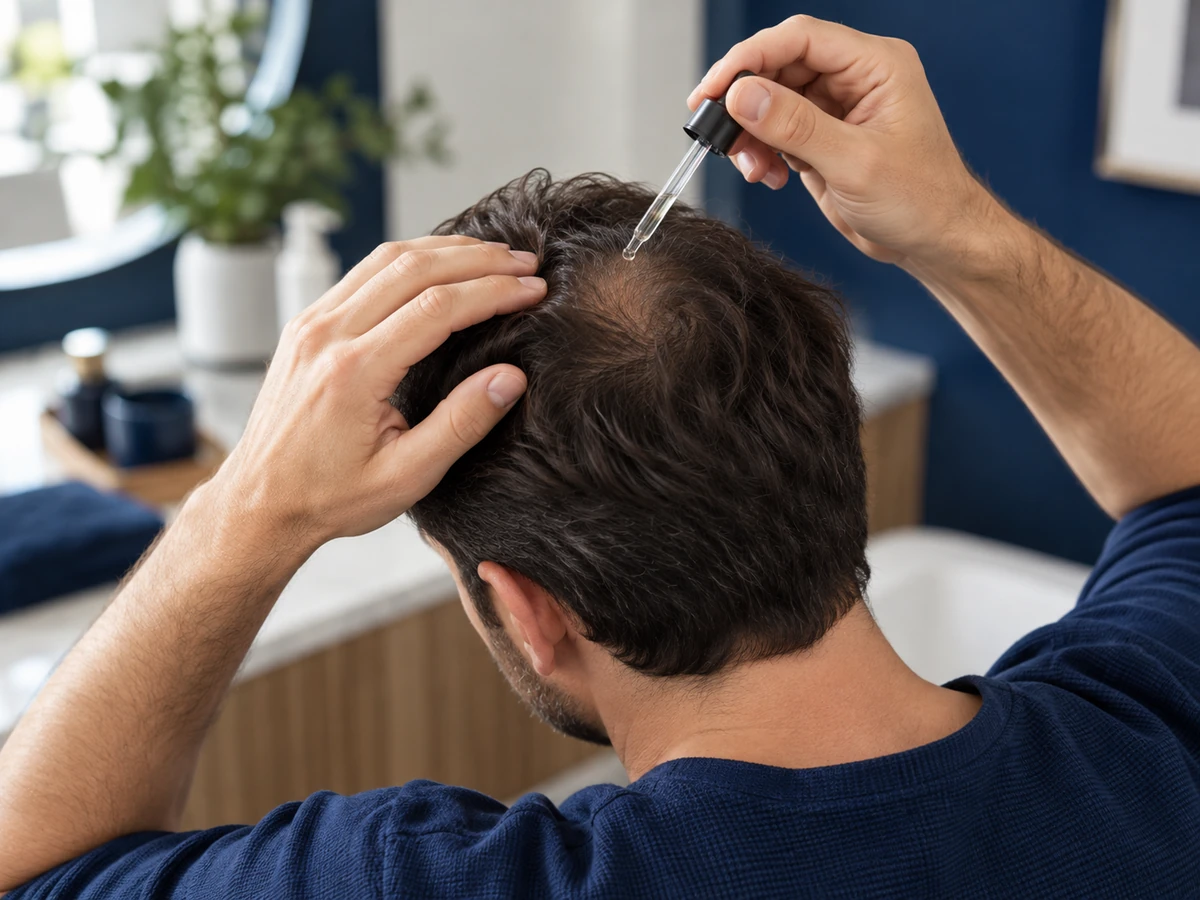
Topical minoxidil is the most robustly supported over-the-counter treatment for pattern hair loss in both men and women, and it is where most people should start. Three honest caveats. Patience: expect at least four to six months of consistent use before visible improvement. The shedding phase: many users shed more in the first weeks as resting hairs are pushed out to make way for new growth — expected, not failure. And commitment: minoxidil maintains results only while you use it. Scalp irritation and flaking are the common side effects.
Prescription options: finasteride, dutasteride and spironolactone
For male pattern loss, oral finasteride — and its stronger cousin dutasteride — block the conversion of testosterone to DHT, addressing the disease mechanism rather than just stimulating growth. Finasteride is well supported in trials, works better at the crown than the frontal hairline, and combining it with minoxidil outperforms either alone.
The side-effect conversation deserves honesty in both directions. A minority of men in trials reported sexual side effects — reduced libido or erectile difficulty — which often improve with continued use or resolve after stopping; a smaller number report persistent symptoms, an area of genuine scientific debate. These drugs also lower PSA, which matters for prostate screening, and they are strictly off-limits in pregnancy — DHT blockade can harm a male fetus. In female pattern loss, finasteride’s evidence is uncertain; dermatologists more often use spironolactone, an anti-androgen whose side effects include menstrual irregularity and raised potassium. None of these is a self-prescribing decision — doses, monitoring and suitability belong with a doctor.

Laser combs, caps and helmets: what the evidence really shows
A laser comb or laser cap uses low-level laser therapy (LLLT) — red light at roughly 620–680 nm — intended to stimulate follicle activity. The honest summary: the evidence is real but modest, and these devices are best framed as an add-on, not a replacement for diagnosis or medication.
Here is what the research says. Dozens of home-use devices hold FDA clearance — by early 2020, 32 devices across four designs: caps, helmets, combs and headbands. Clearance means the device is judged safe and similar to previously cleared devices — not proven strongly effective. A 2021 meta-analysis of the sham-controlled trials behind these devices — seven double-blinded randomized trials, 607 participants — found a statistically significant increase in hair density versus sham, in both men and women, with comb-style devices performing at least as well as helmets.
The limitations matter just as much: the trials were small, ran no longer than 26 weeks, covered only mild-to-moderate pattern loss, and no head-to-head brand comparisons exist — so nobody can tell you which laser hair growth device is best, and marketing routinely outruns the data. Realistically, a laser comb for hair growth may add measurable density in early pattern loss with consistent use, is safe, and is entirely reasonable alongside minoxidil or finasteride. It will not resurrect a bald crown, does nothing for scarring alopecia, and is never a substitute for finding out why you are losing hair.
PRP: promising, with an evidence asterisk
Platelet-rich plasma — your own blood, concentrated for platelets and injected into the scalp — sits a rung below the medications on the evidence ladder. A 2023 meta-analysis of nine randomized trials (238 patients) found significantly improved hair density versus placebo at three and six months, with good safety; gains in hair count and thickness were less convincing, and preparation methods vary so widely that results are hard to generalize. PRP is a legitimate adjunct for pattern loss under medical supervision — not a proven standalone cure, and results fade without maintenance.
Supplements: helpful in deficiency, harmful in excess
A supplement fixes hair loss only when a genuine deficiency is causing it — iron deficiency being the classic, correctable example. Biotin, despite the marketing, has no good evidence of benefit in people who are not deficient.
Less well known: over-supplementing can itself cause hair loss. Hair loss is the most common sign of chronic selenium excess (selenosis) — the NIH sets the adult upper limit at 400 micrograms a day, a threshold stacked supplements can approach — and excess vitamin A is likewise a recognized cause of shedding. If your “hair vitamin” contains megadoses of either, it may be working against you. Test first; supplement only what is actually low.
See a doctor rather than buying a device if…
Some presentations need medical assessment first — a laser hair comb or supplement would only delay diagnosis. See a dermatologist promptly for: sudden or patchy loss; loss with scalp pain, burning, redness, scaling or scarring; a receding frontal hairline with eyebrow loss; shedding alongside systemic symptoms such as fatigue, unexplained weight change or menstrual changes; and any hair loss in a child. Several of these — scarring alopecia above all — cost hair permanently while untreated.
When a hair transplant is worth considering
A transplant is the right answer when three things are true: the diagnosis is pattern hair loss, the loss is stable, and the donor area at the back and sides is dense enough to supply grafts. Transplanted follicles come from the DHT-resistant zone, which is why they persist — but surgery redistributes hair rather than creating it. Two consequences follow. A young man whose pattern is still evolving is usually a poor candidate: transplant the front today, and continuing loss behind the grafts can leave an unnatural island of hair. And because native hair keeps thinning, medical therapy usually continues after surgery to protect it.

The two modern techniques both harvest individual follicular units. In FUE, grafts are extracted, channels are opened, and grafts are placed; in DHI, a pen-shaped implanter opens the channel and places the graft in one motion. Neither is universally “better” — the surgeon’s planning, hairline design and realistic density matter more than the acronym. Women can also be candidates in selected cases; our female hair transplantation page covers how candidacy differs. For what surgery involves, see the hair transplant overview; for honest numbers on what patients actually pay, our hair transplant cost in the USA guide breaks down real pricing, and our before-and-after gallery shows results on real patients.

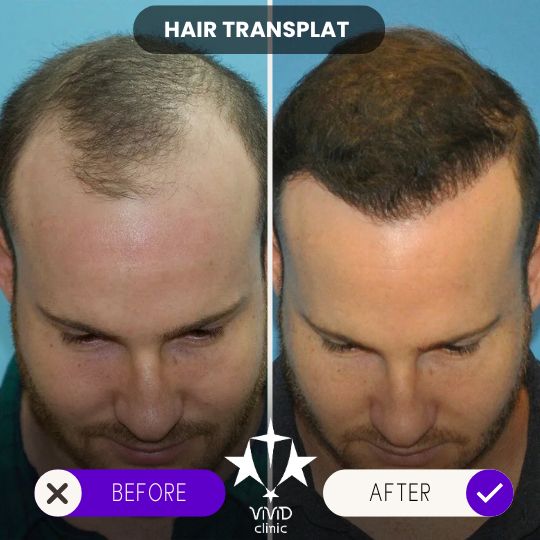
Hair Transplant Before and After Results at Vivid Clinic
These before-and-after photos show real Vivid Clinic patients treated in Istanbul, shared with their consent. Photos are matched for angle and lighting wherever possible. Individual results vary. Browse the full Before & After Gallery.




Frequently Asked Questions
How much hair loss per day is normal?
Shedding 50 to 100 hairs a day is normal. Shedding noticeably above your own baseline — handfuls in the shower, a suddenly full brush — is worth investigating, especially if it began two to three months after illness, surgery, childbirth or rapid weight loss, the classic timing of telogen effluvium. Steady thinning at the temples, crown or part line without extra shedding points instead toward pattern hair loss.
Do laser combs really work for hair growth?
They can help modestly, and they are not a scam — but the effect is smaller than marketing suggests. Sham-controlled trials of FDA-cleared home devices show a statistically significant increase in hair density in mild-to-moderate pattern loss, though the trials are small and short and no independent brand comparisons exist. The sensible role for a laser comb is as a safe add-on to minoxidil or prescription treatment in early pattern loss, not a first response to unexplained shedding.
What is the best treatment for hair loss?
There is no single best treatment, because hair loss is not a single condition. For pattern loss, topical minoxidil and, in men, oral finasteride have the strongest evidence, and combining them beats either alone. Telogen effluvium is treated by fixing the trigger; alopecia areata and scarring alopecias need dermatologist-led treatment. Anyone promising one product for “hair loss” as a whole is describing a condition that does not exist.
Can hair grow back after stress-related shedding?
Usually, yes. Telogen effluvium pushes follicles into the resting phase but does not destroy them, so once the trigger has passed or been corrected, hair typically regains its normal fullness over six to nine months. If shedding continues beyond that, or thinning follows a pattern at the temples or part line, something else is going on and deserves assessment.
What happens if I stop using minoxidil?
The benefit gradually reverses. Minoxidil supports follicles only while it is used; stop, and gained hair typically sheds over the following months, returning you roughly to where you would have been without it. That is not unique to minoxidil — pattern hair loss is progressive, and every medical treatment for it is maintenance rather than cure, which is worth knowing before you start.
At what age is a hair transplant appropriate?
There is no fixed age, but surgeons are cautious with young patients for a biological reason: an unstable, still-evolving pattern makes planning unreliable, and continuing loss behind persistent grafts can strand an island of transplanted hair. Most good candidates have had stable, documented loss — often supported by a period of medical treatment — before surgery is planned. A clinic willing to operate on a rapidly progressing 21-year-old without discussing this is showing you a warning sign.
Can women have hair transplants?
Yes, in selected cases. Diffuse thinning across the whole scalp — the most common female pattern — is often a poor surgical target, because the donor area is thinning too. But women with a stable localized pattern or traction alopecia at the hairline can be genuine candidates. The workup matters even more in women: causes such as thyroid disease and iron deficiency must be excluded before any surgical plan.
Not sure what is causing your hair loss — or whether a transplant would even help? Send photographs for a free online assessment and get a straight answer about the realistic options — including when the honest answer is that surgery is not the right tool.