
 ChatGPT

When a Breast That Felt Soft Starts to Feel Different
You know your own body. For months, maybe years, your implants simply felt like part of you. Then one morning in the shower, one breast feels firmer than the other, sits a little higher, or aches when you lie on your side. One late-night search later, you have met the term capsular contracture.
Take a breath. Firmness after breast surgery has several possible explanations, and only an examination can tell you which one applies to you.
This guide explains the grades, the symptoms and the revision options in plain language. At Vivid Clinic in Istanbul, Turkey, you can also request a free consultation with a plastic surgeon to have your situation reviewed privately, wherever your first operation took place.
What Is Capsular Contracture?
Quick Answer: Capsular contracture is a tightening of the natural scar tissue layer, called the capsule, that the body forms around every breast implant. When that capsule thickens and squeezes the implant, the breast can feel firm, change shape or become uncomfortable. It is one of the more common reasons for breast implant revision.
A Capsule Is Normal, Tightening Is Not
Your body treats any implanted device as something foreign. Within weeks it builds a thin, flexible lining of collagen around it, whether the device is a breast implant, a joint replacement or a pacemaker.
A healthy capsule is soft, and you cannot feel it. Capsular contracture begins only when that lining shrinks, thickens or hardens. The implant itself is usually unchanged. It is the envelope around it that has become too tight.
Baker Grades I to IV: How Surgeons Classify Capsular Contracture
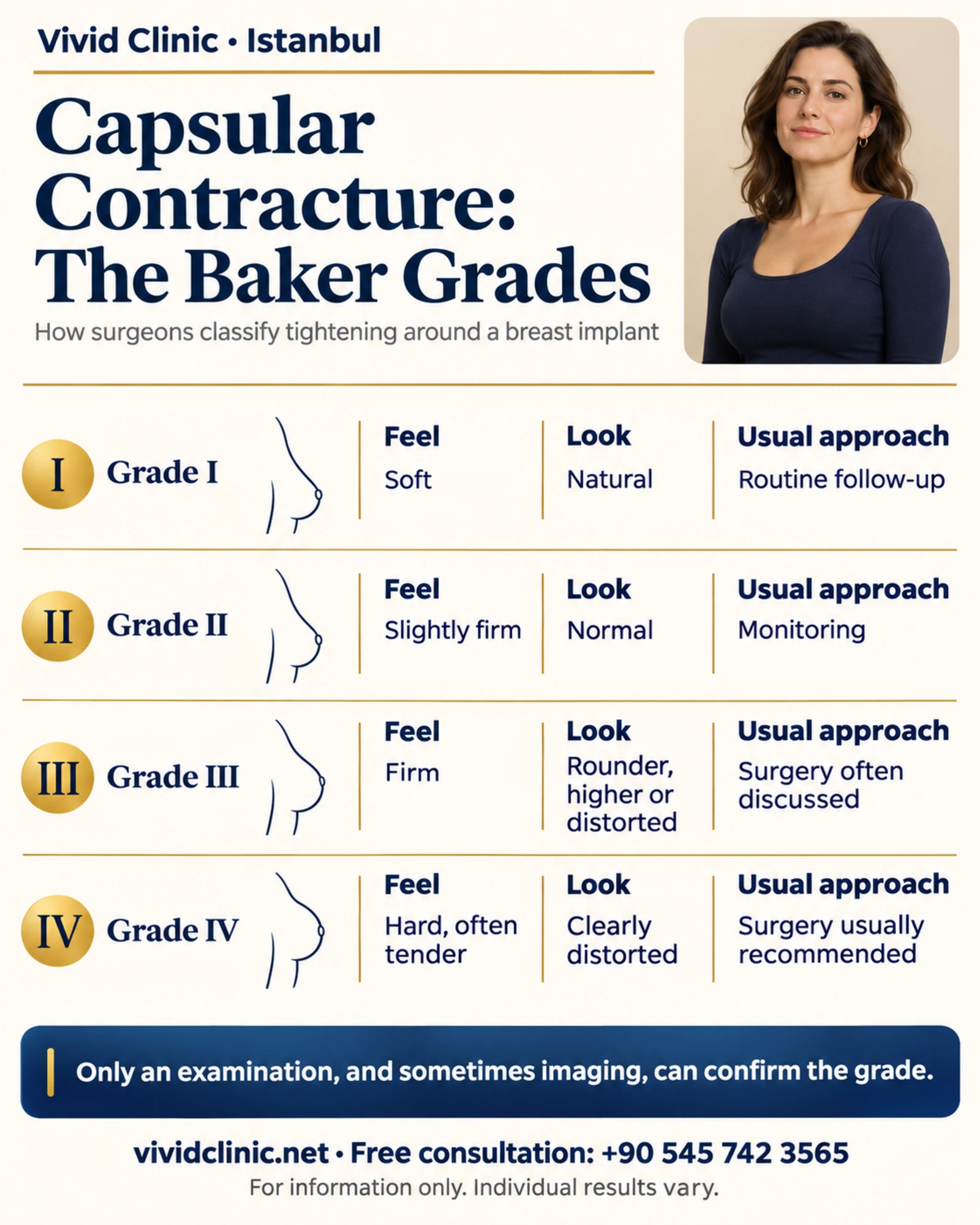
Surgeons describe severity with the Baker classification, a four-step clinical scale based on how the breast feels and looks. A Baker grade is assigned during a physical examination, not from a photograph alone.
| Baker grade | How the breast feels | How the breast looks | Usual approach |
|---|---|---|---|
| Grade I | Soft | Natural | No treatment, routine follow-up |
| Grade II | Slightly firm | Normal | Monitoring, review if it progresses |
| Grade III | Firm | Visibly changed: rounder, higher or distorted | Surgery is often discussed |
| Grade IV | Hard, often tender or painful | Clearly distorted | Surgery is usually recommended |
Grades I and II are generally considered mild. Grading has limits, though: two surgeons may grade the same breast slightly differently, and some mild cases stay stable for years while others progress.
Capsular Contracture Symptoms: What to Look For
Capsular contracture symptoms tend to develop gradually, and often on one side only. The most common signs include:
- Increasing firmness. The breast feels harder than before, or harder than the other side.
- A change in position. The implant appears to ride higher on the chest.
- A rounder, ball-like shape. The upper breast looks more curved and fixed.
- New asymmetry. One breast no longer matches the other.
- Tightness or discomfort. Pressure when lying on the breast or during exercise.
- Pain or tenderness. More typical of the higher grades.
Normal Healing or Early Contracture?
In the first weeks after breast augmentation, almost every patient feels firm, high and tight. That is swelling and muscle tension, and it normally eases over the following months. Our guide to breast augmentation side effects describes what is expected early on.
The pattern that deserves attention is the opposite: a breast that had softened and then becomes firmer again, or one side that keeps tightening while the other relaxes.
When to See a Doctor Promptly
Quick Answer: Any new firmness, swelling, pain or shape change in a breast with an implant needs an in-person assessment by a surgeon, with imaging if advised. Sudden swelling, redness, fever or a new lump should be reviewed promptly, not watched at home.
A fluid collection that appears a year or more after surgery also needs prompt medical review, because in rare cases late swelling is linked to conditions other than contracture, including an uncommon implant-associated lymphoma known as BIA-ALCL. Please do not self-diagnose from a checklist. Implant rupture, infection and unrelated breast conditions can produce similar symptoms.
What Causes Capsular Contracture?
Quick Answer: No single cause has been proven. Research points to a prolonged inflammatory reaction around the implant, and several factors are associated with a higher likelihood. In many patients no clear trigger is ever identified.
Capsular contracture is rarely caused by anything you did. The factors below are associations reported in the surgical literature, not certainties.
Bacterial Contamination and Biofilm
One leading theory is that a few low-grade bacteria reach the implant surface and form a thin layer called a biofilm. This does not cause an obvious infection, but it may keep the surrounding tissue mildly inflamed.
Haematoma or Seroma
Blood (haematoma) or clear fluid (seroma) collecting around the implant after surgery is thought to feed inflammation and scar formation.
Implant Surface and Placement
Some research has reported differences between smooth and textured surfaces, and between implants placed above and below the chest muscle, but findings are not uniform and every option has its own trade-offs. Our guide to round versus teardrop implants covers surface and shape choices in more detail.
Radiotherapy, Time and Individual Healing
Radiotherapy to the breast is a well-recognised risk factor. Tightening can also appear at any point, from the first year to many years later, and a previous capsular contracture seems to raise the chance of another.
Do You Always Need Treatment?
No. A Baker grade I or II breast that is comfortable and looks the way you want usually needs monitoring, not surgery. Your surgeon may suggest periodic check-ups and imaging to confirm that the implant is intact.
Treatment is considered when the breast is painful, visibly distorted or progressing, or when the firmness bothers you in daily life.
Non-Surgical Capsular Contracture Treatment: An Honest Look
Many patients hope for a capsular contracture treatment that avoids another operation. To be direct: the evidence for non-surgical measures is limited, and none of them reliably reverses an established grade III or IV contracture.
- Massage and implant displacement exercises. Often recommended after augmentation, but studies have not consistently shown that they prevent or reverse tightening.
- Prescription anti-inflammatory tablets. Certain asthma medicines have been used off-label for early contracture. The data are small and mixed, and these drugs carry their own side effects.
- External ultrasound therapy. Reported in small studies, without strong long-term evidence.
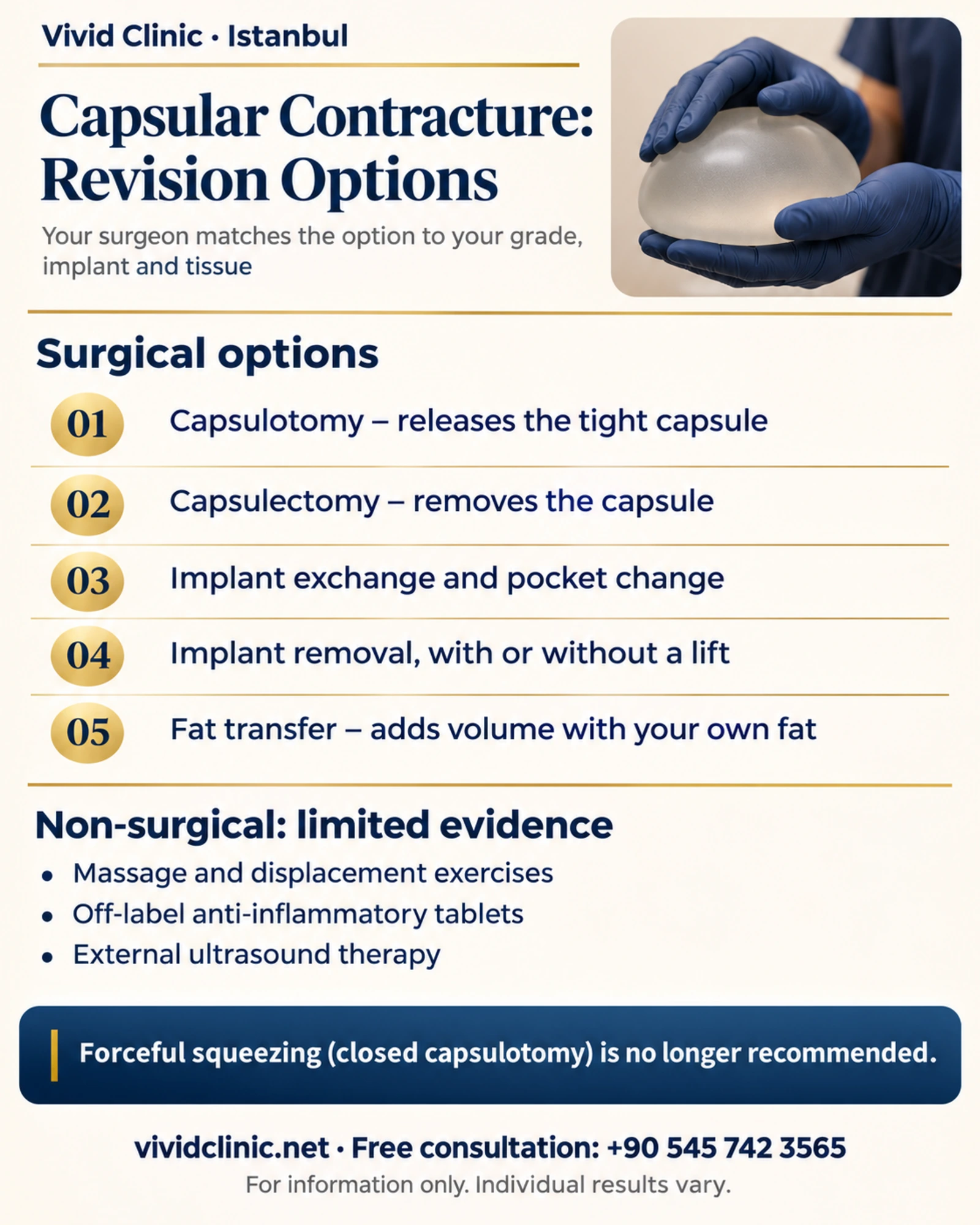
- Forceful external squeezing (closed capsulotomy). An older technique that is no longer recommended, because it can rupture the implant or cause bleeding.
Mild, early cases may be observed or managed conservatively. Established grade III to IV capsular contracture is usually treated surgically.
Breast Implant Revision: Surgical Options Explained
Breast implant revision for capsular contracture is tailored to your tissue, your implants and your goals. Most plans combine two or three of the steps below.
Capsulotomy: Releasing the Capsule
In an open capsulotomy, the surgeon reopens the pocket and makes controlled cuts in the capsule so it can expand. The capsule stays in place. It is a shorter operation, and recurrence is a known limitation.
Capsulectomy: Removing the Capsule
In a capsulectomy, part or all of the scar capsule is removed. A partial capsulectomy leaves the portion attached to the ribs or muscle, where removal carries more risk. A total capsulectomy removes the whole capsule where that is safe.
It is a longer operation with more bleeding risk, and drains are often used afterwards.
Implant Exchange and Pocket Change
Most surgeons replace the old implant with a new one during revision, not reinsert the original. You can read about size, shape and surface choices on our breast implants page.
The pocket is often changed as well, for example from above the muscle to partly beneath it, so the new implant sits in fresh tissue.
Implant Removal With or Without a Lift
Some women decide they no longer want implants. Breast implant removal with capsule treatment is a valid choice, and without an implant there is no capsule left to tighten.
The skin has been stretched, so the breast may look flatter or lower afterwards. A breast lifting procedure can be combined or planned later to reshape the remaining tissue.
Fat Transfer as an Option
Fat taken from your own body can restore modest volume after removal, or soften the contour over a new implant. Some of the transferred fat is naturally absorbed. Our comparison of breast implants versus fat transfer explains the trade-offs.
Who Is a Good Candidate for Revision Surgery?
Quick Answer: Suitable candidates are healthy adults with a firm, painful or distorted breast confirmed on examination as a higher Baker grade, who have had appropriate imaging and hold realistic expectations. Suitability is confirmed only after a surgeon has examined you.
Who May Not Be Suitable Yet?
Surgery is usually postponed if you are pregnant or breastfeeding, have an active infection, or have a medical condition that is not well controlled. Smokers are asked to stop well in advance.
Any swelling, lump or fluid collection that has not been investigated needs a diagnosis first.
Procedure Overview Table: Breast Implant Revision Surgery
| Aspect | Details |
|---|---|
| Duration Process | About 1.5 to 3 hours, depending on capsule work and combined steps |
| Hospitalization Duration | Usually 1 night |
| Mobility Duration | Gentle walking from the same day or the next morning |
| Return to Activity | Desk work in about 1 to 2 weeks; exercise after 4 to 6 weeks with approval |
| Complete Recovery | About 6 to 8 weeks |
| Anticipated Results | Shape settles over 3 to 6 months; final assessment at up to 12 months |
Timings are general estimates for capsulectomy or capsulotomy with implant exchange or removal.
Operation Process Overview at Vivid Clinic
Your journey begins with your arrival in Istanbul, where a VIP airport transfer takes you to your 5-star hotel for check-in and rest. Next comes a one-on-one consultation, in which your surgeon examines both breasts, reviews your previous operation report, implant details and imaging, and confirms the plan discussed online. On surgery day, the hospital team looks after you from admission and anesthesia through to your recovery room. Post-operative care includes dressing and drain checks, a support bra fitting and clear written instructions. A checkup visit before departure confirms that healing is on track and that you are comfortable to fly. After you return home, remote aftercare follow-up continues with scheduled photo reviews and direct contact with your coordinator.
Recovery Timeline After Revision Surgery
First 24 to 48 Hours
Expect tightness, swelling and soreness, managed with prescribed medication. Short walks are encouraged.
Days 3 to 7
Swelling peaks and then eases. Drains, if used, are usually removed once the output is low. You wear a support bra day and night.
Weeks 2 to 4
Many patients return to desk work. Lifting and upper-body exercise are still off limits.
Weeks 6 to 8
With your surgeon’s approval, exercise resumes step by step.
Months 3 to 12
The new shape settles and the tissue softens. This is also the period when your surgeon watches for any sign of tightening returning.
Benefits and Realistic Expectations
When revision is well planned, patients often notice:
- Relief from tightness, pressure or pain
- A softer feel and a more natural slope
- Better balance between the two sides
- The chance to update implant size or type, or to live without implants
Now the honest part. Capsular contracture can come back after any revision, and nobody can tell you in advance whether it will. A new capsule forms around every new implant, and no technique can promise it will stay soft. Results vary by individual.
Risks and Possible Side Effects
Revision is generally more complex than a first breast augmentation, because the surgeon works in scarred tissue. Possible issues include:
- Bleeding, haematoma, seroma or infection
- Recurrent contracture
- Changes in nipple or breast sensation
- Asymmetry, visible rippling or implant movement
- Thinner tissue cover after capsule removal
- Delayed wound healing or widened scars
- Anesthesia-related risks and the possibility of further surgery
For wider context, read our guides to breast augmentation surgery complications and breast augmentation surgery risks.
How to Prepare Before Revision Surgery
- Collect your original operation report and implant card (brand, size, surface, placement)
- Have the imaging your surgeon requests, such as ultrasound or MRI
- Share your full medical history, medications and supplements
- Stop smoking and nicotine products as advised
Aftercare Tips for a Smoother Recovery
- Wear your support bra exactly as instructed
- Sleep on your back with your upper body slightly raised
- Avoid lifting and upper-body exercise until you are cleared
- Attend every checkup and send your follow-up photos on time
- Contact the clinic promptly about fever, sudden swelling on one side, spreading redness or increasing pain
Cost Factors in Istanbul, Turkey
Revision pricing is individual, because no two cases need the same work. The main factors are the extent of capsule surgery, whether one or both sides are treated, new implants or removal only, a pocket change, an added lift or fat transfer, operating time, anesthesia, drains and hospital stay.
Imaging, hotel, transfers and aftercare also play a part. For an early idea, try the surgery price calculator. It gives an estimate only, and final pricing is confirmed after your assessment.
Why Choose Vivid Clinic in Istanbul?
Vivid Clinic is a premium, international clinic focused on personalised planning and natural-looking proportions. Revision planning starts with listening: what changed, when, and what you want now.
You can meet our doctors online before you travel. Every plan starts with a free consultation with a plastic surgeon, who reviews your photos, history and imaging and tells you honestly whether surgery, monitoring or a local in-person examination is the right next step.
What International Patients Can Expect
Most planning happens before you fly. You send photographs, your implant details and any scan reports, and receive a recommendation. Your coordinator then arranges dates, transfers and accommodation.
It is also sensible to arrange a doctor at home who can examine you in person if needed.
FAQs
How can I tell capsular contracture from normal firmness after breast augmentation?
Timing and direction are the main clues. In the first weeks after surgery, both breasts normally feel firm, high and tight, and they soften gradually over the following months. Capsular contracture usually behaves differently: a breast that had already softened becomes firmer again, or one side keeps tightening while the other relaxes. A rounder shape, a higher implant position or new discomfort can follow. These signs are not proof. Only an examination by a surgeon, often with ultrasound or MRI, can confirm what is happening.
Which Baker grade of capsular contracture usually needs revision surgery?
Baker grades I and II describe a breast that is soft or only slightly firm and still looks normal, and these are usually monitored. Surgery is most often discussed for grade III, where the breast is firm and visibly changed, and usually recommended for grade IV, where it is hard, distorted and often painful. The grade is not the only factor in capsular contracture decisions. Your comfort, the condition of the implant on imaging, how quickly things are changing and your own wishes all matter.
Is capsulectomy or capsulotomy better for treating capsular contracture?
Neither suits everyone. A capsulotomy releases the tight capsule with controlled cuts and leaves it in place, which means a shorter operation but a recognised chance of the tightness returning. A capsulectomy removes part or all of the capsule, takes longer and carries more bleeding risk, and is often preferred when the capsule is thick or calcified. For capsular contracture, most surgeons also exchange the implant and frequently change the pocket. Your surgeon chooses the approach during planning and may adjust it in theatre.
How long should I stay in Istanbul after revision surgery for capsular contracture?
Most international patients are advised to plan for roughly a week, and sometimes a little longer when a full capsule removal or drains are involved. Your surgeon confirms the exact length once your plan is set. That period covers your consultation, surgery day, a hospital night, early recovery at your hotel, drain removal if needed and a checkup visit before you fly. Because capsular contracture revision is more involved than a first augmentation, your surgeon will want to see early healing before clearing you to travel.
What affects the cost of capsular contracture revision surgery in Turkey?
Cost reflects complexity. Revision for capsular contracture generally takes longer than a first augmentation, and the plan may include capsule release or removal, new implants, a pocket change, a lift or fat transfer. Treating one side or both, implant choice, drains, operating time, anesthesia and hospital stay all influence the total. For these reasons a fixed price cannot be given without assessment. Vivid Clinic provides a personalised quote after reviewing your photographs, implant details and history during your free consultation.
Conclusion
Capsular contracture is a tightening of the capsule your body naturally forms around an implant. It is not a sign that you did something wrong. Mild grades are often simply monitored, while firm, painful or distorted breasts are usually treated surgically, with honest counselling about the chance of recurrence. Any new firmness, swelling or shape change deserves an in-person examination first.
Vivid Clinic in Istanbul, Turkey offers a free consultation with a plastic surgeon so you can share your history and photos privately and receive a plan based on your own anatomy. Get a Free Consultation whenever you feel ready.
Real Before and After Results at Vivid Clinic
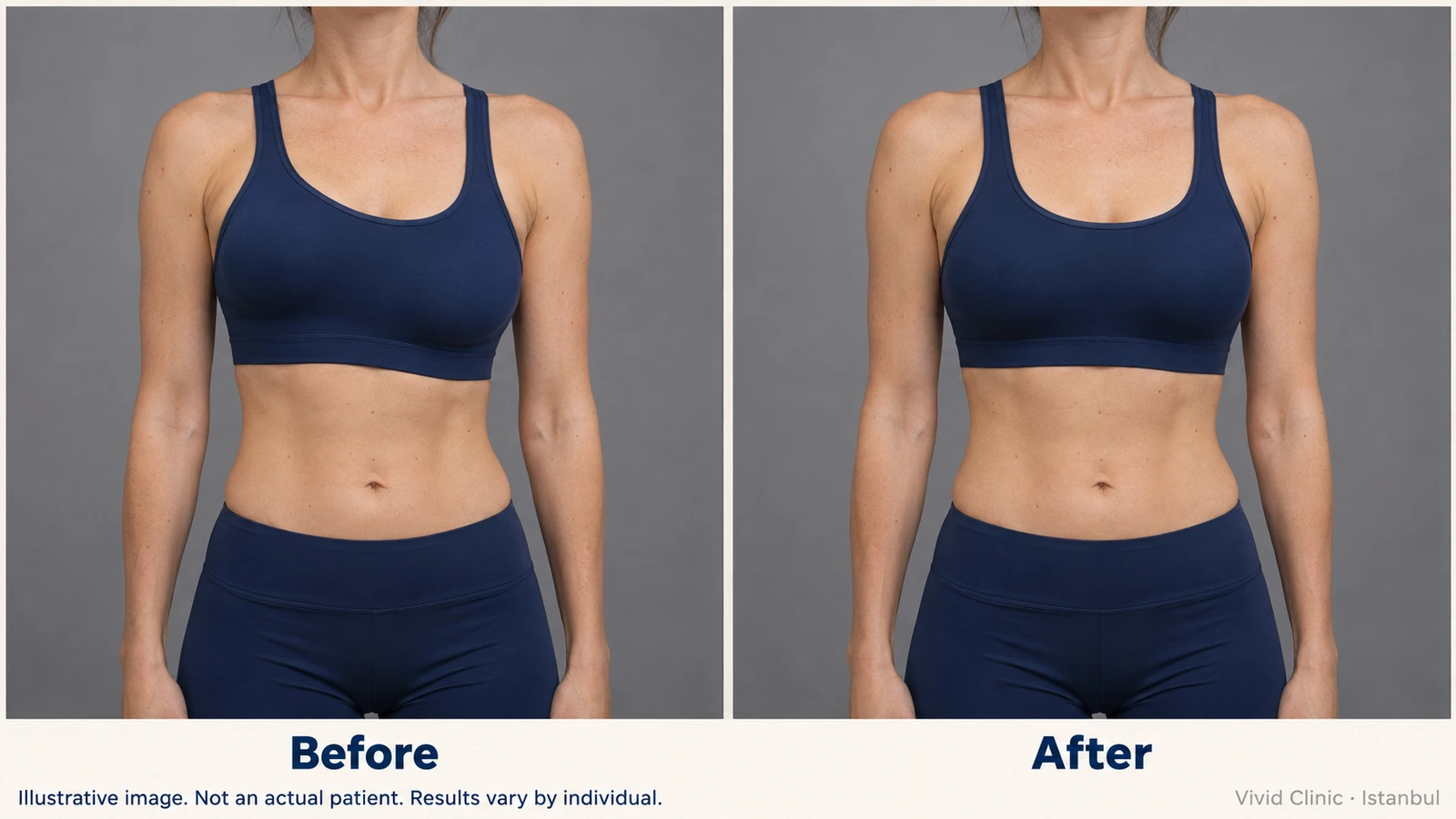
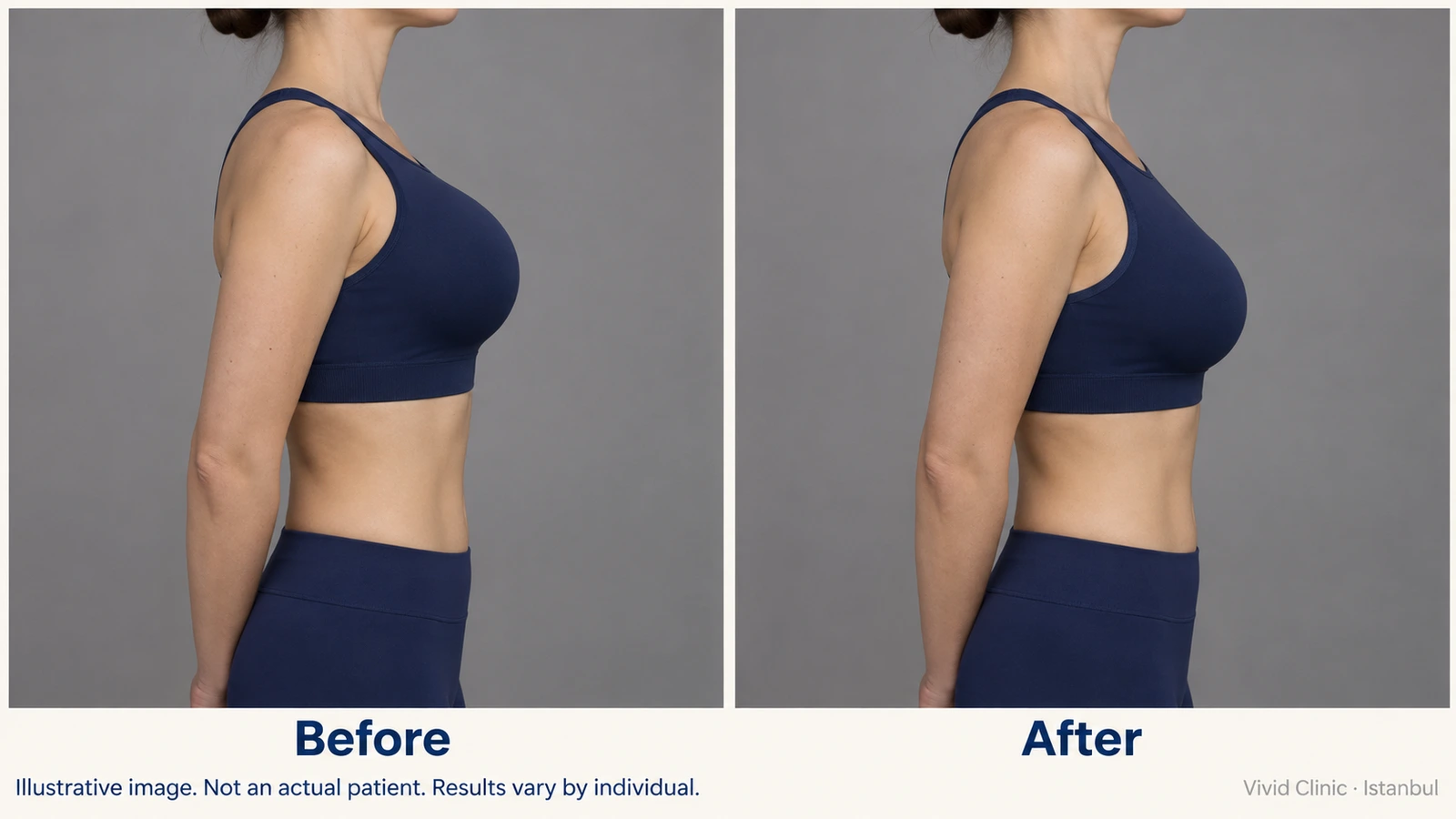
These photos show real Vivid Clinic patients from the clinic’s own gallery, shared with consent as published on the clinic site, and results vary by anatomy, healing and treatment plan. Please note that they are breast revision and breast implant cases, not specifically capsular contracture corrections, and the reason for each revision is not stated.
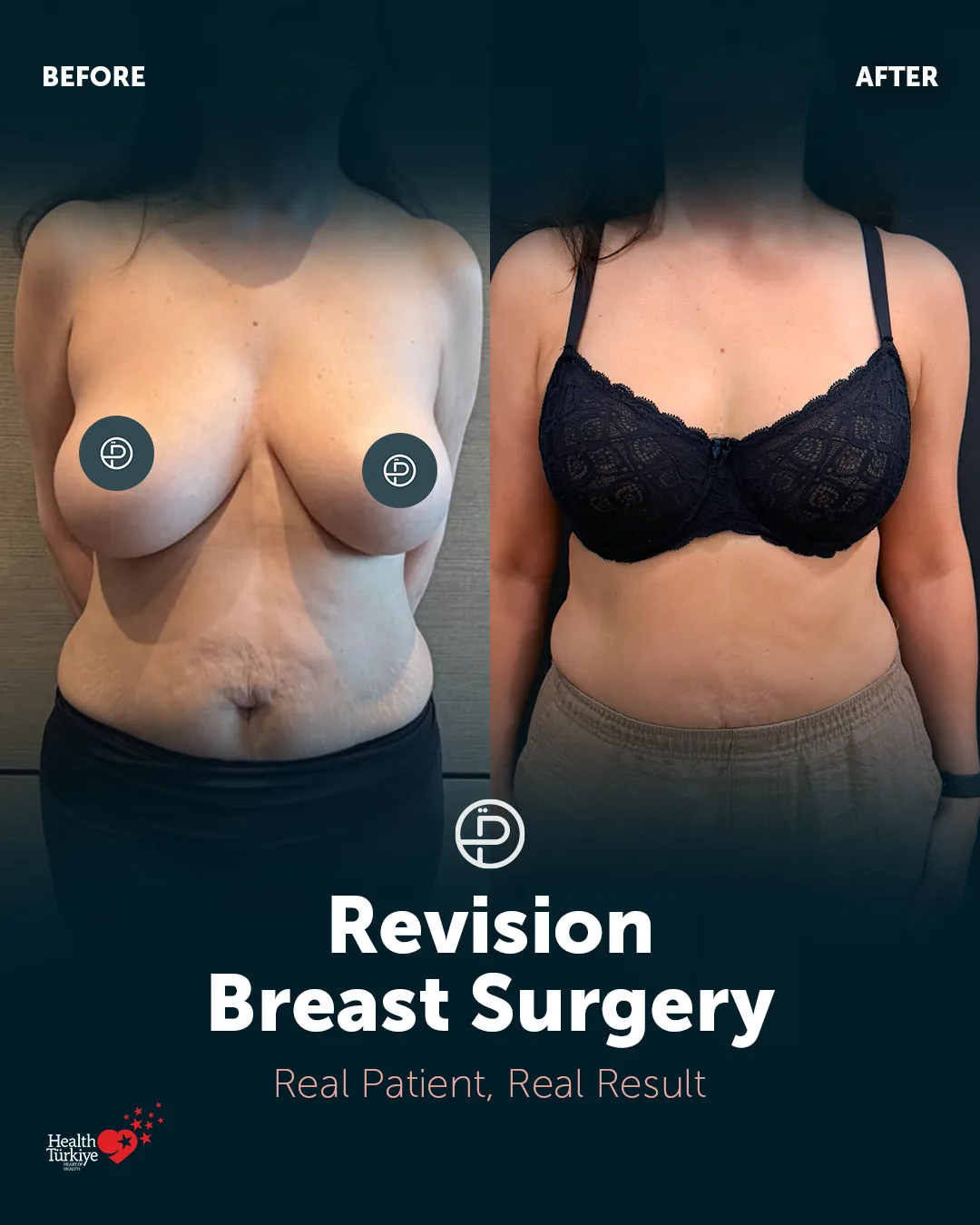
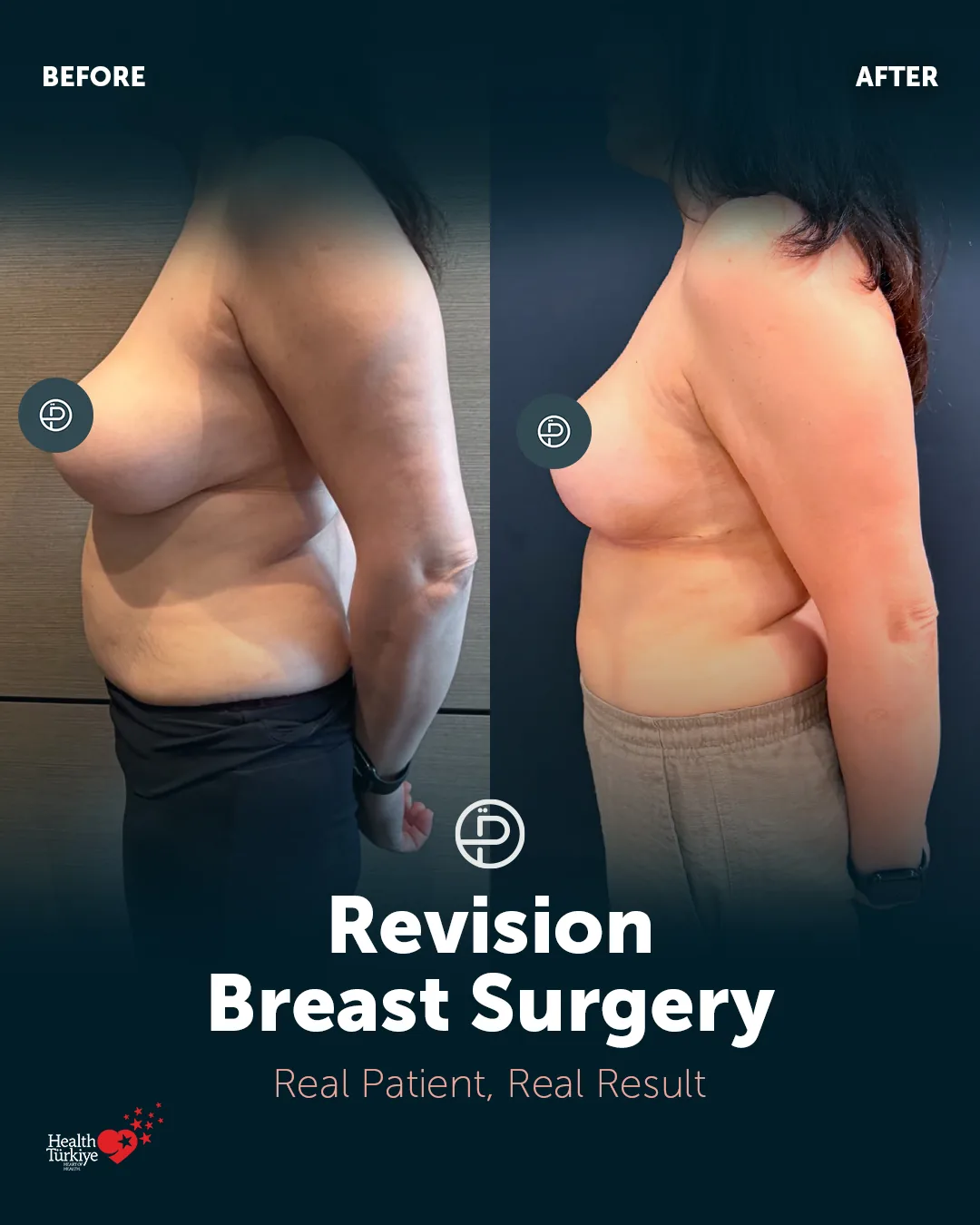


You can view more cases in the full before and after gallery. To find out which approach may suit your own situation, send your photos and implant details to the Vivid Clinic team and request your free consultation.
This article is for general information and does not replace a personal medical consultation. Suitability, risks, recovery and expected results should always be discussed with a qualified medical professional. Results vary by individual.