
 ChatGPT
Medically reviewed by Prof. Dr. Özgür Pilancı, Plastic, Reconstructive & Aesthetic Surgeon — August 2026
Quick answer (updated August 2026): Implant volume is measured in cubic centimetres, and cc is not a cup size — the same 300cc implant reads as a large change on a narrow chest and a modest one on a broad chest. Surgeons work in the opposite direction from patients: they measure the breast first, mainly its base width, then pick the volume and profile that fit that footprint. Round and teardrop implants both have a place, but in blinded studies surgeons cannot reliably tell them apart. If you want a small, device-free increase, fat transfer is the option to ask about.

What “cc” actually means — and why it is not a cup size
A cc is a cubic centimetre, identical to a millilitre, so a 300cc implant displaces 300 millilitres. What it cannot do is convert into a bra cup letter, because a cup letter is not a fixed volume — it is a ratio between two measurements that shifts with band size and between manufacturers.
A 2025 study in Aesthetic Surgery Journal found women describing themselves as a C cup spanned six “sister bra size” groups, with average breast weights from 325 g to 771 g, and concluded that “cup size alone is not a reliable predictor of breast tissue weight.” Charts converting cc into cup letters are marketing shorthand, not measurement.
How surgeons actually size an implant
The implant is chosen to fit your anatomy, not the reverse. The dominant measurement is the base width of the breast — its footprint on the chest wall — because an implant wider than that has nowhere to go but sideways or towards the midline.

The literature calls this biodimensional planning: profile selection across the low, moderate, full and extra-full range is driven by base width, with trial sizers confirming width and projection during surgery. The surgeon also assesses chest wall dimensions and asymmetry, nipple-to-fold distance and — critically — soft tissue coverage, judged by pinching the tissue at the upper pole; thin coverage means a visible implant edge and rippling, and changes both device and pocket. Our breast implants page covers this.
What 250cc, 300cc and 350cc actually look like
There is no answer that applies to everyone. Volume is half the equation; the footprint it spreads across is the other half. The same 300cc implant on a narrow chest delivers its volume through projection, producing a rounder, fuller upper pole; on a wide chest it reads as subtle.
The steps are smaller than they sound, too — 300cc to 350cc is 50 ml, about three tablespoons across a whole breast. So someone else’s photograph tells you little unless her anatomy resembles yours: read our before-and-after gallery for range, not a target figure, and our breast augmentation page for how surgery is planned.
Round vs teardrop implants: what the evidence shows
Round implants have the same profile in every direction, so if they turn in the pocket nothing changes. Teardrop implants — properly anatomical or shaped — carry more fill in the lower pole, on the reasoning that this better mimics an unoperated breast. The evidence is weaker than the marketing suggests.
In a randomised trial in Plastic and Reconstructive Surgery, 75 patients each received one round and one anatomical implant, one per breast. Ten blinded plastic surgeons identified which side held which shape in only 26.5% of cases, and preferred the anatomical side 51.1% against 48.9% (p = 0.496); the trial found “no aesthetic superiority of anatomical over round implants.” A blinded Aesthetic Surgery Journal study of 60 patients agreed, warning that “anatomical implants should not be assumed to produce a more natural result.”
Rotation is the trade-off. A shaped implant is asymmetrical, so turning in the pocket distorts the breast; ASPS notes shaped implants risk visible asymmetry if they rotate and may need corrective surgery, while round implants are “the same shape all over.” An ultrasound study of 138 anatomical implants found rotation beyond 30° in 42% of patients and 27% of implants, though reviewers spotted only about 5% on photographs and judged most rotations clinically insignificant. Shaped implants are also textured, which brings the surface question into the decision.
Projection profiles: low, moderate, full and extra-full
Profile decides how a chosen volume behaves: for any given number of cc, a wider base means a flatter implant and a narrower base a more projecting one. It is why two people with 350cc implants can look nothing alike.
Silicone, saline, and what “cohesive gel” means
Both types have a silicone outer shell; the difference is the fill.
Saline implants hold sterile salt water. If the shell leaks, ASPS notes the implant “will collapse and the saline will be absorbed and naturally expelled by the body,” so rupture is obvious. FDA-approved from age 18.
Silicone gel implants hold a gel ASPS describes as feeling “a bit more like natural breast tissue,” and will not collapse if the shell fails. FDA-approved from age 22, and they need imaging surveillance.
Cohesive gel, form-stable or “gummy bear” implants use a thicker, cross-linked gel that holds its shape even if the shell breaks; ASPS notes they are firmer and need a longer incision.
A 2025 meta-analysis found no significant difference in capsular contracture between silicone and saline (OR 0.39, p = .52), so the choice is about feel, rupture behaviour and monitoring.
Smooth vs textured surfaces, and the BIA-ALCL question
Texturing was introduced to reduce capsular contracture and hold shaped implants in position, and the 2025 meta-analysis did find higher contracture rates with smooth implants than textured ones (OR 2.80, 95% CI 1.92–4.08) — though it stressed the evidence is low quality and largely from the 1980s and 1990s.
Set against that is BIA-ALCL — breast implant-associated anaplastic large cell lymphoma. It is not breast cancer; the FDA calls it “a type of non-Hodgkin’s lymphoma (cancer of the immune system)” arising in the scar capsule around an implant, and states that “the risk of BIA-ALCL is higher for textured surface implants versus smooth surface implants.” ASPS reports “there are not any confirmed BIA-ALCL cases that involve only a smooth implant,” and puts the lifetime risk with textured implants at between 1 in 2,207 and 1 in 86,029.
Symptoms usually appear more than a year after surgery, on average eight to ten years later: persistent swelling or fluid collection, a lump, pain, asymmetry, hardening or a rash. Treatment is removal of the implant with its capsule, and ASPS states that “when caught early, BIA-ALCL is curable in most patients.” In 2019 the FDA requested a voluntary recall of Allergan’s Natrelle BIOCELL textured devices.
If you have textured implants and no symptoms, the FDA is explicit: “We are not recommending the routine removal of these or other types of breast implants in patients who have no symptoms.” If you develop persistent swelling, a mass or pain around an implant, have it assessed — our breast implant removal page covers explant surgery.
Two related conditions belong here: BIA-SCC, a squamous cell carcinoma of the implant capsule that ASPS calls very rare but potentially aggressive, with 19 published cases; and breast implant illness, a cluster of systemic symptoms — fatigue, rash, “brain fog”, joint pain — reported with implants of any type, for which ASPS notes there is no test.
Where the implant sits: subglandular, submuscular and dual plane
Subglandular placement puts the implant behind the breast tissue, in front of the pectoralis major. Submuscular places it behind the muscle, adding coverage over the upper pole. Dual plane is the hybrid used most often in cosmetic augmentation: the muscle’s lower attachment is released so the implant’s top sits under the muscle and its base behind the gland.
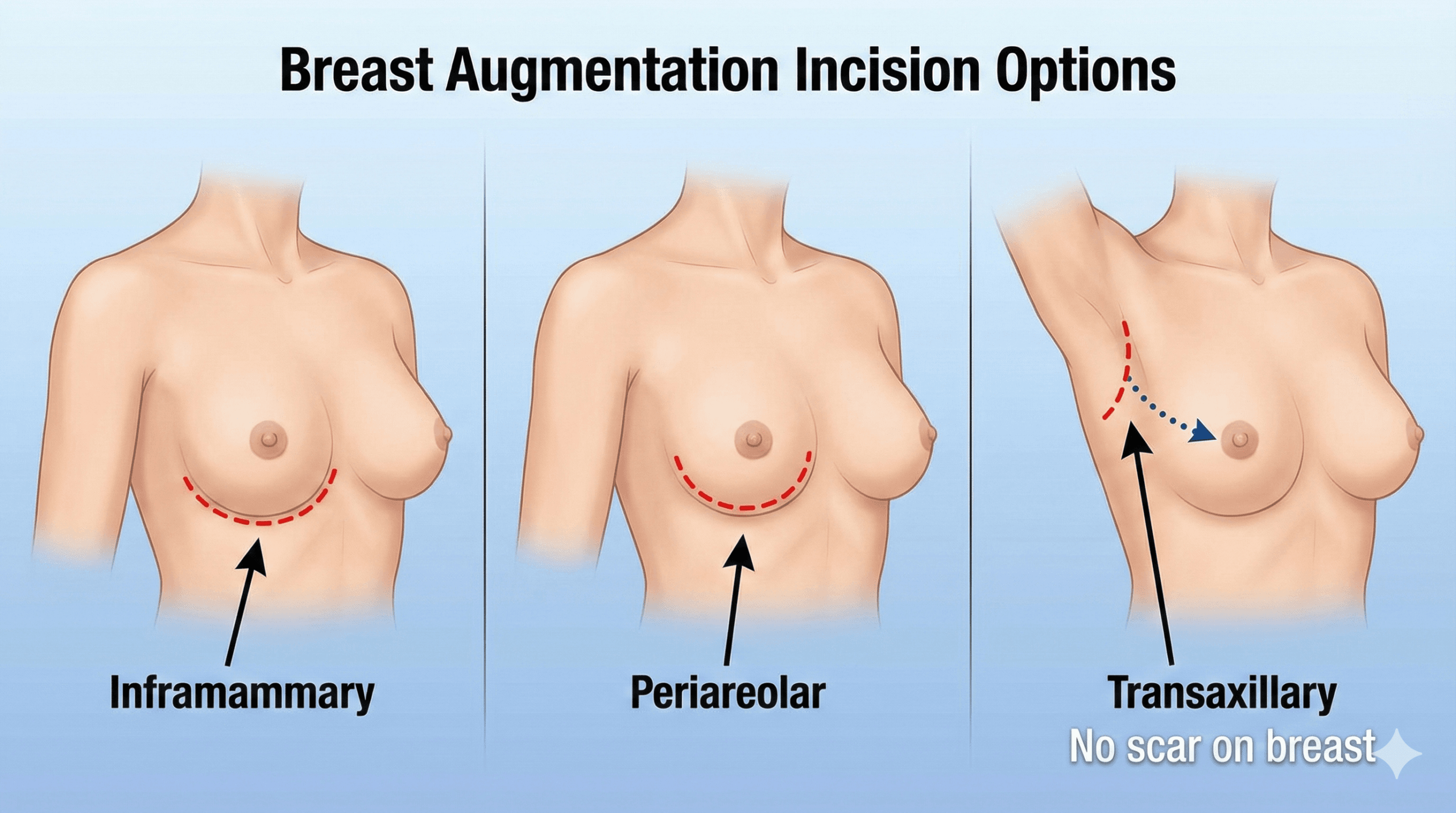
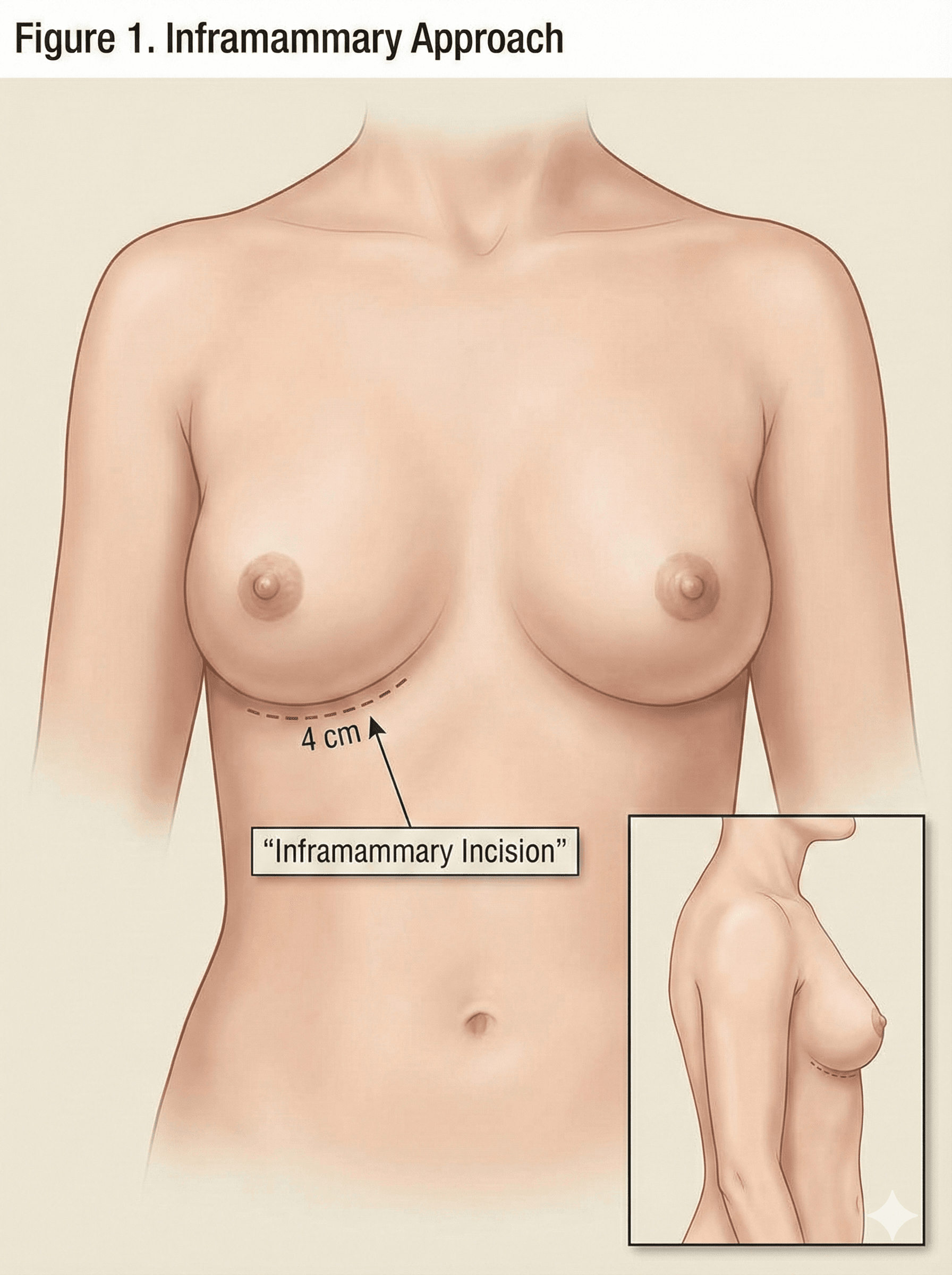
The evidence favours going under the muscle — the 2025 meta-analysis found subpectoral placement substantially reduced capsular contracture (OR 0.35, 95% CI 0.25–0.50) — and thin soft-tissue coverage pushes the same way, because muscle disguises the implant edge. ASPS says the choice depends on implant type, the enlargement wanted and your body type. Access is inframammary, periareolar or transaxillary.
Implants are not lifetime devices
The FDA is unambiguous: “Breast implants are not considered lifetime devices. The longer people have them, the greater the chances are that they will develop complications.”

Published lifespan estimates vary widely, which is itself informative: Mayo Clinic says implants “last about 10 years,” the NHS says some women need further surgery after about ten years, and surgical texts estimate 12 to 35 years. One review reports rupture in 10% to 15% of implants within 10 to 15 years. The message is direction, not duration: budget for revision surgery.
Follow-up imaging for silicone implants is a real commitment. Because most silicone ruptures are silent, the FDA states that “magnetic resonance imaging (MRI) is the most effective method for detecting silent rupture,” with ultrasound “an acceptable alternative imaging for screening for rupture for asymptomatic patients.” The schedule, per Mayo Clinic and ASPS, is five to six years after surgery, then every two to three years. Saline implants need no surveillance, because deflation is visible.
Capsular contracture is graded I to IV on the Baker scale, with surgery usually reserved for grades III and IV. One limit also deserves stating plainly: an implant adds volume, it does not lift. ASPS is direct that “breast augmentation does not correct severely drooping breasts,” and that a breast lift may be needed too.
Implantes de senos naturales: fat transfer as the natural alternative
The Spanish phrase implantes de senos naturales — “natural breast implants” — usually means one of two things: a result that does not look operated, or an augmentation with no device at all. The second is a real procedure: fat transfer, also called autologous fat grafting or lipofilling. Fat is harvested by liposuction, processed and injected into the breast in small amounts. There is no shell, no rupture risk and no surveillance schedule, plus contouring of the donor area — see our breast fat injections page.
ASPS positions fat transfer for people “looking for a relatively small increase in breast size” — it does not replicate the projection of a 350cc implant. Not all transferred fat survives, so ASPS notes patients “may have to have touch-up injections,” and lists cysts, infection, microcalcification and fat necrosis as risks.
One point matters for anyone who will have mammograms: fat necrosis after fat transfer is reported in 2% to 18% of cases and can appear on imaging as a lucent mass or pleomorphic microcalcifications — findings that, as the surgical literature states, “can mimic malignancy on radiologic studies.” That does not prevent screening, but it does mean telling your radiologist you have had fat grafting, every time. Composite augmentation — a smaller implant with fat grafted over it — also exists in the field.
Frequently Asked Questions
Breast Augmentation Before and After at Vivid Clinic
Implant size and shape are easier to judge on real bodies than on a chart. These breast augmentation before and after photos show results for Vivid Clinic patients in Istanbul.


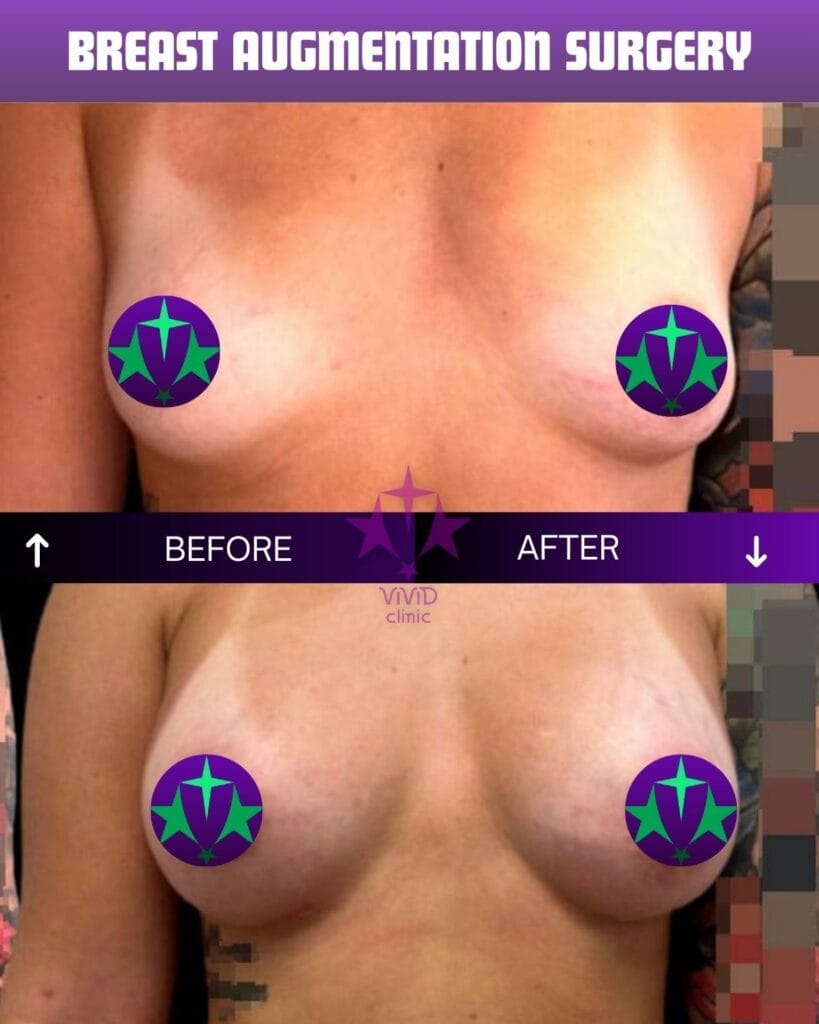
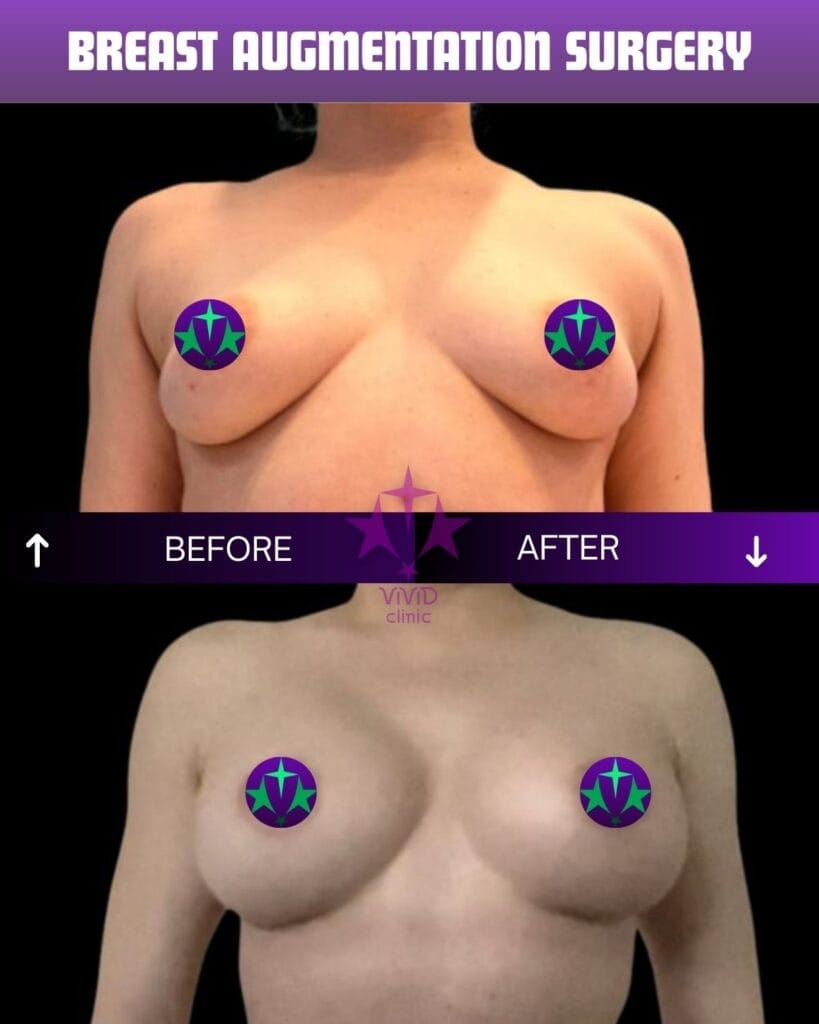
Results vary from person to person. These photos show individual outcomes and are not a guarantee of results; your surgeon will explain what is realistic for you during your free consultation.
How many cc is a C cup?
There is no correct answer, and any clinic that gives you one is guessing. A cup letter is a ratio between band and bust measurement, not a fixed volume, and it varies between manufacturers. A 2025 Aesthetic Surgery Journal study found women self-reporting a C cup spanned six sister bra size groups, with average breast weights from 325 g to 771 g, and concluded cup size alone does not reliably predict breast tissue weight.
What is the difference between 250cc, 300cc and 350cc implants?
Fifty millilitres per step — roughly three tablespoons across an entire breast, and far less dramatic than the numbers suggest. Base width and projection profile change the visible result much more, because the same volume through a narrow, highly projecting device looks nothing like it spread across a wide, low-profile one.
Are teardrop implants more natural-looking than round implants?
Not reliably, on the best available evidence. In a randomised trial where each patient received one round and one anatomical implant, ten blinded plastic surgeons identified which was which in only 26.5% of cases and showed no significant preference. A separate blinded study of 60 patients found no difference in natural appearance either.
Are textured breast implants safe?
Textured implants carry a higher risk of BIA-ALCL, a lymphoma of the immune system that arises in the implant capsule, than smooth ones. ASPS reports no confirmed cases involving only a smooth implant and puts the lifetime risk with textured implants at between 1 in 2,207 and 1 in 86,029. For people with no symptoms the FDA does not recommend routine removal, but persistent swelling, a mass or pain should be assessed promptly.
Do breast implants need replacing after 10 years, and will I need scans?
They are not on a ten-year timer, but they are not lifetime devices either: the FDA states that the longer you have implants the greater the chance of complications, and that any implant’s lifespan cannot be predicted. For silicone implants it recommends imaging for silent rupture — MRI most effective, ultrasound an acceptable alternative — starting five to six years after surgery, then every two to three years.
Can I make my breasts bigger without implants?
Yes, within limits, and this is what most people searching implantes de senos naturales are looking for. Fat transfer takes fat from elsewhere on your body by liposuction and injects it into the breast, with no device involved. ASPS positions it for a relatively small increase, and because not all the fat survives, touch-ups are often needed.
Still working from a number rather than a measurement? Send photographs for a free online assessment and get a straight answer about what your anatomy will and will not support — including when the honest answer is a different size, shape, or fat transfer.