 ChatGPT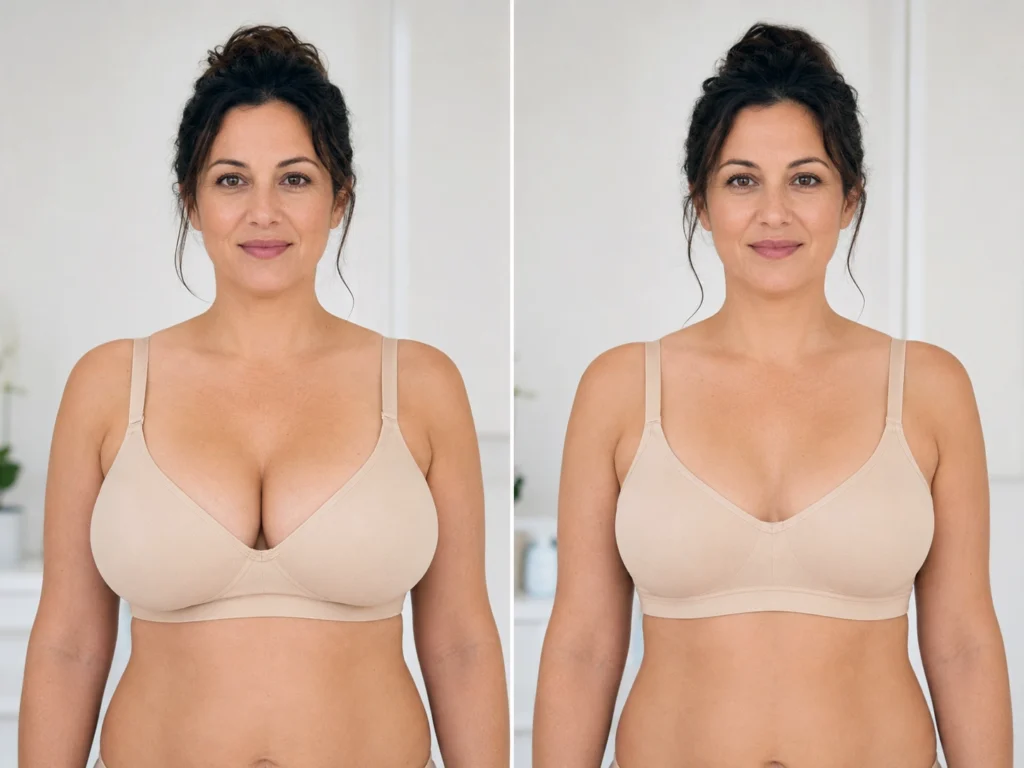
Medically reviewed by Prof. Dr. Özgür Pilancı, Plastic, Reconstructive & Aesthetic Surgeon — August 2026
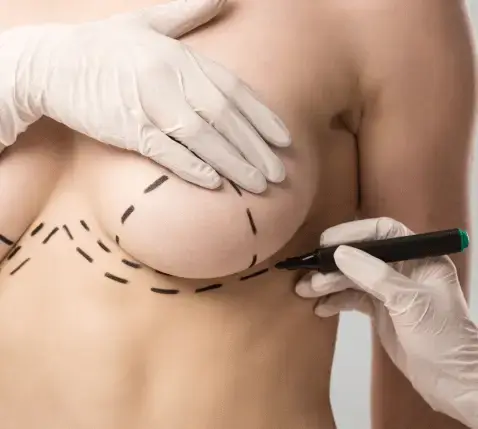
Quick answer (updated August 2026): Before-and-after photos are the most useful and the most misleading thing in cosmetic surgery. A breast lift repositions the tissue you already have and adds no volume; a reduction removes volume and lifts at the same time. Both leave permanent scars whose pattern is decided by how much tissue has to move — from a single circle around the areola to the three-part anchor. Scars look their worst at six to twelve weeks and keep fading for twelve to eighteen months, which is why any photo taken before six months is showing you an unfinished result.
What each operation actually changes
The most common misunderstanding in a consultation is what a lift does. A breast lift (mastopexy) removes excess skin, tightens the envelope and moves the nipple-areola complex back up to where it sits on a young breast. It changes position and shape. It does not change volume — a lift cannot make you a cup size larger, and on its own it rarely restores real convex fullness in the upper pole. Patients who want both lift and fullness need an augmentation-mastopexy, where an implant supplies the volume the lift cannot.
A breast reduction removes glandular tissue, fat and skin, then lifts what remains. It is the same reshaping work with volume taken out of the middle of it, which is why the before-and-after change is usually the most dramatic in breast surgery — and why it is the breast operation with the best-documented symptom relief rather than only aesthetic satisfaction.
Fat transfer sits in a different category again. It adds modest volume — realistically around half a cup to one cup per session, with roughly 50–70% of the transferred fat surviving long term and the rest resorbing (ASPS). It fills and softens; it does not lift a sagging breast, and larger goals usually mean two or three sessions.
The one measurement behind every "before" photo
Surgeons do not classify breasts by adjective. They measure where the nipple sits relative to the inframammary fold — the crease under the breast — using the Regnault scale:
- Grade I (mild): the nipple sits level with the fold.
- Grade II (moderate): the nipple sits below the fold but is not the lowest point of the breast.
- Grade III (severe): the nipple sits below the fold and is the lowest point of the breast.
- Pseudoptosis: the nipple is at or above the fold, but the tissue has dropped below it — the classic pattern after weight loss, after breastfeeding, or after implant removal.
That grade, more than any preference you arrive with, decides which incision your surgeon proposes — and therefore which scar you will live with. When you look at a gallery, look for a "before" whose grade matches yours. A stunning Grade III result tells you very little about what a Grade I lift will look like on you.
Scars: what each pattern leaves and why
Scar pattern is not a style choice. It is the minimum access needed to move the tissue.
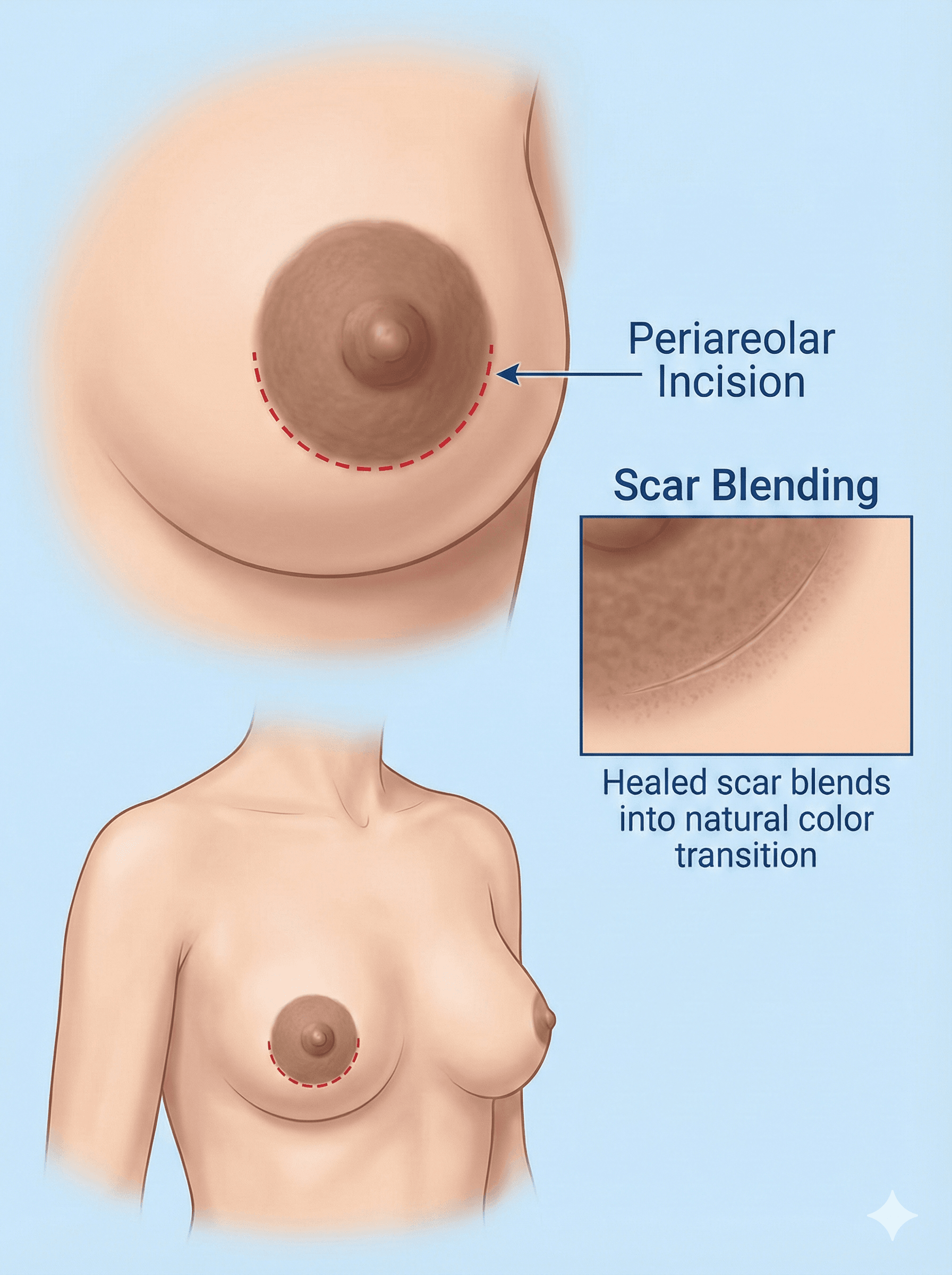
Periareolar (donut). A single circle at the edge of the areola. Suits mild ptosis and small reductions, and can reduce an enlarged areola at the same time. The scar hides in the colour change at the areola border, which makes it the least visible pattern — but it allows the least tissue movement, and pushing it beyond its limits tends to flatten the breast and widen the areola over time.
Vertical (lollipop). The circle plus a vertical line from areola to fold. This is the workhorse for moderate ptosis and moderate reductions: far more reshaping power than the donut, considerably less scar than the anchor.
Inverted-T (anchor, Wise pattern). The circle, the vertical line, and a horizontal line along the fold. Required for large reductions and severe ptosis, where a great deal of skin has to come out in two directions. It leaves the most scar and carries the highest rate of delayed wound healing at the junction where the three lines meet.
Free nipple graft. Reserved for very large reductions where the tissue bridge carrying blood to the nipple cannot safely be preserved. The nipple-areola complex is removed and replaced as a graft. It removes the risk of losing the nipple altogether, at the cost of permanent numbness and the loss of any ability to breastfeed.
Hypertrophic — raised, thickened — scarring is reported in up to 15% of breast reduction scars. That is not a rare complication; it is a realistic outcome you should be shown examples of before you consent.
How scars change, month by month
This is the timeline that makes before-and-after photos readable.
Weeks 1–2: the line is closed, flat and pink, often taped or covered. It looks better now than it will in a month, which surprises people.
Weeks 3–8: collagen floods the wound. The scar becomes red, firm and slightly raised. This is the worst it will look, and it is also when most patients privately panic.
Months 3–6: remodelling. Redness converts to pink and then to a duller mauve. Firmness softens. Itching usually settles.
Months 6–12: colour drains toward pale. The scar flattens.
Months 12–18: final maturation. A well-healed breast scar ends as a thin, pale, flat line — visible if you look for it, unremarkable in a bra or a bikini.
On what actually helps: silicone gel or sheeting is the most widely used scar treatment, but the honest evidence is weak — a Cochrane review found only low to very low certainty that it improves scar appearance. It is cheap, harmless and worth doing; it is not a guarantee. What is not optional is sun protection. A new scar exposed to UV can pigment permanently, so keep it covered or blocked for a full year.
Reading a before-and-after gallery honestly
A trustworthy pair is boring in all the right ways. Same camera distance, same lighting, same posture, same arm position, same background. Multiple angles — front, three-quarter, side — because a single front-on shot hides the shape change a surgeon actually worked for. A stated post-operative interval, and one long enough to mean something: tissue settles for three to six months and swelling can persist toward a year. Unedited skin, showing the scars rather than smoothing them away. And a range of ages and body types, not only the easiest cases.
The red flags are the inverse. Warmer, more flattering light in the "after". A different posture — shoulders back, chest lifted — doing half the work. One angle only. No stated timeframe. Visibly retouched skin where the incision lines should be. If a gallery will not show you the scars, it is not showing you the result. You can hold ours to that standard in the before-and-after gallery.
What breast reduction actually delivers
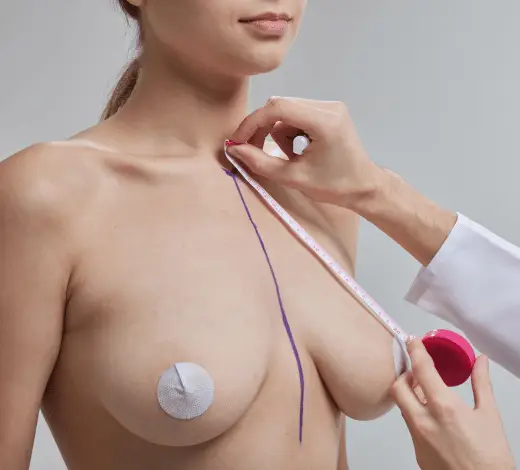
Reduction is the breast operation with the strongest functional case. It is performed for documented symptoms — thoracic back pain, bra-strap grooving into the shoulders, intractable intertrigo under the fold, restricted exercise — and health systems fund it on those grounds rather than on appearance. NHS commissioning policies typically require a stable BMI under about 27, symptoms unrelieved by proper bra fitting and physiotherapy, and a planned resection of roughly 500 g per breast or more. In the US, insurers use the Schnur sliding scale, which sets a required resection weight against body surface area.
It is also honest to state the complication profile plainly. Large series report overall complication rates as high as 53% — dominated by delayed wound healing rather than serious events — with reoperation in roughly 5–6.5% of cases and patient dissatisfaction reported up to 18.4%. Nipple sensation changes are common and sometimes permanent, and the ability to breastfeed may be reduced or lost depending on the technique used. Our breast reduction in Turkey guide covers the practical side of planning the operation.
Implant removal: the before-and-after nobody prepares you for

Explant photographs are the most misread images in this category. Removing implants that have been in place for years leaves a skin envelope stretched to a volume that is no longer there, and native tissue that has thinned under the pressure. The result is often pseudoptosis — the "explant droop" — and it is a predictable consequence of anatomy, not a surgical failure.
The vocabulary matters when you compare quotes. Simple removal takes the implant and leaves the capsule. Capsulectomy removes the capsule as well. En bloc capsulectomy removes the capsule intact with the implant sealed inside — technically harder, longer, and indicated for suspected rupture or specific concerns. Many patients need a lift at the same operation or later to get the shape they are picturing; some choose fat transfer to soften the deflation.
Two safety facts belong in any explant discussion. BIA-ALCL — a rare lymphoma of the capsule — is overwhelmingly associated with textured implants, with cited lifetime risk ranging from 1 in 2,207 to 1 in 86,029, and is curable in most patients when caught early (ASPS). Breast implant illness describes a cluster of systemic symptoms attributed to implants; there is no diagnostic test and causation is not established, though some patients report improvement after removal (ASPS). The FDA also recommends imaging surveillance for silicone rupture from five to six years after implantation, then every two to three years.
What it costs

Third-party benchmarks first, checked August 2026. The American Society of Plastic Surgeons lists average surgeon’s fees — before anaesthesia, facility and implant costs — of $6,816 for a breast lift, $7,800 for a cosmetic breast reduction, $4,875 for augmentation with implants, $5,719 for augmentation with fat grafting, and $3,979 for implant removal (plasticsurgery.org, checked August 2026). Those are fee components, not final prices; all-in US totals typically run well above them. In the UK, private breast reduction commonly runs £6,000–£9,000 and a lift from around £7,400, rising when an implant is added.
Istanbul prices sit below both, and the reason is cost base — surgeon wages, facility overheads, rent — not a shortcut in the operating room. What must be identical wherever you book: a named, credentialled surgeon; an accredited hospital; anaesthesia delivered by an anaesthesiologist; and a written quote that states the technique, the incision pattern, what aftercare includes, and what a revision would cost. Vivid Clinic confirms breast lift and reduction quotes at consultation after a photo assessment, because the honest price depends on the ptosis grade and the resection weight, not on a menu.
When a shape change is a doctor’s problem, not a surgeon’s
One paragraph that matters more than the rest of this article. If a breast changes on its own — a new lump or thickening in the breast or armpit, skin dimpling or puckering, an orange-peel texture, a rash or redness, a nipple that turns inward when it did not before, or discharge outside pregnancy and breastfeeding — that is a medical assessment, urgently, and not a cosmetic consultation. Cosmetic planning waits until that has been cleared.
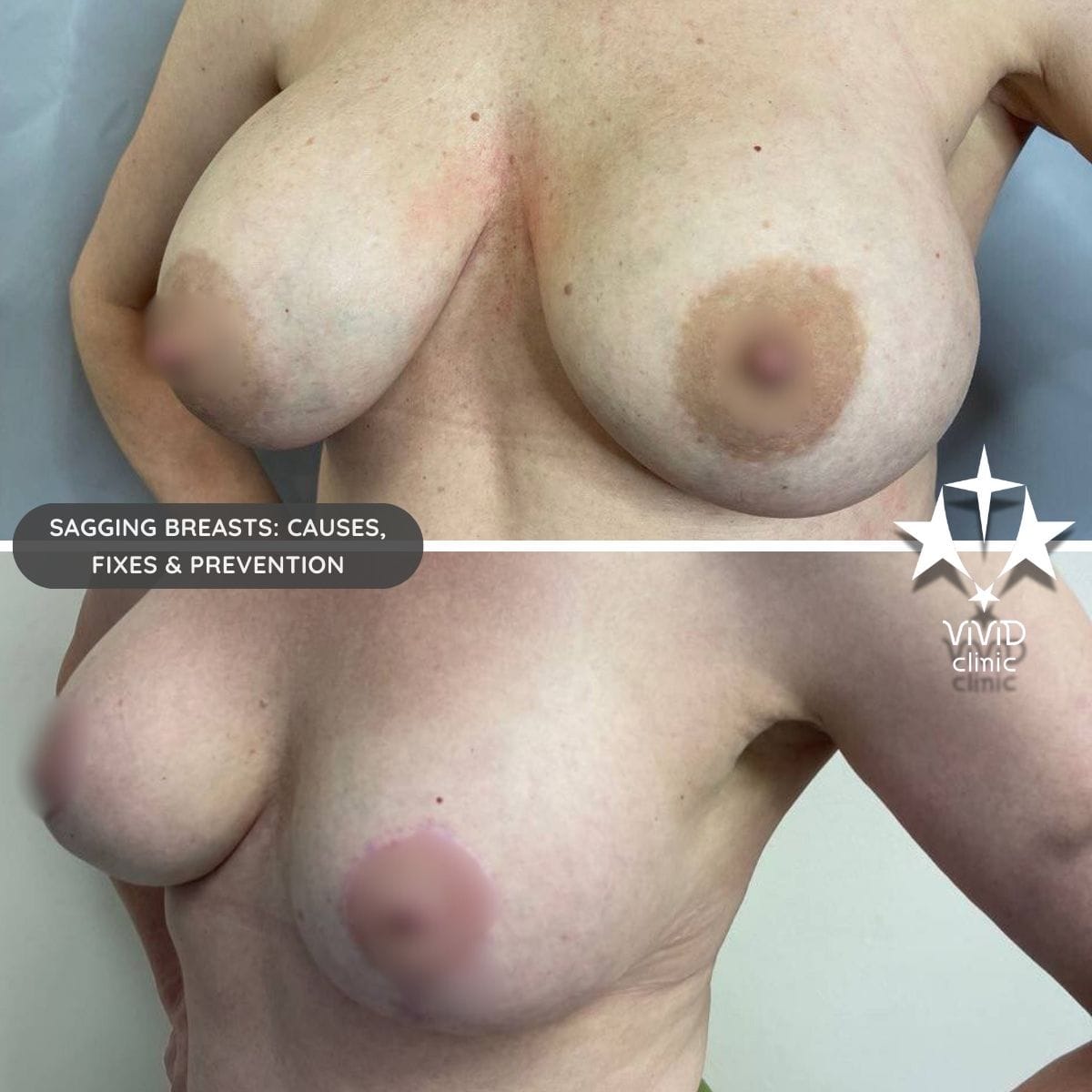
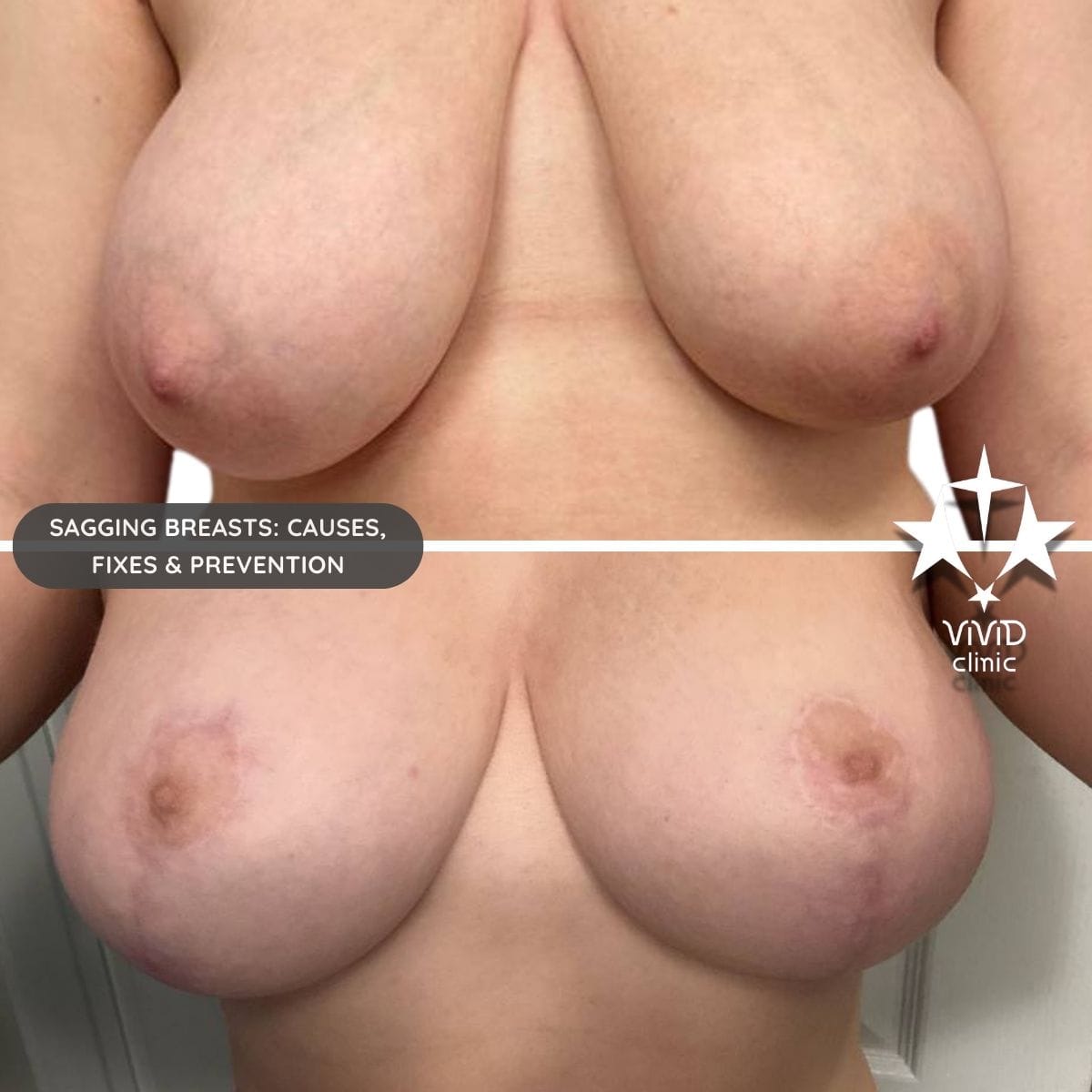
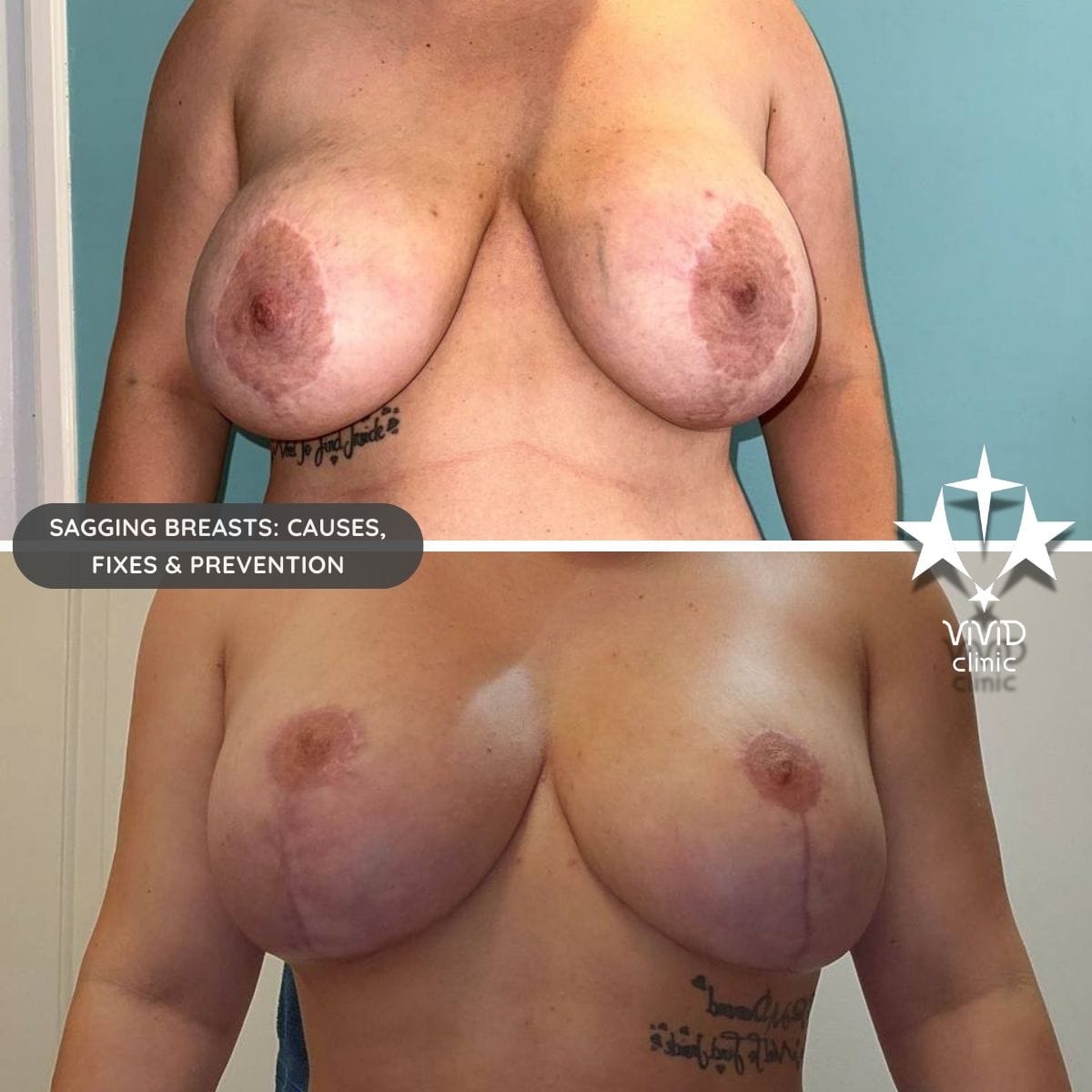
Breast Lift Before & After Results at Vivid Clinic


Frequently Asked Questions
How much is breast reduction surgery?
As third-party benchmarks checked in August 2026: the ASPS average surgeon’s fee for a cosmetic breast reduction is $7,800, which excludes anaesthesia and facility costs, so US all-in totals run considerably higher. UK private pricing commonly falls between £6,000 and £9,000. In the UK and much of Europe, reduction may be funded by the health system where documented symptoms and resection-weight criteria are met. Vivid Clinic confirms your quote at consultation after a photo assessment, since price follows resection weight and technique.
Will breast lift or reduction scars ever disappear?
No — they fade, they do not vanish. A well-healed breast scar becomes a thin, pale, flat line over twelve to eighteen months, visible on close inspection and unremarkable under clothing. Up to 15% of reduction scars heal raised and thickened. Silicone gel or sheeting is worth using, though the evidence supporting it is weak, and rigorous sun protection for the first year genuinely prevents permanent pigmentation.
Can a breast lift make my breasts bigger or fuller on top?
Not on its own. A lift moves tissue and removes skin; it adds nothing. Upper-pole fullness — the convex slope at the top of the breast — requires an implant, structural fat grafting, or both, which is why patients wanting lift and fullness are offered augmentation-mastopexy. A surgeon who promises a cup size from a lift alone is describing something the operation cannot do.
How long before I can judge my result?
Three months for a rough impression, six months for a fair one, twelve months for the real thing. Swelling drops steadily for the first six weeks, tissue settles into its final position over three to six months, and scars keep maturing to eighteen months. Photograph yourself monthly in the same light rather than judging in the mirror daily — the daily version lies in both directions.
What happens to breast shape after implant removal?
It depends on how long the implants were in place, how large they were, and how much native tissue remains. Skin stretched around a volume that is suddenly gone often settles into pseudoptosis — the nipple stays reasonably positioned while the tissue drops below the fold. Some patients are happy with the softer, smaller result; others add a lift, at the same operation or later, to restore shape. Explant photographs taken at six weeks are not the final answer.
Does breast reduction affect breastfeeding?
It can. Techniques that preserve the tissue bridge to the nipple often preserve some ability to breastfeed, but never guarantee it; free nipple grafting, used in very large reductions, eliminates it entirely. Nipple sensation may also change temporarily or permanently. If future breastfeeding matters to you, say so before the technique is chosen — it changes the surgical plan.
Not sure whether you need a lift, a reduction, or something else entirely? That answer comes from where your nipple sits relative to the fold, how much tissue is involved, and what your skin will do afterwards — not from a photograph you liked. Send images for a free online assessment and get a straight answer on which operation fits, which scar it leaves, and what it would cost.