
 ChatGPT
Medically reviewed by Prof. Dr. Özgür Pilancı, Plastic, Reconstructive & Aesthetic Surgeon — August 2026
Quick answer (updated September 2026): A double chin — clinically, submental fullness — is not one thing. It has four possible causes: fat under the chin, loose skin, a slackened platysma muscle in the neck, and a chin or jaw that sits further back than average. Most people have some combination, and the mix decides the treatment. Fat responds to fat treatments. Loose skin does not. A chin that sits back will not change however much weight you lose. That single distinction — which of the four is yours — matters more than any product, device or exercise below.

What a double chin actually is
The area under your chin is the submental region, and four separate structures can fill it out. The first is subcutaneous fat, sitting between skin and muscle — and in some people a deeper pad beneath the platysma. The second is skin, which loses collagen and elastin with age and stops retracting cleanly over the jaw. The third is the platysma, a broad, thin sheet of muscle running from the collarbone up over the jaw; as it slackens and separates in the midline it bows forward, blunting the angle between chin and neck and sometimes showing as two vertical cords. The fourth is skeletal: the position of your chin and jaw, and the height of the hyoid bone.
That last one is why a thin person can have visible fullness under the chin: if the chin sits back relative to the lip and forehead, there is less bone holding the soft tissue taut, and the same skin and fat drapes into a soft, rounded angle instead of a defined one.
Why does this matter? Because every treatment on the market targets exactly one of the four. Injections dissolve fat. Liposuction removes fat. A neck lift repositions skin and muscle. An implant or genioplasty changes projection. Buy the wrong one and you will spend real money and see almost nothing.
A composite example: two women, both 42, both describing a double chin in photographs. One has a fingertip-thick pad of soft fat and firm skin, and would do well with fat reduction. The other has almost no fat and a chin sitting several millimetres back — fat reduction would change nothing for her.
Why do I have a double chin?
Five causes account for nearly all of it, and only one is weight. Genetics is the biggest and least discussed. Chin projection, jaw shape, hyoid position and how readily you store fat in the neck are all inherited, which is why submental fullness runs in families and why some people have had it since their teens at a stable weight. If you have searched “genetic double chin” or “skinny with double chin”, this is almost certainly your answer: the cause is architectural, not dietary.
Weight is the second — the submental region is a common fat store, and gaining weight often shows there early. Neck circumference broadly tracks total body fat, which is why a thicker neck and submental fullness usually appear together.

Age is the third. From roughly the mid-thirties, skin loses elasticity, the platysma slackens and separates, and deep fat compartments shift downward, producing loose skin under the chin and a softening jawline in people whose weight has never changed. Posture is the fourth and the most fixable: hours looking down at a phone or laptop hold the neck in flexion and make the area look fuller than it is. Stand at a mirror and lengthen the back of your neck — you will see how much of it is posture.
The fifth is medical: swelling that is not fat at all. That deserves its own section, because it is the one thing here that could matter to your health.
When it isn’t fat: medical causes worth ruling out
Most fullness under the chin is fat, skin and muscle. Occasionally it is not, and the difference is usually clear once you know what to feel for. Fat is soft, even, symmetrical, changes gradually over months or years, and does not hurt. A swelling that is firm, one-sided, tender, appeared quickly, or is a distinct lump belongs with a doctor, not a cosmetic clinic.
Swollen lymph nodes sit under the jaw and in the neck and commonly swell with colds, throat and ear infections; the NHS notes they usually settle within one to two weeks. Salivary gland problems have a distinctive pattern: nearly all salivary stones affect the submandibular gland under the jaw, and Cleveland Clinic describes sudden pain and swelling that comes on with eating, lasts an hour or two, then settles until the next meal.
Thyroid problems are the most-searched of these and the most misunderstood. An enlarged thyroid — a goitre — sits at the lower front of the neck over the windpipe, not under the chin, so a swelling right beneath the jaw is more likely a node or a salivary gland. What an underactive thyroid can do is cause facial puffiness and weight gain: Mayo Clinic lists “puffy face” among the symptoms of hypothyroidism. A thyroglossal duct cyst is a benign congenital cyst in the midline that moves upward when you swallow or stick out your tongue — usually found in childhood, occasionally in adults.
One more, unrelated to appearance: a larger neck circumference is a recognised risk factor for obstructive sleep apnea, and Mayo Clinic cites more than 17 inches in men and 16 inches in women as a threshold worth noting — one factor among many, not a diagnosis. If a thicker neck comes with heavy snoring or daytime sleepiness, raise it with your doctor before a surgeon.
See a doctor — not a cosmetic clinic — if any of these apply
- A lump that feels hard, or does not move when you press it
- A swelling on one side only, or clearly a lump rather than a general fullness
- Anything growing, or that has not settled within two weeks
- Pain, redness or fever alongside the swelling
- Difficulty swallowing, a persistently hoarse voice, or any difficulty breathing — the NHS advises urgent care for breathing difficulty or wheezing with neck swelling
- Unexplained weight loss, night sweats, or swelling just above or below the collarbone
None of this is common and none of it is cause for panic — it is cause to get examined first. Any clinic willing to inject or operate on a lump it has not properly worked up is one to walk away from. Starting points: the NHS on swollen glands and goitre, and Cleveland Clinic on salivary gland stones.
What does a double chin look like?
In plain terms: a soft, rounded fullness between the point of the chin and the front of the neck, so that instead of a clear angle where jaw meets neck, the line runs in a gentle curve. It is most visible from the side or slightly below, and most people first notice it in a photograph taken by someone else — a camera held low, chin tucked, is the least forgiving angle there is.
You will also see “triple chin” and “quadruple chin”, and they are worth demystifying. Nobody has four chins. Those words describe the number of horizontal creases visible in the skin between jaw and neck — folds that appear when skin has enough laxity to buckle, and deepen when the head tips forward. Count them with your head level rather than in a tucked-chin selfie and there are usually fewer than you thought.
Surgeons describe the same thing as the cervicomental angle: where the underside of the chin meets the front of the neck. A crisply defined jawline generally corresponds to an angle around 90 to 120 degrees; a softer one is a wider angle. That is a measurement, not a verdict. Plenty of faces that photograph beautifully sit outside the range. If it does not bother you, the correct treatment is none — a legitimate answer, and the right one more often than the internet suggests.
Do chin exercises work? An honest answer
Partly, and much less than you have been told. Chin tucks, the “chin lift” or ceiling kiss, tongue presses, jaw juts and neck rotations do genuine things: they strengthen the deep neck flexors, improve head-forward posture and may modestly tone the platysma. Since posture contributes to how full the area looks, working on it can visibly improve your neckline — particularly if you spend your day at a screen.

What they do not do is remove fat. There is no good evidence that facial or neck exercises reduce submental fat, and the reason is basic physiology: spot reduction is not a thing. Contracting the platysma a hundred times a day burns a negligible number of calories and does not instruct the fat above it to leave. Even the consumer health sites that publish these exercise lists state plainly that there is no scientific evidence they get rid of a double chin.
Do chin straps work? Not for fat. A chin strap is a compression garment. There is no evidence it reduces submental fat or reshapes the jawline, and the tightness people notice after taking one off is compressed tissue and displaced fluid, which rebounds within hours. The one legitimate use is specific: after chin or neck surgery, surgeons often prescribe compression to control swelling and help skin settle. That is a post-surgical instruction, not a home treatment.
And weight loss? It works well when the cause is fat — losing overall body fat usually reduces the submental pad along with everything else. It does nothing when the cause is skin laxity, platysma slackening or chin position, which is why people who lose a significant amount of weight sometimes find the area looks looser: the fat went, the skin it was filling stayed.
Non-surgical treatments and what the evidence shows
These are real options with real limits, and the limits are the part clinics tend to skip. Deoxycholic acid injections (Kybella in the US, Belkyra in several other markets) use a synthetic bile acid to destroy fat cells in the submental pad. The evidence is decent: in the phase 3 REFINE trials, roughly 66–70% of treated patients showed improvement versus about 19–22% on placebo.
Expect two to six sessions four to eight weeks apart, and expect swelling — the area can look markedly puffy for days to a couple of weeks after each session, with bruising and numbness. It is not suitable where skin laxity is the main issue, because removing fat from under loose skin makes the looseness more obvious. Licensing varies by country.
Cryolipolysis of the submental area — controlled cooling through a small applicator — is gentler and slower. Published work suggests one or two treatments six weeks apart producing modest measured reductions, around 2 mm of fat layer thickness in one study, with high satisfaction and little downtime beyond redness and numbness. Paradoxical adipose hyperplasia, where treated tissue enlarges rather than shrinks, is a rare but genuine complication.
Radiofrequency and microfocused ultrasound target skin rather than fat, stimulating collagen to tighten mild laxity. One radiofrequency study of two treatments a month apart found improvement in 82% of patients at one month, falling to 53% by six months — which tells you both that these devices do something and that it is modest and not permanent. They will not lift genuinely loose skin.
Botulinum toxin to the platysmal bands, often marketed as a “Nefertiti lift”, relaxes the muscle’s downward pull and can soften vertical cords and sharpen the jawline slightly. It lasts a few months and does nothing to fat or skin. As a refinement it is a nice option; as an alternative to a neck lift, no.
Surgery: liposuction, neck lift, and when the answer is your chin bone
Surgery is where meaningful change lives, and there are three operations because there are three different problems. Submental liposuction removes the fat pad through one or two very small incisions, usually hidden under the chin and behind the ears. It suits someone with a defined fat pad and skin that still retracts — typically younger patients. The principles are the same as elsewhere on the body, described on our liposuction page, and ultrasound-assisted techniques such as VASER emulsify fat before removal.
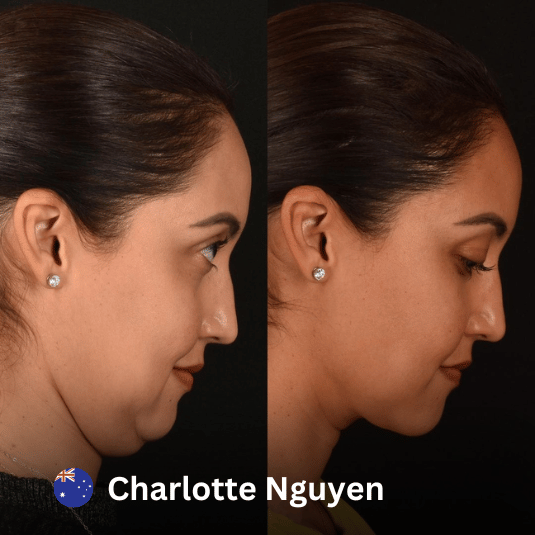
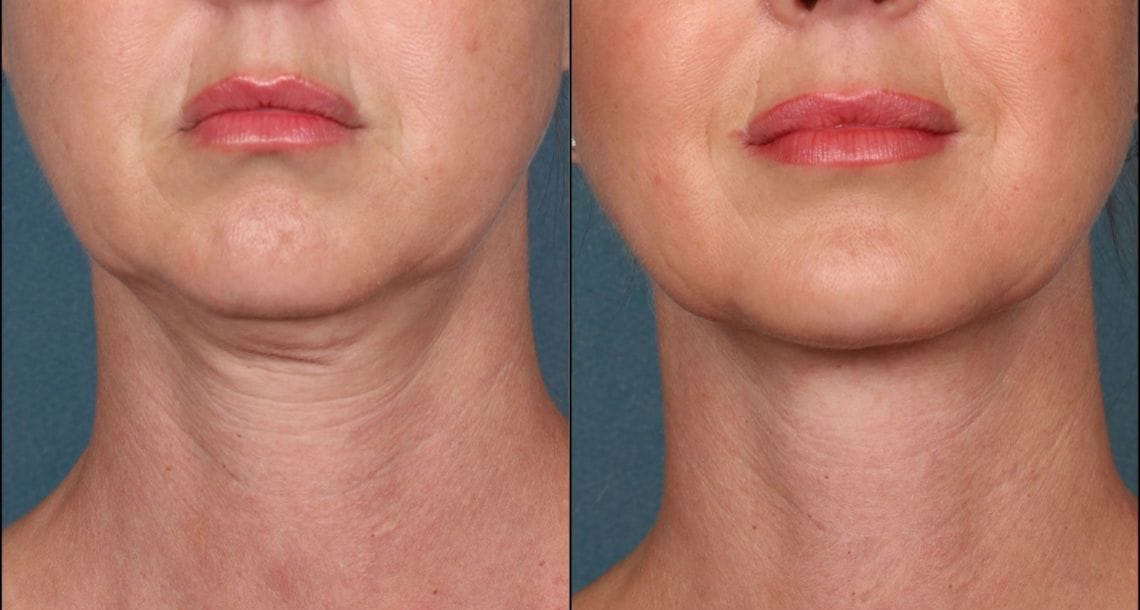
A neck lift with platysmaplasty is the answer when skin and muscle are the issue. The surgeon repositions and tightens the platysma — often suturing the separated edges together in the midline — trims redundant skin, and usually addresses fat at the same time.

Our neck lift page covers it in detail: roughly two to four hours, one night in hospital, back to daily activities in one to two weeks, largely recovered by three to four weeks, final contour settling over six to twelve months. Cleveland Clinic gives comparable figures and is candid about the risks — bruising and swelling for around two weeks, and the real if uncommon possibilities of asymmetry, infection, altered sensation, nerve injury affecting the lower lip, and scarring.
Then there is the case nobody sells you, because there is nothing to sell. If your chin sits back, the operation you need is on bone, not fat. A chin implant or sliding genioplasty brings the chin point forward, stretching the soft tissue beneath it and producing a jaw-to-neck angle no amount of fat removal can create. Patients in this group often have submental liposuction first, see very little change, and only then discover projection was the issue. Any competent assessment looks at chin position in profile before it looks at fat — the core idea behind facial balancing.
How to read double chin before-and-after photos
Skeptically, and with four checks — because the submental region is the easiest area on the body to fake photographically. Head position is the biggest: tipping the chin down compresses the tissue and creates fullness, while lifting it and pushing the head slightly forward stretches the same tissue smooth. A “before” with the chin tucked and an “after” with the chin raised can show a dramatic difference in someone who has had nothing done.

Camera height does the same job — shot from below, everyone has fullness under the chin; from slightly above, almost nobody does. Lighting is third: a source above and in front casts a shadow under the jaw that reads as definition, and flat frontal light erases it. Distance matters too, since a phone held close distorts facial proportions.
So look for matched pairs: same angle, same distance, same lighting, same neutral head position, and ideally a profile view — profile is where a chin-to-neck angle either changed or did not. Ask how long after surgery the “after” was taken, because a neck lift photographed at three weeks is still swollen. Ask to see a case resembling your own anatomy rather than the clinic’s most photogenic outcome.
Apply all of this to our before-and-after gallery — and to everyone else’s. One term confuses matters: searches for “chin tucks before and after” return both the exercise and “chin tuck surgery”, a name some clinics use for submentoplasty. The photographs are not comparable.
What double chin treatment costs
Honestly: it depends on which of the four causes you have, and no responsible clinic can quote before seeing your face. What we can give you is published third-party benchmarks. The American Society of Plastic Surgeons lists an average surgeon’s fee of $7,885 for a neck lift and $4,711 for liposuction (plasticsurgery.org, checked August 2026).
Read those carefully: they are surgeon’s fees only, excluding anaesthesia, facility fees, garments and follow-up, which together can add several thousand dollars in the US market. Non-surgical treatments are priced per session — and since deoxycholic acid typically needs two to six sessions, the per-session price is not the price of the treatment.
What actually moves a surgical quote is the number of structures addressed (fat only, versus fat plus muscle plus skin), whether it is done under sedation or general anaesthesia, and whether it is combined with another procedure at the same sitting. Combining is usually more economical than staging — but only when it is clinically sensible.
Vivid Clinic pricing is confirmed at consultation, after a photo assessment. That sequence is deliberate: until someone has looked at your profile and worked out whether you are dealing with fat, skin, muscle or projection, a price is a number attached to the wrong operation.
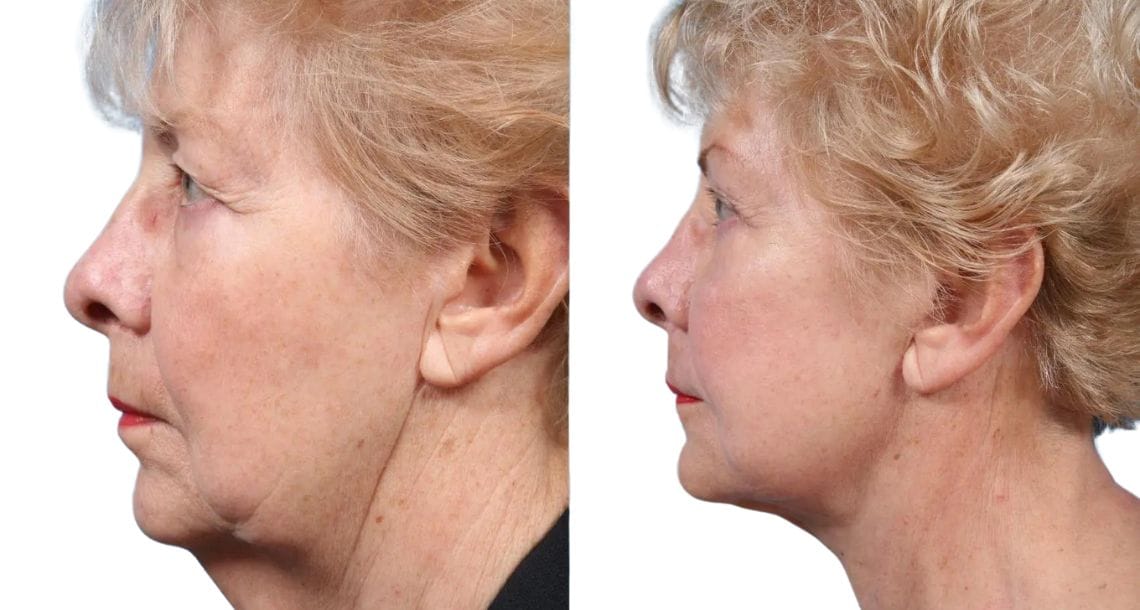
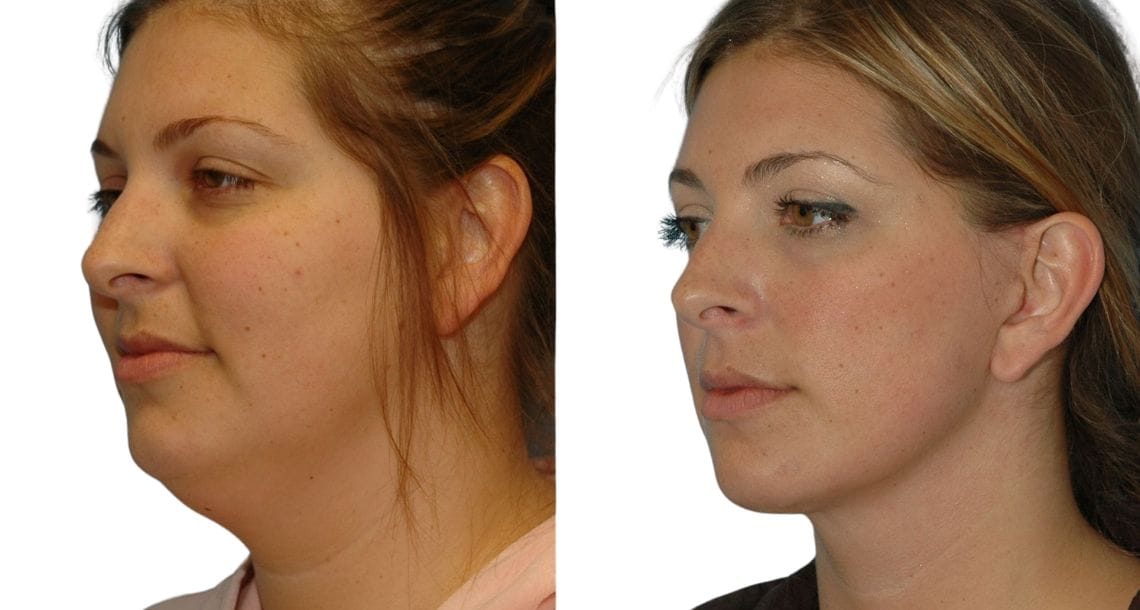
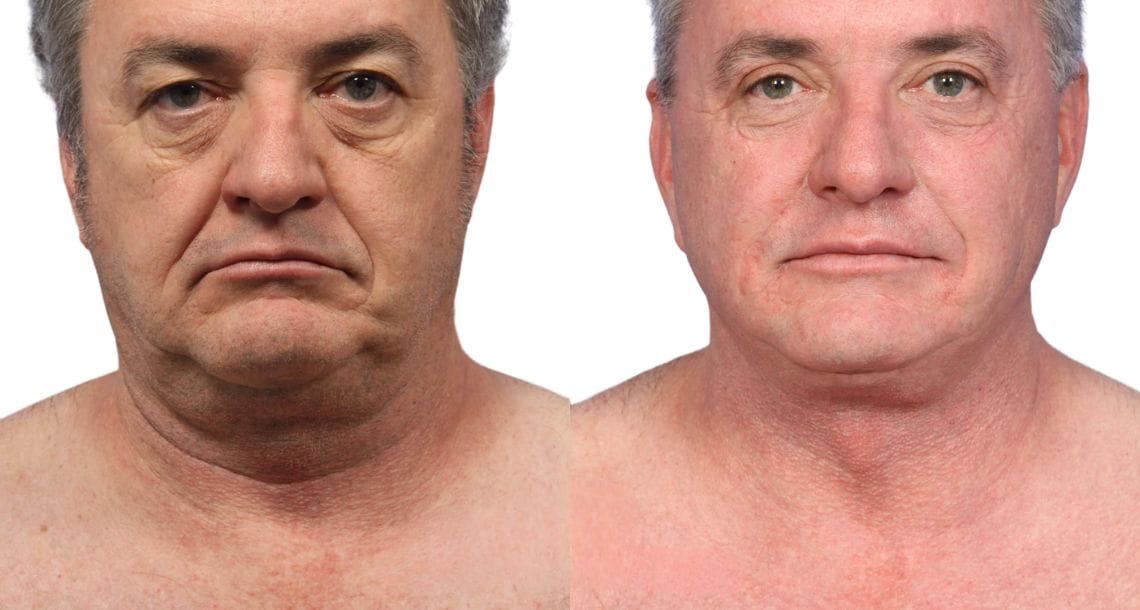
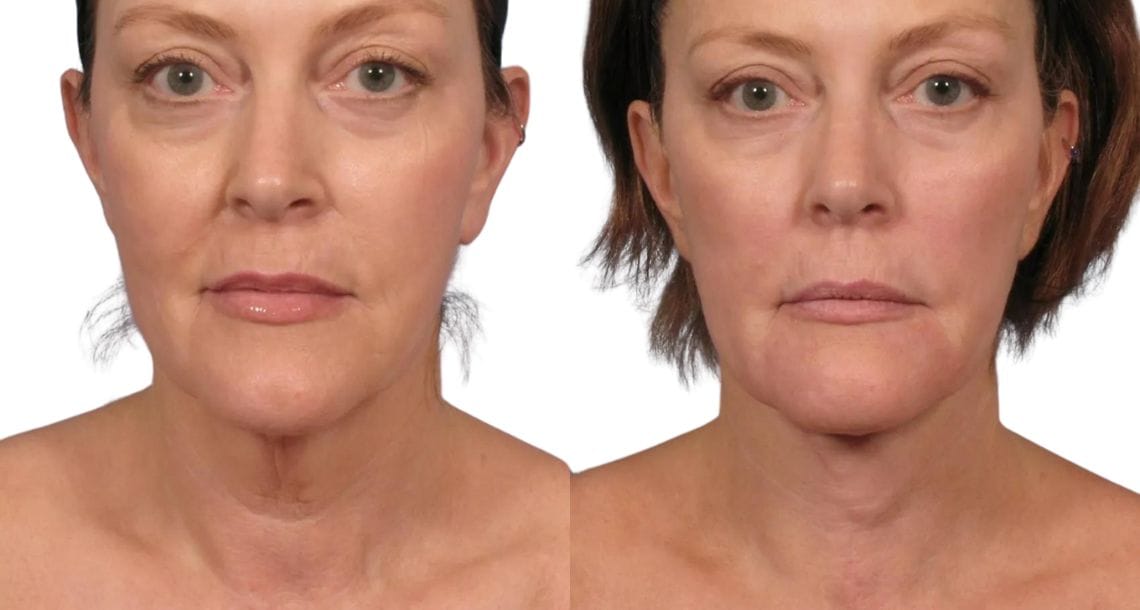
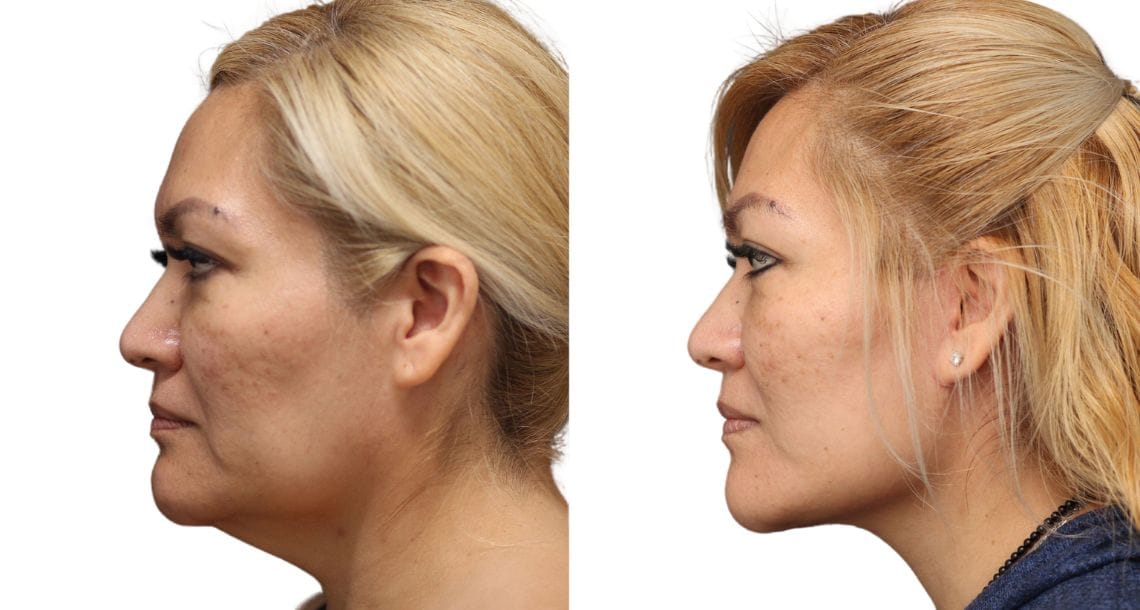
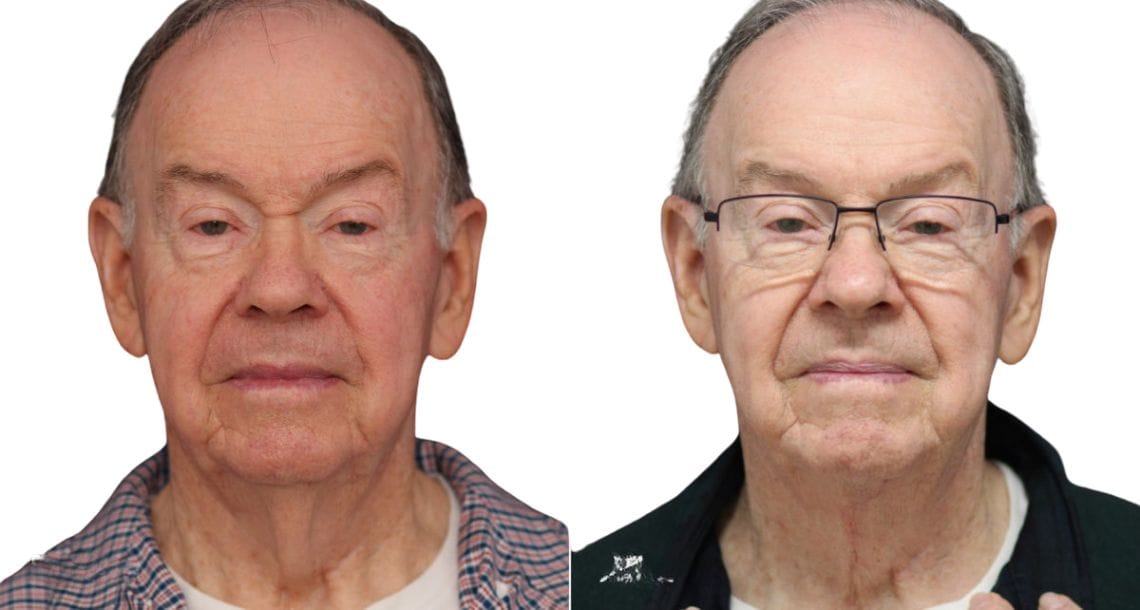
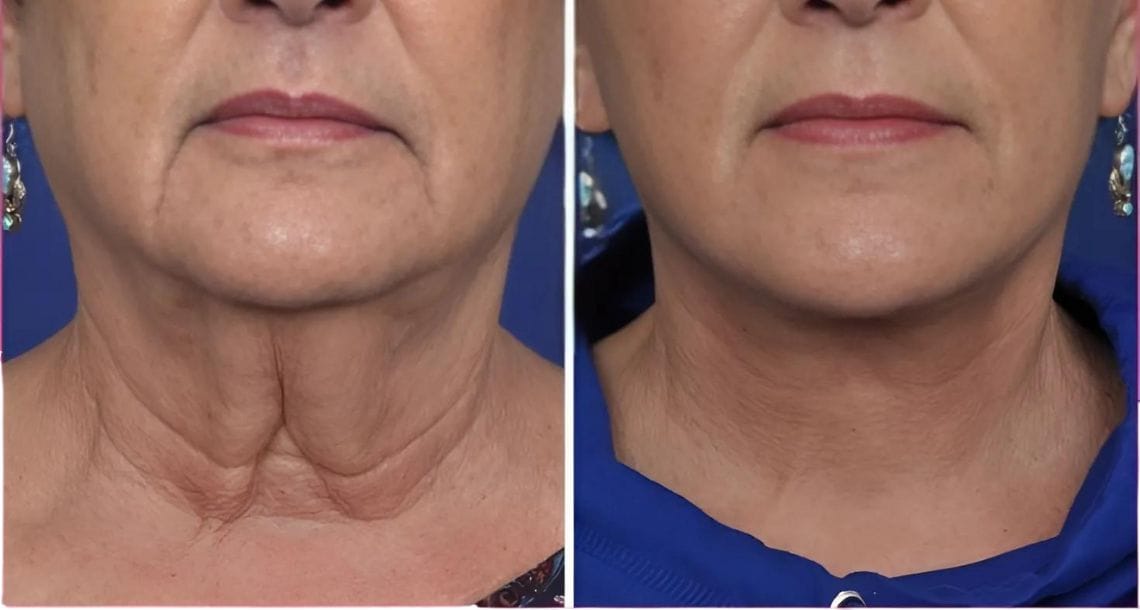
Neck Lift Before & After Results at Vivid Clinic
Frequently Asked Questions
Why do I have a double chin if I’m skinny?
Almost always because the cause is not fat. A chin sitting further back than average, or a hyoid bone positioned low and forward, leaves less bony support under the soft tissue of the neck, so the area reads as full at any weight. Mild skin laxity does the same. It is why assessment should start with your profile, not the scales.
How do I get rid of fat under my chin?
If it is genuinely fat, three things work: overall weight loss, deoxycholic acid injections over two to six sessions, or submental liposuction. Cryolipolysis gives a smaller, slower reduction. Exercise aimed at the area, chin straps and gum-chewing do not — spot reduction is not physiologically possible. Confirm it is fat first, because loose skin and chin projection look similar in photos.
Can a thyroid problem cause a double chin?
Indirectly, sometimes. An underactive thyroid can cause facial puffiness and weight gain, and Mayo Clinic lists ‘puffy face’ among its symptoms. But a goitre sits at the base of the front of the neck rather than under the chin, so fullness beneath the jaw is more often a lymph node or salivary gland. Any firm, one-sided or growing neck swelling should be assessed by a doctor first.
Do chin straps work for a double chin?
No. There is no evidence a chin strap reduces submental fat or reshapes the jawline. It is a compression garment, and the tightness you see after removing it is compressed tissue and fluid that rebounds within hours. Compression does have a role after chin or neck surgery, controlling swelling and helping skin settle — but that is a post-operative measure, not a treatment.
How can I tighten loose skin under my chin without surgery?
Modestly, at best. Radiofrequency and microfocused ultrasound stimulate collagen and can improve mild laxity: one radiofrequency study found improvement in 82% of patients at one month, dropping to 53% by six months. Nothing non-surgical lifts genuinely loose skin. If the laxity is significant, a neck lift is the honest answer — and doing nothing is the honest alternative.
Will losing weight get rid of my double chin?
If the cause is fat, usually yes: the submental pad reduces along with overall body fat. If the cause is skin laxity or chin projection, no — and significant weight loss can leave the area looking looser, because the fat filling the skin has gone and the skin has not retracted. The outcome depends on your starting anatomy.
Not sure which of the four causes is yours? That is the only question worth answering first, and it takes a profile photo and a proper look rather than a guess. Send photographs for a free online assessment and get a straight answer on whether you are dealing with fat, skin, muscle or projection — including, where it applies, that nothing needs doing at all.