
 ChatGPT

Medically reviewed by Prof. Dr. Özgür Pilancı, Plastic, Reconstructive & Aesthetic Surgeon — August 2026
Quick answer (updated August 2026): Ethnic nose shapes are best understood as natural variation shaped by ancestry and climate, not as problems to correct. Nose shape varies across human populations in ways that are real, measurable and almost entirely explained by ancestry and ancestral climate — not by any hierarchy of beauty. A Roman nose describes a bridge with a slight convexity; a Greek nose a notably straight one; many East and Southeast Asian and West and Central African noses have a lower bridge and a wider base. Every one of these is normal anatomy. Ethnic rhinoplasty is the practice of changing a nose while keeping the features that make it belong to that face and that family, and it is a technical discipline as much as an aesthetic one, because different noses need genuinely different operations.

Why noses differ, and what that actually tells you
Human nasal shape is one of the more variable features of the face, and the reasons are reasonably well understood.
The nose conditions the air you breathe, warming and humidifying it before it reaches the lungs. Across long stretches of human history, populations in cold, dry climates tended toward narrower, taller nasal apertures, which increase contact between air and mucosa; populations in warm, humid climates tended toward wider, shorter ones, where less conditioning is needed. This climate association has been documented repeatedly in anthropometric and craniometric research, and it is the main environmental thread in the story.
Genetics fills in the rest. Genome-wide studies have identified specific genes influencing nasal width, height, bridge shape and tip projection, and these variants are distributed unevenly across populations for the ordinary reasons of ancestry, migration and drift. Sexual selection and simple chance almost certainly contributed too.
Here is the part that matters most, and that most of the internet gets wrong: the variation within any population is far greater than the average difference between populations. There are Nigerians with narrow, high-bridged noses and Norwegians with low, wide ones, and both are entirely unremarkable. Population averages describe distributions, not individuals, and they predict essentially nothing about the person in front of you. Any statement of the form "people from X have Y noses" is describing a tendency at best and a stereotype at worst.
It is also worth being direct about the history. Nineteenth and early twentieth-century race science used nasal measurements — the "nasal index" in particular — to rank populations into hierarchies. That work was scientifically worthless and morally indefensible, and its residue is still visible in how people search for this topic today. The anthropometric vocabulary survives in anatomy because it is descriptively useful; the ranking it was built to serve does not survive at all.
The vocabulary, and what each term describes
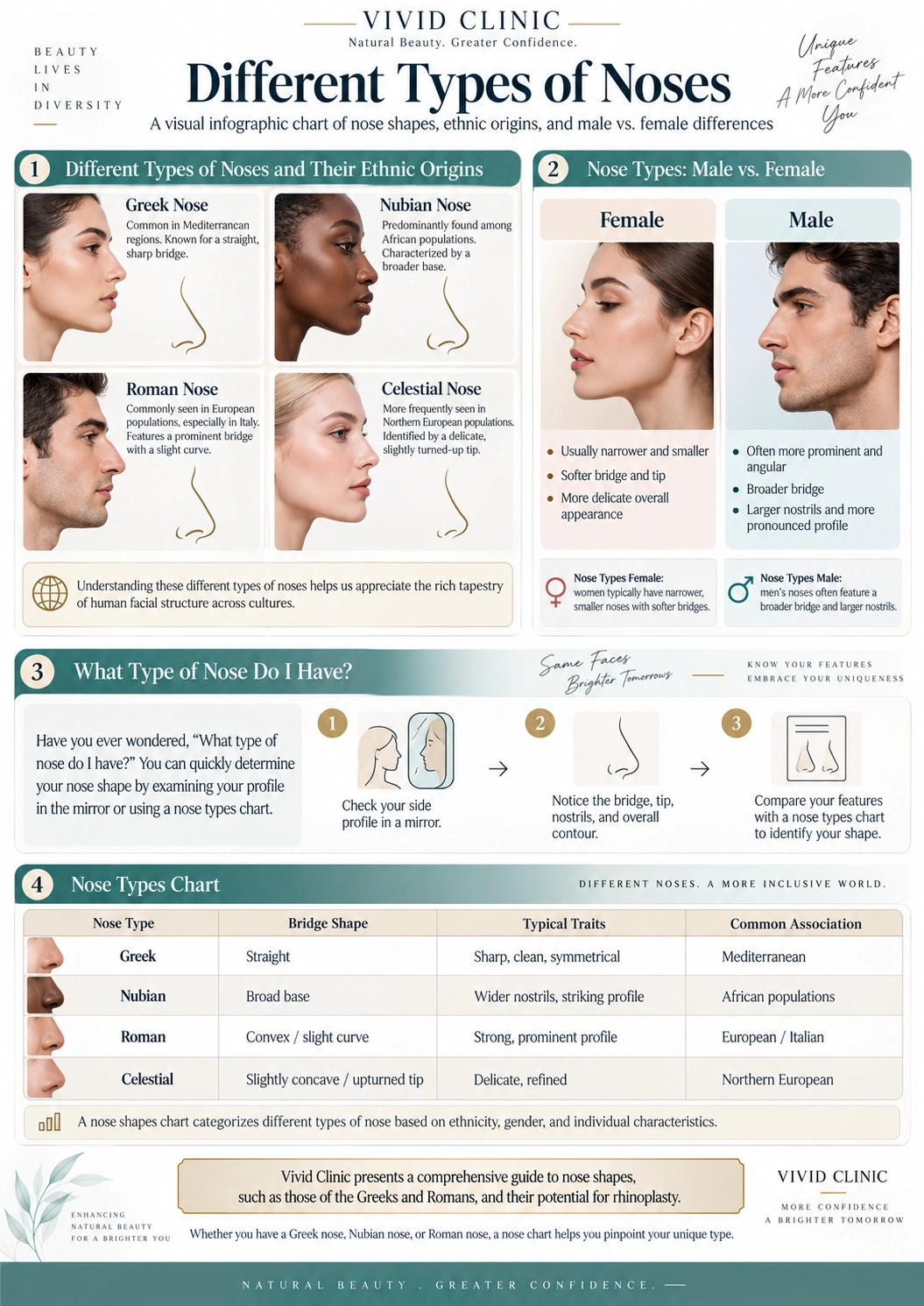
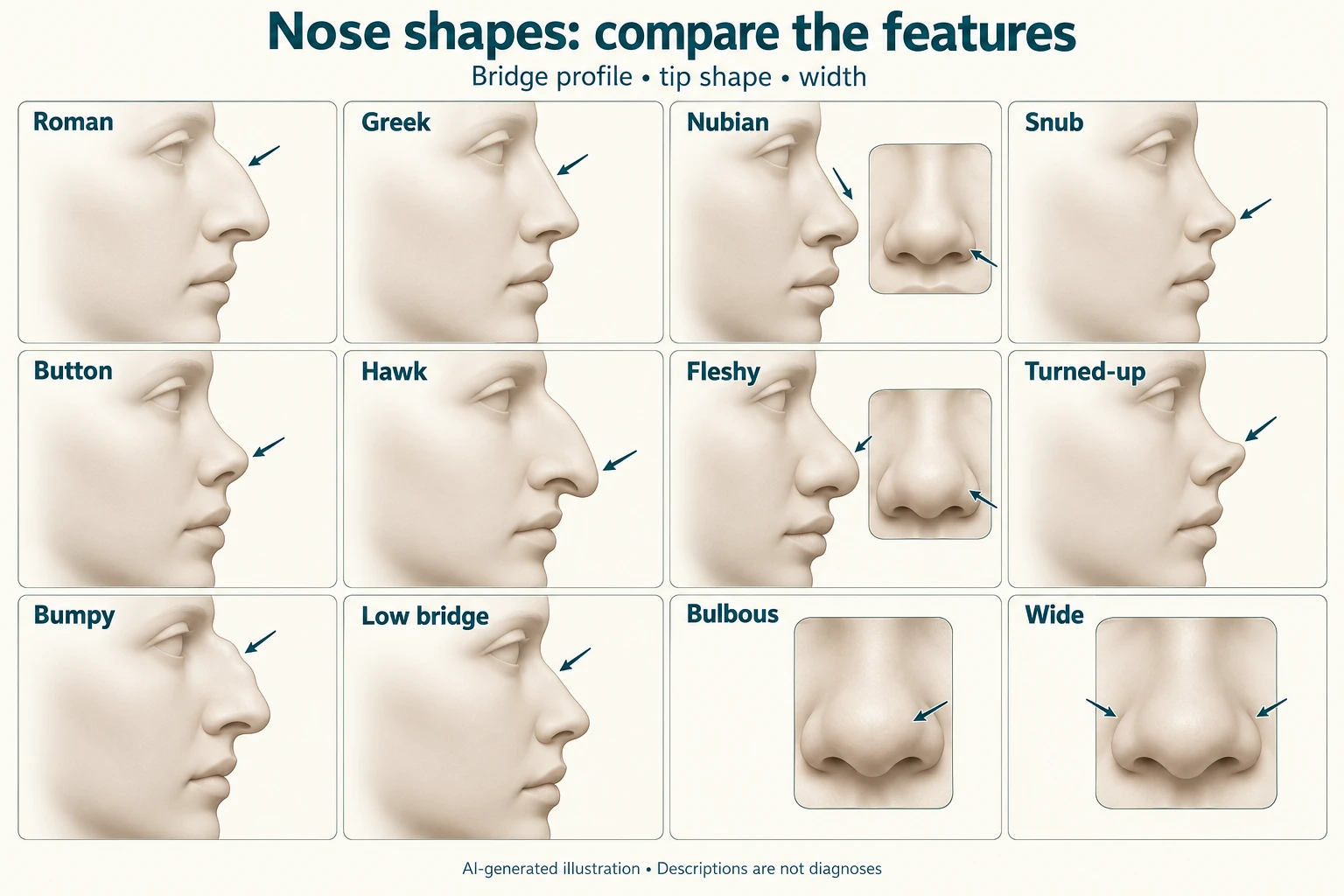
These terms describe shapes, and the geographic names attached to them are historical labels rather than statements about who has which nose. Any of these can appear on any face.

Roman nose (aquiline). A bridge with a slight downward convexity and often a somewhat downturned tip — the profile familiar from Roman portrait sculpture, which is where the name comes from. Aquiline derives from the Latin for eagle. It is common around the Mediterranean, the Middle East, South Asia and Indigenous North America, and it is common in Northern Europe too. In Spanish this is nariz romana or nariz aguileña.
Greek nose. A notably straight bridge running in an almost unbroken line from the forehead, as idealised in classical Greek sculpture. It is worth noting that classical sculpture was an aesthetic convention rather than a survey — real Greek noses vary as much as anyone else’s.
Nubian nose. A longer nose with a wider base and a relatively low bridge, the term historically associated with Northeast African populations.
Snub or button nose. Short, with a small tip and often an upturned angle.
Hawk nose. A more pronounced convexity than a Roman nose, with a sharper downward tip.
Bulbous nose. A rounded, less defined tip, driven by thicker skin, wider tip cartilages, or both.
Flat or low-bridge nose. A dorsum sitting closer to the level of the eyes in profile. Common in East and Southeast Asian populations and in many African populations, and — a point patients are rarely told — this is the shape that most often calls for adding structure surgically rather than removing it.
Anthropometry also groups noses by the nasal index, the ratio of width to height: leptorrhine (narrow), mesorrhine (intermediate) and platyrrhine (broad). These are descriptive measurements, nothing more. They were historically abused, they carry no aesthetic meaning, and a surgeon has no business treating one as a goal.
What ethnic rhinoplasty actually means
The phrase causes confusion, so it is worth defining precisely. Ethnic rhinoplasty is not an operation that makes a nose look European. That approach — the "one ideal nose" era of the mid-twentieth century — produced a generation of results that looked wrong precisely because a narrow, high-bridged nose was grafted onto a face whose other features did not support it, and it stripped patients of a family resemblance they had never asked to lose.

Modern practice starts from the opposite premise: the goal is a nose that fits this face, in balance with these cheekbones, this lip, this chin and this skin, and that still reads as belonging to the person’s family. Most patients who come in asking about their nose want a refinement — a smoother profile, a more defined tip, a slightly narrower base — and are alarmed at the idea of a nose that erases where they come from. Sorting out which of those a patient actually wants is the most important part of the consultation, and it takes longer than the surgery does to plan. Genetic research has linked nostril width to ancestral climate, as shown in this PLOS Genetics study on nose shape and climate adaptation.
Why different noses need different operations
This is the practical core, and it is technical rather than political.

Skin thickness is the dominant variable. Thicker, more sebaceous nasal skin — common in many African, Middle Eastern, South Asian, Hispanic and Southeast Asian patients, and in plenty of European ones — hides the underlying cartilage work. Refinement has to show through the skin envelope, so the achievable definition is lower and the swelling lasts longer, often well past a year. It also raises the risk of soft-tissue fullness developing above the tip. Thick skin does not prevent an excellent result; it changes what the result looks like and how long it takes to arrive.
Cartilage strength varies too. Weaker, more flexible lower lateral cartilages give less natural tip support, so the surgical strategy shifts toward building support with structural grafts rather than trimming tissue away. Reduction techniques that work on a strong, thin-skinned nose will simply collapse a weaker one.
Dorsal height. A lower bridge needs augmentation — adding height with a graft — which is close to the opposite operation from the hump reduction most people picture when they hear "nose job". This is the mainstay of much Asian rhinoplasty and of a good deal of African American rhinoplasty. Septal cartilage is often insufficient in these cases, so ear (conchal) or rib cartilage is used, or in some practices an implant. Grafting choice has real consequences for longevity, and it is a fair question to ask a surgeon directly.
Alar base width. Narrowing the base is a common request and a genuinely delicate one. Alar flare and alar base width are different measurements needing different excisions, over-narrowing is difficult to reverse, and thicker skin scars differently. Conservatism here is not timidity — it is the difference between a natural result and an obviously operated one.
Tip projection and rotation are set by cartilage strength, skin thickness and the support the surgeon builds, and the targets should follow the face rather than a published ratio.
Which brings us back to the numbers. The proportions quoted in rhinoplasty planning — nasolabial angle ranges, Goode’s ratio, interalar width against intercanthal distance — derive substantially from aesthetic-preference studies conducted on predominantly European faces. They are useful to a surgeon as a way of thinking about internal balance. They are not a standard other faces should be measured against, and a surgeon who treats them as universal targets is applying the wrong tool.
What to ask a surgeon
If you are considering surgery on a nose whose character you want to keep, these questions separate surgeons quickly:

- Can I see results on patients with skin and cartilage like mine, at twelve months or later? This is the single most informative question. A portfolio of thin-skinned European noses tells you very little about what will happen to a thick-skinned one.
- What will my skin thickness mean for my result, and for how long swelling lasts? A surgeon who has not raised this before you ask is not planning around it.
- Am I having tissue removed, or structure added — or both? You should be able to describe your own operation afterwards.
- If grafts are needed, where will the cartilage come from?
- What will stay the same? A good answer to this is as important as the list of changes, and it is the question that most reliably reveals whether a surgeon has understood what you actually want.
You can see how these judgments read on real faces in our before-and-after gallery, and our rhinoplasty page covers the operation itself.
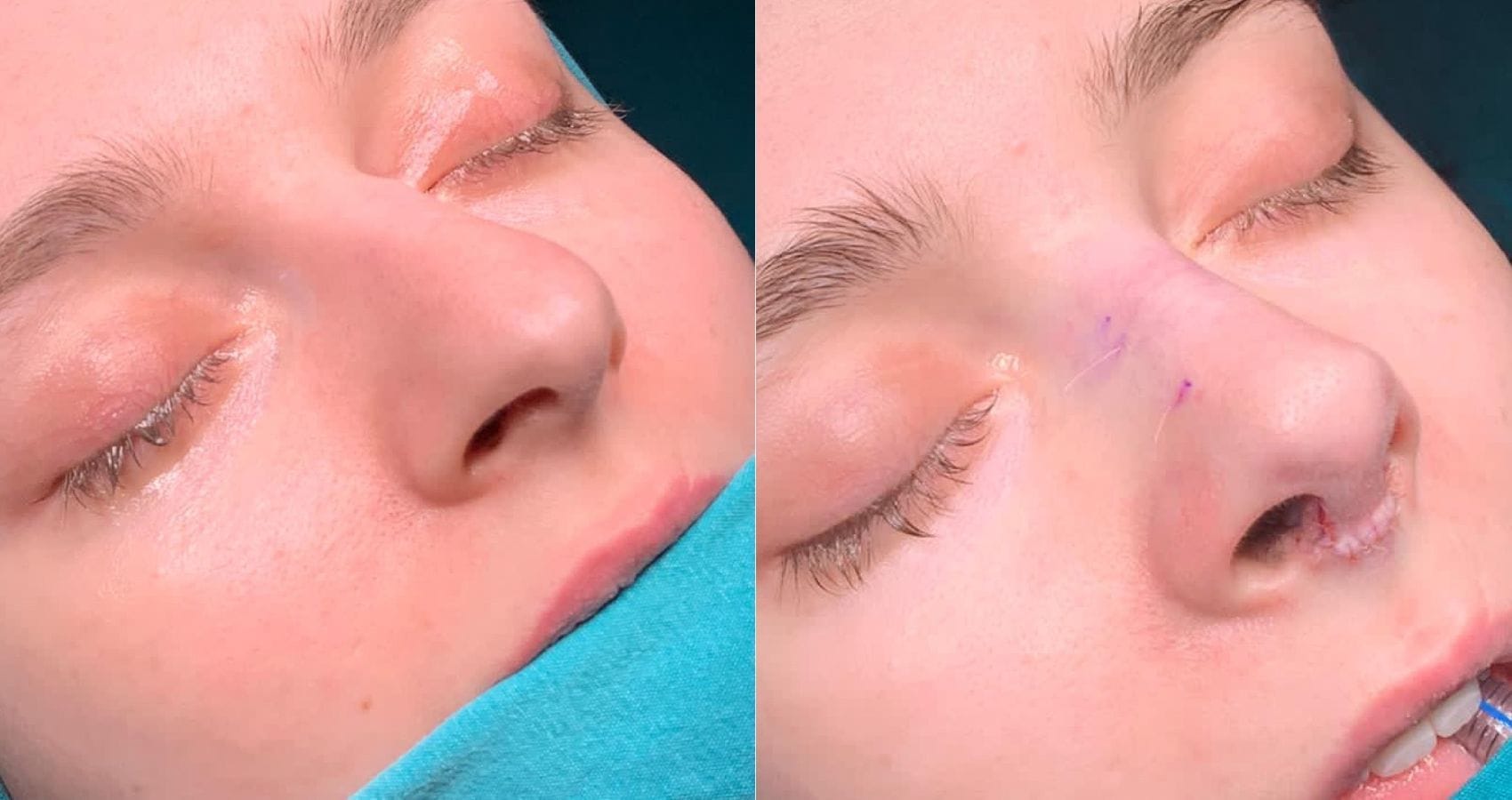
Ethnic Nose Shapes Before and After Results at Vivid Clinic
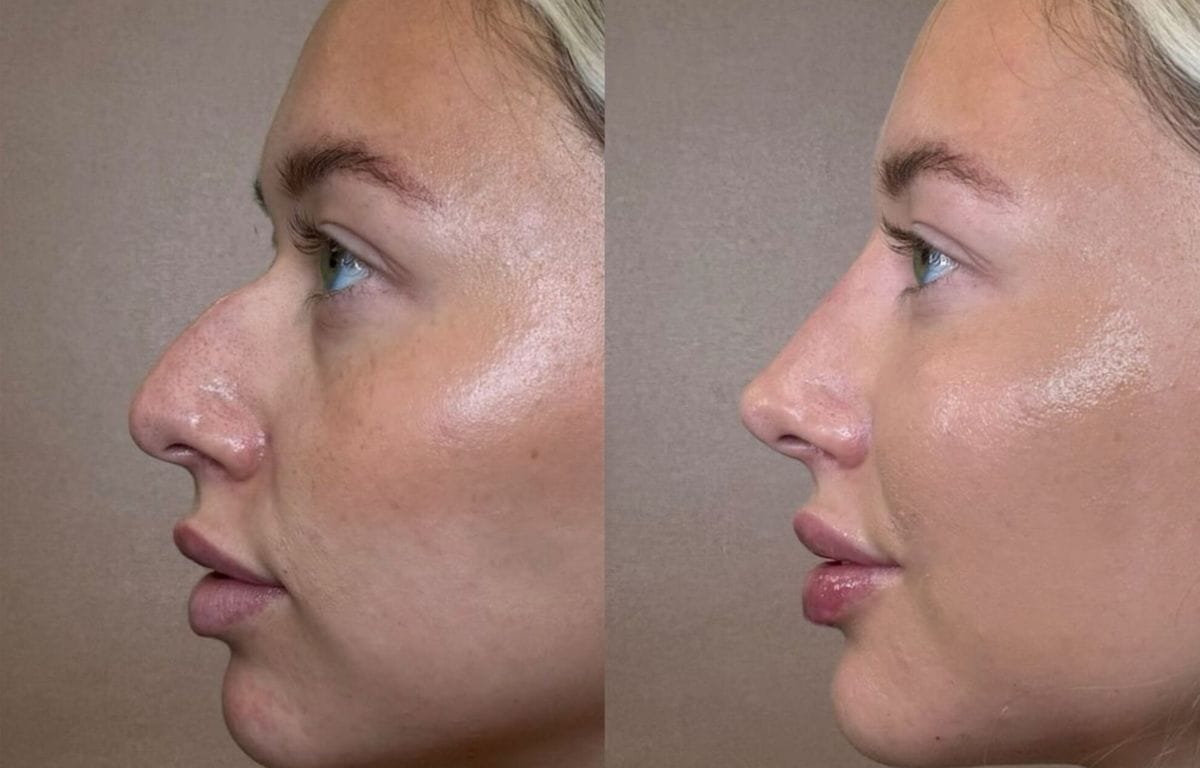
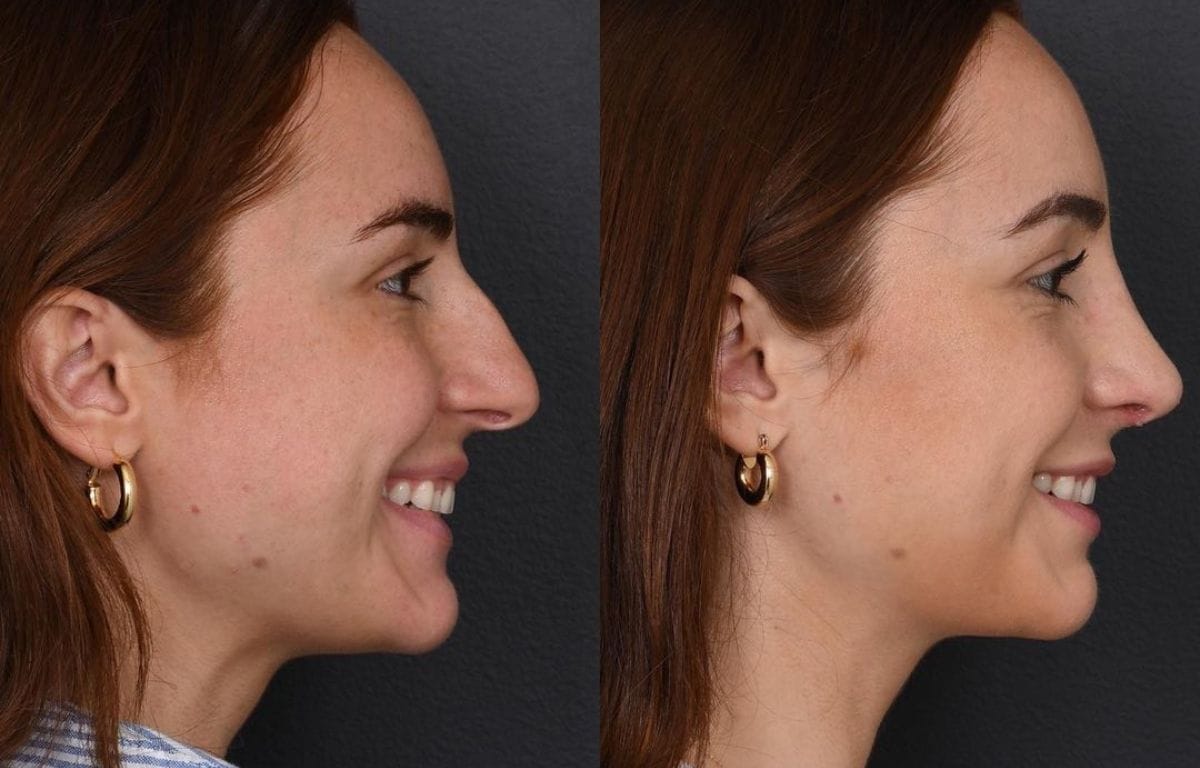
These before-and-after photos show real Vivid Clinic patients treated in Istanbul, shared with their consent. Photos are matched for angle and lighting wherever possible. Individual results vary. Browse the full Before & After Gallery.



Frequently Asked Questions
What is a Roman nose?
A Roman or aquiline nose has a bridge with a slight downward convexity and often a somewhat downturned tip — the profile seen in Roman portrait sculpture, which gave it the name. Aquiline comes from the Latin for eagle. It appears commonly across the Mediterranean, the Middle East, South Asia, Indigenous North America and Northern Europe, and it is entirely normal anatomy with no effect on breathing or health.
Does nose shape really vary by ancestry?
Yes, at the level of population averages, and the reasons are well studied: ancestral climate shaped nasal dimensions, since narrower nasal passages condition cold dry air more effectively while wider ones suit warm humid air, and genome-wide studies have identified specific genes influencing nasal width, height and tip shape. The essential caveat is that variation within any population is far larger than the average difference between populations. Averages describe distributions, not people, and they predict nothing reliable about any individual.
What is ethnic rhinoplasty?
It is rhinoplasty planned to change a nose while preserving the features that make it consistent with the patient’s face and family resemblance — not surgery that makes a nose look European. It also describes a set of genuine technical differences: thicker skin limits achievable definition and prolongs swelling, softer cartilage requires structural grafting rather than tissue removal, and lower bridges need augmentation rather than reduction. The term covers a surgical approach, not a cosmetic destination.
Can rhinoplasty keep my nose looking like my family’s?
Yes, and for most patients that is the point. Refinements such as smoothing a profile, improving tip definition or modestly narrowing the base can be made without changing the features that give a nose its character. Being explicit at consultation about what you want kept — not only what you want changed — is the most reliable way to get there, and a surgeon should be able to tell you clearly which characteristics will remain.
Why do some rhinoplasty patients need cartilage grafts?
Because many noses need structure added rather than removed. Augmenting a lower bridge, supporting a tip whose cartilage is naturally softer, or holding the middle of the nose open all require grafted cartilage. Septal cartilage is the usual first choice, but there is often not enough of it in these cases, so ear or rib cartilage is used instead. Asking where your grafts would come from is a reasonable and useful question.
Does thicker nasal skin change what surgery can achieve?
Yes, and it is one of the most important things to establish before surgery. Thick, sebaceous skin conceals the cartilage refinement underneath, so definition is softer than in a thin-skinned nose however precise the work. Swelling also lasts considerably longer, often beyond a year, and there is a higher risk of fullness developing above the tip. It does not prevent a good outcome, but it changes what a realistic outcome looks like and how long it takes to appear.
Are there ideal nose measurements?
Not in any meaningful sense. The proportions quoted in rhinoplasty planning come largely from aesthetic-preference studies of predominantly European faces, and they exist to help a surgeon think about balance within a face rather than to define a correct nose. Historically, nasal measurements were misused to rank populations, which is a good reason to be sceptical of anyone presenting them as universal ideals today. A nose that suits your face and breathes well is the goal.
Considering surgery but worried about losing what makes your nose yours? Send photographs for a free online assessment and get an honest account of what could change, what would stay the same, and what your skin and cartilage realistically allow.