
 ChatGPT
Medically reviewed by Prof. Dr. Özgür Pilancı, Plastic, Reconstructive & Aesthetic Surgeon — August 2026
Quick answer (updated August 2026): “Cat eye surgery” almost always means lateral canthoplasty — an operation that divides and repositions the tendon anchoring the outer corner of the eye to the orbital bone. It is the only technique that changes the angle of the eye opening itself. Everything else sold as a “fox eye lift” — brow-tail lifting, thread lifts, toxin, filler — changes the tissue around the eye, not the tilt of it. Because canthal tilt is set largely by your orbital bones, the honest answer to “how do I get a positive canthal tilt” is that you can soften the impression of a downturned eye far more easily than you can rebuild the angle.
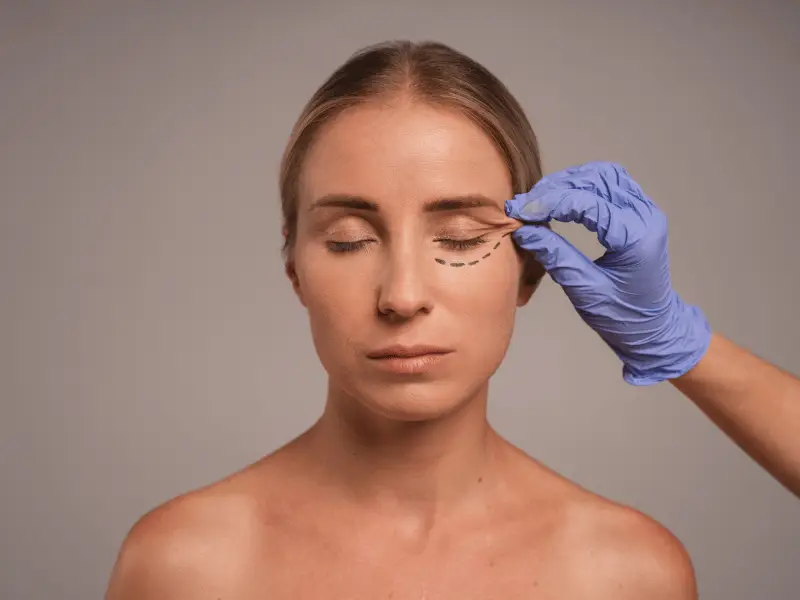
What canthal tilt actually means
Every eye has two corners: the medial canthus beside the nose and the lateral canthus at the outer edge. The line between them is the intercanthal axis; its angle is the canthal tilt.

In most people the lateral canthus sits slightly higher than the medial one — StatPearls puts the usual difference at around 2 mm — and that upward outer inclination is a positive canthal tilt. A neutral tilt runs flat. A negative tilt is the reverse, and surgeons treat it as a clinical finding rather than a cosmetic label: it raises the risk of lower-eyelid malposition after eyelid surgery.
The lateral canthus is not floating in soft tissue. Its tendon anchors to Whitnall’s tubercle, an elevation on the inner surface of the lateral orbital rim, roughly 5 mm behind the bone edge — which is why moving the outer corner is surgery on a tendon and a bone, not a skin treatment.
The honest answer to “how do I get a positive canthal tilt”
Mostly, you don’t — and the content promising otherwise is overselling.
Canthal tilt is a product of your orbital skeleton. The orbit is built from seven bones; its lateral wall — the strongest of them — is formed by the zygomatic bone and the greater wing of the sphenoid. That zygomatic bone carries the tubercle the canthal tendon attaches to, so where it sits largely fixes where your outer corner can sit. StatPearls notes ancestry and sex both affect the measurements of the bony orbit: this is inherited architecture.
So, plainly: makeup does not change canthal tilt. A winged liner creates the impression of an upswept eye — nothing wrong with that, but nothing has been tilted. The same goes for the exercises, taping and massage routines circulated in looksmaxxing content: none moves a tendon fixed to periosteum, and none has evidence behind it.
Camera angle is doing more work than you think. Tilt is only meaningful measured straight on, head level. A tucked chin and a raised camera manufacture a positive tilt on any face — which is what much “how I fixed my canthal tilt” content actually shows.
Cat eye surgery: lateral canthoplasty and canthopexy
Canthoplasty is the procedure usually meant by cat eye surgery: it lengthens the eye opening while lifting the outer corner toward an almond shape.
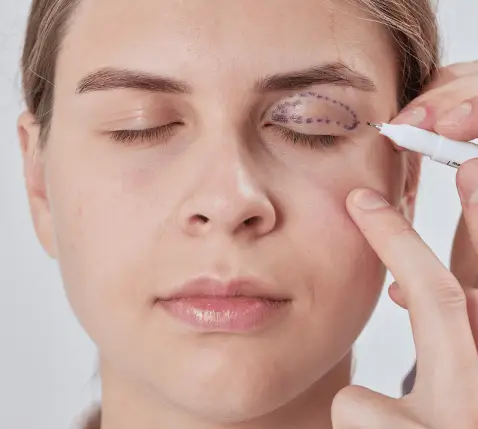
Canthopexy reinforces what is already there — a suture or internal fixation that tightens and supports without detaching the tendon. StatPearls describes it as usually sufficient for mild lateral canthal laxity.
Canthoplasty goes further: the tendon is divided, excess tissue excised and the tendon reattached — often as a tarsal strip, a 3–4 mm strip of tarsal plate secured to the periosteum inside the lateral orbital rim. The American Society of Plastic Surgeons describes it as delivering more dramatic and lasting change while carrying a higher risk profile and a longer recovery than canthopexy.
The lever in both is that attachment: the American Academy of Ophthalmology’s EyeWiki notes that moving the tendon at its posterior fibrous attachments is what “provides an opportunity to alter the lateral canthal angle.” How far it can move is set by the bone underneath.
Our fox eye lift page covers what this operation involves at our clinic.
Lifting the brow tail, not the eye
Much of what reads as a “fox eye” is not the eye at all — it is the tail of the brow.

An endoscopic brow lift works through small incisions concealed behind the hairline, using a camera to release and reposition forehead and temporal tissue. Surgeons quoted by ASPS are blunt about where the value sits: the lateral third of the brow is “the most attractive area to lift,” and the whole brow rarely needs raising. A temporal lift uses one or two small incisions behind the hairline for less downtime. ASPS also reports that the celebrity-level fox eye is typically not one operation but a brow lift, mid-facelift and canthopexy combined.
Patient selection is the whole game. ASPS notes good candidates have a brow sitting below the superior orbital rim, and warns that brow surgery “can make people look really bad if it is not done on the right patient.” Over-elevation reads as permanent surprise.
Our forehead lift page and eyelid lift page cover the neighboring operations.
Fox eye thread lifts: what they deliver, and what they cost you
The version of the fox eye that went viral is the thread lift — barbed absorbable sutures, usually polydioxanone, passed under the temple skin and drawn upward to lift the brow tail.
Threads are quick, done under local anesthetic, and produce a visible change on the table. ASPS describes the results as temporary, lasting up to 18 months, and positions them as a “prejuvenation” step for younger patients — with the caveat that “surgery is the next step after minimally invasive stops working.”
Threads do not touch canthal tilt. They lift skin and superficial tissue in the temple; the canthal tendon is never reached.
The complication profile is not trivial. A 2026 meta-analysis in Frontiers in Surgery, pooling 26 studies and 2,827 patients, found skin dimpling in about 7% (95% CI 4–12%), visible or palpable threads in about 10%, thread exposure in about 5% (95% CI 3–8%), infection in about 2% and paresthesia in about 6%. Swelling (34%) and bruising (26%) are common but early, settling within two to four weeks. The authors single out the late group — visible threads, dimpling and migration — as carrying greater clinical significance: they surface after the patient has stopped expecting trouble.
The arithmetic is unforgiving. A result lasting under two years, repeated indefinitely, accumulates cost and scar tissue that a later surgeon must work through.
Toxin and filler: real, small, temporary
A brow-tail toxin treatment, or chemical brow lift, works indirectly: the orbicularis oculi is a brow depressor, so relaxing its outer fibers lets the frontalis raise the brow tail unopposed. The change is subtle and it wears off. ASPS lists brow and eyelid droop (ptosis) among the risks — the same relaxation that lifts a brow can drop one.
Filler in the temple or along the brow tail adds volume rather than lift, restoring support under a hollow temple so the brow sits better. It is also the highest-consequence item here: ASPS warns that filler injected into a blood vessel can block blood flow, and that “if your eye is affected, you might lose your eyesight or go blind.” Rare, but real — which is why the injector’s anatomical training matters more than the product.
Neither changes canthal tilt.
Recovery, risks and what can go wrong
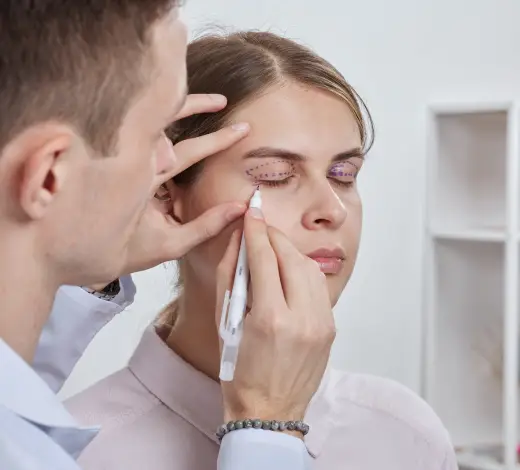
Cleveland Clinic describes canthoplasty as taking 30 minutes to three hours under local or general anesthesia, with roughly a week before returning to work, two to four weeks to recover fully and two to three months for incision lines to fade. StatPearls puts suture removal within a week and restricts strenuous activity for about two weeks.
Cleveland Clinic lists scarring, bleeding, swelling, bruising, pain, dry eyes, difficulty closing the eyes and infection; EyeWiki adds that dry eye is frequently reported after canthal surgery, along with canthal rounding where the sharp outer angle blunts, eyelid malposition, canthal asymmetry, and webbing (symblepharon) in around 5.9% of lateral canthoplasty cases.
Retrobulbar hematoma, the emergency of eyelid surgery, is rare: StatPearls cites roughly 0.055%, or 1 in 2,000, with subsequent blindness at about 0.0045%, or 1 in 22,000.
Overcorrection is a genuine failure mode, and revising a canthus is harder than the primary operation.
How to read a cat eye surgery before-and-after
Almost every “cat eye surgery before and after” online is uncontrolled, so read it skeptically.
Check the head position. Tilt is only measurable head-level and straight on. If the chin drops between the two photographs, the result is photographic.
Check the timing. Swelling around the lateral canthus persists for weeks, so a two-week image flatters.
Check the brow. If the brow tail has clearly moved, you are looking at brow surgery, not canthal surgery.
Check the starting anatomy. A patient with a projected cheekbone and a mildly negative tilt has room to move that a flat midface does not.
You can see how eye-area decisions read on real faces in our before-and-after gallery and our blepharoplasty before-and-after page.
Frequently Asked Questions
Related Eye-Area Before and After Result
The photo below is not a fox eye lift case. It shows a related lifting procedure, an endoscopic mid facelift with temporal and lateral brow lift, to illustrate how lifting changes the outer eye and brow area.
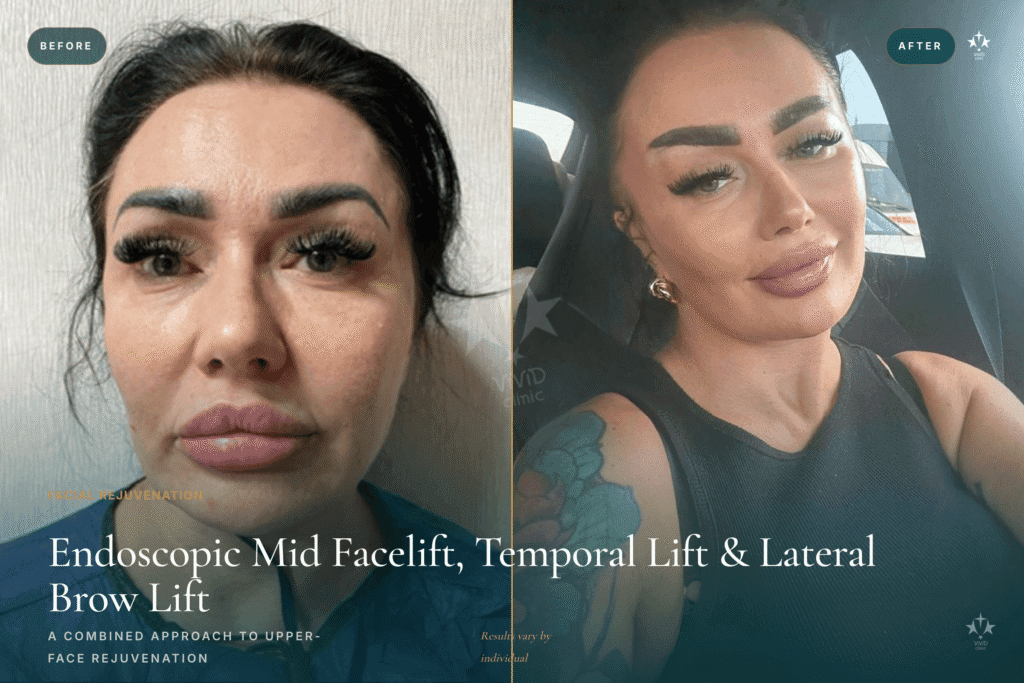
Results vary from person to person. These photos show individual outcomes and are not a guarantee of results; your surgeon will explain what is realistic for you during your free consultation.
What is cat eye surgery?
Cat eye surgery is the popular name for lateral canthoplasty. The surgeon divides the lateral canthal tendon, removes excess tissue and reattaches it higher and further back inside the lateral orbital rim, lengthening the eye opening and lifting the outer corner toward an almond shape. ASPS notes canthoplasty is commonly called cat eye surgery for that reason. It is surgery on a tendon and a bony anchor, not on skin.
Can you actually change your canthal tilt?
Only within limits, and only surgically. Canthal tilt is set largely by your orbital skeleton — where the zygomatic bone sits, how the lateral rim is angled — and that architecture is inherited. Canthoplasty can reposition the tendon on that rim and change the angle of the eye opening; nothing non-surgical can. Makeup, taping, exercises and looksmaxxing routines change how an eye photographs, not where its corner is anchored.
Is a fox eye thread lift worth it?
Threads lift the brow tail and superficial temple tissue, not the canthus, so they do not alter canthal tilt at all. ASPS puts the duration at up to 18 months, and a 2026 meta-analysis found skin dimpling in about 7% of cases, visible or palpable threads in 10% and thread exposure in 5%. For a temporary change with little downtime that trade can be reasonable; to change eye shape, it is the wrong procedure.
What is the difference between canthoplasty and canthopexy?
Canthopexy tightens and supports the existing canthal tendon with sutures or internal fixation without detaching it; StatPearls describes it as usually sufficient for mild lateral canthal laxity. Canthoplasty divides the tendon, excises excess tissue and reattaches it, often as a tarsal strip fixed to the periosteum inside the orbital rim. ASPS describes it as producing more dramatic and lasting change, with a higher risk profile and a longer recovery.
Does a fox eye lift look natural?
It can, and the difference is almost entirely patient selection and restraint. ASPS surgeons warn that brow procedures “can make people look really bad if it is not done on the right patient,” and that over-elevation produces a startled look — particularly in men, where a high brow removes masculine proportion. A subtle change on suitable anatomy reads as rested; a large one on unsuitable anatomy reads as surgery.
How long does cat eye surgery take to heal?
Cleveland Clinic describes canthoplasty as taking 30 minutes to three hours, with about a week before most people return to work and two to four weeks for full recovery; incision lines take two to three months to fade. StatPearls advises suture removal within a week and no strenuous activity for about two weeks. Combined with eyelid or brow surgery, plan longer — one ASPS surgeon suggests at least a month of social downtime.
Wondering whether your eye shape is something surgery can change — or something a camera angle has been changing for you? Send photographs for a free online assessment and get a straight answer about what would and would not move, including when the honest answer is that nothing needs operating on. You can also browse our wider face aesthetics options.