FUE, sapphire FUE and DHI

Hair Transplant Istanbul FUE, DHI or sapphire FUE, grafts planned by Norwood stage and a 3-day trip

A hair transplant moves your own follicles from the back of the scalp to thinning areas, under local anaesthesia. It suits men and women with stable pattern hair loss and a healthy donor area. Plan a 3-day trip; most people return to desk work within a week.

  • 3 days in Istanbul
  • No stitches, same-day hotel
  • FUE, sapphire FUE or DHI

Free medical review within 24 hours · No obligation · ★ 5.0 from 157 Google reviews

Editorially reviewed by the Vivid Clinic Surgical Board · Last reviewed September 2026

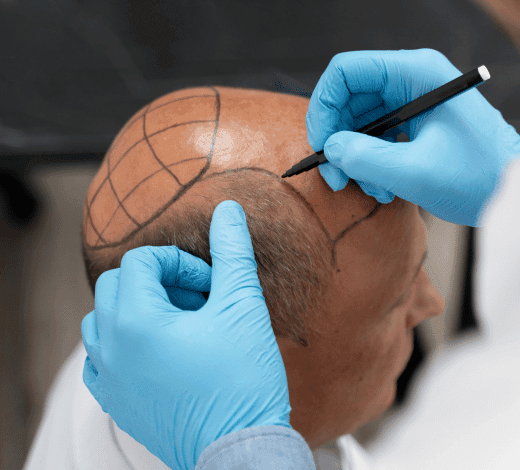
Gloved hands drawing a planned hairline and grid with a marker on the scalp of a balding man
At a glance

What is a hair transplant in Istanbul, and what to expect

A hair transplant relocates follicles from the donor zone at the back and sides of the scalp, where hair resists loss, to thinned areas. Because follicles keep the traits of where they came from, transplanted hair usually keeps growing. At Vivid Clinic, one patient coordinator arranges the whole trip, from transfers and hotel to aftercare.

Illustration of a patient coordinator welcoming a hair transplant patient at Istanbul airport beside a transfer vehicle
Your coordinator meets you on arrival.Illustration
Procedure time
6–8 hDepending on grafts and technique
Stay in Istanbul
3 daysArrival, surgery, check-up
Back to desk work
5–7 daysRedness and crusts for 10–14 days
Shedding
Weeks 2–8A normal “shock loss” phase
New growth
Months 3–4Density improves by months 6–9
Final result
12–18 monthsThe crown often matures last
See all procedure details
Hair transplant in Istanbul at a glance
Procedure timeTypically 6–8 hours, depending on graft number and technique
AnaesthesiaLocal anaesthesia, with light sedation if your doctor recommends it
Hospital stayNone — you return to your hotel the same evening
Recommended stay in Istanbul3 days (arrival, surgery, check-up and first wash)
Back to desk workUsually 5–7 days; visible redness and crusts for about 10–14 days
ExerciseLight walking straight away; gym after about 2 weeks; contact sports and swimming after about 4 weeks
SheddingWeeks 2–8 (a normal “shock loss” phase)
New growthFrom months 3–4
Final result12–18 months
Results lastTransplanted follicles usually keep growing long term; native hair may continue to thin
StitchesNone — FUE and DHI leave tiny round marks that heal within days
Real patient results

Hair transplant before and after

Results from Vivid Clinic patients, shared with consent. Individual results vary. 6 cases shown; each caption states what the photos show and what is not recorded.

See the full gallery
  • Hair transplant · Case VC-24327
    • Left: before · Right: after
    • View: front
    • Follow-up interval: not recorded

    Before: Extensively receded hairline (Norwood-type recession). After: Lowered, denser hairline.

    Vivid Clinic patient, shared with consent. Individual results vary; this is one case, not a promise of your outcome.

  • Hair transplant · Case VC-24345
    • Left: before · Right: after
    • View: front, head bowed
    • Follow-up interval: not recorded

    Before: Receded hairline and thin frontal zone. After: Denser, lowered hairline.

    Vivid Clinic patient, shared with consent. Individual results vary; this is one case, not a promise of your outcome.

  • Hair transplant · Case VC-24316
    • Left: before · Right: after
    • View: front (eyes masked)
    • Follow-up interval: not recorded

    Before: Receded temples and thin frontal hair. After: Fuller frontal hairline.

    Vivid Clinic patient, shared with consent. Individual results vary; this is one case, not a promise of your outcome.

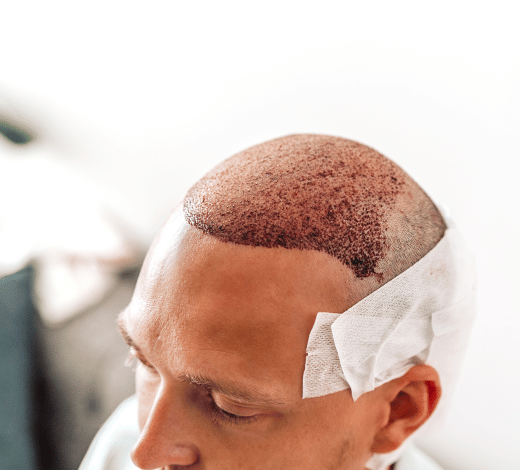
  • Hair transplant · Case VC-24312
    • Left: before · Right: after
    • View: top of head, head bowed
    • Follow-up interval: not recorded

    Before: Receded hairline with pre-op hairline marking. After: Restored hairline and frontal density.

    Vivid Clinic patient, shared with consent. Individual results vary; this is one case, not a promise of your outcome.

  • Hair transplant · Case VC-24313
    • Left: before · Right: after
    • View: front (eyes masked)
    • Follow-up interval: not recorded

    Before: Extensive baldness. After: Full, grey-toned coverage.

    Vivid Clinic patient, shared with consent. Individual results vary; this is one case, not a promise of your outcome.

  • Hair transplant · Case VC-24307
    • Left: before · Right: after
    • View: top of head
    • Follow-up interval: not recorded

    Before: Advanced frontal and crown thinning. After: Dense curly coverage over the frontal and crown zones.

    Vivid Clinic patient, shared with consent. Individual results vary; this is one case, not a promise of your outcome.

Photos are unedited clinic composites; before and after photos may differ in lighting, clothing and pose. Consent is on file at the clinic.

Candidacy

Who is a hair transplant right for — and who should wait?

A hair transplant in Istanbul tends to work well if you

  • Have male or female pattern hair loss that has been fairly stable for at least a year
  • Have enough good-quality donor hair to cover the area you want to restore
  • Are in good general health and can stop blood-thinning supplements before surgery, if your doctor agrees
  • Have realistic expectations about density, especially on the crown

It may be better to wait if

  • You are in your early twenties and still losing hair quickly
  • The cause of your hair loss has not been diagnosed, for example thyroid problems, low iron or alopecia areata
  • Your donor area is already thin

Your doctor may first discuss medical options such as finasteride or minoxidil, and plan surgery once the pattern settles. The NHS overview of hair transplants gives an independent summary of suitability.

Three ways to implant

FUE, DHI or sapphire FUE: which technique suits you?

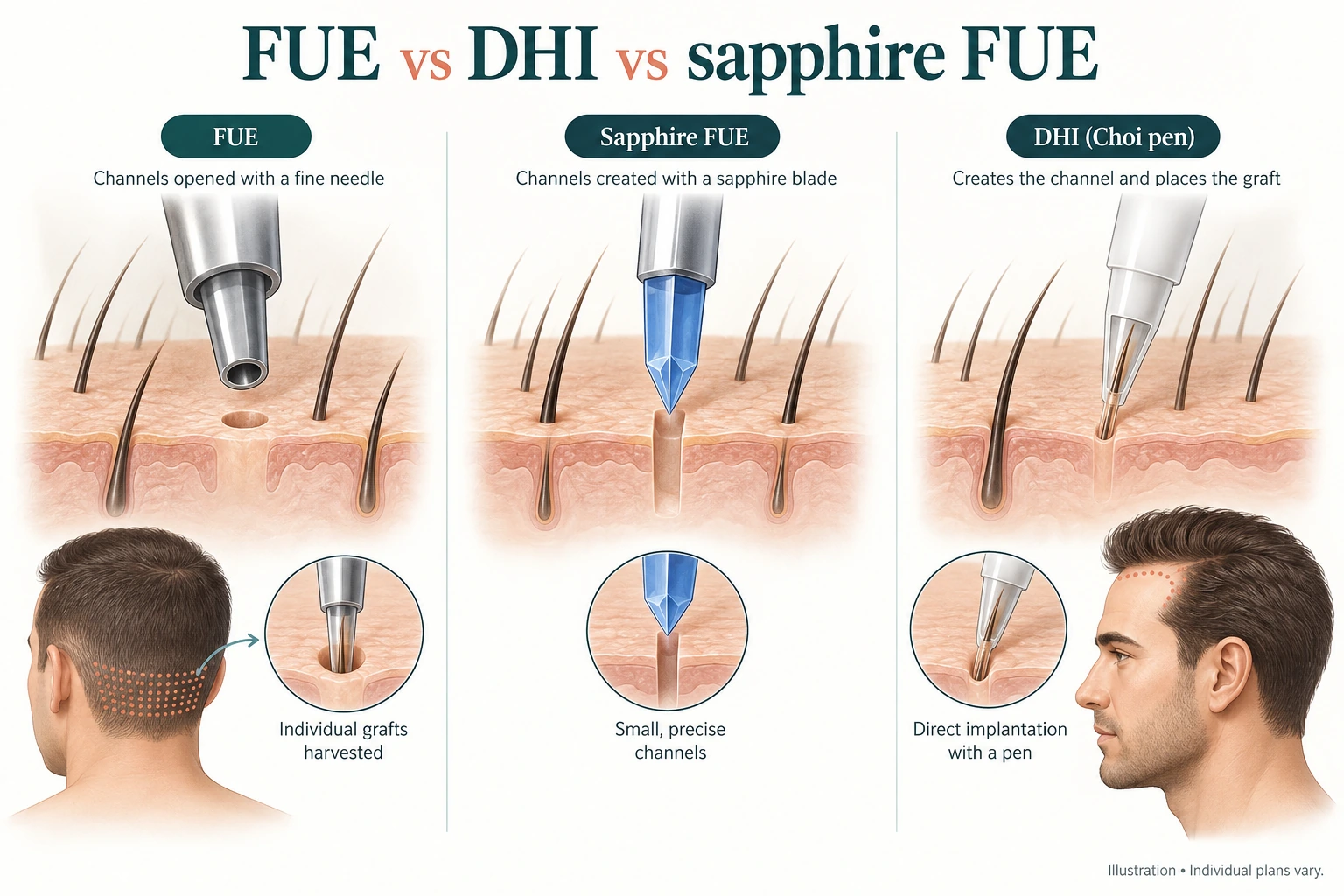
All three methods start the same way, with grafts extracted one by one from the donor area. They differ in how the grafts go in.

Medical illustration comparing FUE channel opening, sapphire blade channels and DHI Choi pen implantation
How the three implantation methods differ.Illustration
Large sessions

Classic FUE

The surgeon opens tiny recipient channels first, then places the grafts with fine forceps. It is efficient for wide areas such as the mid-scalp and crown.

Channels
Opened first (steel blade)
Often chosen for
Large areas, crown
Shaving
Usually full shave
Grafts per session
Large sessions possible
Fine channels

Sapphire FUE

The same FUE process, but channels are opened with sapphire-tipped blades. Their fine, smooth edge allows small, precise channels, which many surgeons prefer for dense packing.

Channels
Opened first (sapphire blade)
Often chosen for
Dense packing, large areas
Shaving
Usually full shave
Grafts per session
Large sessions possible
Choi implanter pen

DHI

Each graft is loaded into a pen-like implanter and placed directly, creating the channel and inserting the graft in one movement.

Channels
Created during implantation
Often chosen for
Hairline, density between existing hair
Shaving
Full, partial or unshaven options
Grafts per session
Usually slightly fewer per day

Your doctor may combine methods, for example sapphire FUE on the crown and DHI along the hairline. Read more on our FUE hair transplant page, DHI hair transplant page and sapphire FUE guide. Women and beards need different planning: see our female hair transplant page and beard transplant page.

Step by step

How a hair transplant is done

You stay awake under local anaesthesia and can watch a film or rest. Surgery usually runs for most of the day, with breaks for lunch.

  1. Hairline design

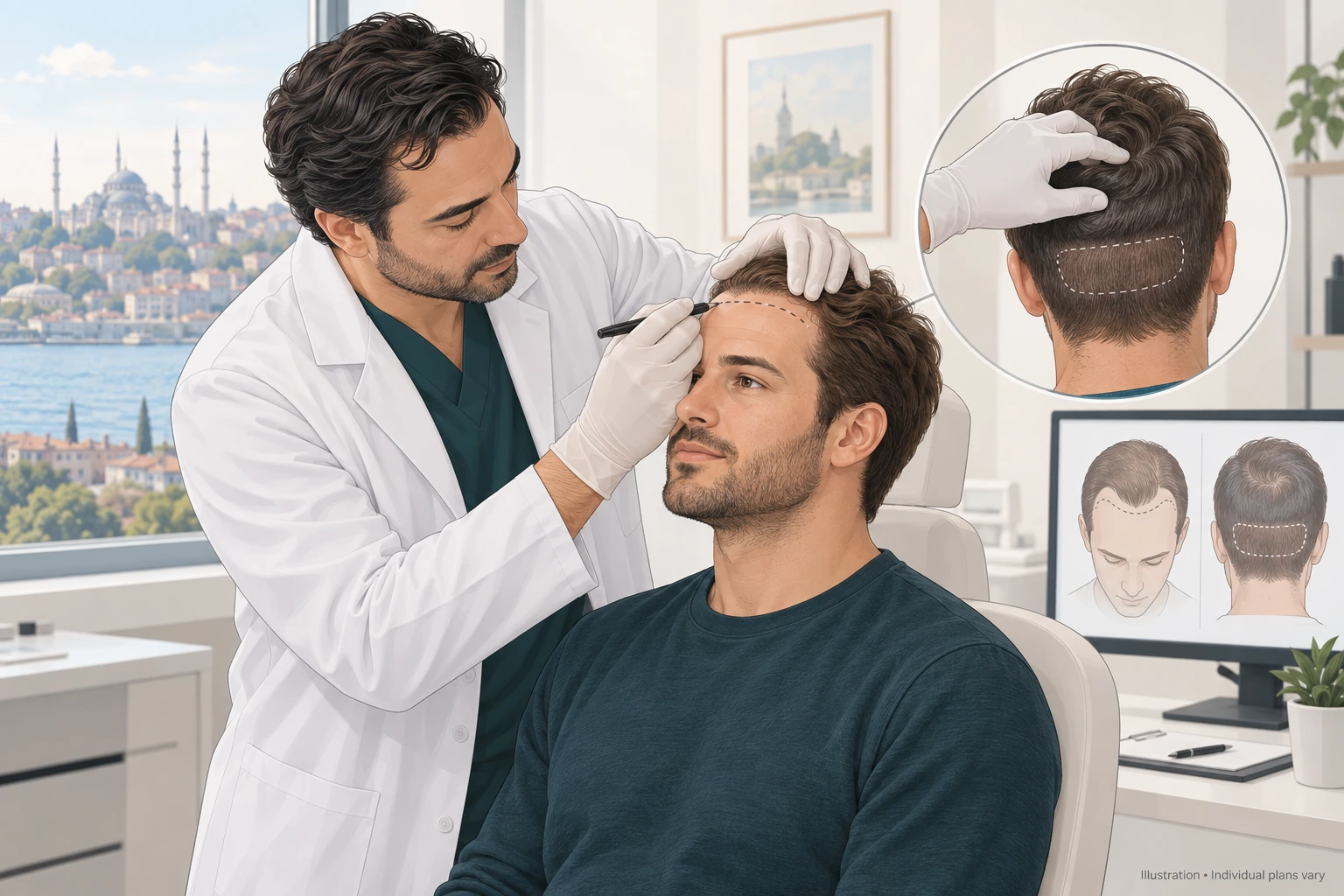
    Hairline and zones drawn with you, to suit your age and face.

  2. Preparation

    Donor area, and usually recipient area, trimmed short unless unshaven DHI.

  3. Anaesthesia

    The scalp is numbed with local anaesthesia.

  4. Extraction

    Grafts harvested one by one and sorted under magnification.

  5. Implantation

    Placed by FUE, sapphire FUE or DHI, following natural hair direction.

  6. Aftercare kit

    Donor area dressed; medication and aftercare kit provided.

Illustration of a doctor marking a patient's hairline and assessing the donor area before a hair transplant
Step 1: hairline and donor assessment on the day of surgery.Illustration
Your Istanbul journey

Three days, fully coordinated

Day 1

Arrival and hotel

Your patient coordinator meets you at the airport and a VIP transfer takes you to your hotel. You receive a timetable and a direct number for your coordinator.

Day 2

Consultation, tests and surgery

You meet the doctor, agree the hairline and graft plan, and have routine blood tests. An interpreter or coordinator is available, and you return to your hotel the same evening.

Day 3

Check-up, first wash, fit to fly

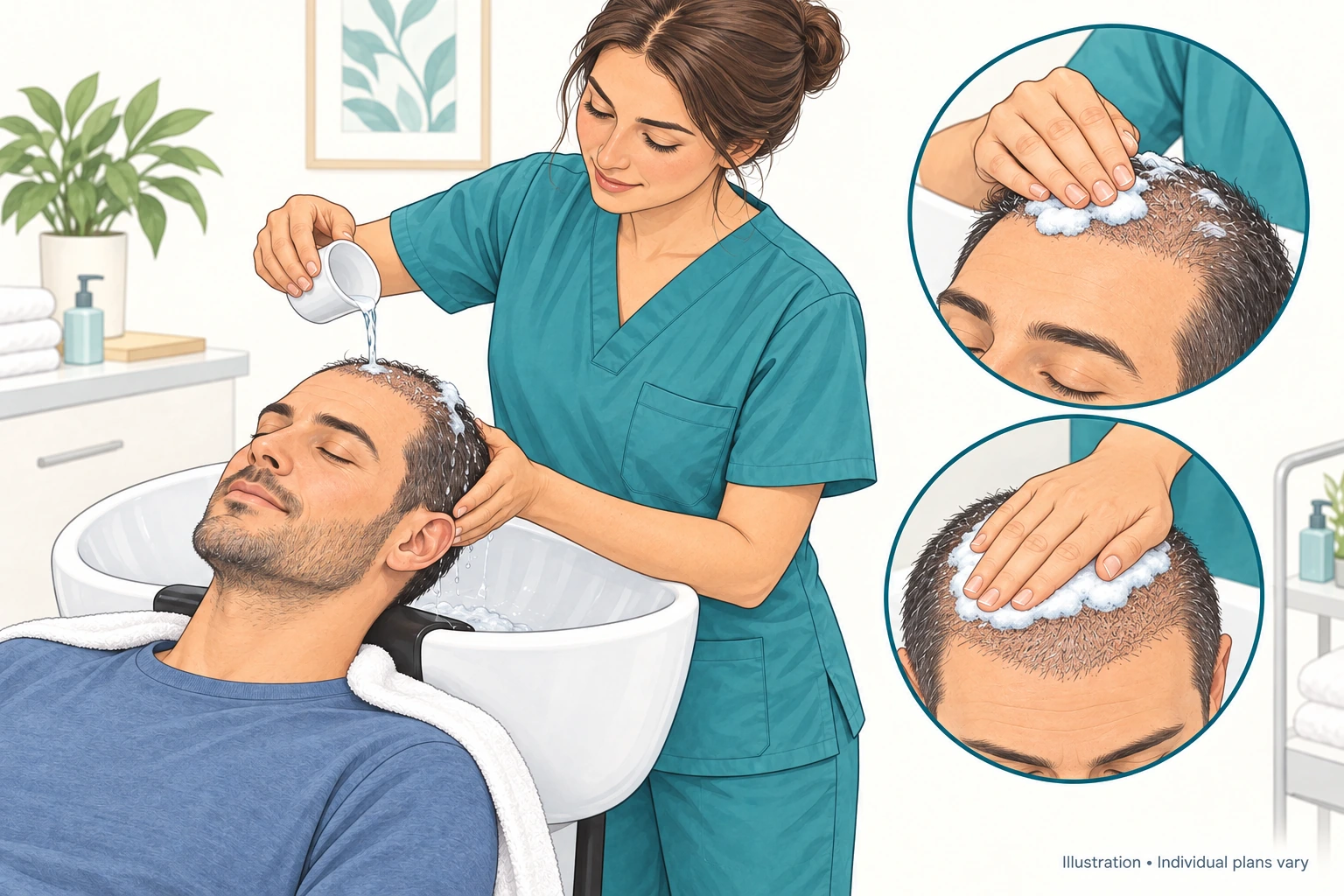
The team checks both areas, removes the dressing and performs the first gentle wash, showing you how to repeat it. Most patients fly home the same afternoon or evening.

Send your hair photos. Get an honest graft estimate.

Clear photos from the front, top, sides and back let the medical team suggest a technique and estimate your graft range. You receive a personalised 3-day plan. Free, no obligation.

Recovery

Hair transplant recovery timeline

Transplanted hairs shed in the first weeks, and this is expected. New growth starts around months 3–4, and the final result takes 12–18 months.

  1. Days 1–3Mild tightness and swelling of the forehead are common; sleep semi-upright and take medication as prescribed.
  2. Days 4–10Wash as instructed; small crusts loosen and fall away. Avoid touching or scratching the grafts.
  3. Days 10–14Most visible signs settle; many people return to normal social life.
  4. Weeks 2–8Transplanted hairs shed; the follicles stay in place.Normal “shock loss”
  5. Months 3–4New, fine hairs start to appear.
  6. Months 6–9Hairs thicken and density improves noticeably.
  7. Months 12–18Final result, particularly on the crown, which often matures last.

How long hair transplant results last

Transplanted follicles come from a zone resistant to pattern hair loss, so they usually keep growing long term. Native hair around them can continue to thin with age, so your doctor may discuss medication and plans the hairline for future loss.

Results depend on donor quality, hair characteristics and aftercare, so no clinic can promise a specific density. Our hair transplant aftercare guide explains each day, and our before and after gallery shows examples.

Illustration of a nurse gently pouring water and foam over the scalp for the first wash after a hair transplant
The first wash is gentle: foam and poured water, no rubbing.Illustration
Price and packages

What determines your hair transplant quote

Hair transplant pricing in Turkey is often more affordable than in the UK, US or Western Europe. A responsible quote is given only after the medical team has seen your photos, and the assessment is free.

Your all-inclusive package

Typically covers:

  • Consultation and hairline design
  • Routine blood tests
  • The procedure under local anaesthesia
  • Medication and aftercare kit
  • The first wash
  • Hotel accommodation
  • VIP airport and clinic transfers
  • Interpreter or coordinator support

Your price depends on

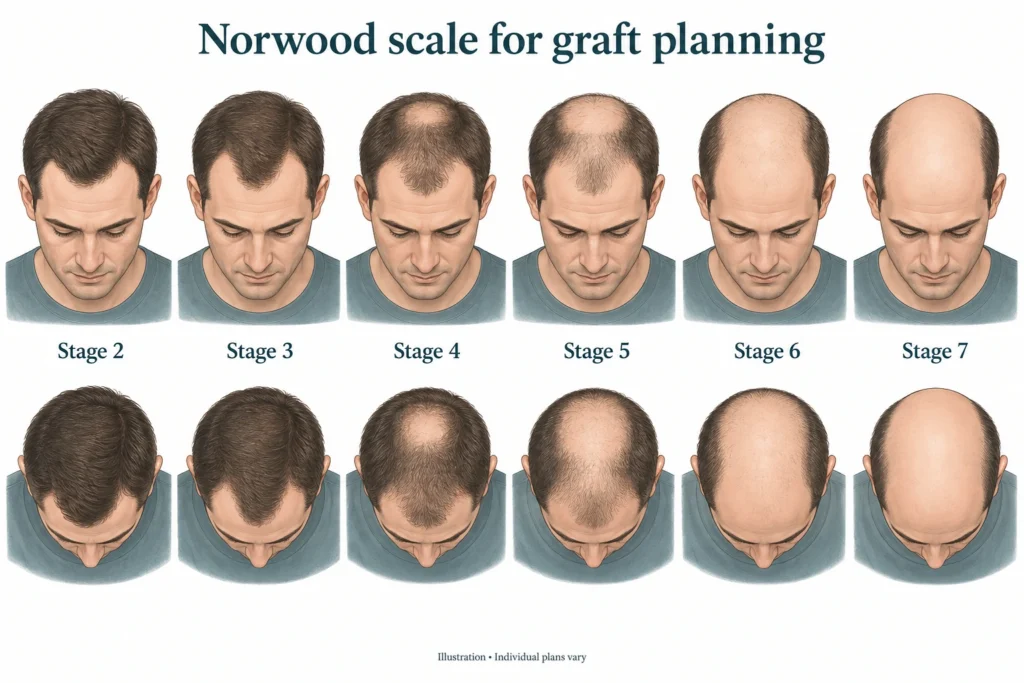
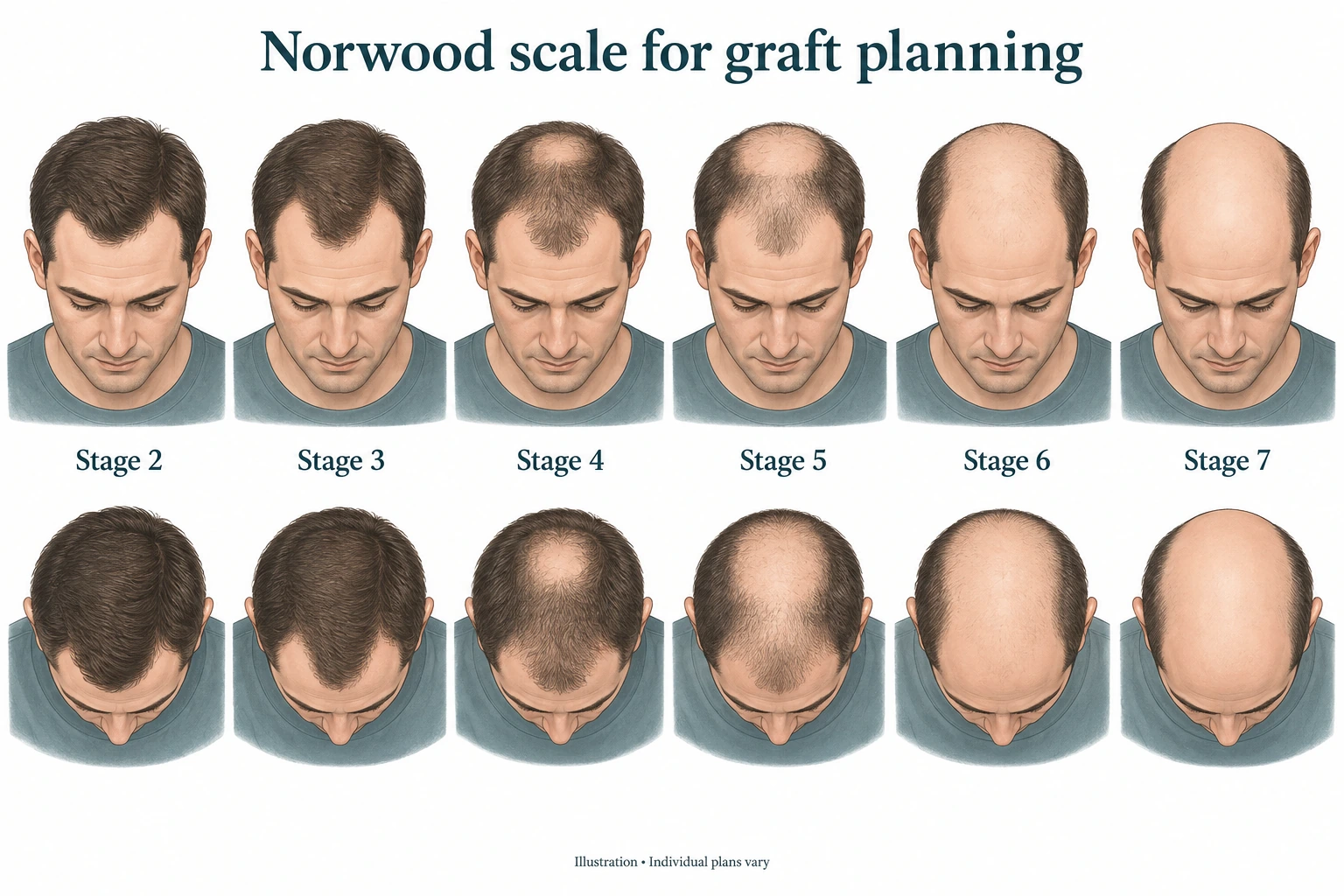
  • Graft number, driven by your Norwood stage, donor density and goals
  • Technique: classic FUE, sapphire FUE, DHI or a combination
  • Shaving option: unshaven or partial-shaven DHI takes longer
  • Hotel nights and extras, such as longer stays or companion arrangements

Quick graft estimate

Compare your hairline and crown with the chart, then choose the closest Norwood stage. Ranges are general guidance only; the medical team confirms your number after reviewing photos.

Tap the head that looks most like yours, or choose your Norwood stage below.

1,800–2,800 typical grafts · deeper temples, early hairline loss
Why Vivid Clinic

Why patients choose Vivid Clinic for a hair transplant in Istanbul

Meet our medical team
  • Accredited partner hospitals and clinics in Istanbul, with sterile operating environments
  • Procedures planned and supervised by licensed doctors
  • All-inclusive coordination of transfers, hotel and scheduling
  • Multilingual patient coordinators throughout your stay
  • 24/7 aftercare line and online follow-ups at key milestones
5.0 157 Google reviewsVivid Clinic Google Business Profile · checked September 2026 Read reviews

Your hair transplant team

The specialists who work on DHI and FUE cases, currently at Avrasya Hospital in Istanbul.

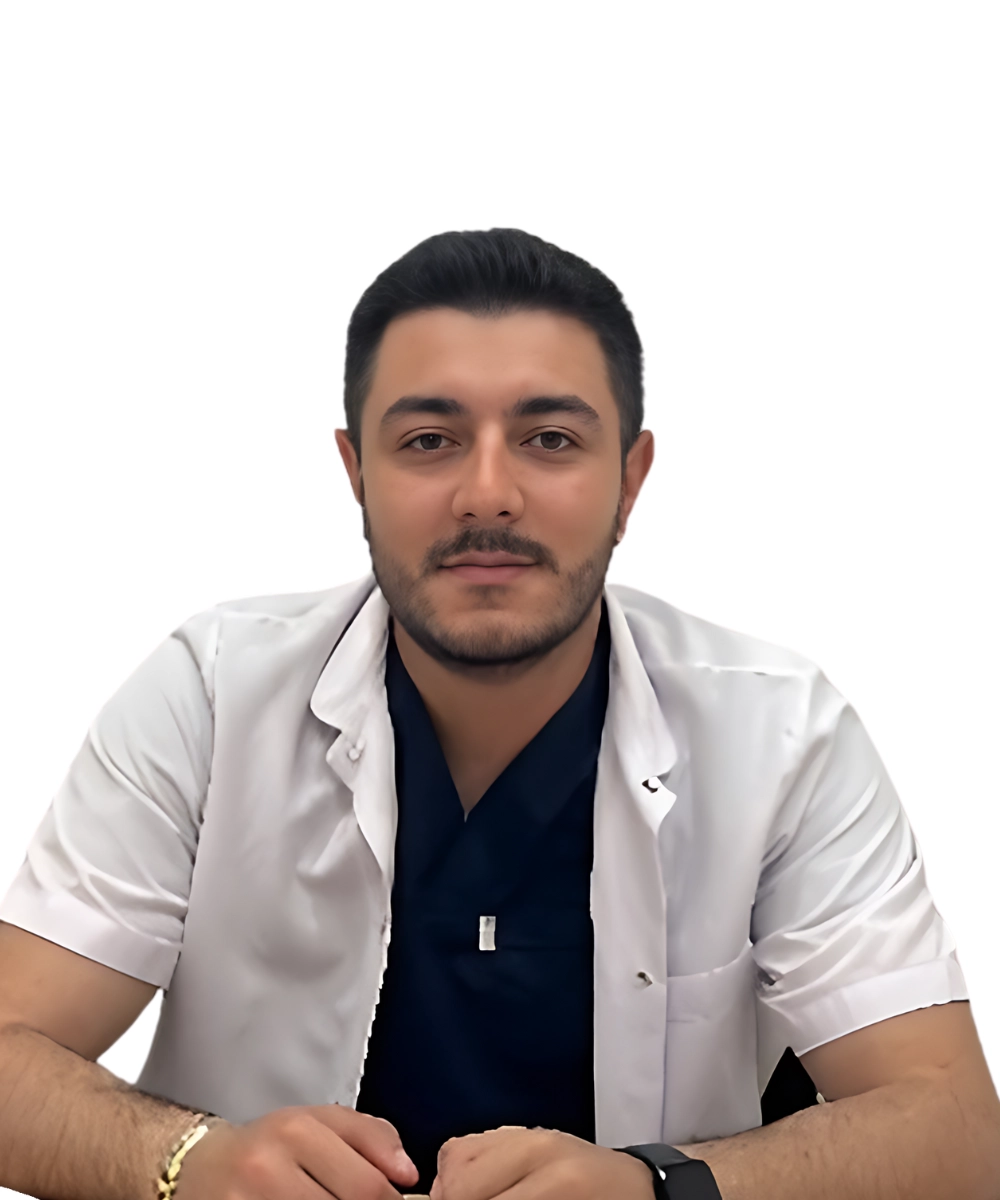
Portrait of Berat Salman, hair transplant specialist on the Vivid Clinic team

Berat Salman

Hair Transplant Specialist

  • In hair transplantation since 2015
  • FUE and DHI, including Afro hair
  • More than 2,500 operations, per his profile
View profile
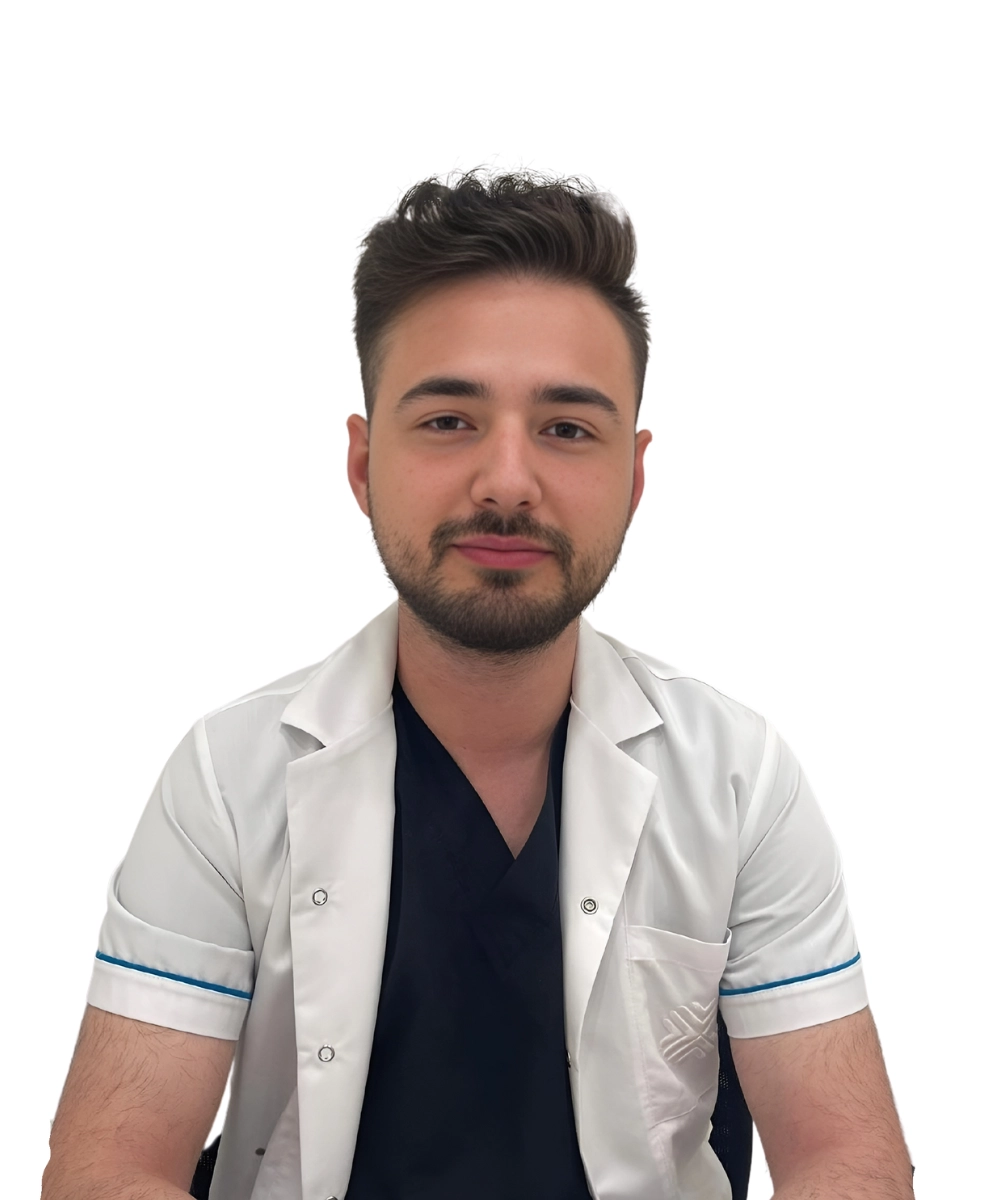
Portrait of Hasan Nur, hair transplant specialist on the Vivid Clinic team

Hasan Nur

Hair Transplant Specialist

  • In hair transplantation since 2018
  • FUE and DHI
  • Natural hairline design
View profile
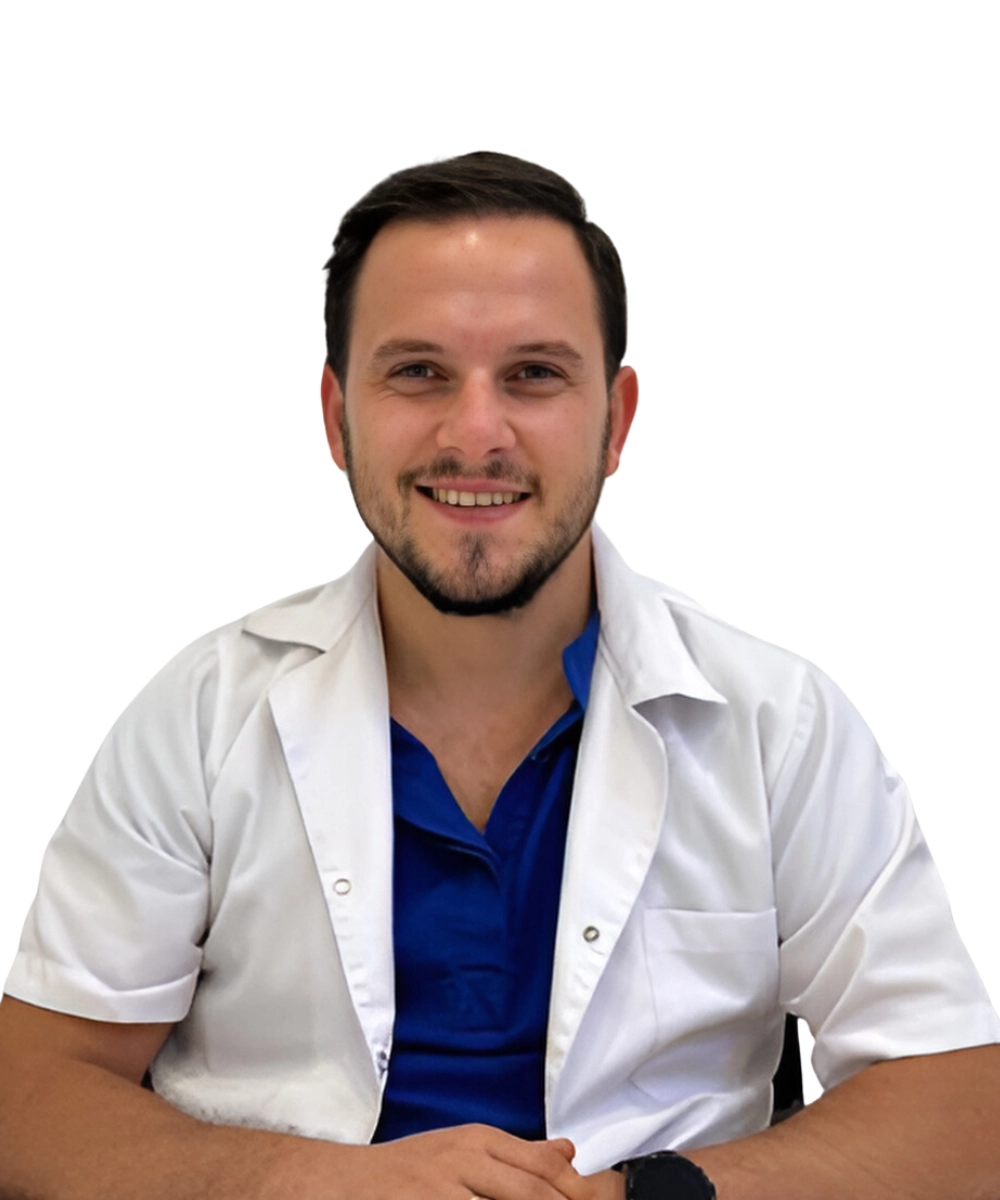
Portrait of Kadir Ban, hair transplant specialist on the Vivid Clinic team

Kadir Ban

Hair Transplant Specialist

  • In hair transplantation since 2013
  • FUE and DHI
  • Hairline design suited to your face
View profile
Safety

Risks of a hair transplant and how we reduce them

Hair transplantation is generally well tolerated, but it is still surgery.

Possible effects

  • Swelling and temporary numbness
  • Folliculitis (small spots) or infection
  • Temporary shock loss of existing hair
  • Visible donor thinning if too many grafts are taken
  • Patchy growth

How we reduce them

  • Limiting extraction to a safe proportion of your donor area
  • Keeping grafts cool and hydrated, with minimal time out of the scalp
  • Sterile, single-use consumables and medical-grade instruments
  • Reviewing your medical history and blood tests before any procedure
  • Clear written aftercare and follow-up at set milestones

The International Society of Hair Restoration Surgery publishes independent patient information on these risks. Meet the wider medical team on our doctors page.

FAQ

Frequently asked questions about hair transplant Istanbul trips

How many days should a hair transplant Istanbul trip take?

Three days is usually enough. Day 1 is arrival and hotel check-in, Day 2 is consultation, blood tests and surgery, and Day 3 is the check-up and first wash. Most patients fly home on Day 3, and the 24/7 support line and online follow-ups stay available afterwards. If you would like a longer rest before travelling, your coordinator can add hotel nights to your plan.

How many grafts will my hair transplant Istanbul plan need at Norwood 4?

Many people at Norwood 4 fall somewhere around 2,500–3,500 grafts. The real figure depends on donor density, hair calibre and how dense you want the front and crown. Send clear photos from the front, top, sides and back. The Vivid Clinic medical team then gives you a personal estimate before you travel. Your number is then confirmed in person before surgery.

Should I choose FUE or DHI for a hair transplant Istanbul trip?

The choice depends on the area and your priorities. FUE or sapphire FUE suits large sessions and the crown, while DHI gives fine control for hairlines and allows partial-shaven or unshaven options. Many plans combine both, for example sapphire FUE on the crown and DHI along the hairline. Your doctor recommends a technique after examining your scalp, rather than applying one method to everyone.

What does a hair transplant Istanbul package at Vivid Clinic include?

The Vivid Clinic package typically includes consultation, hairline design, blood tests, the procedure, medication and an aftercare kit. It also covers the first wash, hotel accommodation, VIP transfers and coordinator or interpreter support. The exact inclusions and hotel nights are confirmed in writing before you book, so you know what is covered and what is not. The photo assessment is free, with no obligation.

When can I go back to work after a hair transplant Istanbul trip?

Most people return to desk work five to seven days after surgery, once swelling settles. Redness and small crusts can remain visible for about 10–14 days, so some patients plan two weeks off if appearance matters for their job. Physical or dusty work may need a longer break; your doctor will advise you individually. The gym usually waits about two weeks, and swimming about four.

Can women have a hair transplant Istanbul procedure?

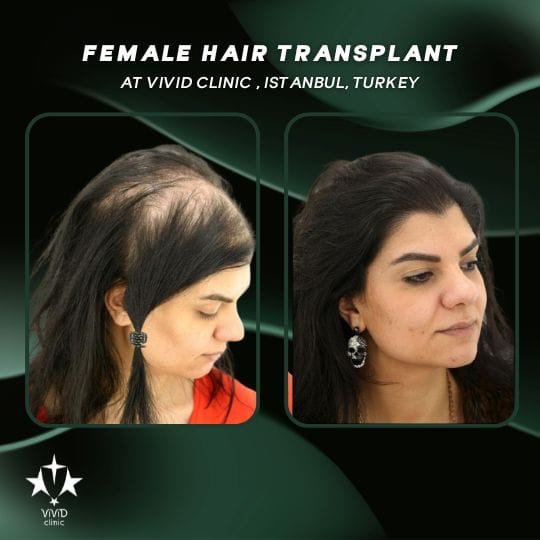
Yes, when the pattern and donor area are suitable. Women often need a diagnosis of the cause of thinning first, because problems such as thyroid disease, low iron or alopecia areata are treated differently. Many women are suited to unshaven techniques such as DHI. Our female hair transplant page explains the planning in more detail, and the medical team reviews your photos before recommending surgery.

When will I see the final result of a hair transplant Istanbul procedure?

Transplanted hairs usually shed between weeks 2 and 8, which is expected; the follicles stay in place. New, fine hairs start to appear around months 3–4, and density improves noticeably by months 6–9. The final result takes 12–18 months, and the crown often matures last. Online follow-ups at key milestones let the medical team track your progress after you return home.

Free assessment

Plan your hair transplant in Istanbul

Send a few clear photos of your hair from the front, top, sides and back. It is free and there is no obligation.

  1. Share your details and photosHere, or by WhatsApp on +90 545 742 3565.
  2. Medical review within 24 hoursA suggested technique, your estimated graft range and a personalised 3-day plan.
  3. Your personalised Istanbul planDates, hotel, transfers and your coordinator’s contact.

Get my free hair transplant plan

Free · No obligation · Reply within 24 h

Vivid Clinic — Consultation Request
This site is protected by reCAPTCHA and the Google Privacy Policy and Terms of Service apply.
Hair restoration in Istanbul

Hair Transplant Clinic Istanbul FUE, DHI, female and beard transplants in 3 days

Vivid Clinic plans FUE, DHI, female and beard transplants in Istanbul. Your own follicles move from the back of the scalp to thinning areas under local anaesthesia. Most trips take 3 days, and most people return to desk work within a week.

  • 3 days in Istanbul
  • No stitches, same-day hotel
  • Free medical review within 24 hours

Free medical review within 24 hours · No obligation · ★ 5.0 from 157 Google reviews

Editorially reviewed by the Vivid Clinic Surgical Board · Last reviewed September 2026

Gloved hands drawing a planned hairline and grid with a marker on the scalp of a balding man
Before and after a DHI hair transplant at Vivid Clinic Istanbul, showing a restored frontal hairline
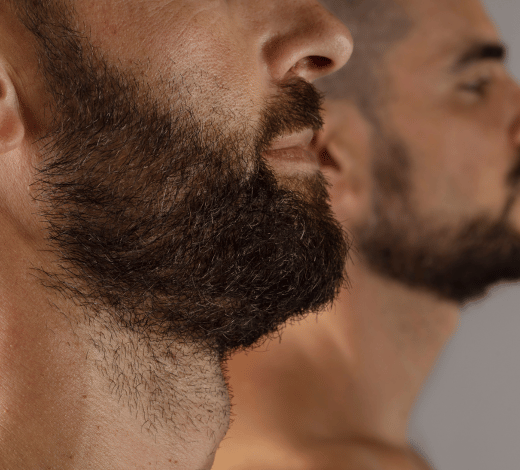
Close-up side profile of two men with full, dark beards along the cheeks and jawline
5 procedures

Find the right procedure

Choose what matters most to you, and we highlight the pages that fit.

Showing all 5 procedures

01

Hair Transplant Istanbul

Your own follicles moved from the back of the scalp to thinning areas, with FUE, DHI or sapphire FUE in a 3-day trip.

Stay in Istanbul
3 days
Procedure time
6–8 h
Back to desk work
5–7 days
Full guide
02

FUE Hair Transplant

Follicles taken one at a time and placed into tiny channels. Classic or sapphire FUE, with no linear scar.

Stay in Istanbul
3 days
Procedure time
6–8 h
Back to desk work
5–7 days
Full guide
03

DHI Hair Transplant

Each graft placed with a Choi implanter pen for hairlines and density, with partial-shaven or unshaven options.

Stay in Istanbul
3 days
Procedure time
6–9 h
Back to desk work
5–7 days
Full guide
04

Female Hair Transplant

Diagnosis first, then follicles moved to a thinning parting, temples or hairline, often without shaving.

Stay in Istanbul
3 days
Procedure time
5–8 h
Back to desk work
3–7 days
Full guide
05

Beard Transplant

Single follicles, usually from the back of the scalp, placed into a patchy beard, moustache or sideburns.

Stay in Istanbul
3 days
Procedure time
4–7 h
Back to desk work
5–7 days
Full guide
Overview

Four ways to restore hair, one medical team

Vivid Clinic is a hair transplant clinic Istanbul patients can plan with from home. You send photos, our medical team reviews your hair-loss pattern and donor area, and you receive a suggested technique and graft range. Most trips take 3 days, with no hospital stay.

The main options are FUE hair transplant and DHI hair transplant. With FUE, follicles are extracted one at a time and placed into tiny channels. With DHI, each graft is placed with a Choi implanter pen. FUE, including sapphire FUE, suits large areas and the crown. DHI suits hairlines, temples and density between existing hair, often without shaving your head.

Neither technique is automatically better. The right choice depends on your donor area, hair-loss pattern, scalp and density goals, and many plans combine both. For women, a female hair transplant starts with a diagnosis of the cause, because only stable, localised thinning suits surgery. A beard transplant uses the same extraction method with smaller grafts and flatter angles.

Results build slowly. New growth usually starts around months 3–4, and the final result takes 12–18 months for the scalp. Read how the whole trip works in our hair transplant Istanbul guide.

Side by side

Compare hair transplant options at a glance

Typical timings for each option, taken from its own page.

ProcedureProcedure timeAnaesthesiaStay in IstanbulBack to desk workFinal result
Hair Transplant Istanbul6–8 hLocal, light sedation if advised3 days5–7 days12–18 months
FUE Hair Transplant6–8 hLocal, light sedation if advised3 days5–7 days12–18 months
DHI Hair Transplant6–9 hLocal, light sedation if advised3 days (unshaven may need 1 more)5–7 days12–18 months
Female Hair Transplant5–8 hLocal, light sedation if advised3 days3–7 days12–18 months
Beard Transplant4–7 hLocal3 days5–7 days9–12 months

Typical ranges from each procedure page; your doctor confirms your plan.

Choosing

Which hair transplant fits your goal?

A quick guide to what each technique suits.

  1. You want a sharper hairline or fuller temples

    DHI is the precision choice for hairlines, temples and density between existing hair. It usually suits Norwood stages 2–4 with a healthy donor area.

  2. You have a large bald area or a thin crown

    FUE or sapphire FUE opens the channels first and can move more grafts in a day. Many larger plans combine FUE for the crown with DHI at the front.

  3. You would rather not shave your head

    Unshaven or partial-shaven DHI keeps your length. It suits smaller areas, and an unshaven session can need one extra day in Istanbul.

  4. You are a woman with a widening parting or thinning temples

    A female hair transplant can help when thinning is diagnosed, stable and localised. Diffuse thinning that also affects the donor area usually needs medical treatment instead.

  5. Your beard is patchy or has scars

    A beard transplant places single hairs at a very flat angle. If you also want scalp work, your doctor balances the donor supply between the two.

Real patient results

Hair transplant before and after

Results from Vivid Clinic patients, shared with consent. Individual results vary. 6 cases shown; each caption states what the photos show and what is not recorded.

See the full gallery
  • Hair transplant · Case VC-24327
    • Left: before · Right: after
    • View: front
    • Follow-up interval: not recorded

    Before: Extensively receded hairline (Norwood-type recession). After: Lowered, denser hairline.

    Vivid Clinic patient, shared with consent. Individual results vary; this is one case, not a promise of your outcome.

  • Hair transplant · Case VC-24345
    • Left: before · Right: after
    • View: front, head bowed
    • Follow-up interval: not recorded

    Before: Receded hairline and thin frontal zone. After: Denser, lowered hairline.

    Vivid Clinic patient, shared with consent. Individual results vary; this is one case, not a promise of your outcome.

  • Hair transplant · Case VC-24316
    • Left: before · Right: after
    • View: front (eyes masked)
    • Follow-up interval: not recorded

    Before: Receded temples and thin frontal hair. After: Fuller frontal hairline.

    Vivid Clinic patient, shared with consent. Individual results vary; this is one case, not a promise of your outcome.

  • Hair transplant · Case VC-24312
    • Left: before · Right: after
    • View: top of head, head bowed
    • Follow-up interval: not recorded

    Before: Receded hairline with pre-op hairline marking. After: Restored hairline and frontal density.

    Vivid Clinic patient, shared with consent. Individual results vary; this is one case, not a promise of your outcome.

  • Hair transplant · Case VC-24313
    • Left: before · Right: after
    • View: front (eyes masked)
    • Follow-up interval: not recorded

    Before: Extensive baldness. After: Full, grey-toned coverage.

    Vivid Clinic patient, shared with consent. Individual results vary; this is one case, not a promise of your outcome.

  • Hair transplant · Case VC-24307
    • Left: before · Right: after
    • View: top of head
    • Follow-up interval: not recorded

    Before: Advanced frontal and crown thinning. After: Dense curly coverage over the frontal and crown zones.

    Vivid Clinic patient, shared with consent. Individual results vary; this is one case, not a promise of your outcome.

Photos are unedited clinic composites; before and after photos may differ in lighting, clothing and pose. Consent is on file at the clinic.

How it works

Your Istanbul journey

Most hair transplant trips take 3 days, fully coordinated.

  1. Free medical review

    Send clear photos of your hairline, top, crown and donor area. Our medical team replies within 24 hours, free and with no obligation.

  2. Your plan and quote

    You receive a suggested technique, shaving option and graft range, then a personal quote and 3-day plan.

  3. Arrival and transfer

    Your patient coordinator meets you at Istanbul airport, and a VIP transfer takes you to your hotel with your schedule.

  4. Consultation and tests

    Meet the doctor, agree your hairline and graft plan, and have routine blood tests. An interpreter or coordinator stays with you.

  5. Procedure day

    The procedure takes most of the day under local anaesthesia. There are no stitches, and you return to your hotel that evening.

  6. First wash and flight home

    The team checks the grafts and carries out the first wash. Most patients fly home the same day, with a 24/7 aftercare line.

What your package usually includes

  • Consultation and blood tests
  • The procedure under local anaesthesia
  • Medication and aftercare kit
  • First wash at the clinic
  • Hotel accommodation
  • VIP airport and clinic transfers
  • Multilingual patient coordinator
  • 24/7 aftercare line and online follow-ups

Your written quote lists exactly what is included. We do not publish prices before a medical review.

Why Vivid Clinic

Why patients choose Vivid Clinic for hair restoration

Meet our medical team
  • Procedures in licensed, accredited partner facilities in Istanbul
  • Planning and supervision by a qualified medical team
  • A diagnosis-first approach, with honest advice when surgery is not suitable
  • Full, partial-shaven and unshaven options discussed openly
  • 24/7 aftercare line and scheduled online follow-ups
5.0 157 Google reviewsVivid Clinic Google Business Profile · checked September 2026 Read reviews

Your hair transplant team

The hair transplant specialists on the Vivid Clinic team, currently at Avrasya Hospital in Istanbul.

Portrait of Berat Salman, hair transplant specialist on the Vivid Clinic team

Berat Salman

Hair Transplant Specialist

  • In hair transplantation since 2015
  • FUE and DHI, including Afro hair
  • More than 2,500 operations, per his profile
View profile
Portrait of Hasan Nur, hair transplant specialist on the Vivid Clinic team

Hasan Nur

Hair Transplant Specialist

  • In hair transplantation since 2018
  • FUE and DHI
  • Natural hairline design
View profile
Portrait of Kadir Ban, hair transplant specialist on the Vivid Clinic team

Kadir Ban

Hair Transplant Specialist

  • In hair transplantation since 2013
  • FUE and DHI
  • Hairline design suited to your face
View profile
FAQ

Hair transplant questions, answered

Should I choose FUE or DHI?

Both extract grafts one at a time from the donor area. FUE opens channels first and suits large areas and the crown, usually with a full shave. DHI places each graft with a Choi pen and suits hairlines, temples and density between existing hair, with unshaven options. Recovery is similar. Many plans combine both, and your doctor recommends a technique after reviewing your photos.

What should I check before booking a hair transplant clinic Istanbul trip?

Ask who plans and supervises your procedure, and where it takes place. Check what the package includes, such as blood tests, medication, the first wash, hotel and transfers. A careful team diagnoses the cause of hair loss first and gives an honest graft estimate. It should also explain aftercare once you are home. Our free review answers these questions before you travel.

How long do I need to stay in Istanbul?

Plan 3 days for most hair transplants. Day 1 is arrival and hotel check-in. Day 2 is the consultation, blood tests and procedure, and you return to your hotel that evening. On day 3 the team checks the grafts and carries out the first wash, and most patients fly home the same day. An unshaven DHI session can need one extra day.

Can I combine a beard transplant with a scalp hair transplant?

Sometimes, yes. Both use grafts from the back of the scalp, so the deciding factor is your donor supply. Beard work usually needs fewer, smaller grafts placed at a flatter angle. If you want both, your doctor balances the grafts between the two areas and tells you whether one trip is realistic. See our beard transplant page for timings.

Is a hair transplant suitable for women?

It can be, when the cause of thinning is diagnosed and the loss is stable and localised. Good examples are a widening parting, temple recession, a high hairline or stable traction alopecia. Diffuse thinning that also affects the donor area usually is not suitable. Blood tests come first, and many women keep their length. See our female hair transplant page.

Am I too young for a hair transplant?

Age matters less than how stable your hair loss is. If you are in your early twenties and still losing hair quickly, it is often better to wait. The cause of thinning should be diagnosed first, for example thyroid problems, low iron or alopecia areata. Your doctor may also discuss finasteride or minoxidil to protect your existing hair.

When will I see the final result?

Redness and crusts usually clear within 10–14 days. Shedding of the transplanted hairs between weeks 2 and 8 is normal. New growth starts around months 3–4, and density improves by months 6–9. The final scalp result takes 12–18 months, and the crown often matures last. Beard transplants usually settle sooner, at around 9–12 months. Transplanted follicles usually keep growing long term.

How does the free medical review work?

Send clear photos of your hairline, top, crown and donor area through the form or WhatsApp. Our medical team replies within 24 hours with a suggested technique, shaving option and graft range. You then receive a personal quote and a 3-day plan. The review is free, and there is no obligation to book. If surgery is not the right step yet, we tell you.

Free assessment

Plan your hair transplant in Istanbul

Send a few clear photos of your hairline, top, crown and donor area. It is free and there is no obligation.

  1. Share your details and photosHere, or by WhatsApp on +90 545 742 3565.
  2. Medical review within 24 hoursRecommended technique, shaving option and graft range.
  3. Your personalised Istanbul planDates, hotel, transfers and your coordinator’s contact.

Get my free graft plan

Free · No obligation · Reply within 24 h

Vivid Clinic — Consultation Request
This site is protected by reCAPTCHA and the Google Privacy Policy and Terms of Service apply.