
 ChatGPT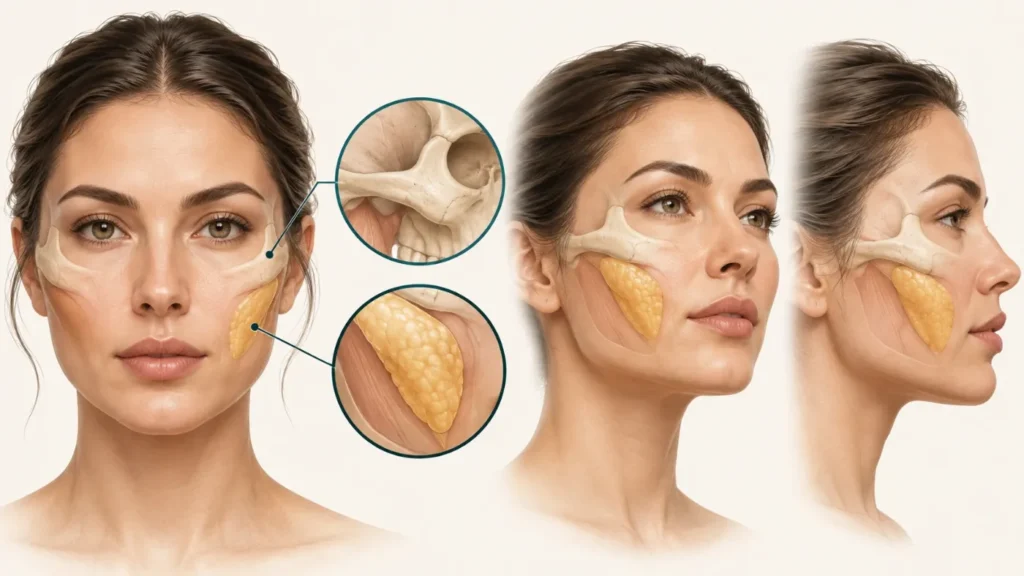
Quick answer: High cheekbones usually reflect where the cheekbone sits and how much soft tissue lies over it. Many features look more prominent with lighting, weight, or age, so a single photo rarely settles the question. At Vivid Clinic in Istanbul, Turkey, a free consultation with a plastic surgeon can help you understand what shapes your face.
Editorially reviewed by the Vivid Clinic Surgical Board. Last updated: October 2026.
If you have ever stood in front of a mirror and wondered why your cheeks look the way they do, you are far from alone. Cheekbones are one of the features people notice most in a face, and they shape how we read expression, symmetry, and youthfulness. Yet the words we use to describe them, such as “high” or “low,” are often vague. This guide explains what those terms mean, how to tell structure from softness, and when treatment is worth discussing. It is educational rather than diagnostic, and it treats every face as a range of normal variation.
What High and Low Cheekbones Describe
When people talk about high cheekbones, they usually mean that the highest point of the cheek sits closer to the lower eyelid and the outer corner of the eye, creating a lifted look. Low cheekbones tend to appear when that point sits lower, nearer the line between the nose and mouth. Neither position is better. They are simply different proportions, and most faces fall somewhere along a continuum rather than into two neat boxes.
The cheekbone itself is the zygomatic bone, a paired facial bone that forms the prominence of the cheek and part of the outer wall of the eye socket. GetBodySmart’s anatomy reference describes the zygomatic bones as bones that “form the cheeks and the lateral walls of the orbits.” Their shape and projection are set largely by genetics and by bone growth during adolescence, so two people can have similar bone structure and still look very different because of the soft tissue on top.
Bone Position Versus Fullness and Shadows
Two things can make high cheekbones appear, and they are easy to confuse: where the bone sits, and how full the soft tissue is above and around it. Bone position is a structural feature. Fullness is a soft-tissue feature that changes with fat, muscle tone, hydration, and fluid. A cheek can look lifted because of fullness that sits on a lower bone, or look flat even when the bone is prominent but covered by a thin layer of tissue.
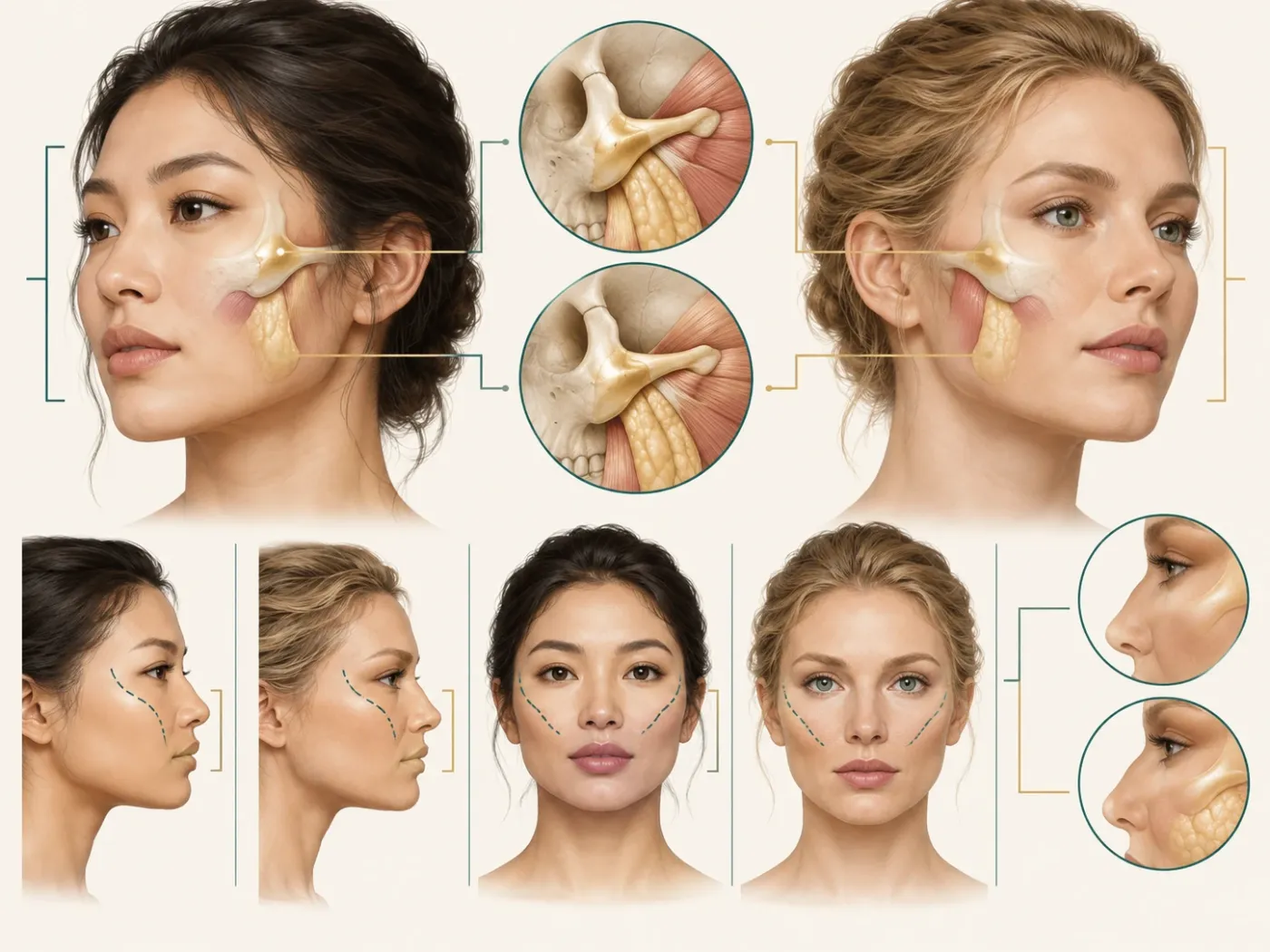
Shadows matter as well. A pronounced cheek casts a shadow beneath it, and that shadow creates a visual line that reads as a cheekbone edge. Under overhead light the line can disappear; under side light it can look dramatic. This is why a consultation often includes photographs taken under consistent, neutral lighting, and why patients are encouraged to bring several images from different angles rather than relying on one snapshot.
A Non-Diagnostic Observation Guide
If you want to think through your own features, the following observations can help you organize your thoughts before a consultation. They are not a diagnosis and cannot replace an in-person assessment by a qualified clinician. Use them to notice patterns, then bring your questions to the team.
- Look at a relaxed, front-facing photo in natural daylight, and note where the cheek’s highest point sits relative to your lower eyelid and the outer corner of your eye.
- Take a side-profile photo and observe whether the cheek projects forward, sits flat, or sits behind the line of the nose.
- Compare photos taken under overhead light and side light, and note how much the cheek edge changes.
- Notice whether the hollow beneath the cheek is shallow or deep, and whether it changes when you smile or relax.
- Consider how your weight has changed over time, since fullness shifts the appearance of the mid-face.
How Lighting, Weight, and Ageing Change the Look
Lighting is the most common reason people believe their high cheekbones have changed. A cheek photographed under a single bright lamp can look sculpted, while the same face in flat indoor light can look soft. Makeup, contouring, and the angle of the head add to the effect. None of these changes reflect a change in bone structure, which is why they can be so confusing.
Cheek Enhancement Versus Buccal Fat Reduction
Patients researching high cheekbones often encounter two very different procedures, and they should not be treated as interchangeable. Buccal fat removal, sometimes called bichectomy, removes a naturally occurring pad of fat in the cheek hollow. The American Society of Plastic Surgeons describes its goal as thinning the cheeks, especially the cheek hollows, and its procedure page focuses on that fat pad. It is not a way to raise the cheekbone itself.
Cheek augmentation has a different aim. According to the American Society of Plastic Surgeons, “the goal of cheek augmentation is to add volume or lift to the cheeks.” The society describes two surgical options, fat grafting using a patient’s own fat and solid cheek implants, and notes that injectable fillers are a nonsurgical alternative. Cheek augmentation is not listed among the facial procedures on Vivid Clinic’s face aesthetics page, so any discussion of it would be confirmed directly with the team.
The distinction matters for expectations. Removing cheek fat can make the contour look more defined in some faces, but it can also make a face look thinner or older if it is not suited to the individual. Adding volume can soften a hollow, but it cannot change the position of the bone. A consultation should clarify which concern you are trying to address, because the right approach depends on that answer.
High Cheekbones: Candidacy and Reasons to Defer Treatment
There is no single profile that makes someone a candidate for any cheek procedure. For high cheekbones, the key questions are functional and personal: what is bothering you, how long it has been a concern, and whether your expectations are realistic. Some people are better served by waiting, by adjusting lighting and grooming habits, or by addressing a different feature entirely. For broader context on how surgeons balance the whole face, see this guide to facial balancing in Turkey.
The ASPS notes that buccal fat removal is typically not performed on people with thin, narrow faces, because removing the fat may cause the face to look more gaunt with age. It also notes that fat pad size varies between individuals and that the two cheeks may differ. These points show why a face should be evaluated as a whole rather than judged by one feature.
Reasons to defer treatment can include an unsettled weight, recent significant changes in your face, a medical history that needs review first, or a concern driven mainly by one photograph or by comparison with someone else. Your surgeon will discuss whether any of these apply to you. This article cannot determine your eligibility.
Cheekbone Enhancement Overview: Realistic Expectations
Because this is an anatomy guide, the table below is optional. It gives a general overview of the relevant treatments for people researching cheek shape. It is not a recovery table for a natural feature, and no timing in it should be read as a promise. The sources reviewed for this article did not publish fixed numeric ranges for these rows, so each entry states what the source says and where your clinician will confirm details.
Optional overview of relevant treatments, not a recovery table for a natural feature.
| Aspect | Details |
|---|---|
| Duration Process | Varies by technique and by any combined work. The ASPS buccal fat removal page does not state a fixed duration, so the treating surgeon confirms an estimate for your plan. |
| Hospitalization Duration | Depends on the option and on admission needs, which the treating clinician reviews. The sources reviewed do not set a standard length of stay for either buccal fat removal or cheek augmentation. |
| Mobility Duration | Walking and light movement guidance is individual. The sources reviewed do not state a timeframe, so it is confirmed after your assessment. |
| Return to Activity | Desk work, exercise, and travel are cleared separately. The ASPS lists “When can I resume normal activity and exercise?” as a question to raise with your surgeon. |
| Complete Recovery | Surface healing and longer tissue settling are different stages. The ASPS buccal fat removal recovery page states, “Healing will continue for several weeks as swelling decreases.” |
| Anticipated Results | Results are judged after swelling has settled, and the timing is confirmed by your surgeon. Outcomes vary by anatomy and healing, and no result is guaranteed. |
How to Prepare for a Cheekbone Enhancement Consultation
Preparation begins with honesty about your history. Your surgeon will ask about past surgeries, dental or jaw concerns, bleeding tendencies, allergies, and every medication and supplement you take, including those that affect bleeding. Functional concerns matter too. If you have difficulty chewing, jaw pain, or dental issues, these should be assessed before any cheek work is considered.
Cheekbone Enhancement Recovery and When to Judge Results
Early effects after facial surgery typically include swelling and bruising, which are part of the normal healing process. The ASPS buccal fat removal recovery page notes that healing continues for several weeks as swelling decreases, and that patients may be asked to follow a liquid diet for several days or longer. Your surgeon will decide which instructions apply to you.
It helps to separate early effects from the final picture. The face often looks different in the first days, and the cheek contour may change as tissues settle. Judging results too early can lead to unnecessary worry. Your clinician will tell you when it is appropriate to assess the outcome, because that depends on your individual healing.
Cheekbone Enhancement Risks, Limitations and Medical Red Flags
Facial surgery is not simple or risk-free, and it should never be described that way. The ASPS buccal fat removal safety page lists possible risks that include anesthesia-related problems, bleeding, hematoma and fluid buildup, infection and poor incision healing, blood clots, salivary duct injury, facial nerve injury, numbness or sensation changes, ongoing pain, prolonged swelling, uneven or less than ideal results, and the possible need for revision surgery. The page states that this list is not complete.
Some of these risks need particular attention. The ASPS notes that facial nerve injury can cause temporary or permanent facial muscle weakness, which is one reason to ask a surgeon about their experience and how they manage complications. Results are also limited. A procedure can change soft tissue within the limits of your anatomy, and no clinic can guarantee a particular look.
What Affects the Cost of Cheekbone Enhancement in Istanbul
Costs for facial procedures vary widely, and this article does not provide a fixed price. Quotes depend on the surgeon’s experience, the facility, the type of anesthesia, the complexity of the plan, whether procedures are combined, accommodation and transfers if you travel, and the aftercare included. Comparing two quotes is only meaningful when they cover the same procedures and the same services.
When you compare care plans, ask what is included, what is excluded, and what happens if a revision is needed. Ask about the surgeon’s experience with the specific procedure you are considering, not only with facial surgery in general. A lower quote that omits key follow-up may cost more in the long run.
Cheekbone Enhancement in Istanbul: Your Patient Journey at Vivid Clinic
For readers who decide to explore care in Istanbul, the journey at Vivid Clinic is designed to be organized and unhurried, and eligibility is confirmed at consultation. Where a package includes it, your journey may begin with arrival in Istanbul and a VIP airport transfer, followed by check-in at a five-star hotel. Your one-on-one consultation with the clinical team would then assess your anatomy, medical history, and goals. If you decide to proceed, the surgery or treatment day would be planned around your individual needs, followed by post-operative care and a check-up visit before departure. Remote aftercare continues once you are home. Hotel and transfer benefits apply only to select procedures, so current inclusions are confirmed for your plan before you travel.
Choosing a Qualified Surgeon for Cheekbone Enhancement
A thoughtful decision about high cheekbones depends on a clinician who looks at your whole face. Vivid Clinic’s doctors page describes a team of specialists working under one surgical board in Istanbul. Before you commit to any plan, review each surgeon’s credentials, ask about their experience with the specific procedure, and confirm their qualifications through the official registry in your country. You can meet the Vivid Clinic medical team before you book.
Your free consultation with a plastic surgeon at Vivid Clinic is an opportunity to ask questions, not a commitment to treatment. You can bring your photographs, your medical history, and your list of goals. The team can explain what is possible, what is not, and whether waiting or choosing a different approach might serve you better.
Frequently Asked Questions About High Cheekbones
Do High Cheekbones Always Look More Prominent?
No. Whether high cheekbones look prominent depends on several factors at once, including bone position, the amount of soft tissue over the cheek, lighting, weight, and the angle of the photograph. A cheek that looks dramatic under side light may appear softer in flat daylight. Two people with similar bone structure can look very different because of fullness and shadows. If high cheekbones are your concern, a clinician can evaluate the whole mid-face in consistent conditions and explain what is creating the look you see. Results and expectations are individual, and nothing in this answer replaces a personal medical assessment.
How Can I Distinguish High Cheekbones From Cheek Fullness?
Start by separating structure from softness. High cheekbones describe where the bone sits, while cheek fullness describes the soft tissue above and around it. One useful test is to compare photographs taken in flat light and side light, then notice whether the cheek edge stays visible. If the edge remains sharp, the bone may be the main influence. If it softens or disappears as tissue fullness changes, weight or fluid may be affecting the look. Because a single photo can mislead, a consultation is the most reliable way to tell whether your high cheekbones are mainly structural or mainly a matter of soft tissue.
Can Lighting Change the Appearance of High Cheekbones?
Yes, lighting can change the appearance of high cheekbones dramatically. Side light and low angles create shadows beneath the cheek, which make the edge look sharper. Overhead light can flatten the same face and make the cheekbone seem softer. Makeup, contouring, and head position add further variation. These changes do not alter bone structure, which is why a face can look high-boned in one picture and balanced in another. Your surgeon will evaluate high cheekbones under consistent conditions before discussing any options.
Does Buccal Fat Removal Create High Cheekbones?
No. Buccal fat removal targets a pad of fat in the cheek hollow and is intended to thin the cheek, not to raise the cheekbone or change the bone. Some people feel that removing this fat makes the contour look more defined beneath the bone, but it does not create high cheekbones in the structural sense. The American Society of Plastic Surgeons notes that the procedure is typically not performed on people with thin, narrow faces, because removing fat may make the face look more gaunt with age. If you are considering high cheekbones, ask a clinician which concern is actually present before discussing any procedure.
What Should I Discuss Before Seeking High Cheekbones Treatment?
Bring a clear account of what bothers you about your cheeks, why it matters, and what outcome you hope for. Share your full medical history, current medications and supplements, past facial or dental procedures, and any functional concerns such as chewing or jaw pain. Ask which options are realistic for your anatomy, what risks apply to you, what recovery will involve, and how results are assessed over time. Ask about cost factors, including aftercare. A consultation with a plastic surgeon at Vivid Clinic in Istanbul, Turkey, is a good place to have these conversations before any decision is made.
Sources and Further Reading on High Cheekbones
- American Society of Plastic Surgeons: Buccal Fat Removal
- American Society of Plastic Surgeons: Buccal Fat Removal Recovery
- American Society of Plastic Surgeons: Buccal Fat Removal Safety
- American Society of Plastic Surgeons: Cheek Augmentation
- GetBodySmart: Zygomatic Bone Anatomy
Related reading: Eye shapes chart
Deciding Whether to Enhance Your Cheekbones
If you are considering high cheekbones in Istanbul, Turkey, Vivid Clinic can help you understand your options with a personalized plan.
This article is for informational purposes only and does not replace a personal medical consultation. Suitability, risks, recovery, and expected results should always be discussed with a qualified medical professional.
Contact Vivid Clinic to request your Get a Free Consultation with a plastic surgeon, and take a thoughtful, unhurried step toward an informed personal choice.