
 ChatGPT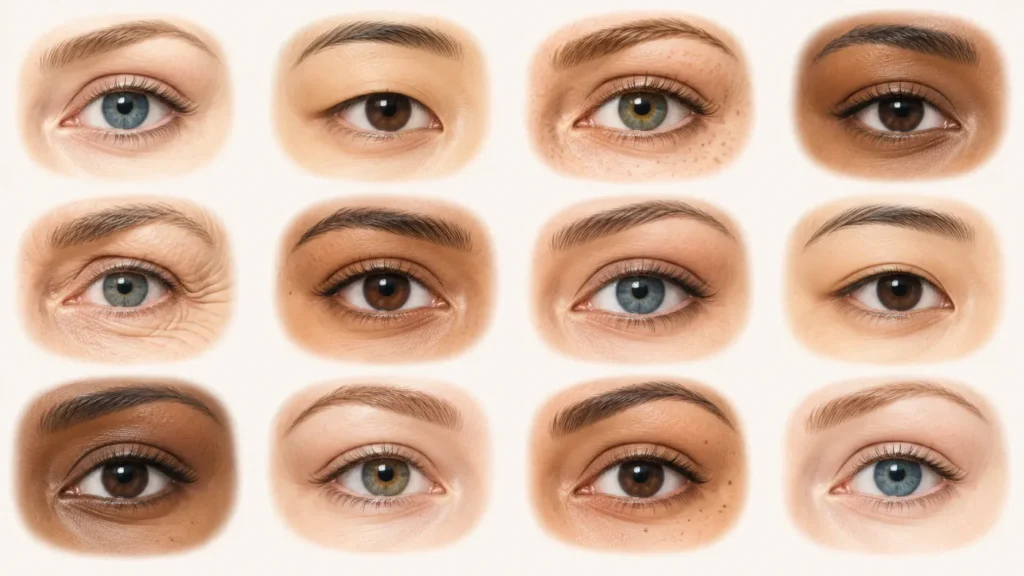
Quick answer: Eye shapes describe how eyes look, including the outline, eyelid crease, position in the socket and angle of the eye opening. These are overlapping descriptors, not medical diagnoses, and most people fall between labels. At Vivid Clinic in Istanbul, Turkey, a free consultation with a plastic surgeon helps you understand normal variation and options.
Editorially reviewed by the Vivid Clinic Surgical Board. Last updated: October 2026.
If you have ever looked in the mirror and wondered why your eyes look the way they do, you are in good company. Many people search for eye shapes because they want words for what they see: almond, round, deep-set, hooded or doe. Those labels can be useful for describing features, but they are not a ranking of beauty and they are not diagnoses. Your eyes are shaped by bone, fat, muscle, skin and the eyelid crease, and most of this is ordinary anatomy.
This guide from Vivid Clinic explains the common labels in plain language, shows how to observe your own eyes without treating the exercise as a test, and explains when a conversation with a plastic surgeon makes sense. Vivid Clinic is based in Istanbul, Turkey, and anyone curious about options can request a free consultation with a plastic surgeon. Treatment is always optional.
How to Inspect Your Eyes Without a Diagnostic Self-Test
Looking at your eyes is a natural thing to do, but a mirror is not a medical instrument. Self-observation helps you describe what you notice and bring specific questions to a clinician. It cannot tell you whether a feature is a problem, whether it affects vision or whether treatment would be suitable.
A simple approach is to look at your eyes in natural daylight, with a relaxed face and no heavy eye makeup. Note these points one at a time rather than comparing yourself to a filtered photo:
- The outline of the eye opening, which may look rounded, almond-shaped or angular.
- The visible crease above the upper lid, and whether it is clearly visible, partly visible or hidden.
- How deep the eye sits under the brow bone and how far it sits from the nose.
- The angle of the eye opening from the inner corner to the outer corner.
Photographs help you compare your own pictures over time, but lighting, camera angle, lens distortion and expression all change how eyes look. A selfie taken from slightly above or in dim light can make the same eye look entirely different. Repeat the observation on several days and treat the results as a starting point for conversation, not a conclusion.
Almond and Round Eyes: Describing the Shape of the Opening
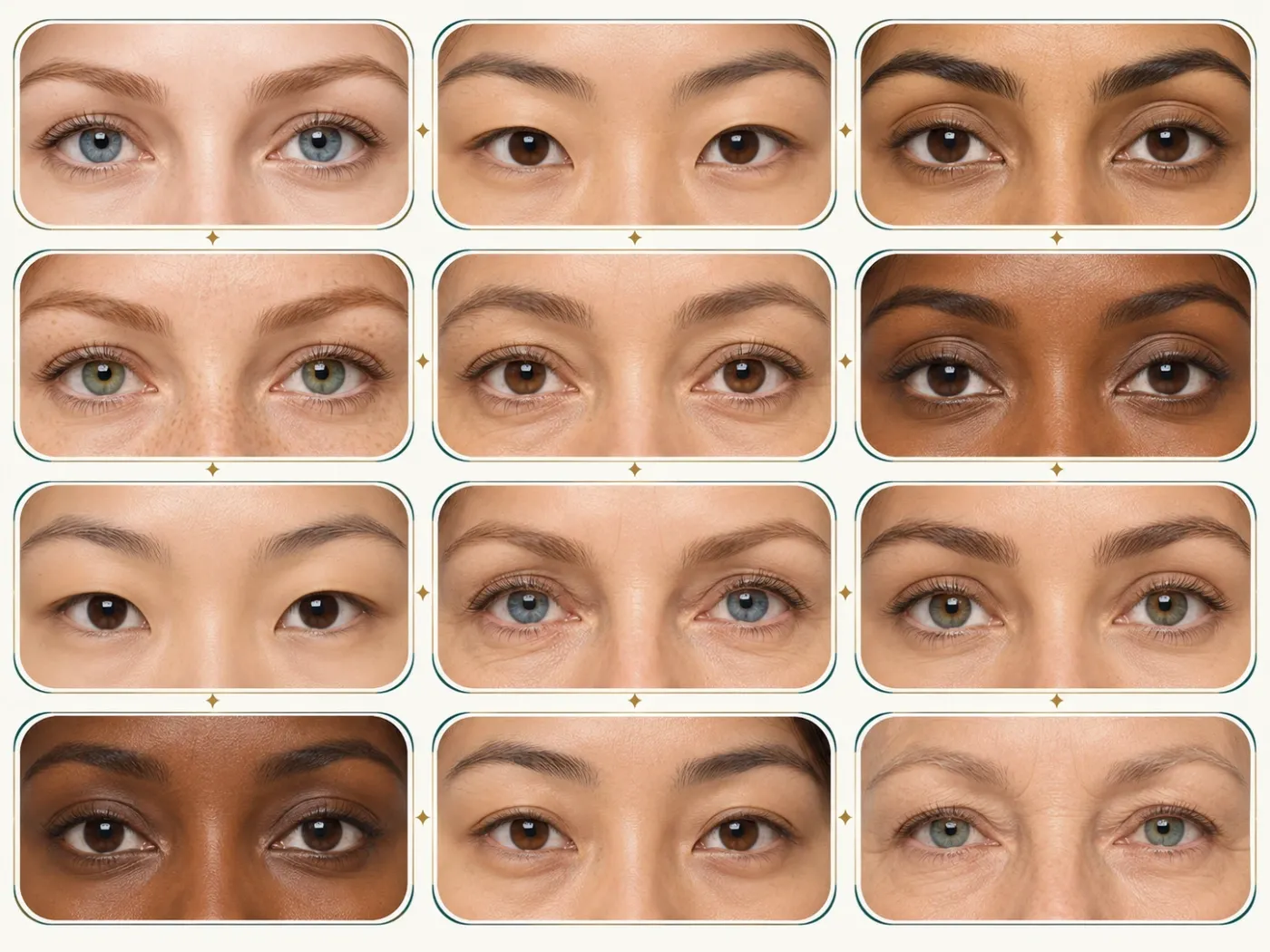
Almond eyes are a common descriptive label for an eye opening that is wider at the middle and narrower at both ends, with a gentle curve. Round eyes have a more circular opening, where height and width look more similar. Neither is a medical category. Both appear across all backgrounds, and each is a normal variation of human anatomy.
The shape of the opening is influenced by the bony orbit, the position of the eyelids and the amount of skin and soft tissue around them. Two people with almond-shaped eyes can therefore look quite different once lid thickness, lash line and brow position are taken into account. Labels describe appearance; they do not explain cause.
For example, someone who feels their eyes look smaller may have a heavier upper lid or a lower brow position rather than a different eye shape. This is one reason a consultation looks at the whole face rather than the eye alone.
Crease, Monolid and Hooded Eyes: Understanding Eyelid Folds
The eyelid crease is the fold that forms when the upper eyelid lifts. Some people have a clearly visible crease, some have a shallow or partly hidden one, and some have a fold of skin that covers much of the lid. Monolid describes an upper lid without a visible crease. Hooded describes an upper lid where extra skin folds over the crease or lash line. These labels are common in beauty and makeup contexts, and they often overlap.
Monolids are a normal anatomical variation found across many populations and are not a sign of a problem. Hooded lids can be associated with loose upper-lid skin that changes how the eyelids look. According to the American Society of Plastic Surgeons, sagging upper-lid skin can sometimes affect vision, so functional concerns are a reason to seek assessment, while a cosmetic preference alone is a separate question.
Makeup can change how a crease appears, but it does not change the underlying structure. Many people choose makeup or styling rather than any procedure, and that is a perfectly sound choice.
Position: Deep-Set, Prominent, Close-Set and Wide-Set Eyes
Position labels describe where the eyes sit in the face. Deep-set eyes appear to sit further back under the brow, which can create more shadow in the upper lid. Prominent eyes appear to stand forward, often with more visible eyeball and a fuller lower lid. Close-set eyes have a narrower distance between the inner corners, and wide-set eyes have a greater distance. Each label describes spacing or depth, and each is found across the full range of human faces.
Position is largely determined by the skull and facial bones, which develop over time and change with age. Soft tissue changes, including fat distribution and skin laxity, also affect how deep or full the eye appears. A position label is best understood as a description of structure, not something to fix by default.
In practice, a person who looks deep-set in photographs may find that much of the difference is shadow from the brow. Changing lighting or brow position can reduce the impression. A clinician will check whether a concern relates to bone, soft tissue or the eyelid itself before suggesting any approach.
Tilt and Trend Labels: Upturned, Downturned, Doe and Siren
Tilt describes the angle of the eye opening from the inner corner to the outer corner. An upturned tilt means the outer corner sits higher than the inner corner, and a downturned tilt means the outer corner sits lower. Many people have a neutral or slight tilt, and the difference is often small.
Doe eyes and siren eyes are not anatomical categories. They are beauty labels used in social media and makeup content. Doe eyes are commonly described as large, rounded eyes with a soft, gentle look. Siren eyes are commonly described as having an upward lift with a defined lid. Because these labels describe an impression, the same eye can be called doe by one person and almond by another.
Trend labels also change over time. A term that is popular in one period may feel dated in the next. Choosing an eye shape should not depend on keeping up with a trend.
Eye Shapes: Candidacy and Reasons to Defer Treatment
Eye shapes are overlapping descriptors, not separate medical types. A single eye can be almond-shaped, have a visible crease, sit slightly deep and show a mild upward tilt all at once. The labels help people talk about features, but they do not tell a clinician what to treat.
According to the American Society of Plastic Surgeons, eyelid surgery is generally considered for healthy people with no medical conditions that can impair healing, for nonsmokers, for people with a positive outlook and realistic goals, and for people without serious eye conditions. ASPS also notes that a drooping upper lid can result from loosening of the forehead skin and eyebrow rather than the eyelid itself, which is why the surgeon examines the whole face.
There are good reasons to defer any decision. You may simply prefer your eyes as they are. You may be going through a period of change such as a recent illness or a significant change in weight. You may be considering treatment mainly to match a trend or someone else’s opinion. A consultation is a useful place to slow down and examine those motives honestly.
Eye Shape Enhancement Overview: Realistic Expectations
Eye shape itself is normal anatomy, and normal anatomy has no procedure duration. The overview below covers eyelid surgery (blepharoplasty), the main treatment area people connect with the eye features described above.
Optional overview of relevant treatments, not a recovery table for a natural feature.
| Aspect | Details |
|---|---|
| Duration Process | Depends on which eyelids are treated (upper, lower or both) and on the technique chosen. Your surgeon gives an estimate at consultation. Source: ASPS, Eyelid Surgery. |
| Hospitalization Duration | Set by the clinician for each option, based on the procedures planned and your health. Not assumed in advance. Source: ASPS, Eyelid Surgery Safety. |
| Mobility Duration | Walking and light movement limits are individual and set by the treating team. This is separate from return to work. |
| Return to Activity | Desk work, exercise and travel are cleared separately. ASPS advises asking your surgeon when normal activity and exercise can resume. Source: ASPS, Eyelid Surgery Recovery. |
| Complete Recovery | Early swelling, bruising, irritation and dry eyes are followed by a longer settling period. ASPS advises sun protection until healing is fully complete. Source: ASPS, Eyelid Surgery Recovery. |
| Anticipated Results | Final appearance is judged after healing and settling. Timing and durability are individual, and results vary. Source: ASPS, Eyelid Surgery Recovery. |
These values are intentionally qualitative. Numeric timings differ with the eyelids treated, the technique, individual healing and the care setting, so your surgeon should give your own estimate. You can review the clinic’s eyelid information on the eyelid lift page, which is a useful starting point before a consultation.
How to Prepare for an Eye Shape Enhancement Consultation
Preparation begins with an honest medical history. Your surgeon will ask about existing medical conditions, medications and supplements, previous eye problems, dry eye, and any earlier eyelid or facial procedures. Smoking status matters, because ASPS lists nonsmokers among typical candidates for eyelid surgery.
Functional concerns deserve as much attention as appearance. If your upper lids affect your sight, if your eyes feel dry or if your lids feel heavy, say so clearly. These details help a clinician decide whether a concern is cosmetic, functional or both.
Bring a list of goals written in your own words. “I want my eyes to look less tired in photos” is more useful than “I want almond eyes.” A realistic goal is one a surgeon can discuss honestly. Please do not attempt self-diagnosis or unsupervised treatment based on any online guide, including this one. Related facial options are described in the Vivid Clinic face aesthetics section.
Eye Shape Enhancement Recovery and When to Judge Results
Recovery has two phases. Early effects such as swelling, bruising, irritation, dry eyes and discomfort are common after surgery. ASPS notes that they can be managed with medication, cold compresses and ointment, as your surgeon directs. Settling is the slower phase, when tissue softens and the final shape becomes clearer.
For this reason, the first appearance after surgery is not a reliable guide to the final result. Many people feel tempted to judge too early. Your treating clinician will advise when it is appropriate to assess the outcome, and that timing depends on your procedure and healing.
Aftercare usually includes protecting the eyes from sun and bright light. ASPS advises diligent sun protection and darkly tinted sunglasses until healing is fully complete. Clearance for desk work, exercise and travel should be individual, and your surgeon will explain each one.
Eye Shape Enhancement Risks, Limitations and Medical Red Flags
Eyelid surgery is a real operation, not a simple cosmetic step, and it is never risk-free. ASPS lists possible complications including bleeding at the incision lines, changes in skin sensation or numbness around the eyelashes, difficulty closing the eyes, dry eyes, ectropion (an outward rolling of the lower lid), infection, lid lag, persistent pain, sensitivity to sun or bright light, swelling and bruising, unfavorable scarring and the possible need for revision surgery.
ASPS also describes a temporary or even permanent change in vision and a very rare chance of blindness. This is one reason the consultation includes an eye health review. Any sudden change in vision after any procedure needs urgent medical attention.
Some concerns call for assessment before any cosmetic discussion. According to ASPS, a drooping upper lid caused by the eyelid muscle, known as eyelid ptosis, requires a different surgical treatment. People with serious eye conditions are not typical candidates for elective eyelid surgery. If you notice eye pain, sudden vision change or a lid that will not close, contact a doctor promptly rather than waiting for a scheduled visit.
What Affects the Cost of Eye Shape Enhancement in Istanbul
Cost depends on factors such as the surgeon’s experience, the facility and anesthesia used, the complexity of the plan, whether procedures are combined, travel and accommodation for patients coming from abroad, and the aftercare included. Two quotes can look similar on paper and still differ in what they include.
This article does not list a fixed price. Treat any figure you find online with caution unless it is dated, itemized and comparable. A consultation provides a personal estimate based on your plan. When comparing care plans, ask what each one includes, what happens if a revision is needed and who manages follow-up.
Eye Shape Enhancement in Istanbul: Your Patient Journey at Vivid Clinic
If you choose to explore a consultation with Vivid Clinic, your journey begins when you arrive in Istanbul, Turkey. Where the package includes a VIP airport transfer, you are collected and taken to your hotel, and where a five-star hotel stay is included for your plan, you check in before your appointment. Eligibility for transfer and hotel benefits is confirmed at consultation, because these benefits apply only to select procedures. Your one-on-one consultation with the medical team reviews your anatomy, medical history, goals and expectations, and it is the point where a suitable plan is agreed or where you may be advised not to proceed. On the surgery or treatment day, the team follows the plan you agreed together. Post-operative care follows, with a check-up visit before you depart for home. Remote aftercare then continues, so questions about healing can still be answered by the clinic team.
Choosing a Qualified Surgeon for Eye Shape Enhancement
At Vivid Clinic, your treatment plan is created after a one-on-one consultation with the medical team, not from a photo alone. Your surgeon evaluates your anatomy, goals, medical history and expectations before recommending any approach. The clinic’s medical team page lists the doctors and their specialties so you can review backgrounds before you decide.
Whichever clinic you consider, verify credentials independently. Check board certification in plastic surgery, ask about training and experience, and ask how often the team performs the procedure you are considering. A consultation with a plastic surgeon is the right place for these questions. You can request a free consultation with a plastic surgeon at Vivid Clinic in Istanbul, Turkey, to talk through your options with the team.
Frequently Asked Questions About Eye Shapes
Can eye shapes belong to more than one category?
Yes. Eye shapes are overlapping descriptors, so one eye can be almond-shaped, have a visible crease, sit slightly deep and show a mild upward tilt at the same time. A person might describe their eyes as almond in one conversation and doe in another, because the labels describe different features and different impressions. Shape categories are a vocabulary for describing appearance, not a set of exclusive boxes. When you talk with a clinician about eye shapes, it helps to name the specific features that bother you, such as crease visibility or lid heaviness, rather than choosing one label. A consultation looks at the combined picture and at how those features work together.
How can I observe eye shapes without a diagnostic test?
Start in daylight with a relaxed face, then look at one feature at a time: the outline of the opening, the visibility of the crease, how deep the eye sits under the brow and the angle from inner to outer corner. Take photos from the same distance and height on several days, because lighting and camera angle change how eye shapes look. Write down what you notice in plain words rather than trying to match a single label. This is observation, not a medical test, and it cannot show whether a feature affects vision or whether treatment would be suitable. If you have concerns about heaviness, dryness or vision, a clinician can assess them directly.
Are doe and siren eye shapes medical categories?
No. Doe and siren are beauty labels used in social media, makeup and styling content, not terms from anatomy or medicine. They describe an impression: a soft, gentle look for doe eyes and a more lifted, defined look for siren eyes. People use these words differently, so the same eye may be described in more than one way. Because they are not clinical categories, a plastic surgeon does not diagnose a condition called doe eyes or siren eyes. Clinicians talk about measurable features such as lid position, crease, tilt, brow height and skin laxity. If you like a doe or siren look, describing it in those terms keeps the conversation focused on what can be assessed and what is realistic.
Do eye shapes change with age or makeup?
Both can change how eye shapes look, though in different ways. Makeup can alter how visible a crease appears, how the eye seems to sit and how wide it looks, but it does not change the underlying bone or eyelid structure. Age changes skin, fat, muscle and brow position over time. Skin can become looser, the upper lid can appear heavier and the brow can descend, which may make eyes look smaller or more hooded. These changes vary widely between people. Because age-related changes affect the whole face, a clinician usually evaluates the brow, eyelids and midface together before discussing how eye shapes might be addressed.
Can treatment change eye shapes without compromising function?
Some treatments can change how eye shapes appear, but the goal is to preserve function as well as appearance. Eyelid surgery, for example, can address sagging upper-lid skin and puffiness, and ASPS notes that loose upper-lid skin can sometimes affect vision, so functional concerns form part of the assessment. Any treatment carries risks, including changes in vision that ASPS describes as temporary or sometimes permanent, and results vary. Whether a change is appropriate depends on your anatomy, health and goals, and a surgeon will explain what is realistic. Eye shapes that are simply normal variation do not need correction, and choosing no treatment is a valid decision.
Sources and Further Reading on Eye Shapes
- American Society of Plastic Surgeons: Eyelid Surgery
- American Society of Plastic Surgeons: Eyelid Surgery Candidates
- American Society of Plastic Surgeons: Eyelid Surgery Safety
- American Society of Plastic Surgeons: Eyelid Surgery Recovery
Related reading: Fox eye lift and canthal tilt · Lip shapes chart and natural variation · High cheekbones: how to tell if you have them
Embracing or Enhancing Your Natural Eye Shape
Eye shapes are part of your natural appearance, and a label is only a starting point. Whether you leave your eyes as they are, adjust your makeup or discuss a procedure, the decision should be personal and informed.
This article is for informational purposes only and does not replace a personal medical consultation. Suitability, risks, recovery, and expected results should always be discussed with a qualified medical professional.
If you are considering eyelid or facial treatment in Istanbul, Turkey, Vivid Clinic can help you understand your options with a personalized plan. Get a Free Consultation with a plastic surgeon at Vivid Clinic and take the first step toward a clear, informed decision about your eye shapes.