
 ChatGPT
Quick answer: Lip shapes vary widely, and most differences are normal variation rather than defects. A lip shape chart names features such as fullness, width, balance and cupid bow, but it cannot diagnose anything. At Vivid Clinic in Istanbul, Turkey, you can request a free consultation with a plastic surgeon to talk through your goals.
Editorially reviewed by the Vivid Clinic Surgical Board. Last updated: October 2026.
Understanding Lip Shapes: How to Read a Lip Shape Chart
If you have searched for a lip shapes chart, you probably want a simple way to describe what you see in the mirror. A chart is a shared vocabulary, not a verdict. It gives names to common patterns, such as full, thin, wide or cupid bow lips, so you and a clinician can talk about the same features.
Lip shapes are built from several layers working together. The vermilion is the reddish part of the lip, and according to StatPearls a pale “white roll” about 2 to 3 mm wide outlines its border where the underlying orbicularis oris muscle bulges. That structure helps explain why two people with similar lip fullness can look quite different in photographs and in person.
The illustration below is an educational comparison of relevant anatomy and assessment factors. It is not a photograph of a patient and does not show a result.
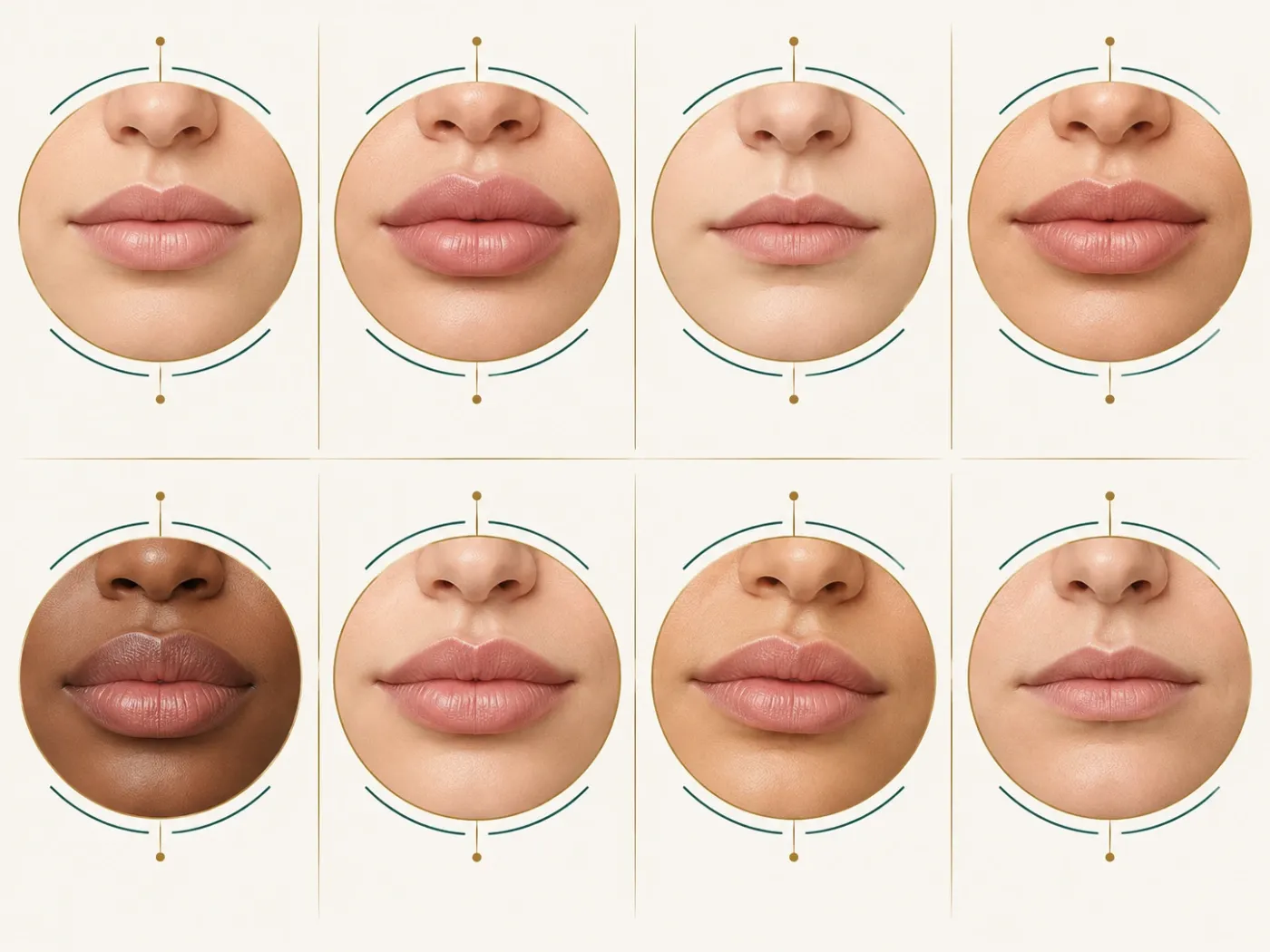
A useful way to read a chart is to start with observation rather than a label. Describe one feature at a time, then notice how the features combine.
Fullness, Width and Upper-to-Lower Balance
Fullness describes how much volume the lips have at rest. Width is the horizontal span between the two corners of the mouth. Balance compares the upper lip with the lower lip. Many people have a lower lip that is fuller than the upper lip, and that pattern is common and widely seen across all genders and backgrounds.
For example, someone might say their lips look “bottom-heavy” because the lower lip appears larger than the upper one. That description is useful for conversation, but it is a matter of appearance and preference, not a medical problem. A clinician would look at the proportions in context, including the rest of the face.
Lips also change over time. StatPearls notes that the philtrum, the central groove below the nose, becomes less prominent as skin elasticity declines with age. Lip color is another variable: the vermilion ranges from reddish-pink to brown, and pigmentation varies naturally from person to person. Color and lighting can make fullness look different even when the shape is identical.
Cupid Bow and Contour Descriptors
The cupid’s bow is the downward arch at the lower edge of the philtrum, the groove directly beneath the nose. The fleshy fullness just below it is called the tubercle. Some people have a pronounced cupid’s bow, while others have a softer or flatter one. Neither version is a defect; both are normal variation.
Contour descriptors refer to how the edges of the lips look. Some people describe their lip edges as defined and crisp, while others describe them as soft or blended. These are visual impressions influenced by lighting, lipstick and the surrounding skin. When someone says they want a “more defined cupid’s bow,” it helps to clarify whether they mean the arch itself, the height of the upper lip, or the overall outline.
Lip contour is also part of the wider face. If your concern is how your lips relate to your nose, chin and cheeks, our guide to facial balancing planning in Istanbul explains how clinicians consider features in relation to one another rather than in isolation.
Asymmetry, Posture and Photographic Limitations
Almost every face has some asymmetry. Lips may sit at slightly different heights, or one side may look fuller when you smile. This is a normal feature of human anatomy, and it is one of the main reasons a lip shapes chart should never be used as a checklist of flaws.
Head position, camera angle, lens distortion, lighting and fatigue can all change how lips look in a photograph. A practical test is to take several photos from the same distance, in natural light, with a neutral expression and then with a smile. Compare the sets over a few days. If an apparent difference appears only in one angle, it is probably influenced by the photo rather than by the lip itself.
Photos also have limits. They cannot show texture, movement, or how lips behave during speech and eating. A chart cannot diagnose anything. Sudden changes, weakness, drooping or numbness on one side of the face should be assessed by a doctor promptly, rather than compared against a chart at home.
When Lip Aesthetics Becomes a Treatment Discussion
Many people never need to change their lips, and that is a perfectly good outcome. Lip aesthetics becomes a worthwhile conversation when a concern is persistent, specific and connected to a clear goal. For example, you may feel that your lips look thinner than they did before, or that the balance with the rest of your face bothers you when you see yourself in photos.
Treatment is always optional. Vivid Clinic’s face aesthetics services in Istanbul outline the facial procedures and non-surgical alternatives the team discusses. Lip-specific options are not assumed to be available for every patient, so availability and suitability are confirmed individually during consultation.
Lip Shapes: Candidacy and Reasons to Defer Treatment
Lip shapes are shared across people of every gender, age and background. Full, thin, wide, narrow and asymmetrical lips are all forms of normal variation. A shape is not a defect, and a lip that differs from a chart label does not need correction to be considered acceptable.
Some people are better served by waiting. You may be unsure what you want to change, you may be recovering from an illness, or you may have questions about medications or your medical history that need answers first. Taking time to think is a sensible step, and a good clinician will respect it rather than rushing you toward a plan.
Lip Enhancement Overview: Realistic Expectations
Optional overview of relevant treatments, not a recovery table for a natural feature.
| Aspect | Details |
|---|---|
| Duration Process | Dermal filler: about 15 to 60 minutes, depending on how many areas are treated (ASPS dermal filler procedure). Normal lip anatomy has no procedure duration. |
| Hospitalization Duration | Dermal filler: no hospital stay is described on the ASPS procedure page, which covers numbing of the injection sites and short appointments. Setting and admission needs for any other option are confirmed by a clinician. |
| Mobility Duration | Dermal filler: most people can resume most everyday activities right away (ASPS dermal filler recovery). |
| Return to Activity | Dermal filler: intense physical activity is generally discouraged for the first 24 to 48 hours to limit swelling and bruising (ASPS recovery page). Desk work, exercise and travel should be cleared individually. |
| Complete Recovery | Dermal filler: mild swelling or bruising may improve within hours or a few days, while severe reactions can take longer and need medical care (ASPS recovery page). Surface settling is not the same as full tissue settling, and completion is not promised. |
| Anticipated Results | Dermal fillers are described by ASPS as temporary, and most dissipate over time, so repeat treatment may be needed (ASPS dermal filler safety). Durability varies by product and by person, and the assessment interval is set by your clinician. |
How to Prepare for a Lip Enhancement Consultation
Bring a complete medical history and a current list of medications and supplements, including blood thinners and previous aesthetic treatments. Your clinician will also ask about functional concerns, such as how your lips affect speaking, eating or dental fit, because these matter as much as appearance.
Think about your goals in plain language. Describe what you would like to change, what you already like about your lips, and what would feel like too much. Ask which results are realistic, which are not, and whether waiting or a non-treatment approach is sensible for you.
Please do not inject or self-treat lips with products bought online or from unlicensed providers. Diagnosis and treatment planning should be carried out by a qualified clinician in a supervised setting. A free consultation with a plastic surgeon is the right place to start, because it gives you a personal assessment instead of a generic chart.
Lip Enhancement Recovery and When to Judge Results
Early effects and settling are different things. Swelling and bruising can range from mild to severe, and mild cases often improve with cold packs and gentle care within hours or a few days (ASPS recovery page). Some people notice temporary numbness or redness, and small lumps at injection sites may be felt for a while.
Plan your activity around the guidance you receive. Intense exercise is generally discouraged in the first 24 to 48 hours. Return to work, travel and social plans should be confirmed with the clinician, because they depend on how your body responds and on the treatment itself.
Results should be assessed only after early swelling has settled, and the timing is set by your clinician. Keep your follow-up appointments, and contact the clinic promptly if something feels wrong.
Lip Enhancement Risks, Limitations and Medical Red Flags
Treatment is never risk-free, and no lip procedure should be described as easy. According to the ASPS safety page, severe complications from dermal fillers are uncommon, but common reactions include swelling, bruising, redness, asymmetry, lumps, bleeding at the injection site, and under- or over-correction. Infection and skin damage that may scar are also listed.
A rare but serious risk is that filler enters a blood vessel and blocks blood flow, which can lead to skin loss or wounds. The ASPS page also notes that visual disturbances are uncommon but can occur. Any change in vision, pain, or weakness after treatment needs immediate medical care.
Your surgeon should explain these risks in detail before you sign a consent form. Choosing a board-certified plastic surgeon who is prepared to manage complications is one of the most important decisions you can make (ASPS dermal filler safety page).
What Affects the Cost of Lip Enhancement in Istanbul
Costs depend on several factors, including the surgeon’s experience, the facility, anesthesia where it is used, the complexity of the plan, whether treatments are combined, travel and accommodation, and aftercare and follow-up. Personal needs also change the plan, so no two quotes are identical.
For this reason, exact prices are not published in this article. Compare written plans on a like-for-like basis, and confirm what each one includes.
Lip Enhancement in Istanbul: Your Patient Journey at Vivid Clinic
Your optional journey with Vivid Clinic begins when you arrive in Istanbul, Turkey. Where your package includes it, a VIP airport transfer takes you to a five-star hotel for check-in, and eligibility for these transfer and hotel benefits is confirmed at consultation because they apply only to select procedures. Your one-on-one consultation with the medical team reviews your goals, medical history and anatomy before any treatment day is scheduled. If a procedure is recommended and you decide to proceed, the treatment day is planned for comfort and safety, followed by post-operative care with the clinic team. A check-up visit takes place before you depart for home, and remote aftercare follow-up continues after your return.
Choosing a Qualified Surgeon for Lip Enhancement
Before you commit to any treatment, verify the credentials of the person who will treat you. Vivid Clinic’s medical team page lists the doctors in Istanbul, Turkey, and explains that every treatment plan is reviewed by the surgical board and that patients meet their doctor in person before any procedure. Ask for board certification details, and ask how the clinician handles complications.
A free consultation with a plastic surgeon gives you a personal evaluation of your lip shapes, your goals and your options, with no obligation to proceed. It is the right place to ask about alternatives, about waiting, and about what results you can realistically expect.
Frequently Asked Questions About Lip Shapes
Can lip shapes fit more than one description?
Yes. Most lip shapes fit more than one description, because fullness, width, balance, cupid bow and contour are separate features. A lip can be full in the lower part, narrow at the corners and have a soft cupid bow all at once. Chart labels are useful shorthand, but they overlap and are not rigid categories. Describing each feature separately usually gives a clearer picture than choosing one label. For example, you might notice that your upper lip is slightly thinner than your lower lip while your corners are relatively narrow. This is normal variation. A clinician at Vivid Clinic in Istanbul, Turkey can help you decide which features matter to you during a free consultation with a plastic surgeon.
How do lip shapes change when smiling?
Lip shapes change when you smile because the muscles around the mouth move the lips, pull the corners and shift how much of the lip border shows against the teeth and gums. Some people reveal more upper lip, others show more of the lower lip, and the cupid bow can look sharper or softer. These changes are normal and reflect how the face moves. Photographs taken at rest and while smiling can give different impressions of the same lips, so judge lip shapes using both views. If a feature changes in an unexpected way, such as drooping on one side or difficulty moving the mouth, speak with a doctor promptly. Discuss any movement concern with a clinician at your consultation.
What does a lip shapes chart tell me about asymmetry?
A lip shapes chart can help you notice asymmetry and describe it clearly, but it cannot measure or diagnose it. Almost every face has some asymmetry, so a small difference in height, fullness or the curve of the cupid bow is common. A chart gives you words such as “slightly higher on the left” to use with a clinician. Photographs can exaggerate differences because of lighting, camera angle, head tilt and expression, so take several images under similar conditions before drawing conclusions. Sudden or new changes, weakness, drooping or numbness on one side of the face need medical assessment rather than chart comparison. A surgeon can explain whether an observed difference is within normal variation.
Can filler change lip shapes without copying another person?
Filler can change some features of lip shapes, such as perceived fullness, border definition or the balance between the upper and lower lips. The goal should be to refine your own features, not to copy someone else. A clinician planning any lip treatment starts from your anatomy, proportions and goals. ASPS describes dermal fillers as temporary treatments, and results depend on the product, the amount used and your own tissue, so repeat treatment may be needed over time. Filler also carries risks, including swelling, bruising, asymmetry and under- or over-correction. Availability and suitability for lip treatment are confirmed individually at a free consultation with a plastic surgeon.
How should lip shapes be assessed before treatment?
Lip shapes should be assessed in person by a qualified clinician, using a full consultation rather than a chart or a photo alone. The assessment usually covers your medical history, current medications and supplements, previous aesthetic treatments, dental and functional concerns such as speaking or eating, and the goals you want to achieve. The clinician examines fullness, width, balance, cupid bow, contour and symmetry both at rest and in movement, then explains which options are realistic and which are not. Expect a discussion of risks, alternatives and the option to wait. At Vivid Clinic in Istanbul, Turkey, you can request a free consultation with a plastic surgeon to start this assessment.
Sources and Further Reading on Lip Shapes
- StatPearls: Anatomy of the Lips and Oral Region
- American Society of Plastic Surgeons: Dermal Fillers
- American Society of Plastic Surgeons: Dermal Filler Procedure
- American Society of Plastic Surgeons: Dermal Filler Recovery
- American Society of Plastic Surgeons: Dermal Filler Safety
Related reading: Lip filler shapes and how to choose one · Natural-looking injectables in Istanbul · Eye shapes chart
Embracing or Enhancing Your Natural Lip Shape
Understanding lip shapes is a useful first step, because it helps you describe what you see and decide what matters to you. Most lip shapes are normal variation, and treatment is always optional. If you are considering lip shapes in Istanbul, Turkey, Vivid Clinic can help you understand your options with a personalized assessment rather than a generic chart.
This article is for informational purposes only and does not replace a personal medical consultation. Suitability, risks, recovery, and expected results should always be discussed with a qualified medical professional.