
 ChatGPT

The Photo You Did Not Expect to See
It usually starts with a picture you did not take yourself. A friend films the table from behind, or the barber holds up the hand mirror, and for a second you do not recognize the top of your own head. The crown under a ceiling light tells a different story from the bathroom mirror.
After that moment, most men want a straight answer about where they stand. The Norwood scale gives you one. It sorts male pattern hair loss into seven stages and turns a vague worry into something you can measure and plan around.
This guide covers every stage, what usually helps at each, and how many grafts a transplant might involve. At Vivid Clinic in Istanbul, Turkey, Norwood scale staging is the first step of every hair assessment, and you can request a free consultation with a plastic surgeon and the hair team to have your photos reviewed.
What Is the Norwood Scale?
Quick Answer: The Norwood scale is a seven-stage classification of male pattern hair loss. It describes how far the hairline has receded and how much the crown has thinned, from stage 1 (no visible loss) to stage 7 (only a band of hair at the sides and back). Doctors use it to plan treatment.
Dr. James Hamilton created the system in the 1950s and Dr. O’Tar Norwood revised it in the 1970s, so it is also called the Hamilton-Norwood scale.
Why Staging Matters Before Any Treatment
A stage is a shared language. It lets you and your doctor compare photos year to year and judge whether a treatment is holding the line.
What the Norwood Scale Cannot Tell You
The Norwood scale describes a pattern, not a person. It does not measure hair calibre, donor density or speed of loss, so two men at the same stage can need very different plans.
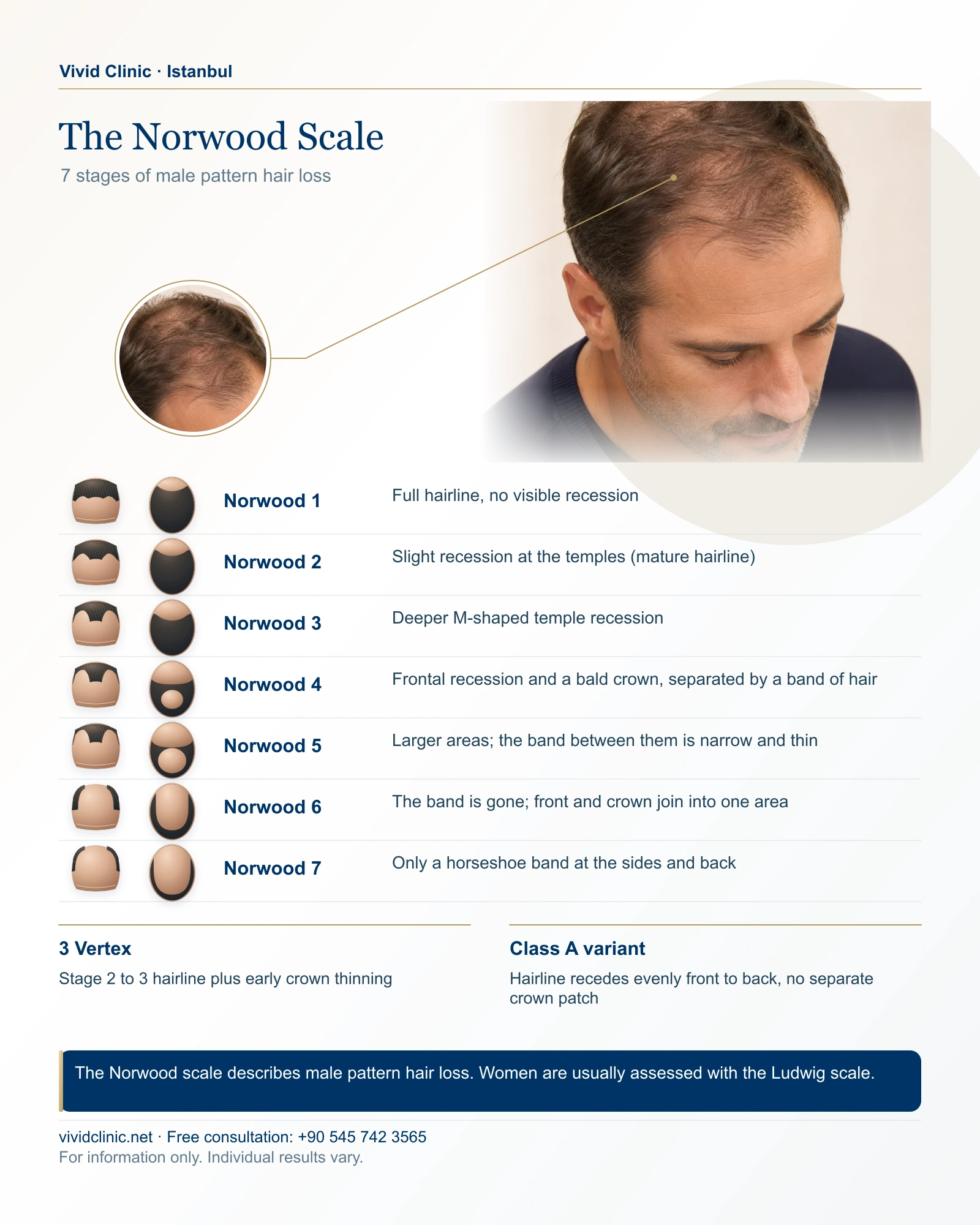
Norwood Scale Stages at a Glance
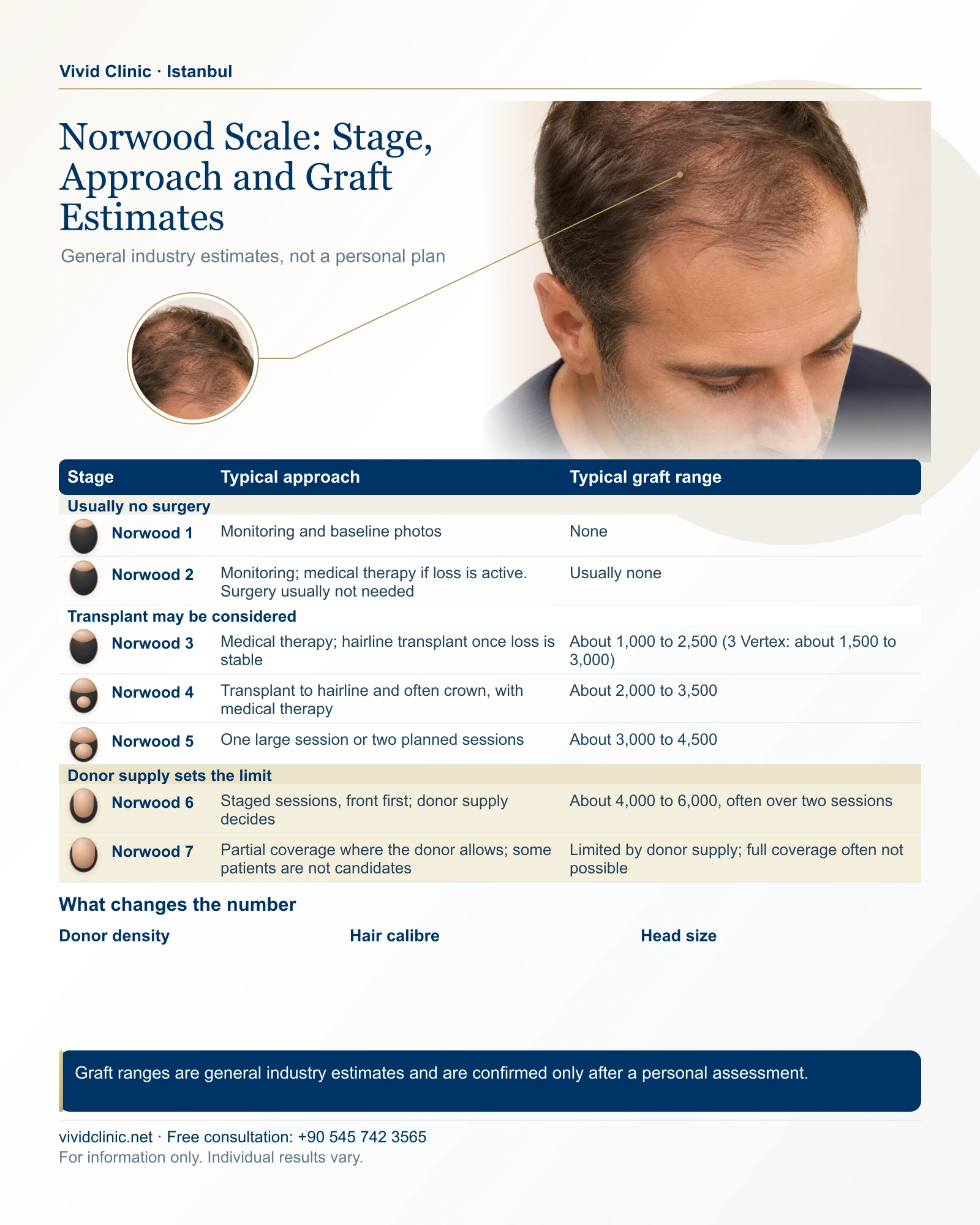
The table sets out the seven Norwood scale stages and the approach doctors usually discuss at each. Graft figures are broad, general industry estimates that depend on donor density, hair calibre and head size, and they are confirmed only after a personal assessment.
| Stage | What it looks like | Typical approach | Typical graft range (general estimate) |
|---|---|---|---|
| Norwood 1 | Full hairline, no visible recession | Monitoring and baseline photos | None |
| Norwood 2 | Slight recession at the temples, often called a mature hairline | Monitoring; medical therapy if loss is active. Surgery is usually not needed | Usually none |
| Norwood 3 | Deeper M-shaped temple recession. In 3 Vertex, early crown thinning is added | Medical therapy; a hairline transplant can be considered once loss is stable | About 1,000 to 2,500 (3 Vertex: about 1,500 to 3,000) |
| Norwood 4 | Marked frontal recession and a bald crown, separated by a solid band of hair | Transplant to the hairline and often the crown, with medical therapy | About 2,000 to 3,500 |
| Norwood 5 | Larger front and crown areas; the band between them is narrow and thin | One large session or two planned sessions, with clear priorities | About 3,000 to 4,500 |
| Norwood 6 | The band is gone; front and crown join into one area | Staged sessions, front first; donor supply decides the plan | About 4,000 to 6,000, often over two sessions |
| Norwood 7 | Only a horseshoe band of hair at the sides and back | Partial coverage where the donor allows; some patients are not candidates | Limited by donor supply; full coverage is often not possible |
Estimates only. Results vary by individual.
The 7 Hair Loss Stages on the Norwood Scale, One by One
Norwood 1: No Visible Loss
A full hairline with no meaningful recession. Nothing needs treating, though yearly photos give you a useful baseline.
Norwood 2: The Mature Hairline
At Norwood 2, the temples have moved back slightly. Many men stay here for decades, so it is often a normal adult hairline, not the start of balding. Surgery is usually not needed. Monitoring is standard, and medical therapy may be discussed if the recession keeps moving.
Norwood 3: The First Clinically Significant Stage
Norwood 3 is where most doctors begin to use the word “balding”. The temples recede into a clear M, U or V shape. A hairline transplant can be reasonable once the loss has been assessed and, ideally, stabilized.
Norwood 3 Vertex: When the Crown Joins In
The hairline looks like stage 2 or 3, but a thinning patch appears at the crown, often spotted in photos first. Crown thinning often responds to medical therapy, so that is usually discussed before surgery.
Norwood 4: Two Separate Areas
Frontal recession is more pronounced and the crown is clearly bald or sparse. A band of denser hair still separates the two zones. Many plans address the hairline first.
Norwood 5: The Bridge Narrows
The two areas are larger, and the band between them has become narrow and thin. More grafts are needed, and you and your surgeon must decide where density matters most.
Norwood 6: One Connected Area
The bridge has gone, and the front and crown have merged into a single area of loss. Restoration is possible for many men, but donor hair must be budgeted carefully.
Norwood 7: The Horseshoe Pattern
The most advanced pattern. Only a band of hair remains around the sides and back, so honest conversations about limits matter most here.
What Is the Norwood Class A Variant?
In the less common class A variant, the hairline recedes evenly from front to back without leaving a central forelock, and no separate crown patch forms. Planning focuses almost entirely on rebuilding the frontal zone.
How to Find Your Norwood Scale Stage at Home
Take Four Honest Photos
Use the same bright overhead light each time, with dry hair. Photograph the front with hair pulled back, each temple, the top and the crown.
Compare the Pattern, Not the Day
Match what you see to the descriptions above. Sitting between two stages is normal. Repeat the photos every six months, because the trend matters more than one snapshot.
If the loss is sudden, patchy, itchy or scaly, see a doctor first. Those features point away from male pattern loss.
What Causes Male Pattern Hair Loss?
Male pattern hair loss, or androgenetic alopecia, is driven by genetics and DHT, a derivative of testosterone. In sensitive men, DHT gradually shrinks follicles at the hairline and crown until they stop producing visible hair.
Follicles at the back and sides usually resist this process, which is what makes transplantation possible.
Is the Norwood Scale Used for Women?
No. It describes male pattern loss. Women usually thin diffusely across the top while keeping the frontal hairline, so they are usually assessed with the Ludwig scale.
Treatment by Norwood Scale Stage: When Is Surgery Not Needed?
Quick Answer: At Norwood 1 and Norwood 2, surgery is usually not needed, and monitoring or medical therapy is the normal approach. From stage 3 onward a transplant may be considered if the loss is stable, the donor area is healthy and expectations are realistic.
Non-Surgical Options
Medical therapy aims to slow loss and, in some men, thicken existing hair. The mainstream options are topical minoxidil and prescription finasteride, which have possible side effects, only work while you continue them and should be discussed with a doctor. Supportive treatments such as PRP are also used. See our hair loss treatment page.
They protect hair you still have. They do not regrow hair on skin that has been bald for years.
Surgical Options: FUE, Sapphire FUE and DHI
A hair transplant moves follicles from the donor area to thinning zones. With FUE hair transplant techniques, grafts are extracted one by one with a fine punch. Sapphire FUE uses sapphire-tipped blades to open the recipient channels, and DHI hair transplant places grafts with implanter pens, which can suit hairline work.
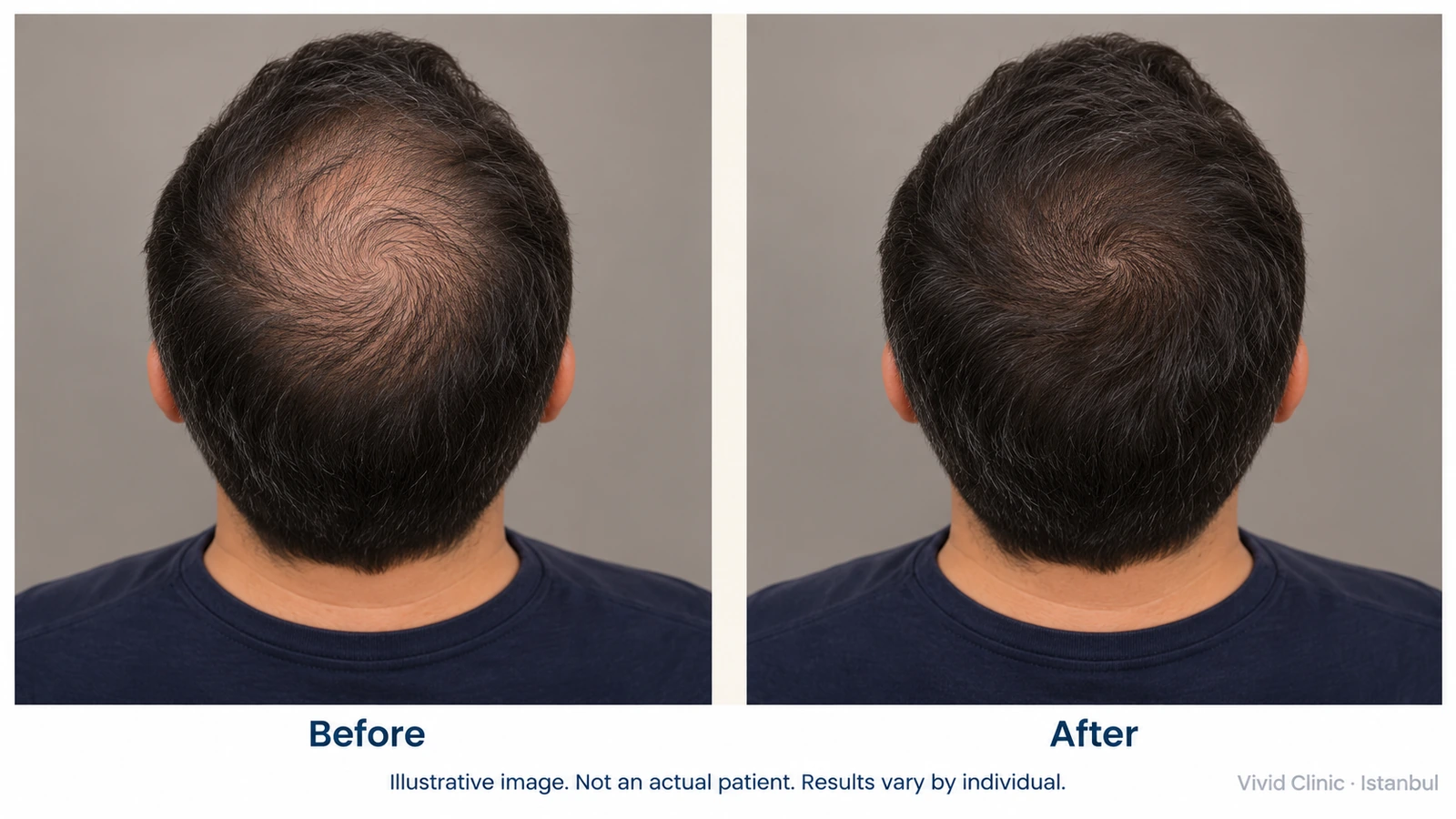
Crown hair grows in a spiral and often needs more grafts than it appears to. Our crown hair transplant guide covers this.
Who Is a Good Candidate, and Who Is Not?
Quick Answer: Good candidates are usually men at stage 3 or above with stable hair loss, a healthy donor area and realistic goals. Men at stage 1 or 2, those with rapidly progressing loss, and some men at stage 6 or 7 with a weak donor area may be advised against surgery.
Good Candidates
- Stable or medically controlled hair loss
- Sufficient donor density at the back and sides
- Good general health and realistic goals
When a Transplant May Not Be the Right Choice
Very young men with fast-moving loss are a common example. A low hairline built too early can be left stranded as the hair behind it recedes.
Honest Limits at Norwood 6 and 7
The donor area is finite. A man at stage 6 or 7 has the largest area to cover and often the smallest reserve. Some of these patients have limited donor supply and are not candidates for full coverage.
That can mean framing the face and accepting a lighter crown, or deciding against surgery. A responsible clinic tells you this before you travel.
How a Transplant Is Planned Around Your Stage
Your stage sets the map, and your donor area sets the budget. The surgeon designs a hairline that suits your age and face, calculates the grafts each zone needs, and checks that the donor area can supply them without visible thinning.
If your pattern is likely to progress, grafts are kept in reserve and medical therapy is usually recommended to protect native hair.
Procedure Overview Table: Hair Transplant (FUE / DHI)
| Aspect | Details |
|---|---|
| Duration Process | About 6 to 8 hours, depending on graft number |
| Hospitalization Duration | Not required; day procedure under local anesthesia |
| Mobility Duration | Walking the same day |
| Return to Activity | Desk work in about 3 to 7 days; strenuous exercise after about 2 to 4 weeks |
| Complete Recovery | Scabs clear in about 10 to 14 days; redness can take several weeks to fade |
| Anticipated Results | Early growth at 3 to 4 months; mature result at about 12 months, crown up to 18 months |
Operation Process Overview at Vivid Clinic
Your journey starts with your arrival in Istanbul, where a VIP airport transfer takes you to your 5-star hotel and check-in is arranged for you. A one-on-one consultation follows, during which your scalp and donor area are examined, your stage is confirmed and the hairline design is agreed. On the treatment day, the procedure is carried out under local anesthesia with rest breaks. Post-operative care includes clear written instructions, medication guidance and your first hair wash with the team. A checkup visit confirms that the grafts and the donor area are settling well before your departure. Once you are home, remote aftercare follow-up continues with scheduled photo reviews over the following months.
Recovery Timeline After a Hair Transplant
Days 1 to 3
Mild forehead swelling, tightness in the donor area and small scabs around each graft. Sleep with your head raised and do not touch the grafts.
Days 4 to 14
Gentle washing begins as instructed and the scabs lift away. Most men return to office work in this window.
Weeks 2 to 8
The transplanted hairs often shed. This shock loss is expected, and the follicles stay in place beneath the skin.
Months 3 to 12
New hairs emerge, fine at first and then thicker. Density keeps maturing to about 12 months, and the crown can take up to 18. Results vary from patient to patient.
Benefits of Planning Around Your Stage
- A hairline that still looks appropriate as you age
- Donor hair used carefully, with a reserve for later
- Clear expectations about coverage before you commit
Risks and Side Effects to Understand
A hair transplant is a surgical procedure and carries risks. These include swelling, temporary numbness, infection, folliculitis, small dot scars in the donor area, shock loss of existing hair, uneven growth and lower graft survival than hoped for.
Planning mistakes carry their own risks: an over-harvested donor area or a hairline placed too low can be difficult to correct.
How to Prepare Before Your Procedure
- Share your full medical history and all medications
- Stop smoking and avoid alcohol for the period your doctor advises
- Do not change blood-thinning medication without medical guidance
- Leave your hair uncut so the donor area can be assessed
Aftercare Essentials
Follow the washing routine exactly as shown. Avoid sun exposure, swimming, heavy sweating and tight headwear until you are cleared, and send your coordinator a photo if anything looks unusual.
Cost Factors in Istanbul, Turkey
Cost depends on your treatment plan: the number of grafts, the technique, whether one or two sessions are planned, the experience of the medical team, and the hotel, transfer and aftercare services in your package.
Our hair transplant cost in Turkey guide explains these factors, and the surgery price calculator gives an initial estimate. Final pricing is confirmed after consultation.
What International Patients Should Expect
Most patients plan a stay of a few days covering consultation, procedure day, first wash and checkup. Your photos are reviewed before you book, so the likely plan is discussed in advance.
Why Choose Vivid Clinic in Istanbul, Turkey?
Vivid Clinic is a premium, international clinic focused on natural-looking, personalized results. Planning begins with an honest reading of your Norwood scale stage and donor area, including a clear answer when surgery is not the right step yet.
Meet our doctors and start with a free consultation with a plastic surgeon and the hair team. Our coordinators organize transfers, hotel, treatment and remote aftercare for you.
FAQs
At which Norwood scale stage should I consider a hair transplant?
Most surgeons start to consider a transplant from stage 3, when temple recession is clearly visible, or 3 Vertex when the crown is involved. At Norwood 1 and Norwood 2, monitoring or medical therapy is usually the better choice. The Norwood scale is only part of the decision. Your age, the speed of loss, your donor area and your expectations all matter. A young man with fast-changing loss may be advised to wait, while an older man with a stable pattern may be a good candidate.
How many grafts are needed for each Norwood scale stage?
There is no fixed number, only broad general estimates. As a rough guide, stage 3 often falls around 1,000 to 2,500 grafts, stage 4 around 2,000 to 3,500, stage 5 around 3,000 to 4,500, and stage 6 around 4,000 to 6,000, frequently over two sessions. At stage 7 the limit is usually the donor area. These Norwood scale figures shift with donor density, hair calibre and head size. Hair colour and the density you want also play a part. Your range is confirmed only after a personal assessment.
Can a Norwood scale 6 or 7 patient get full coverage?
A meaningful improvement is sometimes possible, but full coverage is often not realistic. At the top of the Norwood scale the area of loss is at its largest, while the donor band at the back and sides may be narrow or thin. Donor hair does not grow back once moved, so it has to be budgeted. Many plans prioritize the frontal third and mid-scalp, which frame the face, and accept a lighter crown. Some patients with weak donor areas are advised against surgery.
How long should I stay in Istanbul for a Norwood scale assessment and hair transplant?
Most international patients plan about three to four days. A typical schedule includes arrival and hotel check-in, an in-person consultation where your Norwood scale stage and donor area are confirmed, the procedure day, and a first wash and checkup before departure. Much of the assessment happens earlier, because the team reviews your photos online before you book flights. Flying home is normally possible a few days after the procedure, with instructions for sleeping, washing and protecting the grafts. Follow-up then continues remotely with photo reviews.
Does a higher Norwood scale stage change hair transplant cost in Turkey?
It can, because a more advanced stage usually means more grafts, a longer procedure day and sometimes a second session. Other cost factors include the technique selected, such as FUE, Sapphire FUE or DHI, the experience of the medical team, supportive treatments, and the hotel, transfer and aftercare services in your package. The Norwood scale alone does not set the price, since two men at the same stage can have very different donor areas and goals. A consultation is the most accurate way to receive pricing.
Conclusion
The Norwood scale will not make the decision for you, but it gives you a clear starting point. Stages 1 and 2 usually call for patience and good photos. Stages 3 to 5 are where a well-planned transplant often makes the most sense. Stages 6 and 7 demand honesty about what the donor area can deliver.
To have your Norwood scale stage read and your graft range estimated, Vivid Clinic in Istanbul, Turkey offers a free consultation with a plastic surgeon and the hair team. Get a Free Consultation and find out what is realistically possible for you.
Real Before and After Results at Vivid Clinic
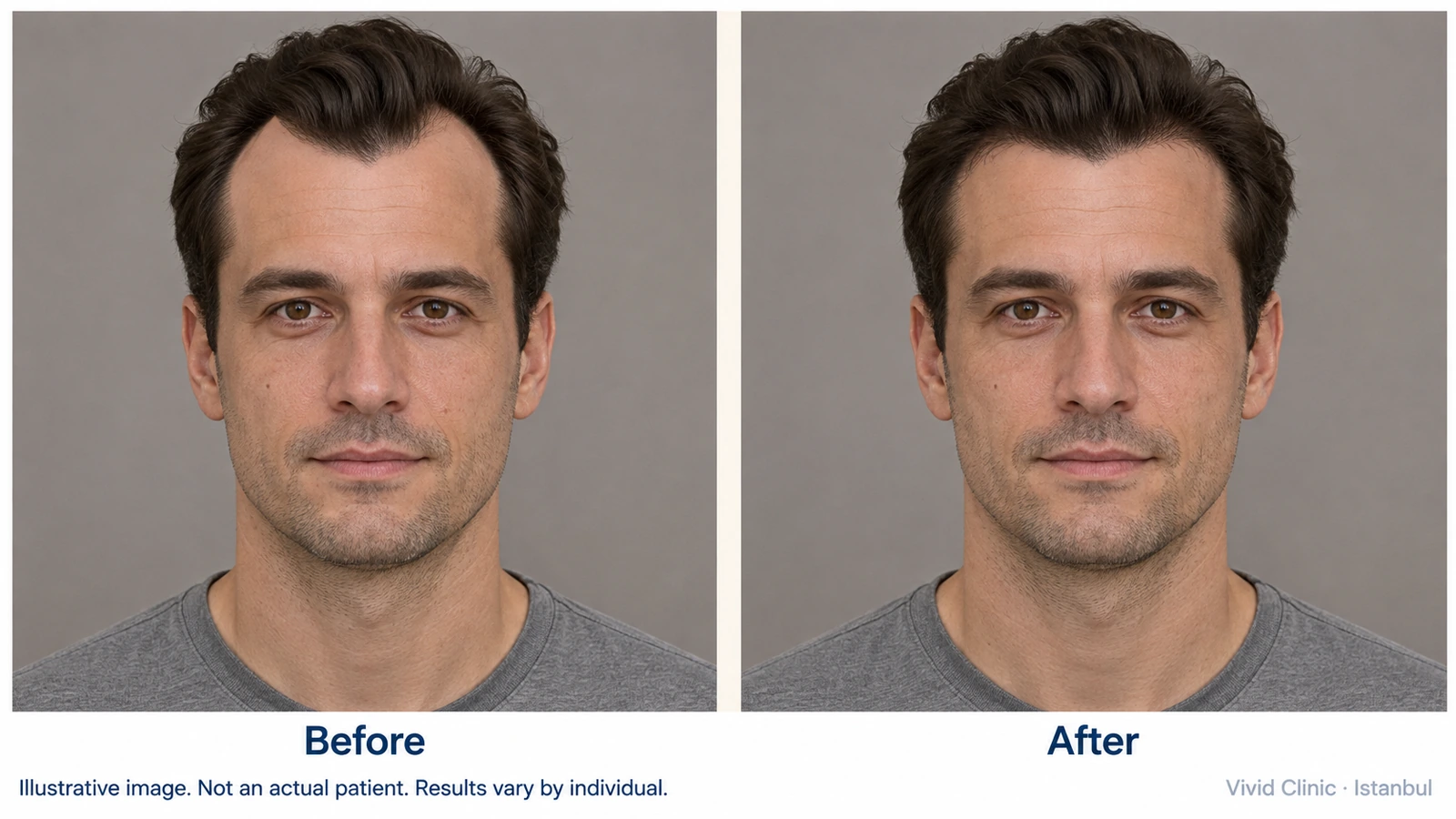
The photos below show real Vivid Clinic hair transplant patients from the clinic’s own gallery, shared with consent as published on the clinic site. No stage, graft count, technique or timing is recorded for these images, so none is assigned, and results vary by anatomy, healing and treatment plan.


You can see more patient results in the full before and after gallery. To find out what may be achievable in your own case, send your photos for a free assessment by the Vivid Clinic team.
This article is for general information and does not replace a personal medical consultation. Suitability, risks, recovery and expected results should always be discussed with a qualified medical professional. Results vary by individual.