 ChatGPT

The Line You Only Notice in Profile
You know your face from the front. Then someone takes a photo from the side, and you notice a line you rarely see: the slope that runs from between your eyes down to the tip of your nose. That line is your nose bridge, and it quietly shapes how your whole profile reads.
Maybe yours rises high and straight, sits low and soft, or carries a small bump. Every one of these is a normal variation of human anatomy, not a flaw that needs fixing.
This guide from Vivid Clinic in Istanbul, Turkey explains bridge types, why they differ, and what filler or surgery can and cannot do. You can also request a free consultation with a plastic surgeon before deciding anything.
What Is the Nose Bridge?
Quick Answer: The nose bridge is the firm upper part of the nose that runs from the point between the eyes down toward the tip. Its upper section is formed by the two nasal bones, and its middle section by cartilage attached to the septum. Its height, width and straightness define your profile.
The Anatomy in Simple Terms
The top third is bone: two nasal bones that meet in the middle and join the forehead. The middle third is cartilage: the upper lateral cartilages, which attach to the septum, the wall that divides the nostrils inside.
Skin and a thin layer of soft tissue cover this framework. Thin skin shows every contour, while thicker skin softens them. For more detail, see our guide to nose anatomy.
Radix, Dorsum and Profile Line
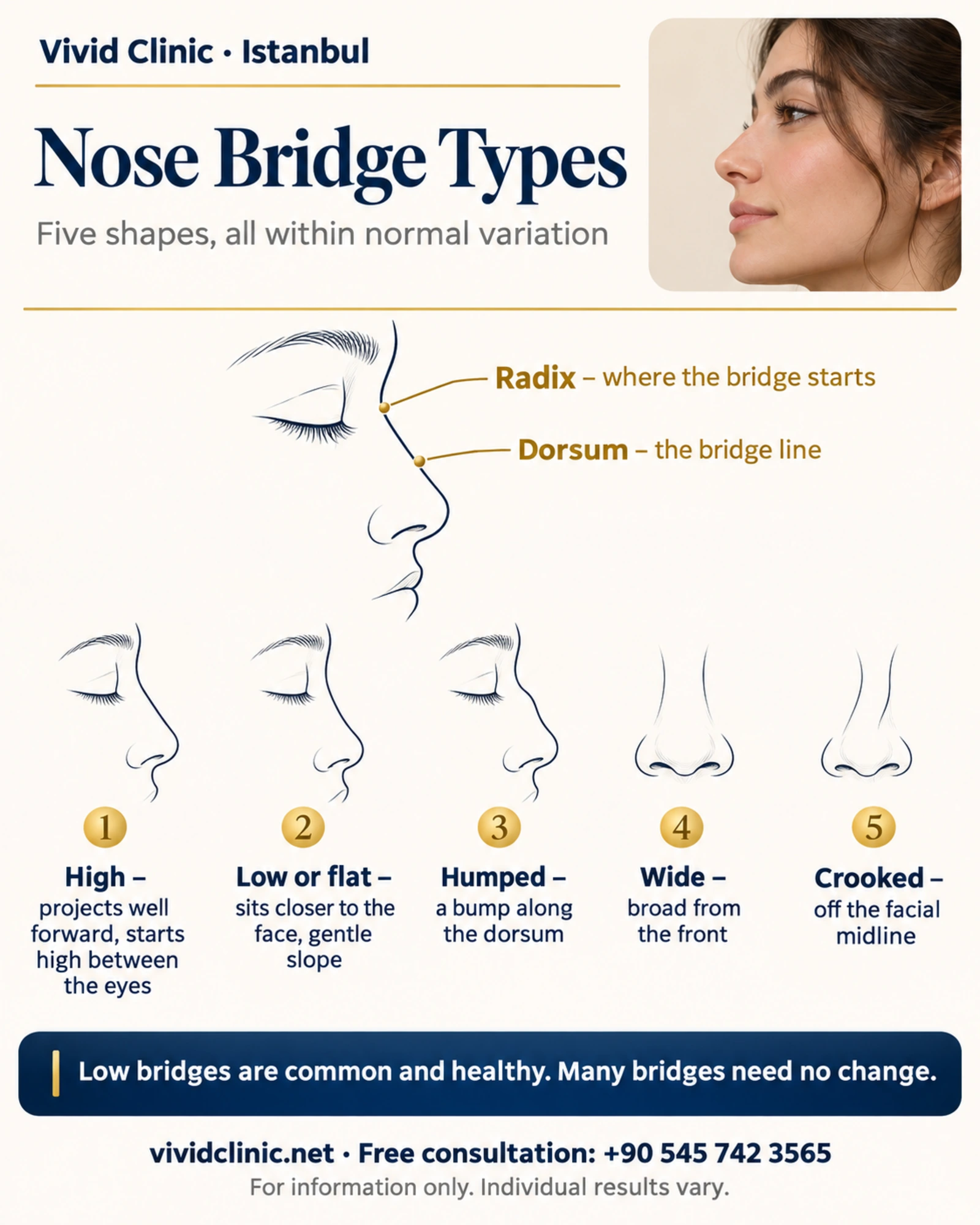
Two terms come up in consultations. The radix is the root of the nose, the dip where it meets the forehead. The dorsum is the line from the radix down to the tip, and nose bridge height is judged along it.
Nose Bridge Types: High, Low, Humped, Wide and Crooked
Quick Answer: Nose bridge types are usually described by height and shape: high, low or flat, humped, wide and crooked. Many people have a mix. None of these types is medically better than another, and all are part of normal human variation.
High Nose Bridge
A high nose bridge projects well forward from the face, with a radix that starts high between the eyes. It tends to give a strong, defined profile and holds glasses easily.
Low or Flat Nose Bridge
A low nose bridge sits closer to the face, with a shallow radix and a gentle slope. A flat nose bridge is simply the lower end of that range, where the bridge barely rises between the eyes.
Low bridges are common across many populations and are a healthy, normal shape.
Humped Bridge
A hump is a raised area of bone, cartilage or both along the dorsum, often visible only in profile. Our article on the dorsal hump covers this shape in detail.
Wide Nose Bridge
A wide nose bridge describes nasal bones that sit further apart, so the upper nose looks broad from the front. This is about the bones, not the nostrils.
Crooked or Asymmetric Bridge
A bridge can also lean to one side or curve, often after an injury or because the septum beneath it is deviated. Breathing is then assessed along with shape.
Why Do Bridges Differ?
Genetics and Ancestry
The shape of your nose bridge is mostly inherited. Height, width and slope run in families, and average shapes vary between populations. Higher, narrower bridges are more common in some ancestries, lower and broader bridges in others, and every population includes a wide range.
No shape is a default that others depart from. A good surgeon plans changes that fit your own face and heritage, an approach often described as ethnic rhinoplasty.
Injury and Previous Surgery
A broken nose can leave the bridge flattened, widened, humped or shifted, and earlier nose surgery can also change its height. Any sudden change after an injury deserves a medical check.
Does Your Bridge Need Changing at All?
In most cases, no. A bridge only needs treatment if it bothers you or is linked to a breathing or structural problem. Keep in mind that close-range selfies distort the nose and make it look wider and larger than it is.
Glasses Fit: A Practical Angle
With a low bridge, frames can slide, rest on the cheeks or sit too close to the lashes. Adjustable nose pads and frames sold as low bridge fit often solve this without any procedure. A high or humped bridge can make frames press on one spot. If glasses fit is your only complaint, start with an optician.
Who Is a Good Candidate for Bridge Reshaping?
Quick Answer: Good candidates are healthy adults whose facial growth is complete, who have a specific and stable concern about their bridge, and who hold realistic expectations. An examination is needed to confirm suitability.
Signs you may be a good fit:
- The concern has been consistent for years, and you can describe what you would like changed
- You are in good general health and do not smoke, or can stop as advised
- You understand that surgery refines a nose and cannot copy someone else’s
When Surgery Is Not the Right Step
Surgery is usually postponed or avoided if you are still growing, pregnant or breastfeeding, or managing an uncontrolled medical condition. It is also not advised when expectations are unrealistic. If your concern is mild, filler or no treatment at all may be the wiser choice.
Non-Surgical Option: Liquid Rhinoplasty and Its Limits
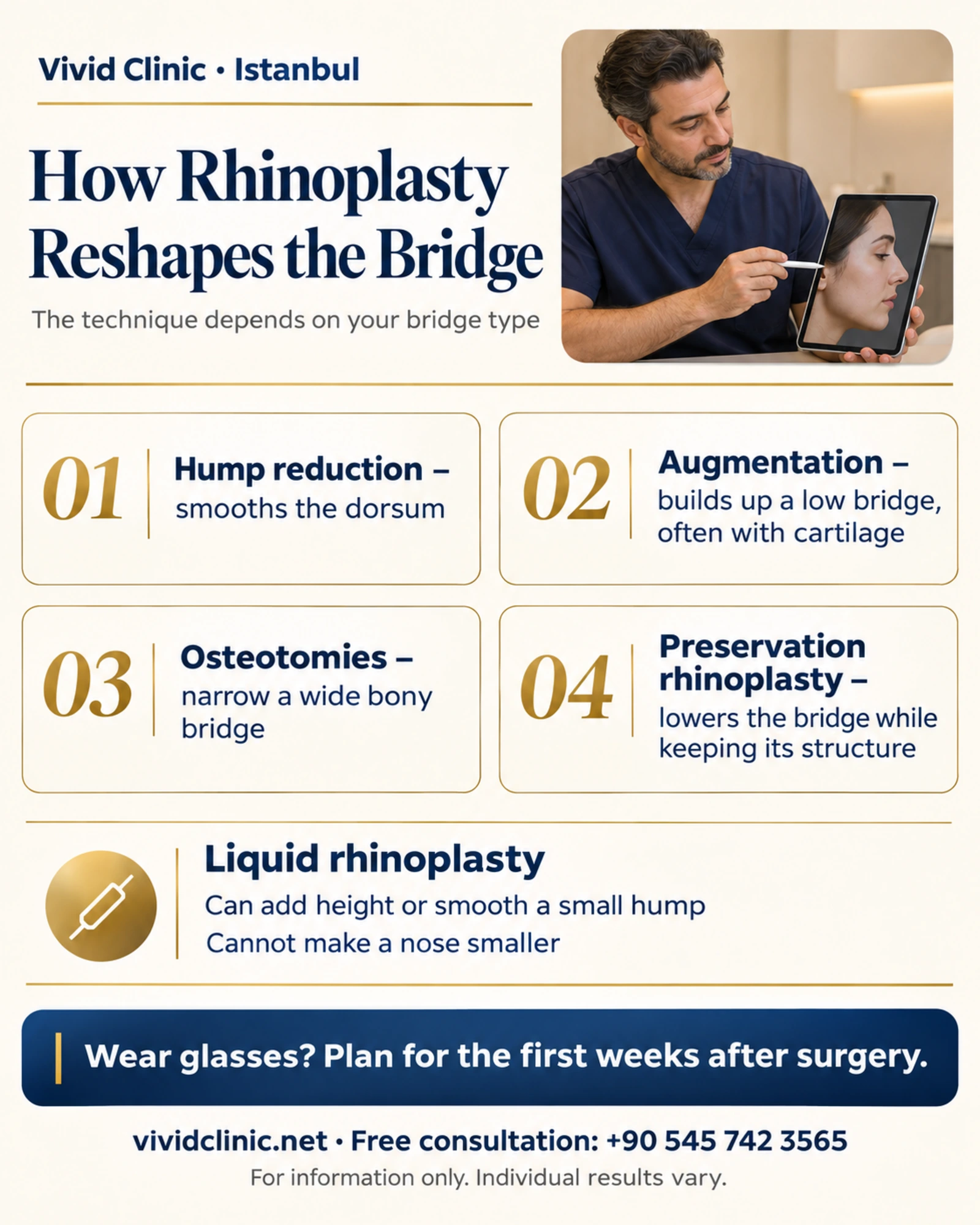
A liquid rhinoplasty uses small amounts of dermal filler, usually hyaluronic acid, placed along the bridge. It can raise a low radix or disguise a small hump by filling the areas above and below it.
Filler only adds volume. It cannot lower a high bridge, remove a hump, narrow wide bones or improve breathing. Results are temporary, often lasting from several months to around eighteen months, and vary by person.
See our comparison of a non-surgical nose job vs rhinoplasty for a dorsal hump.
Risks of Filler in the Nose
Common effects are swelling, bruising, tenderness and occasional lumps or unevenness.
The serious risk is rare but real: filler can block or compress a blood vessel. This can damage the skin and, in very rare cases, affect vision. The nose is a higher-risk area for this, especially after previous surgery.
Nasal filler should only be performed by a medically qualified injector with an emergency protocol in place.
How Rhinoplasty Reshapes the Bridge
Rhinoplasty is the surgical way to change the height, width and straightness of the nose bridge. It is usually performed under general anaesthesia, through incisions inside the nostrils, sometimes with a small one between them.
Consultation and Planning
Your surgeon examines the nose inside and out, checks breathing, assesses skin thickness and studies your profile against your chin and forehead. Photos help you agree on a realistic goal, and results vary.
Hump Reduction
To lower a hump, the surgeon carefully reduces the excess bone and cartilage along the dorsum. Small humps may be filed down, and larger ones are removed in a controlled way.
This can leave the top of the bridge open, like a roof without its ridge. The nasal bones are then repositioned to close it, and the middle third is supported so the bridge stays smooth and the airway open.
Augmenting a Low Bridge
Raising a low nose bridge means adding material. Most surgeons prefer your own cartilage, taken from the septum, sometimes the ear, or occasionally a rib. It may be placed as a shaped piece or finely diced.
In some parts of the world, synthetic implants are also used to build up the bridge. They avoid a donor site but carry their own risks, including infection, shifting and, rarely, the implant working through the skin over time.
Narrowing With Osteotomies
To narrow a wide nose bridge, the surgeon makes precise, controlled cuts in the nasal bones, called osteotomies, and moves the bones closer together. The same step closes the open roof after hump removal.
Preservation Rhinoplasty
Preservation rhinoplasty takes a different route for suitable noses. Instead of removing the top of the hump, the surgeon removes tissue from beneath the bridge and lowers it as one unit, keeping the natural surface lines intact. Suitability depends on the shape of the hump, the bones and the septum.
The tip, nostrils and septum are only adjusted when needed to keep the nose balanced with its new bridge.
Procedure Overview Table: Rhinoplasty
| Aspect | Details |
|---|---|
| Duration Process | About 1.5 to 3 hours, longer for complex or revision cases |
| Hospitalization Duration | Same day discharge or 1 night, depending on the plan |
| Mobility Duration | Gentle walking the same day or the next day |
| Return to Activity | Desk work after about 7 to 14 days; strenuous exercise after 4 to 6 weeks, once cleared |
| Complete Recovery | Most visible swelling and bruising settle within 3 to 6 weeks |
| Anticipated Results | Early shape visible after splint removal; final refinement over about 12 months |
Timings are general estimates. Results vary by individual.
Recovery Timeline After Bridge Surgery
Quick Answer: Most people wear a splint on the nose for about a week and return to desk work within one to two weeks. Bruising usually fades over two weeks, and the final contour refines over about a year.
First 24 to 48 Hours
Expect a blocked nose, swelling and bruising around the eyes, especially if the bones were repositioned. Rest with your head raised and take medication as prescribed.
First Week
The external splint stays in place and must be kept dry. At about one week, the splint and any stitches are usually removed.
Weeks Two to Six
Bruising fades. Avoid contact sports, heavy lifting and resting glasses on the bridge until your surgeon clears you, often around four to six weeks when bones have been moved.
Months Three to Twelve
Swelling continues to settle and the bridge line sharpens. Thicker skin and revision surgery can take longer.
Benefits of Reshaping the Bridge
- A profile line that feels more in balance with the rest of the face
- A smoother dorsum after hump reduction
- More definition for a low bridge, and often easier glasses fit
- Improved breathing when a structural problem is treated in the same operation
Benefits depend on your anatomy and plan.
Possible Risks and Side Effects
Every operation carries risk, including those of anaesthesia. Common, usually temporary effects include swelling, bruising, congestion and numbness of the nasal skin.
Less common risks include:
- Contour irregularities such as small bumps, dips or visible edges along the bridge
- Breathing difficulty if the middle of the nose narrows
- Infection or bleeding that may need treatment
- Graft or implant problems, such as shifting, visibility or partial absorption
- Over- or under-correction, which sometimes leads to revision surgery
Discuss your personal risk profile with your surgeon before treatment.
How to Prepare
- Share your full medical history, medications, supplements and any previous nose procedures, including filler.
- Ask whether to pause blood-thinning medicines or supplements, and follow your doctor’s advice.
- Stop smoking and nicotine products as instructed.
- If you wear glasses, plan for the first weeks.
Aftercare Tips
- Sleep with your head raised for the first one to two weeks.
- Do not blow your nose until you are told it is safe.
- Keep the splint dry and never remove it yourself.
- Seek advice quickly for heavy bleeding, fever, increasing pain or a sudden change in shape.
Cost Factors in Istanbul, Turkey
Quick Answer: The cost of bridge reshaping depends on the technique, the complexity of your nose, whether grafts are needed, the hospital and anaesthesia, the surgeon’s experience and what your travel package includes. A personalised quote follows your evaluation.
The main factors are:
- Filler treatment or surgery, and primary surgery or revision
- Hump reduction alone, or combined narrowing, augmentation or septum work
- Cartilage grafts from the septum, ear or rib
- Hospital setting, anaesthesia and operating time
- Accommodation, VIP transfers and follow-up visits
See our guide to rhinoplasty cost in Turkey or try the surgery price calculator.
Why Choose Vivid Clinic for Bridge Reshaping?
Quick Answer: Vivid Clinic offers anatomy-led planning in Istanbul, Turkey, honest advice about whether filler, surgery or no treatment fits your case, and organised support for international patients from first contact to remote aftercare.
At Vivid Clinic, planning starts with a one-on-one assessment of your nose bridge, skin, breathing and facial balance. The aim is a nose that still looks like yours. You can meet our doctors, browse the before and after gallery and begin with a free consultation with a plastic surgeon before you commit to anything.
What International Patients Can Expect
Many patients plan roughly a week to ten days in Istanbul for rhinoplasty, so the splint can be removed before the flight home. Expect written aftercare instructions and a direct line to the team once you are home.
Operation Process Overview at Vivid Clinic
Your journey with Vivid Clinic begins when you arrive in Istanbul, where a VIP airport transfer takes you to your 5-star hotel for check-in and time to rest. Next comes your one-on-one consultation, where the surgeon examines your bridge, skin, septum and breathing, reviews your goals and explains whether hump reduction, augmentation, narrowing, filler or no treatment suits you. Surgery day is planned carefully for comfort, safety and a natural profile. Post-operative care starts straight away, with your splint, written instructions and a direct contact line. A checkup visit before your departure confirms that healing is on track, and remote aftercare follow-up continues once you are back home.
FAQs
Can a high nose bridge be lowered without surgery?
No. A high nose bridge can only be lowered with surgery, because lowering it means reducing bone and cartilage. Filler adds volume, so it cannot make a bridge smaller. In selected cases, a small amount of filler above or below a hump can make the line look straighter, but the nose becomes slightly larger overall, not lower. If your goal is a lower or less projecting bridge, rhinoplasty or, for suitable noses, preservation rhinoplasty is the realistic route. A surgeon needs to examine your bones, cartilage, skin and breathing before recommending either. Results vary by individual.
How is a flat nose bridge built up with rhinoplasty?
A flat nose bridge is raised by adding material along the dorsum. Most surgeons prefer your own cartilage, usually from the septum, sometimes from the ear, and occasionally from a rib when a larger amount is needed. The cartilage may be shaped as a single piece or finely diced and placed along the bridge. Synthetic implants are used in some parts of the world, but they carry risks such as infection and shifting over time. Height is added conservatively so the bridge suits your face, skin thickness and heritage.
How long should I stay in Istanbul for nose bridge surgery?
For nose bridge surgery, many patients plan roughly a week to ten days in Istanbul. That allows time for arrival, consultation and tests, the operation, early recovery and a checkup when the splint is removed, usually at about one week. Your surgeon confirms when you are fit to fly, and the timing can be longer after complex or revision surgery. Filler treatment needs far less time. Individual healing varies, so keep some flexibility in your travel dates. Your Vivid Clinic coordinator will suggest dates once your plan is clear.
When can I wear glasses after nose bridge surgery?
After nose bridge surgery, glasses should not rest on the nose until your surgeon says it is safe. When the nasal bones have been repositioned, this is often around four to six weeks, because pressure can shift healing bones or leave a dent. In the meantime, many people use contact lenses, tape the frames lightly to the forehead or use a support that lifts the glasses off the bridge. If only cartilage work was done, the wait may be shorter. Sunglasses follow the same rule.
What affects the cost of nose bridge reshaping in Turkey?
The cost of nose bridge reshaping depends on your individual plan. Filler treatment is priced differently from surgery. For rhinoplasty, the main factors are the complexity of the work, such as hump reduction alone or combined narrowing and augmentation, whether cartilage grafts from the septum, ear or rib are needed, and whether it is a first operation or a revision. The hospital setting, anaesthesia and the surgeon’s experience also play a part, as do hotel nights and VIP transfers. Vivid Clinic provides a personalised quote after reviewing your photos and goals.
Conclusion
Your nose bridge is one of the quiet architects of your profile, and whether it is high, low, humped or wide, it is a normal part of who you are. If it bothers you, the options are clear: filler can add subtle height for a limited time, while rhinoplasty can lower, raise, narrow or straighten the bridge with lasting structural change. Each route has limits and risks, and sometimes the best advice is to change nothing.
Vivid Clinic in Istanbul, Turkey offers a free consultation with a plastic surgeon to help you understand your options with no pressure. Request your free consultation and get a clear, personal view of what is realistic for your nose.
Real Before and After Results at Vivid Clinic
The photos below show real Vivid Clinic patients from the clinic’s own gallery, shared with consent as published on the clinic site. They are general rhinoplasty cases, not specifically bridge reshaping cases, and results vary by anatomy, healing and treatment plan.
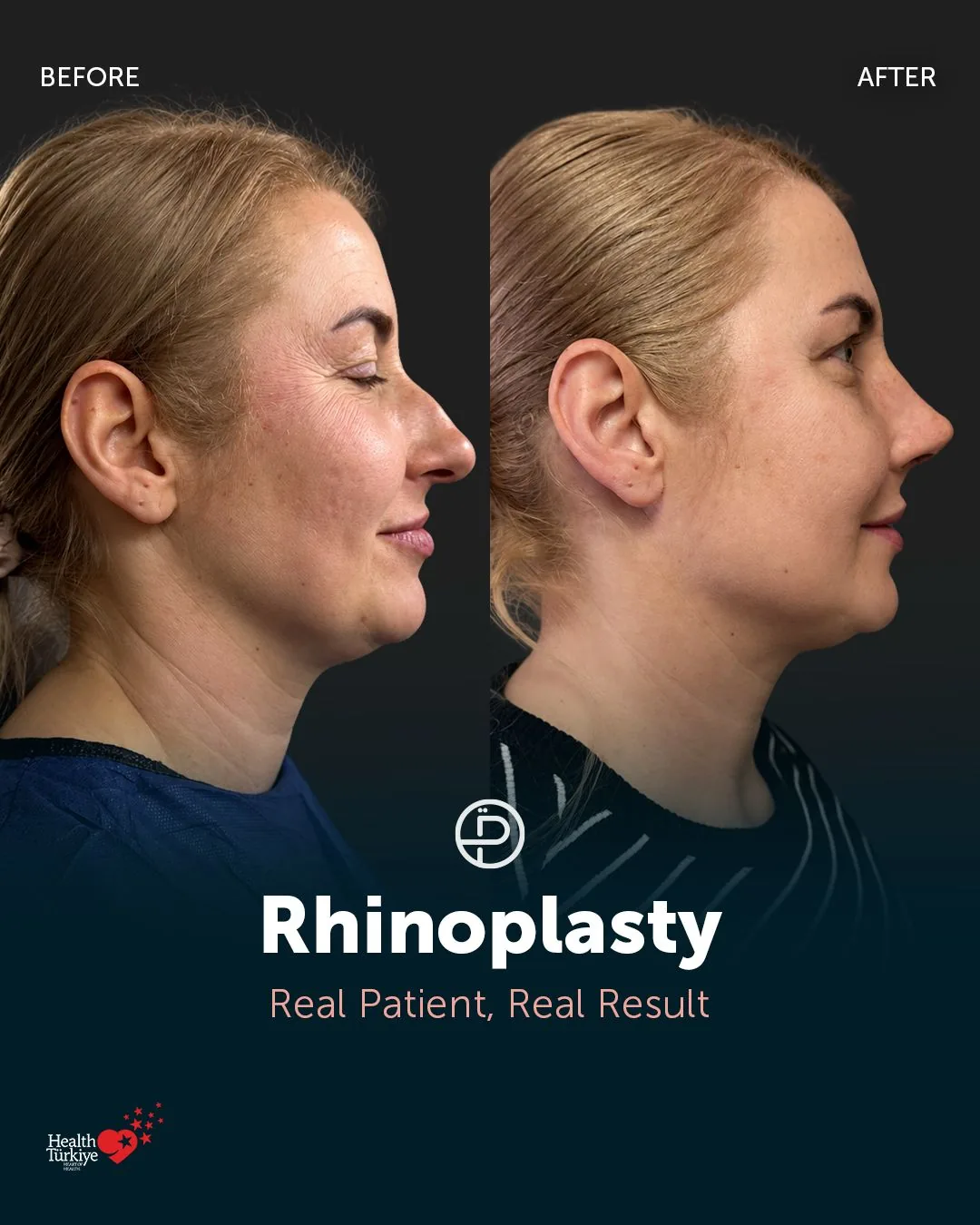
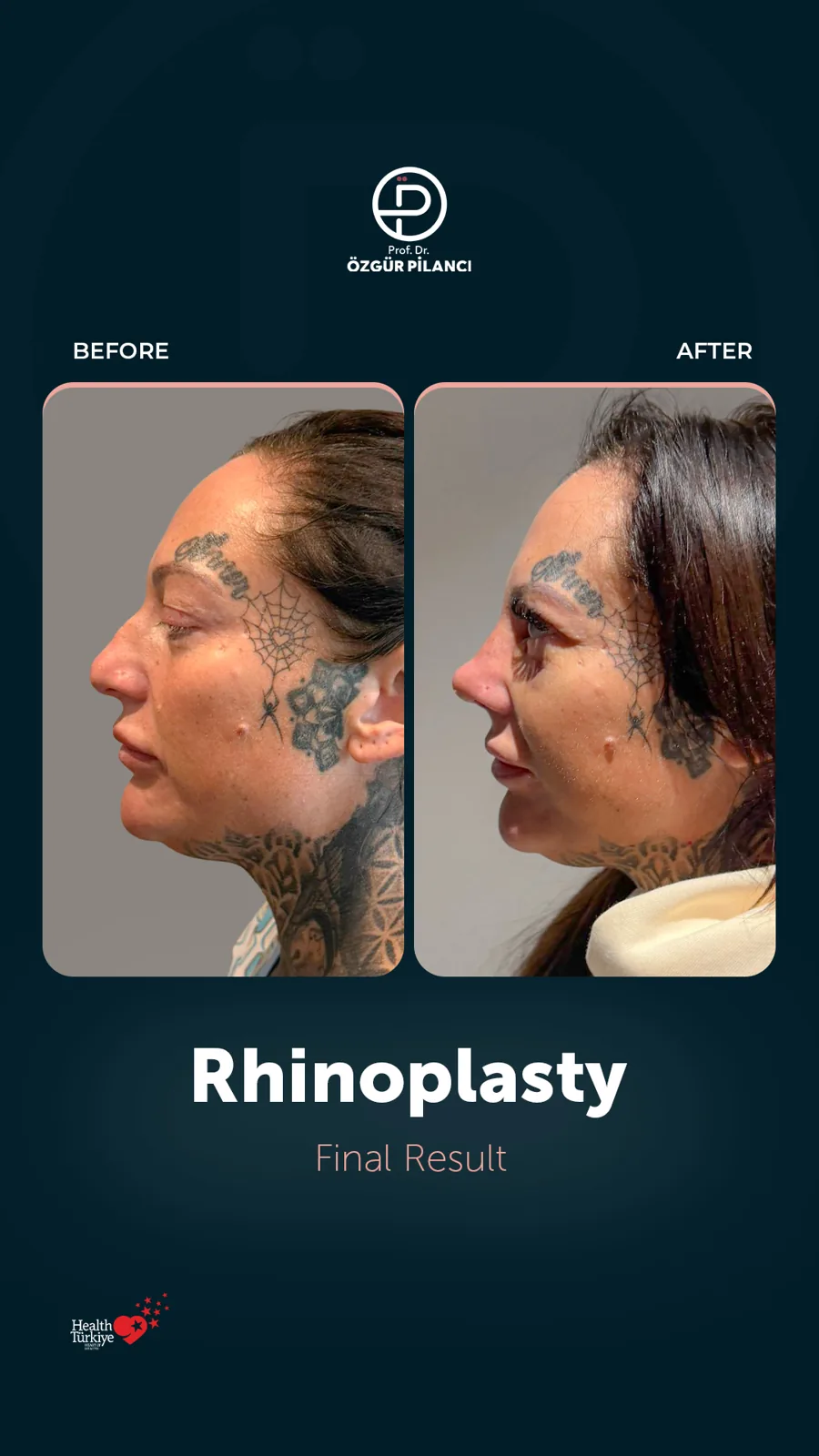
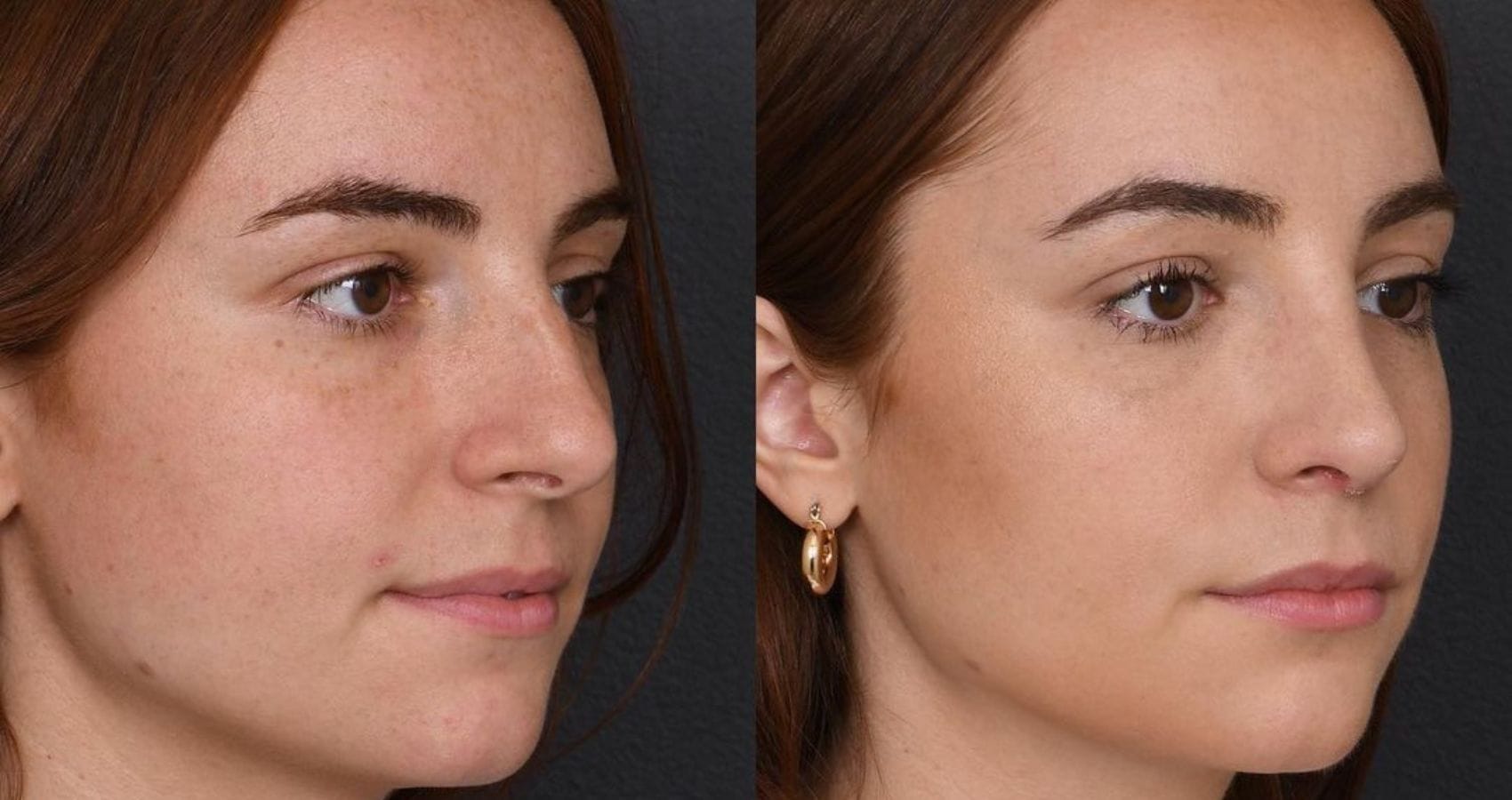

You can explore more cases in the full Vivid Clinic before and after gallery. To discuss your own profile, ask for a free quote and the team will arrange your consultation.
This article is for general information and does not replace a personal medical consultation. Suitability, risks, recovery and expected results should always be discussed with a qualified medical professional. Results vary by individual.