 ChatGPT

The Lift You Give Yourself in the Mirror
You have probably done it without thinking. Standing at the mirror, you gather your hair into a high ponytail and pull it tight, and for a second your brows sit higher, your cheeks look fuller and your eyes seem more awake. Then you let go, and everything settles back. That small mirror test is where the name ponytail lift comes from.
The appeal is obvious: a fresher face without an operated look, and incisions tucked away in the hair. But the name is a marketing label, not a single standard operation, and its meaning can differ from one clinic to the next.
This guide from Vivid Clinic in Istanbul, Turkey explains what the procedure involves, who it suits, who it does not, where the scars sit and what recovery looks like. If you would like a personal opinion on your own face, you can request a free consultation with a plastic surgeon before deciding anything.
What Is a Ponytail Lift?
Quick Answer: A ponytail lift is a popular name for an endoscopic lift of the brow, temple and midface, performed through small incisions hidden in the hairline. Guided by a slim camera, the surgeon releases and repositions deeper tissues upward instead of removing a strip of skin in front of the ear. It is not one standardised technique, so always ask exactly what is planned.
A Marketing Name, Not a Single Operation
The term spread through social media, and you will also see it written as ponytail facelift or ponytail face lift. None of these names has an official medical definition.
Surgeons use the label for somewhat different operations. Some mean an endoscopic brow and midface lift only, while others add work on the lower face or neck through extra incisions.
So the label matters less than the plan. Ask any surgeon which areas will be lifted, where the incisions will be and which tissue layer is moved.
How We Use the Term in This Guide
In this article, the term means an endoscopic mid facelift with temporal brow lift. This is an endoscopic facelift of the upper two thirds of the face: the outer brow, the temple and the cheek.
It does not directly treat the jawline or the neck.
Why the Brow and Midface Change First
For many people, the first signs of facial ageing appear in the middle of the face and around the eyes, not at the jawline. The fat pads of the cheek thin and slide downward, and the ligaments that hold soft tissue in place stretch. Genetics, sun exposure, smoking and large weight changes all influence how early this happens.
Early Signs People Notice
- The outer brow sits lower, which can make the eyes look heavier or more tired
- The cheek looks flatter, with less fullness over the cheekbone
- The fold between nose and mouth looks deeper
When these changes appear while the jawline and neck are still firm, a ponytail lift can make sense.
Who Is a Good Candidate for a Ponytail Lift?
Quick Answer: The best candidates for a ponytail lift are healthy adults, often in their 30s to 50s, with early descent of the brow and midface, good skin quality and a jawline and neck that are still reasonably firm. People with significant jowls, neck laxity or a lot of loose skin usually need a facelift or neck lift instead.
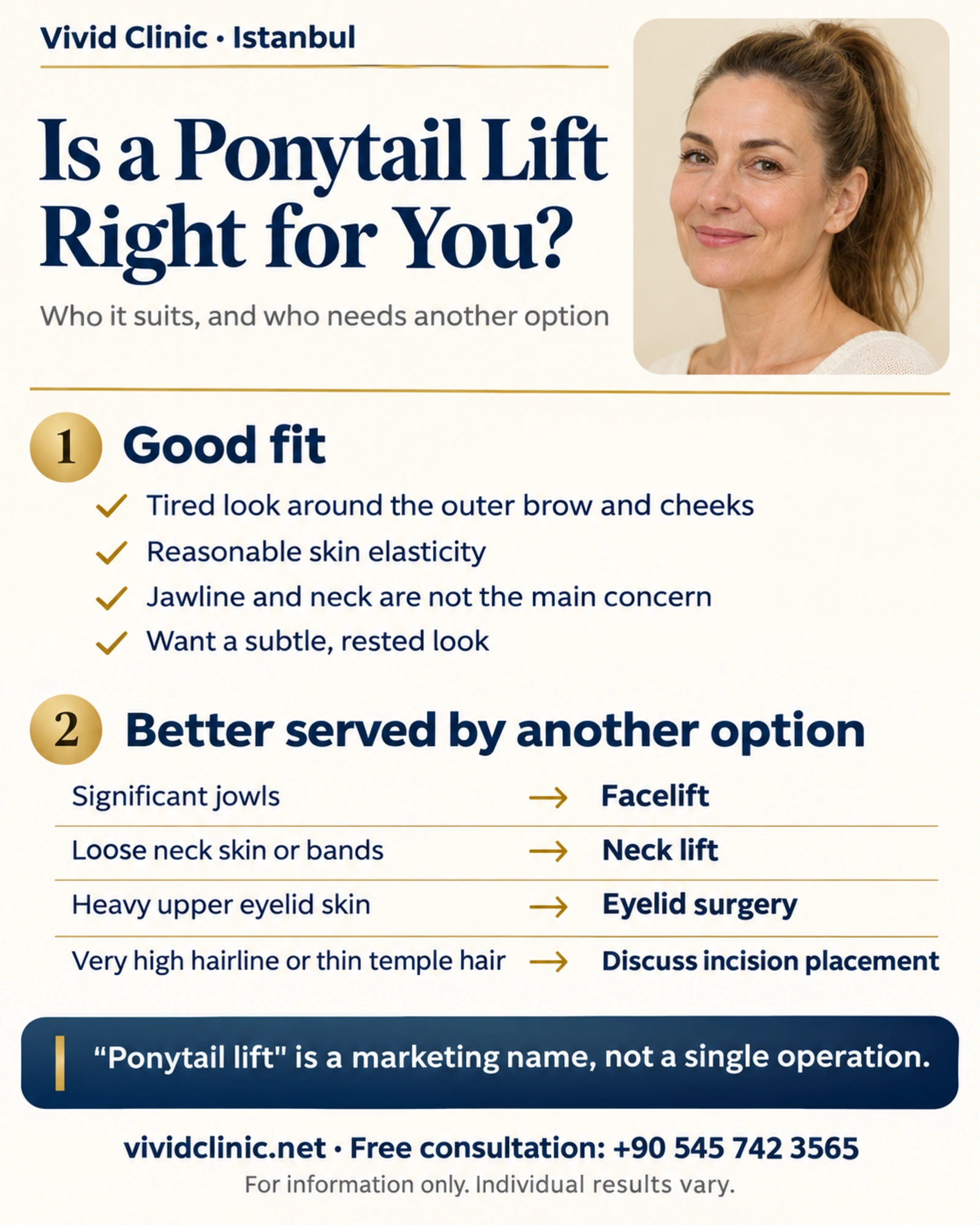
Signs You May Be a Good Fit
- Your main concern is a tired look around the outer brow, temples and cheeks
- Your skin still has reasonable elasticity
- Your jawline and neck do not bother you much
- You are in good health and do not smoke, or can stop well before surgery
- You want a subtle, rested look, not a different face
Who a Ponytail Lift Does Not Suit
This is the part marketing often leaves out. An endoscopic lift removes little or no skin and works mainly above the level of the mouth.
- Significant jowls or a blurred jawline: these usually need a facelift that lifts the lower face directly.
- Loose neck skin or neck bands: a neck lift, often together with a facelift, is the usual answer.
- Heavy upper eyelid skin: true excess eyelid skin may also need eyelid surgery.
- A very high hairline or thin temple hair: incision placement needs careful discussion.
Surgery is also not advised during pregnancy, with uncontrolled medical conditions, or for anyone who cannot stop nicotine.
Ponytail Lift vs Other Options
Not everyone who likes the mirror test needs surgery. A careful surgeon will tell you when a different option fits better.
When Surgery Is Not Needed Yet
If your changes are mild, good skin care, daily sun protection and stable weight may be all you need for now. Injectable treatments, such as wrinkle-relaxing injections around the brow or fillers for cheek volume, can give a temporary, modest improvement. They do not lift descended tissue, but they can be a sensible first step.
Thread Lifts
A thread lift uses dissolvable threads passed under the skin to pull it slightly upward, with little downtime. The lift is usually modest and tends to fade within months to a couple of years. Possible problems include dimpling, visible threads and asymmetry.
Mini Facelift
A mini facelift uses shorter incisions around the ear to tighten the lower cheek and early jowls, so it does little for the brow or the upper cheek. The two operations treat different zones. Our overview of facelift types explains how the main techniques compare.
SMAS and Deep Plane Facelift
When jowls and neck laxity are part of the picture, a full facelift is usually the honest recommendation. A SMAS facelift tightens the muscular layer under the skin, while a deep plane facelift releases and moves the deeper tissues as one unit.
Both use incisions around the ear and allow excess skin to be removed. Our deep plane vs SMAS facelift comparison explains the difference. Some patients combine an endoscopic upper lift with a lower facelift.
Brow Lift Alone
If your cheeks are still well supported and only the brows have dropped, a brow lift on its own may be enough.
How an Endoscopic Facelift Works
Consultation and Planning
Your surgeon examines brow position, cheek volume, skin quality, hairline, jawline and neck, and asks about your health. This is when you should hear plainly whether an endoscopic lift, a different facelift or no treatment suits your face.
Anaesthesia
This type of lift is usually performed under general anaesthesia in a hospital setting.
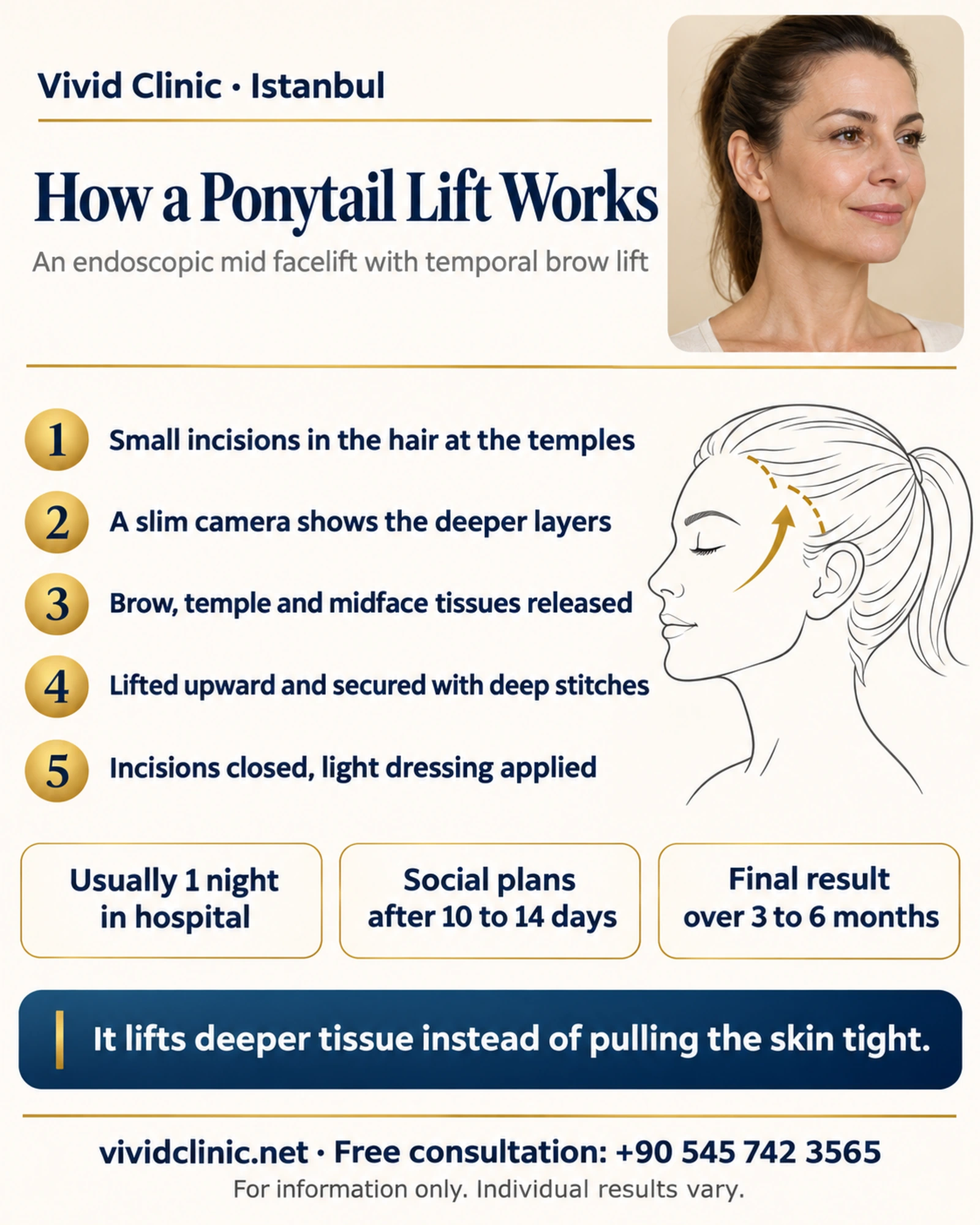
The Technique Step by Step
- Small incisions in the hair: a few short incisions are placed within the hair, mainly at the temples.
- Endoscopic view: a slim camera shows the deeper layers on a screen.
- Release: the tissues of the outer brow, temple and midface are freed from their deeper attachments, protecting the nerves that move the forehead.
- Repositioning: the brow and cheek are moved upward, in the direction a ponytail would pull, and secured with deep stitches or small fixation devices.
- Closure: the incisions are closed and a light dressing is applied.
Depending on technique and anatomy, a small additional incision inside the mouth or at the lower eyelid may be used to reach the midface.
Where Are the Scars?
Every incision heals with a scar. The advantage of a ponytail lift is where the scars sit: within the hair, where they are usually hard to see once healed. Read more on our page about the endoscopic mid facelift with hidden incisions.
Scar quality varies with skin type and healing. Temporary hair thinning around an incision can occur, and occasionally a small area of lasting hair loss.
Procedure Overview Table: Ponytail Lift (Endoscopic Mid Facelift With Temporal Brow Lift)
| Aspect | Details |
|---|---|
| Duration Process | About 2 to 4 hours; longer if combined with another procedure |
| Hospitalization Duration | Usually 1 night |
| Mobility Duration | Gentle walking the same day or the next day |
| Return to Activity | Desk work and social plans after about 10 to 14 days; strenuous exercise after 4 to 6 weeks |
| Complete Recovery | 6 to 8 weeks for most swelling to settle; mild swelling or numbness can last a few months |
| Anticipated Results | Early shape visible within 3 to 4 weeks, final result over 3 to 6 months |
Timings are general estimates. Results vary by individual.
Ponytail Lift Recovery Timeline
Quick Answer: Most people feel ready for desk work and social plans about 10 to 14 days after a ponytail lift. Swelling is most noticeable in the first two weeks, and the brows may look a little high at first. The final result settles gradually over three to six months.
First 24 to 48 Hours
Expect swelling around the eyes, cheeks and temples, with tightness and some bruising. You rest with your head elevated, and most patients stay one night in hospital.
First Week
Swelling often peaks around day two or three and then begins to ease. Light walking is encouraged, and many people manage short outings by the end of the week.
Weeks Two to Four
Stitches or clips in the scalp are usually removed within about 7 to 14 days. Bruising fades, and many people return to work. The brows and cheeks can still look slightly overlifted or uneven while swelling settles.
Months Two to Six
Remaining swelling resolves, and numbness or tingling in the scalp and forehead usually improves. This is when the final result becomes clear, and healing speed differs from person to person.
Ponytail Lift Results: What to Expect
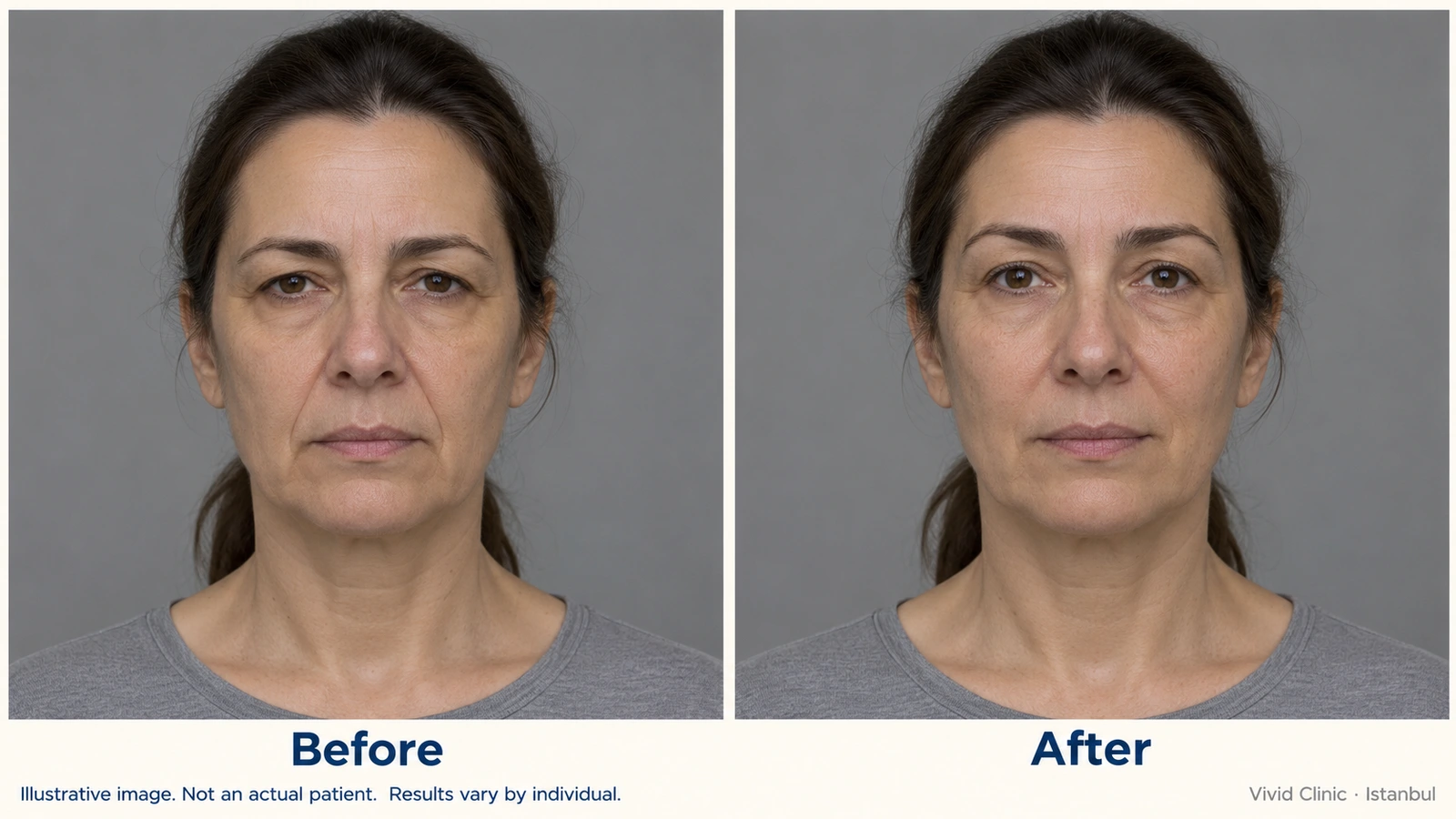
A well-planned result looks rested, not operated: a gently higher outer brow, a more open eye area and fuller cheeks sitting closer to the cheekbone.
The change is meant to be subtle. If you hope for a sharper jawline or a tighter neck, this operation alone will not deliver that.
Results can last for years, but ageing continues, and no surgeon can promise how long a result will hold.
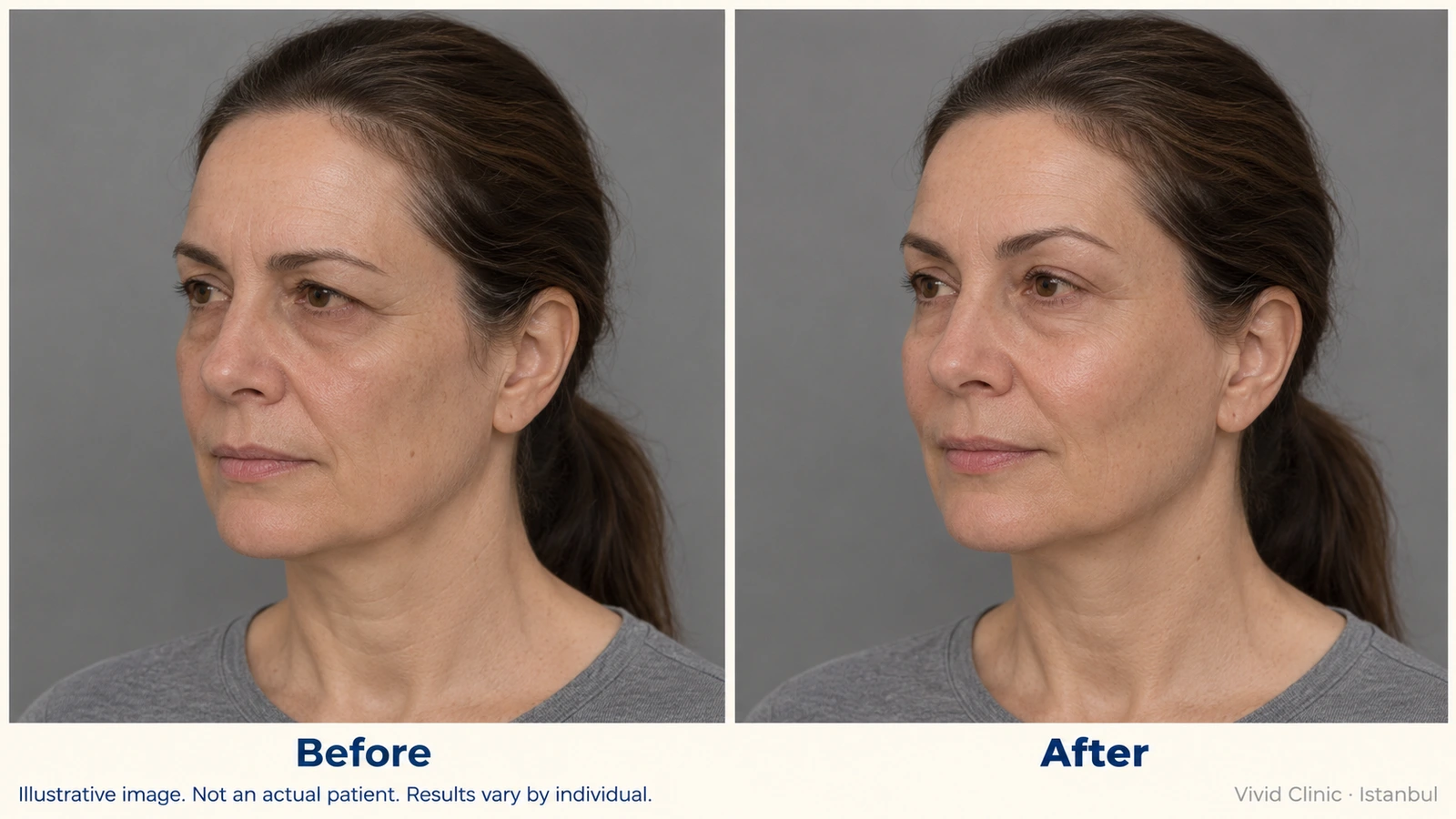
Photos can show the type of improvement that may be possible, but individual results vary. See our guide to mid face lift before and after results and the Vivid Clinic before and after gallery for related cases.
Benefits of a Ponytail Lift
- Addresses the brow, temple and cheek together
- Incisions hidden within the hair, away from the front of the ear
- Repositions deeper tissue instead of pulling the skin tight
- Can be combined with eyelid surgery or a lower facelift when needed
Benefits vary by anatomy, and this lift does not replace a full facelift.
Possible Risks and Side Effects
Every operation carries risk. Common, usually temporary effects include swelling, bruising, tightness and numbness of the scalp and forehead.
Less common risks include:
- Bleeding, infection or delayed wound healing
- Weakness of a facial nerve branch affecting brow movement, usually temporary and rarely lasting
- Hair thinning or hair loss around the incisions
- Asymmetry, overcorrection or undercorrection, sometimes requiring a revision
- Risks of general anaesthesia and, rarely, blood clots
Discuss your personal risk profile with your surgeon before you decide.
How to Prepare for Surgery
- Share your full medical history, medications and supplements, and ask whether any should be paused.
- Stop smoking and all nicotine products well before surgery, as instructed.
- Avoid colouring your hair shortly before the operation.
Aftercare Tips for a Smoother Recovery
- Sleep with your head elevated for the first one to two weeks.
- Wash your hair gently when allowed, and delay hair dye until cleared.
- Avoid heavy lifting and strenuous exercise until you are cleared.
- Seek advice quickly for increasing pain, sudden one-sided swelling, fever or spreading redness.
Ponytail Lift Cost Factors in Istanbul, Turkey
Quick Answer: The cost of this surgery depends on what is actually planned: the areas lifted, operating time, hospital setting, anaesthesia, the surgeon’s experience, any combined procedures and what your travel package includes. A personalised quote follows your consultation.
The main cost factors are:
- Whether the plan covers brow, temple and midface, or adds eyelids, lower face or neck
- Length and complexity of the operation
- Hospital stay and general anaesthesia
- Medications and follow-up visits
- Accommodation, VIP transfers and the length of your stay
For an early idea, try the surgery price calculator.
Why Choose Vivid Clinic for a Ponytail Lift?
Quick Answer: Vivid Clinic offers anatomy-led planning in Istanbul, Turkey, clear advice about when an endoscopic lift is or is not the right operation, and organised support for international patients from first contact to remote aftercare.
At Vivid Clinic, the plan starts with your face, not with a trend. If a facelift would serve you better, you will hear that plainly. You can meet our doctors and begin with a free consultation with a plastic surgeon before you commit to anything.
What International Patients Can Expect
Most people plan around 8 to 10 days in Istanbul for a ponytail lift; combined procedures can need longer. Before you travel, the team reviews your photos and medical history.
Operation Process Overview at Vivid Clinic
Your journey with Vivid Clinic begins when you arrive in Istanbul, where a VIP airport transfer takes you to your 5-star hotel for check-in and time to rest. Next comes your one-on-one consultation, where the surgeon examines your brow position, midface, skin quality, hairline, jawline and neck, and explains whether an endoscopic lift, a different facelift or no surgery at all suits you. On surgery day, every step is planned carefully for comfort, safety and a natural look. Post-operative care starts straight away, with monitoring in hospital, written instructions and a direct contact line. A checkup visit before your departure confirms that healing is on track, and remote aftercare follow-up continues once you are back home.
FAQs
How long should I stay in Istanbul for a ponytail lift?
For an endoscopic brow and midface lift on its own, most people plan around 8 to 10 days in Istanbul. That allows a day for arrival and consultation, the operation with one night in hospital, several days of early recovery in your hotel and a checkup before flying home. Swelling is usually most visible during the first week. If the surgery is combined with eyelid surgery, a facelift or a neck lift, a longer stay may be advised. Your Vivid Clinic coordinator will suggest dates once your plan is clear.
Is a ponytail lift the same as a mini facelift?
No. A ponytail lift, as described in this guide, is an endoscopic lift of the outer brow, temple and midface through small incisions in the hair. A mini facelift uses shorter incisions around the ear to tighten the lower cheek and early jowls. They treat different zones, so one does not replace the other. Someone with a tired upper face and a firm jawline may suit the endoscopic approach, while someone with early jowls may be better served by a mini facelift or a fuller facelift. Ask any surgeon exactly which areas they plan to treat.
Where are the scars after a ponytail lift?
With a ponytail lift, the main incisions are placed within the hair-bearing scalp, usually at the temples, so the resulting scars are generally hidden by your hair once healed. Depending on the technique, a small incision inside the mouth or at the lower eyelid may also be used to reach the midface. Every incision leaves a scar, and how it heals depends on your skin and aftercare. Temporary hair thinning near an incision can occur. If the plan also includes the lower face or neck, expect additional incisions around the ear.
Can a ponytail lift fix jowls or a sagging neck?
Usually not. A ponytail lift works mainly on the upper two thirds of the face, lifting the outer brow, temple and cheek. It removes little or no skin and does not directly tighten the jawline or neck. Significant jowls, loose neck skin or neck bands generally need a facelift, a neck lift or both, with incisions around the ear. Some patients combine an endoscopic upper lift with a lower facelift in a single operation. An honest assessment at consultation helps you avoid an operation that cannot reach your main concern.
What affects the cost of a ponytail lift in Istanbul?
The cost of a ponytail lift depends on your individual plan, and because the name covers different operations, the plan matters more than the label. The main factors are which areas are lifted, the length and complexity of surgery, the hospital setting, general anaesthesia and the surgeon’s experience. Adding eyelid surgery, a lower facelift or a neck lift changes the total. Travel package elements such as hotel nights and VIP transfers also play a part. Vivid Clinic provides a personalised quote after reviewing your photos and goals.
Conclusion
A ponytail lift can be a good choice when the brow, temple and midface have started to descend while the jawline and neck are still firm. It offers a subtle, rested look through incisions hidden in the hair, but it is a marketing name, and it is not the right answer for significant jowls or loose neck skin.
Vivid Clinic in Istanbul, Turkey offers a free consultation with a plastic surgeon to help you understand your options with no pressure. Request your free consultation and get a personal view of what this surgery can and cannot do for you.
Real Before and After Results at Vivid Clinic
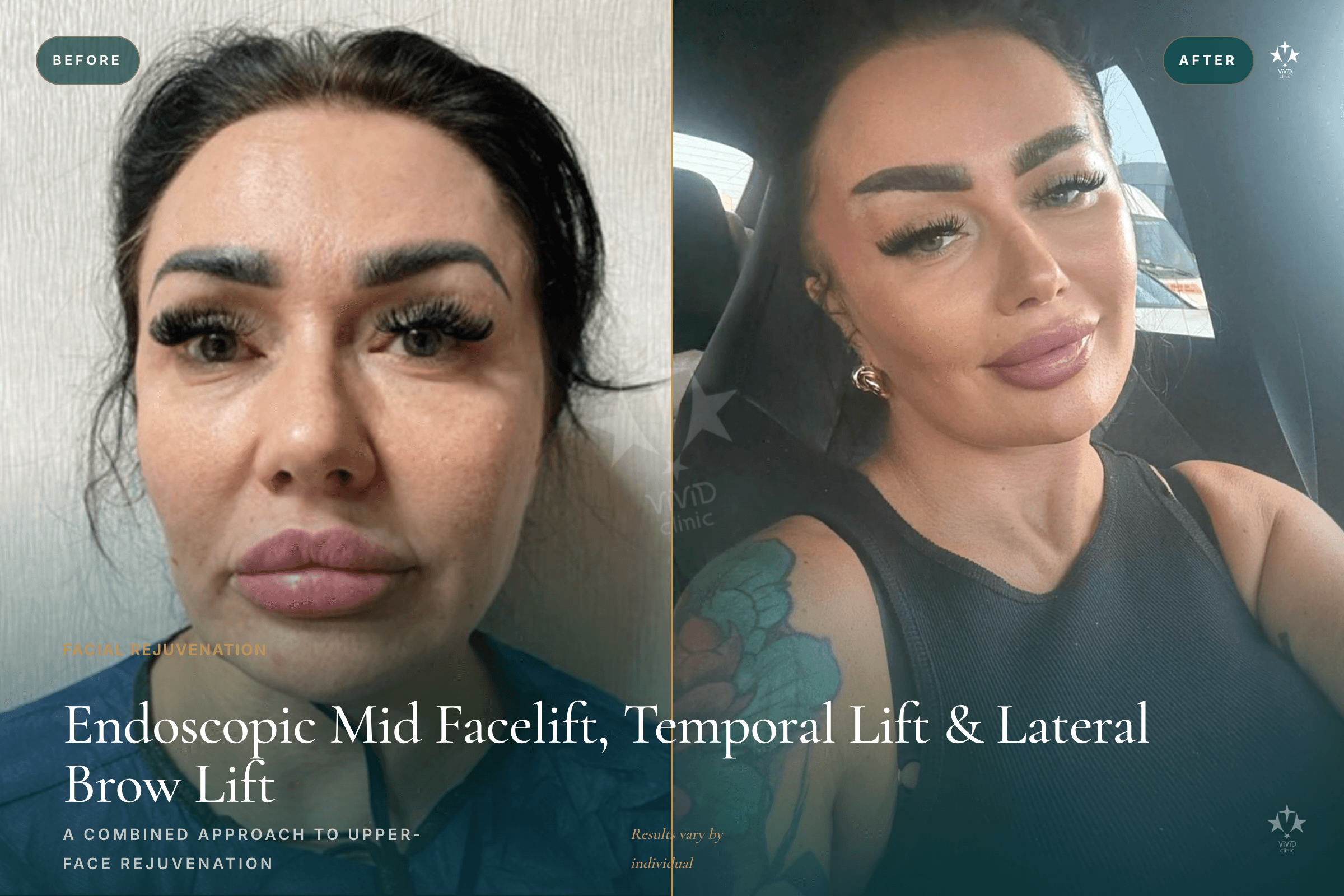
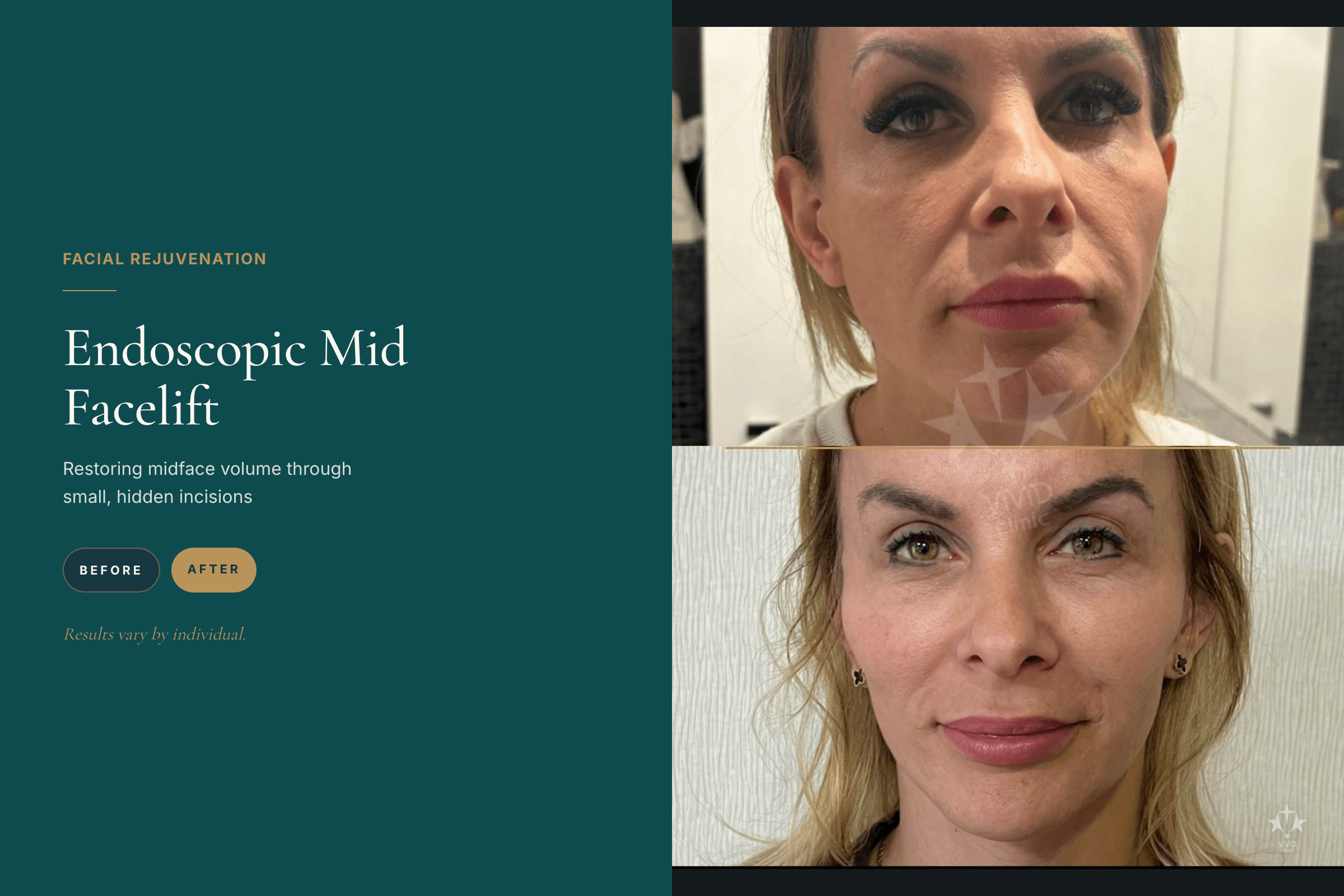
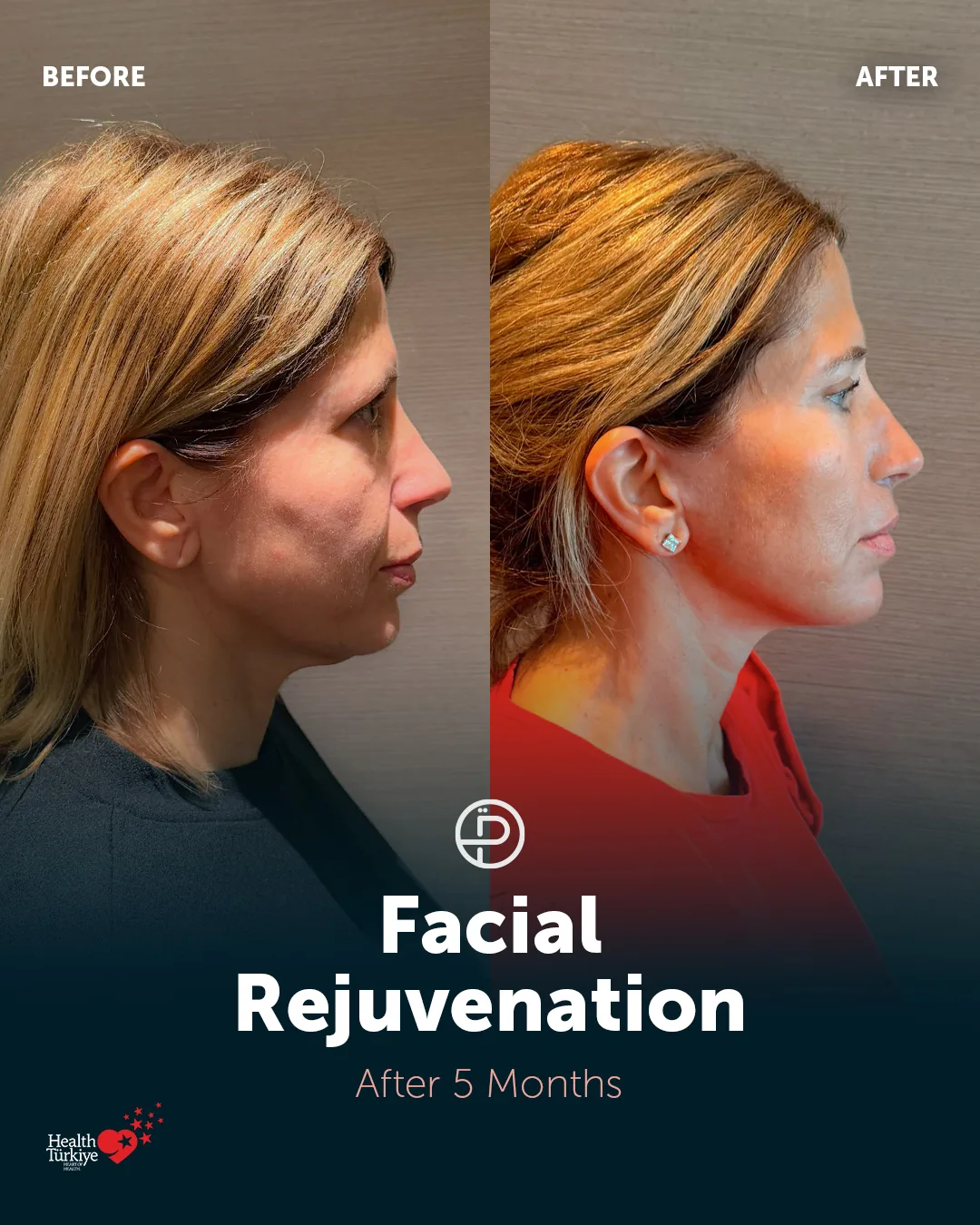
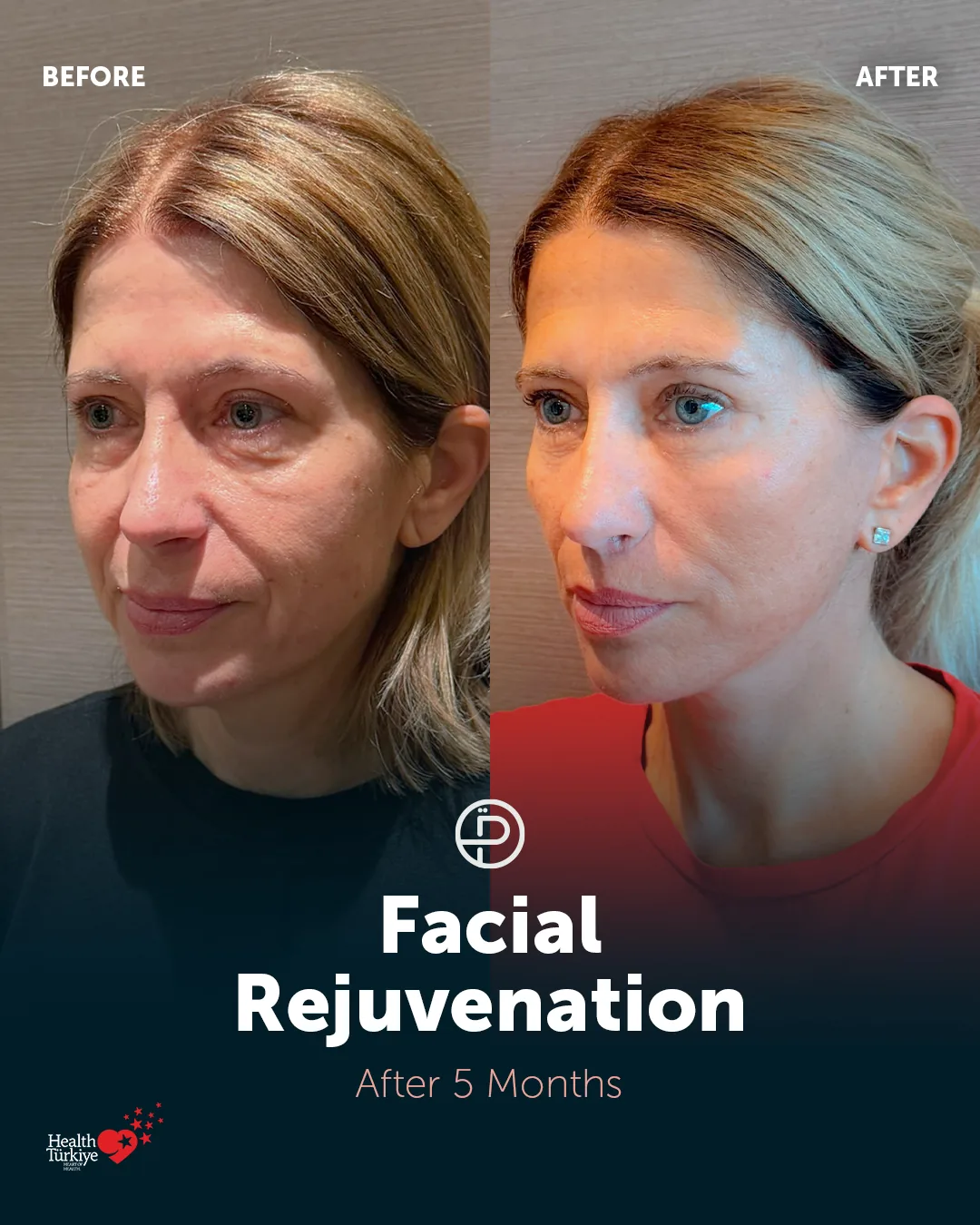
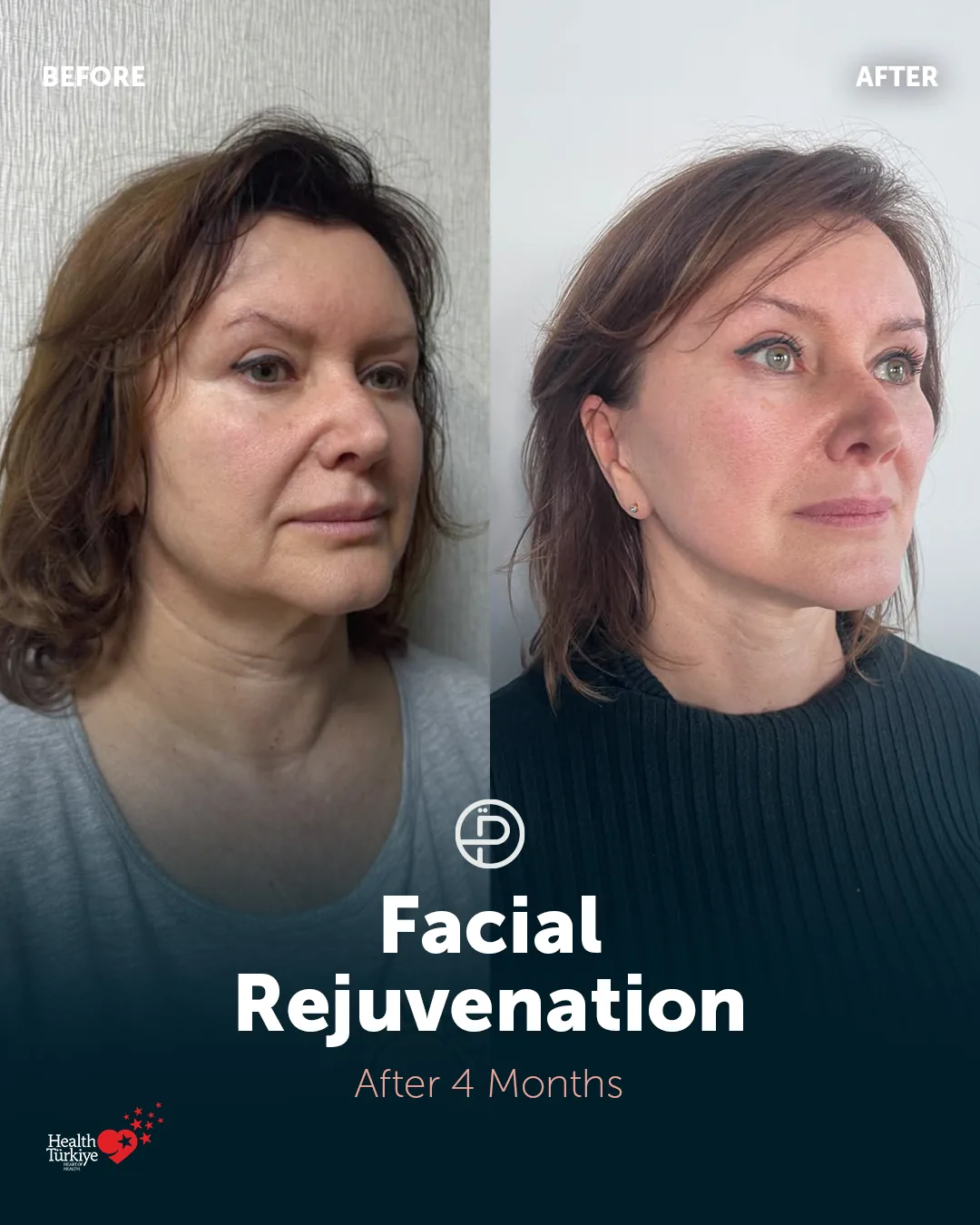
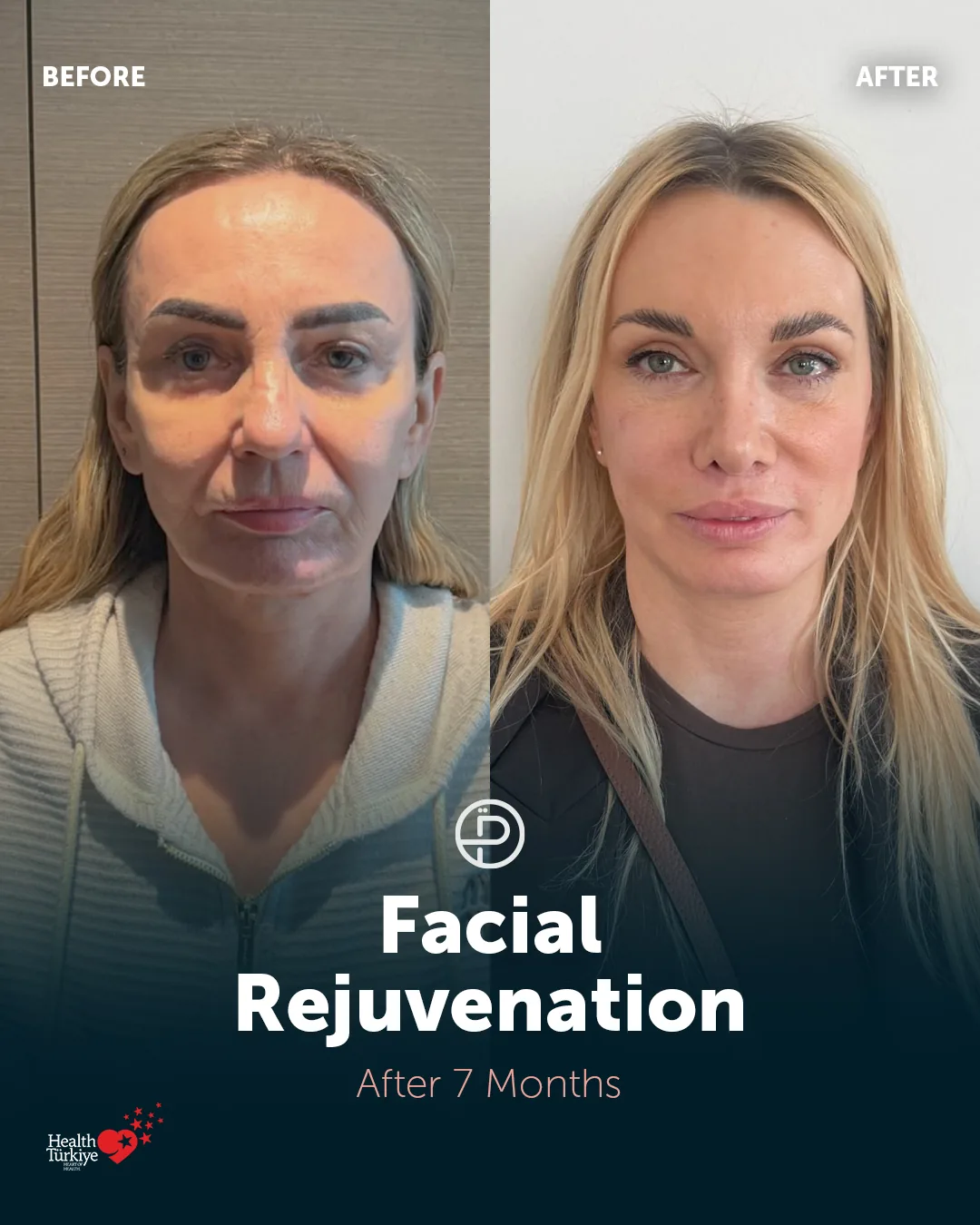
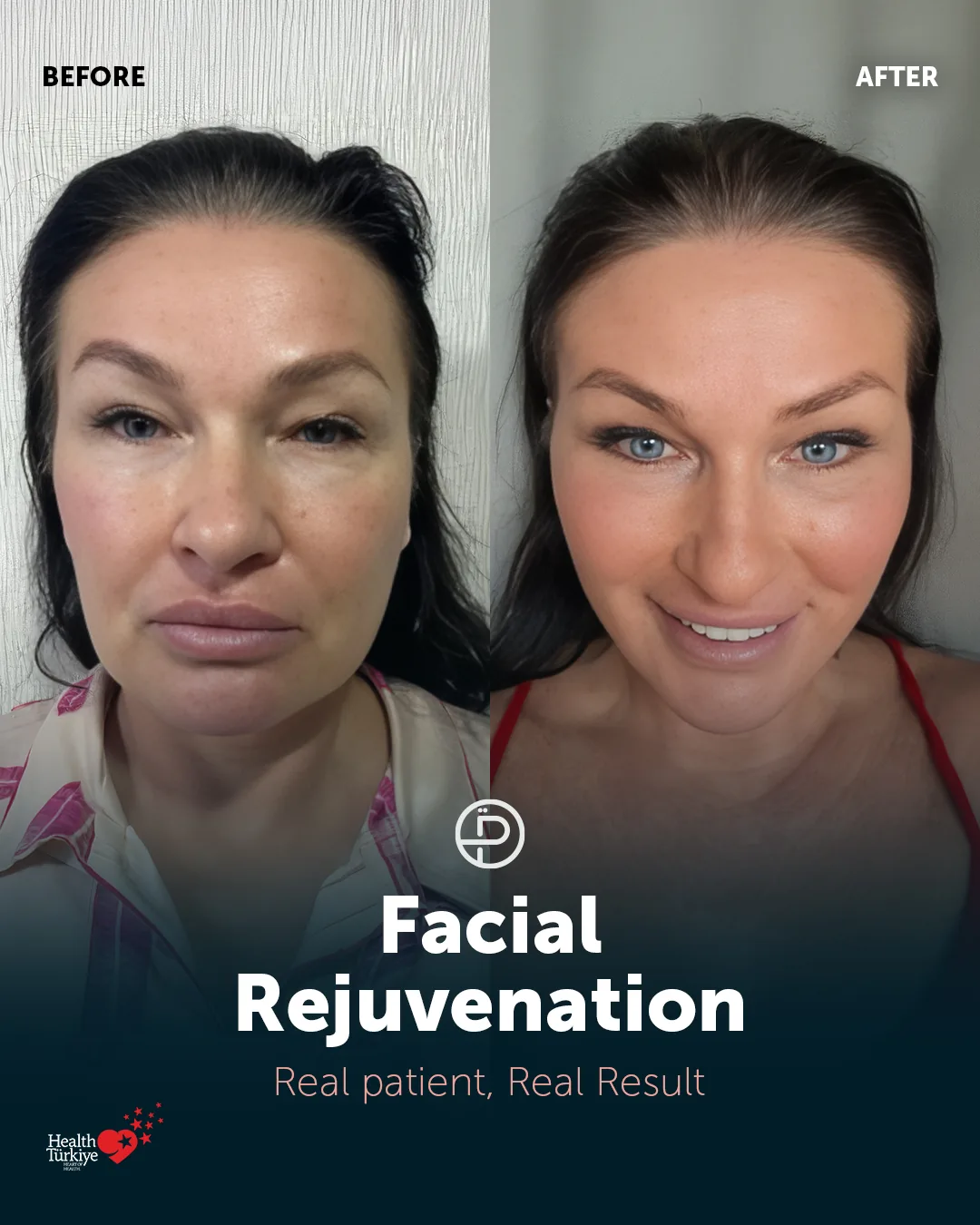
The photos below show real Vivid Clinic patients from the clinic’s own gallery, shared with consent as published on the clinic site. The first two are endoscopic mid facelift cases, one combined with a temporal lift and lateral brow lift, which is the combination this guide calls a ponytail lift. The others are related facial rejuvenation cases. Results vary by anatomy, healing and treatment plan.
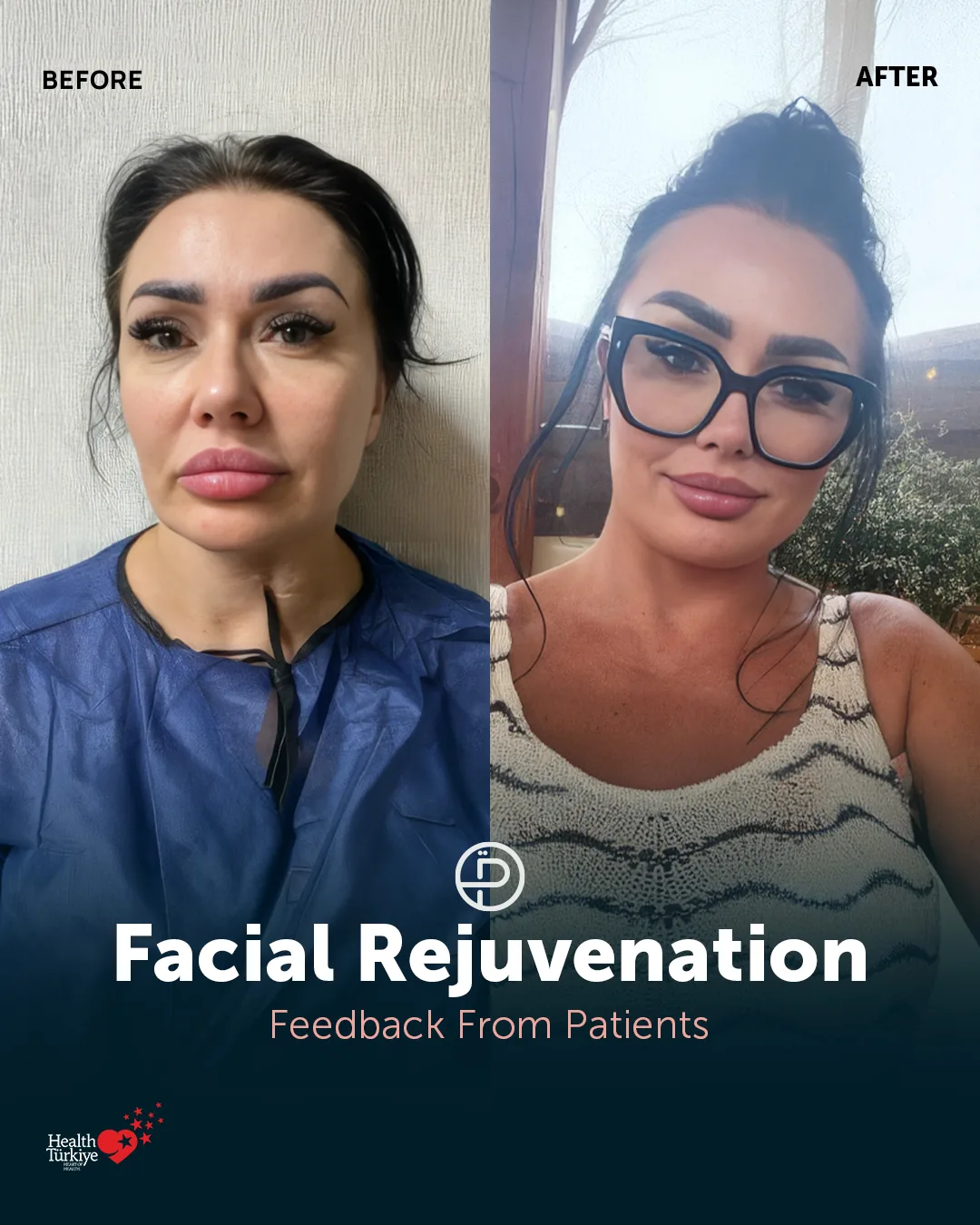
You can explore more cases in the full Vivid Clinic before and after gallery. To discuss your own face, ask for a free quote and the team will arrange your consultation.
This article is for general information and does not replace a personal medical consultation. Suitability, risks, recovery and expected results should always be discussed with a qualified medical professional. Results vary by individual.