
 ChatGPT

Medically reviewed by Prof. Dr. Özgür Pilancı, Plastic, Reconstructive & Aesthetic Surgeon — August 2026
Quick answer (updated August 2026): Understanding facelift types starts with one question: which tissue layer does the surgeon actually lift? Facelift techniques differ mainly in how deep the surgeon works. A SMAS facelift lifts and tightens the fibrous layer under the skin, either by folding it (plication) or by cutting and advancing it. A deep plane facelift goes beneath that layer and releases the ligaments tethering the cheek to the bone, which is what allows the midface and nasolabial fold to move. A mid-face lift repositions the cheek only, often endoscopically. A “ponytail facelift” is a marketing name for an endoscopic lift through hidden temporal incisions — it lifts, but it cannot remove loose skin. None of them lifts the neck on its own.

The one thing that explains every facelift technique
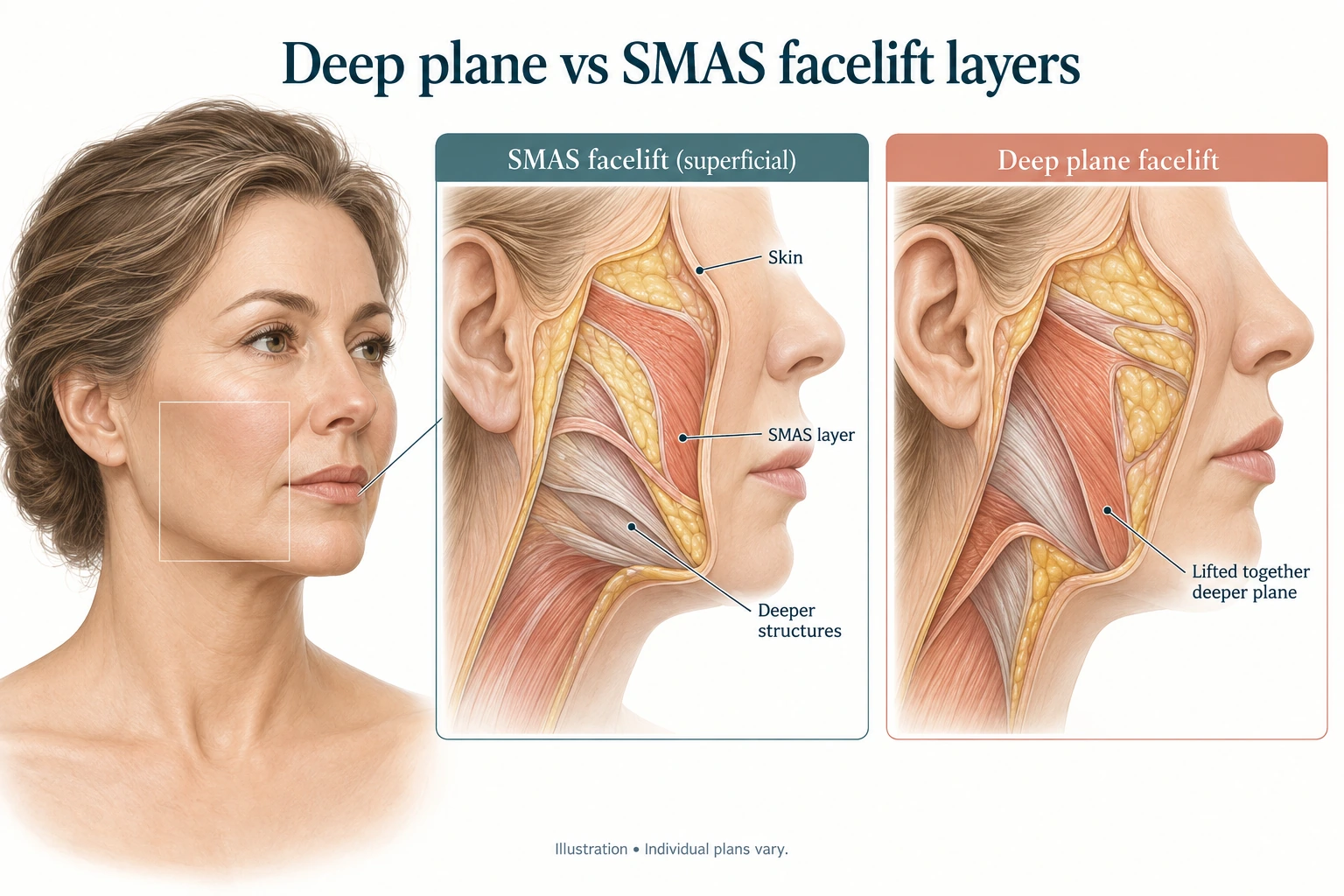
Under the skin of your face sit distinct layers, and every facelift is defined by which one the surgeon works in.

Directly beneath the skin is a thin layer of fat. Below that is the SMAS — the superficial musculoaponeurotic system — a fibrofatty sheet that covers the parotid gland and masseter muscle at the side of the face and wraps the muscles of facial expression further forward. It is continuous with the platysma muscle in the neck below and with the temporoparietal fascia above the cheekbone. Deeper still are the facial nerve branches, the deep fascia and the bone.
Anchoring all of this to the skeleton are the retaining ligaments — the zygomatic ligament over the cheekbone (the strongest), the masseteric ligament along the jaw muscle, the maxillary ligament and the mandibular ligament. They are the reason a face sags in a specific pattern rather than sliding uniformly downward, and they are the reason the tissue between them will not move unless they are released.
That is the whole argument between techniques. Work above the SMAS and you are moving skin. Work on the SMAS and you are moving the sheet the skin sits on. Work under the SMAS and divide the ligaments, and you can move the cheek itself.
Skin-only facelifts, and why surgeons moved on
The earliest facelifts lifted skin alone, undermining it and pulling it tight. The technique is largely historical now for one reason: skin is elastic. Tension placed on skin stretches out, so results faded relatively quickly, and the tension needed to produce a visible change tended to distort the ear and the hairline — the tell-tale “pulled” look most people are trying to avoid.
Modern techniques all share the same principle: suspend the deeper layer and let the skin drape over it without tension. That is what makes a good facelift look unremarkable.
SMAS facelift
The SMAS facelift is the workhorse of facial rejuvenation and still the most commonly performed technique worldwide. The skin is elevated as a flap, the SMAS underneath is tightened, and the skin is redraped with the excess trimmed.
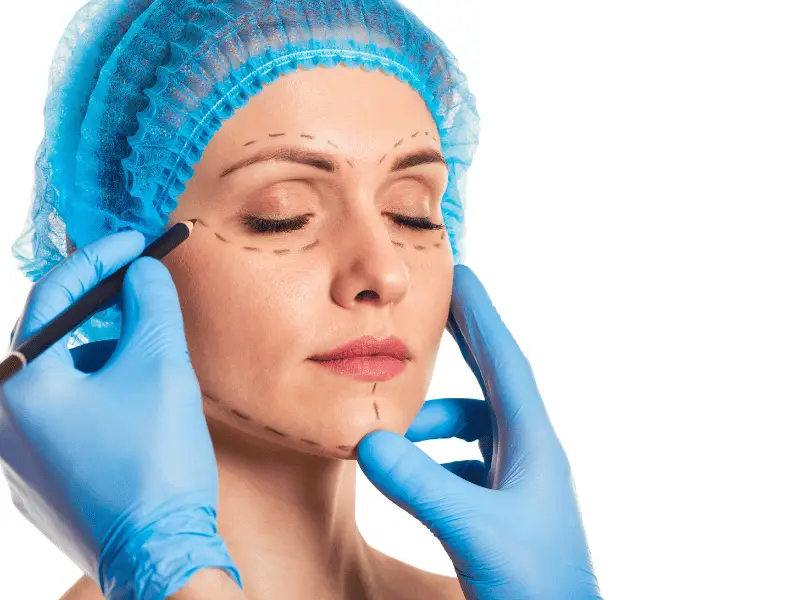
Surgeons tighten the SMAS in several ways.
Plication folds the SMAS onto itself and holds it with sutures, lifting in an upward-and-outward direction. It is quick, safe and keeps the surgeon well away from the facial nerve.
Imbrication cuts the SMAS, advances it and often removes a strip to avoid bulk — a stronger pull than plication.
Extended SMAS raises the SMAS as a separate flap beneath the skin flap, carrying the dissection further forward toward the cheek so more of the midface moves.
SMAS transposition turns a flap of SMAS backward and anchors it to the mastoid periosteum behind the ear, which is particularly useful along the jawline and upper neck.
What it does well. Jowls, the jawline, the lower cheek and the upper neck — the complaints that bring most people to a facelift in the first place. Jowling comes largely from descent of the buccal fat pad distorting the jaw contour, and a SMAS lift addresses it directly.
Its limits. Standard SMAS techniques do relatively little for the midface and the nasolabial fold, because those tissues stay tethered by ligaments the surgeon has not released. If your main complaint is a deep nasolabial fold or a flattened cheek, a straightforward SMAS lift may under-deliver.
You can see how facial rejuvenation decisions read on real faces in our before-and-after gallery, and our facelift page covers what the operation involves at our clinic.
Deep plane facelift
The deep plane facelift dissects beneath the SMAS, in the plane between the SMAS and the fascia over the parotid and masseter, and divides the zygomatic, maxillary, masseteric and mandibular retaining ligaments. Skin and SMAS are then lifted as one composite unit rather than as two separate layers.

Why surgeons favour it. Releasing the ligaments is what actually mobilises the malar fat pad, so the midface and the nasolabial fold genuinely reposition rather than merely tightening at the edges. Because the lift is carried by fascia rather than skin, closure is tension-free, which tends to produce a more natural result and a more durable one. The deeper plane also preserves the blood supply to the skin flap better than superficial dissection — which is why deep plane techniques are often preferred where healing is already compromised, including in smokers.
Its costs. It is technically harder and takes longer, and the dissection runs closer to the facial nerve branches. In experienced hands the published complication figures are reassuring — hematoma under 2%, skin ischaemia and permanent facial nerve injury each under 1% — but “in experienced hands” is doing real work in that sentence. Deep plane surgery is a case where surgeon selection matters more than technique selection.
A composite facelift extends the same idea upward, additionally mobilising the fat pad under the eye muscle (the SOOF) to soften the junction between the lower eyelid and the cheek.
Mid-face lift and the “ponytail facelift”
A mid-face lift — also written midface lift — targets one region: the cheek. It elevates the malar soft tissue, usually in the subperiosteal plane against the bone, and is frequently performed endoscopically through small incisions in the temporal hairline, sometimes combined with a lower eyelid approach.
The ponytail facelift is the same family of operation under a name invented for marketing. It is worth saying plainly, because patients searching the term deserve to know: ponytail facelift is not a medical classification. It describes the effect — the lifted look you get when you pull your hair back tightly — and the technique behind it is endoscopic lifting of the midface and outer jowl through incisions concealed in the scalp and temporal hairline.
What it genuinely offers. No visible incision in front of the ear. A shorter recovery than a full facelift. Restored fullness over the cheekbone, which is much of what makes a face read as younger from the front.
What it cannot do, and this is the crux. Small hidden incisions give the surgeon nowhere to remove skin. The procedure repositions tissue upward; it does not excise anything. So it suits a younger patient with early volume descent and good skin quality — someone with fallen cheeks but not loose skin, jowls or a slack neck. Used on the wrong patient it delivers a modest lift and leaves the actual complaint untouched. Recognised trade-offs also include hair thinning near the scalp incisions.
Half face lift and jowl lift are used loosely for various limited-scope operations, usually short-scar procedures addressing the lower face only. Ask exactly what plane and what incision any branded name refers to — the answer tells you what it can achieve.

Short-scar and MACS lifts
Between the limited endoscopic lift and the full facelift sit the short-scar techniques, of which MACS (minimal access cranial suspension) is the best known. It uses shortened incisions around the ear and two or three purse-string suture loops anchored upward to the temporalis fascia, producing a mainly vertical lift.
Operating time and recovery are shorter than with a full technique, and the scar is shorter. The lift is correspondingly less powerful and generally less durable, and it does comparatively little for the neck. For a patient in their forties with early jowling and firm skin, that trade can be an entirely reasonable one.
What no facelift does
Three honest limits, each of which sends people to the wrong operation.
A facelift does not lift the neck by itself. Loose neck skin and platysmal banding need neck-lift work, typically through an incision behind the ear and often a small one under the chin. The two operations are usually combined, and our neck lift page explains that side.
A facelift does not lift the brow or the eyelids. The forehead, brow position and hooded upper lids are separate territory, addressed by a forehead lift and eyelid surgery respectively.
A facelift does not replace lost volume, and it does not change skin quality. Repositioning tissue is not the same as adding it, which is why facelifts are so often combined with fat grafting. And sun damage, fine lines and pigmentation are surface problems that surgery leaves exactly as it found them; they need resurfacing or skincare.
Recovery, risks and how long results last
Anaesthesia is general or intravenous sedation, depending on the technique, the extent of the surgery and the surgeon’s preference. The American Society of Plastic Surgeons publishes independent patient information on facelift surgery.
A representative recovery, drawn from published deep plane series, looks like this: dressings for the first 24 hours, drains removed at about a day, head elevated for a week, sutures out at roughly a week, and activity restrictions for around two weeks. Discomfort around the incisions is typically worst for the first three or four days.
Bruising and swelling dominate the first fortnight; most patients are socially presentable somewhere between two and four weeks. Numbness around the ears and cheeks is normal early on and settles over months. Surgeons formally assess the result at six to twelve months, because that is genuinely how long the last of the swelling and scar maturation takes.
Risks. Hematoma is the most common complication, reported anywhere from 0.2% to 8% across techniques, and is much more likely in men and in patients whose blood pressure is not tightly controlled — keeping systolic pressure under about 120 mmHg after surgery has been shown to cut the rate substantially. Facial nerve injury runs at roughly 0.7% to 2.5%, and permanent injury is rare; the great auricular nerve is the one most often affected, causing numbness of the lower ear.
Skin necrosis affects under 1%, and smoking is the dominant risk factor — one classic series reported skin sloughing in 7.5% of smokers against 2.7% of non-smokers. Infection is uncommon because the face is so well supplied with blood.
Longevity. A facelift does not stop ageing; it resets your starting point. Deep plane techniques are generally held to last longer than skin-based or plication-based ones because the lift is carried by released, repositioned fascia rather than by tension. Everyone continues to age from wherever the surgery leaves them.

How to read a facelift before-and-after
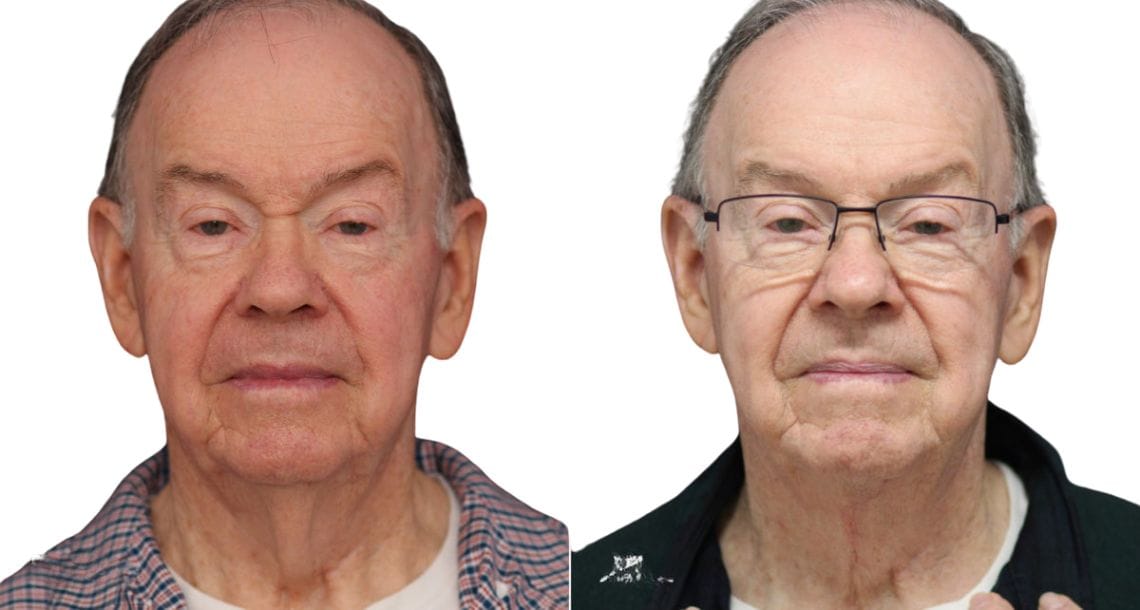
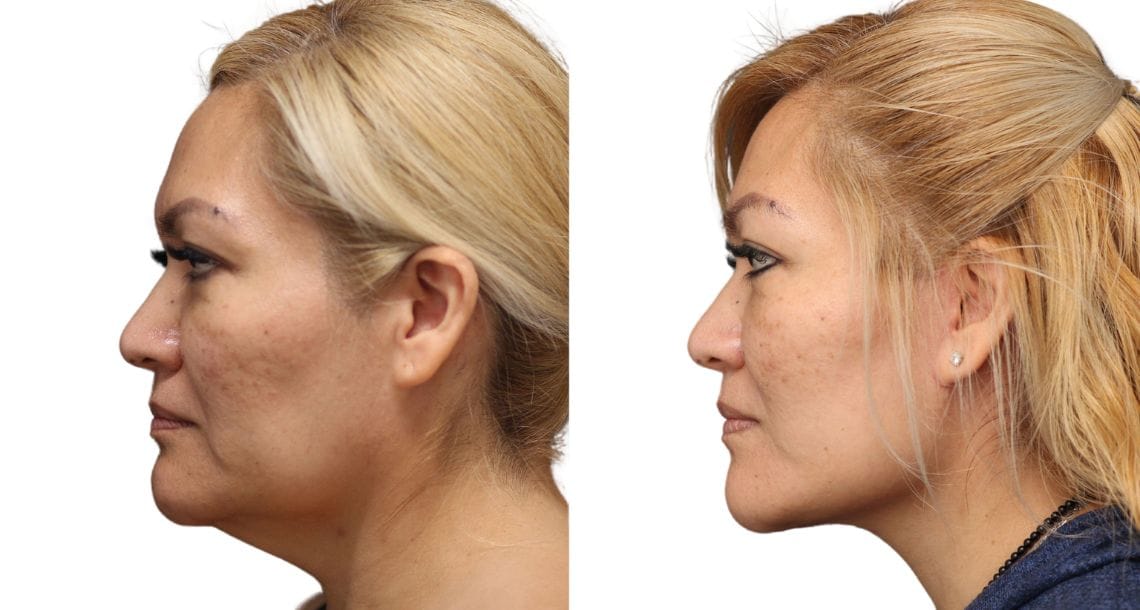
Look for the same head position, distance and lighting in both photographs — a lifted chin and a softer light will manufacture a result no surgeon produced. Look for images taken at six months or later, because at six weeks everyone still looks tight and slightly swollen. Check the earlobe and the hairline: a stretched, forward-pulled lobe or a hairline displaced backward is the signature of skin-tension technique. And look for patients whose starting anatomy resembles yours — a face with heavy jowls and thick skin does not follow the same trajectory as a thin one with early laxity.
Both patients below combined more than one procedure in the same operation, which is typical at Vivid Clinic since a deep plane lift alone will not correct the mid-face, nasal profile or upper eyelids. They are shown here as an illustration of what the deep plane and mid-face planes accomplish, not as single-technique comparisons.
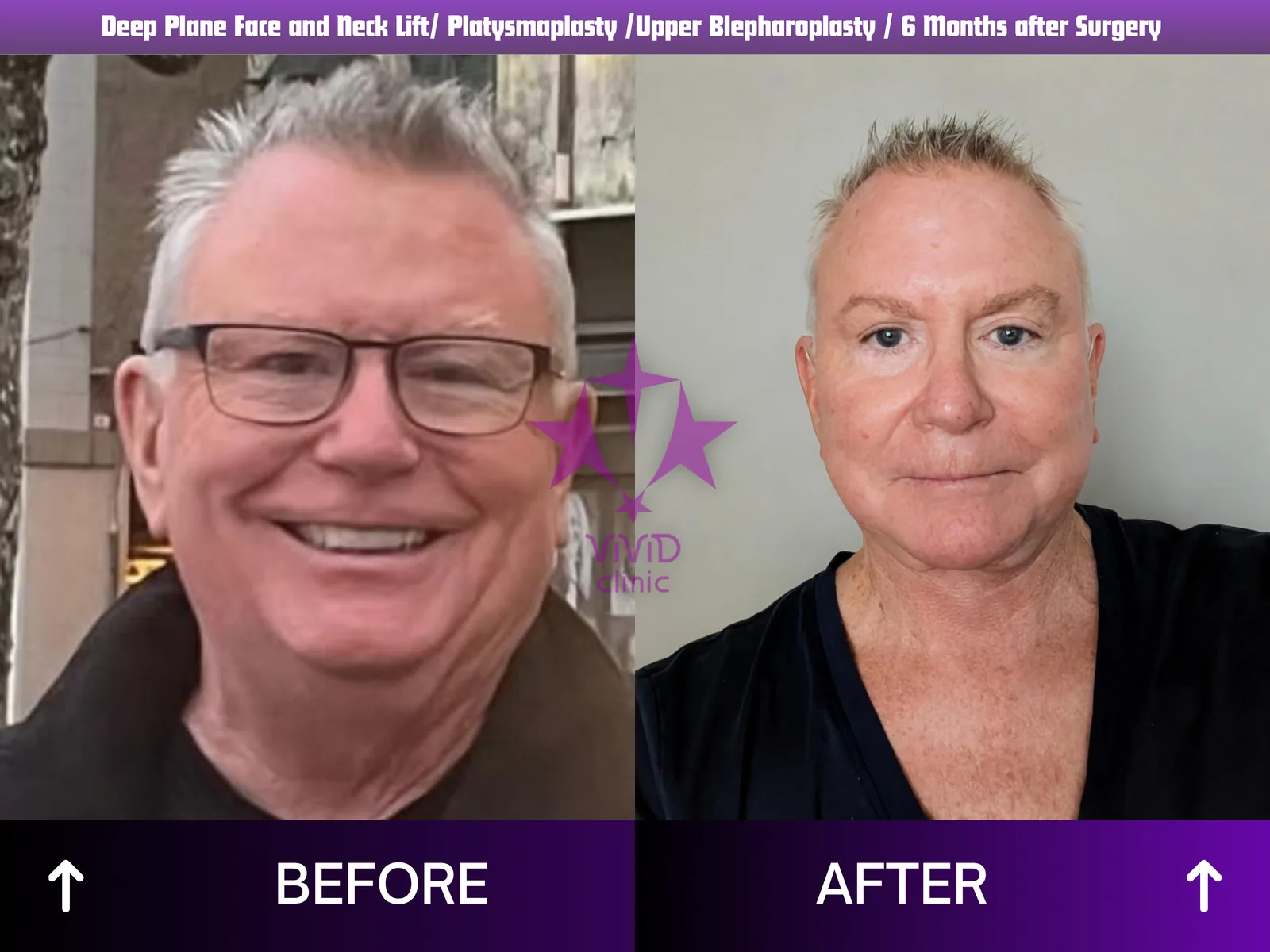
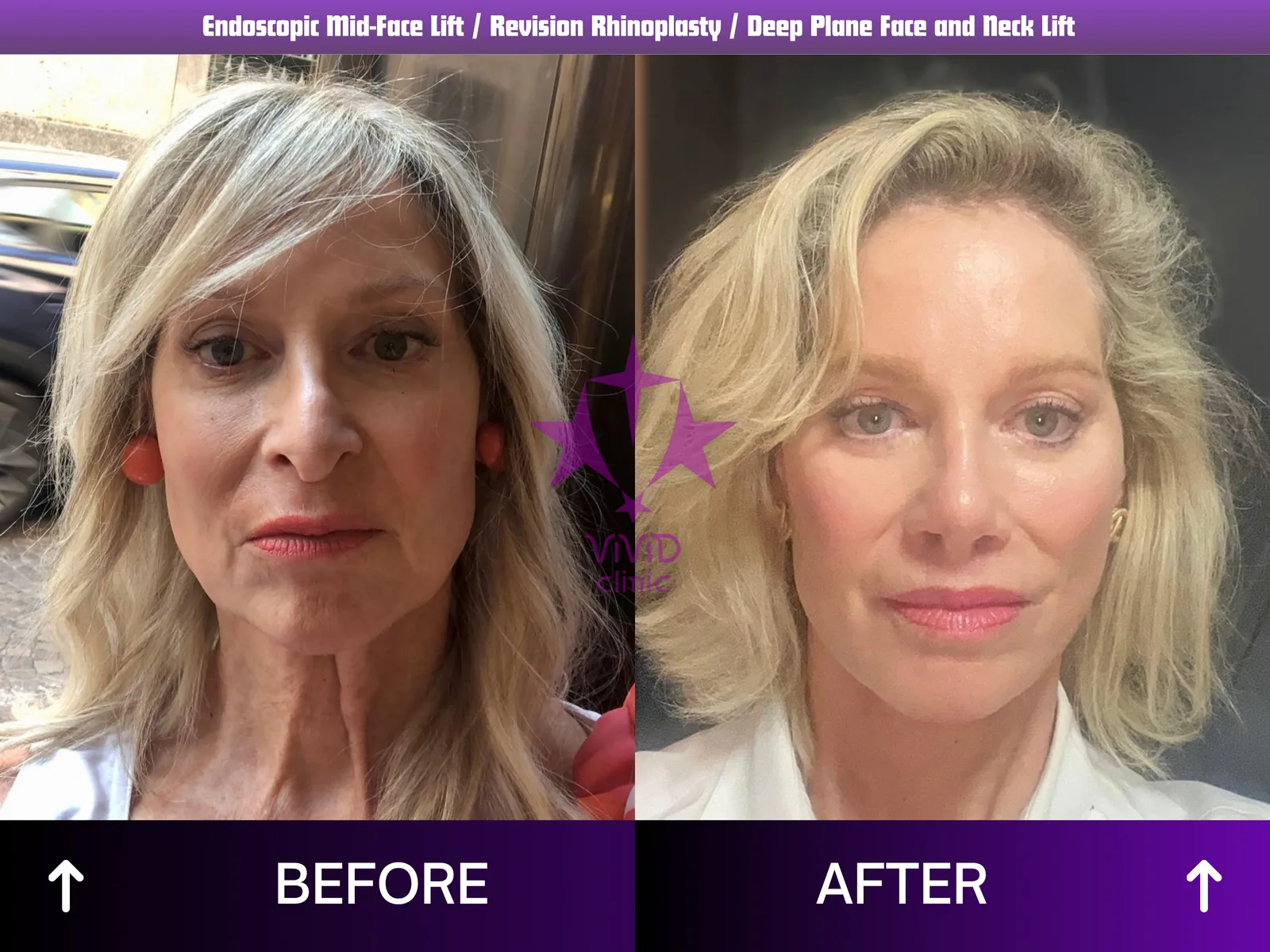
Facelift Types Before and After Results at Vivid Clinic
These before-and-after photos show real Vivid Clinic patients treated in Istanbul, shared with their consent. Photos are matched for angle and lighting wherever possible. Individual results vary. Browse the full Before & After Gallery.




Frequently Asked Questions
What is the difference between a SMAS facelift and a deep plane facelift?
Both lift the SMAS, the fibrous layer under the skin, but they work at different depths. A SMAS facelift elevates the skin as a flap and tightens the SMAS beneath it by folding, cutting or advancing it. A deep plane facelift dissects underneath the SMAS and divides the retaining ligaments that tether the cheek to the bone, then lifts skin and SMAS together as one unit. Because the ligaments are released, the deep plane technique repositions the midface and nasolabial fold more effectively, and closure is tension-free. It is technically more demanding and takes longer.
Is a ponytail facelift a real operation?
Yes, but the name is marketing rather than medicine. It refers to endoscopic lifting of the midface and outer jowl through small incisions hidden in the temporal hairline and scalp, producing the effect of pulling your hair back into a tight ponytail. The technique is real; the branded name is not a surgical classification. Ask any surgeon offering it exactly which plane they dissect and where the incisions sit — that tells you far more than the name does.
Who is a good candidate for a ponytail or mid-face lift?
Typically a younger patient with early signs of ageing: descent of the cheek and mild volume loss, combined with good skin quality and elasticity. Because the incisions are small, the surgeon cannot remove excess skin — the procedure repositions tissue rather than excising it. Someone with significant skin laxity, established jowls or a loose neck will be disappointed by it and is better served by a technique that includes skin removal and neck work.
How long does facelift recovery take?
Most of the visible bruising and swelling settles over the first two to three weeks, and many patients feel socially presentable somewhere between two and four weeks. Sutures typically come out around a week, and strenuous activity is usually restricted for about two weeks. Numbness near the ears and cheeks is normal and resolves over months. Surgeons assess the final result at six to twelve months, once residual swelling has gone and scars have matured.
Does a facelift tighten the neck?
Not on its own. A facelift addresses the cheeks, jowls and jawline; loose neck skin and the vertical platysmal bands need neck-lift surgery, which uses its own incision behind the ear and often a small incision under the chin. The two are very commonly performed together, and for most patients seeking an improved jawline it is that combination — not the facelift alone — that produces the result they had in mind.
What are the main risks of facelift surgery?
Hematoma is the most common, reported between 0.2% and 8% depending on technique and patient, and is significantly more likely in men and in anyone whose blood pressure is poorly controlled after surgery. Facial nerve injury occurs in roughly 0.7% to 2.5% of cases and is usually temporary. Skin necrosis affects under 1% and is strongly linked to smoking. Infection is uncommon. Beyond the surgical risks, dissatisfaction with the aesthetic outcome is the most frequent adverse result, which is why an unhurried consultation matters as much as the operation.
How long do facelift results last?
There is no fixed number, and any clinic quoting one precisely is guessing. Techniques that suspend released deep tissue — deep plane and extended SMAS — are generally considered more durable than skin-based or simple plication lifts, because the result does not depend on tension held in the skin. What is certain is that ageing continues afterwards, from a younger starting point rather than stopping.
Not sure which technique your face actually needs? Send photographs for a free online assessment and get a straight answer about what would and would not change — including when the honest answer is that it is too early for surgery.