
 ChatGPT
Quick answer: Recessed chin before and after photos can show how a receding chin may look after treatment, but a single image rarely tells the whole story. Head position, camera angle and healing stage all change appearance. At Vivid Clinic in Istanbul, Turkey, options are individualized, so a free consultation with a plastic surgeon is the best place to start.
Editorially reviewed by the Vivid Clinic Surgical Board. Last updated: October 2026.
What Recessed Chin Before and After Photos Can and Cannot Show
A chin that sits behind the lower lip, or that seems to recede relative to the nose and forehead, is a common concern. Many people look up recessed chin before and after images because they want to see realistic change before deciding anything. That is a sensible instinct, but a comparison image is only one piece of the picture.
Normal variation is wide. A smaller or softer chin can be an ordinary part of a face, and it does not automatically need correction. Treatment is always optional. This guide is designed to help you read photos critically, understand the main approaches, and know which questions to bring to a consultation.
Before-and-after images can reveal the type of change that may be possible. They cannot show how your anatomy, healing and expectations will combine. Individual results vary, and no image can guarantee an outcome for you.
Why Head Position and Lens Perspective Change the Picture
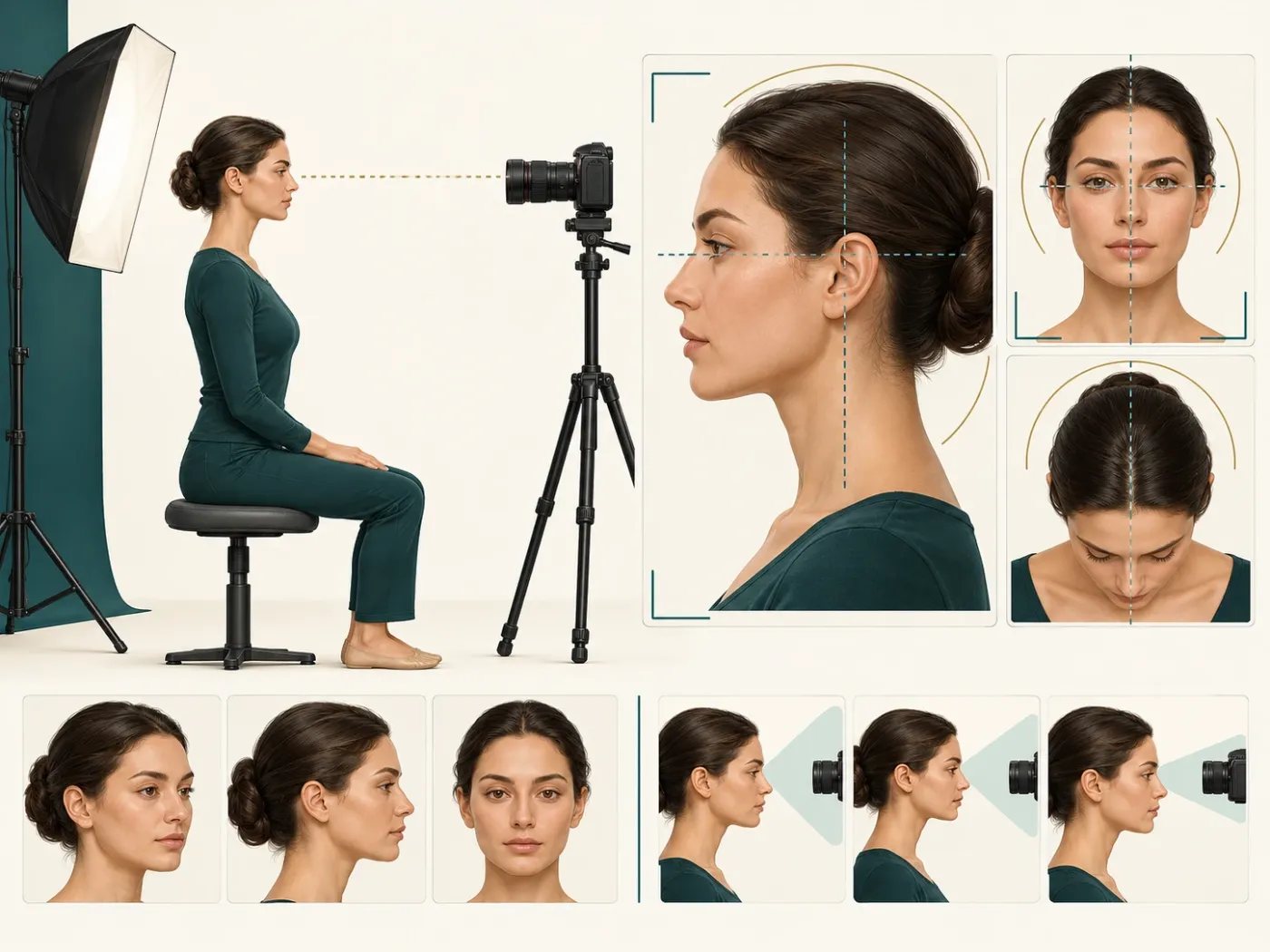
Head tilt is one of the most common reasons a chin looks more or less prominent in a photo. Changing the angle of the head can shift how far the chin appears to sit behind the lower lip. A camera held low can exaggerate the jawline, and a lens held close to the face can distort the nose and chin relative to each other.
Consider a practical example. Two photos of the same face, taken a few minutes apart, can appear to show different chin profiles if one is taken from slightly above and the other straight on. Comparisons only make sense when angle, distance, lighting and expression are consistent.
When you review a gallery, look for matching profile views taken at the same distance. Ask whether the photos were taken on the same day or at comparable stages of healing. Photos that are cropped, filtered or lit differently are harder to interpret, so treat them as a rough guide rather than a precise measurement.
Distinguishing Filler, Implant and Genioplasty Results
Several approaches are used to change chin projection, and each produces a different kind of result. The three most discussed are dermal filler, a silicone chin implant, and genioplasty, a term that Cleveland Clinic uses for chin augmentation through an implant or through repositioning the chin bone. Each approach differs in how quickly results appear, how long they last and what healing is involved.
- Dermal filler: The American Society of Plastic Surgeons (ASPS) notes that most fillers gradually dissipate, so repeat treatments may be needed to maintain the effect. Filler results are therefore temporary by design.
- Chin implant: A soft silicone implant is placed to add size or definition to a small chin. Cleveland Clinic notes that swelling should settle over the first one to two months as the true result appears.
- Genioplasty: Cleveland Clinic describes a sliding genioplasty, in which the surgeon cuts the chin bone, moves it forward, backward or sideways, and secures it with plates and screws. This is a different kind of change from an implant, and its healing differs accordingly.
Because each technique changes tissue differently, a before-and-after photo of one approach should not be used as a template for another. A filler photo shows a short-lived result, while an implant or bone repositioning reflects a longer-term change. The timing of the photo also matters, because swelling can hide early results.
How Profile and Frontal Balance Shift After Treatment
Chin projection affects the whole profile. Changing the chin can alter how the lower face, lips and neck appear from the side, while the front view depends more on jaw width, cheek fullness and symmetry. A chin that looks better in profile may look unchanged from the front, and the reverse can also be true.
For that reason, a surgeon usually evaluates both views, along with lip position and neck shape. Our facial balancing guide for Turkey explains this planning approach in more detail.
Healing, Combined Procedures and Photo Attribution
Healing changes appearance for weeks. Early swelling can make a chin look fuller or softer than it will be later, which is why the timing of after photos matters. ASPS notes that the final results of chin surgery may be initially obscured by swelling.
Combined procedures also change how a result should be judged. A patient who has a chin procedure alongside rhinoplasty or a neck lift will look different from someone who had only the chin treated. Galleries should disclose all procedures performed. Ask whether a gallery identifies the technique and the time since treatment. You can view our before and after gallery with those questions in mind.
How to Evaluate a Result Like Your Own Anatomy
Start with your own features in mind rather than a single ideal. Look at your profile in a neutral posture, your bite, your lip position and the relationship between your chin and nose. Bring a few photos taken with consistent lighting and distance, so the clinical team can see your starting point clearly.
A useful exercise is to compare photos of people with a similar face shape and age, rather than the most dramatic examples. When reviewing any comparison, check the following points:
- Head position and camera distance match between the photos
- Time since treatment, including whether swelling had settled
- Which procedures were performed, and whether others were combined
- Whether the photo has been edited, cropped or filtered
- Whether the clinic describes limitations alongside the result
When Recessed Chin Treatment Should Wait
Not everyone with a receding chin is a good candidate for treatment right away. Cleveland Clinic notes that good candidates for facial implant surgery have facial bones that have reached physical maturity, which generally occurs in late adolescence. Good candidates are also healthy, without major medical conditions. Anyone who is still growing, or who has an unstable health condition, may be asked to wait.
Treatment can also wait when concerns are mainly functional. A recessed chin can be connected to the way the jaws and teeth meet, and a cosmetic result does not diagnose or correct a bite disorder or an airway problem. If you have pain when chewing, a bite that has changed, or breathing or sleep concerns, speak with a dentist, orthodontist or physician before choosing a cosmetic option.
Procedure Overview: Relevant Treatments at a Glance
Optional overview of relevant treatments, not a recovery table for a natural feature.
| Aspect | Details |
|---|---|
| Duration Process | Filler, implant and genioplasty: the procedure duration was not stated in the sources verified for this article. Your clinician will confirm the timing for your plan. |
| Hospitalization Duration | Genioplasty: most people go home the same day after a few hours of observation (Cleveland Clinic). Filler and implant admission needs are confirmed by your clinician. |
| Mobility Duration | Individualized for each plan. After chin surgery, avoid heavy lifting, bending or strenuous activity for at least a week (Cleveland Clinic). |
| Return to Activity | Desk work: time off varies by job, from a few days to a few weeks (Cleveland Clinic, genioplasty). Exercise: avoid strenuous activity for at least a week. Travel clearance is individualized. |
| Complete Recovery | Surface healing and tissue settling are different. Swelling and bruising are common for a few weeks after chin surgery (Cleveland Clinic). For facial implants, swelling should go away fully in one to two months. Filler effects appear sooner but are temporary. |
| Anticipated Results | Chin surgery: final results may be initially obscured by swelling, and ASPS gives no fixed timeframe. Filler: most fillers gradually dissipate, so repeat treatments may be needed (ASPS). Individual variation is expected, and good results are not guaranteed. |
Your Optional Patient Journey at Vivid Clinic in Istanbul
Where a plan includes travel support, your journey with Vivid Clinic in Istanbul, Turkey could begin with your arrival in Istanbul, followed by a VIP airport transfer and check-in at a five-star hotel. Eligibility for transfer and hotel benefits is confirmed at consultation, because these benefits apply to select procedures only.
Your one-on-one consultation with the medical team comes next, followed by your surgery or treatment day, if that option is recommended for you. Post-operative care and a check-up visit come after that, and your clinician reviews your progress before you depart. Once you are home, remote aftercare can continue with the Vivid Clinic team. Each step depends on the plan you and your clinician agree on.
Preparing for Your Consultation
A thoughtful consultation starts with your medical history, current medications and supplements, and any functional concerns, such as chewing or breathing. Mention any previous jaw, dental or facial surgery.
Before your visit, prepare a short list of questions and bring recent photos taken in neutral light. Ask the surgeon which option fits your anatomy, what a realistic result looks like, how long healing takes for that option, and what the alternatives are. A free consultation with a plastic surgeon at Vivid Clinic in Istanbul, Turkey gives you the chance to ask these questions before any decision. Do not start any treatment based on photos alone.
Recovery, Aftercare and When Results Can Be Judged
Early recovery usually includes swelling and bruising. Cleveland Clinic notes that after genioplasty most people go home the same day, that liquids or very soft foods are recommended for a few days, and that swelling and bruising are normal for a few weeks. Sleeping with your head elevated can help during this period.
Activity guidance is individual. Avoid heavy lifting, bending or strenuous activity for at least a week, and expect time off work to vary by job. After chin implant surgery, stitches inside the mouth dissolve on their own, while other stitches are typically removed within about a week.
Judge a result only after swelling has settled. For facial implants, Cleveland Clinic says swelling should go away fully in one to two months as the true results appear. Photos taken at set intervals, using the same angle and lighting, are the most useful comparison.
Risks, Limitations and When Medical Assessment Comes First
Every chin procedure carries risks, and none should be described as risk-free or easy. Cleveland Clinic describes genioplasty complications as rare, including bleeding, bruising, anesthesia complications, infection, pain, poor wound healing, problems with the implant or hardware, scarring, and numbness in the lower lip or chin.
For chin implants, Cleveland Clinic also lists shifting of the implant, pressure on surrounding structures, and changes in skin sensation from nerve injury. Dermal filler has its own profile. ASPS describes severe complications as uncommon, with common local effects such as bruising, swelling, redness, lumps and asymmetry. In very rare cases, filler may be injected into a blood vessel, which can block blood flow and lead to skin loss or, if the eye is affected, loss of vision.
Seek urgent medical care for symptoms that concern you after any procedure, and for shortness of breath, chest pain or an unusual heartbeat. Results are not guaranteed. ASPS notes that a single operation may not always achieve the best result, that another procedure may be needed, and that some patients use injectable fillers to touch up their results.
Cost Factors and Comparing Care Plans
The cost of a chin treatment depends on the treatment plan, the surgeon’s experience, the facility, the type of anesthesia, the complexity of the procedure, and whether other procedures are combined. Accommodation, transfers, aftercare and individual needs also affect the total. Because these factors vary, quotes are individual, and this article does not publish fixed prices.
Why Consultation and Verified Surgeon Credentials Matter
At Vivid Clinic in Istanbul, Turkey, your plan is built after a one-on-one consultation with the medical team, not from a photo alone. Your surgeon evaluates your anatomy, goals, medical history and expectations before recommending an approach. You can meet our medical team on the doctors page and ask to review the credentials of the surgeon who would treat you.
Related guide: weak chin causes and options from filler to surgery.
Frequently Asked Questions About Recessed Chin Before and After
How can head position distort a recessed chin before and after comparison?
Head position changes how far the chin appears to sit relative to the lower lip and neck, so a recessed chin before and after comparison is only meaningful when both photos match. A tilted head, a camera held above or below eye level, or a lens used too close can each make the chin look more or less prominent. Look for profile photos taken at the same distance, in neutral posture and under similar light. Ask whether the photos were taken on the same day or at comparable healing stages. If the angles differ, the difference may come from the camera rather than the treatment. A clinician can take standardized photos at consultation for a fair comparison.
How do filler, implant and genioplasty recessed chin before and after results differ?
Filler, implants and genioplasty each change the chin in a different way, so a recessed chin before and after comparison from one approach does not predict another. Dermal filler is temporary, and ASPS notes that most fillers gradually dissipate, so repeat treatments may be needed. A chin implant places a silicone device to add projection, and Cleveland Clinic notes that swelling should settle fully over one to two months. Genioplasty can refer to an implant or to repositioning the chin bone. Each option has different healing, risks and limits, so your surgeon will recommend the approach that fits your anatomy.
Why should combined procedures be disclosed in a gallery?
Combined procedures change the outcome, so a gallery should disclose every treatment performed when it shows a recessed chin before and after result. A chin change alongside rhinoplasty, a neck lift or dental work can make the face look different in ways the chin alone did not cause. Without disclosure, readers may assume the chin treatment produced the whole change and expect a similar result. Responsible galleries also state the time since treatment, the technique used and whether photos were edited. Readers should look for those details, then ask a surgeon to explain which changes came from which procedure.
When is healing settled enough to judge a recessed chin before and after result?
Healing is usually settled when swelling has gone down, which takes weeks rather than days. Cleveland Clinic notes that swelling and bruising are common for a few weeks after chin surgery, and that for facial implants swelling should go away fully in one to two months as the true results appear. ASPS also notes that final results can be hidden by swelling early on. For a recessed chin before and after comparison, photos taken in the first weeks may not reflect the final shape. Your surgeon can advise on the right assessment interval for your treatment.
Can a cosmetic result demonstrate correction of a bite or airway problem?
No. A cosmetic result shows how the face looks, not whether a bite or airway problem has been corrected. A recessed chin before and after photo cannot confirm changes in jaw alignment, chewing function or breathing. If you have pain when chewing, a bite that has changed, or breathing or sleep concerns, speak with a dentist, orthodontist or physician first. Cosmetic chin treatment should be discussed alongside those assessments, not as a substitute for them. A plastic surgeon can explain which concerns are aesthetic and which need a medical or dental evaluation.
Sources and Further Reading
- ASPS: Chin Surgery Recovery
- ASPS: Chin Surgery Results
- ASPS: Dermal Filler Safety
- Cleveland Clinic: Genioplasty (Chin Augmentation)
- Cleveland Clinic: Facial Implants and Chin Surgery
Your Next Step: an Informed Personal Choice
If you are researching recessed chin before and after results, you deserve clear information and a personal assessment. Vivid Clinic in Istanbul, Turkey can help you understand your options, including what is realistic for your anatomy, before you decide anything.
This article is for informational purposes only and does not replace a personal medical consultation. Suitability, risks, recovery, and expected results should always be discussed with a qualified medical professional.
To take a careful, informed next step, Get a Free Consultation with a plastic surgeon at Vivid Clinic.