
 ChatGPT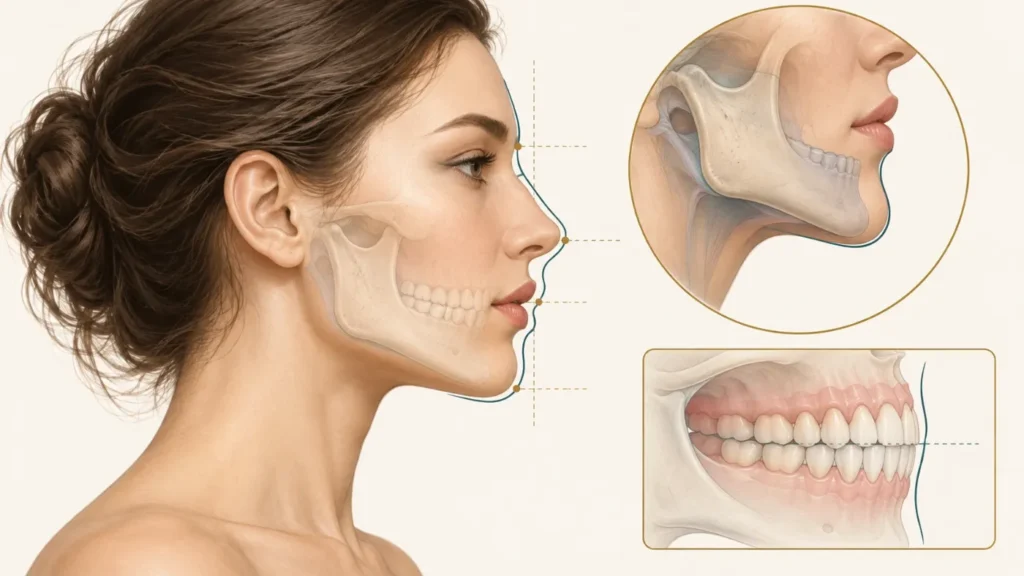
Quick answer: A weak chin usually describes how the chin looks in profile, often a small or recessed chin. Options range from filler, which is temporary, to chin implant or genioplasty surgery. A consultation at Vivid Clinic in Istanbul, Turkey, helps clarify the cause and the right option.
Editorially reviewed by the Vivid Clinic Surgical Board. Last updated: October 2026.
If you are wondering whether your chin is part of why your profile looks the way it does, you are far from alone. A weak chin is one of the most common reasons people look at their photographs and feel that something is “off,” even when they cannot name it. The chin is also one of the most measurable parts of the face, and there are several clear ways to understand it. A free consultation with a plastic surgeon is the place to begin, whether you are considering Vivid Clinic in Istanbul or simply gathering information.
Weak chin is a profile description, not a diagnosis
The term weak chin is an everyday phrase, not a medical diagnosis. It usually describes a chin that appears to sit back from the lower lip or looks small in profile. Many people use it for a chin that lacks definition under the lower lip, which can make the lower face look shorter or softer than the upper face.
Because the phrase is descriptive, two people with a weak chin may have very different underlying causes. One may have a small chin bone with normal soft tissue. Another may have a normal chin with a lower jaw set further back, or a profile shaped by the nose, the lips, or the fullness under the chin. Naming the cause matters because each cause points to a different option.
Normal variation is part of human anatomy. A chin that projects less than a friend’s is not a flaw, and treatment is always optional. A consultation can help you separate what you notice in the mirror from what is measurable in your facial proportions.
Chin projection versus a recessed lower jaw
Chin projection describes how far the chin sits forward in profile. Microgenia is the term for a chin that is small in its bony projection. A recessed lower jaw, known as mandibular retrusion, describes a jaw that sits further back relative to the upper face. The two can look similar from the front, but they are not the same, and they may need different plans.
A simple example helps. Two people might both feel their chin looks weak in photos. One has a lower jaw that sits well behind the upper teeth, while the other has a normal jaw position with a small chin. The first may benefit from an assessment of the jaw and bite, while the second may be a candidate for a chin-focused option. Which applies to you is a question for a clinician who examines your face in person.

The illustration above is an original educational diagram. It is schematic and is not a photograph of a patient or an outcome.
When bite, breathing or jaw symptoms need assessment
A weak chin is mainly an appearance concern, but the lower jaw is also part of the bite and the airway. Some people notice that their teeth do not meet comfortably, that the jaw clicks or aches, or that they breathe through the mouth or snore heavily during sleep. These symptoms do not always point to a jaw problem, but they deserve a proper evaluation before any aesthetic plan is made.
A dentist, orthodontist, oral and maxillofacial surgeon, or sleep specialist is the right person for bite, jaw joint, or breathing concerns. A cosmetic consultation can note these concerns and make a referral, but a chin treatment should not be used to address a functional problem that has not been assessed. This matters most if you have a history of jaw injury or jaw joint pain.
Filler, implant and genioplasty comparison
Several approaches are used to change chin shape. Each has a different purpose, timeline, and level of commitment, so the right choice depends on how much projection you want, the underlying bone and soft tissue, and how long you want the change to last.
- Chin filler is an injectable, non-surgical option. According to the American Society of Plastic Surgeons, fillers are temporary treatments, so repeat treatments are needed to keep the effect. Common effects include bruising, swelling, lumps, and asymmetry, and rare vascular complications are possible.
- Chin implant places a silicone implant over the chin bone through a surgical incision. It adds projection without moving bone. It is generally a longer-term change than filler, although implant position can shift and revision surgery is possible.
- Sliding genioplasty moves the chin bone forward, backward, or sideways. It is a bone procedure rather than a soft-tissue one, and it is generally considered when the goal is a structural change in chin position.
Availability differs by clinic. The current facial treatment pages at Vivid Clinic do not list chin implants, genioplasty, or chin filler as standard services, so treat this comparison as general education. Whether any of these options can be arranged for you is confirmed individually at consultation.
How facial balance guides an individual plan
Chin shape is best judged in relation to the nose, lips, cheeks, and jaw. A chin that looks weak beside a strong nose may look different once the nose is balanced, and the reverse is also true. This is the idea behind facial balancing, a planning approach that treats the face as a set of related proportions rather than separate features. Vivid Clinic explains this approach in its guide to facial balancing planning in Turkey.
A good plan also considers how you want to look, not only how the chin measures. Some people want a modest change that still looks like themselves. Others want a more defined profile. Either goal is valid, and a clinician should explain what each option can and cannot change.
If you are reviewing other facial concerns, you can explore the facial aesthetic options Vivid Clinic currently lists in Istanbul on its face aesthetics page. Those pages describe services in general and are not a substitute for an individual assessment.
Weak chin: candidacy and reasons to defer treatment
A chin treatment is not appropriate for everyone. Candidacy depends on your overall health, your expectations, the cause of your concern, and whether dental, jaw, or breathing issues need assessment first. Your surgeon will explain whether timing or health factors should delay treatment. MedlinePlus notes that smoking can delay healing after chin surgery.
Reasons to defer treatment include unclear goals, a recent illness, an active dental problem, or a feeling of pressure to decide quickly. A bite or jaw concern that has not been assessed is also a reason to pause. Taking more time to compare options is a responsible decision, not a missed opportunity.
Ready for a more personal evaluation? Your consultation is the place to discuss whether treatment, further assessment, or no treatment at all makes sense for you.
Relevant procedure overview and realistic expectations
Optional overview of relevant treatments, not a recovery table for a natural feature.
| Aspect | Details |
|---|---|
| Duration Process | Chin implant or genioplasty surgery: 1 to 3 hours for the bone-moving approach (MedlinePlus). Chin filler: not timed in the sources reviewed; set by the treating clinician. |
| Hospitalization Duration | Chin surgery: the sources reviewed do not state a hospital stay, so setting and any admission are confirmed by the clinician. Chin filler: no admission is described in the sources reviewed. |
| Mobility Duration | Chin surgery: avoid heavy lifting, bending or strenuous activity for at least a week (Cleveland Clinic). Chin filler: no mobility restriction is described in the sources reviewed. |
| Return to Activity | Chin surgery: return to work and usual activities within 7 to 10 days (MedlinePlus), with desk work, exercise and travel cleared by your surgeon. Chin filler: not sourced; confirm with your clinician. |
| Complete Recovery | Chin surgery: swelling and bruising for a few weeks, with most swelling gone by about 6 weeks and chin numbness possible for up to 3 months (MedlinePlus). Chin filler: no surgical healing period is described; effects are temporary (American Society of Plastic Surgeons). |
| Anticipated Results | Chin surgery: the final appearance may take 3 to 4 months to show (MedlinePlus). Chin filler: ongoing treatments are needed for long-term results (American Society of Plastic Surgeons). Durability varies by individual. |
Surface healing and deeper tissue settling happen on different schedules, and final results can take months. Filler does not have a surgical recovery timeline in the same sense, and the sources reviewed did not give a fixed duration for filler appointments, so those cells say so rather than estimating.
Preparation and the consultation assessment
A good consultation starts with your medical history, including previous facial or dental surgery, bleeding tendencies, allergies, and the medications and supplements you take. Your surgeon will also ask about functional concerns such as bite, jaw comfort, breathing during sleep, or speech, because these can change the recommendation.
Bring a clear list of goals. Describe what bothers you, when you notice it, and what you hope to change. Photos taken in natural light from the front and the side can help the team understand your starting point, although photos are only one part of the evaluation.
At Vivid Clinic in Istanbul, Turkey, this assessment happens during your free consultation with a plastic surgeon. Before any procedure, you should receive specific instructions from your treating clinician. This article does not provide self-treatment steps, and no one should start or stop medications or supplements based on general reading.
Recovery, aftercare and when results can be assessed
Early recovery after chin surgery usually involves swelling and bruising. The Cleveland Clinic describes some swelling and bruising for a few weeks as normal. The American Society of Plastic Surgeons notes that healing continues for several weeks as swelling decreases, and that an elastic bandage or compression garment may help limit swelling.
Aftercare varies by technique. If an incision is made inside the mouth, a liquid diet or special mouth rinses may be needed. Your surgeon will explain wound care, medications, warning signs, and follow-up visits. Numbness of the chin or lower lip can last for a time, and MedlinePlus describes chin numbness that may last up to 3 months.
Results should not be judged in the first weeks. The final appearance of the chin may take 3 to 4 months to show. For filler, the timing of the assessment is set by your clinician, and maintenance is a separate decision that depends on how the result settles.
Risks, limitations and when medical assessment comes first
Chin surgery is a real operation with real risks, and it is not simple or risk-free. The American Society of Plastic Surgeons lists possible complications including implant displacement, asymmetry, bleeding, infection, poor healing, scarring, persistent pain, skin numbness, and the possibility of revisional surgery. That list is not complete, and your surgeon should review every risk before you sign consent forms.
Dermal filler is generally less invasive, but it is not without risk. Common effects include bruising, swelling, lumps, asymmetry, and infection. Rare but serious problems occur when filler enters a blood vessel and blocks blood flow, which can cause skin loss and, if the eye is affected, vision loss. The American Society of Plastic Surgeons advises choosing a board-certified plastic surgeon who is trained to handle complications.
Seek urgent medical care for sudden vision changes, severe pain, or signs of infection after any facial treatment. Your clinician will also give you a written list of warning signs to follow at home.
Cost factors and comparing care plans
Quotes for chin treatment are individual. Cost depends on the surgeon’s experience, the facility, anesthesia type, procedure complexity, whether chin work is combined with other procedures, travel and accommodation, and follow-up care. Filler costs depend on the product, the amount used, and how often maintenance is needed.
When comparing offers, check whether each quote includes the consultation, the procedure, the facility, anesthesia, follow-up visits, and any medications. Compare like with like, and ask for the plan in writing. No single figure applies to every patient, and any price you see online is a starting point rather than a promise. Vivid Clinic provides a personalized quote after your free consultation with a plastic surgeon.
Your optional patient journey at Vivid Clinic in Istanbul
If you choose to travel for care, your journey with Vivid Clinic in Istanbul, Turkey, typically begins with your arrival in the city. Where your package includes a VIP airport transfer, you are collected at the airport and taken to your hotel, and where it includes a five-star hotel stay, you check in before your appointments. Eligibility for transfers and hotel benefits is confirmed at consultation and depends on the procedure.
Your one-on-one consultation with the medical team follows, where your anatomy, medical history, and goals are reviewed. If surgery or a treatment is planned, the treatment day is scheduled with your safety and comfort in mind. Post-operative care follows your treatment plan, and a checkup visit is arranged before departure, which is planned once your clinician confirms you are fit to travel. Once you return home, remote aftercare follow-up continues with the team, so questions about healing can be addressed from abroad.
Why consultation and verified surgeon credentials matter
Choosing a surgeon matters more than choosing a destination. Verify any surgeon’s board certification and training through recognized medical boards before you commit, and ask who will perform your procedure and who will follow your recovery. At Vivid Clinic, you can review the team on the Vivid Clinic doctors page, and you can meet your doctor in person before any procedure.
Your free consultation with a plastic surgeon is the next step. It gives you a personal assessment, a clear explanation of the options, and an honest answer about which approach suits your face and goals. If the answer is that you do not need treatment, that is valuable information too.
Related guide: recessed chin before and after.
Five frequently asked questions
How does a weak chin differ from a recessed lower jaw?
A weak chin describes the chin’s appearance in profile, which may look small or set back. A recessed lower jaw describes a jaw that sits further back than the upper face, which is a broader position of the lower face. The two can look alike, and in some people they occur together. A weak chin is often addressed in the chin itself, for example with a chin implant or genioplasty, while a recessed jaw may need an assessment of the bite and jaw position first. Because the cause decides the option, a clinician usually examines the teeth, jaw and profile before recommending anything. Vivid Clinic in Istanbul, Turkey, offers a free consultation with a plastic surgeon, where this difference can be explained using your own facial measurements. Treatment is optional, and some people with a weak chin choose to keep their profile as it is.
Can a weak chin affect the appearance of the nose?
Yes. A weak chin can change how the nose appears in profile, because the chin and nose work together to define the middle of the face. When the chin sits back, the nose may seem more prominent by comparison. For this reason, a clinician looking at a weak chin also looks at the nose, lips and cheeks. This is part of facial balancing, which evaluates the face as a whole rather than one feature at a time. It does not mean that every nose needs change. Some people find that the chin is the main concern, while others need a combined plan. A free consultation with a plastic surgeon at Vivid Clinic in Istanbul can review how a weak chin relates to your nose and whether any change would improve overall balance.
What can filler change in a weak chin?
Filler can add some volume and definition to the chin in a non-surgical way. According to the American Society of Plastic Surgeons, fillers can restore volume and enhance shallow contours, and they are temporary, so ongoing treatments are needed to maintain the result. For a weak chin, filler may create a modest increase in projection and a more defined chin line for some people, but it cannot change the position of the underlying bone. Common effects include bruising, swelling, lumps, and asymmetry, and rare complications need urgent care. Filler is not appropriate for every profile, and it may not suit someone whose main concern is jaw position. A consultation at Vivid Clinic in Istanbul, Turkey, can clarify whether a weak chin is suited to filler, and availability of any treatment is confirmed individually.
When is an implant or bone surgery considered for a weak chin?
A chin implant or genioplasty is usually considered when the goal is a longer-lasting change in chin projection than filler can offer, or when the chin bone itself needs repositioning. The Cleveland Clinic notes that genioplasty can move the chin bone forward, backward or sideways, while an implant places a silicone piece instead. MedlinePlus describes the best candidates as having a small or receding chin with a normal bite, which is one reason a bite check is part of the assessment. Surgery carries risks, including bleeding, infection, implant displacement, and numbness, so it is not a simple decision. Your surgeon will discuss recovery timing, which can include swelling for several weeks and a final appearance over 3 to 4 months. Whether these options are available for you is confirmed at your free consultation with a plastic surgeon at Vivid Clinic in Istanbul.
When does a weak chin need a bite or airway assessment?
A weak chin needs a bite or airway assessment when you notice symptoms beyond appearance, such as teeth that do not meet comfortably, jaw pain or clicking, difficulty chewing, mouth breathing, or heavy snoring during sleep. These signs do not confirm a diagnosis, but they mean the jaw and airway should be examined by a dentist, orthodontist, oral and maxillofacial surgeon, or sleep specialist before any cosmetic chin treatment. A chin implant or bone surgery can change how the lower face sits, so the bite must be understood first. Diagnosis of a bite or breathing problem belongs to the appropriate specialist. Your plastic surgeon at Vivid Clinic in Istanbul, Turkey, can review these concerns during a free consultation and refer you when needed, so that a weak chin is never considered in isolation.
Sources and Further Reading
- American Society of Plastic Surgeons: Dermal Fillers
- American Society of Plastic Surgeons: Dermal Filler Safety
- American Society of Plastic Surgeons: Chin Surgery Recovery
- American Society of Plastic Surgeons: Chin Surgery Safety
- Cleveland Clinic: Genioplasty (Chin Augmentation)
- MedlinePlus: Chin Augmentation
Your Next Step: an Informed Personal Choice
A weak chin is a normal variation for many people, and choosing to do nothing is a valid decision. If you are curious about your options, the next step is a clear, individual assessment. At Vivid Clinic in Istanbul, Turkey, you can request a free consultation with a plastic surgeon to discuss your profile, your goals, and whether filler, an implant, genioplasty, or no treatment suits you.
This article is for informational purposes only and does not replace a personal medical consultation. Suitability, risks, recovery, and expected results should always be discussed with a qualified medical professional.