
 ChatGPT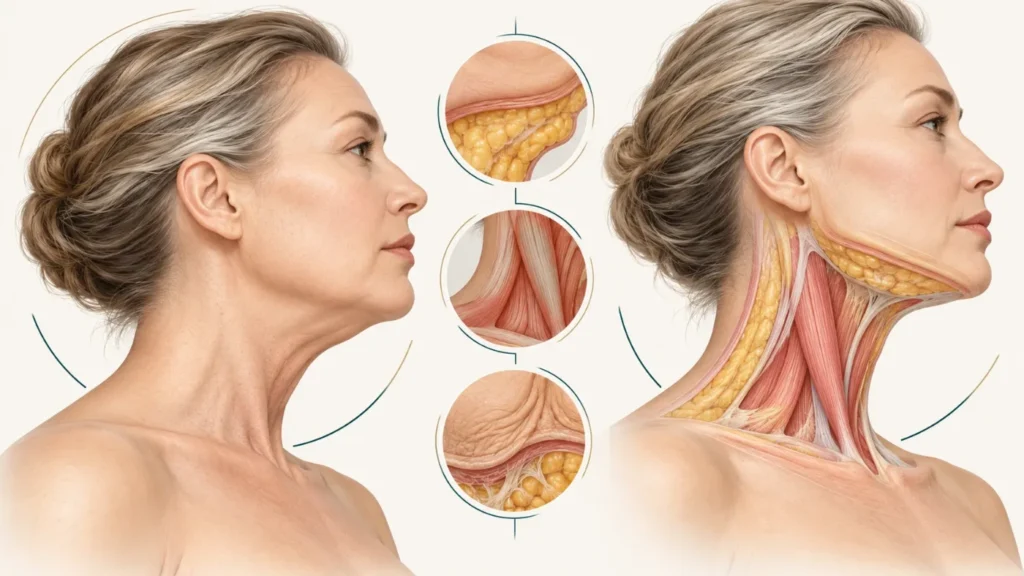
Quick answer: Turkey neck is an informal term for loose skin, extra fat and vertical muscle bands under the chin and along the neck, changes that often appear with age. Many of these changes are normal variation and need no treatment. At Vivid Clinic in Istanbul, Turkey, a free consultation with a plastic surgeon can help you understand your options.
Editorially reviewed by the Vivid Clinic Surgical Board. Last updated: October 2026.
Few people look at their necks as often as they look at their faces, yet the neck is often where the first signs of time show. One morning you may notice a softer line under the chin, a band that appears when you turn your head, or skin that no longer sits as smoothly as it once did. That moment is when many people start searching for answers about turkey neck.
What Turkey Neck Describes in Everyday Language
Turkey neck is a casual phrase, not a medical diagnosis. It describes a neck where the skin looks loose or wrinkled, the area under the chin looks full, or vertical lines show along the front of the neck. The comparison to a bird is informal and does not describe a disease.
Because the phrase is informal, two people using it may mean different things. One may be describing skin that has lost firmness. Another may mean fullness under the chin, or bands that become more visible when they tighten their jaw or speak. Sorting out which features are present is the first useful step, and that is why a clinical assessment matters more than a label.
Neck changes are a common part of aging, and they do not mean something is wrong. Treatment is always optional. Wanting to feel more comfortable in photographs or in a turtleneck is a valid reason to ask questions, and also a reason to take time before deciding.
Loose Skin, Neck Fat and Muscle Bands Are Different
The phrase covers three features that are related but not the same. Loose skin is excess skin that has lost elasticity. Neck fat is a layer that sits above or below the neck muscle. Muscle bands are vertical cords that form along the front of the neck. A single photograph can show all three at once, which is why they are often confused.
The platysma is a thin, broad muscle covering the front and sides of the neck. The StatPearls review of the platysma notes that with aging, the muscle becomes lax and the fascia supporting its midline weakens, which can produce the bands. Loss of skin elasticity, fat accumulation, sun damage and hormonal change can contribute as well. Some studies suggest certain bands may instead come from muscle overactivity, so appearance alone does not always reveal the cause.
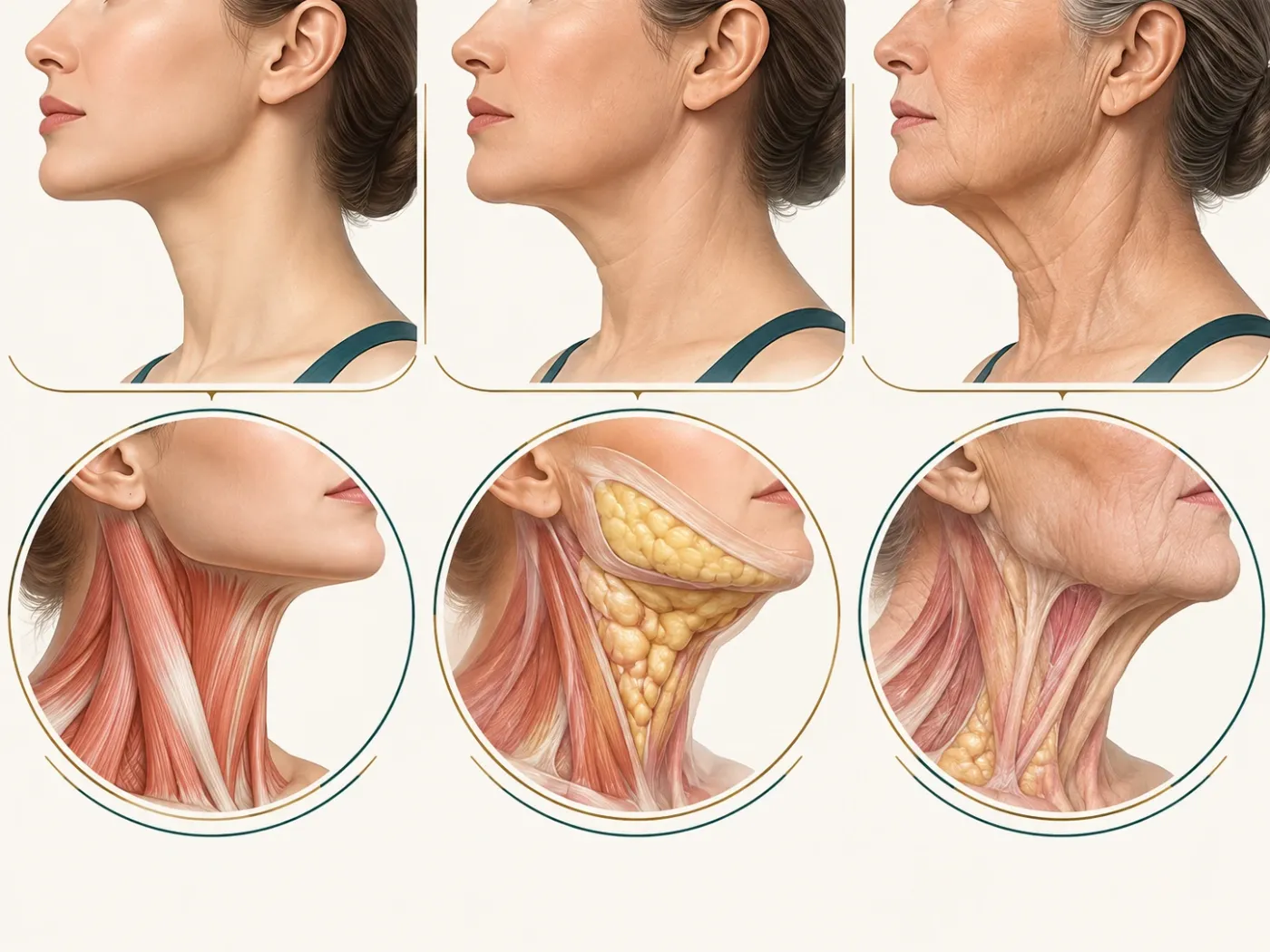
Clinicians usually separate these features during an examination. Skin quality, fat distribution, band strength and the position of the jawline and chin all shape a plan. Treating fat alone will not remove loose skin, and a surgery aimed at bands will not remove fat. Understanding the mix helps you ask better questions and compare options realistically.
Creams and Exercises: What the Evidence Shows and Where It Stops
Many readers ask whether creams or exercises can remove excess neck skin. The sources reviewed for this article do not show that either approach removes excess skin or fat.
Exercise is the clearest example. A Harvard Medical School dermatologist, interviewed in a Harvard Health article, says there are no good, rigorous studies verifying that face workouts are effective. She suggests any effect on sagging would likely be very subtle. Facial exercise is not generally described as dangerous, but it should not be presented as a substitute for treatment that changes tissue.
Creams and other skincare products may support the look and feel of the skin surface. None of the sources reviewed here show that a topical product can lift loose neck skin or reduce neck fat, and this article does not claim otherwise. If a product promises to lift or slim the neck, ask a clinician about it before relying on it.
Non-Surgical Options Versus a Neck Lift
Non-surgical options aim to tighten or improve the skin without removing tissue. Energy-based devices are one group that clinicians discuss for mild laxity. A 2020 retrospective study in Plastic and Reconstructive Surgery Global Open reviewed 247 patients treated with combined bipolar and fractional radiofrequency for lower face and neck laxity. Average scores on a grading scale improved by 1.4 points.
The study has clear limits. It had no control group, the photographs were graded by surgeons not described as blinded, and most patients were women. Most of the authors were consultants for the device manufacturer. The authors themselves say the approach is not meant to replace a facelift or neck lift in appropriate candidates, and present it as a way to fill a gap between surgery and milder care.
A surgical neck lift at Vivid Clinic works differently. The American Society of Plastic Surgeons describes neck lift options that can address fat in the lower face and under the chin, loose neck skin and muscle bands. Its page also notes that a neck lift is restorative surgery that does not change your fundamental appearance and cannot stop the aging process. The StatPearls review describes a standard facelift as addressing most age-related neck changes, with neck lifts and platysmaplasty offered to patients who prefer not to have a facelift.
Neither option is automatically right. The choice depends on the mix of skin, fat and bands, the shape of the jawline and chin, your health history and the outcome you want.
Planning a Proportionate Neck Treatment
A proportionate plan matches the treatment to the findings. It avoids doing more than the anatomy calls for, and it avoids promising a change that one method cannot deliver. For a mild concern, a clinician may discuss less invasive options or simply monitoring over time. For more pronounced loose skin or bands, a surgical plan may be discussed, and the surgeon will explain what each part of it is meant to change.
Proportion also applies to expectations. A realistic plan describes what can improve and what cannot. Neck work may be paired with treatment of the face, eyelids or chin when those areas are part of your goals, as described in the face aesthetic services at Vivid Clinic, but no combination should be presented as a guarantee.
Turkey Neck: Who Is a Candidate, and When to Defer Treatment
Good candidates usually have a clear concern, realistic goals and good general health. A surgeon also reviews medical history, medications, smoking habits and any condition that affects healing. Surgery is not suitable for everyone, and a clinician may recommend waiting or choosing a different approach.
Reasons to defer include a recent change in health, a condition that affects healing, a medication your clinician needs to review, or weight that has not yet settled. Expectations built on a single photograph or a filtered image also deserve a slower conversation.
Turkey Neck Treatment Options: Neck Lift, Platysmaplasty and Non-Surgical Care
Optional overview of relevant treatments, not a recovery table for a natural feature.
| Aspect | Details |
|---|---|
| Duration Process | Neck lift: typically 2 to 4 hours, depending on technique (Vivid Clinic neck lift page). Platysmaplasty: no duration stated in the sources reviewed; your surgeon confirms it for your plan. |
| Hospitalization Duration | Neck lift: usually one night, and limited procedures may be same-day (Vivid Clinic neck lift page). Platysmaplasty: typically a day case, or one night when combined with a facelift or neck lift (Vivid Clinic platysmaplasty article). |
| Mobility Duration | Platysmaplasty: light activity within days (Vivid Clinic platysmaplasty article). Walking and early movement guidance is set by your surgeon for your plan. |
| Return to Activity | Neck lift: desk work around 10 to 14 days; strenuous exercise after 4 to 6 weeks, with surgeon approval (Vivid Clinic neck lift page). Platysmaplasty: avoid neck strain for about 2 weeks; social recovery around 10 to 14 days (Vivid Clinic platysmaplasty article). Travel clearance is individual. |
| Complete Recovery | Swelling and bruising are expected in the first one to two weeks, and neck tightness typically eases over weeks to a few months (Vivid Clinic platysmaplasty article). Contour settles over 3 to 6 months and can refine for up to 12 months (Vivid Clinic neck lift page). |
| Anticipated Results | Initial contour is visible by about 4 to 6 weeks, and the final result is usually judged around 6 to 12 months after surgery (Vivid Clinic platysmaplasty article). Individual healing and anatomy affect the outcome. |
These ranges come from the clinic’s own published pages. They are general guidance for surgical plans, not promises, and the treating clinician confirms the timeline for each patient.
Preparing for the Consultation Assessment
Preparation starts with honest information. Bring a list of medications, supplements, past surgeries and health conditions. Mention any functional concerns, such as neck discomfort or changes in how the jaw moves, because they matter for the assessment. Describe what you would like to change and what you would like to keep.
Do not self-diagnose, and do not start or stop any medication or supplement because of this article.
Turkey Neck Treatment Recovery and When to Judge Results
Early changes are not final changes. Swelling, bruising and tightness are common in the first days. The American Society of Plastic Surgeons recovery guidance advises keeping the head raised above the heart to limit swelling, notes that a thin drain may be placed in some cases, and warns against applying ice to the neck because it can compromise blood flow.
Recovery has two stages. Surface healing can look complete before deeper tissues finish settling. Chin strap use is commonly one to three weeks, according to the Vivid Clinic neck lift page, and your surgeon sets the exact plan. Driving, desk work, exercise and travel should follow individual clearance rather than a generic date.
Results are best judged once swelling has settled and the surgeon has confirmed the healing timeline.
Turkey Neck Treatment Risks, Limitations and Medical Red Flags
Neck surgery carries risks and should not be described as easy. The ASPS safety guidance lists possible complications, including reactions to anesthesia, bleeding and fluid buildup, infection, poor wound healing, uneven appearance, lingering swelling or pain, changes in skin sensation, visible sutures, hair loss along incisions, scarring, and results that fall short and may need another procedure. Rarely, a nerve injury can weaken the lower lip, and a blood clot in a deep vein can occur.
The same guidance describes the decision as extremely personal, and your surgeon reviews risks and consent forms with you before any surgery. Seek urgent medical help for symptoms that worry you, especially trouble breathing or swallowing, rapidly increasing swelling, or fever.
What Affects the Cost of Turkey Neck Treatment in Istanbul
The cost of a neck treatment depends on the plan rather than a single price. Surgeon experience, the facility, anesthesia, complexity, combined procedures, accommodation and transfers, and aftercare all affect the total. Personal needs, such as the number of follow-up visits, also matter. Quotes are individual, and this article does not list fixed prices or averages.
When comparing options, ask for a written, dated quote that lists what is included. A quote that includes anesthesia, facility and follow-up is not directly comparable with a lower figure that leaves those items out.
Turkey Neck Treatment in Istanbul: Your Patient Journey at Vivid Clinic
If you decide to explore treatment with Vivid Clinic, your journey begins when you arrive in Istanbul, Turkey. Where your package includes it, a VIP airport transfer takes you to a five-star hotel for check-in; eligibility for these benefits is confirmed at consultation, because they apply only to select procedures. Your one-on-one consultation with the medical team follows, where your anatomy, medical history and goals are reviewed. If surgery or a treatment day is recommended, each step is explained in advance. After the procedure, post-operative care and a check-up visit are arranged according to your plan, before you depart. Remote aftercare follow-up then continues after you return home.
Choosing a Qualified Surgeon for Turkey Neck Treatment
A consultation turns a general article into a personal plan. At Vivid Clinic in Istanbul, Turkey, you can request a free consultation with a plastic surgeon, who will assess your concerns and explain which options may be appropriate. The surgeon decides whether treatment is suitable, and this article does not replace that decision.
Credentials deserve the same care. Review the surgeon’s profiles on the Vivid Clinic doctors page, then confirm specialty training and qualifications with the relevant professional registry before you decide.
Frequently Asked Questions About Turkey Neck
How do loose skin, neck fat and muscle bands differ?
Loose skin, neck fat and muscle bands are three separate features that often appear together in a turkey neck. Loose skin is excess skin that has lost elasticity. Neck fat is a layer that sits above or below the neck muscle and can make the area under the chin look full. Muscle bands are vertical cords formed by the platysma, the thin muscle along the front of the neck. A clinician examines each feature because each responds differently to treatment, and knowing which one drives your concern shows whether a non-surgical or surgical option is worth discussing.
Can exercises or creams remove excess neck skin?
The sources reviewed for this article do not show that exercises or creams remove excess neck skin. A Harvard Health article quotes a dermatologist who says rigorous studies do not verify that face workouts are effective. Skincare products may improve the look of the skin surface, but none of the reviewed sources show they remove loose tissue. Facial exercise may be harmless, yet neither approach is a reliable way to treat a turkey neck with significant laxity. A clinician can explain which changes are realistic and which would need a procedure.
When might a non-surgical treatment be considered?
A non-surgical treatment may be considered for a turkey neck when the concern is mild and the patient wants a lower-intensity option. Energy-based devices are one group clinicians discuss in this context. A 2020 retrospective study of 247 patients reported an average improvement of 1.4 points on a grading scale, but it had no control group. Its authors describe these treatments as a way to fill a gap, not as a replacement for a facelift or neck lift in suitable candidates. Non-surgical care is not suitable for everyone, so your surgeon will explain whether it fits your turkey neck goals.
What can a neck lift improve, and what are its limits?
A neck lift can address features that contribute to a turkey neck, including fat under the chin, loose neck skin and muscle bands. The American Society of Plastic Surgeons describes it as restorative surgery that does not change your fundamental appearance and cannot stop the aging process. Its limits include recovery time, the possibility of scarring, uneven results and the need for refinement. The technique, whether platysmaplasty or a lateral approach, depends on your anatomy. Your surgeon will discuss whether a neck lift is the right choice for your turkey neck goals.
How are travel and recovery plans individualized?
Travel and recovery plans for a turkey neck are individualized because each procedure, health history and home situation differs. The plan may cover the length of any hospital stay, when light activity is allowed, when desk work can resume and when flying home is considered. These timings are set by your surgeon, not by a general calendar. At Vivid Clinic in Istanbul, Turkey, hotel and transfer benefits apply only to select procedures, so eligibility is confirmed at consultation. Remote aftercare continues after you return home, so questions about your turkey neck recovery can be handled from abroad.
Sources and Further Reading on Turkey Neck
- American Society of Plastic Surgeons: Neck Lift
- American Society of Plastic Surgeons: Neck Lift Safety
- American Society of Plastic Surgeons: Neck Lift Recovery
- StatPearls: the platysma and neck rejuvenation
- Harvard Health: Does your face need a workout?
- Multimodal Radiofrequency Application for Lower Face and Neck Laxity, Plastic and Reconstructive Surgery Global Open (2020)
Related reading: Botox in Turkey
Choosing the Right Way to Address Turkey Neck
Deciding how to respond to a turkey neck is a personal choice, and it works best when it is informed. This article is for informational purposes only and does not replace a personal medical consultation. Suitability, risks, recovery and expected results should always be discussed with a qualified medical professional.
If you are considering options for a turkey neck in Istanbul, Turkey, Vivid Clinic can help you understand your choices with a personalized plan. Get a Free Consultation with a plastic surgeon and take the first step toward a clearer, more confident decision.