
 ChatGPT

Medically reviewed by Prof. Dr. Özgür Pilancı, Plastic, Reconstructive & Aesthetic Surgeon — August 2026
Quick answer (updated August 2026): Ten types of eyes are commonly described — almond, round, monolid, hooded, upturned, downturned, deep-set, protruding, close-set and wide-set. They are not ten separate boxes: almost everyone is two or three at once, because eye shape comes from several independent anatomical variables stacking up. No eye type is a problem, and none needs correcting.

What actually determines your eye shape
Eye shape is barely a property of the eye. The eyeball is close to the same size in almost every adult; what varies is the frame around it, and five things do most of the work.
The orbital rim — the bony socket — sets depth: a deep socket under a projecting brow bone tucks the eye back, a shallow one pushes it forward. The upper eyelid crease, where the levator muscle attaches to skin, decides how much lid platform shows. Canthal tilt is the angle of a line from inner corner to outer corner — tilt the outer corner up and the eye reads alert, level or down and it reads softer.
Orbital fat pads cushion the eye: full pads give a rounder, forward-set look, thin or descended pads a hollow one. And brow position, not part of the eye at all, changes how it looks more than anything else here. Drop a brow two millimeters and a bright open eye becomes a hooded one.
Age moves several at once: skin loosens, the crease drops, fat shifts, the brow descends. That is why people feel their eye type has changed since their twenties. Functionally it has. The bone has not.
Every eye shape, explained
These are the ten different eye types on any eye shape chart — descriptions of features, not boxes you must pick one of.


Almond eyes
The corners taper and the lids just graze the iris top and bottom, so white shows at either side but not above or below, usually with a visible crease. Almond sits in the middle of every variable at once.
Round eyes
The iris is fully visible with white showing above or below it, and the eye is taller relative to its width. Round eyes read open and expressive, and tend to look younger.
Monolid eyes
No visible crease: skin runs smoothly from lash line to brow, often with an epicanthal fold over the inner corner. Both are normal variants. Cleveland Clinic puts epicanthal folds at roughly half of people of Asian descent, and notes they also appear in young children of any background.
Hooded eyes
A crease exists but a fold of skin drops over it, so the lid platform vanishes when the eye opens. Hooding can be congenital — plenty of people have it at nineteen — or acquired with age.
Upturned eyes
The outer corner sits above the inner corner: positive canthal tilt, the shape the “fox eye” trend chased. In real faces the tilt is a couple of degrees, not the angle of a filtered photograph.
Downturned eyes
The outer corner sits level with or below the inner corner, and often reads as gentle. A slight downturn is very common and entirely normal; one that is new, one-sided or worsening is worth having looked at.
Deep-set eyes
The eye sits back in a deeper socket under a prominent brow bone, casting a shadow across the lid. Striking and sculptural, and prone to looking tired under overhead lighting — a lighting problem more often than an anatomy one.
Protruding (prominent) eyes
The eye sits forward of the orbital rim, so the lid closes over a more convex surface. Usually just anatomy. Protrusion developing over months — especially with lid retraction, dryness or double vision — points to thyroid eye disease and needs an ophthalmologist.
Close-set eyes
The gap between the inner corners is narrower than one eye’s width — a matter of nasal bridge and orbit position rather than the eyes themselves.
Wide-set eyes
The gap is wider than one eye. Close-set and wide-set describe spacing, which is why honest guides list them separately.
The part most guides miss: these combine. Deep-set hooded eyes with a slight downturn. Round protruding eyes that are wide-set. Almond monolid eyes with positive tilt. Forcing yourself into one of the different kinds of eyes above is why people decide their eye type “isn’t on the list”. It is — it is just two or three at once.
How to identify your eye shape, and which types are most and least common
Stand at a well-lit mirror, eye level, no makeup, face relaxed, looking straight ahead. Do not raise your brows — most people lift them unconsciously at a mirror, which erases hooding and is why self-assessments come out wrong.
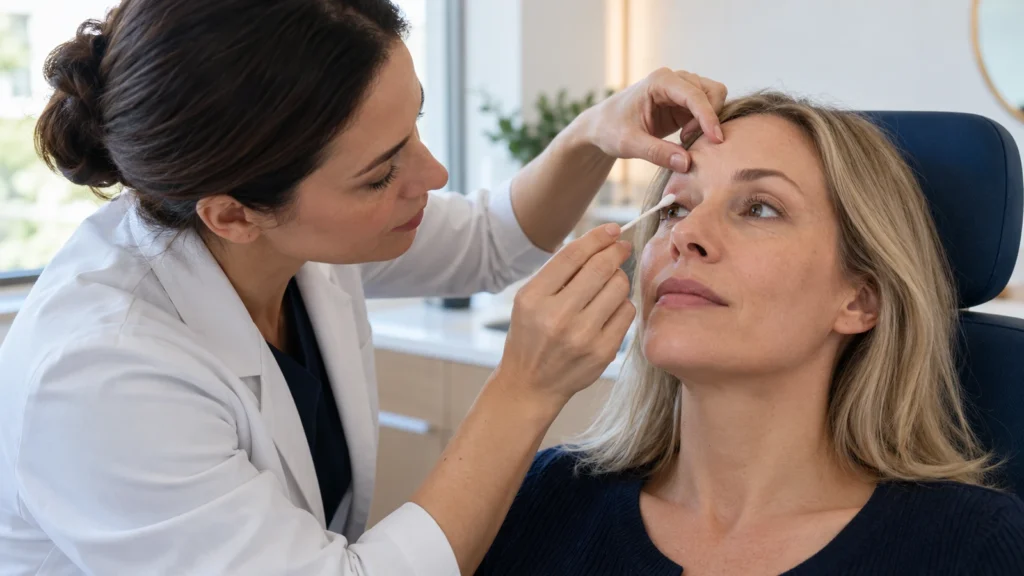
Then five questions. Crease? None means monolid; one hidden under an overhanging fold means hooded. Outer corner above, below or level with a horizontal line through both inner corners — upturned, downturned or neutral. White above or below the iris? If yes, round or prominent; if the lids graze it, almond. Gap between the inner corners narrower, equal to or wider than one eye. Now turn side-on: eyes behind a projecting brow bone are deep-set, eyes forward of the rim are protruding.
Of all eye shapes, almond is the usual answer for the most common eye shape: it describes the mid-point of every variable. Monolid and hooded types are also enormously common worldwide. As for the rarest eye shape, be skeptical of everything you read — no published dataset measures all eye types across a representative global sample, so the percentages online trace back to nothing. Unusual combinations are genuinely rare, but nobody has counted them.
Eye shapes in men
Male eye shapes use the same vocabulary, but the average starting point differs. Men tend to have greater brow-bone projection and a brow sitting lower and flatter, closer to the orbital rim. A large share of male eyes therefore read as deep-set, hooded or both — often from early adulthood, and not because anything has gone wrong.
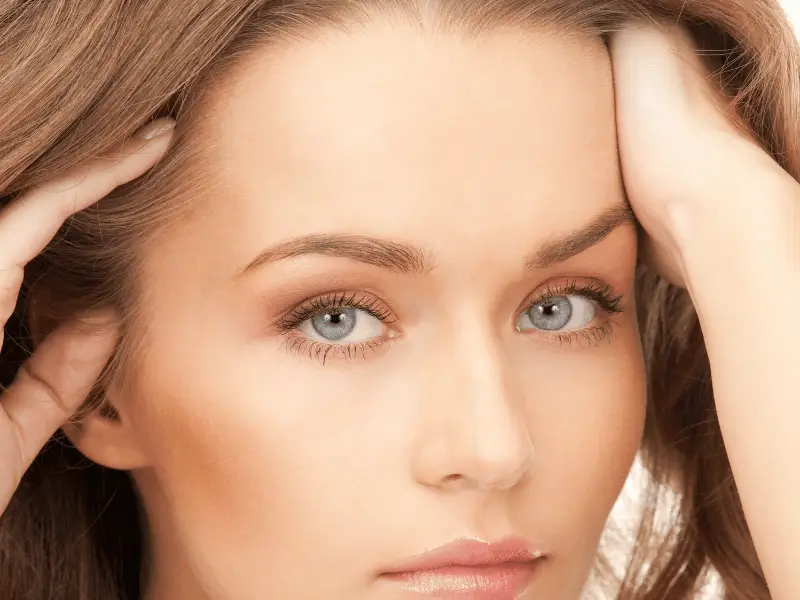
A low straight brow and a small lid platform are normal male features, not signs of aging, and treating them as aging is how people end up looking permanently surprised; over-elevating a male brow is the commonest error in the upper face and it is hard to reverse. Men researching different eye types also tend to arrive via tiredness rather than shape — told they look exhausted when they feel fine. That is normally brow position, upper lid skin or shadow across a deep-set eye, and the fix, if any, is small.
The interest is not marginal: in the ISAPS Global Survey for 2024, eyelid surgery overtook liposuction to become the world’s most-performed cosmetic operation for the first time — more than 2.1 million procedures, up 13.4% year on year. Rising volume is not, by itself, a reason to have anything done.
Eye color is a separate question — and one worth being careful about
Color and shape are unrelated. Eye color comes from melanin in the iris stroma: more pigment gives brown, less produces the light scattering we read as blue, gray or green. MedlinePlus Genetics attributes most of the effect to OCA2 and HERC2 on chromosome 15, with at least eight other genes contributing, which is why color behaves as a continuum. Bluish-gray eyes (bluish grey, in British spelling) are simply a low-melanin iris scattering light a little differently from a pure blue one — not a distinct type.
Which brings us to a question we are asked often: how to change eye color, or make eyes lighter. The answer is no, and it deserves explaining. Three surgical approaches exist — cosmetic iris implants, keratopigmentation (corneal tattooing) and laser iris depigmentation — and all three carry serious, sometimes permanent risks. The American Academy of Ophthalmology has warned specifically about cosmetic iris implants, linked to raised eye pressure and glaucoma, corneal damage, cataract, uveitis and vision loss, and issued a broader warning in 2024 covering color-changing procedures generally.
Laser depigmentation risks releasing pigment that clogs the eye’s drainage; keratopigmentation can scar the cornea and permanently complicate future eye examinations. Vivid Clinic does not perform any eye-color procedure and will not refer you for one.
If you want a different eye color, colored contact lenses are the only sensible route — fitted and prescribed by an eye care professional. Novelty lenses sold without a prescription cause abrasions and infections.
Why eye anatomy varies from person to person
Some features of the eye region do differ in average frequency between populations. Epicanthal folds are far more common in some groups than others; average brow-bone projection, orbital rim depth and crease height differ too. A surgeon who ignores that will operate badly.
But the framing people search with — asking what type of eyes a given nationality or region “has” — does not survive contact with the data. Human variation is overwhelmingly within populations rather than between them: the range of eye shapes in any single town dwarfs the difference between the averages of any two populations. There is no national eye shape, and any article handing you a lookup table is selling a stereotype dressed as anthropology.
The useful version is that anatomy is individual. Someone with an epicanthal fold and a low crease needs a different plan from someone with a deep socket and a heavy brow — an assessment question, not a heritage question. Where a feature is characteristic of someone’s family, the default assumption here is that it stays.
Ptosis: when a lid is not a shape but a medical question
“Ptotic” is the adjective from ptosis (properly, blepharoptosis): an abnormally low upper eyelid margin with the eye looking straight ahead. It is a specific medical finding, not a synonym for hooded. The upper lid normally covers about 1–2 mm of the cornea, measured as MRD1 — pupil light reflex to lid margin.


The two problems live in different tissues. Dermatochalasis is excess upper lid skin draping over a crease; the lifting mechanism works fine, there is simply too much skin above it. Ptosis means the lifting mechanism itself is underperforming — most often the levator aponeurosis has stretched or detached, though it can also be neurological, muscular, mechanical or traumatic.
Removing skin from a truly ptotic lid will not fix it and can make asymmetry more obvious; as Cleveland Clinic sets out, a droopy eyelid is treated by addressing the levator. Because ptosis can obstruct vision, repair is sometimes covered by health insurance where cosmetic eyelid surgery is not — but only against measured thresholds. US Medicare policy, for example, looks for an MRD of 2.5 mm or less, or visual field testing showing at least a 12-degree or 30% improvement when the lid is lifted.
See a doctor promptly if an eyelid droops suddenly; if drooping comes with double vision, eye pain or a severe headache; if pupil size changes or the pupils become unequal; if drooping fluctuates through the day or worsens with fatigue; or if there is weakness elsewhere in the face or body. These can indicate third nerve palsy, Horner syndrome or myasthenia gravis, and some causes are urgent.
Sudden ptosis with headache or pupil change is an emergency, not an aesthetic consultation. The same goes for eyes that become newly prominent, and for a lid narrowing on one side only — often described as one eye going “thin”. New asymmetry deserves examination.
What suits each eye shape: makeup and glasses come first
Before anything clinical, two things change how eyes read more cheaply and reversibly than any treatment. Makeup manipulates the same variables anatomy does. Hooded eyes want color placed slightly above the natural crease so it stays visible with the eye open, and thin liner tight to the lash line — thick liner disappears under the fold and closes the eye. Round eyes lengthen when liner and shadow extend outward at the outer third rather than building up in the center.

Downturned eyes lift with a short flick angled up. Monolid eyes hold a horizontal gradient better than a crease-based one. Deep-set eyes read brighter with light, low-shimmer shadow on the lid. Close-set eyes open up with light at the inner corner; wide-set eyes want the opposite.
Glasses do more than people expect. Frames sit on the same visual line as the brow, so a frame’s top edge effectively becomes your brow line at conversational distance. A top rim below your real brow shortens the eye area and accentuates hooding; one skimming just under the brow usually flatters. Angular, upswept frames counterbalance downturned corners, and deeper frames give protruding eyes room. A wider, lower bridge makes close-set eyes look further apart.
Neither is a consolation prize. For most people asking about all types of eyes and what suits them, this section is the whole answer.
Treatments that change how the eye area reads — and what they cannot do
Eye shape is set by bone, canthal position and crease anatomy. Procedures adjust the soft tissue around that framework; they do not rebuild it.
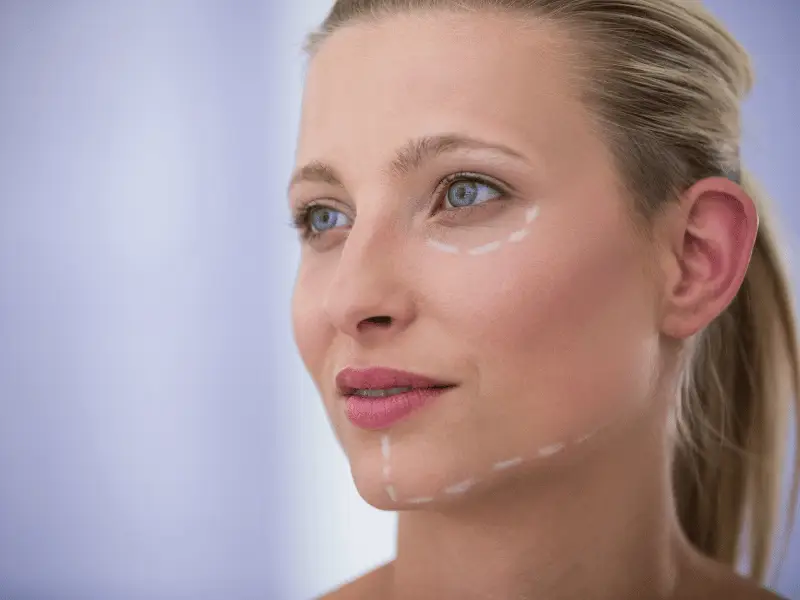
Botulinum toxin around the brow
Relaxing the muscles that pull the outer brow down raises it slightly and opens the lateral eye. Published measurements of the effect are in millimeters, not centimeters, and it lasts months. Anyone promising a dramatic eye lift from injections alone is overselling.
Filler in the temples to lift the eyes
Temple filler treats temporal hollowing, the concave area between the brow’s tail and the hairline. Restoring that volume can give a small indirect lift at the brow tail and outer eye, mostly by re-tensioning the tissue the brow sits on. It does not change canthal tilt, does not lift the eyelid, and will not reproduce a surgical result.
It also deserves respect. The temple holds the middle temporal vein — commonly 5–10 mm across, roughly 2 cm above the zygomatic arch — plus the sentinel vein, which drains into the ophthalmic venous system and cavernous sinus. Reported complications of filler here include cavernous sinus thrombosis and pulmonary embolism, and filler anywhere in the upper face or around the eye carries a rare but real risk of blindness when material travels backward into the ophthalmic artery. Rare, and usually irreversible. Insist on a practitioner with detailed regional anatomy training and dissolving agent on site, and expect to hear about vision loss during consent.
Thread lifts
PDO threads for the brow or outer eye are marketed hard as a non-surgical fox eye. Cleveland Clinic puts thread lift longevity at roughly one to three years, with reported lumpiness, pulling, infection and asymmetry. The margin between subtle and visibly odd is narrow here.
Surgery, when it is genuinely the right answer
Upper and lower eyelid surgery removes or repositions excess skin and redistributes fat, restoring a visible lid platform and softening lower lid puffiness. It does not change canthal tilt or turn one eye type into a different eye shape. Canthoplasty, the surgical basis of the fox eye lift, does alter tilt because it repositions the outer corner itself — but it is demanding surgery on the structure holding the lower lid against the eye, and poor versions cause lid malposition, dry eye and a pulled corner that is hard to revise.
Where the real problem is a descended brow, a forehead and brow lift addresses the actual cause; done for the wrong reason it produces the over-elevated look described earlier. Double eyelid surgery and epicanthoplasty are common in some countries; they are choices about identity as much as aesthetics.
A surgeon worth their fee will sometimes say the answer is none of the above. Deep-set eyes with good lid function and no visual obstruction are a feature to light well, not a diagnosis. Costs are confirmed at consultation after a photo assessment.
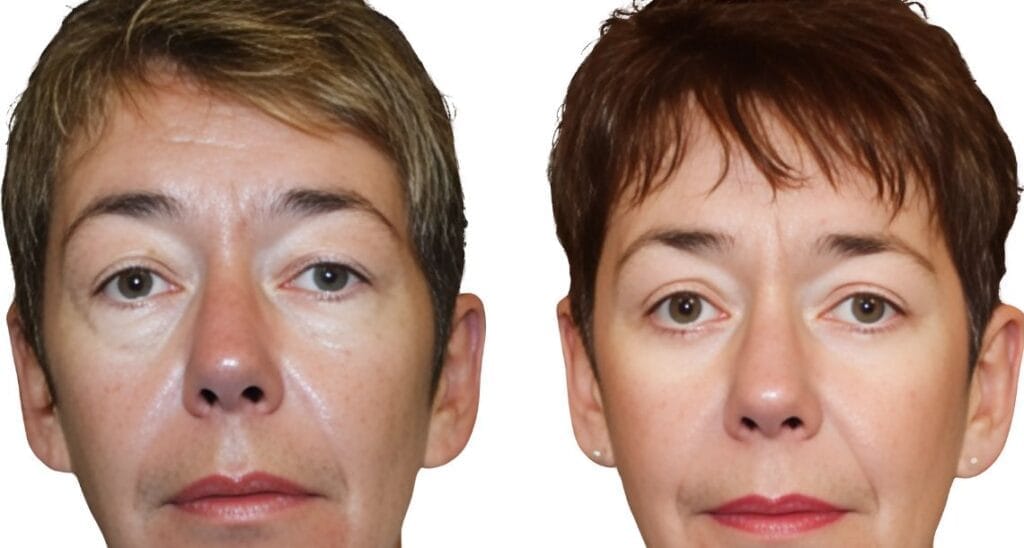
Eye Area Before & After Results at Vivid Clinic
These consented Vivid Clinic cases show how eyelid surgery and fox eye lift techniques change the look of different types of eyes. Every eye shape responds differently, so your surgeon in Istanbul will plan around your own anatomy rather than a trend.




Frequently Asked Questions
What are the different types of eyes?
Ten: almond, round, monolid, hooded, upturned, downturned, deep-set, protruding, close-set and wide-set — the last two describing spacing rather than shape. Most people match two or three at once. A hooded, deep-set eye with a slight downturn is far more typical than a textbook single type.
What is the most common eye shape, and what is the rarest?
Almond is the usual answer for the most common, because it describes the mid-point of every variable that makes up eye shape. For the rarest eye shape there is no reliable answer: no study has measured all eye types across a representative worldwide sample, so any exact percentage is quoting something nobody counted.
Can you change your eye shape without surgery?
Not the underlying shape — bone position, canthal tilt and crease anatomy do not respond to non-surgical treatment. Makeup, brow shaping and glasses change how eyes read, sometimes dramatically, and botulinum toxin can raise the outer brow a few millimeters for a few months. Everything beyond that is surgical.
Is a droopy eyelid the same as a hooded eye?
No. Hooded eyes have excess skin covering a crease while the lifting muscle works normally. Ptosis means the lid-lifting mechanism itself is underperforming, so the margin sits abnormally low, and the two need different operations. See a doctor urgently if a lid droops suddenly, or with double vision, headache or a change in pupil size.
Is it safe to change your eye color?
No cosmetic eye-color procedure is considered safe. Iris implants, keratopigmentation and laser iris depigmentation have all been linked to glaucoma, corneal damage, inflammation and vision loss, and the American Academy of Ophthalmology has warned against them. Vivid Clinic does not perform them. Prescribed, professionally fitted colored contacts are the only sensible option.
Not sure which of these describes your eyes — or whether anything needs doing at all? Most people who ask us that leave with reassurance rather than a quote, and that is a good outcome. For a considered opinion from a plastic surgeon rather than a mirror and a chart, start with our face aesthetics team and send photographs for assessment. We will say plainly if the honest answer is to leave your eyes alone.