
Medically reviewed by Prof. Dr. Özgür Pilancı, Plastic, Reconstructive & Aesthetic Surgeon — August 2026
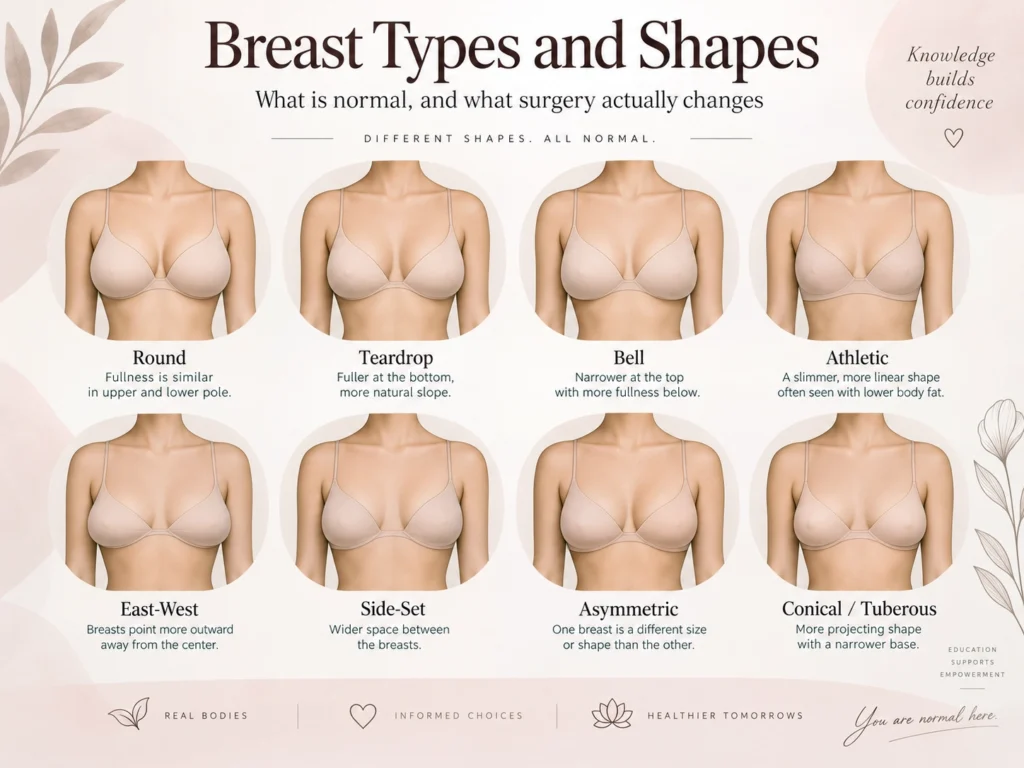
Quick answer (updated September 2026): Most of the breast “shape types” circulating online — round, teardrop, east-west, bell, athletic, side-set — come from the lingerie industry, not from medicine. They are useful for buying a bra and useless for planning surgery. Surgeons classify breasts by three things that can actually be measured: where the nipple sits relative to the fold beneath the breast (ptosis grade), how the volume distributes between the upper and lower pole, and whether the base of the breast is normally proportioned or constricted. Almost every shape is a normal variation. A small number are recognised clinical conditions with specific corrections.
What a breast is made of
The breast sits on the pectoralis major muscle and is built from glandular tissue — 15 to 20 lobes with their duct system — held in a framework of fibrous stroma and fat. The proportion of gland to fat varies enormously between individuals and shifts over a lifetime, moving toward more fat after menopause as oestrogen falls.
Running through it is a network of fibrous bands called Cooper’s ligaments, which anchor the skin to the chest wall. They provide the breast’s internal support, and they are not rigid — they stretch and loosen over time, which is a large part of why breasts change shape with age.
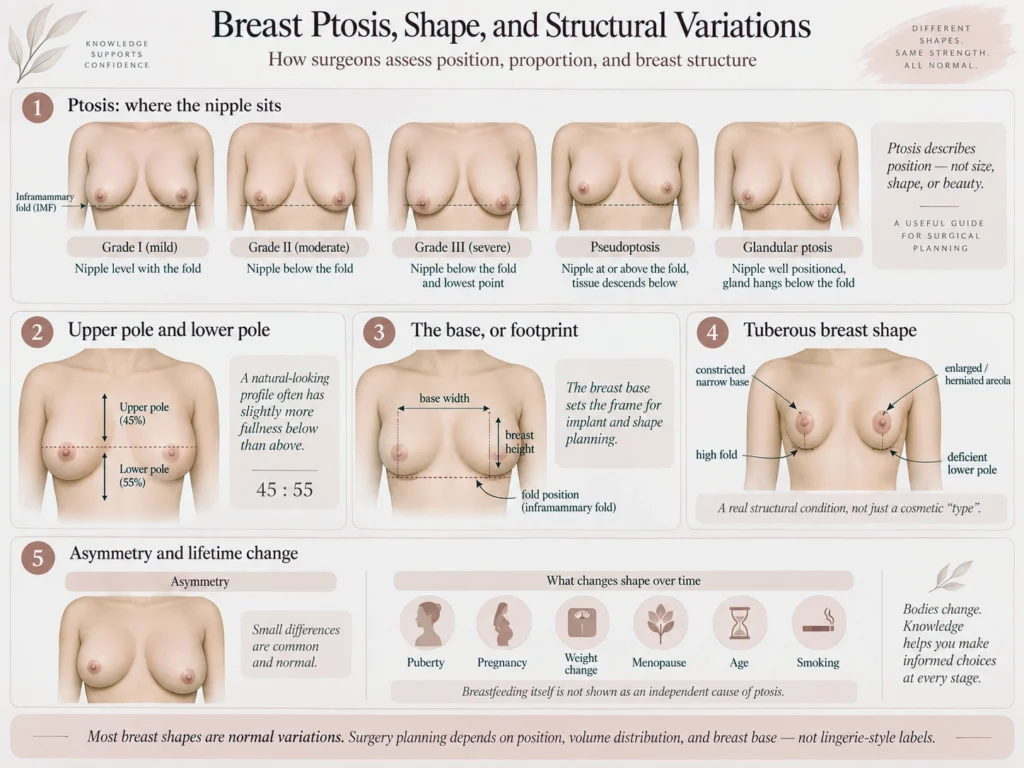
Two landmarks decide almost everything a surgeon says about shape. The inframammary fold (IMF) is the crease where the breast meets the chest wall. The nipple-areola complex sits, on a young breast, just above that fold and roughly level with the fourth rib. Where the nipple sits relative to the fold is the single most informative measurement in breast surgery.
The shape categories you find online — and what they are worth
Round, teardrop, bell, slender, athletic, east-west, side-set, asymmetric, relaxed, conical. These lists are everywhere, and there is nothing wrong with them so long as you know what they are: descriptive categories developed by bra manufacturers to help with fit. No peer-reviewed system defines or validates them. Two surgeons will not agree on which one you are, because there is nothing to agree on.
They are genuinely useful for one thing — finding a bra that fits — and they are the wrong vocabulary for a surgical consultation, where the questions are how much tissue there is, where it sits, and what the skin will do.
One term on that list is the exception. Conical or tuberous describes a real, recognised developmental variation with a clinical classification and a specific surgical correction. We come to it below.
The classifications surgeons actually use
Ptosis: where the nipple sits
Ptosis is the clinical word for breast descent, and it is graded on the Regnault scale by nipple position relative to the inframammary fold:
- Grade I (mild) — the nipple is level with the fold.
- Grade II (moderate) — the nipple is below the fold, but is not the lowest point of the breast.
- Grade III (severe) — the nipple is below the fold and is the lowest point of the breast.
- Pseudoptosis — the nipple is at or above the fold, but the tissue has descended below it. This is the classic pattern after weight loss, after breastfeeding, or after implant removal.
- Glandular ptosis — the nipple is well positioned but the gland itself hangs below the fold.
The distinction is not academic. It decides whether the answer is a lift, an implant, both, or neither. An implant placed under a Grade III nipple does not lift it — it produces the “double bubble” where the implant sits high and the native tissue hangs off it.
Upper pole and lower pole
Divide a breast horizontally at the nipple. The upper pole is the tissue above; the lower pole is the tissue below. The relationship between the two is what people are describing when they say a breast looks “natural” or “done”.
The most-cited work on this is Mallucci and Branford’s morphometric study, which asked more than 1,300 people plus 53 plastic surgeons to rank breast profiles. The clear winner across every demographic tested — around 87–95% preference — was an upper-to-lower pole ratio of 45:55, with slightly less volume above the nipple than below, and a gently sloping rather than convex upper pole. That single number explains a lot of dissatisfaction with breast surgery: a 50:50 or top-heavy result reads as artificial to almost everyone, including surgeons.
“Upper pole fullness” is the term for convex volume in that upper half. It is worth being blunt about it: nothing non-surgical creates it, and a lift alone does not create it. It requires an implant, structural fat grafting, or release of tissue that is restricting the upper pole from expanding.
The base, or footprint
The breast’s footprint on the chest wall — its width and height, and where the fold sits — is set developmentally and is the frame everything else works inside. A narrow base cannot hold a wide implant without the implant sitting outside the breast’s natural boundary. This is why two people who ask for the same result and the same implant size get very different-looking outcomes.
Tuberous breast shape: the one that is a real condition
Tuberous (or tubular) breast development produces a distinctive combination: a constricted, narrow base, a high or absent inframammary fold, a deficient lower pole, and an areola that appears enlarged and herniated as tissue pushes forward through it. It is often asymmetric, affecting one side more than the other.
It is much more common than most people realise. In a study of 800 women from the general population, 27.6% had at least one tuberous feature; among 400 women presenting for breast augmentation, that rose to 48.5%. Roughly one woman in four has some degree of it, and nearly half of those seeking augmentation do.
This matters because tuberous shape cannot be corrected by putting an implant in. An implant placed inside a constricted base makes the constriction more obvious, not less — the tissue simply herniates further through the areola. Correction requires releasing the fibrous bands holding the base narrow, lowering or recreating the fold, redistributing the glandular tissue, reducing the areola, and only then adding volume. Severe cases are staged.
If a surgeon proposes a straightforward augmentation and you have any of the features above, ask specifically whether they consider your breasts tuberous and how they plan to address the base.
Asymmetry
Some difference between the two sides is close to universal — different volume, different nipple height, different fold position, or all three. It is normal variation and, in most people, invisible to anyone else.
Asymmetry becomes a clinical question when the difference is large enough to be visible in clothing, when bra fitting is genuinely difficult, or when it causes real distress. Correction usually means operating on both sides — reducing or lifting the larger, augmenting or repositioning the smaller — because matching one side to the other rarely works from one side alone.
The rare structural cause is Poland syndrome, a congenital condition involving absence or underdevelopment of the pectoralis major, often with associated chest wall and breast asymmetry. It is uncommon, well described, and reconstructable.
Separately: a new asymmetry, in an adult whose breasts were previously even, is not a cosmetic matter. See the final section.
What actually changes breast shape over a lifetime
Puberty sets the base and the initial gland volume. The menstrual cycle produces short-term fluid and glandular changes. Pregnancy expands the gland dramatically; after weaning, that gland involutes and is largely replaced by fat, often inside a skin envelope that is now larger than the tissue filling it — which is the mechanism behind post-pregnancy deflation, and the reason it is a shape change rather than only a size change.
Weight change adds and removes fat, stretching and slackening skin as it goes. Menopause shifts the gland-to-fat ratio further and thins the supporting tissue.
On what causes sagging specifically, the most useful evidence comes from Rinker’s 2007 study of 132 women. Its findings were: age, number of pregnancies, and smoking were significant independent risk factors for ptosis. Breastfeeding was not. The proposed mechanism for smoking is that it degrades elastin, which is exactly what the skin needs to hold shape.
That last point is worth repeating because it contradicts advice given to women constantly: breastfeeding itself does not cause sagging. Pregnancy, ageing and smoking do.
Things that do not change breast shape

Creams and pills. No breast enhancement product has been demonstrated to work. There is no topical route to gland or fat growth, and the FDA position is that no such product has ever been proven effective. We cover this in detail in do breast enlargement pills and creams work?.
Exercise. Chest exercises build the pectoralis major underneath the breast. That can change how the chest looks overall and can very slightly alter projection, but it does not enlarge, lift or reshape breast tissue itself, which contains no muscle.
Wearing or not wearing a bra to bed. This deserves an honest answer rather than a confident one. The widely circulated claim that bras cause sagging traces to a single French study by Jean-Denis Rouillon, following 320 women aged 18–35 over 15 years, which reported that nipple position rose slightly in women who did not wear bras.
The researcher himself said the results were preliminary, the sample was too small and unrepresentative to conclude from, and that they explicitly did not apply to women over 45. No clinical body endorses bra-wearing choice as either a cause of or a protection against sagging. Wear one to bed if it is comfortable; do not if it is not. Neither choice is doing anything to your Cooper’s ligaments.
What surgery can and cannot change
| Concern | What actually addresses it |
|---|---|
| Volume too small | Augmentation with implants, or fat transfer for modest gains |
| Volume too large, with symptoms | Reduction, which also lifts |
| Nipple sitting low (ptosis) | Mastopexy (lift) — repositions, adds no volume |
| Sagging and wanting fullness | Augmentation-mastopexy — lift plus implant |
| No upper pole fullness | Implant, structural fat grafting, or release of restricting tissue. Not a lift alone |
| Constricted base / tuberous shape | Base release, fold recreation, areola reduction, then volume — not an implant alone |
| Areola too large or stretched | Areola reduction, usually combined with a lift |
| Asymmetry | Usually a different operation on each side |
| Deflation after pregnancy | Depends on the ptosis grade — lift, implant, or both |
Implant shape interacts with all of this. Round implants distribute fullness evenly and add upper pole volume regardless of orientation. Anatomical (teardrop) implants taper toward the top to mimic a natural sloping upper pole, and carry a specific risk of rotating out of position. Neither is universally better; the right choice depends on your base width, your existing tissue, and whether you want that upper pole convex or sloped.
When a change in shape is a doctor’s problem, not a surgeon’s
This section matters more than the rest of the article. A shape change that happens on its own, in one breast, in an adult, needs medical assessment — not a cosmetic consultation. Specifically: a new lump or thickening in the breast or armpit; a change in size, shape or feel that you did not expect; skin puckering, dimpling, or an orange-peel texture; a rash or persistent redness; a nipple that turns inward when it did not before; or nipple discharge outside pregnancy and breastfeeding.
Most of these turn out to be benign. All of them are checked first, by a doctor, before anything cosmetic is planned.
Separately, if you have been told you have dense breast tissue on a mammogram, that is a description of tissue composition, not a disease. Roughly half of screened women have breasts classified as dense. It matters for two reasons: dense tissue appears white on a mammogram, as tumours can, which reduces detection sensitivity; and density is itself an independent risk factor. It has no bearing on how your breasts look or on whether you are a surgical candidate.
Frequently Asked Questions
What are the different breast types?
The lists of "types" you will find online — round, teardrop, bell, athletic, east-west, side-set, relaxed, asymmetric — come from the lingerie industry and are useful for bra fitting rather than for medicine. Clinically, breasts are described by three measurable things: ptosis grade (where the nipple sits relative to the fold beneath the breast), the distribution of volume between the upper and lower pole, and whether the base of the breast is normally proportioned or constricted. Almost every shape is normal variation.
What is breast ptosis?
Ptosis is the clinical term for breast descent, graded by nipple position relative to the inframammary fold. Grade I means the nipple is level with the fold; Grade II means it is below the fold but not the lowest point of the breast; Grade III means it is below the fold and is the lowest point. Pseudoptosis means the nipple is still well positioned but the tissue has dropped below the fold — common after weight loss, breastfeeding or implant removal. The grade determines whether a lift, an implant, or both is the right operation.
What is a tuberous breast?
Tuberous or tubular breast development produces a narrow, constricted base, a high inframammary fold, a deficient lower pole and an areola that looks enlarged because tissue herniates forward through it. It is a developmental variation, not a disease, and it is common — about one woman in four has some feature of it, and nearly half of women seeking augmentation do. It matters because an implant alone makes it look worse: correction requires releasing the constricted base and recreating the fold before adding volume.
Is it bad to sleep in a bra?
There is no good evidence either way, and no clinical body recommends for or against it. The claim that bras cause sagging comes from one small French study whose own author called it preliminary, unrepresentative and inapplicable to women over 45. Sleeping in a bra does not prevent sagging and does not cause it. Comfort is the only sensible basis for the decision.
Can anything non-surgical make breasts fuller on top?
No. Upper pole fullness — convex volume above the nipple — requires an implant, structural fat grafting, or surgical release of tissue restricting the upper pole. No cream, supplement or exercise produces it. Chest exercises build the muscle underneath the breast, which can slightly change the overall chest contour but does nothing to the breast tissue itself, which contains no muscle.
Is breast asymmetry normal?
Some asymmetry is close to universal and is normal variation — differing volume, nipple height or fold position between sides. It becomes a clinical question only when it is visible in clothing, makes bra fitting genuinely difficult, or causes real distress, in which case correction usually involves a different operation on each side. What is not normal is a new asymmetry appearing on its own in an adult; that needs medical assessment first.
Wondering which of these describes you — and what, if anything, would actually change it? That comes down to where your nipple sits, how your volume distributes, and how wide your base is. Send photographs for a free online assessment and get a straight, unhurried answer, including "nothing needs changing" where that is the honest one.