
 ChatGPT

Medically reviewed by Prof. Dr. Özgür Pilancı, Plastic, Reconstructive & Aesthetic Surgeon — August 2026
Quick answer (updated August 2026): Skin stretched for years by excess weight does not shrink back after bariatric surgery or a GLP-1 medication. An arm lift (brachioplasty) removes the hanging skin of the upper arm through an incision running from the armpit toward the elbow. A lower body lift, or belt lipectomy, removes a belt of skin and fat right around the trunk, lifting abdomen, flanks, outer thighs and buttocks in one operation. Both trade loose skin for a long, permanent scar. That trade is the entire decision.

Why loose skin does not go back on its own
Skin is elastic, but only up to a point. Cleveland Clinic puts it plainly: carrying extra weight stretches skin and tissue until they lose elasticity, so when the weight comes off the stretched skin cannot conform to your new shape and hangs loosely.
Speed makes it worse: ISAPS, in its guidance on GLP-1 receptor agonist drugs, notes that rapid weight loss has been shown to impair the skin’s ability to regenerate and maintain elasticity.
No cream, wrap or gym program removes a skin apron. Excess skin is a volume problem, and the only way to reduce it is to cut it out. Everything else — including Vaser liposuction — treats fat, not skin.

Arm lift (brachioplasty): the scar is the whole decision

A brachioplasty removes a wedge of skin and fat from the underside of the upper arm and closes the gap, leaving a scar down most of the arm. ASPS places that incision on the inner arm or the back of the arm, running from the axilla to just above the elbow.
Where that scar sits is the one thing worth arguing about with your surgeon.
Along the bicipital groove. The conventional line follows the furrow between biceps and triceps, usually with a W, S, L or Z-plasty at the armpit so a straight scar cannot contract into a band.
On the back of the arm. StatPearls sets out the trade: a less visible anterior scar, though one more apparent posteriorly at rest.
Short-scar (mini) brachioplasty. Suitable, per StatPearls, where skin ptosis measures less than 12 cm from the mid-humerus to the lowest hanging point.
Extended or “L” brachioplasty. Where loose tissue continues onto the lateral chest wall, the incision curves along the axillary dome and down the chest.
With liposuction. StatPearls reports that adding liposuction to brachioplasty was associated with a significantly lower overall complication rate.
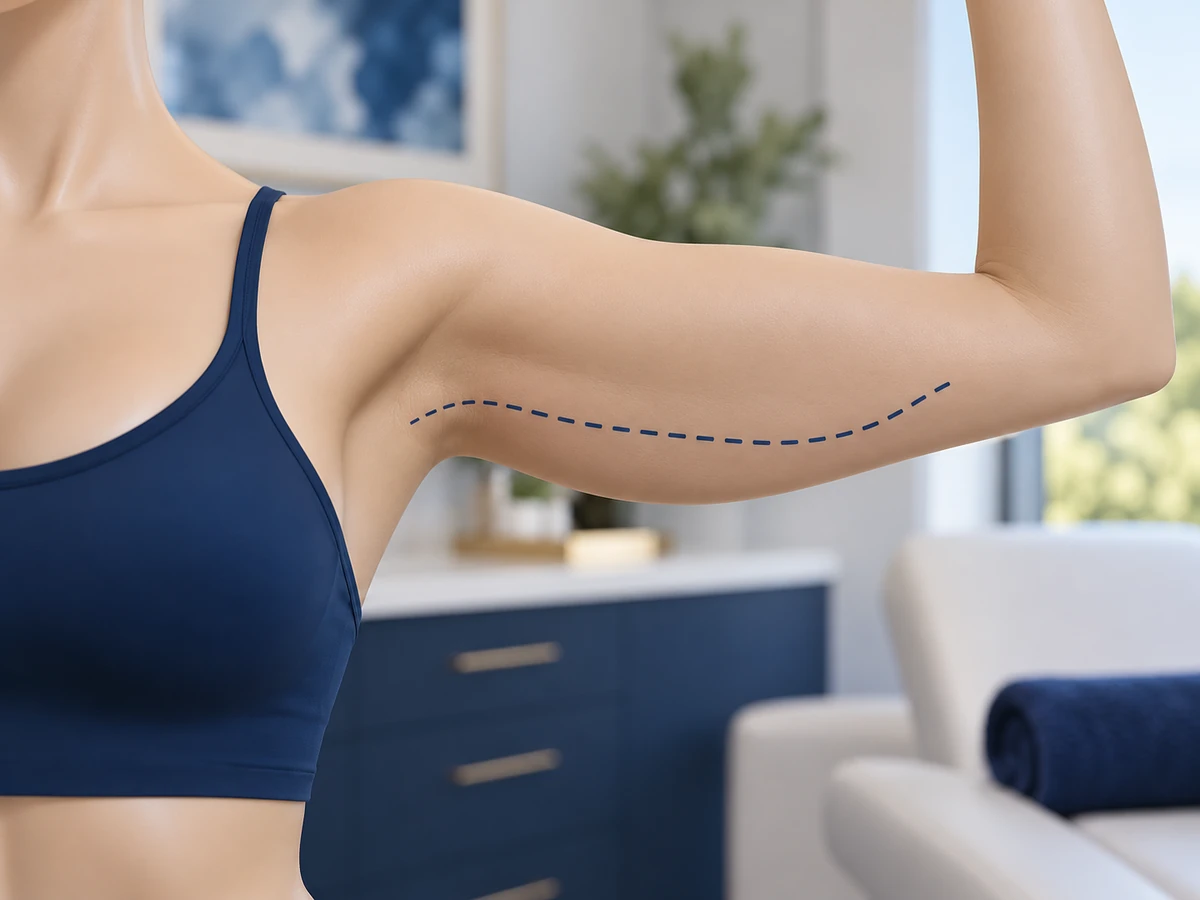
What an arm lift scar looks like at one year
At twelve months, most arm lift scars are still settling. StatPearls is explicit: because of the tension-bearing nature and dependent position of the upper arm, scar remodeling may take 12 to 18 months to reach optimal flattening and fading — considerably longer than in other anatomic regions.
So a one-year arm lift scar is usually flatter and paler than at three months, but often still pink and sometimes still slightly raised. Judging your result at twelve months is judging it early.
It does not always settle well. Across a meta-analysis of 29 studies and roughly 1,600 patients, unfavorable scarring was the most common complication at 9.9%, and about 7.5% had revision surgery for aesthetic reasons.
Silicone sheeting or gel, massage, sun protection and intralesional corticosteroid where a scar thickens all help. The scar is permanent: Cleveland Clinic’s line on body lift scars applies equally to arms — they fade in time but never disappear entirely.
Lower body lift (belt lipectomy): one operation, all the way around
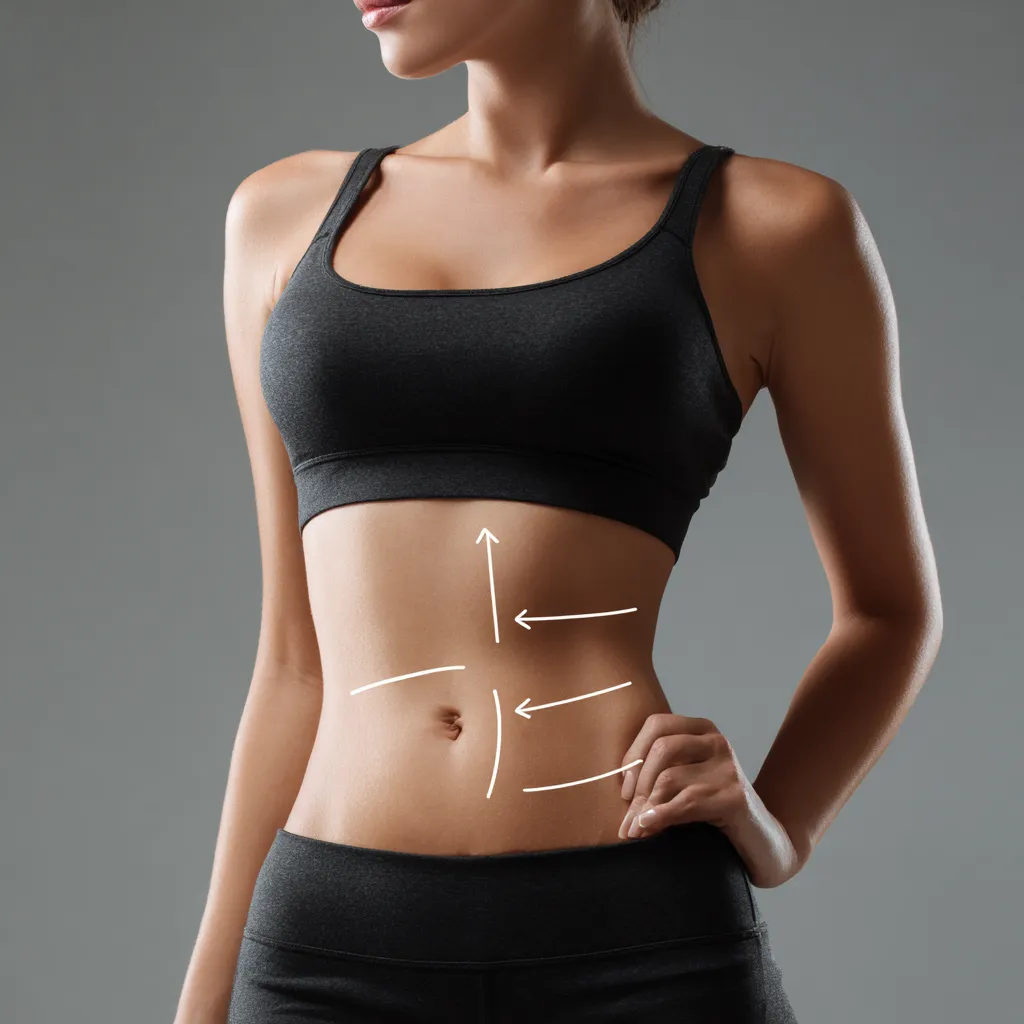
A lower body lift — also called belt lipectomy, circumferential body lift or torsoplasty — removes a continuous belt of skin and fat from around the lower trunk. ASPS describes a bikini-pattern incision that tightens abdomen, groin, waist, thigh and buttock in one procedure, removing an apron of excess skin and fat and repositioning the tissues.
That circumferential design separates it from a tummy tuck. An abdominoplasty treats the front; a lower body lift carries the same excision around the flanks and across the back, so the outer thigh is lifted and the buttock resuspended rather than left flat.
It is a far bigger undertaking: StatPearls describes roughly three position changes on the table, undermining of the abdominal flap, plication of muscle separation, relocation of the umbilicus and quilting sutures to close dead space. Cleveland Clinic states that belt lipectomy complications are more common than in other forms of plastic surgery — a sentence worth reading twice.
Are you actually a candidate?

Four things decide this, and none is how much you dislike your arms.
Weight stability. For brachioplasty after bariatric surgery, StatPearls suggests being at least 12 months post-bariatric and holding weight within 5 kg of target for three to six months, ideally a year; for belt lipectomy, stable weight for six months to a year. Cleveland Clinic advises holding goal weight for at least six months, and notes reaching it can take one to two years after bariatric surgery. One NHS trust expects two years.
BMI. StatPearls prefers a BMI below 30 kg/m² for elective contouring and reports a BMI of 30 or above as the strongest predictor of infection after brachioplasty. For belt lipectomy it cites research finding complication rates as high as 50% above a BMI of 32.
Nutrition. Bariatric patients may carry deficiencies caused by malabsorption, and StatPearls is direct that these must be corrected before belt lipectomy to support wound healing. Protein, iron, B12 and vitamin D are the usual suspects: a wound built from protein you do not have will not close well.
Smoking. StatPearls advises stopping at least a month before surgery; active smoking is a relative contraindication to brachioplasty in its own right.
Staging: you cannot have it all in one day
Most post-weight-loss patients need more than one operation, and Cleveland Clinic states that excess skin removal often takes place in stages. What gets combined depends on operative time, position changes and total blood loss.
A lower body lift is already a combined operation, so it usually stands alone. An arm lift is more often paired with upper body work such as a breast lift. Upper and lower halves are typically separated by several months — long enough for drains to be out, scars to begin maturing and protein stores to recover.
Ask your surgeon to sequence the whole plan at the first consultation, not one operation at a time. It changes the total cost, the total recovery and sometimes whether you proceed.

Risks worth hearing before you agree
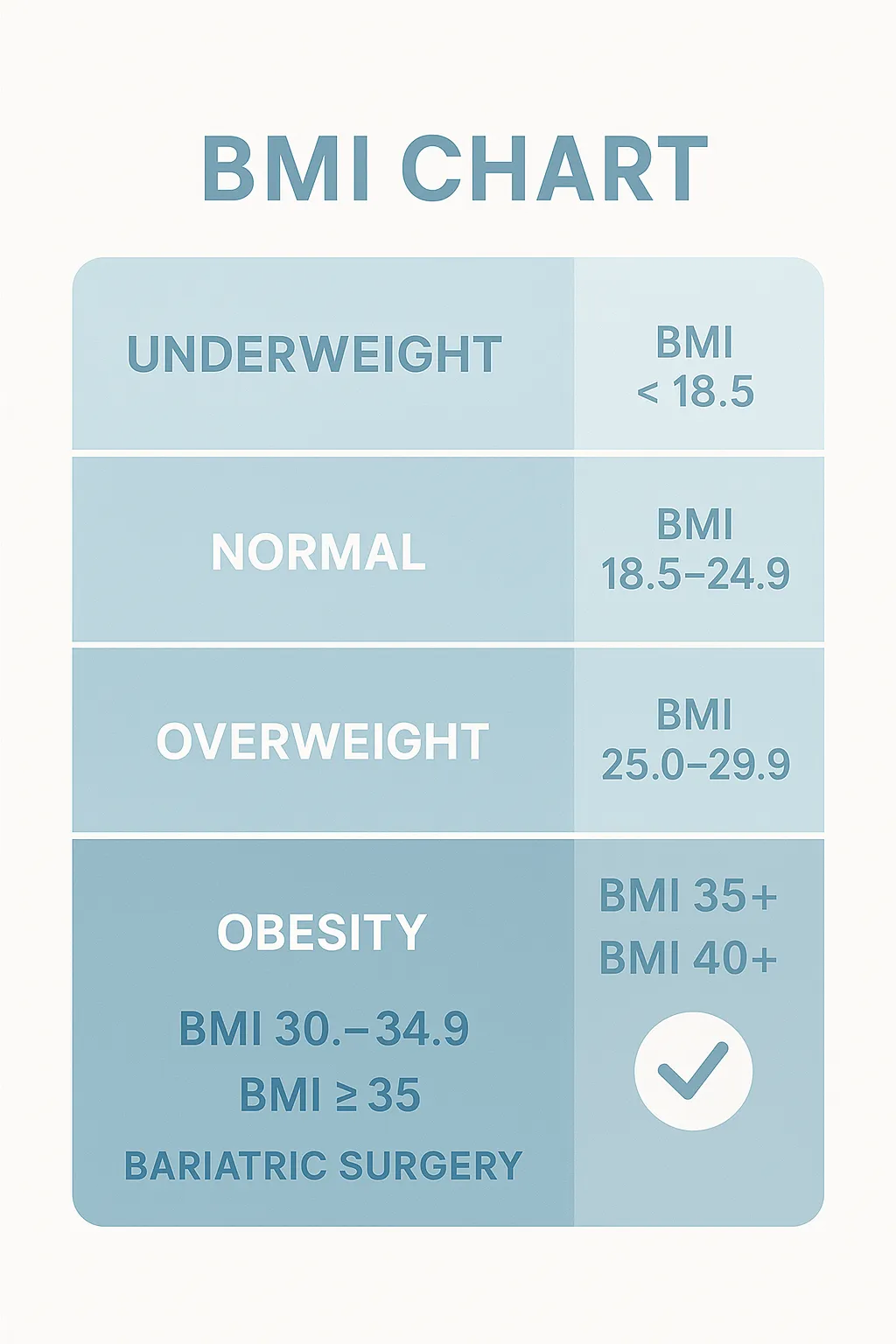
These are large-surface-area operations, and the published complication rates reflect that.
For belt lipectomy, a meta-analysis of 1,380 patients reported an overall complication rate of 37%: wound dehiscence 17%, seroma 13%, infection 5%, skin necrosis 4%, hematoma 3%, and DVT or pulmonary embolism 3%.
For brachioplasty, a meta-analysis of 29 studies found unfavorable scarring 9.9%, recurrent skin ptosis 7.8%, wound dehiscence 6.9%, seroma 5.9%, infection 3.6%, altered sensation 2.5%, lymphedema or lymphocele 2.5%, delayed healing or skin necrosis 2.3% and hematoma 2%. Sensory change follows injury to branches of the medial antebrachial cutaneous nerve near the inner elbow.
Clots deserve their own line. In one series of 138 post-bariatric contouring patients, venous thromboembolism risk was 2.9% overall and 8.9% in a higher-risk subgroup, with no events below a BMI of 35; the authors concluded routine prophylaxis is justified.
Expect drains: Cleveland Clinic notes they may stay in for a week or two, advises avoiding bending and heavy activity for about six weeks, and puts the final result at up to a year or more.
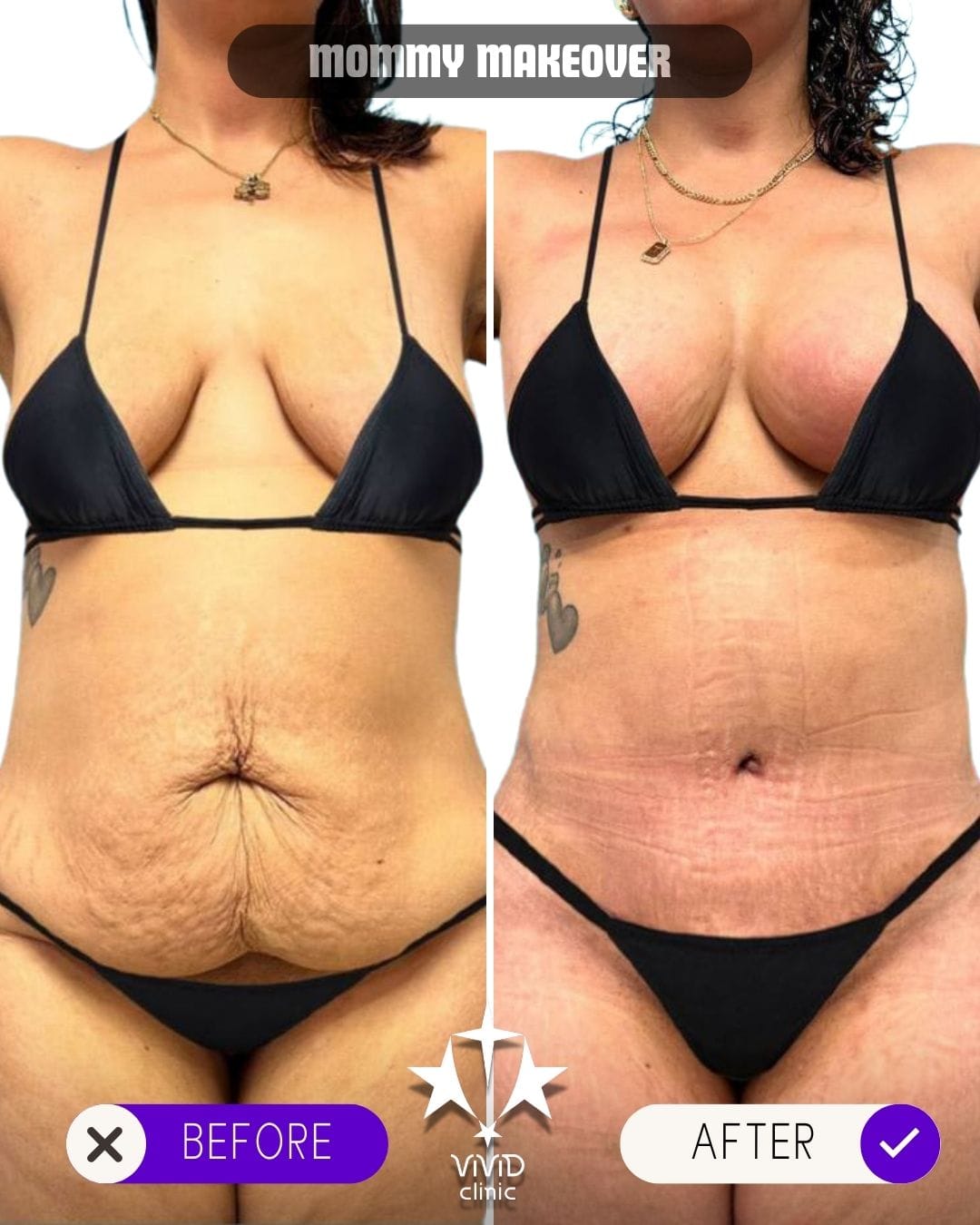
Related Before and After Results at Vivid Clinic
The photos below show real Vivid Clinic patients who had tummy tuck and body contouring — a related procedure, not a lower body lift itself — shared with their consent to show how our Istanbul team documents results. Ask during your free consultation to see cases that match your own treatment. Individual results vary. Browse the full Before & After Gallery.



Frequently Asked Questions
How long does an arm lift scar take to fade?
Longer than most scars. StatPearls attributes this to the tension-bearing nature and dependent position of the upper arm, and states scar remodeling may take 12 to 18 months to reach optimal flattening and fading. At one year a typical arm lift scar is paler and flatter than before, but often still pink and occasionally raised. Silicone gel, massage and sun protection help; a thickening scar can be injected with corticosteroid.
Where is the arm lift scar placed?
Usually on the inner arm along the bicipital groove, the furrow between biceps and triceps, often with a Z-plasty at the armpit so the scar cannot contract into a band. Some surgeons prefer the back of the arm: StatPearls notes this gives a less visible scar from the front but one more apparent from behind at rest.
What is the difference between a lower body lift and a tummy tuck?
An abdominoplasty treats the front of the abdomen. A lower body lift, or belt lipectomy, carries the same excision the whole way around the trunk, so the flanks, back, outer thighs and buttocks are lifted at the same time. ASPS describes a bikini-pattern incision that tightens abdomen, groin, waist, thigh and buttock in one procedure. If loose skin stops at the front, a tummy tuck is the right operation, and its shorter scar is an advantage.
How long after bariatric surgery or GLP-1 weight loss should I wait?
Long enough for your weight to be genuinely stable. StatPearls suggests being at least 12 months past bariatric surgery, with weight held within 5 kg of target for three to six months and ideally a year, before brachioplasty, and stable weight for six months to a year before belt lipectomy. Cleveland Clinic notes goal weight can itself take one to two years to reach, and some NHS services expect two years of stability. Operating early risks the skin excess simply returning.
Can I have an arm lift without a long scar?
Only if your skin excess is small. StatPearls describes short-scar brachioplasty as suitable where skin ptosis measures less than 12 cm from the mid-humerus to the lowest hanging point — mild laxity confined to the upper arm. One published series reported a 12% revision rate, mostly for scar revision. Where there is more skin than that, a short scar cannot remove it, and choosing one anyway means a disappointing result plus a scar.
Is a lower body lift a high-risk operation?
It carries more risk than most cosmetic surgery, and you should be told so directly. A meta-analysis of 1,380 belt lipectomy patients reported an overall complication rate of 37%, with wound dehiscence at 17% and seroma at 13%. Most complications are wound-healing problems rather than emergencies, but they extend recovery, and clot risk rises sharply with BMI. Careful patient selection keeps the numbers down.
Not sure whether you are ready for body contouring — or which operation you actually need? Send photographs and your weight history for a free online assessment and get a straight answer, including when the honest answer is to wait six months.