
 ChatGPT
The Greek nose — that straight, statue-like bridge — is the most searched nose shape in the world, and the Nubian nose isn’t far behind. But your nose is the one feature every other feature on your face is measured against, and it comes in far more than two shapes. Whether you’re comparing your profile to a classical sculpture, wondering why your bridge curves the way your grandfather’s did, or quietly researching rhinoplasty in Istanbul because breathing or confidence has become an issue, this guide gives you the full picture: all 7 nose shapes from Greek to Nubian, what actually causes each one, how each is treated, real Vivid Clinic before-and-after results, what it costs in Turkey, and what the Istanbul patient journey really looks like from your first video call to your flight home.
Related reading: how your nose shape fits your face — facial balancing explained.
Quick answer: There are 7 widely recognized nose shapes — the Greek nose (straight bridge), Roman (aquiline), Nubian nose (broad base), celestial (turned-up), fleshy, hawk (hooked) and snub — each shaped by the underlying bone and cartilage rather than skin alone. None is “better” than another, but if a shape affects your breathing, self-confidence, or facial balance, rhinoplasty in Istanbul starts from around $2,000 and can refine it in a single procedure while keeping your ethnic features intact. Jump to the technique comparison table, the before-and-after gallery or the FAQs if you already know what you’re looking for.
What Actually Shapes Your Nose?
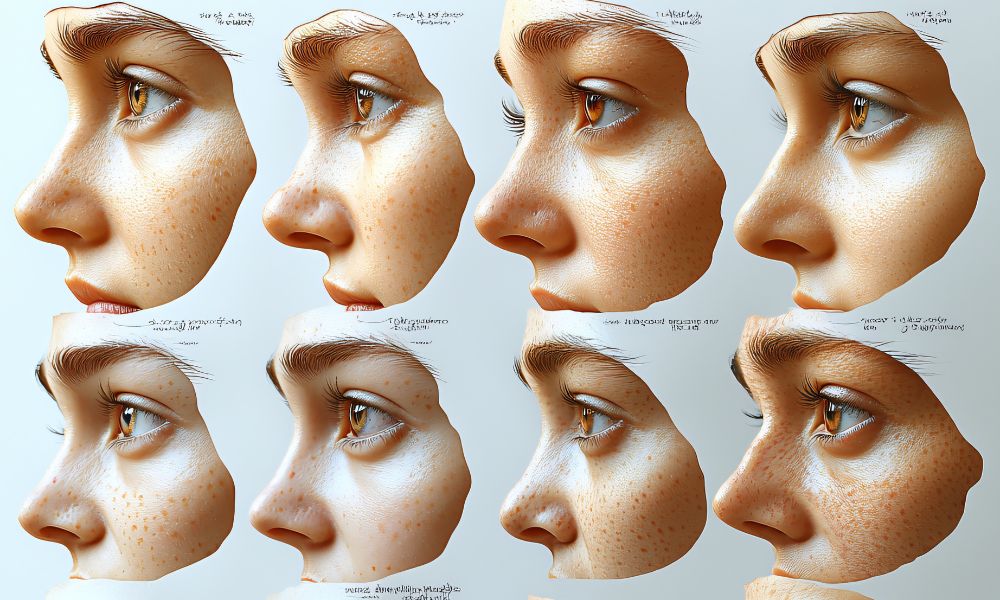
Nose shape isn’t random. It’s the visible result of three things layered on top of each other: the nasal bones (the upper, bony third of the bridge), the cartilage (the lower two-thirds, including the tip and nostrils), and the skin-and-soft-tissue envelope wrapped around both. Genetics — and by extension, ethnic heritage — largely decide the size and angle of the bones and cartilage, which is why certain nose shapes cluster in certain populations. Thickness of the skin envelope then decides how sharply those underlying structures show through; thin skin reveals every contour, while thicker skin softens them into a fuller, fleshier look. Understanding which layer is driving your shape is the first thing a surgeon assesses, because it decides whether a rhinoplasty needs to reshape bone, cartilage, skin — or, most often, some combination of all three.
The 7 Main Nose Shapes Explained: From Greek Nose to Nubian Nose
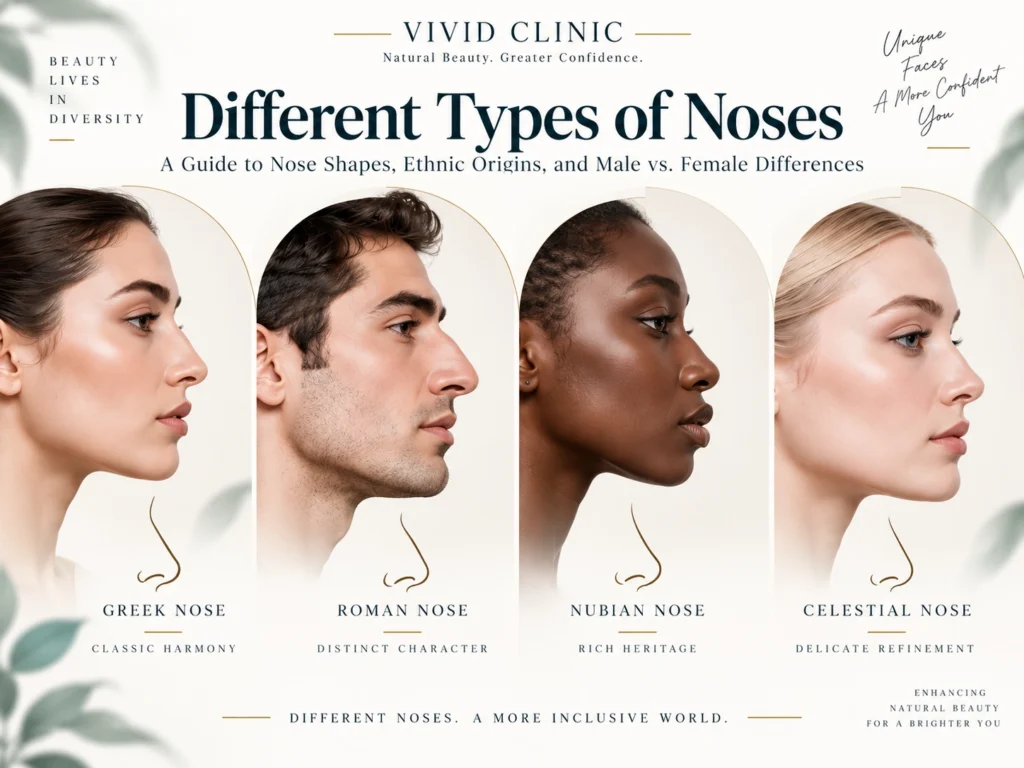
Use this section as your nose shapes chart. Most people are a close match to one of these seven categories, though many faces blend two.
1. Greek Nose
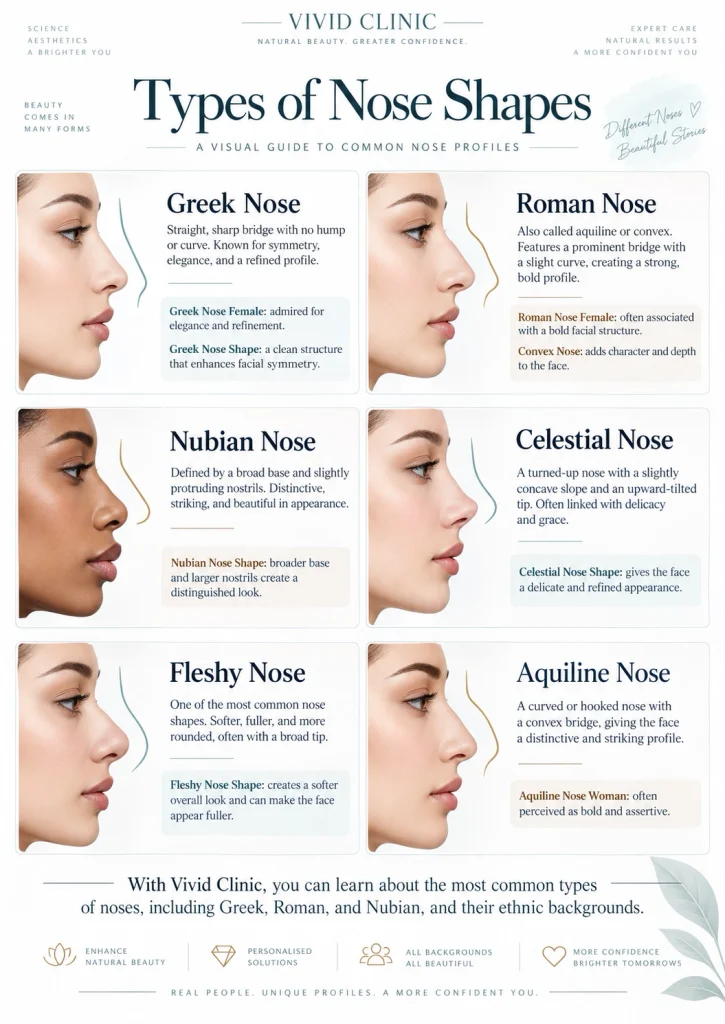
The Greek nose is the straight-bridge shape often called the “perfect nose” in cosmetic literature: no visible hump, no dorsal curve, and a bridge that runs in an almost uninterrupted line from the brow to the tip, with a soft rather than deep angle where it meets the forehead. It’s common across Mediterranean and Southern European populations — hence the name, borrowed from classical Greek sculpture — and is prized for how symmetrically it sits with the rest of the face.
A Greek nose on a woman typically reads as slender with a subtly lifted tip, while a Greek nose on a man is usually a touch wider at the bridge with a tip that sits closer to 90 degrees to the lip — the same straight line, different proportions. Patients with a Greek-leaning nose rarely need bridge work; when they do seek rhinoplasty, it’s usually for a slightly wide tip, a minor bump only visible in photographs, or nostril refinement rather than a full reshape. Because so little bone work is needed, closed rhinoplasty in Istanbul is often enough — and the Greek profile is also the shape most patients with a Roman or hawk nose ask Vivid Clinic’s surgeons to move towards.
2. Roman (Aquiline) Nose
Also called the aquiline or convex nose, the Roman nose has a bridge that curves outward partway down, resembling the profile of an eagle’s beak. It’s frequently seen across European and Middle Eastern populations and reads as strong and defined rather than a flaw — plenty of patients keep the curve and simply soften its most prominent point. When patients do request surgery, it’s typically to reduce a dorsal hump or refine a downward-pointing tip, both straightforward goals for an experienced rhinoplasty surgeon.
3. Nubian Nose
The Nubian nose is broad at the base with a wider, flatter bridge and more pronounced nostrils, and is most common among people of African and some Middle Eastern descent. It’s a strong, distinctive shape rather than something to “correct” — which is exactly why ethnic rhinoplasty exists as its own discipline. A surgeon experienced with Nubian nose shapes narrows or refines the base and tip in proportion to the face while deliberately preserving the natural width and heritage character patients want to keep.
Two things matter most in Nubian nose rhinoplasty: skin thickness and nostril shape. Thicker skin over the tip means cartilage work underneath shows through more slowly and more softly, so the surgeon often adds structure and definition rather than removing tissue, and any alar base reduction (narrowing the nostrils) is planned in millimetres to avoid the pinched look that gives away a poorly planned nose job. At Vivid Clinic in Istanbul, ethnic rhinoplasty for Nubian, Middle Eastern and Afro-Caribbean noses is one of the most requested procedures among patients flying in from the US, UK, Gulf and North Africa — and it’s assessed in a free video consultation before you book anything.
4. Celestial (Turned-Up) Nose
Also known as the turned-up or “ski-slope” nose, the celestial nose has a gentle concave slope and a tip that angles slightly upward. It’s most often seen in women and is associated with a softer, youthful profile. Because the underlying cartilage is usually delicate, rhinoplasty on a celestial-shaped nose tends to focus on small, precise tip adjustments rather than large structural changes.
5. Fleshy (Bulbous) Nose
The fleshy or bulbous nose is defined less by bone angle and more by a thicker skin-and-soft-tissue envelope, which rounds out the tip and softens definition across the whole nose. It appears across every ethnic background and in both men and women. Because thick skin hides cartilage work more than it reveals it, surgeons use more conservative cartilage sculpting on fleshy noses and manage patient expectations carefully around how much visible refinement is realistic.
6. Hawk (Hooked) Nose
The hawk nose shares the Roman nose’s convex bridge but adds a tip that hooks noticeably downward, sometimes appearing to almost touch the upper lip on profile. It can be inherited or develop after a previous injury or an earlier rhinoplasty that under-rotated the tip. Correcting a hawk-shaped nose usually combines a hump reduction with tip rotation, which is why it’s one of the more technically demanding shapes to reshape well.
7. Snub Nose
The snub nose is short in length with a slightly upturned tip and minimal bridge projection, giving the whole nose a compact, understated look. It’s often mistaken for the celestial shape, but a snub nose is shorter overall rather than simply concave. Patients seeking rhinoplasty for a snub nose usually want more bridge projection or length rather than reduction — the opposite goal from most other shapes on this list.
Greek Nose vs Roman Nose: How to Tell Them Apart
The Greek nose and the Roman nose are the two most confused shapes, because both are long and “classical”. The difference is the bridge line: a Greek nose is straight from top to tip, while a Roman nose has a convex curve or hump about a third of the way down, often with a tip that dips slightly. Run a finger down your bridge — if it travels in one smooth line, you’re Greek-leaning; if it rises over a bump before descending, you’re Roman-leaning. Both are considered strong, attractive profiles, and most “Roman-to-Greek” rhinoplasty requests are simply a conservative hump reduction with the tip left largely untouched. For the full breakdown of the Roman shape and its variations, see our dedicated Roman nose guide.
Nose Shapes by Ethnic Origin and Heritage
Nose shape correlates strongly — though never absolutely — with ancestry, because the underlying bone and cartilage structure is inherited. The Greek nose is most common across Mediterranean Europe; the Roman nose across Southern Europe, the Balkans and parts of the Middle East; the Nubian nose across Sub-Saharan and North-East Africa; the celestial nose across Northern Europe and parts of East Asia; and fleshy noses appear broadly across every population. None of this is a rulebook for any individual face — it’s simply useful context when you’re trying to understand why your nose looks the way it does, and it’s exactly why a one-size-fits-all rhinoplasty template produces the “over-operated” look patients dread. At Vivid Clinic, every consultation starts by identifying which heritage traits you want to keep before discussing what, if anything, should change.

Male vs Female Nose Shapes: What Really Differs
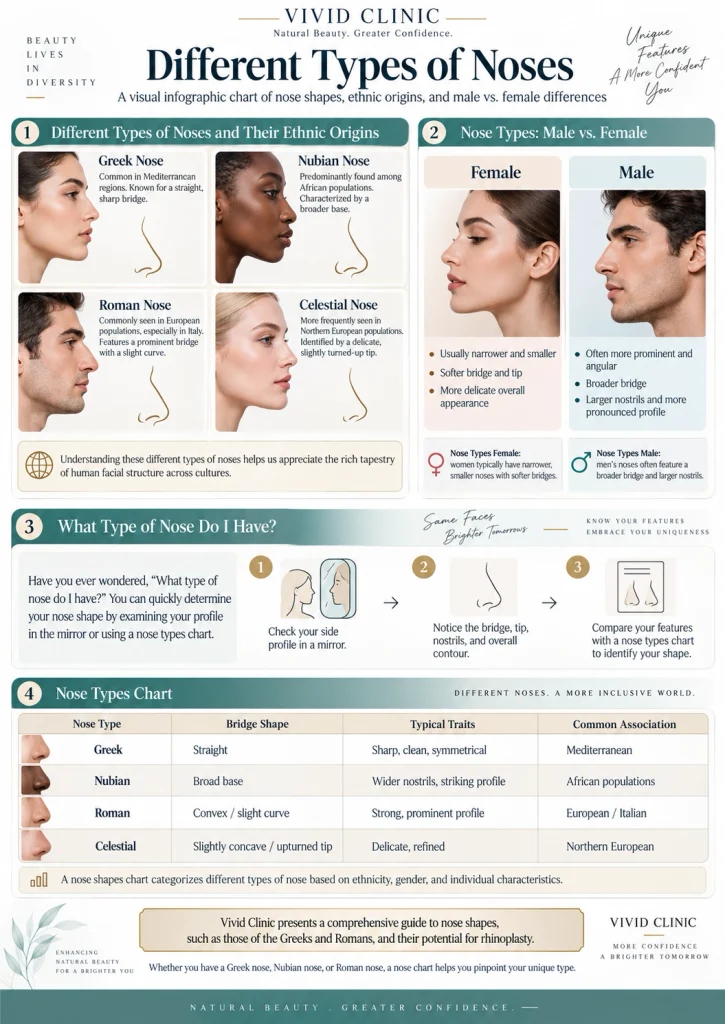
Men and women can share any of the seven shapes above, but there are consistent proportional differences a surgeon plans around. Male noses tend to run larger relative to the face, with a straighter or more angular bridge, a wider base and a tip that sits at roughly a 90-degree angle to the upper lip. Female noses tend to be proportionally smaller and narrower, with softer bridge contours and a tip angled slightly upward, closer to 95–105 degrees. This is why a rhinoplasty plan that would look natural on a man can look feminizing on a woman and vice versa — the goal at Vivid Clinic is always a result that matches the patient’s own face and gender presentation, not a generic “ideal” nose.
What Type of Nose Do I Have? A 60-Second Self-Check
Stand side-on to a mirror in natural light, or take a profile photo. Then work through these four questions:
- Bridge line: Straight (Greek), curved outward (Roman/hawk), or concave (celestial/snub)?
- Tip direction: Neutral, upturned (celestial/snub), or downturned (hawk)?
- Base width: Narrow, medium, or broad with visible nostrils (Nubian)?
- Skin thickness: Can you see the cartilage contours clearly, or does the tip look soft and rounded (fleshy)?
Most people land close to one shape with a trace of another — that’s completely normal, and it’s exactly what a rhinoplasty consultation at Vivid Clinic refines with 3D imaging rather than guesswork.
Ready to Talk Through Your Nose Shape?
Get a personalized opinion from our surgical board — free, confidential, and with no obligation.
Rhinoplasty Techniques Compared: Which Approach Fits Your Nose Shape?
“Rhinoplasty” isn’t one operation — it’s a family of techniques, and the right one depends on your nose shape, your goals, and whether this is your first procedure. Here’s how the main options compare.
| Technique | Best For | Downtime | Istanbul Starting Price |
|---|---|---|---|
| Closed (endonasal) rhinoplasty | Minor bridge or tip refinement on Greek or celestial-shaped noses | 7–10 days, no visible scar | From $2,000 |
| Open rhinoplasty | Reshaping a Roman hump, hawk tip, or Nubian nose base | 10–14 days, tiny columella scar fades within months | From $2,500 |
| Ethnic-preserving rhinoplasty | Refining a fleshy or Nubian nose while keeping heritage proportions | 10–14 days | From $2,800 |
| Revision rhinoplasty | Correcting a previous nose job that doesn’t match your natural shape | 2–3 weeks, more swelling | From $4,000 |
| Non-surgical nose job (filler) | Temporarily smoothing a small hump or asymmetry, no anesthesia | Same-day, lasts 12–18 months | From $350 |
Prices above are indicative starting figures; your exact quote is confirmed after a free consultation with Vivid Clinic’s surgical board, once your nose shape, goals and any prior surgery have been assessed. If you’re dealing with breathing trouble alongside the aesthetic concern, ask about combining rhinoplasty with a septoplasty for a deviated septum in the same operation — it’s one of the most common combined procedures we perform. If you are weighing these figures against a quote at home, our guide to how much is a nose job in the UK and US versus Istanbul compares them line by line.
The Istanbul Rhinoplasty Patient Journey at Vivid Clinic
Most international patients follow the same path. It starts with a free video consultation where you share photos of your nose from the front, side and base angles; our surgical board reviews your shape, discusses which technique fits, and gives you a firm, no-obligation quote. Once you book, our concierge team arranges your travel dates, VIP airport transfer, and hotel stay in Istanbul — many patients combine the trip with our current five-star hotel and VIP transfer package on select procedures. On arrival, you’ll have an in-person consultation and pre-operative tests at our JCI-aligned partner hospital in Atakoy, followed by surgery the next day under general or local anesthesia depending on the technique. You’ll recover in a private room with 24/7 nursing support, then move to your hotel for the remainder of your stay, with a follow-up check before you fly home — typically seven to ten days after surgery for most techniques. From there, our team stays in touch remotely for photo check-ins through your full recovery. You can see how this plays out in practice in our before-and-after gallery, including real revision rhinoplasty results from patients who had a previous nose job elsewhere.
Rhinoplasty Before and After: Real Vivid Clinic Results in Istanbul
Charts only get you so far — the fastest way to understand what rhinoplasty can do for your nose shape is to look at real patients. The cases below come from Vivid Clinic’s Istanbul rhinoplasty gallery: a dorsal hump smoothed into a straighter, Greek-style line, a drooping tip lifted and refined, and a wide base narrowed in proportion to the face. Three of the photos were taken on the operating table immediately after surgery, before any swelling settled, so the final shape continues to refine for 6–12 months. Every patient consented to publication and the images are unedited, though lighting and angle can differ slightly between the before and after shots.
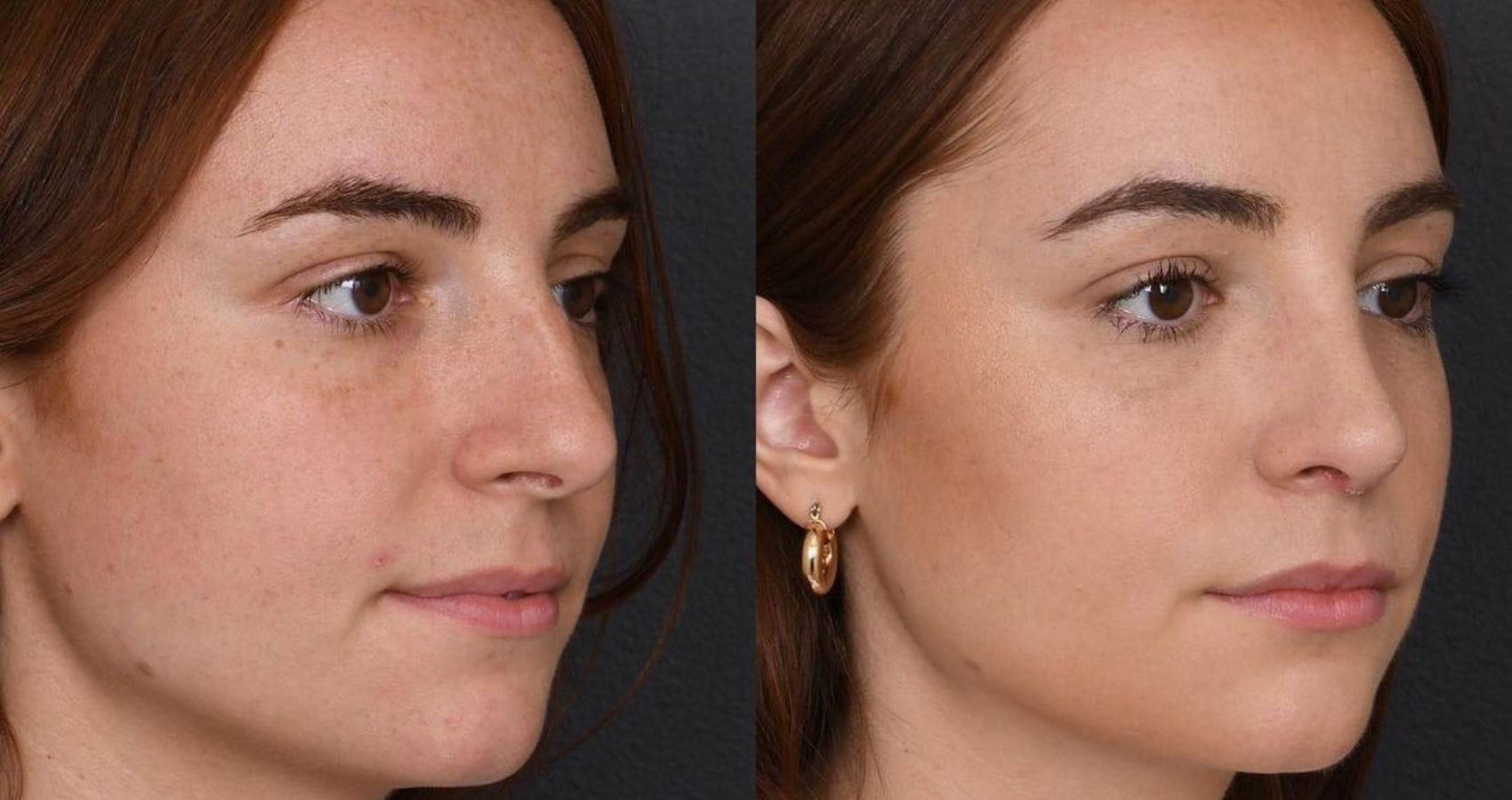
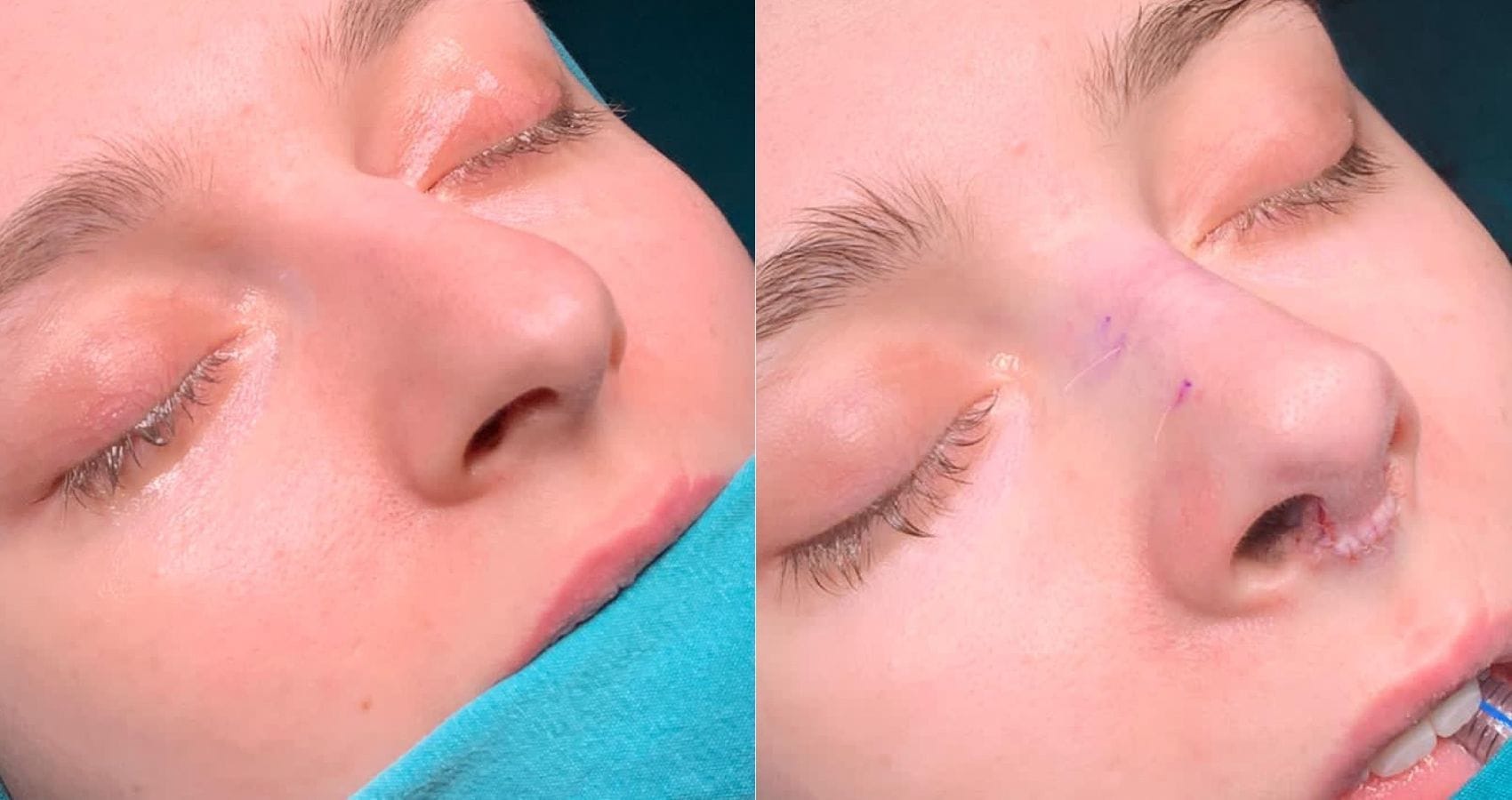


Browse more cases — including a 9-month revision rhinoplasty before and after case where a previous nose job was corrected — in the full Vivid Clinic before-and-after gallery. When you compare results, look for cases with a similar starting shape and skin thickness to yours, not just the most dramatic transformation.
How Much Does a Nose Job Cost in Turkey?
Rhinoplasty in Turkey typically runs from $2,000 to $6,000, against $5,000–$15,000 for the same procedure in the United States or the UK — which is the main reason Istanbul has become one of the world’s busiest rhinoplasty destinations. Where you land in that Turkey range depends on the technique (see the comparison table above), whether it’s a first-time or revision procedure, and whether it’s combined with septoplasty or other facial work. The quote you receive at Vivid Clinic is all-inclusive: surgeon and hospital fees, anesthesia, your VIP transfer, and post-operative care are bundled into one number, so there are no surprise add-ons once you land in Istanbul. For a full breakdown of what drives rhinoplasty pricing, see our complete nose job cost guide.
Ethnic Rhinoplasty: Refining Your Nose Without Losing Your Identity
Ethnic rhinoplasty is a planning philosophy, not a separate operation — it means shaping a Nubian, Middle Eastern, Asian or Afro-Caribbean nose in proportion to the rest of that patient’s face, rather than defaulting to a narrow, high-bridged template that reads as ethnically mismatched. A surgeon working this way pays close attention to skin thickness (thicker skin needs more conservative cartilage work to avoid future scar-tissue thickening at the tip), nostril shape and base width, and the patient’s own stated goals for what to keep versus refine. Done well, the result looks like a more balanced, confident version of the patient’s own nose — never like someone else’s.
Non-Surgical Nose Job vs Surgical Rhinoplasty
A non-surgical nose job uses dermal filler to smooth a small dorsal bump or correct minor asymmetry by camouflaging it with added volume — it takes about 20 minutes, needs no anesthesia, and settles within days. It cannot reduce the size of your nose, narrow the base, or fix breathing problems, and results fade within 12 to 18 months. Surgical rhinoplasty, by contrast, physically reshapes bone and cartilage for a permanent result and is the only option that can genuinely reduce, narrow, or restructure a nose shape — including correcting the functional airway issues a filler can never touch. Patients often use filler as a “trial run” to visualize a subtle change before committing to surgery, which is a reasonable strategy for minor concerns but not a substitute for surgery when the goal is a structural change.
Recovery Timeline After Rhinoplasty, Week by Week
- Days 1–2: Splint in place, swelling and bruising peak around the eyes.
- Days 3–7: Most bruising fades; splint and any stitches are removed around day 7.
- Week 2: Comfortable flying home for most patients; swelling still visible to you, not to others.
- Weeks 3–6: Return to gym and more strenuous activity once cleared by your surgeon.
- Months 3–6: Tip swelling — the last and slowest to resolve — settles into its refined shape.
- Month 12: Final result, especially for thicker-skinned or fleshy nose shapes which take the longest to fully settle.
Want the day-by-day version — when you can wear glasses, fly, exercise and expect the splint to come off? Read our step-by-step rhinoplasty recovery in Turkey guide.
Choosing the Right Surgeon for Your Nose Shape
Nose shape is exactly why “best rhinoplasty surgeons in Istanbul” rankings are less useful than they sound — what matters is experience with your specific shape and skin type. Ask to see before-and-after cases of patients with a similar bridge curve, base width and skin thickness to yours, not just a generic portfolio. Ask how many revision rhinoplasty cases the surgeon handles, since revision volume is a strong signal of how a clinic manages complications. And ask what happens if your result needs a touch-up — Vivid Clinic’s surgical board reviews every rhinoplasty patient at three and twelve months specifically to catch this early, rather than leaving patients to seek out a revision rhinoplasty specialist elsewhere.
Ready When You Are
Whichever of the 7 shapes fits your profile, our surgical board can tell you honestly what surgery can and can’t change — free, and with no pressure to book.
Conclusion: Your Nose, Your Confidence
Greek, Roman, Nubian, celestial, fleshy, hawk or snub — every nose shape on this list is a normal, heritage-linked variation, not a flaw to be fixed by default. The decision to pursue rhinoplasty should come from how your nose functions and how you feel about it, not from comparing yourself to a chart. If you do decide surgery is right for you, understanding your shape, the technique that fits it, and the realistic Istanbul price range puts you in a far stronger position to have that first consultation — whether it’s with Vivid Clinic or anyone else.
FAQs
How much does rhinoplasty cost in Istanbul for a Greek nose or Nubian nose reshape?
Rhinoplasty cost in Istanbul at Vivid Clinic starts from around $2,000 for a closed technique on a Greek or celestial nose, $2,500–$2,800 for open or ethnic-preserving rhinoplasty on a Roman, hawk or Nubian nose, and from $4,000 for revision work — all-inclusive of surgeon, hospital, anesthesia and VIP transfer. See our full rhinoplasty cost in Turkey guide for what moves your quote.
Is ethnic rhinoplasty in Turkey suitable for a Nubian nose?
Yes — ethnic rhinoplasty in Turkey is one of the most requested procedures at Vivid Clinic, particularly for Nubian, Middle Eastern and Afro-Caribbean noses. The surgeon refines the base, tip and bridge in proportion to your face while preserving heritage traits such as natural width and skin thickness, so the result looks like a more balanced version of your own nose rather than a generic template.
Who are the best rhinoplasty surgeons in Istanbul for hump reduction on a Roman or hawk nose?
The best rhinoplasty surgeons in Istanbul for hump reduction are those who can show healed before-and-after cases with a similar bridge curve and skin thickness to yours, and who handle a steady volume of revision cases. Vivid Clinic’s surgical board reviews every Roman and hawk nose with 3D imaging in a free consultation and plans a conservative dorsal reduction with tip rotation, rather than over-resecting the bridge.
Can revision rhinoplasty in Turkey fix a nose job that over-narrowed my Greek nose?
Yes — revision rhinoplasty in Turkey specifically addresses a previous surgery that over-narrowed, over-rotated or otherwise mismatched your natural nose shape, often using rib or ear cartilage grafts to rebuild lost structure. It is more complex than a first-time procedure because of scar tissue, so surgeon experience with revisions matters; see a 9-month revision rhinoplasty case from Vivid Clinic.
How long do I need to stay in Istanbul after a nose job in Turkey?
Most international patients stay 7–10 days after a nose job in Turkey: surgery on day two after arrival, splint removal around day seven, and a final check before Vivid Clinic’s surgical board clears you to fly. Visible bruising fades within the first week; tip swelling takes 3–12 months to fully settle. Our nose job in Turkey page covers the full package and what is included.