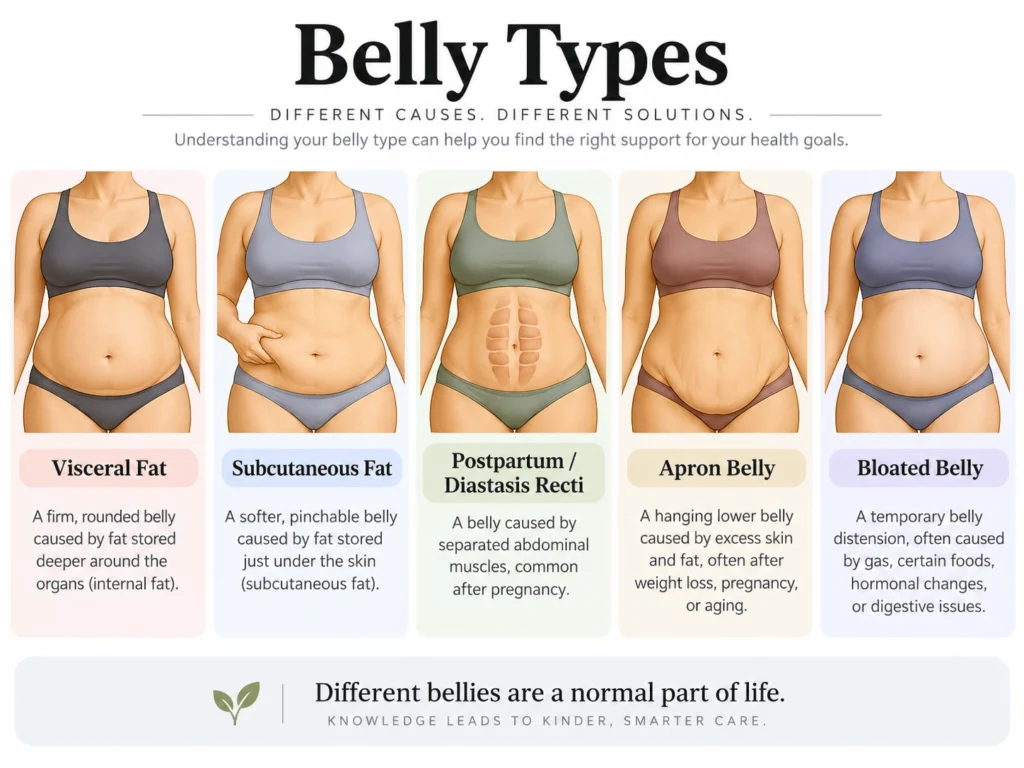
Quick answer (updated October 2026): “Belly types” are everyday descriptions, not medical diagnoses. People usually mean a firm, rounded belly; a soft, pinchable belly; a postpartum bulge; an apron fold that hangs over the lower abdomen; a B-shaped belly with a crease across the middle; a bloated belly that changes through the day; or what is sometimes called a “hormonal belly”. These descriptions overlap, and the same shape can have different causes: fat under the skin, fat around the organs, stretched muscles or skin after pregnancy or weight change, bloating, or posture. Appearance alone cannot tell you which is responsible. A waist measurement, your history and, where needed, an examination are what separate them, and only some of those causes respond to surgery.
Belly types at a glance
This table sets out what each everyday description can involve, what you can and cannot tell yourself, and a sensible next step. Read it as a starting point for a conversation, not a way to label yourself.
| Description | Possible causes | Limits of a self-check | Next step |
|---|---|---|---|
| Firm, rounded belly | Fat around the organs, fat under the skin, bloating, posture | Firmness cannot show how much fat lies around the organs | Measure your waist; talk to a GP about weight-related health if it is high |
| Soft, pinchable belly | Fat under the skin; often normal | A pinch shows fat under the skin, not what lies deeper | Nothing, if you are comfortable; overall fat loss or body contouring if you wish |
| Postpartum bulge | Normal recovery, fat, stretched skin, separated muscles, hernia | A finger check can suggest separation but cannot confirm it | Physiotherapy assessment; medical review for a painful or growing bulge |
| Apron fold | Excess skin and fat after pregnancy or major weight loss | You cannot tell how much is skin and how much is fat | Weight stability first; surgical assessment if the fold causes problems |
| B-shaped belly | Fat distribution, a skin crease, a scar, an early apron | The crease does not reveal its cause | Assessment only if it bothers you; not all need treatment |
| Bloated belly | Gas, food, constipation, periods, gut conditions | You cannot rule out a medical cause yourself | A GP if bloating is frequent, persistent or comes with warning signs |
| “Hormonal belly” | Menopause-related fat shifts; less often a hormonal condition | A photograph cannot diagnose a hormonal cause | A GP if you have several new or progressive symptoms, not for shape alone |

Why bellies look so different: the layers underneath
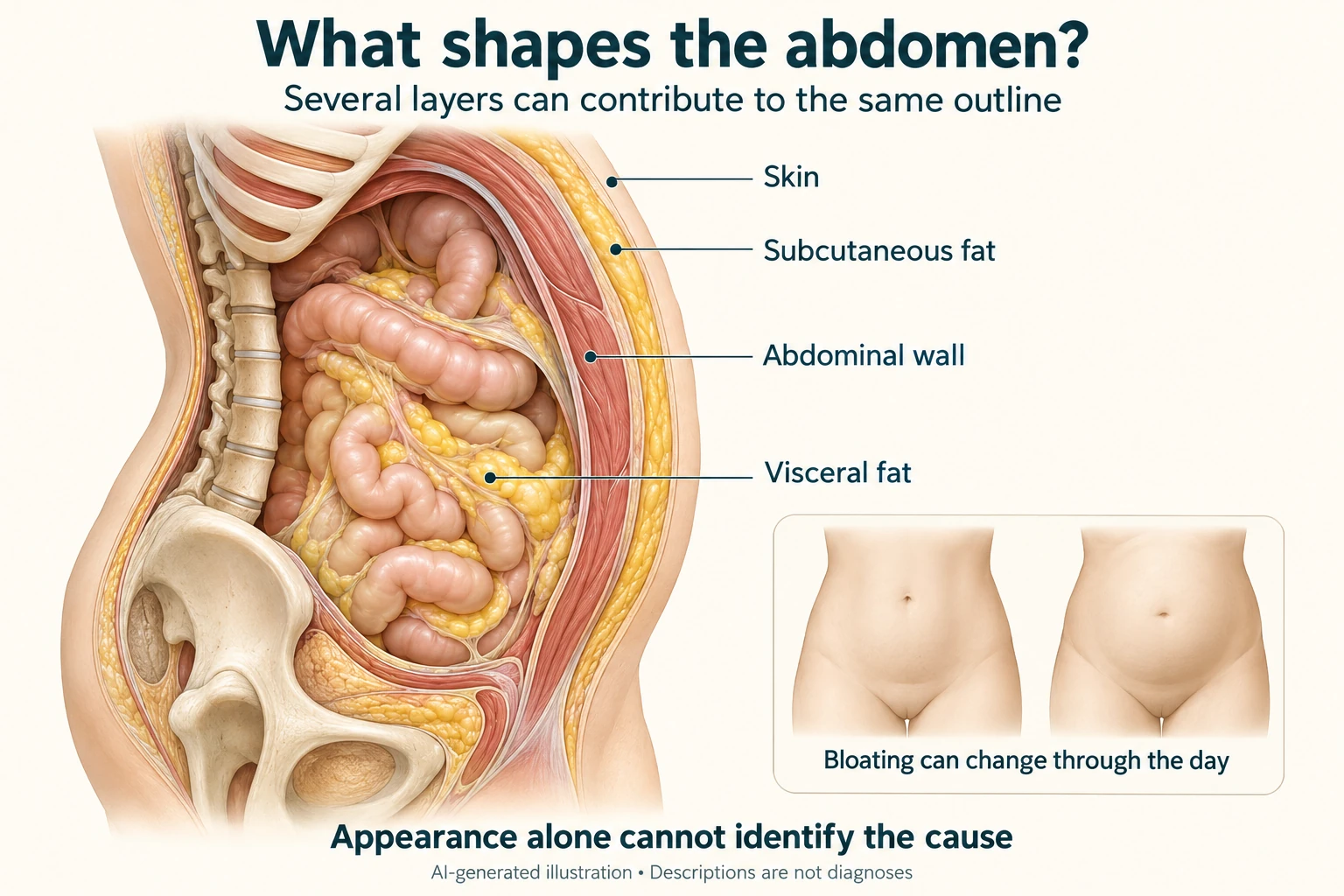
Between your skin and your organs sit distinct layers, and most “belly type” descriptions are really guesses about which layer dominates. From the outside in: skin; subcutaneous fat, the soft layer you can pinch; the abdominal muscle wall, with its central seam; and, inside the abdominal cavity, visceral fat, which surrounds the organs and cannot be pinched.
Two people of the same weight can carry very different bellies because these layers vary with genetics, sex, age and hormones. Women after menopause tend to store more fat around the waist (NHS), as men often do; before menopause, many women store more on the hips and thighs. Pregnancy stretches the muscle wall and skin, large weight changes stretch the skin, and the gut itself expands and contracts through the day. On top of that, posture changes how the belly sits: an arched lower back pushes the abdomen forward.
Fat around the organs and fat under the skin: what you can and cannot tell
Visceral fat, the fat stored around the organs, is linked to type 2 diabetes and cardiovascular disease. It is the reason doctors pay attention to waist size. But it cannot be seen or felt: Cleveland Clinic notes that you cannot judge it by looking (Cleveland Clinic), and it can only be measured precisely with imaging such as CT or MRI (Harvard Health). A firm belly is not proof of high visceral fat, and a soft one is not proof of low visceral fat.
What you can do is measure. For adults with a BMI under 35, NICE uses waist-to-height ratio alongside BMI to assess central adiposity, the fat carried around the middle: a ratio of 0.4 to 0.49 is classed as healthy central adiposity, 0.5 to 0.59 as increased and 0.6 or more as high (NICE NG246). These bands describe one risk factor; a ratio in the healthy band does not by itself mean someone is healthy.
The everyday NHS message is simpler: try to keep your waist to less than half your height (NHS). NHS guidance in London suggests aiming for a waist below 94 cm for men and 80 cm for women, with a lower figure of 90 cm for men from some ethnic backgrounds (NHS MyHealth London). Measure halfway between your lowest rib and the top of your hip bone, after breathing out normally.
The encouraging part is that visceral fat responds to the same changes that reduce body fat overall. A meta-analysis found that exercise reduced visceral fat even when body weight barely changed (Verheggen et al., Obesity Reviews, 2016). Diet quality, activity, sleep and less alcohol all help, and a doctor can advise on medical support where weight affects health.
The equally important point for anyone reading a cosmetic clinic’s website: liposuction removes fat under the skin. It does not reach fat around the organs, and it is not a treatment for obesity (NHS).
The soft, pinchable belly
If you can gather a fold of your belly in your hand, that fold is subcutaneous fat. It carries less health risk than visceral fat (Cleveland Clinic), and a soft lower belly is a normal feature of many healthy bodies, especially female ones. The flat-stomach images that dominate social media show a level of body fat that many people cannot comfortably maintain, and they are not a standard anyone needs to meet.
Lower-belly fat can be slow to change, and a small curve often remains even after weight loss. This is the one layer where body contouring can play a part, if someone wants it. Liposuction removes localised fat under the skin. The American Society of Plastic Surgeons describes suitable candidates as adults within about 30 per cent of their ideal weight, with firm, elastic skin (ASPS). Where skin is loose, removing fat can leave it looser, so a pinchable belly is not, by itself, a reason to choose liposuction.
Postpartum changes: not every bulge is diastasis recti
After pregnancy, the uterus, muscles and skin keep changing for months. A rounded lower belly at this stage can reflect normal recovery, fat, stretched skin, separation of the abdominal muscles, or a combination.
Diastasis recti is a widening of the gap between the two vertical abdominal muscles along their central seam. It is very common: in a Norwegian study, about 60 per cent of first-time mothers had it six weeks after birth, about 45 per cent at six months and about a third at twelve months (Sperstad et al., British Journal of Sports Medicine, 2016). A gap wider than about 2 cm, or two finger-widths, is commonly used as the threshold (Cleveland Clinic).
A simple finger check, lying on your back with knees bent and lifting your head slightly, can suggest a gap or show doming along the midline. It cannot confirm diastasis, measure it precisely or rule out a hernia. A physiotherapist or doctor can examine you, and ultrasound can measure the gap more accurately. A lump near the navel that gets bigger when you cough and smaller when you lie down can be a hernia and should be checked (NHS).
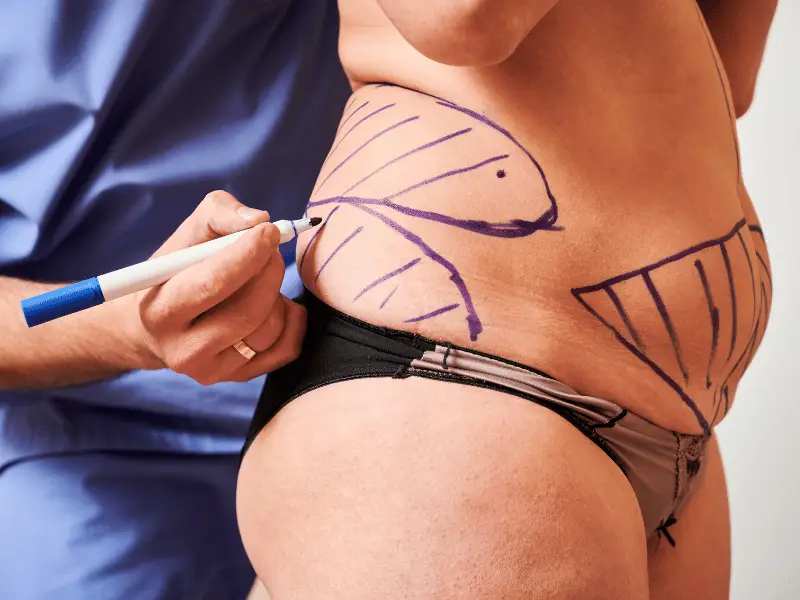
Treatment usually starts with guided rehabilitation from a women’s health physiotherapist. Surgery is considered for some people, typically when a wide separation persists after rehabilitation and causes symptoms or concern: the muscle repair is usually performed as part of a tummy tuck (abdominoplasty). Many postpartum bellies never need surgery, and the American Society of Plastic Surgeons advises women planning further pregnancies to postpone a tummy tuck (ASPS).
The apron fold: skin and fat that hang
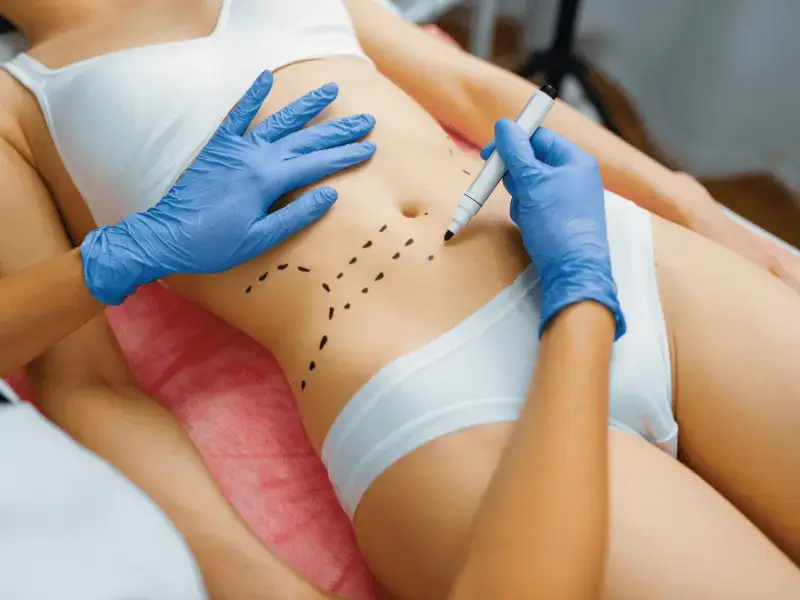
An apron belly is a fold of skin and fat that hangs over the lower abdomen; doctors call it a panniculus. It is most common after pregnancy and after major weight loss, when the skin has stretched and may not shrink back fully (ASPS; StatPearls: Panniculectomy).
Weight loss can reduce the fat inside an apron, and for some people that makes a real difference. Significant excess skin, however, may remain after weight loss, and exercise strengthens the muscle beneath without shortening the skin. Beyond appearance, a large fold can cause rashes, chafing and skin infections in the crease, and can get in the way of clothing and exercise (StatPearls).
Some surgeons describe the fold using a grading scale based on how far it hangs (Igwe et al., Obesity Surgery, 2000; grades as summarised by GMS):
| Grade | How far the fold hangs |
|---|---|
| 1 | Covers the pubic hairline but not the genitals |
| 2 | Covers the genitals |
| 3 | Reaches the upper thigh |
| 4 | Reaches the mid-thigh |
| 5 | Reaches the knees or beyond |
A grade describes the fold; it does not decide the operation. The choice between no surgery, a panniculectomy and an abdominoplasty depends on your health, weight stability, symptoms, skin quality and wishes. A panniculectomy removes the hanging skin and fat, mainly to relieve symptoms, without tightening the muscles; an abdominoplasty usually also repairs separated muscles and reshapes the abdomen (StatPearls: Panniculectomy). If your fold appeared after a caesarean section, our guide to the hanging belly after a C-section covers that situation in more detail.
The B-shaped belly
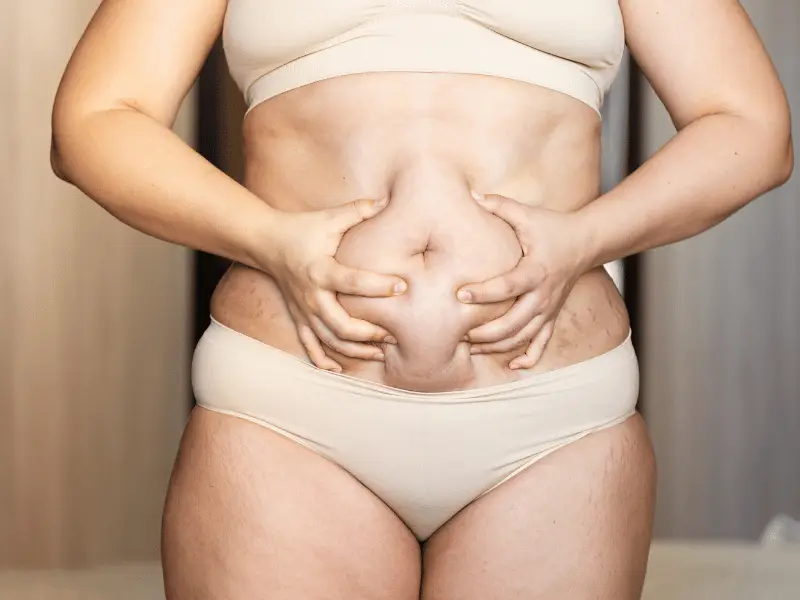
A “B-shaped” belly has a horizontal crease at or near the navel, so the side profile shows an upper and a lower curve, like the letter B. It is an everyday description and has no accepted clinical definition.
Several things can create the crease: how fat under the skin is distributed, a natural skin fold, tethering from a caesarean scar, an early apron fold, or the waistband of clothing. Because the causes differ, so do the options. Many B-shaped bellies need nothing at all. Where someone wants change, the right approach depends on what an examination finds: overall fat loss, liposuction for localised fat with good skin, or skin removal where loose skin is the main factor. A B shape on its own does not mean surgery is needed or suitable.
The bloated belly: the one that is not fat
A belly that is flatter in the morning and larger by evening is usually bloating, not fat, because fat does not change over hours. The NHS lists common causes including trapped wind, certain foods, swallowing air, constipation, food intolerance, coeliac disease, irritable bowel syndrome and periods (NHS).
Most bloating is harmless and settles with simple changes. See a GP if you are often bloated or it does not go away, or if bloating comes with unintended weight loss or blood in your poo (NHS). Persistent bloating can occasionally be a symptom of ovarian cancer, and the NHS advises seeing a GP if symptoms such as bloating happen roughly 12 or more times a month (NHS). No cosmetic treatment has any role in bloating.
What people mean by “hormonal belly”
“Hormonal belly” is not a medical diagnosis. It usually describes fat that seems to settle around the waist during hormonal change. The most common situation is menopause: the NHS notes that weight gained around this time tends to collect around the tummy and upper body (NHS), and fat can shift towards the waist even when overall weight changes little.
Hormonal conditions such as polycystic ovary syndrome, an underactive thyroid and, rarely, Cushing’s syndrome can affect weight and where fat is stored. They are diagnosed from your overall symptoms, history and examination, not from the shape of your belly, and certainly not from a photograph. Testing everyone with a larger waist is not recommended: Endocrine Society guidance advises against widespread testing for Cushing’s syndrome (Endocrine Society), and NICE notes that single common symptoms on their own do not predict thyroid disease (NICE NG145).
If you have several new or worsening symptoms, such as changes to your periods, unusual tiredness, feeling cold, new hair growth, easy bruising or weight gain you cannot explain, a GP can decide whether any tests are appropriate. Surgery does not treat a hormonal cause.
Pain, lumps and other medical signs
A sharp, localised pain in the abdominal wall after lifting or twisting, worse when you tense the muscles, can be a muscle strain. A bulge that appears when you cough or strain and disappears when you lie down can be a hernia. Both need medical rather than cosmetic assessment, and a hernia that becomes painful, cannot be pushed back, or comes with vomiting needs urgent care (NHS).
What can change each contributor
| Contributor | What can help | Role of surgery |
|---|---|---|
| Fat around the organs | Diet, activity, sleep, less alcohol; medical support where needed | No cosmetic surgery removes it |
| Fat under the skin | Overall fat loss; acceptance; body contouring if wanted | Liposuction can remove localised fat at a stable weight with good skin |
| Separated muscles | Guided physiotherapy | Muscle repair, usually within an abdominoplasty, for selected cases |
| Loose or excess skin | Weight stability; skin care in folds | Panniculectomy or abdominoplasty can remove skin; exercise cannot |
| Bloating | Eating pattern, trigger foods, constipation treatment, medical review | None |
| Hormonal change | Medical assessment where symptoms suggest it; lifestyle | None for the hormonal cause itself |
Shape alone does not establish whether someone is suitable for liposuction, a tummy tuck or a panniculectomy. A surgeon also considers your general health, whether your weight has been stable, your skin quality, previous operations, smoking and any plans for pregnancy. The American Society of Plastic Surgeons describes a tummy tuck as unsuitable as a substitute for weight loss and best suited to people at a stable weight (ASPS). There is no good evidence that spot-reduction exercises, waist trainers or sweat belts remove fat from one area or tighten skin.
Our tummy tuck guide explains the different types of abdominoplasty, and the mommy makeover page covers combined procedures after pregnancy.
If you are considering body contouring in Istanbul
The first step at Vivid Clinic is a consultation with a plastic surgeon, who will examine your abdomen, ask about pregnancies, weight history and health, and explain whether surgery would help at all. Vivid Clinic’s lead surgeon is Prof. Dr. Özgür Pilancı, a specialist in plastic, reconstructive and aesthetic surgery. If you are travelling for surgery, the NHS suggests checking your surgeon’s qualifications, planning aftercare and asking when it will be safe to fly (NHS: cosmetic surgery abroad). Our guide to tummy tuck costs in Istanbul explains what affects the price.
Frequently asked questions
What are the main belly types?
The descriptions people use most are a firm, rounded belly; a soft, pinchable belly; a postpartum bulge; an apron fold; a B-shaped belly; a bloated belly; and a “hormonal belly”. They overlap and are not diagnoses, because the same shape can come from fat, skin, muscle, bloating or posture.
Can I tell if I have visceral fat by how my belly feels?
No. Fat around the organs cannot be seen or felt, and only imaging measures it precisely. A waist measurement, ideally less than half your height, is a practical guide to health risk.
Is a bulge after pregnancy always diastasis recti?
No. A postpartum bulge can also be normal recovery, fat, stretched skin or, less often, a hernia. A finger check can suggest muscle separation, but a physiotherapist or doctor needs to confirm it.
Will losing weight get rid of an apron belly?
Weight loss can reduce the fat inside the fold, sometimes noticeably. If the skin has stretched a great deal, some excess skin may remain, and only surgery removes it. Whether that is worthwhile is an individual decision.
Is “hormonal belly” a medical condition?
No. It is an informal description, most often of fat settling around the waist during menopause. Hormonal conditions are diagnosed from your overall symptoms and history, not from the shape of your belly.
Does a B-shaped belly need surgery?
Not necessarily. A B shape can come from fat distribution, a skin crease, a scar or loose skin, and many need no treatment. If you want change, an examination is what decides which option, if any, is suitable.
Can liposuction flatten any belly?
No. Liposuction removes fat under the skin and is best suited to people at a stable weight with reasonably elastic skin. It does not remove fat around the organs, tighten separated muscles, remove loose skin or help bloating.
Not sure what is shaping your belly? If you are considering body contouring and would like a surgeon’s view, you can request a free consultation through Vivid Clinic’s consultation form. You do not need to send photographs to make an enquiry. For bloating, pain or new symptoms, start with your GP.
Related guides: breast types and shapes, nose shape chart and hanging belly after a C-section.
Sources
- American Society of Plastic Surgeons. Body contouring after major weight loss.
- American Society of Plastic Surgeons. Liposuction candidates.
- American Society of Plastic Surgeons. Tummy tuck candidates.
- Cleveland Clinic. Diastasis recti.
- Cleveland Clinic. Visceral fat.
- Endocrine Society. Diagnosis of Cushing’s syndrome clinical practice guideline.
- Harvard Health Publishing. Taking aim at belly fat.
- Igwe D, et al. Panniculectomy adjuvant to obesity surgery. Obesity Surgery, 2000. (grade wording as summarised in GMS Interdisciplinary Plastic and Reconstructive Surgery: www.egms.de)
- NHS. Bloating.
- NHS. Cosmetic surgery abroad.
- NHS. Hernia.
- NHS. Liposuction.
- NHS. Menopause symptoms.
- NHS MyHealth London. Measurements matter.
- NHS. Ovarian cancer symptoms.
- NHS. Overweight and obesity in adults: diagnosis.
- NICE. Overweight and obesity management (NG246): identifying and assessing central adiposity.
- NICE. Thyroid disease: assessment and management (NG145), rationale and impact.
- Sperstad JB, et al. Diastasis recti abdominis during pregnancy and 12 months after childbirth. British Journal of Sports Medicine, 2016.
- StatPearls. Panniculectomy.
- Verheggen RJ, et al. A systematic review and meta-analysis on the effects of exercise interventions on body weight and visceral adipose tissue. Obesity Reviews, 2016.