
 ChatGPT

The Mirror Test Almost Everyone Tries Once
You are standing at the bathroom mirror with an old lipstick in one hand, tracing your reflection on the glass and squinting at the result. Is that an oval? A heart? Something in between? Curiosity about face shapes usually starts exactly like this, with a smudged mirror and a quiet hope that the answer will explain why some haircuts and frames simply work for you.
The good news is that finding your shape takes about five minutes and a soft tape measure. The better news is that no shape is wrong, and most faces borrow features from two of them.
This guide from Vivid Clinic in Istanbul, Turkey covers a simple measuring method, an overview of each type, styling tips, and the treatments some people use to enhance facial balance. If you ever want a professional view of your proportions, you can request a free consultation with a plastic surgeon, with no obligation to treat anything.
What Are Face Shapes, Really?
Quick Answer: Face shapes are a simple way of describing the outline of your face, based on the width of your forehead, cheekbones and jaw, and the overall length. The seven common categories are oval, round, square, heart, diamond, oblong and triangle. They are styling tools, not medical diagnoses.
Your outline comes mostly from bone structure: the forehead, cheekbones and lower jaw. Soft tissue shapes the details, including cheek fat pads, the bulk of the chewing muscles and the firmness of the skin.
Why Most People Are a Mix
Real faces rarely match a textbook diagram. You might have the length of an oblong face with the soft jaw of an oval one. That is completely normal, and it is why face shapes work best as a starting point, not a box you must fit inside.
How to Find Your Face Shape in Five Minutes
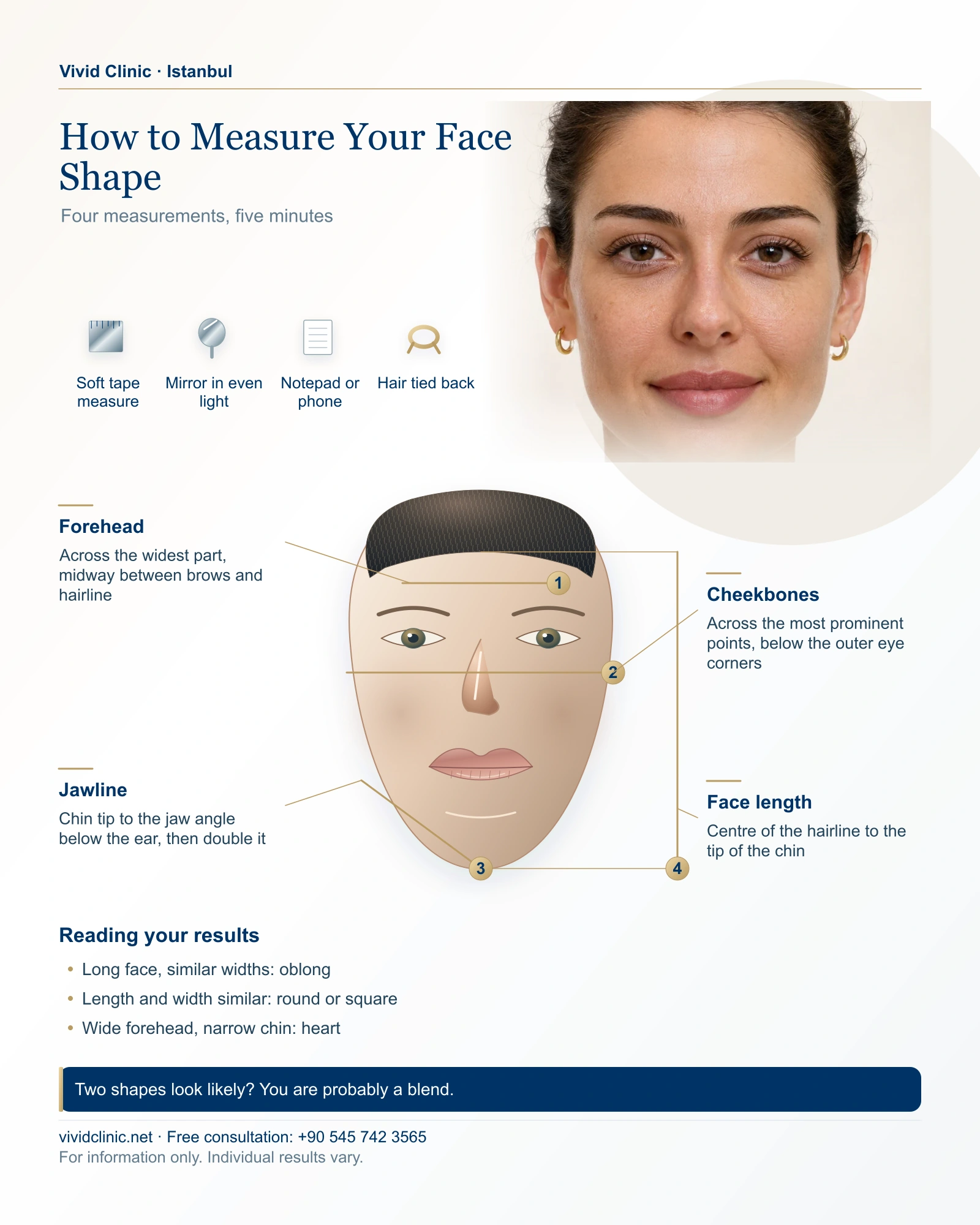
Quick Answer: Pull your hair back, stand in front of a mirror and measure four things: forehead width, cheekbone width, jawline length and face length. Compare which measurement is largest and how length relates to width. The pattern points to your closest shape.
What You Need
- A soft fabric tape measure
- A mirror in good, even light
- A notepad or your phone
- Hair tied back and a relaxed expression
A straight-on photo at eye level also works. Avoid close wide-angle selfies, which distort proportions.
The Four Measurements
- Forehead: measure across the widest part, roughly midway between your brows and hairline.
- Cheekbones: measure across the most prominent points, just below the outer corners of the eyes.
- Jawline: measure from the tip of the chin to the angle of the jaw below the ear, then double it.
- Face length: measure from the centre of the hairline down to the tip of the chin.
Reading Your Results
A long face with similar widths suggests oblong. Similar length and width suggests round or square, depending on the jaw angle. A wide forehead tapering to a narrow chin points to heart. If two face shapes seem equally likely, you are probably a blend.
What Is My Face Shape? A Quick Comparison
| Shape | Widest Area | Length vs Width | Jaw and Chin |
|---|---|---|---|
| Oval | Cheekbones, gently | Longer than wide | Softly rounded, slightly narrower than forehead |
| Round | Cheeks | About equal | Soft angle, rounded chin |
| Square | Even across forehead, cheeks, jaw | About equal | Strong, angular jaw |
| Heart | Forehead | Slightly longer | Narrow, often pointed chin |
| Diamond | Cheekbones, clearly | Longer than wide | Narrow jaw, pointed chin |
| Oblong | Even, straight sides | Clearly longer | Can be rounded or angular |
| Triangle | Jaw | Varies | Jaw wider than forehead |
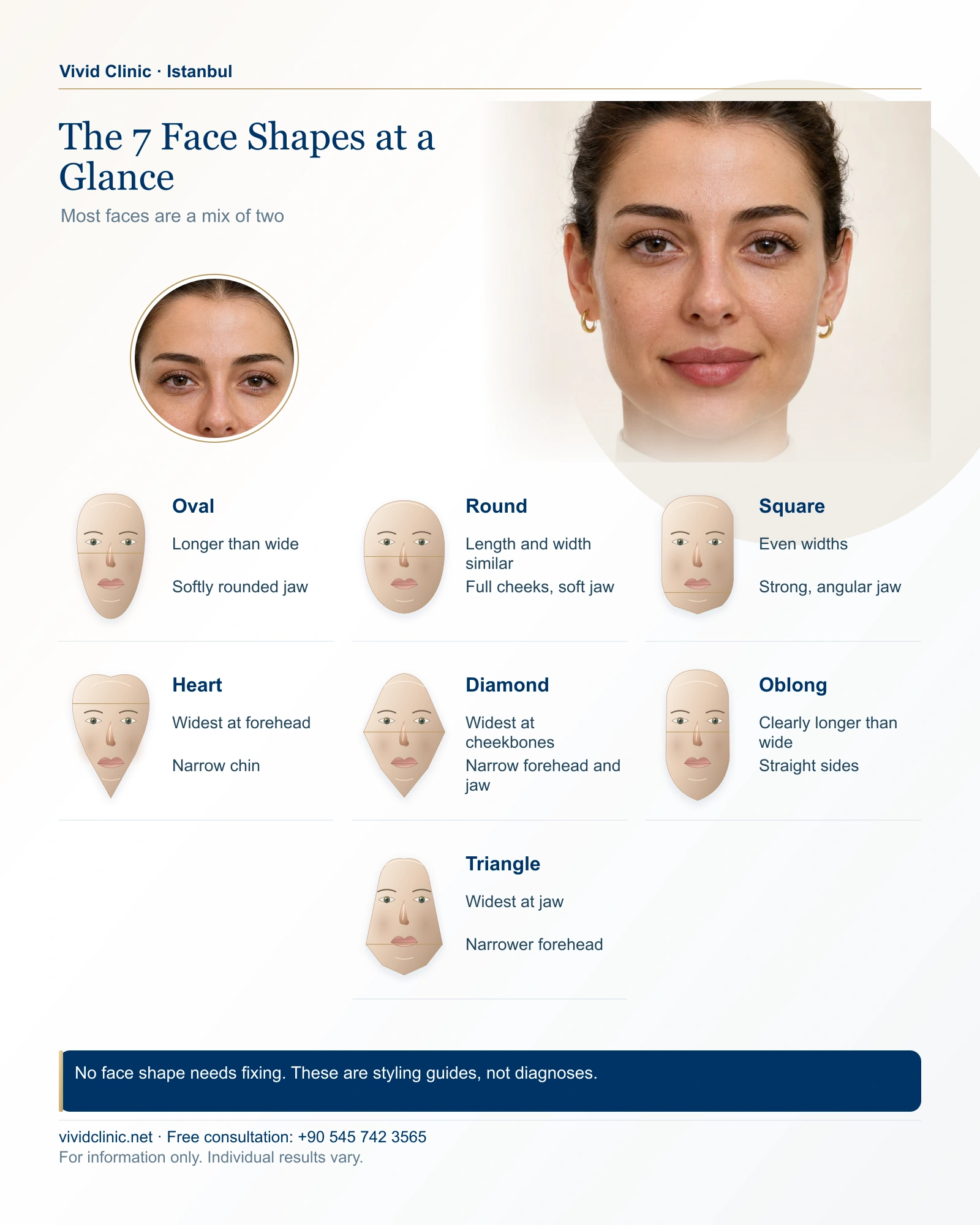
The 7 Face Shapes Explained
Each overview below is intentionally brief, a quick introduction to the seven face shapes rather than a deep dive.
Oval
The oval face is about one and a half times longer than it is wide, with a forehead slightly wider than a softly rounded jaw. Most hairstyles and frames suit it.
Round
Round faces have similar length and width, full cheeks and a soft jaw angle. They often look youthful for longer. Styles that add height or vertical lines create a gentle lengthening effect.
Square
A square face has a forehead, cheekbones and jaw of similar width, with a strong jawline. Soft layers and rounded frames add contrast, while sharp cuts emphasise the angles.
Heart
The heart shape is wider at the forehead and tapers to a narrower chin, sometimes with a widow’s peak. Volume around the jaw and chin creates balance.
Diamond
Diamond faces have wide, prominent cheekbones with a narrower forehead and jaw. Side-swept fringes and wider-topped frames add harmony.
Oblong (Rectangle)
Oblong faces are noticeably longer than they are wide, with fairly straight sides; a rectangle face has a squarer jaw. Fringes, waves at the cheeks and deeper frames visually shorten the length.
Triangle (Pear)
In a triangle face, the jaw is the widest point and the forehead is narrower. Volume at the crown and temples balances the lower face. A strong chewing muscle sometimes adds to jaw width.
What Flatters Each of the Face Shapes: Hair, Glasses and Makeup
Styling is the simplest way to play with proportion across all face shapes. Treat these tips as a menu, not rules.
Hairstyles
- Oval: almost anything, from blunt bobs to long layers.
- Round: height at the crown, long layers below the chin, side parts.
- Square: soft waves, face-framing layers, textured ends that blur the jaw angle.
- Heart: chin-length bobs, volume at jaw level, side-swept fringes.
- Diamond: fringes that widen the forehead, fullness at the chin.
- Oblong: fringes, waves at cheek level, styles that stop near the jaw.
- Triangle: lift and volume at the crown and temples, softness near the jaw.
Glasses
The useful principle is contrast. Angular frames balance round faces, rounded frames soften square ones, and bottom-heavy styles suit heart faces. Oblong faces suit deeper frames, while diamond faces suit oval or cat-eye shapes.
Makeup and Contouring
Contour adds shadow where you want less emphasis, and highlight adds light where you want more. Round faces often contour under the cheekbones, and heart faces highlight the chin.
Can Your Face Shape Change Over Time?
Yes, to a degree. Bone structure is largely set in adulthood, but soft tissue keeps changing, so face shapes can drift over the years. Weight gain can round out a face, while major weight loss can make it look longer.
Ageing plays a larger role. Cheek fat pads descend and deflate, the jawline loses definition, and jowls can blur a sharp outline, so a heart face may look more square in later decades.
Do Face Shapes Need Treatment?
Quick Answer: No. Face shapes are normal variations and none of them needs correcting. Some people choose treatment to enhance balance or restore definition lost with age, but that is a personal preference, and a good surgeon will tell you when treatment is not needed.
At Vivid Clinic, the starting question is never “what is wrong with your shape?” It is “what would you like to feel more confident about?” Sometimes the honest answer is a new haircut.
Who Might Consider Facial Contouring
- Healthy adults with a specific, realistic goal, such as a more defined chin
- People who feel one feature looks out of proportion
- Those whose outline has softened with age or weight change
Who Is Not a Good Candidate
Treatment is not advisable during pregnancy or breastfeeding, with active skin infection, or with certain medical conditions until a doctor has assessed you. It is also not right for anyone hoping to look like someone else or feeling pressured by trends.
Non-Surgical Facial Contouring With Dermal Fillers
Dermal fillers, usually hyaluronic acid gels, add structure at specific points. The aim is not to change face shapes but to refine proportion. Results are visible straight away, are temporary, and most hyaluronic acid fillers can be dissolved if needed.
Cheek, Chin and Jawline Filler
Cheek filler can define the mid-face, which some people with round or oblong faces enjoy; our guide to high cheekbones explains what creates them. Chin filler can add projection, often helping heart and round faces, while jawline filler sharpens the lower outline. Our overview of chin types shows how much the chin shapes overall balance.
Anti-Wrinkle Injections for the Jaw Muscle
When a wide lower face comes from a strong masseter muscle rather than bone, anti-wrinkle injections into the muscle can gradually slim its bulk over several weeks. The effect usually lasts a few months.
Surgical Options for Facial Balance
Surgery is only appropriate when non-surgical options cannot reach a goal your surgeon agrees is realistic.
Buccal Fat Removal
Buccal fat removal reduces a fat pad inside the cheek through a small incision in the mouth. It can make full cheeks look more contoured. It cannot be undone, and because faces lose volume with age, surgeons are cautious with already slim faces.
Chin Options
A small or retruding chin affects the balance of many face shapes. Options range from filler to surgical approaches such as implants or bony repositioning, discussed case by case. Our guide to a recessed chin and weak jawline explains the differences.
Facelift and Neck Lift
When definition has been lost to sagging, filler alone can make the face look heavier. A facelift, often with a neck lift, repositions descended tissue to restore a cleaner jawline. It treats ageing changes, not a naturally round or square outline.
How the Filler Technique Works
After cleansing and numbing cream, the practitioner marks key points and injects small amounts of gel with a fine needle or blunt cannula. The goal is support at specific points rather than volume everywhere, with symmetry checked from several angles.
Procedure Overview Table: Non-Surgical Facial Contouring With Dermal Fillers
| Aspect | Details |
|---|---|
| Duration Process | 30 to 60 minutes, depending on the number of areas |
| Hospitalization Duration | Not required (outpatient) |
| Mobility Duration | Immediate |
| Return to Activity | Same day for most daily tasks; avoid strenuous exercise for 24 to 48 hours |
| Complete Recovery | 1 to 2 weeks for swelling and any bruising to settle |
| Anticipated Results | Visible straight away, settled at about 2 to 4 weeks; often lasting 6 to 18 months depending on area and product |
Timings are general estimates. Results vary by individual.
Recovery Timeline After Facial Contouring Filler
Treatment Day
Mild swelling, redness and tenderness are common. You can usually resume light activities, but avoid touching the area.
First 2 to 3 Days
Swelling often peaks and then eases. Small bruises may appear. Sleeping slightly elevated and avoiding alcohol can help.
First Two Weeks
The gel settles into the tissues and the shape becomes easier to judge. A review around two weeks allows small refinements.
The Months Ahead
The filler gradually breaks down. Some people choose maintenance, while others let it fade.
Benefits of Balance-Focused Contouring
- Works with your natural face shapes rather than against them
- Adjustable and, for hyaluronic acid fillers, usually reversible
- Little downtime for most people
- A way to test a look before considering surgery
Benefits vary between patients.
Possible Risks and Side Effects
Common effects include swelling, bruising, tenderness and temporary lumpiness. Less common risks include asymmetry, infection, filler migration and delayed nodules. A rare but serious risk is filler entering a blood vessel, which can damage skin and, very rarely, affect vision. This is why anatomy knowledge and careful technique matter. Surgical options carry their own risks, which your surgeon will explain.
How to Prepare
- Share your full medical history, medications and supplements.
- Ask whether to pause blood-thinning supplements.
- Avoid alcohol for a day or two beforehand.
- Do not book treatment just before a major event.
Aftercare Tips
- Avoid makeup for several hours, or as advised.
- Avoid saunas and strenuous exercise for 24 to 48 hours.
- Do not massage the area unless asked to.
- Seek urgent advice for increasing pain, skin colour change or vision changes.
Cost Factors in Istanbul, Turkey
Costs vary from person to person. The main factors are:
- The number of areas and the amount of filler needed
- The type of product used
- The practitioner’s or surgeon’s experience
- Whether surgery, anaesthesia and a hospital stay are involved
- Accommodation, transfers and follow-up in your package
For an early estimate, try the surgery price calculator, then confirm details during your consultation.
Why Choose Vivid Clinic for Facial Contouring?
Quick Answer: Vivid Clinic offers personalised, balance-focused planning in Istanbul, Turkey, an honest view on whether you need treatment at all, and organised support for international patients from first message to remote aftercare.
You can meet our doctors, browse the before and after gallery, and start with a free consultation with a plastic surgeon before deciding anything.
What International Patients Can Expect
Filler treatment fits into a short stay, while surgery needs a longer visit before flying. Expect written aftercare, a review appointment and a direct line to the team after you return home.
Operation Process Overview at Vivid Clinic
Your journey with Vivid Clinic begins when you arrive in Istanbul, where a VIP airport transfer takes you to your 5-star hotel for check-in and a chance to rest. Next comes your one-on-one consultation, where the doctor reviews your proportions, medical history and goals, and explains whether filler, surgery or no treatment at all makes the most sense. On treatment day, the plan is carried out carefully with a focus on comfort and natural balance. Post-operative care, including written aftercare and a direct contact line, follows straight away. A checkup visit before your departure confirms that healing is on track, and remote aftercare follow-up continues once you are home.
FAQs
How do face shapes influence which filler areas a doctor might suggest?
Face shapes give the doctor a useful starting map, but the plan is always based on your individual anatomy and goals. A heart face with a narrow chin may benefit most from subtle chin projection, while a round face might gain definition from cheekbone support rather than more volume lower down. A square face often needs very little, and sometimes the advice is to treat nothing. At Vivid Clinic, the doctor also checks your profile, symmetry and skin quality. The aim is to enhance balance with as little product as necessary, so you still look like yourself.
Can face shapes change after weight loss or with age?
Face shapes can shift over time, even though bone structure stays largely the same in adulthood. Significant weight loss can make a round face look longer and more angular, while weight gain can soften a defined jaw. Ageing is a bigger factor: cheek fat pads descend, the jawline loosens and jowls can make a heart or oval face look more square. These changes vary with genetics, sun exposure and lifestyle. A doctor can assess whether volume support, lifting surgery or simply new styling choices would serve you best. Treatment is optional, and results vary.
Are dermal fillers suitable for all face shapes?
Dermal fillers can be used with all face shapes, but suitability depends on the person, not the category. Healthy adults with a realistic, specific goal are usually good candidates. Filler is not advised during pregnancy or breastfeeding, with active skin infection, or with certain medical conditions until a doctor has reviewed them. It is also less suitable when the main issue is sagging tissue, because adding volume to loose skin can make the face look heavier; a facelift may be discussed instead. A consultation at Vivid Clinic can clarify which approach, if any, fits you.
What affects the cost of contouring treatments for different face shapes in Turkey?
The cost is shaped by your plan rather than by face shapes themselves. The main factors are how many areas are treated, how much filler is needed, the type of product and the practitioner’s experience. Surgical options such as buccal fat removal, chin surgery or a facelift add anaesthesia, the hospital setting and a longer stay in Istanbul. Package inclusions such as hotel nights, VIP transfers and follow-up appointments also affect the total. Vivid Clinic provides a personalised quote after reviewing your photos, and the online price calculator gives an early idea.
How long should international patients stay in Istanbul when planning contouring around face shapes?
For non-surgical contouring planned around face shapes, two to three days is often enough for consultation, treatment and a quick check before flying. Many doctors prefer you not to fly within the first day while initial swelling settles. Surgical options need longer: buccal fat removal or chin surgery usually requires around five to seven days, and a facelift often about ten to fourteen days before travelling home is advised. Your coordinator at Vivid Clinic will suggest dates based on your plan, and remote aftercare continues after you return. Individual recovery varies.
Conclusion
Learning about face shapes is less about labels and more about understanding your own proportions. Once you know whether you lean oval, round, square, heart, diamond, oblong or triangle, choosing haircuts, frames and makeup becomes easier. And if you wonder whether a feature could be brought into gentler balance, you now know the options and their honest limits.
Vivid Clinic in Istanbul, Turkey offers a free consultation with a plastic surgeon to talk through your goals with no pressure. Request your free consultation and get a personal, balanced view of your features.
Real Before and After Results at Vivid Clinic
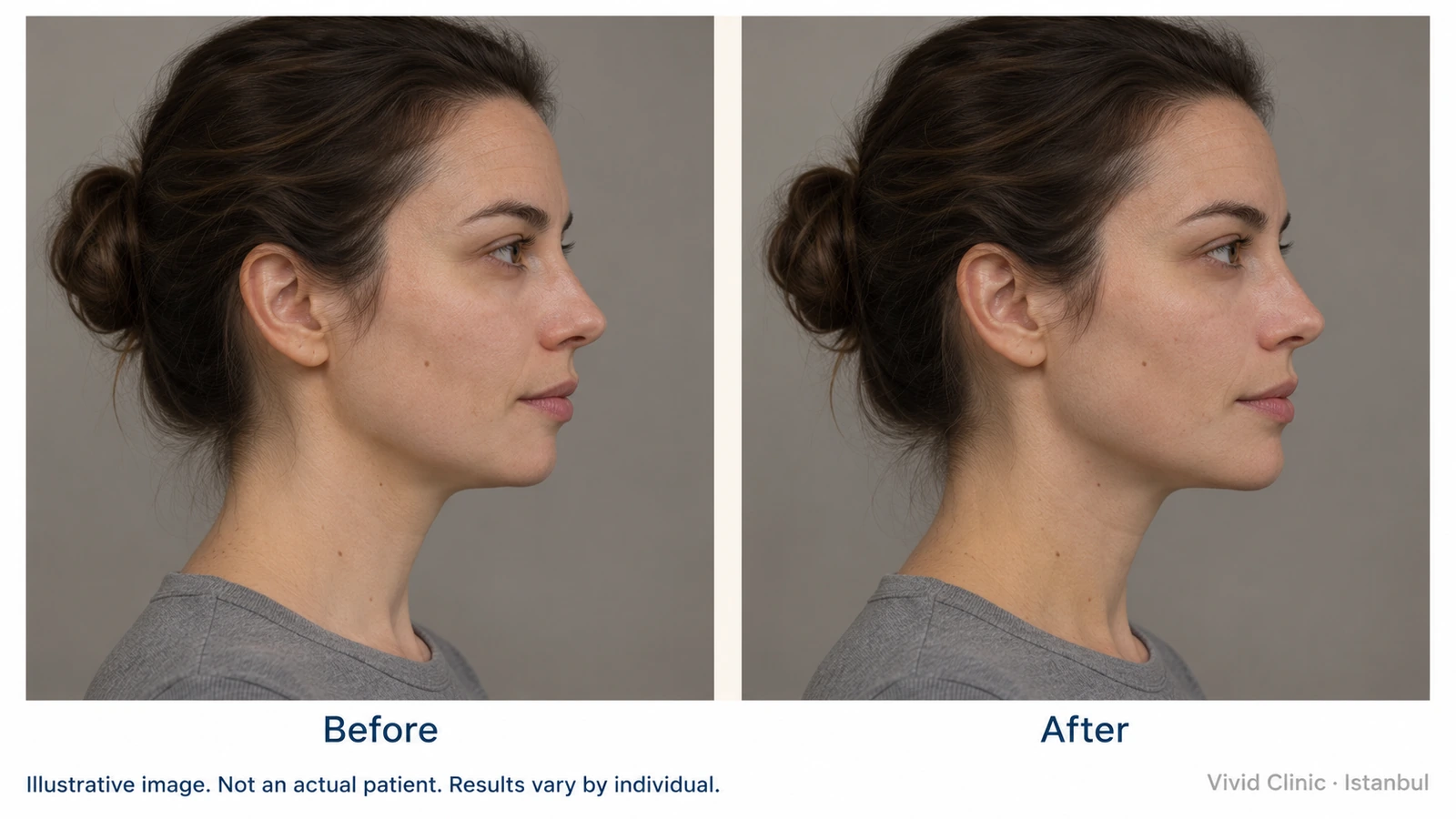
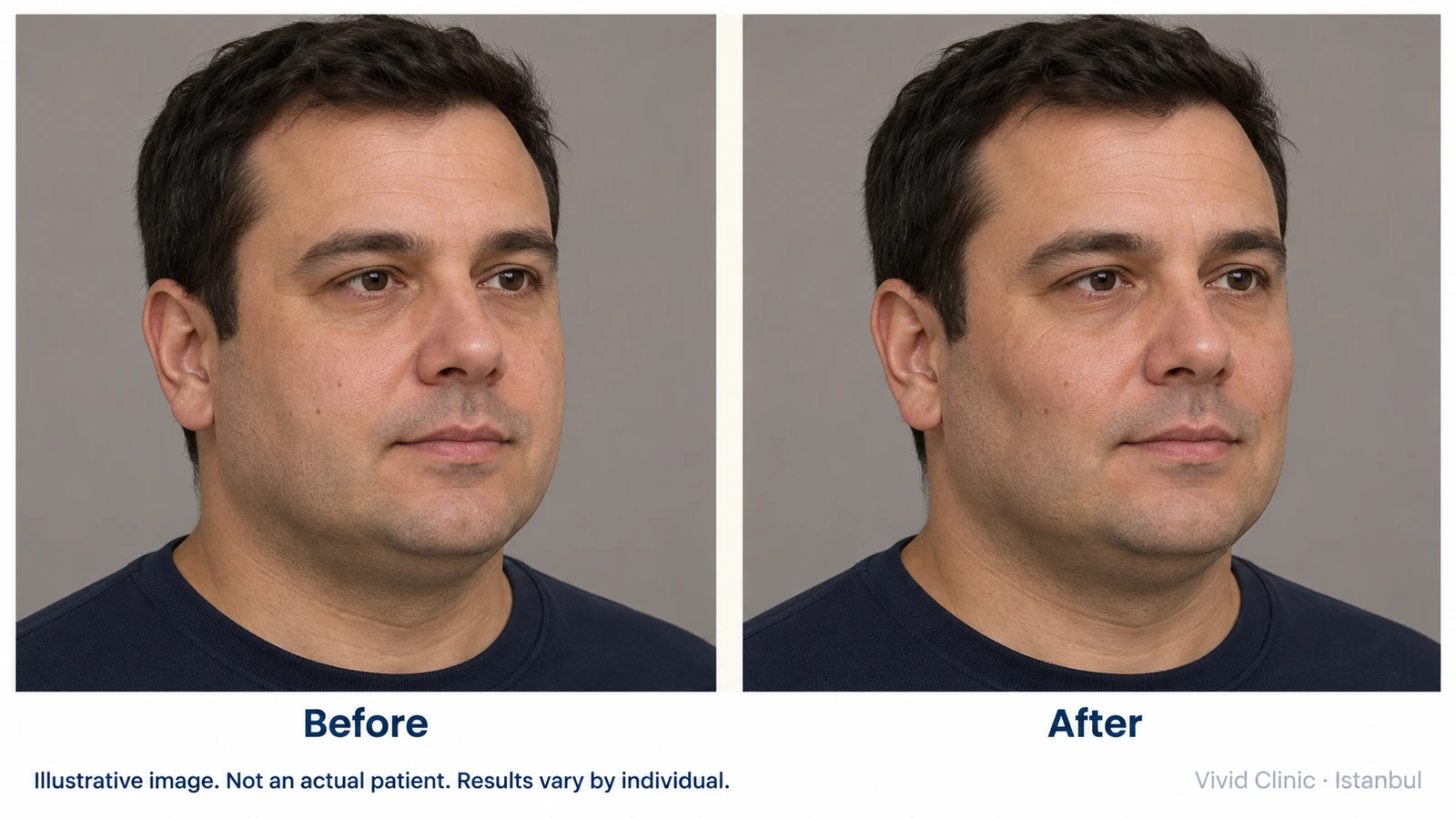
The photos below show real Vivid Clinic patients from the clinic’s own gallery, shared with consent as published on the clinic site, and they show facial contouring and facial rejuvenation treatments rather than any specific face shape. Results vary by anatomy, healing and treatment plan, so these images illustrate possibilities, not predictions.
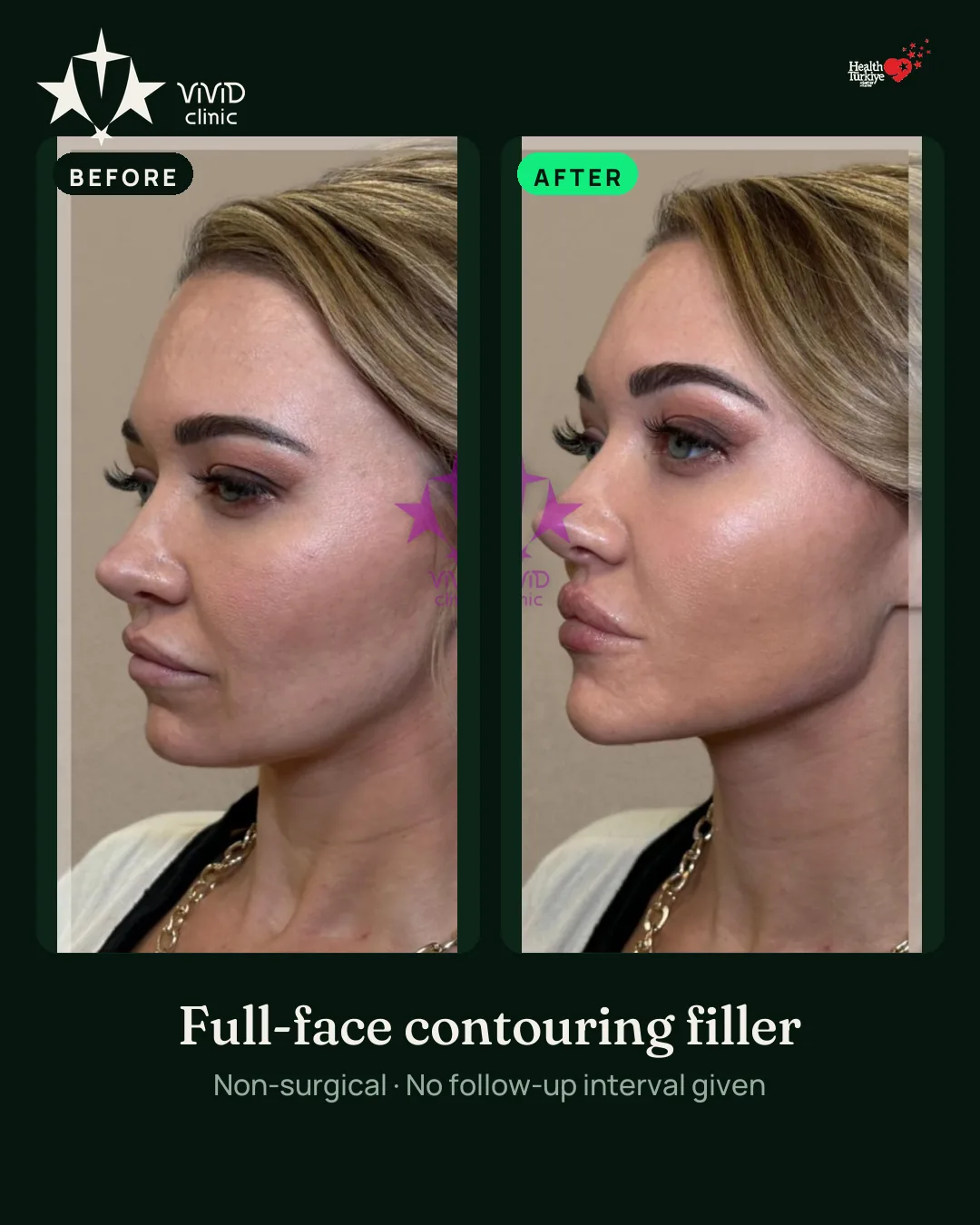
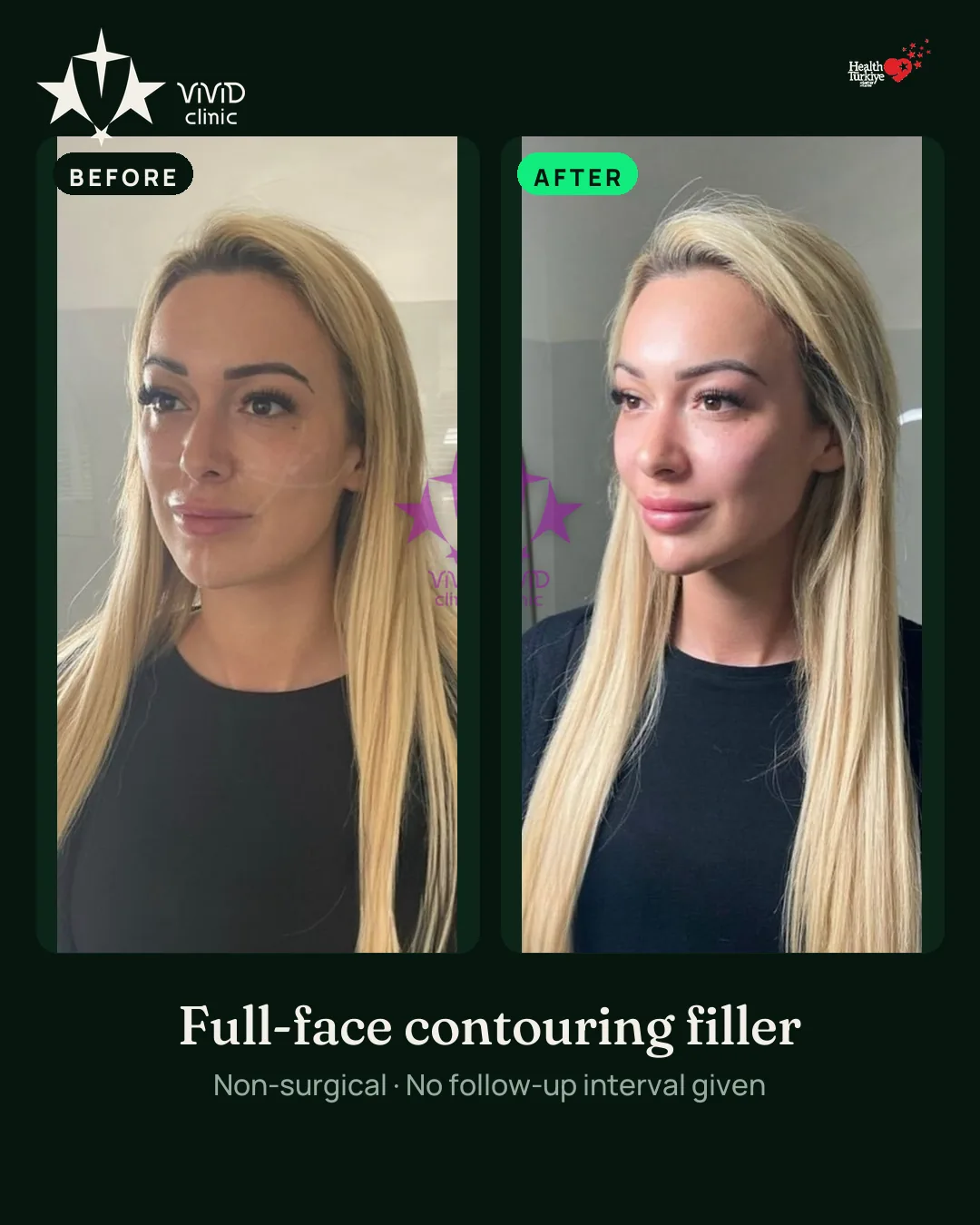
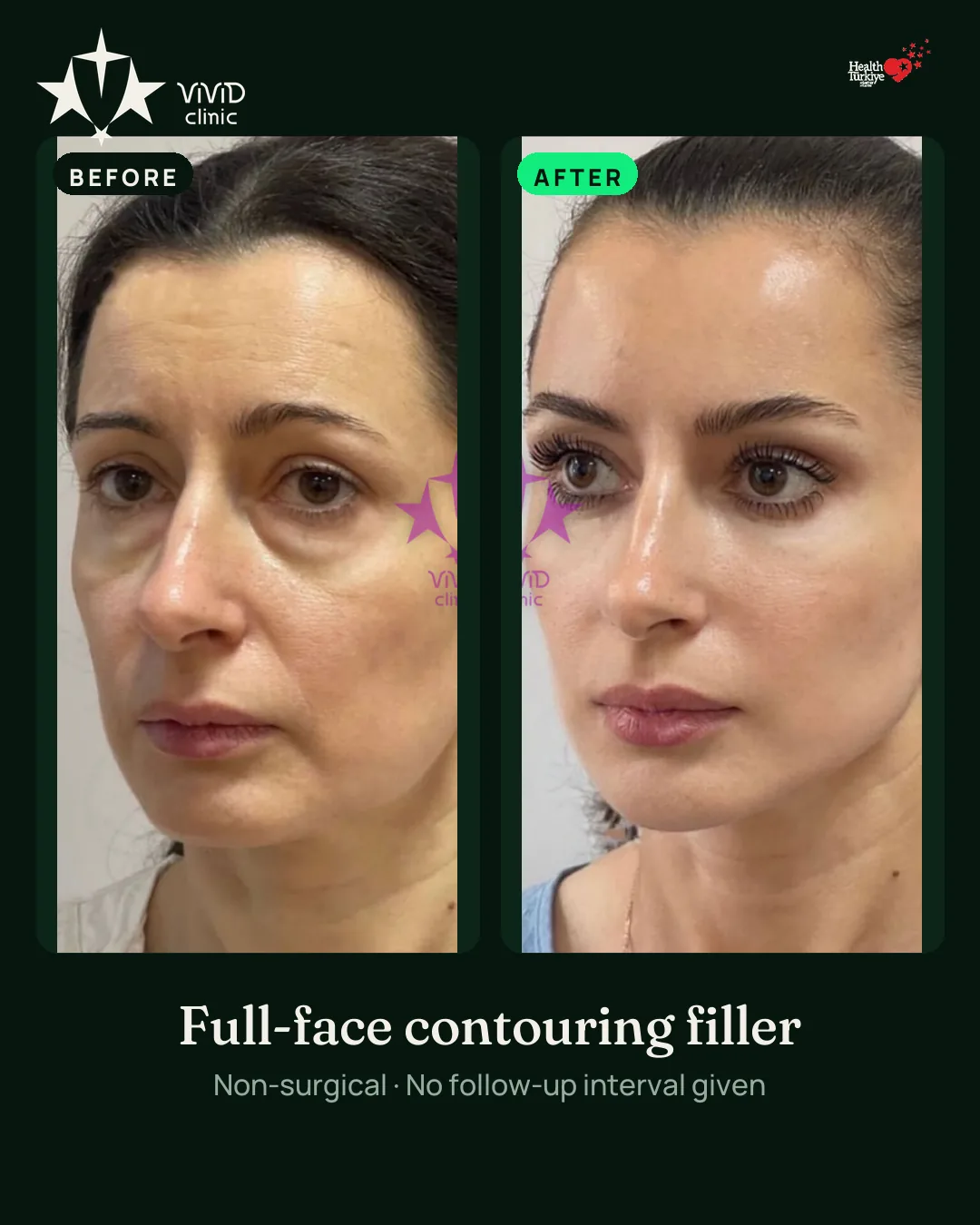
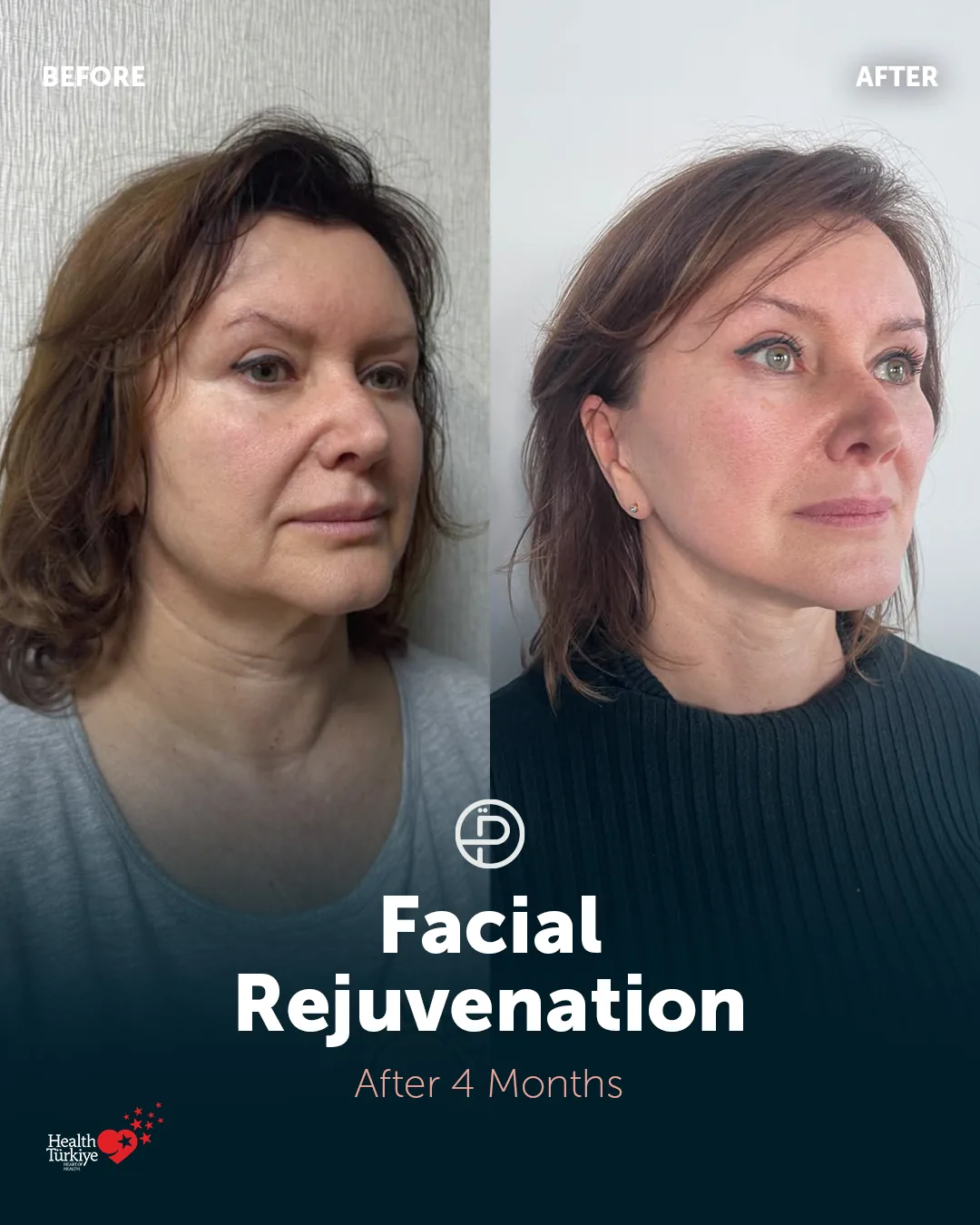
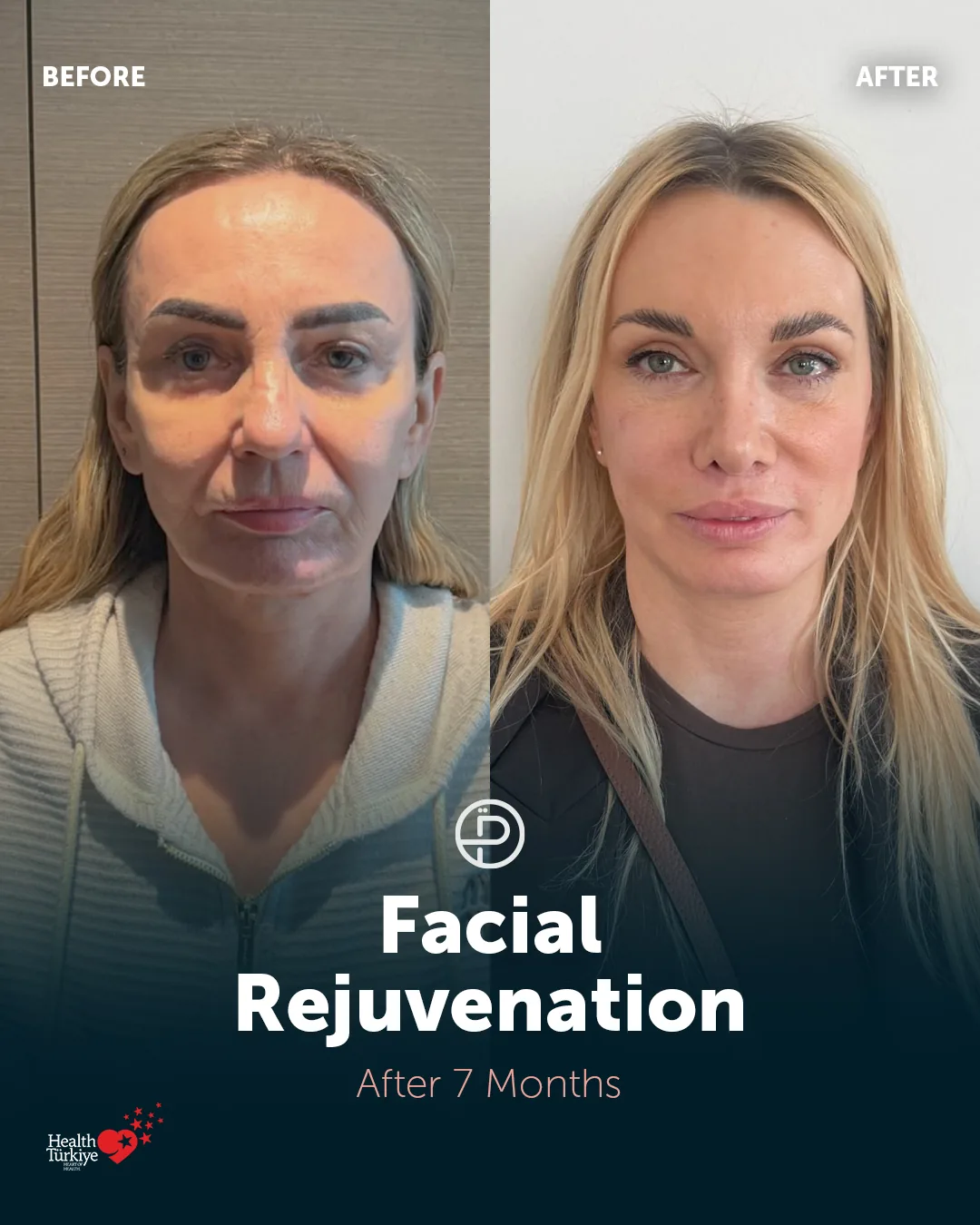
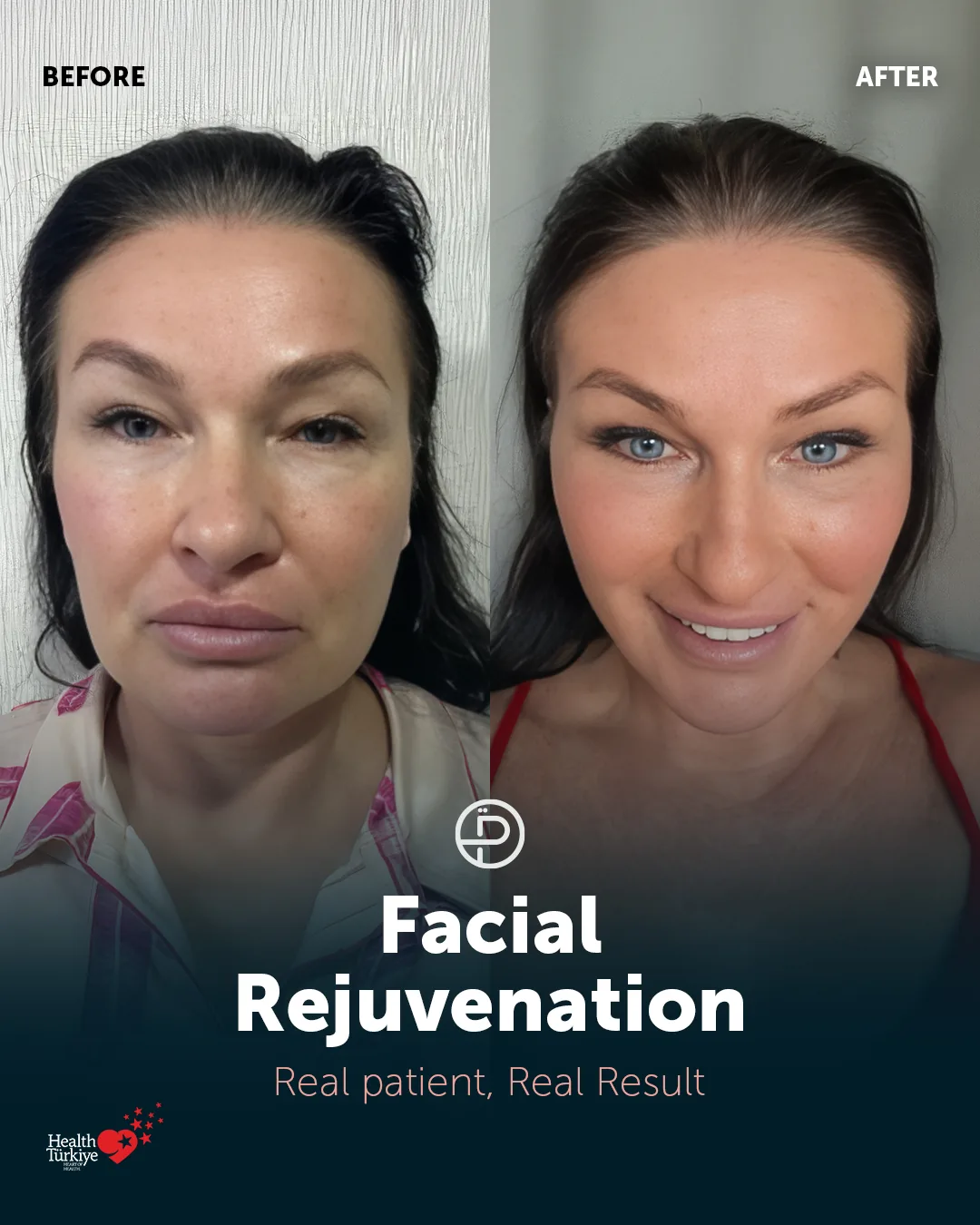
You can explore more cases in the full Vivid Clinic before and after gallery. To discuss your own goals, ask for a free quote and the team will arrange your consultation.
This article is for general information and does not replace a personal medical consultation. Suitability, risks, recovery and expected results should always be discussed with a qualified medical professional. Results vary by individual.