
 ChatGPT

Medically reviewed by Prof. Dr. Özgür Pilancı, Plastic, Reconstructive & Aesthetic Surgeon — August 2026
Quick answer (updated August 2026): Use the skin tone chart below to find both your depth of colour and your undertone. Your complexion is the natural color, tone, and texture of your facial skin, and every human complexion sits somewhere on one continuous spectrum produced by a single pigment family: melanin. Clinicians classify that spectrum with the Fitzpatrick scale (types I–VI), which describes how skin responds to sun, not ethnicity; the newer Monk Skin Tone scale describes the same spectrum in ten shades built for representativeness. Everyday shade words — fair, light, medium, olive, tan, brown, deep — are descriptions, not rankings. No shade is better than another, and knowing yours matters mainly for sun protection and for planning treatments safely.

What does "complexion" actually mean?
The dictionary-style complexion definition is simple: the natural appearance of the skin, especially of the face — its color, tone, and texture. When people say someone has a fair complexion or a deep complexion, they are describing where that person’s skin sits on the human pigment spectrum, plus qualities like evenness and radiance.
Two terms get used almost interchangeably, and it helps to separate them. Skin tone (or skin complexion) refers to the surface shade you can see — the lightness or depth of the skin. Undertone is the subtle hue beneath that shade — cool, warm, or neutral — which stays the same even when your surface tone tans or fades. Two people can share the same medium skin tone and have completely different undertones, which is why foundation matching frustrates so many people.
One more thing worth saying at the start, because everything below depends on it: all skin colors are normal, healthy variations of the same biology. There are no "good" or "bad" complexion types — only different ones, each with its own practical considerations for sun care and skin treatments.
Where do different skin tones come from? The biology
Every one of the world’s skin shades comes from melanin — pigment made by cells called melanocytes in the deepest layer of the epidermis. What differs between people is not how many melanocytes they have, but how much melanin those cells produce; according to the Cleveland Clinic, humans generally have similar numbers of melanocytes regardless of skin color, and it is the output that varies.
Melanin comes in two main skin-relevant forms. Eumelanin is brown-to-black and is the dominant pigment in deeper skin tones and dark hair. Pheomelanin is red-to-yellow, pigments areas like the lips, and — in people who produce relatively more of it — is associated with red hair and freckling. The ratio and total amount of these two pigments, spread across billions of skin cells, produces every shade humans have.
That ratio is set mostly by genetics. Pigmentation is polygenic — many genes each contribute a little — which is why children’s skin tones can differ from each other and from either parent, and why skin tones map only loosely, never one-to-one, onto ancestry or ethnicity.
Sunlight then adjusts the baseline. UV exposure signals melanocytes to produce more melanin — a tan is literally your skin’s protective response to DNA damage, not a sign of health. Melanin absorbs UV radiation and shields the DNA in surrounding cells, which is why deeper skin tones have more built-in UV protection. But as the Cleveland Clinic notes plainly, melanin alone is not enough protection for anyone — a point we come back to below.
The Fitzpatrick scale: the classification clinics actually use

The Fitzpatrick scale classifies skin into six types — I through VI — based on one question: how does your skin respond to sun exposure? It was created by dermatologist Thomas B. Fitzpatrick in 1972 to help doctors dose ultraviolet light therapy safely, and it remains the standard classification used in dermatology and aesthetic medicine today.
The six skin tone types are usually summarized like this:
- Type I — always burns, never tans. Often very fair or pale skin color, frequently with freckles.
- Type II — usually burns, tans minimally and with difficulty. Fair skin.
- Type III — sometimes burns mildly, tans gradually and evenly. Light to medium skin; in US data this is the most common single type.
- Type IV — burns minimally, tans easily. Often described as olive or light brown skin.
- Type V — very rarely burns, tans very easily. Brown skin.
- Type VI — almost never burns visibly. Deeply pigmented brown to darkest brown skin.
Three things about the scale are worth knowing. First, it measures UV response, not ethnicity — the original 1972 version only covered types I–IV, with V and VI added in 1988. Second, it is self-reported and imperfect: people interpret "burning" and "tanning" differently, and research cited in StatPearls found it correlates with sun sensitivity well in some populations and poorly in others. Third, despite those limits, it is genuinely useful clinically: it helps predict sunburn risk, guides phototherapy dosing, informs skin-cancer risk conversations, and determines how laser and light-based treatments must be adjusted to be safe.
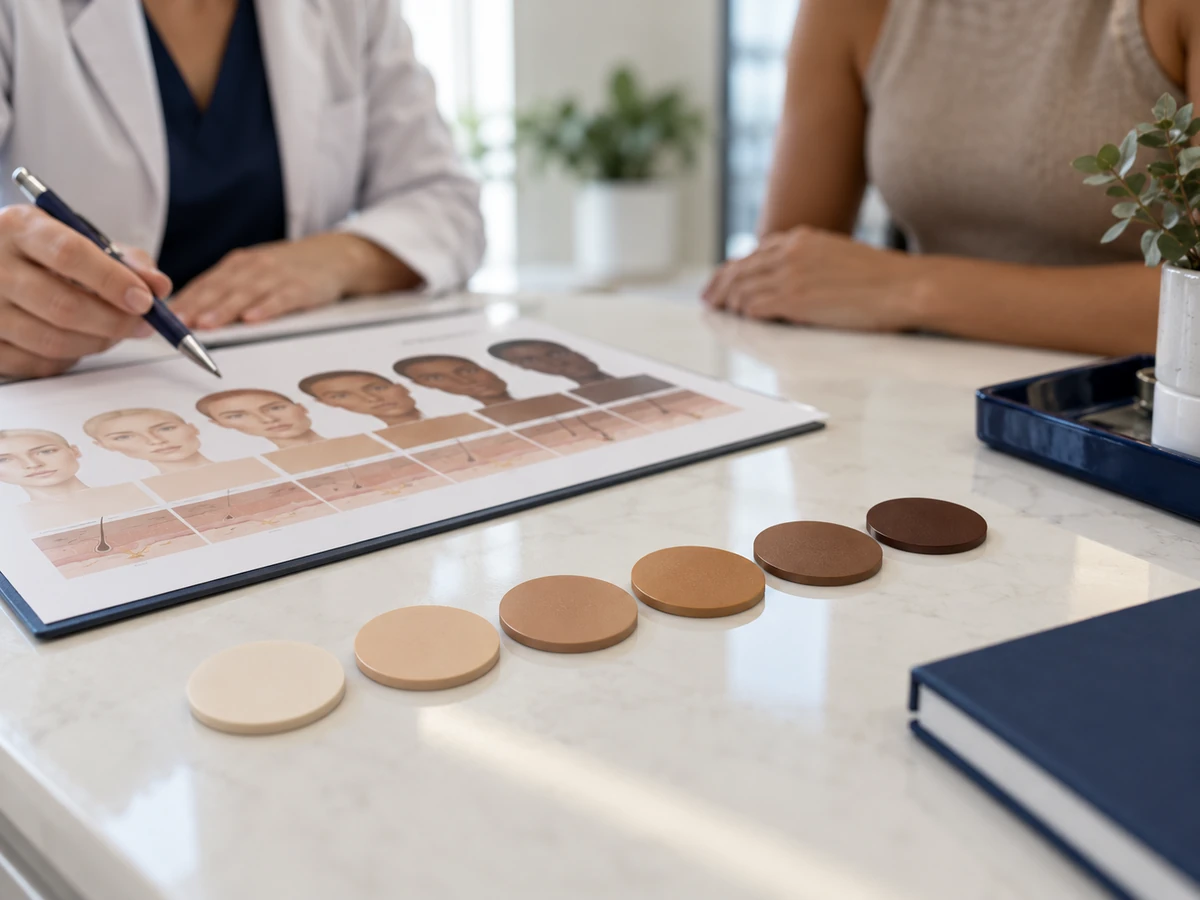
The Monk Skin Tone scale: a modern ten-shade alternative
The Monk Skin Tone (MST) scale is a ten-shade scale developed by Dr. Ellis Monk, a Harvard sociologist who has studied skin tone and colorism for over a decade. Google adopted and openly released it in 2022, specifically because the tech industry’s reliance on narrower scales was leaving darker skin tones underrepresented in cameras, photo software, and AI systems.
Where Fitzpatrick asks "how does your skin respond to UV?", the Monk scale asks a different question: "is the full range of human skin tones actually represented here?" Ten shades instead of six gives finer gradation, particularly across the brown and deep end of the spectrum, where Fitzpatrick compresses enormous variation into just two categories. In Google’s research, people across demographic groups — especially those with darker skin — found the MST scale more representative of their own skin than the older industry standard.
The two scales answer different questions. A clinic still reaches for Fitzpatrick when setting a laser, because burn risk is what it encodes; the Monk scale is a better mirror of what human skin colors actually look like, and a useful corrective to treating light skin as the default.
Skin tone chart: every shade named — fair, light, medium, olive, tan, brown, deep
Everyday shade vocabulary is descriptive, not scientific — and not a ranking. Here is what people usually mean by the common skin shades, presented in the order they sit on the spectrum, with no order of merit.
Fair and pale. A fair skin color is one of the lightest naturally occurring tones, often with visible pink or peachy undertones and a strong tendency to burn. "Pale" describes much the same depth, though it is also used for temporary lightness — illness, winter, low sun exposure. What is sometimes loosely called white skin color is in reality a range of light shades, none of them literally white.
Light and light-medium. A light skin color sits just past fair: it may tan a little, burn a little, and often shifts noticeably between summer and winter.
Medium. Medium skin tones tan more readily than they burn. Terms like light tan and light brown skin describe the transition zone between light and medium-deep — the part of the spectrum where a large share of the world’s population sits.
Olive. Olive skin is a medium tone with a distinctive greenish-golden cast, common around the Mediterranean, the Middle East, Latin America, and South Asia — searches for "Mediterranean" or "Greek skin color" usually mean this shade. Olive behaves like a tone and an undertone at once, which is why it gets its own mention in the undertone section below.
Tan. As a shade name (rather than a verb), tan describes warm medium-depth skin that darkens easily and rarely burns.
Brown. The shades of brown skin span an enormous range — golden brown, reddish brown, deep brown — and contain more visible variation than any other part of the spectrum, which is exactly the range the Monk scale was built to represent properly.
Deep. Deep or richly pigmented skin has the highest eumelanin content and the most built-in UV protection — though, as the medical section below explains, "most" is not "complete".
Two people can share a shade name and look quite different, because surface depth is only half the description. The other half is undertone.
Undertones: cool, warm, neutral — and olive
An undertone is the hue beneath your surface shade, and it comes in three standard varieties. Cool undertones lean pink, red, or bluish. Warm undertones lean golden, yellow, or peachy. Neutral undertones show no strong lean either way — a balance of both. Many people also describe a fourth, olive, which reads as a subtle green-gray-golden cast and can accompany light, medium, or deep surface tones.
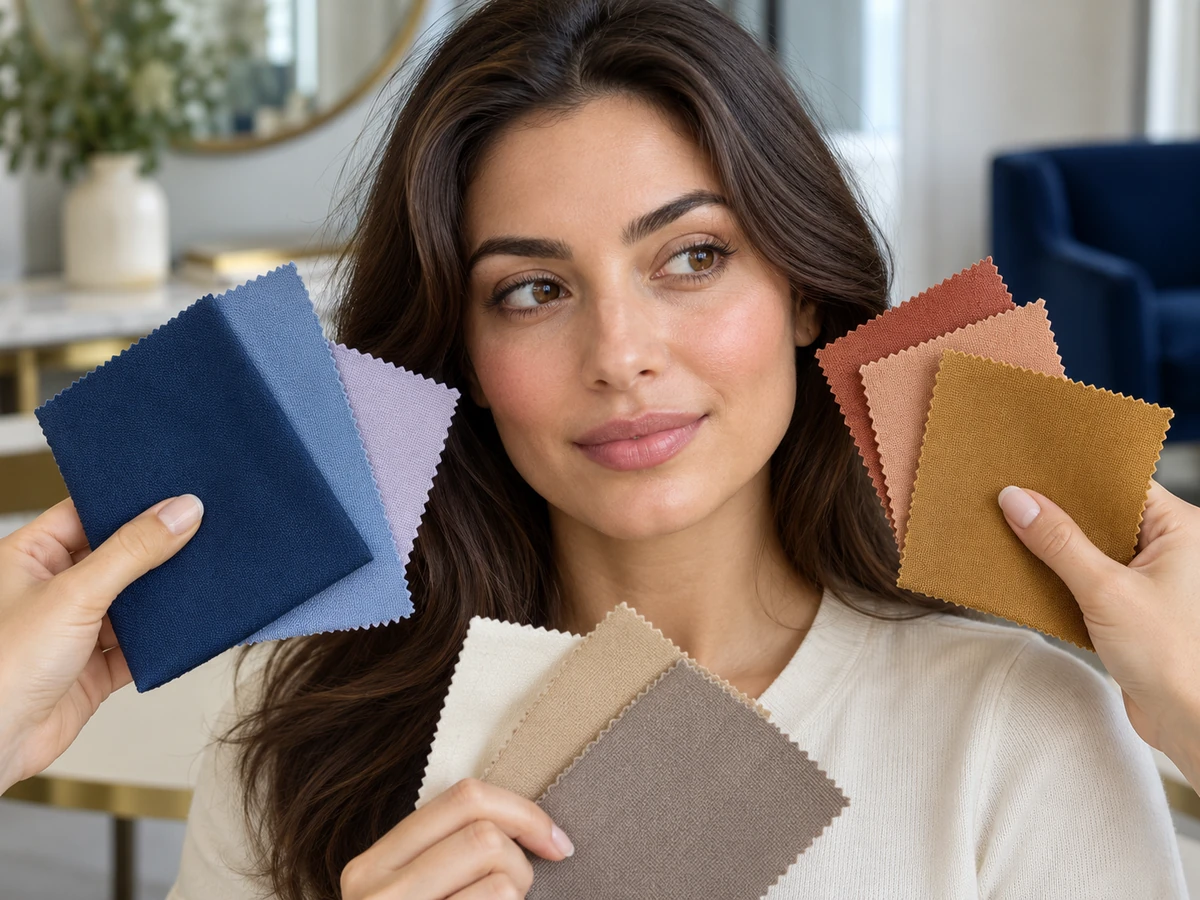
The key facts: every undertone occurs at every skin depth — deep skin can be cool, fair skin can be warm — and your undertone stays constant through life even as your surface tone tans or fades. That is why undertone, not surface shade, is the better guide for matching foundation and choosing colors. Working out your own undertone takes a few simple checks — the vein test, the jewelry test, the white-fabric test — and we cover the full step-by-step method in a companion guide to finding your undertone.
Why your skin tone matters medically and cosmetically

Skin tone is never a matter of better or worse, but it is a genuine clinical variable. The same treatment, the same sun exposure, and the same injury can behave differently at different points on the spectrum, and good clinics plan for that explicitly.
Sun protection — for every tone. The American Academy of Dermatology recommends broad-spectrum, water-resistant sunscreen of SPF 30 or higher for everyone, regardless of skin tone. Deeper skin’s extra melanin raises the threshold for burning, but it does not prevent UV damage, and anyone can get skin cancer.
Melanoma is far less common in darker skin — AAD-cited data put lifetime risk at roughly 1 in 33 for white individuals versus about 1 in 1,000 for Black individuals — yet it is diagnosed at later stages more often, survival is correspondingly poorer, and it favors low-UV sites people rarely check: the palms, the soles, under the nails, and inside the mouth. For darker tones specifically, the AAD notes that visible light can drive hyperpigmentation and suggests tinted sunscreens containing iron oxide.
Laser and IPL safety. Energy-based treatments target pigment or use it as a bystander, so Fitzpatrick type directly changes the safety calculus. In types IV–VI, the extra epidermal melanin absorbs laser energy intended for deeper targets, raising the risk of burns, post-treatment darkening, or lightening. StatPearls’ guidance for treating darker skin types includes longer wavelengths, lower fluences, longer pulse durations, and active skin cooling. The practical takeaway for patients: any provider offering laser or IPL should ask about your skin type and sun exposure before quoting a treatment plan — and be wary of anyone who does not.
Post-inflammatory hyperpigmentation (PIH). After inflammation — acne, a cosmetic procedure, an injury — skin can respond by over-producing melanin in the healed area. PIH is far more common and more persistent in Fitzpatrick types III–VI; among people with acne and darker skin, studies report PIH in up to 65%. Epidermal PIH typically fades over 6–12 months; deeper, dermal pigment can persist much longer. This is a major reason procedure planning differs by skin tone.
Scarring and keloid risk. Raised scars — hypertrophic scars and keloids — occur across all skin tones but are more common in skin of color. A surgeon planning incisions, or a practitioner planning any skin-breaking treatment, should factor personal and family scarring history alongside skin type.
Treatment planning. All of the above is why an honest consultation starts with your skin, not with a menu. At a surgical level — the procedures covered across our face aesthetics pages — skin tone shapes incision planning, scar management, and aftercare advice; at the level of any energy-based or resurfacing treatment anywhere, it shapes device choice and settings. Your skin tone is information, never a limitation.

Does your skin tone change over a season — or a lifetime?
Yes, within a genetically set range. Your baseline tone is fixed by your genes, but sun exposure moves your surface tone darker within that range each summer, and the tan fades over weeks to months once exposure stops. That seasonal swing is largest in the middle Fitzpatrick types, which both tan and fade noticeably.
Across a lifetime, skin tone can also shift subtly: cumulative sun exposure produces uneven pigment (sun spots), hormonal changes can trigger patches of darkening such as melasma, and mature skin often looks slightly paler as it thins. Your undertone does not change. A patch of skin changing color on its own — darkening, lightening, or a changing mole — is not a normal tone shift and deserves a dermatologist’s opinion.
Related Before and After Results at Vivid Clinic
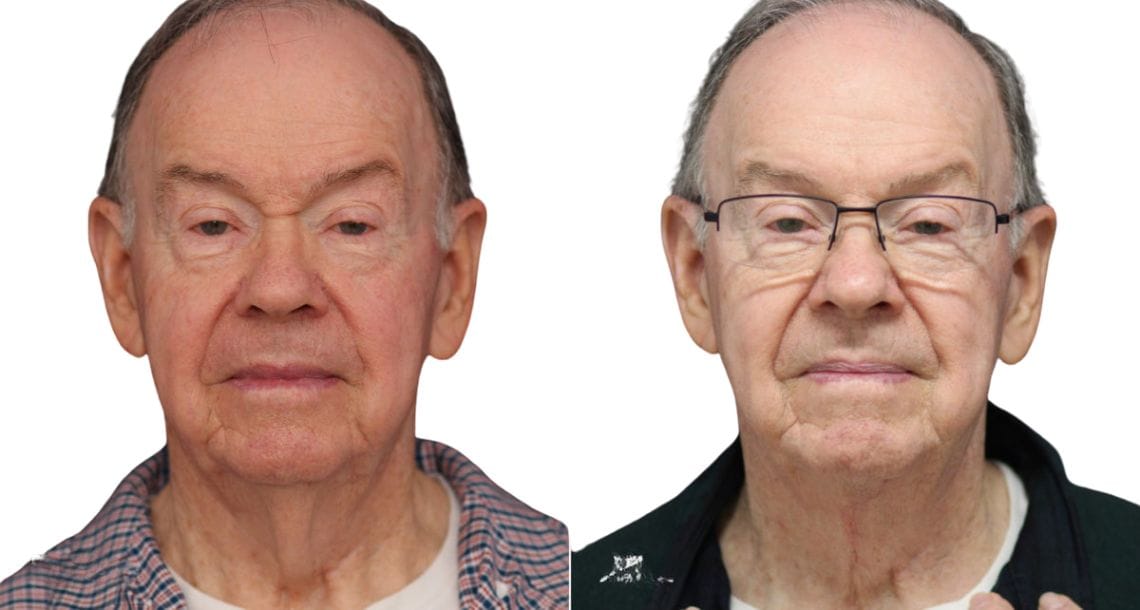
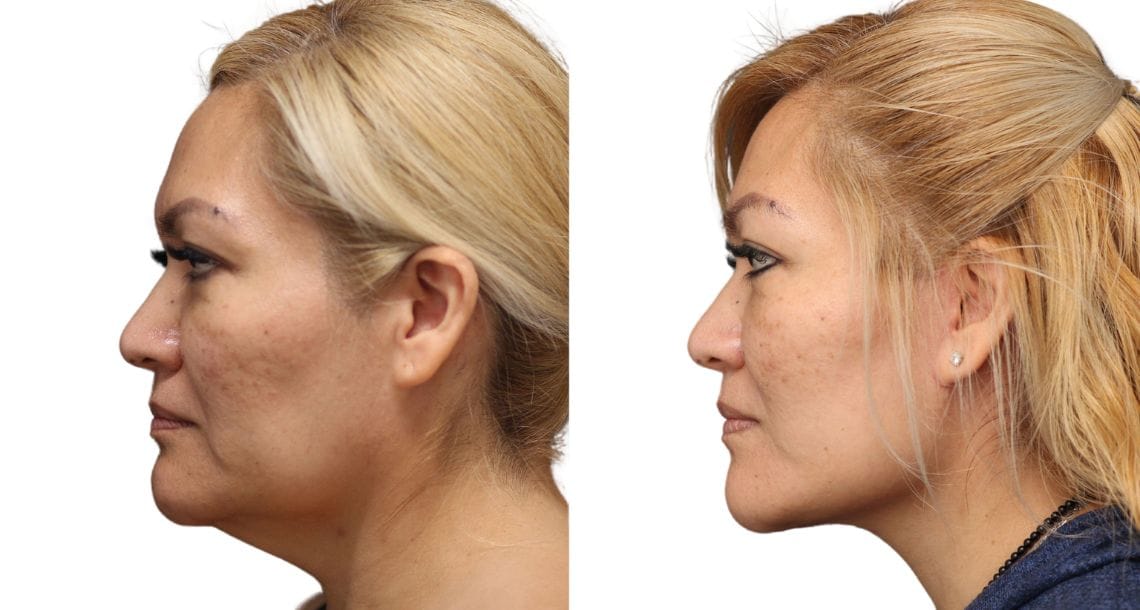
The photos below show real Vivid Clinic patients who had facial rejuvenation (facelift) — a related procedure, not skin-tone care itself — shared with their consent to show how our Istanbul team documents results. Ask during your free consultation to see cases that match your own treatment. Individual results vary. Browse the full Before & After Gallery.




Frequently Asked Questions
What is a complexion, in simple terms?
Your complexion is the natural appearance of your skin — its color, tone, and texture, usually referring to the face. Saying someone has a fair, medium, olive, or deep complexion just locates their skin on the natural human pigment spectrum; an “even complexion” refers to uniformity of tone, not to any particular shade.
How many skin tones are there?
Human skin tone is one continuous spectrum, so any number of categories is a simplification. The Fitzpatrick scale used in clinics defines six types based on how skin responds to sun; the Monk Skin Tone scale defines ten shades chosen for representativeness; everyday vocabulary uses names like fair, light, medium, olive, tan, brown, and deep. All of these are ways of describing the same unbroken range, and none of them ranks one tone above another.
What are the six Fitzpatrick skin types?
Type I always burns and never tans; type II burns easily and tans minimally; type III sometimes burns and tans gradually; type IV burns minimally and tans easily; type V very rarely burns and tans very easily; type VI almost never burns visibly. The scale was created in 1972 to dose ultraviolet light therapy safely and is still used to guide laser settings and sun-risk advice. It classifies UV response — it was never designed to classify ethnicity.
What is the difference between skin tone and undertone?
Skin tone is the surface shade you see — how light or deep your skin is — and it can shift with sun exposure and season. Undertone is the subtle hue beneath it — cool (pink/bluish), warm (golden/peachy), neutral, or the olive cast many people describe — and it stays constant throughout life. Every undertone occurs at every skin depth, which is why two people with the same surface shade can suit completely different foundation shades.
Do people with dark skin need sunscreen?
Yes. The American Academy of Dermatology recommends broad-spectrum SPF 30+ sunscreen for everyone, whatever their skin tone. Melanin raises the threshold for sunburn but does not stop UV damage, and skin cancer occurs in every skin tone — in darker skin it is often found at a later, harder-to-treat stage. Darker skin also darkens more readily after inflammation, and sunscreen — the AAD suggests tinted formulas with iron oxide — helps limit that hyperpigmentation.
Why do laser treatments depend on skin tone?
Most lasers and IPL devices work by heating pigment. The melanin in the skin’s surface competes for that energy, so in deeper skin tones (Fitzpatrick IV–VI) standard settings can overheat the epidermis and cause burns, dark patches, or light patches. Safe treatment in darker skin uses longer wavelengths, gentler settings, and cooling — which is why a proper skin-type assessment should always come before any energy-based treatment is planned or priced.
Can my skin tone change permanently?
Your genetically set baseline does not change, and no safe treatment exists to change it — claims to permanently lighten or darken overall skin tone should be treated as red flags. What can change is pigment within your range: tans fade, sun spots and melasma can appear, and post-inflammatory marks usually fade over months. A patch of skin that changes color on its own, or a changing mole, is a reason to see a dermatologist rather than a cosmetic concern.
Every shade on this chart is a normal, healthy human skin tone — the useful question is never which shade you are, but how to care for the one you have.